
Articles
Lịch sử và so sánh quốc tế về quy định xây dựng dựa trên nghiên cứu mới nhất
Product
Career
Introduction
How do building regulations differ from country to country? As AI-based compliance checking spreads, AI will not deliver sound and stable judgments unless it correctly understands the rules by which law is interpreted. To help readers understand how the building regulations of different countries are structured, this article focuses on the major economies such as the G20, builds on a comprehensive survey of the history, origins and structure of each country's entire legal system, building regulations included, and then sets out the characteristics of each country in turn.
The scope and novelty of this article are as follows.
- Classifying legal systems and building regulations within a single framework: Comparative law's scholarship on legal families and the reception of law, and the international comparative study of building regulation, have each built up a substantial body of work, yet the two have never been connected. This article classifies each country's legal system by 13 elements and its building regulations by 15 elements, and shows, as a one-to-many correspondence, which elements of the legal system give rise to each element of the building regulations. This makes it possible to explain the shape of a country's building regulations (who writes the standards, how they are written, and who reviews compliance) in terms of the character of that country's legal system.
- Lining up 20 countries and regions against the same yardstick: For every element, the classification follows the same sequence of "explanation, then categories, then the countries and regions that adopt each", and the article closes by listing the characteristics of the legal system and the building regulations of each country and region under the same eight headings. The aim is to go beyond country-by-country commentary and allow any two countries to be compared on identical terms.
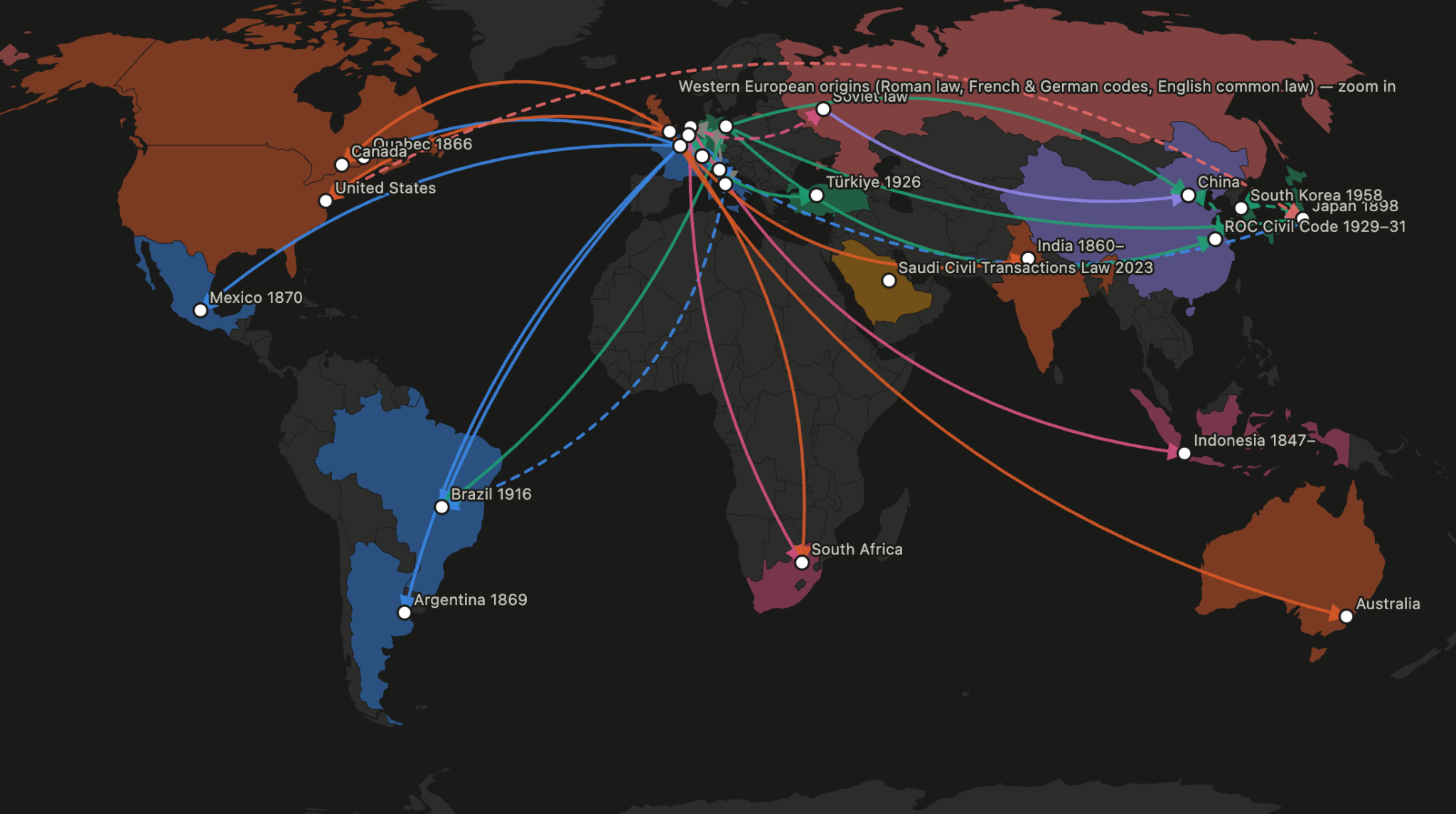
- Visualizing the lineages of "legal families" and "technical families": For four domains, general law, building regulations, urban planning and national land development, the article maps the flow of reception into the major economies (the G20) as lineage diagrams.
The history of legal systems (general and building-related) and their constituent elements are visualized here. They can be viewed at the links below.
Reception of law (world map and lineage diagram: from which country to which, when, and against what background law was transmitted)
Constituent elements of law (a branching diagram of categories, elements and options: select a country and the options that apply to it are highlighted)
The History of Law
Prehistory to the 3rd millennium BCE: Why law came into being
Law did not exist from the very beginning of human history. It developed as one function of government, in response to the demands created by structural change in society.
- Hunter-gatherer societies (until about 10,000 years ago): There was no written law; order was maintained through custom, reputation and sanctions within the group. A mobile way of life left little property to accumulate, so there was little "ownership" to protect and little to dispute.
- Farming and settlement (from about 10,000 years ago): Storable surpluses appeared, and with them "property worth protecting" in the form of land, grain and livestock, along with the disputes, inequality and inheritance that surround it. A demand arose for rules that would settle ownership and adjudicate disputes.
- Early states (from about 5,000 years ago): Writing was invented. It was first used for taxation and granary records, and it has been argued that the first states emerged where crops that were easy to measure and collect, such as grain, could be grown (Scott, 2017). Once states had writing, they began to proclaim what had been oral custom as written codes. In other words, the birth of written law came as a package with the birth of the state.
Within society, law sits at the core of "authority", one of the four resources available to government (Hood, 1983).
- Authority: Making rules and having them obeyed. Legislation, regulation, licensing, the judiciary. Law and its enforcement belong here, and by protecting property rights and enforcing contracts they provide the foundation of a market economy.
- Organization: Supplying services directly. Police, schools, hospitals, infrastructure.
- Treasure: Collecting and distributing money. Taxation, subsidies, benefits.
- Nodality (information): Organizing and coordinating information. Statistics, benchmarks, standard-setting, public communication.
The "rule of law" is the condition in which the state exercises "authority" not arbitrarily but according to rules laid down in advance. The conditions under which it is established, in the balance between the capacity of the state and the power of society, have been a central theme of recent political economy (Acemoglu & Robinson, 2019).
21st–18th century BCE: The oldest law codes
The oldest law codes on record were born in Mesopotamia. The invention of cuneiform made it possible to "write down" rules that had hitherto been oral or customary.
The Code of Ur-Nammu (c. 2100 BCE)
- Origin: The oldest surviving law code, promulgated in Sumerian by Ur-Nammu, king of the Third Dynasty of Ur (or by his son Shulgi). The original has been lost; the prologue and some 40 provisions have been reconstructed from fragments of later clay-tablet copies (Roth, 1995).
- Structure: It consists of a prologue and provisions; no epilogue survives. The prologue states that the gods entrusted rule to the king, proclaims justice in the words "the orphan was not delivered up to the rich man, the widow was not delivered up to the mighty man", and records that the king fixed weights and measures (the one-sila measure and the one-mina weight). The provisions are arranged roughly by subject, in the order of homicide, robbery, rape, divorce, slaves, false witness, bodily injury and farmland (Roth, 1995).
- Characteristics: While it prescribes death for homicide, robbery and rape, it prescribes compensation in silver for bodily injury (for example, 10 shekels of silver for cutting off another person's foot and two-thirds of a mina for cutting off a nose). Although it predates the Code of Hammurabi by some 350 years, monetary compensation rather than corporal punishment is the rule, and differences in treatment by social rank are less systematic than in Hammurabi's code. It shows that the earliest role of law was to "settle disputes between private parties by a fixed price rather than by retaliation".
- Relevance to building regulations: There are no provisions on buildings themselves. The standardization of weights and measures in the prologue, however, was an act by which the state fixed dimensions and weights, a precondition for the technical standards that came later.
The Code of Hammurabi (c. 1755 BCE)
- Origin: Promulgated in Akkadian by Hammurabi, king of the First Dynasty of Babylon. It is carved on a diorite stele about 2.25 m tall that survives in the Louvre. Many clay-tablet copies also exist, making it the most widely copied law code of the ancient Near East (Roth, 1995; Avalon Project, n.d.).
- Structure: It consists of a prologue, 282 provisions and an epilogue. The prologue proclaims the divine grant of kingship and the king's commitment to justice; the epilogue prays that the code will endure and curses anyone who alters it. The provisions are arranged by subject, roughly as follows.
- Sections 1–5: Court procedure and penalties for perjury and false accusation
- Sections 6–25: Theft, robbery and property offences
- Sections 26–65: Land tenure, tenant farming, irrigation and agriculture
- Sections 100–126: Commerce, loans, interest and deposits
- Sections 127–194: Marriage, divorce, dowry, inheritance and adoption
- Sections 195–214: Bodily injury and retaliation in kind
- Sections 215–277: Professional liability and fees (the wages of physicians, builders, shipwrights, farm labourers and craftsmen)
- Sections 278–282: Slaves
- Characteristics: The code is famous for retaliation in kind, "an eye for an eye" (section 196), but retaliation applies only between persons of the same rank; where the victim is of lower rank, it is replaced by monetary compensation. What distinguishes it from the Code of Ur-Nammu is that treatment differs systematically across three ranks: free men, semi-free dependants and slaves. It also sets out, for physicians (sections 215–223), builders (sections 228–233) and shipwrights (sections 234–240), the liability for failed work and the fee for successful work, making it the oldest known example of professional liability laid down by law.
- Relevance to building regulations: Section 228 fixes the fee, providing that "when a builder completes a house, the owner shall pay him two shekels of silver for each sar (about 36 square metres) of floor area", and the following sections 229–233 set out liability where the house collapses and kills the owner, a member of the owner's family or a slave (death for the builder, death for the builder's son, replacement of the slave), together with the duty to rebuild the defective part at the builder's own expense. It writes no technical standard (how to build) and only outcome liability, making it the prototype of a "law of outcome liability".
- Example provision (Code of Hammurabi, section 229, King's translation) "If a builder build a house for some one, and does not construct it properly, and the house which he built fall in and kill its owner, then that builder shall be put to death."
- Section 230: If the owner's son is killed, the builder's son shall be put to death.
- Section 231: If the owner's slave is killed, the builder shall give the owner a slave of equal value.
- Section 232: If property is destroyed, the builder shall make full restitution and rebuild the house at his own expense.
- Section 233: If a wall threatens to collapse, the builder shall strengthen it at his own expense.
What deserves attention here is that the code prescribes nothing at all about wall thickness, materials or construction methods. It does not ask what is built or how; it only fixes liability when a bad outcome occurs. The law of this era, in other words, was a system that held people responsible for outcomes after the fact rather than laying down rules of conduct in advance. In an age when the state had no administrative apparatus for ex-ante regulation, law was above all a system of civil liability and criminal punishment.
5th century BCE to 6th century CE: The distinction between public and private law
The next turning point came in ancient Rome.
- The Twelve Tables (c. 450 BCE): The first written law, promulgated in response to the demands of the plebeians. It included provisions touching on building, reportedly requiring that "a space of two and a half feet (about 74 cm) be left between a building and the neighbouring plot" (Table VII, paraphrased from the standard reconstruction). It is the distant ancestor of the rules on relations between neighbouring landowners found in the civil codes of many countries today.
- The age of the jurists (1st century BCE to 3rd century CE): Jurists such as Gaius, Papinian and Ulpian built a refined system of legal science by accumulating answers to individual cases.
- The *Corpus Juris Civilis* (529–534): Emperor Justinian of the Eastern Roman Empire brought the material together in the *Digest*, a compilation of the jurists' opinions, the *Codex*, a compilation of imperial enactments, and the *Institutes*, a textbook, among other works.
- Urban regulation: Emperor Augustus is reported to have limited the height of buildings facing the street to 70 Roman feet (about 21 m). In Rome, whose population is estimated at one million, the collapse and burning of rented apartment blocks were social problems, and the pattern in which "the housing problems of a dense city give rise to building regulation" is the same as that of 19th-century London and New York.
One of the greatest legacies Roman law left to later ages is the distinction between public and private law. The jurist Ulpian left a definition to the effect that "public law concerns the constitution of the Roman state, private law the interests of individuals" (*Digest* 1.1, paraphrased).
- Private law: The rules governing relations between individuals, such as contract, property, family, inheritance and tort. Disputes are resolved when the parties bring them before a court.
- Public law: The rules governing relations between the state and the individual, such as constitutional law, administrative law and criminal law. The state constrains individual conduct in advance or punishes it.
In today's civil-law countries, this distinction extends to legal education and even to the structure of the courts (the separation of civil courts from administrative courts).
11th–12th century: The divergence of civil law and common law
From the 11th century onward, civil law and common law diverged, laying the foundations of the legal systems of most of the world's states.
How they came about
- The *Corpus Juris Civilis* was forgotten for a time in medieval Western Europe, but after the revival of its study at the University of Bologna from the late 11th century it became the foundation of the common legal science of continental Europe (the *ius commune*). This is where the lineage of civil law begins.
- In England, following the judicial reforms of Henry II in the 12th century, the royal courts travelled the country on circuit, and the common law took shape as the accumulation of their decisions. No systematic reception of Roman law took place.
- Thus were born the two great legal families that divide the legal map of the world (Zweigert & Kötz, 1998; Merryman & Pérez-Perdomo, 2007).
The "codes versus case law" formula does not capture the difference
The difference between the two is often explained as "civil law means codes, common law means case law", but that is not accurate.
- Common-law countries also have vast bodies of statute (the United States Code and state statutes, Acts of Parliament in the United Kingdom).
- Judges in civil-law countries also refer to precedent.
- The difference lies not in whether a source of law exists, but in how the sources of law are ranked and used.
Main points of difference
- The legal status of precedent: In the common law, the decisions of higher courts legally bind lower courts (the doctrine of stare decisis). Precedent itself is "law". In the civil law, a decision in principle binds only the case at hand and is no more than persuasive reference material for other courts. In practice courts do follow the settled case law of the supreme court, but on the footing that "it is unlikely to be overturned", not that "it is law".
- How statutes are read and gaps are filled: A civil-law code is designed to cover a field of law systematically and exhaustively, and cases with no express provision are resolved by analogy from the code's principles or from similar articles. In the common law, statutes are seen as "islands" floating in a "sea" of case law, and the parts not covered by express provision are filled by case law.
- The style of judgments: Civil-law judgments are short and written in a syllogistic style that derives the conclusion from the statutory text. Common-law judgments are long: they examine the facts in detail, reason by distinguishing and applying past precedents one by one, and carry the separate concurring and dissenting opinions of individual judges.
- Judicial careers: The civil law follows a career-civil-servant model, in which judges are appointed young, after law school and an examination. The common law follows a practitioner model, in which judges are appointed from among experienced lawyers.
- Procedure: The civil law is inquisitorial, with the judge taking the lead in investigating the facts; the common law is adversarial, with the parties (through their lawyers) competing with evidence and argument, and in criminal cases a jury of citizens decides the facts.
- The role of legal scholars: In the civil law, the systematic doctrine of university scholars has great influence on the interpretation of the codes. In the common law, the leading actors in making and interpreting law are the judges.
Examples of the process in operation: Civil law
Let us follow, through examples related to building, the process by which an issue becomes "law" and is applied in a civil-law country.
- Example 1: A defect is found in a building in France
- The injured party (the acquirer of the building) brings an action on the basis of a statutory provision, Article 1792 of the Civil Code (the builder's ten-year liability).
- The judge decides whether the facts meet the requirements of the article (is this "damage that compromises the solidity of the structure"?). This is a syllogism.
- Past decisions of the Cour de cassation (the supreme court) are consulted for guidance on how to interpret "compromises the solidity", but what the judgment cites is the article, not the precedent.
- If liability is established, the insurance made compulsory by the Spinetta Act pays out.
- Example 2: A dispute over whether a building permit should be granted in Germany
- The building owner applies for a permit on the basis of the provisions of the state building code, and the building supervisory authority decides whether the proposal conforms to those provisions.
- An owner dissatisfied with a refusal sues in the administrative courts (a separate system from the civil courts), and the court decides as a matter of interpreting the provisions.
- To change the provisions themselves, the state parliament amends the state building code, or the Conference of State Building Ministers revises the Model Building Code.
- Example 3: Making a major change to the law
- Germany rewrote the law of obligations in its Civil Code wholesale through the Act to Modernize the Law of Obligations of 2002. France comprehensively reformed its contract law in 2016 by ordonnance (delegated legislation issued by the government).
- In the civil law, in other words, the law changes when the legislature rewrites the code, and the courts apply it.
Examples of the process in operation: Common law
- Example 1: A dispute in the United Kingdom over the liability of a local authority that carried out building control
- In 1978, the House of Lords (then the highest court) held in Anns v Merton that a local authority that negligently failed to inspect a defective building was liable in damages to the owner. This decision became "law" and bound the lower courts thereafter.
- In 1991, in Murphy v Brentwood, the House of Lords overruled its own decision in Anns and denied liability for pure economic loss. The judgment runs to dozens of pages and examines the past precedents one by one.
- Parliament has separately laid down liability for defective dwellings in statutes such as the Defective Premises Act 1972, but the relationship between such statutes and the case law is interpreted by the courts.
- In the common law, in other words, the courts make and change the law through cases.
- Example 2: A challenge to the constitutionality of zoning in the United States
- In 1926, the US Supreme Court held in Euclid v. Ambler that the zoning ordinance of the Village of Euclid, Ohio, did not violate property rights.
- This single decision became the legal foundation on which municipalities across the United States introduced zoning. Statutes (the zoning enabling acts of the individual states) existed, but it was a precedent that settled that they were "constitutional".
- Example 3: Making a major change to the law
- After the Grenfell Tower fire, the United Kingdom rewrote its regulatory system through a statute, the Building Safety Act 2022. In the common law, too, major reforms are carried out by legislation.
- The meaning of that statute, however, is settled as precedent through subsequent litigation.
Strengths and weaknesses of the civil law
- Strengths
- Predictability: Because the rules are written in the code, citizens and companies can know their rights and obligations in advance.
- System and consistency: Because the code as a whole is designed as a single system, contradictions are few and legal education can be conducted systematically.
- Access to the law: It is enough to read "a single code"; there is no need to research a vast body of case law. The Napoleonic Code was the embodiment of this ideal.
- Ease of wholesale reform: If the legislature rewrites the code, the law changes all at once. This is one reason why countries in a hurry to modernize adopted the civil law.
- Uniform and low-cost adjudication: Because career judges apply the statutory text, decisions vary little, and because the outcome of litigation is easier to predict, settlement is also easier.
- Weaknesses
- Rigidity: Amendment of the code can fail to keep pace with social change. In new cases for which there is no provision, judges have no choice but to rely on analogy or general clauses.
- Abstraction and dependence on doctrine: A systematic code is highly abstract, and its interpretation requires academic doctrine. A citizen may be able to read the article without necessarily understanding what it means.
- A tendency toward administrative dominance and over-regulation: Because the body of public and administrative law is thick, the state readily steps into ex-ante regulation, and empirical studies show that civil-law countries tend to have heavier entry and labour regulation (La Porta et al., 2008).
- Low transparency of case law: Because precedent is formally not "law", how the courts actually decide cannot be seen merely by reading the code.
Strengths and weaknesses of the common law
- Strengths
- Flexibility and adaptability: Faced with new cases, the courts can develop the law case by case. There is no need to wait for a code to be amended.
- Fit to the case: Because judgments are reasoned on the basis of concrete facts, the rules stay close to real disputes.
- Gradual evolution: By accumulating precedents and overruling them when necessary, the law evolves without abrupt breaks.
- Judicial independence and distance from the state: Because the courts make law independently of the state (the legislature and the executive), there is a theory that they more readily serve as a check on state power (Glaeser & Shleifer, 2002).
- Affinity with markets and innovation: Empirical studies show that common-law countries offer stronger investor protection and more readily develop financial markets (La Porta et al., 2008).
- Weaknesses
- Uncertainty: Because precedent depends on the facts of each case and may be overruled at any time, outcomes can be hard to predict in advance.
- Difficulty of access to the law: Knowing the law requires researching a vast body of case law, which increases dependence on professionals (lawyers).
- High litigation costs: Adversarial procedure, juries and discovery (disclosure of evidence) take time and money, making litigation a cost to society.
- Dependence on judges: The content of the law turns on the judgment of individual judges, so the quality and independence of the judiciary become the premise of the entire system.
- Regional variation: Where case law differs from state to state, as in the United States, the uniformity of the law is undermined even within a single country.
The convergence of the two legal families
Today the two legal families are converging.
- Common-law countries have codified commercial law, company law and other fields; the Uniform Commercial Code (UCC) of the United States is the leading example.
- In civil-law countries, the case law of constitutional courts and of the Court of Justice of the European Union functions as a de facto source of law, and the weight of precedent is growing (Merryman & Pérez-Perdomo, 2007).
- Even so, the differences persist in the habits of thought of lawyers and in the default settings of institutional design, and this article takes the view that they are reflected in the shape of building regulations as well.
19th–20th century: Codification and its spread
On the civil-law side, the modern era brought the decisive step of codification.
What came before codification
Before codification, too, law was written in books. But rather than "a single volume", it was a layered accumulation of many sources of law of differing origin (Stein, 1999; Bellomo, 1995).
- Roman law: The 6th-century *Corpus Juris Civilis* was itself a compilation of the opinions of earlier jurists and the enactments of emperors. From the 11th century, the university school of Glossators and the later Commentators (Bartolus and others) added vast commentaries and doctrine to it, forming the common law of continental Europe (the *ius commune*). In Germany, until the Civil Code came into force in 1900, this doctrinally elaborated Roman law was applied on a supplementary basis as the "common law" (*gemeines Recht*).
- Canon law: A parallel set of systematic codes existed, covering marriage, inheritance and contract, such as the *Decretum Gratiani* of around 1140 and the *Decretals of Gregory IX* of 1234.
- The writing down of customary law: From the 13th century, local customs were progressively recorded. Germany had the *Sachsenspiegel* (c. 1220–35); in France the customs of each region were officially compiled in the 16th century on royal orders (the Custom of Paris, 1510, revised 1580), and on the eve of the French Revolution some 60 general customs and some 300 local customs coexisted. This was the state of affairs Voltaire mocked when he said that "the law changes every time you change horses".
- Royal legislation: In France, royal ordinances accumulated field by field, such as the Ordinance of Villers-Cotterêts (1539, requiring the use of French in official documents), Colbert's Ordinance on Civil Procedure (1667) and the Maritime Ordinance (1681). The German territories likewise had their own territorial law (*Landrecht*) and town law.
Civil law before codification, in other words, was a system in which judges and scholars combined, case by case, a multi-layered set of sources: "Roman law + canon law + customary law + royal law + doctrine". Modern codification, by contrast, means rewriting the whole of a field of law into a single systematic and exhaustive code enacted by the sovereign, and abolishing all the earlier sources. Article 7 of the Law of 21 March 1804, which brought the French Civil Code into force, provided that "Roman law, royal ordinances, general and local customs and regulations cease to have the force of law in the matters dealt with by this Code" (Merryman & Pérez-Perdomo, 2007). It is this "exhaustiveness" and "abolition of the old sources" that distinguish codification from mere compilation (Weiss, 2000). Earlier attempts included the Danish Code (1683), the Swedish Code (1734), the Bavarian Civil Code (1756), the Prussian General Land Law (1794), which aimed at completeness in some 19,000 articles, and the Austrian General Civil Code (1811); the French Civil Code surpassed all of them in concision and in readability for the citizen (Zweigert & Kötz, 1998).
- The French Civil Code (1804): It embodied the Enlightenment ideal of "a single book of law that every citizen can read". Its definition of ownership (Article 544) is a single concise sentence: "Ownership is the right to enjoy and dispose of things in the most absolute manner, provided they are not used in a way prohibited by statute or regulation" (paraphrased).
- The German Civil Code (in force from 1900): It appeared roughly a century later as a more systematic and conceptual code.
The French Civil Code spread around the world by three routes (Zweigert & Kötz, 1998; Merryman & Pérez-Perdomo, 2007).
- Direct introduction through conquest and annexation (1804–1815): It was brought into force in the territories France controlled during the Napoleonic Wars: Belgium, the Netherlands, Luxembourg, the left bank of the Rhine, the Italian states and the Duchy of Warsaw (Poland). After Napoleon's fall, Belgium and the Netherlands retained it or built their own codes on its foundation.
- Voluntary adoption after independence (19th century): The Latin American countries that gained independence from Spain and Portugal chose as their model the French Civil Code, then regarded as the most advanced. From Chile (1855, drafted by the jurist Bello) it spread to the rest of South America, followed by Argentina (1869) and Mexico (1870). The US state of Louisiana (1808) and the Canadian province of Quebec (1866) also retain civil codes of the French family.
- Colonial rule and modernizing reform (19th–20th century): In the French colonies of West Africa, North Africa and Indochina it was introduced as colonial legislation. Countries that escaped colonization, on the other hand, voluntarily introduced modern codes in order to revise their unequal treaties with the Western powers. Egypt, the Ottoman Empire and Japan (the Old Civil Code, 1890) are examples.
The influence of the German Civil Code reached Greece, Switzerland (by way of its own code), Turkey (which adopted the Swiss Civil Code in 1926) and East Asia (Japan, and through Japan, Korea, Taiwan and the Republic of China). Whereas the French Civil Code spread through military conquest and colonial rule, the German Civil Code spread mainly through scholarship and voluntary modernizing reform. The course of events was as follows (Zweigert & Kötz, 1998; Merryman & Pérez-Perdomo, 2007).
- Greece (reception through doctrine): After independence in 1830, Greece applied the Roman law of the Byzantine era (the 14th-century *Hexabiblos*) as its provisional civil law by royal decree of 1835, and jurists who had studied at German universities brought home Pandectist legal science in order to interpret it. After about a century of preparation, the Greek Civil Code, enacted in 1940 and in force from 1946, became one of the codes modelled most faithfully on the German Civil Code.
- Switzerland (a shared legal science): The Swiss Civil Code, enacted in 1907 and in force from 1912, is an original code drafted by Eugen Huber, who unified the laws of the cantons; it is not a "translation" of the German Civil Code. But because Huber too was formed within the German Historical School and Pandectist science and shares its system and concepts, comparative lawyers classify Switzerland in the German legal family. Its distinguishing features are a shorter and plainer text than the German code and a greater number of general clauses that leave the decision to the judge, and this "readability" led to Turkey's choice described next.
- Turkey (secularization and the abolition of the unequal treaties): The Ottoman Empire had the *Mecelle*, a codification of Islamic law compiled in 1869–76, but under the Treaty of Lausanne of 1923 it promised to modernize its judiciary in exchange for the abolition of the powers' extraterritorial privileges (the capitulations). In 1926 the government of Kemal Atatürk translated the Swiss Civil Code and Code of Obligations and adopted them in one stroke. The reasons for the choice were that the text was concise and available in a French version, that it was the most recent code at the time, and that the Minister of Justice, Bozkurt, had studied law in Switzerland. It is the most radical example of reception: the transition from religious law to secular civil law accomplished in a single act of legislation.
- Japan (codification for treaty revision): The Meiji government was required to establish Western-style codes as a condition for revising the unequal treaties (consular jurisdiction) concluded at the end of the shogunate, and first had the Frenchman Boissonade draft the Old Civil Code of the French family (promulgated in 1890). Its entry into force was postponed, however, after the codification controversy epitomized by the slogan "the Civil Code appears and loyalty and filial piety perish", and the Meiji Civil Code (1896 and 1898), drafted by Hozumi Nobushige, Tomii Masaakira and Ume Kenjirō, took as its main references the first (1888) and second (1895) drafts of the German Civil Code that had been published by then, adopting the Pandectist structure of general provisions, real rights, obligations, family and succession. The fact that the Meiji Constitution of 1889 had been modelled on the Prussian constitution also reinforced the tilt toward German law (Röhl, 2005).
- Korea and Taiwan (via Japanese colonial rule): After the annexation of Korea in 1910, the Japanese Civil Code was applied in Korea under the Chōsen Civil Ordinance of 1912 (with exceptions for family and succession, which followed custom), and the Japanese Civil Code was also brought into force in Taiwan from 1923. After independence, Korea enacted its own Civil Code in 1958, but its structure rests on the Japanese Civil Code and the German Civil Code, and in some respects, such as the requirements for the transfer of real rights, it adopted German law more directly (Kim, 2012).
- The Republic of China and China (indirect reception via Japan): From 1907 the Qing dynasty invited Japanese jurists such as Matsuoka Yoshimasa to prepare the Draft Civil Code of the Great Qing (1911), and on this foundation the Republic of China enacted its Civil Code in 1929–31. Because the jurists who had studied in Japan drew on the German Civil Code, the Swiss Civil Code and the Japanese Civil Code, its Pandectist structure and concepts belong to the German family. This code has continued as the law in force in Taiwan since 1945, and in the People's Republic of China, too, it forms the conceptual substratum running from the General Principles of Civil Law of 1986 to the Civil Code of 2020 (Chen, 2008).
- Thailand and Brazil (partial reception through doctrine): Thailand's Civil and Commercial Code (1925–35) shifted from its initial French model to the Japanese and German Civil Code type, and Brazil's Civil Code of 1916 incorporated the system of German Pandectist science on top of its French legal tradition.
In sum, the routes by which the German Civil Code spread can be sorted into four: doctrine brought home by jurists who had studied abroad (Greece, Brazil); voluntary adoption aimed at abolishing unequal treaties and modernizing the state (Japan, Turkey); indirect reception via Japan, which had succeeded in modernizing (the Republic of China, Korea, Thailand); and application under colonial rule (Korea, Taiwan). Whereas the spread of French law was completed by military force in the first half of the 19th century, the spread of German law proceeded from the late 19th to the early 20th century as a "choice" made by each country, a telling contrast.
An important consequence of codification and its export is the fact that most of the world's countries built their modern states not on "law they invented themselves" but on "transplanted law". The next chapter sets this out as lineage diagrams.
19th–20th century: The rise of the regulatory state
Indispensable to understanding modern regulation is the rise of the "regulatory state" in the 19th century.
- Background: The concentration of population in cities brought about by the Industrial Revolution produced urban problems such as cholera epidemics, slums and great fires. These cannot be prevented by the ex-post method of private law, "compensation through the courts once harm has occurred".
- Method: The state stepped into the domain of administrative law, with its tools of prior permission, standard-setting and on-site inspection.
- United Kingdom: Under the Public Health Act 1875, standards for the structure, sanitation and fire safety of housing spread across the country through a system in which each local authority adopted model building by-laws (Ley, 2000).
- Germany (Prussia): Under a tradition that understood "police" as the general activity of the state in protecting public safety and order, police law developed in each field, beginning with the building police (*Baupolizei*). It is a legacy of this tradition that German building regulations are still called "building order law" today and fall within the competence of the states (Maiworm, Hammann, & Schleich, 2023).
- United States: Under the federal Constitution, the power to regulate for the health, safety and welfare of citizens (the police power) belongs to the states, and from the late 19th century the states and municipalities developed housing laws and building codes.
In terms of the four categories of government's role, the emergence of the regulatory state was a process in which law as "authority" expanded by absorbing the functions of "organization", in the form of inspectors and regulatory agencies, and of "information", in the form of technical standards and norms. Modern building regulations lie on the extension of this line.
The History of Building Regulations
Where building regulations sit within the legal system
The rules concerning building straddle both public law and private law.
- Rules of private law: Relations between neighbouring landowners (setbacks from the boundary, access to sunlight), the contractual liability and liability for defects of contractors and designers, and damages for defective buildings. These are laid down by each country's civil code or case law. The building provisions of the Code of Hammurabi belong to this lineage.
- Rules of public law: Rules by which the state constrains building activity in advance; these are "building regulations" in the narrow sense. In many countries they divide further into two.
- Regulation of the safety of the building itself: Structure, fire protection, means of escape, sanitation and building services. In English these are called the building code (or building regulations).
- Regulation of the relationship between the building and the city: Zoning districts, building coverage ratio and floor-area ratio, height limits and the relationship to the street. In English these are called zoning or planning law.
Whether these two are housed in a single statute or in separate statutes varies by country, and the difference can be explained by where the two kinds of regulation originated in the 19th century.
- The single-statute type (German origin): In 19th-century Germany, the safety of buildings, building lines set back from the street, and district-by-district limits on height and density all fell under a single administrative power, the building police (*Baupolizei*), and the world's earliest zoning, such as Frankfurt's staggered building ordinance (*Staffelbauordnung*, 1891), was born not as planning law but as part of a building police ordinance (Sutcliffe, 1981; Logan, 1976). In countries that received this framework intact, the standards for the individual building and the standards for its relationship to the city live together in one statute. Japan's Urban Buildings Act (1919) designed zoning as part of the building police, with a division of labour in which the City Planning Act promulgated at the same time "designated" the zoning districts while the substantive restrictions on what could be built within each district were placed in the Urban Buildings Act (Sorensen, 2002; Ishida, 1987). The Building Standards Act of 1950 inherited this structure (individual-building provisions and collective provisions), and Korea's Building Act (1962), which received Japanese law, and Turkey, which handles building permits and urban planning in a single statute (the İmar Kanunu, 1985), belong to the same type. Interestingly, Germany itself, the birthplace of this type, moved to a two-track system of the Federal Building Act (1960) and the state building codes after a 1954 advisory opinion of the Federal Constitutional Court divided competence so that "urban planning law belongs to the federation, building order law to the states" (Bauministerkonferenz, 2002/2023).
- The separate-statutes type (United Kingdom, United States, France): In the United Kingdom, building safety regulation grew out of local building by-laws made under the Public Health Acts of 1848 and 1875, while urban planning was born as a separate statute, the Housing, Town Planning, etc. Act of 1909, against the background of the housing reform and garden city movements (Ley, 2000; Sutcliffe, 1981). In the United States, building codes developed out of great fires and the fire insurance industry, and zoning out of the New York City ordinance of 1916 and the police power of the states, each along its own lineage and with separate departments in charge (Hirt, 2013). France has two codes, the Construction and Housing Code (1978) and the Urban Planning Code (1954). In countries where the two kinds of regulation emerged from different social movements and different sources of law, the statutes too remained separate.
In other words, "one statute or two" is not a matter of better or worse institutional design; it reflects whether, in the 19th century, "regulation of the shape of the city" emerged as an extension of the building police or out of separate movements for public health, housing reform and civic beautification. When this article speaks of "building regulations", it refers mainly to public-law regulation of the safety of the building itself (the building code), and urban planning law and national land development are placed within this chapter as "related institutions" under the same periodization.
18th–5th century BCE: Building rules of antiquity
Background: The first building rules appeared when buildings grew dense in city-states and the relationship of having someone else build for you (contracting) emerged. The state still had no administrative apparatus to inspect buildings in advance, and all it could regulate was "who bears responsibility once an accident has occurred".
What changed? Disputes over building were replaced: instead of private retaliation between the parties, they were adjudicated under rules of outcome liability laid down by the state. The idea of specifying construction methods or materials did not yet exist; the rules fixed only "the result to be achieved" and "the sanction for failure".
Examples:
- Sections 228–233 of the Code of Hammurabi (18th century BCE) provide that if a house collapses and kills the owner the builder shall be put to death; if it kills the owner's son the builder's son shall be put to death; and if property is lost the builder shall compensate for it and rebuild at his own expense. There is no specification whatever of methods or materials. In research on performance-based regulation, these provisions are repeatedly cited as the prototype of performance-based provisions that "prescribe only the result and leave the means open" (Meacham, 2010).
- The Roman Twelve Tables (c. 450 BCE) are said to have required an open space (the *ambitus*) of about 2.5 feet (about 75 cm) between buildings, showing that rules of neighbour relations governing the relationship with adjoining land appeared before public-law regulation (Robinson, 1992).
Limits: With outcome liability alone, defects are left in place until an accident happens. Once cities grew dense and a single house fire could burn down an entire town, ex-post liability was no longer enough.
1st–18th century: Public-law regulation to protect the city
Background:
- Great fires and reconstruction: From ancient Rome to early modern Europe and Edo, cities were built of timber, densely packed, and lived by open flame, and great fires periodically burned them down. The aftermath of a great fire was also a political opportunity: while hurrying the victims' reconstruction, rulers could build "a city that would never burn again".
What changed:
- Inspectors: The state (emperor, king or city authority) began to specify materials, structure and layout before construction, and appointed inspectors to enforce them. The combination "great fire → mandated specifications + inspectors" is the prototype of the building confirmation administration that followed.
- Regulation of the city as a whole: At the same time, rules that regulated the shape of the city as a whole rather than the individual building, such as street widths and height limits, appeared within the same enactments.
Examples:
- The Great Fire of Rome (64 CE). Of the city's 14 districts, three were completely destroyed and seven damaged. Nero's reconstruction regulations widened the streets and regulated the alignment of buildings on the basis of surveys, limited heights, required certain parts to be built of fire-resistant stone rather than timber, required each building to be enclosed by its own walls rather than shared party walls, and required every house to have fire-fighting equipment (Tacitus, *Annals*, Book 15, Chapter 43).
- Medieval London. The Assize of Buildings of 1189 required party walls between neighbouring houses to be of stone, three feet thick and sixteen feet high, and after the great fire of 1212 thatched roofs were banned and roofs of tile, slate or lead made compulsory (Knowles & Pitt, 1972). Many medieval European cities had similar municipal ordinances.
- The Great Meireki Fire in Edo (1657). Firebreaks (*hiyokechi* and *hirokōji*) were established and tiled roofs encouraged; a policy of remaking the shape of the city for fire prevention thus appeared independently in East Asia as well (Central Disaster Management Council, Cabinet Office, 2004).
- The Great Fire of London (1666). About 80% of the City, some 13,200 houses, was destroyed. The Rebuilding Act of the following year, 1667, required external walls to be of brick or stone, divided buildings into four classes according to the rank of the street, specifying the number of storeys and the wall thickness for each class (two storeys on back lanes, three on ordinary streets, up to four on principal streets), and appointed surveyors to enforce it with the power to demolish non-compliant buildings (Ley, 2000). The idea of classifying buildings by the rank of the street is a distant ancestor of later zoning.
- The Lisbon earthquake (1755). The Marquis of Pombal's reconstruction plan, in addition to a grid of streets and standardized façades, made compulsory the *gaiola pombalina* construction method, in which a timber lattice is embedded in masonry walls to withstand earthquakes. It is one of the earliest examples of a state specifying structural requirements with earthquakes in mind (Cardoso, Lopes, & Bento, 2005).
All the rules of this era were prescriptive provisions, and their object was fire and, rarely, earthquakes. There was as yet no "building law applied uniformly across the nation"; this was the age of city-by-city ordinances.
19th century: The birth of modern building regulations and urban planning
Background:
- Population concentration: The Industrial Revolution concentrated population in cities, and the working-class quarters of London, Paris, Berlin and New York filled up with overcrowded rented housing (back-to-back houses, tenements). The cholera epidemics (in Britain, 1831–32 and 1848–49) showed that the squalid living conditions of the poor districts were a threat to the whole city, and Chadwick's *Report on the Sanitary Condition of the Labouring Population* (1842) proposed the regulation of sewerage, water supply and housing as a responsibility of the state (Chadwick, 1842).
- Disorderly development: At the same time, railways, factories and speculative housing development expanded cities haphazardly, creating a need for the planned provision of streets, water supply and sewerage.
What changed:
- First, the purpose of building regulation broadened from fire prevention to public health (daylight, ventilation, drainage, minimum room sizes).
- Second, regulation that had been a matter of city-by-city ordinances was incorporated into national frameworks based on national legislation (the Model Byelaws in Britain, the Building Lines Act in Prussia).
- Third, urban planning, meaning the layout of streets, the separation of uses and district-by-district density limits, emerged from within the building police as an independent discipline. The manner of this separation differed by country, however, and that is what produced today's difference between "one statute and two".
Examples:
- United Kingdom: the Public Health Acts and the Model Byelaws. The Public Health Act 1848 established the General Board of Health, and under the Public Health Act 1875 the Local Government Board issued the Model Byelaws in 1877. Through a system in which each local authority adopted by-laws prescribing street widths, building setbacks, window area in habitable rooms, privies and drainage, and wall thickness, the orderly streetscapes of so-called "byelaw housing" spread across the country (Gaskell, 1983; Ley, 2000). In London, the Metropolitan Building Acts of 1844 and 1855 established a system of review by district surveyors (Knowles & Pitt, 1972).
- France: the rebuilding of Paris and building regulation. Haussmann's transformation of Paris (1853–70) combined the opening of boulevards and the provision of water supply and sewerage with uniform regulation of the height and façades of buildings facing the street. The decree of 1852 linked the improvement of Paris's streets to building permits, and the regulations of 1884 fixed cornice heights and roof pitches according to street width (Sutcliffe, 1981). The idea of "height according to street width" spread to many countries, including Japan's road-slope (setback-plane) restrictions.
- Germany: the building police and the staggered building ordinance. The Prussian Building Lines Act (1875) created a system in which municipalities fixed building lines (*Fluchtlinien*) along the streets as a plan and prohibited building within them (Sutcliffe, 1981). Urban planning became an academic discipline with Baumeister's *Stadterweiterungen* (1876) and Stübben's *Der Städtebau* (1890), and the staggered building ordinance (1891) of Frankfurt's mayor Adickes, which divided the city into several zones from the centre outward and progressively relaxed the limits on storeys, building coverage and use from zone to zone, realized the world's earliest comprehensive zoning in the form of a building police ordinance (Logan, 1976; Sutcliffe, 1981).
- United States: the Tenement House Acts and post-fire fire regulations. New York City's Tenement House Acts of 1867, 1879 and 1901 banned windowless rooms, required light courts, and set a ceiling on building area relative to the lot (70% under the 1901 Act), turning minimum housing standards into law (Plunz, 1990). After the Great Chicago Fire (1871) the city established "fire limits" within which fire-resistant construction was compulsory, and the pattern of great fire followed by fire regulation was repeated in city after city.
- From Germany to Britain, the United States and Japan: Germany's urban extension planning and zoning became the common reference point for Britain's town planning movement (the Housing, Town Planning, etc. Act of 1909), zoning in the United States (the New York City ordinance of 1916) and Japan's City Planning Act and Urban Buildings Act (1919) (Ward, 2010; Hirt, 2013; Ishida, 1987). Howard's *Garden Cities of To-morrow* (1898) and Letchworth (1903) spread around the world the idea of building planned new towns outside the overcrowded cities (Hall, 2014).
Building regulation changed from "protecting the city from fire" to "protecting the health of residents", and from city-by-city ordinances to national systems under national law, and from within it urban planning began to separate out. At the same time, the roles of the professionals who enforced the regulations (surveyors, district inspectors, building police officers) and of the engineers who wrote their content became established.
First half of the 20th century: The nationalization of technical standards
Background:
- Steel frames, reinforced concrete and lifts made tall buildings possible, and the safety of a building became something verified by structural calculation rather than by rules of thumb. The great earthquakes of San Francisco (1906), Messina (1908), Kanto (1923) and Long Beach (1933) prompted the incorporation of a new load, the earthquake, into regulation.
- Meanwhile, the motor car and suburbanization spread cities outward, and the mixing of uses and the rise of tall buildings in the great cities created a need to define "the order of the city as a whole" in law.
- The housing shortage after the First World War and the Great Depression of the 1930s opened an era in which the state intervened directly in housing supply and regional economies.
What changed:
- First, the content of building regulations became engineering-based technical standards (allowable stresses, design loads, seismic coefficients), and engineering societies, standardization bodies and the insurance industry emerged as the parties that wrote them.
- Second, the unit of regulation rose from the city to the nation (or the state), and national model documents appeared.
- Third, zoning was enacted into law as the standard tool of urban planning, and building regulations and urban planning law began to be organized as separate statutes.
- Fourth, a third domain, national land planning, in which the state develops river basins or the whole national territory according to plan, was born amid the Great Depression and total mobilization.
Examples:
- The birth of seismic provisions: Italy's royal decree of 1909, issued in response to the Messina earthquake of 1908 (which killed some 80,000 people), limited building heights and required horizontal forces to be designed as a fixed proportion of building weight (such as 1/8); it is the first example of modern seismic provisions (Fajfar, 2018). In 1924, the year after the Great Kanto Earthquake, Japan amended the enforcement regulations of the Urban Buildings Act to require a design seismic coefficient of at least 0.1, which is regarded as the world's first case of seismic design made compulsory by national regulation (Koyama, 2021). In the United States, because the damage of the 1906 San Francisco earthquake was framed as "fire", no seismic provisions emerged; the first were the 1927 UBC appendix adopted after the 1925 Santa Barbara earthquake, and mandatory requirements at state level date from the California statutes (the Field Act and the Riley Act) passed after the 1933 Long Beach earthquake (Rossberg & Leon, 2013).
- The model codes of the US insurance industry and private organizations: There is no federal building law; regulatory power belongs to the states. After the Great Chicago Fire of 1871 and the Great Baltimore Fire of 1904, the fire insurance industry (the NBFU), which bore the losses from fire, published the first national model code in 1905, and three organizations developed on a regional basis: BOCA (1915), ICBO (1922; the Uniform Building Code, 1927) and SBCCI (1940s) (Rossberg & Leon, 2013). A model code is a publication of a private organization and becomes law only when a state legislature or city council "adopts" it.
- Statute is law in common-law countries too: Here a question may arise: "If the common law is a law of precedent, how can a document adopted by a legislature become law?" In common-law systems, too, statutes and ordinances enacted by legislatures and city councils are formal sources of law standing alongside precedent; indeed, most of today's legal text is statutory (see "Codes versus case law" in the chapter on the history of law). The adoption of a model code is a legislative act in which a state statute or city ordinance provides that "this state adopts the 2021 edition of the International Building Code with the following amendments", and by this act the text of a private document becomes part of the law. This technique is called incorporation by reference (Congressional Research Service, 2025). Because local amendments are added at adoption, strictly speaking there are as many codes as there are jurisdictions.
- Germany's Prussian Unified Building Ordinance: The city-by-city building police ordinances were unified at state level by the Prussian Unified Building Ordinance of 1919, and the lineage of the Building Lines Act was carried into the housing and urban planning of the Weimar period in the 1920s (Sutcliffe, 1981).
- The institutionalization of zoning: In 1916, against the background of skyscrapers blocking sunlight and commerce encroaching on residential areas, New York City enacted a comprehensive zoning ordinance that, drawing on German zoning, designated three kinds of district (use, height and area) across the entire city (Hirt, 2013). With the Commerce Department's Standard State Zoning Enabling Act (1924–26) and the Supreme Court's Euclid decision (1926), zoning had spread across the United States by the end of the 1920s. Britain followed its 1909 Act with the Town and Country Planning Act of 1932, France enacted urban planning law in the Cornudet Act of 1919, and Japan promulgated the City Planning Act and the Urban Buildings Act simultaneously in 1919, introducing zoning districts and a building-line system (Ishida, 1987).
- The birth of national land planning: In the depths of the Depression, the United States established the Tennessee Valley Authority (TVA) in 1933, creating a model of integrated basin development through multipurpose dams. Nazi Germany institutionalized spatial planning (*Raumordnung*) by setting up the Reich Office for Spatial Planning in 1935; Japan's Home Ministry engineers studied this, translating it as "national land planning", which led to the Outline for the Establishment of National Land Planning of 1940 (Ishida, 1987). In Britain, the Barlow Report of 1940 framed the geographical distribution of industry and population as a national issue and became the blueprint for the post-war planning system (Hall, 2014).
The structure established in this era, in which "engineers write, the nation (or state) adopts, and the administration reviews", is the basic form of building regulation today.
Second half of the 20th century: Systematizing post-war national laws, national land planning and regional standards
Background:
- Post-war reconstruction and housing shortages, the establishment of the welfare state, rapid growth and suburbanization, and the Cold War and European integration all created pressure to systematize legal institutions at national level. This was the era in which regulations that had piled up city by city and state by state before the war were consolidated into a single statute and a single set of technical standards for the whole country.
What changed:
- First, many countries put in place a national building law or a national model.
- Second, urban planning law matured into a system that "controls development through permits", and national land planning became a statutory institution.
- Third, in Europe the idea of cross-border regional standards (the Eurocodes) was launched, and the French-type system that secures quality through insurance and liability was also established.
Examples:
- Britain: from an accumulation of by-laws to national regulations: Adoption of building by-laws of the Public Health Act 1875 lineage was made compulsory for all local authorities in 1936, and in 1965 they were replaced by the first nationally uniform rules, the Building Regulations 1965 (Ley, 2000). In urban planning, the Town and Country Planning Act 1947 in effect nationalized development rights and created a discretionary system in which all development requires planning permission, and the New Towns Act 1946 and the Greater London Plan (1944, with its green belt and satellite towns) became the model for post-war urban policy (Hall, 2014).
- United States: from three parallel organizations to consolidation: The three model codes of BOCA, ICBO and SBCCI coexisted region by region, and seismic provisions grew more sophisticated in engineering terms, from SEAOC (1959) to ATC 3-06 (1978) to the NEHRP provisions (from 1985). The three organizations merged into the ICC in 1994, which published the IBC in 2000; it is now adopted in all 50 states (Rossberg & Leon, 2013).
- Germany: the building codes of the 16 states and the Model Building Code: The 1954 advisory opinion of the Federal Constitutional Court made building order law the exclusive competence of the states, and for the sake of uniformity the Conference of State Building Ministers drew up the Model Building Code (MBO, first edition 1960), which each state uses as its reference (Maiworm et al., 2023). Urban planning was organized by federal law, from the Federal Building Act (1960) to the Federal Building Code (BauGB, 1986), and national land planning under the Federal Spatial Planning Act (1965).
- France: codification and the idea of "protection through insurance": Codification advanced with the Urban Planning Code of 1954 and the Construction and Housing Code (CCH) of 1978, and the Spinetta Act of the same year combined the ten-year liability dating back to the Civil Code with compulsory insurance and compulsory inspection by private technical inspection bodies (DHUP, 2021). What the administrative building permit reviews is mainly conformity with urban planning. In national land planning, Perroux's "growth pole" theory of 1955 and the DATAR (Delegation for Spatial Planning and Regional Action) of 1963 supplied the theory and the organization for a policy of concentrating investment in regional hub cities.
- Japan: consolidation into a single statute: In 1950 the Urban Buildings Act was comprehensively revised and the Building Standards Act enacted, retaining the structure that houses individual-building provisions and collective provisions in one statute. The phrase "minimum standards" in its statement of purpose expresses an idea common to all countries: building regulations are public law that sets a floor, and quality above that floor is left to contract (private law). In the same year, 1950, the Comprehensive National Land Development Act was enacted under the Occupation, explicitly providing for "the promotion of comprehensive river development on the TVA model", and it was followed by the Comprehensive National Development Plan of 1962 and the new City Planning Act of 1968 (with its development permit system and area classification) (Ministry of Land, Infrastructure, Transport and Tourism, n.d.; Ishida, 1987).
- The worldwide spread of development models: Besides Japan's Comprehensive National Land Development Act, the TVA served as the model for India's Damodar Valley Corporation (1948), Australia's Snowy Mountains Scheme (1949) and Brazil's CHESF (1945) (Klingensmith, 2007). Britain's green belt spread to Australia's County of Cumberland Plan (1948) and Seoul's development restriction zone in Korea (1971), and the new town to Japan's Senri (from 1962) and Singapore's HDB new towns (Bae, 1998). In the socialist bloc, the Soviet five-year plans and the mikrorayon (neighbourhood unit) became the model for urban and national land planning in China and Eastern Europe, and in Europe the European Regional Development Fund of 1975 became the starting point of supranational spatial planning that led to the European Spatial Development Perspective (ESDP, 1999) (Faludi & Waterhout, 2002).
- The conception of the Eurocodes: In 1975 the European Community, judging that differences in structural design standards between member states had become a barrier to trade, adopted an action programme to create common structural design standards. The work was transferred to the European Committee for Standardization (CEN) in 1990, all 58 parts were completed in 2002–07, and in 2010 the member states withdrew their conflicting national standards.
The outcome of this era was that the three domains of building regulations, urban planning law and national land planning law became separate statutes, each at national level. Regulations that until the first half of the 20th century had sat within the same building police or municipal ordinances were divided among separate statutes, separate ministries and separate professions, and the shape of today's "separate legal systems" was fixed.
1980s to the present: Performance-based regulation, regulatory reform and digitalization
At the end of the 20th century, building regulations went through a worldwide shift from prescriptive to performance-based provisions (from "how to build" to "what must be achieved") (Meacham, Bowen, Traw, & Moore, 2005).
Background to the shift
- Prescriptive provisions were blocking innovation: The prescriptive provisions that kept multiplying after the war could not accept materials and methods not envisaged when the rules were written (long-span structures, new fire-protection materials and, later, tall timber buildings), even when they were safe. The accumulation of specifications bloated the regulations, and the purpose, "what must be achieved for safety", had become invisible in the text (Meacham et al., 2005).
- The maturing of fire safety engineering and structural reliability theory: In the 1970s, fire safety engineering, which calculates fire growth, smoke movement and evacuation times, and reliability-based design, which derives safety factors from the probability distributions of loads and resistances, reached the stage of practical use, making it possible to "prove performance by calculation". In 1978 the Nordic Committee on Building Regulations proposed a five-level model of goals, functional requirements, operative requirements, verification methods and examples of acceptable solutions, which became the blueprint for performance-based regulation (NKB, 1978).
- Regulatory reform and trade liberalization: The regulatory reforms of Britain in the 1980s (under the Thatcher government) and of New Zealand and Australia in the 1990s rewrote building regulations on the philosophy that "government sets the outcomes and leaves the means to the market and the professions". Britain's Building Act 1984 and Building Regulations 1985 were conceived as deregulation, replacing more than 300 pages of prescriptive provisions with a few dozen functional requirements (Imrie & Street, 2011). In the same period, Article 2.8 of the WTO/TBT Agreement (1995), the successor to the GATT Tokyo Round Standards Code (1979), required that "wherever appropriate, Members shall specify technical regulations based on product requirements in terms of performance rather than design or descriptive characteristics", and international pressure to remove trade barriers pushed performance-based regulation forward (WTO, 1994). It was in this context that Japan's 1998 amendment cited compliance with the WTO/TBT Agreement as one of its motives.
- European market integration: The European Community's Construction Products Directive (1989) defined six "essential requirements" for buildings in the language of performance (mechanical resistance and stability; safety in case of fire; hygiene, health and the environment; safety in use; protection against noise; energy economy and heat retention) and required member states to align their product standards and building regulations with this framework (Council Directive 89/106/EEC, 1989).
What changed:
- Example provision: (performance-based provision: United Kingdom, Building Regulations 2010, Schedule 1, Requirement B1, original text) "The building shall be designed and constructed so that there are appropriate provisions for the early warning of fire, and appropriate means of escape in case of fire from the building to a place of safety outside the building capable of being safely and effectively used at all material times."
- Functional requirements: In the British type, no numbers appear in the body of the regulations. Only functional requirements such as "safely" and "appropriate" are written into the regulations, and specific dimensions and construction methods are moved into guidance without legal force (the Approved Documents). Following the guidance is deemed to constitute compliance, and innovative designs are accepted if their performance can be demonstrated.
Examples (Meacham et al., 2005; ABCB, 2017):
- United Kingdom (1985): Moved to the functional requirements plus Approved Documents model. One of the world's earliest at national level.
- New Zealand (1992): Moved to a performance-based model with the Building Code made under the Building Act 1991. In the 2000s, however, the "leaky homes" problem of rainwater penetrating external walls spread, and the case is studied as an example of how the combination of performance-based provisions and private certification led to inadequate verification (May, 2003).
- Australia (1996): Full conversion with BCA96. Performance requirements were placed at the top of the hierarchy, the former specifications became "deemed-to-satisfy" provisions, and alternative designs became verifiable as "Performance Solutions".
- Japan (1998 amendment): Reorganized the individual-building provisions into "required performance plus verification methods".
- France (2018–2020): A reform under the ESSOC Act comprehensively rewrote the rules "from obligations of means to objectives of result" (DHUP, 2021).
This can be read as a partial return from "ex-ante mandated specifications" to "responsibility for outcomes", a throwback, so to speak, to the Code of Hammurabi. Over some 3800 years, building regulations have traced a cycle: "asking only about outcomes", then "specifying the means in detail", then "placing outcomes (performance) at the centre once again". The cycle is not simply one-directional, however: after the Grenfell Tower fire of 2017, for example, Britain, while retaining performance-based provisions, reintroduced prescriptive prohibitions (a blanket ban on combustible cladding) and public review for higher-risk buildings (Hackitt, 2018).
The integration of urban planning and national land planning
- In the same period, urban planning and national land planning also turned away from the system in which "the state decides the shape". In Britain, from the 1990s, the discretion of planning permission was framed in a "plan-led" direction (the Planning and Compulsory Purchase Act 2004); in France, the SRU Act of 2000 rewrote urban planning around the goals of social solidarity and sustainability; and in Japan, the Comprehensive National Land Development Act was replaced in 2005 by the National Spatial Planning Act, shifting the purpose from development to the management of a mature society (Ministry of Land, Infrastructure, Transport and Tourism, n.d.). In Europe, the European Spatial Development Perspective (ESDP) of 1999 set out a supranational spatial planning framework that blended the German, French and Dutch planning traditions (Faludi & Waterhout, 2002). China moved in 2019 to territorial spatial planning, which integrates land-use planning and urban planning. The move to reintegrate the three separated domains is the common direction of the 21st century.
Digitalization of the codes:
- Singapore: CORENET, launched in 1995, was among the world's first nationwide electronic building submission systems. Its e-PlanCheck, which takes BIM as input and checks code compliance automatically, was a global pioneer (Khemlani, 2005; Eastman, Lee, Jeong, & Lee, 2009). Its successor, CORENET X, went live in 2023, and BIM submission becomes mandatory for large projects from 2025.
- Korea: The electronic building administration system has operated nationwide since 2008. Korea also leads in research on making building regulations machine-readable (KBimCode).
- Japan: "BIM drawing review" for building confirmation begins in 2026 (Ministry of Land, Infrastructure, Transport and Tourism, 2024).
- United Kingdom: Linked to the post-Grenfell "golden thread" requirement (a digital record of safety information), work is under way to make the Approved Documents machine-readable.
- Research trends: The consistent finding of research on automated compliance checking is that the bottleneck lies not in the technology but on the side of the regulatory text (ambiguity, discretion, complex reference structures) (Amor & Dimyadi, 2021). This is precisely why Rules as Code, drafting the human-readable and machine-executable versions of a rule at the same time, is being advocated internationally (Mohun & Roberts, 2020).
Performance-based regulation was a reform that widened the discretion of designers, but there is a tension between opposing vectors: for automated checking, prescriptive provisions that leave no discretion are easier to handle.
Sources and Recipients of Reception for the Legal Systems of the Major Countries
Under each country's heading comes an overview of the history of its law, followed by its "sources of reception (what this country inherited)" and "recipients of reception (what spread from this country)", listed from oldest to newest under five headings: general law, building regulations, urban planning law, national land development and regional development, and other.
Civil law (French legal family)
France
The post-revolutionary Civil Code of 1804 (the Napoleonic Code) became the world standard model of the 19th century as "a single code that citizens can read", and spread across the world by three routes: conquest, voluntary adoption after independence, and colonization. In the building field, the Civil Code's ten-year liability was coupled with an insurance system by the Spinetta Act of 1978, creating a distinctive type that secures quality through insurance rather than administrative review. In urban planning, France has exerted influence through codification since the Cornudet Act of 1919 and through regional policy based on growth pole theory (1955).
Sources of reception (what this country inherited)
General law
- 1804: Common legal science → French Civil Code (post-revolutionary codification). "A single code that citizens can read", integrating Roman law, customary law and the ideals of the Revolution, came into being and became the world standard model of the 19th century.
- 1957 onward: EU → member states (superior law). EU law forms a supranational layer that takes precedence over the domestic law of the member states and is bringing their laws closer together in contract law, consumer law, construction product regulation and other fields (shown as a dashed line in the lineage diagram because its nature differs from reception).
Building regulations
- None in particular (the Civil Code's ten-year liability, a statutory regime that imposes strict no-fault liability for ten years from handover of the works on the parties involved in the construction or major renovation of a building (architects, contractors, engineers, craftsmen and so on), is a domestic tradition derived from Roman law, and the Spinetta Act of 1978 also developed domestically)
Urban planning law
- None in particular
National land development and regional development
- None in particular
Other
- Second half of the 20th century: United States → the world (company law, securities regulation, competition law) (globalization of markets, partial influence). US law became a second source of transmission, beyond the English-speaking world, in securities regulation, competition law, contract practice (English-language contracts) and regulatory techniques (cost-benefit analysis).
Recipients of reception (what spread from this country)
General law
- 1865: France → Italy (voluntary adoption immediately after unification). Unified Italy enacted a civil code modelled on the French Civil Code, and in the recodification of 1942 merged civil and commercial law. This unified civil-commercial structure was later drawn on by Brazil (2002) (partial influence).
- 1866: France → Quebec (survived the British conquest; codification). The French private law guaranteed by the Quebec Act of 1774 was codified on the model of the structure of the French Civil Code. Up to the new Civil Code of 1994, Quebec has maintained the only civil-law system of private law in North America.
- 1869: France → Argentina (post-independence codification). The Vélez Sarsfield Civil Code was drafted with reference not only to the French Civil Code and the exegetical school but also to the Chilean Civil Code and Brazil's Freitas draft. It remained the foundation of private law for roughly 150 years, until the Civil and Commercial Code of 2015.
- 1870/1928: France → Mexico (post-independence codification; post-revolutionary reform). The Civil Code of 1870 drew on the French Civil Code, the Portuguese code and Spanish drafts, and the Federal Civil Code of 1928 inherited the majority of its provisions.
- 1890: France → Japan (modernization reform; the Old Civil Code, never brought into force). The Old Civil Code drafted by Boissonade had its entry into force postponed in the "Civil Code controversy" and was then repealed (partial influence). French law nonetheless left its mark on the Penal Code (1880) and other statutes, and served as a bridge to the later reception of German law.
- 1916: France and Germany → Brazil (post-independence codification). The Bevilaqua draft built German Pandectist scholarship on top of the tradition of the French Civil Code; it was updated by the Civil Code of 2002.
Building regulations
- None in particular
Urban planning law
- 1853–70: France (Haussmann) → United States (voluntary reference; 1909). The renovation of Paris became a direct point of reference for the City Beautiful movement; the Plan of Chicago (1909), for instance, called Haussmann "the true hero."
- 1909: France → Argentina (invitation of foreign experts). The French planner Bouvard drew up a plan for Buenos Aires, introducing French-style city beautification into the planning of Latin American capitals.
- 1911–30: France and Germany → Brazil (São Paulo) (invitation of foreign experts). With reference to Bouvard, Hénard, Stübben and others, São Paulo's Plan of Avenues (1930) was drawn up.
- 1957: CIAM → Brasília (construction of a new capital). Lúcio Costa's plan is the representative example of applying the Athens Charter's idea of the functional city to a new capital.
National and regional development
- 1955 → 1959: France (Perroux), Italy and the United States → Brazil (SUDENE) (development of lagging regions). The Northeast Development Superintendency SUDENE was established with reference to Italy's Cassa per il Mezzogiorno (1950) and the TVA, against the backdrop of growth-pole theory (partial influence).
- 1962: France (Perroux) → Japan (growth-center development approach; partial influence). The growth-center approach and the New Industrial Cities of the Comprehensive National Development Plan are discussed in connection with growth-pole theory, but primary sources documenting direct reception are limited.
- 1972: France (Perroux) → South Korea (growth-pole strategy; partial influence). The growth-pole strategy of the First Comprehensive National Territorial Development Plan belongs to the lineage of growth-pole theory, which spread widely across developing countries.
- 1975–99: Germany, France and the Netherlands → EU (European integration). Following the European Regional Development Fund (1975), the European Spatial Development Perspective (ESDP, 1999) was adopted, blending Germany's Raumordnung, France's aménagement du territoire and the Dutch planning tradition; it has been carried forward in the Territorial Agenda.
Other
- 1950: Germany → EU (from the European Coal and Steel Community to the EU legal order) (European integration; partial influence). The basic concepts of EU law (the principle of proportionality, legal certainty and so on) are said to bear the influence of German administrative and constitutional law; they took shape through interaction with the laws of the member states.
Italy
Italy is the birthplace of Roman law, and the rediscovery of the *Corpus Juris Civilis* at the University of Bologna in the 11th century gave rise to the common legal science (ius commune) of continental Europe. As a modern code, Italy enacted a civil code modeled on the French Civil Code in 1865, then moved in 1942 to a distinctive code of its own that merged civil and commercial law. In seismic provisions, its rules from 1909 onward influenced Turkey's early provisions.
Sources of reception (what this country inherited)
General law
- 1865: France → Italy (voluntary adoption immediately after unification). Unified Italy enacted a civil code modeled on the French Civil Code, and merged civil and commercial law in the recodification of 1942. This unified civil-commercial structure was later referenced by Brazil (2002) (partial influence).
- 1957 onward: EU → member states (superior law). EU law forms a supranational layer that takes precedence over the domestic law of member states and is bringing their laws closer together in contract law, consumer law, construction products regulation and other fields (shown as a dashed line in the lineage diagram because it differs in nature from reception).
Building regulations
- None in particular
Urban planning law
- None in particular
National and regional development
- None in particular
Other
- None in particular
Recipients of reception (what spread from this country)
General law
- 17th century: Ius commune → Netherlands (Roman-Dutch law). A distinctive system fusing Roman law with Dutch customary law took shape, and later became a "law for export" carried to South Africa and Indonesia.
- 1804: Ius commune → French Civil Code (post-revolutionary codification). A "single code that citizens could read," integrating Roman law, customary law and the ideals of the Revolution, was enacted and became the world-standard model of the 19th century.
- 1900: Ius commune → German Civil Code (post-unification codification). Roughly a century after the French Civil Code, a code that prized systematic structure and conceptual precision was enacted, becoming the second source of export, to East Asia and southeastern Europe.
Building regulations
- 1909 onward: Italy → Turkey (after the Erzincan earthquake of 1939; 1940). Turkey's first seismic provisions (a uniform seismic coefficient of 0.10) resembled the Italian provisions. Turkey thereafter moved into the lineage that references US provisions.
Urban planning law
- None in particular
National and regional development
- 1955 → 1959: France (Perroux), Italy and the United States → Brazil (SUDENE) (development of lagging regions). The Northeast Development Superintendency SUDENE was established with reference to Italy's Cassa per il Mezzogiorno (1950) and the TVA, against the backdrop of growth-pole theory (partial influence).
Other
- None in particular
Brazil
Brazil inherited the tradition of the French Civil Code by way of Portuguese law, drew on German Pandectist scholarship in the Civil Code of 1916 and on the Italian-style merger of civil and commercial law in the Civil Code of 2002, making it a confluence of several civil-law traditions. Its seismic provisions adopted the US lineage (ASCE 7) in 2006, and in regional development it is known for SUDENE (1959), which referenced the TVA and Italy's Cassa per il Mezzogiorno.
Sources of reception (what this country inherited)
General law
- 1916: France and Germany → Brazil (post-independence codification). The Bevilaqua draft built German Pandectist scholarship on top of the tradition of the French Civil Code; it was updated by the Civil Code of 2002.
Building regulations
- 2006: United States → Brazil (voluntary adoption). Brazil's first seismic design standard, NBR 15421, is based on ASCE 7-05. It is an example of a country with little seismic activity choosing the US lineage for the sake of international alignment.
Urban planning law
- 1911–30: France and Germany → Brazil (São Paulo) (invitation of foreign experts). With reference to Bouvard, Hénard, Stübben and others, São Paulo's Plan of Avenues (1930) was drawn up.
- 1929 → 1972: United States → Brazil (São Paulo) (translation and reference of documents). US zoning materials were translated and consulted, leading to the comprehensive zoning law of 1972.
- 1957: CIAM → Brasília (construction of a new capital). Lúcio Costa's plan is the representative example of applying the Athens Charter's idea of the functional city to a new capital.
National and regional development
- 1945–48: United States (TVA) → Brazil (wartime inter-American cooperation). The São Francisco Hydroelectric Company CHESF (1945) and the river basin commission (1948) were established with reference to the TVA.
- 1955 → 1959: France (Perroux), Italy and the United States → Brazil (SUDENE) (development of lagging regions). The Northeast Development Superintendency SUDENE was established with reference to Italy's Cassa per il Mezzogiorno (1950) and the TVA, against the backdrop of growth-pole theory (partial influence).
Other
- Late 20th century: United States → the world (company law, securities regulation, competition law) (globalization of markets; partial influence). US law reached beyond the English-speaking world to become a second source of diffusion for securities regulation, competition law, contracting practice (English-language contracts) and regulatory techniques (cost-benefit analysis).
Recipients of reception (what spread from this country)
General law
- None in particular
Building regulations
- None in particular
Urban planning law
- None in particular
National and regional development
- None in particular
Other
- None in particular
Mexico
The post-independence Civil Code of 1870 drew on the French Civil Code, the Portuguese code and Spanish drafts, and the post-revolutionary Federal Civil Code of 1928 inherited the majority of its provisions. In building regulations Mexico shows strong originality, with an importance factor in 1942 and the world's first mandatory microzoning in 1957, and it differs from the other Latin American countries that adopted US-lineage provisions in being regarded as a source of export to other countries.
Sources of reception (what this country inherited)
General law
- 1870/1928: France → Mexico (post-independence codification; post-revolutionary reform). The Civil Code of 1870 drew on the French Civil Code, the Portuguese code and Spanish drafts, and the Federal Civil Code of 1928 inherited the majority of its provisions.
Building regulations
- None in particular
Urban planning law
- None in particular
National and regional development
- None in particular
Other
- None in particular
Recipients of reception (what spread from this country)
General law
- None in particular
Building regulations
- None in particular
Urban planning law
- None in particular
National and regional development
- None in particular
Other
- None in particular
Argentina
The Vélez Sarsfield Civil Code of 1869, which took the French Civil Code and the exegetical school as its main sources while also referencing the Chilean Civil Code and Brazil's Freitas draft, is a representative example of Latin American codification. Argentina moved to a unified Civil and Commercial Code in 2015. In urban planning it was influenced by the invitation of French experts (1909).
Sources of reception (what this country inherited)
General law
- 1869: France → Argentina (post-independence codification). The Vélez Sarsfield Civil Code was drafted with reference not only to the French Civil Code and the exegetical school but also to the Chilean Civil Code and Brazil's Freitas draft. It remained the foundation of private law for roughly 150 years, until the Civil and Commercial Code of 2015.
Building regulations
- None in particular
Urban planning law
- 1909: France → Argentina (invitation of foreign experts). The French planner Bouvard drew up a plan for Buenos Aires, introducing French-style city beautification into the planning of Latin American capitals.
National and regional development
- None in particular
Other
- None in particular
Recipients of reception (what spread from this country)
General law
- None in particular
Building regulations
- None in particular
Urban planning law
- None in particular
National and regional development
- None in particular
Other
- None in particular
Civil law (Germanic legal family)
Germany
Germany is characterized by the tradition of police law dating from Prussia and by systematic, conceptual codification, exemplified by the German Civil Code that entered into force in 1900. The German Civil Code became the second source of export, spreading to Switzerland, Greece, Turkey (via Switzerland), Japan, the Republic of China, South Korea and China. In building regulations, the state-level Building Order Acts and the Model Building Code (1960); in urban planning, the Building Line Act of 1875 and the zoning of 1891 became the wellspring of zoning and planning law in the United States, the United Kingdom and Japan; and in national land planning, the concept of Raumordnung has influenced Japan and the EU.
Sources of reception (what this country inherited)
General law
- 1900: Ius commune → German Civil Code (post-unification codification). Roughly a century after the French Civil Code, a code that prized systematic structure and conceptual precision was enacted, becoming the second source of export, to East Asia and southeastern Europe.
- 1957 onward: EU → member states (superior law). EU law forms a supranational layer that takes precedence over the domestic law of member states and is bringing their laws closer together in contract law, consumer law, construction products regulation and other fields (shown as a dashed line in the lineage diagram because it differs in nature from reception).
Building regulations
- None in particular (a domestic tradition derived from the Prussian building police ordinances)
Urban planning law
- 1898: United Kingdom (Howard) → Germany (Hellerau, 1909) (voluntary adoption). Through the German Garden City Association (1902), Germany's first garden city was built. The garden city is the representative example of something that crossed borders not as an institution but as a "concept."
National and regional development
- None in particular
Other
- Late 20th century: United States → the world (company law, securities regulation, competition law) (globalization of markets; partial influence). US law reached beyond the English-speaking world to become a second source of diffusion for securities regulation, competition law, contracting practice (English-language contracts) and regulatory techniques (cost-benefit analysis).
Recipients of reception (what spread from this country)
General law
- 1898: Germany → Japan (modernization reform; the Meiji Civil Code). The Meiji Civil Code, which took the drafts of the German Civil Code as its principal reference, entered into force, placing Japan in the Germanic legal family. The Pandectist system (general provisions, real rights, obligations, family, succession) is retained in the current Civil Code.
- 1907: Germany → Switzerland (influence of legal scholarship; partial). The Swiss Civil Code is a distinctive code drafted under the influence of German legal scholarship, with a more concise style aimed at citizens. It became the source of re-export to Turkey and the Republic of China.
- 1916: France and Germany → Brazil (post-independence codification). The Bevilaqua draft built German Pandectist scholarship on top of the tradition of the French Civil Code; it was updated by the Civil Code of 2002.
- 1929–31: Germany → Republic of China (modernization reform). A civil code based primarily on the German Civil Code, with reference to Swiss, French and Japanese law, was enacted; since 1949 it has remained in force in Taiwan.
- 1986–2020: Germany, Japan and Taiwan → China (reintroduction after reform and opening-up). The General Principles of Civil Law (1986), the Contract Law (1999) and the Property Law (2007) led to the Civil Code (2020). It is a civil-law code under a socialist system, incorporating international norms (CISG) and elements of the East German civil code into a Germanic conceptual framework.
Building regulations
- 1886–1919: Prussia → Japan (partial reception of the Building Line Act). The Prussian Building Line Act (1875) was translated in full at the Home Ministry and incorporated into the building-line system of the Urban Buildings Act of 1919. The reception, however, emphasized the building-police aspect over the urban-planning function, lacking expropriation and compensation provisions, for instance.
Urban planning law
- 1875/1891: Germany → Japan (partial reception; 1886–1919). The Prussian Building Line Act and German zoning were incorporated into the building-line and zoning-district systems of the City Planning Act and the Urban Buildings Act of 1919.
- 1904–09: Germany → United Kingdom (learning from Germany). German town-extension planning was introduced through the writings of Horsfall and others, helping bring about the Housing, Town Planning, etc. Act (1909), Britain's first planning statute.
- 1909–16: Germany → United States (reference plus independent adaptation). Marsh and Williams drew on German zoning in bringing about the New York City Zoning Resolution (1916), but distinctively American adaptations, namely exclusive residential districts and single-family-only districts, were added early on.
- 1911–30: France and Germany → Brazil (São Paulo) (invitation of foreign experts). With reference to Bouvard, Hénard, Stübben and others, São Paulo's Plan of Avenues (1930) was drawn up.
- 1928–32: United Kingdom (Howard) and Germany → Turkey (Ankara) (invitation of foreign experts in the founding period of the republic). The German planner Jansen drew up a plan for Ankara based on the garden city and German planning principles, and went on to plan eight further cities.
National and regional development
- 1934–40: Germany → Japan (wartime total-mobilization regime). Home Ministry engineers studied the Raumordnung of Nazi-era Germany, translating it as "national land planning," and this culminated in the Outline for the Establishment of National Land Planning of 1940. US, British and Soviet planning was consulted as well, so the reliance was not exclusively on Germany.
- 1975–99: Germany, France and the Netherlands → EU (European integration). Following the European Regional Development Fund (1975), the European Spatial Development Perspective (ESDP, 1999) was adopted, blending Germany's Raumordnung, France's aménagement du territoire and the Dutch planning tradition; it has been carried forward in the Territorial Agenda.
Other
- 1889: Prussia → Japan (Constitution of the Empire of Japan) (modernization reform). Ito Hirobumi and his colleagues drafted the Meiji Constitution with the Prussian constitution as its principal model, establishing a constitutional system with strong monarchical powers and a bureaucracy. This is the starting point for placing Japanese public law in the Germanic legal family.
- 1950: Germany → EU (from the European Coal and Steel Community to the EU legal order) (European integration; partial influence). The basic concepts of EU law (the principle of proportionality, legal certainty and so on) are said to bear the influence of German administrative and constitutional law; they took shape through interaction with the laws of the member states.
Japan
In the Meiji era Japan received German law after passing through French law (the Old Civil Code, never brought into force) (the Meiji Constitution of 1889 and the Meiji Civil Code of 1898), and the post-war occupation reforms layered US law onto the constitution, economic law and criminal procedure. In building regulations, Japan introduced the world's first statutory seismic provisions in 1924, shifted to performance-based provisions in 1998, opened building confirmation to the private sector in 1999, and re-strengthened peer review in 2007. It is also a source of reception for South Korea, Taiwan and the Republic of China, and has indirectly influenced China's Civil Code and national land planning.
Sources of reception (what this country inherited)
General law
- 1890: France → Japan (modernization reform; the Old Civil Code, never brought into force). The Old Civil Code drafted by Boissonade had its entry into force postponed in the "Civil Code controversy" and was then repealed (partial influence). French law nonetheless left its mark on the Penal Code (1880) and other statutes, and served as a bridge to the later reception of German law.
- 1898: Germany → Japan (modernization reform; the Meiji Civil Code). The Meiji Civil Code, which took the drafts of the German Civil Code as its principal reference, entered into force, placing Japan in the Germanic legal family. The Pandectist system (general provisions, real rights, obligations, family, succession) is retained in the current Civil Code.
- 1946–48: United States → Japan (occupation reforms; partial influence). The influence of US law entered the Constitution of Japan, the revision of family and succession law, and the Code of Criminal Procedure. A structure emerged in which the skeleton of private law remained Germanic while common-law elements were layered onto public law and procedural law.
Building regulations
- 1886–1919: Prussia → Japan (partial reception of the Building Line Act). The Prussian Building Line Act (1875) was translated in full at the Home Ministry and incorporated into the building-line system of the Urban Buildings Act of 1919. The reception, however, emphasized the building-police aspect over the urban-planning function, lacking expropriation and compensation provisions, for instance.
Urban planning law
- 1875/1891: Germany → Japan (partial reception; 1886–1919). The Prussian Building Line Act and German zoning were incorporated into the building-line and zoning-district systems of the City Planning Act and the Urban Buildings Act of 1919.
- 1918 onward: United Kingdom (Howard) → Japan (Den-en-chofu) (voluntary adoption). Following its introduction by the Home Ministry (1907) and development by the Den-en Toshi Company, the garden city was received in Japan as a method for developing suburban residential areas.
National and regional development
- 1934–40: Germany → Japan (wartime total-mobilization regime). Home Ministry engineers studied the Raumordnung of Nazi-era Germany, translating it as "national land planning," and this culminated in the Outline for the Establishment of National Land Planning of 1940. US, British and Soviet planning was consulted as well, so the reliance was not exclusively on Germany.
- 1950: United States (TVA) → Japan (occupation period). The Comprehensive National Land Development Act established Special Area Comprehensive Development Plans with the main aim of "promoting TVA-style comprehensive river development," and became the starting point of post-war Japan's national land planning.
- 1956–58: United Kingdom (Greater London Plan) → Japan (response to metropolitan growth; partial influence). The suburban zone (green belt) of the National Capital Region Development Act and the National Capital Region Development Plan is said to have referenced the Greater London Plan, but it was never realized in Japan and was abandoned.
- 1958–62: United Kingdom (new towns) → Japan (Senri) (voluntary adoption during the high-growth period). Senri New Town was planned on the neighborhood-unit principle with British new towns as its model, and became the prototype for later new towns such as Tama.
- 1962: France (Perroux) → Japan (growth-center development approach; partial influence). The growth-center approach and the New Industrial Cities of the Comprehensive National Development Plan are discussed in connection with growth-pole theory, but primary sources documenting direct reception are limited.
Other
- 1889: Prussia → Japan (Constitution of the Empire of Japan) (modernization reform). Ito Hirobumi and his colleagues drafted the Meiji Constitution with the Prussian constitution as its principal model, establishing a constitutional system with strong monarchical powers and a bureaucracy. This is the starting point for placing Japanese public law in the Germanic legal family.
- 1946: United States → Japan (Constitution of Japan) (occupation reforms). The Constitution of Japan, based on the GHQ draft, was strongly influenced by the US Constitution in its system of judicial review, its human-rights provisions and its local autonomy, producing a structure in which private law remained Germanic while common-law elements were layered onto public law.
- 1947–48: United States → Japan (Antimonopoly Act and Securities and Exchange Act) (occupation reforms). Economic legislation modeled on antitrust law and federal securities law was introduced, becoming the foundation of post-war Japan's corporate legal system.
- Late 20th century: United States → the world (company law, securities regulation, competition law) (globalization of markets; partial influence). US law reached beyond the English-speaking world to become a second source of diffusion for securities regulation, competition law, contracting practice (English-language contracts) and regulatory techniques (cost-benefit analysis).
Recipients of reception (what spread from this country)
General law
- 1911–31: Japan → Republic of China (advisers and reference; partial influence). Japanese advisers were involved in the late-Qing draft civil code, and the Civil Code of the Republic of China (1929–31) referenced the various civil-law codes, including the Japanese Civil Code.
- 1912 → 1958: Japan → South Korea (colonial application, then post-independence codification). The Japanese Civil Code was applied under the Chosen Civil Ordinance, and the post-independence Civil Code of 1958 inherited the structure of the Japanese Civil Code while drawing directly on German law. This is why South Korea is classified in the Germanic legal family.
- 1986–2020: Germany, Japan and Taiwan → China (reintroduction after reform and opening-up). The General Principles of Civil Law (1986), the Contract Law (1999) and the Property Law (2007) led to the Civil Code (2020). It is a civil-law code under a socialist system, incorporating international norms (CISG) and elements of the East German civil code into a Germanic conceptual framework.
Building regulations
- 1900/1936: Japan → Taiwan (colonial regulations; partial influence). The Taiwan House Building Regulations and the Taiwan Urban Planning Ordinance were put into force, but from 1945 they were replaced by the Building Act of the Republic of China (1938), and the lineage was severed.
- 1934 → 1962: Japan → South Korea (colonization, then post-independence re-legislation). The Chosen Urban Area Planning Ordinance became the basic structure of South Korea's post-independence Building Act (1962), carrying over the Japanese-style arrangement in which individual-building provisions and collective (area) provisions are housed in a single statute.
Urban planning law
- 1934 → 1962: Japan → South Korea (colonization, then post-independence continuation). The centralized structure of the Chosen Urban Area Planning Ordinance was inherited by the post-independence Urban Planning Act (1962) as an "extremely similar basic structure." There is no historical evidence of influence from US zoning.
- 1936: Japan → Taiwan (colonization). The Taiwan Urban Planning Ordinance was put into force; from 1945 it was replaced by the Urban Planning Act of the Republic of China (1939, which referenced Japan's 1919 act; partial influence).
National and regional development
- 1963/1972: Japan → South Korea (similarity of institutional structure; partial influence). The Comprehensive National Land Construction Planning Act (1963) and the First Comprehensive National Territorial Development Plan (1972) have structures similar to Japan's Comprehensive National Land Development Act and Comprehensive National Development Plans, but sources that explicitly document direct reception are limited.
- 1980s: Japan → China (full translation and reference; partial influence). Japan's Comprehensive National Development Plans were translated in full and consulted on the Chinese side, influencing the pilot national land planning schemes for Beijing-Tianjin-Tangshan and other regions.
Other
- None in particular
South Korea
Japanese law (of the Germanic legal family) was applied during the period of Japanese rule, and the post-independence Civil Code of 1958 and the Building Act and Urban Planning Act of 1962 all inherited the structure of Japanese law. At the same time, the seismic provisions have followed the US lineage (UBC and IBC) since 1997, and Seoul's green belt (1971) took Britain as its model, making South Korea a typical example of a country with different sources of reception in different fields. The collapse of the Sampoong Department Store in 1995 was a turning point for building regulation.
Sources of reception (what this country inherited)
General law
- 1912 → 1958: Japan → South Korea (colonial application, then post-independence codification). The Japanese Civil Code was applied under the Chosen Civil Ordinance, and the post-independence Civil Code of 1958 inherited the structure of the Japanese Civil Code while drawing directly on German law. This is why South Korea is classified in the Germanic legal family.
Building regulations
- 1934 → 1962: Japan → South Korea (colonization, then post-independence re-legislation). The Chosen Urban Area Planning Ordinance became the basic structure of South Korea's post-independence Building Act (1962), carrying over the Japanese-style arrangement in which individual-building provisions and collective (area) provisions are housed in a single statute.
- 1997/2005: United States → South Korea (voluntary adoption). The 1997 seismic design standard adopted the base-shear formula of UBC 97, and the KBC of 2005 adopted the framework of IBC 2000. This is the typical case of a "dual lineage": general law in the Germanic family, technical standards in the US lineage.
Urban planning law
- 1934 → 1962: Japan → South Korea (colonization, then post-independence continuation). The centralized structure of the Chosen Urban Area Planning Ordinance was inherited by the post-independence Urban Planning Act (1962) as an "extremely similar basic structure." There is no historical evidence of influence from US zoning.
National and regional development
- 1963/1972: Japan → South Korea (similarity of institutional structure; partial influence). The Comprehensive National Land Construction Planning Act (1963) and the First Comprehensive National Territorial Development Plan (1972) have structures similar to Japan's Comprehensive National Land Development Act and Comprehensive National Development Plans, but sources that explicitly document direct reception are limited.
- 1971: United Kingdom (London) → South Korea (Seoul) (urban problems plus national security). Seoul's development restriction zone took London's green belt as its model and was adapted in a Korean way. It is one of the few green belts maintained to this day.
- 1972: France (Perroux) → South Korea (growth-pole strategy; partial influence). The growth-pole strategy of the First Comprehensive National Territorial Development Plan belongs to the lineage of growth-pole theory, which spread widely across developing countries.
Other
- Late 20th century: United States → the world (company law, securities regulation, competition law) (globalization of markets; partial influence). US law reached beyond the English-speaking world to become a second source of diffusion for securities regulation, competition law, contracting practice (English-language contracts) and regulatory techniques (cost-benefit analysis).
Recipients of reception (what spread from this country)
General law
- None in particular
Building regulations
- None in particular
Urban planning law
- None in particular
National and regional development
- None in particular
Other
- None in particular
Turkey
In the Kemalist secularization reforms of 1926, Turkey abolished the Ottoman Empire's Islamic law code and adopted translations of the Swiss Civil Code and Code of Obligations, the most radical example of a shift from religious law to secular civil law. In building regulations, its first seismic provisions of 1940 resembled the Italian provisions, and since 1968 it has referenced US-lineage provisions after each earthquake. Its urban planning was shaped by a German planner (Jansen) in the founding period of the republic, and its regional policy by the EU accession negotiations.
Sources of reception (what this country inherited)
General law
- 1926: Switzerland → Turkey (Kemalist secularization reforms). Turkey abolished the Ottoman Islamic law code (the Mecelle) and adopted translations of the Swiss Civil Code and Code of Obligations. It is the most radical example of reception, accomplishing the shift from religious law to secular civil law in a single stroke.
Building regulations
- 1909 onward: Italy → Turkey (after the Erzincan earthquake of 1939; 1940). Turkey's first seismic provisions (a uniform seismic coefficient of 0.10) resembled the Italian provisions. Turkey thereafter moved into the lineage that references US provisions.
- 1968 onward: United States → Turkey (post-earthquake reforms). US-style response spectra were introduced in 1968, ductility detailing in 1975 and response modification factors in 1998, and the TBEC of 2018 is aligned with ASCE 7-16. A cycle of referencing US provisions after each earthquake became established.
- 2000s onward: Eurocodes → Turkey (EU accession process). As an EU candidate country, Turkey adopted the TS EN standards, so that US-lineage seismic provisions and Eurocode-lineage structural standards coexist.
Urban planning law
- 1928–32: United Kingdom (Howard) and Germany → Turkey (Ankara) (invitation of foreign experts in the founding period of the republic). The German planner Jansen drew up a plan for Ankara based on the garden city and German planning principles, and went on to plan eight further cities.
National and regional development
- 2002/2006: EU → Turkey (accession negotiations; mandatory policy transfer). As part of the EU accession negotiations, the NUTS regional classification (2002) and the Regional Development Agencies Act (2006) were introduced.
Other
- None in particular
Recipients of reception (what spread from this country)
General law
- None in particular
Building regulations
- None in particular
Urban planning law
- None in particular
National and regional development
- None in particular
Other
- None in particular
Common law
United Kingdom
With case law (the common law) dating from the 12th century at the center of its sources of law, British law spread with the expansion of the British Empire to the United States, Canada, Australia, India, South Africa, Singapore and Hong Kong. In building regulations, the Rebuilding of London Act of 1667 became the prototype of building-control administration; the UK achieved one of the world's earliest shifts to performance-based provisions in 1985, and has re-strengthened its enforcement regime since the Grenfell Tower fire of 2017. In urban planning, the Act of 1909 and Howard's garden city (1898) spread around the world, as did the post-war new towns and green belts in national land planning.
Sources of reception (what this country inherited)
General law
- None in particular (the common law developed indigenously from the 12th century onward as the case law of the royal courts, and no systematic reception of Roman law of the kind seen on the Continent took place)
Building regulations
- None in particular (they developed domestically from the Rebuilding of London Act of 1667 onward; the recent reforms following the Grenfell Tower fire are also of domestic origin)
Urban planning law
- 1904–09: Germany → United Kingdom (learning from Germany). German town-extension planning was introduced through the writings of Horsfall and others, helping bring about the Housing, Town Planning, etc. Act (1909), Britain's first planning statute.
National and regional development
- None in particular
Other
- Late 20th century: United States → the world (company law, securities regulation, competition law) (globalization of markets; partial influence). US law reached beyond the English-speaking world to become a second source of diffusion for securities regulation, competition law, contracting practice (English-language contracts) and regulatory techniques (cost-benefit analysis).
Recipients of reception (what spread from this country)
General law
- 1607 onward: United Kingdom → United States (colonization). The colonies brought in the English common law and equity, and after independence each state preserved "the common law as of 1776" through reception statutes. This also became a cause of the divergence of case law from state to state under the federal system.
- 1763 onward: United Kingdom → Canada (colonization). The provinces other than Quebec received the common law, while Quebec alone retained French private law, giving rise to a system in which two legal families coexist within one federation.
- 1788 onward: United Kingdom → Australia (colonization). Through the reception of the common law, the institutions of case law, the jury and practitioner judges were transplanted intact, and the tendency to model building and urban planning on British law persisted for a long time.
- 1806 onward: United Kingdom → South Africa (re-colonization). British procedural law, company law, evidence law and the doctrine of precedent were layered on top of Roman-Dutch private law, forming the world's most representative "mixed legal system."
- 1860–82: United Kingdom → India (colonial codification). Codification that was never achieved in Britain itself was carried out in India, with the Penal Code (1860) and the Contract Act and Evidence Act (1872), among others. It is a singular example of receiving the substance of the common law in codified form, and it also became a model for the codes of later British colonies.
Building regulations
- 1837/1849: United Kingdom → Australia (colonization). The building acts of Sydney and Melbourne were enacted on the model of the London Building Acts, and separate building acts for each state persisted until national unification under the Building Code of Australia (BCA) in 1988–90.
- 1856 onward: United Kingdom → Hong Kong (colonization). Updates to British public health and building legislation continued to be reflected in amendments to Hong Kong's buildings ordinance, and the ordinance of 1955 became the basis of the current law.
Urban planning law
- 1898: United Kingdom (Howard) → Germany (Hellerau, 1909) (voluntary adoption). Through the German Garden City Association (1902), Germany's first garden city was built. The garden city is the representative example of something that crossed borders not as an institution but as a "concept."
- 1900–14 → 1946: United Kingdom → Canada (movement of experts). Planning ideas were transmitted through the movement of British planners such as Adams and through conferences and journals, culminating in the Ontario Planning Act (1946).
- 1911–13: United Kingdom (Howard) → Australia (Canberra) (new-capital design competition). Griffin's plan applied the garden-city idea to the new capital and determined Canberra's low-density, green-rich urban structure.
- 1915: United Kingdom → India (colonization). The Bombay Town Planning Act, modeled on the British Act of 1909, was India's first town planning statute and became the prototype for the state town planning acts after independence.
- 1918 onward: United Kingdom (Howard) → Japan (Den-en-chofu) (voluntary adoption). Following its introduction by the Home Ministry (1907) and development by the Den-en Toshi Company, the garden city was received in Japan as a method for developing suburban residential areas.
- 1928–32: United Kingdom (Howard) and Germany → Turkey (Ankara) (invitation of foreign experts in the founding period of the republic). The German planner Jansen drew up a plan for Ankara based on the garden city and German planning principles, and went on to plan eight further cities.
- 1931: United Kingdom → South Africa (Commonwealth; transformed by property-rights concepts). The Transvaal Town Planning Ordinance was strongly influenced by British town planning but was transformed into a land-use-control model by the property-rights concepts of Roman-Dutch law; it led on to apartheid spatial control under the Group Areas Act (1950) and, after democratization, to the integrating statute SPLUMA (2013).
- 1939: United Kingdom → Hong Kong (colonization). A Town Planning Ordinance modeled on the British Act of 1932 was enacted.
- 1945–48: United Kingdom → Australia (NSW) (response to post-war growth). With reference to the Act of 1932 and Abercrombie's Greater London Plan, the NSW state act (1945) and the County of Cumberland Plan (1948, with zoning and a green belt) were drawn up. They preceded the British Act of 1947.
- 1958–59: United Kingdom → Singapore (late colonial period). The master-plan approach of the British Act of 1947 was introduced and became the foundation of the post-independence planning system.
National and regional development
- 1948: United Kingdom (Greater London Plan) → Australia (response to post-war growth). The County of Cumberland Plan introduced the concept of a green belt and satellite towns to Sydney.
- 1950s–60s: United Kingdom → Singapore (continuation from the late colonial period). New towns in line with British planning concepts were carried over from the SIT to the HDB and became the foundation of Singapore's public housing policy.
- 1956–58: United Kingdom (Greater London Plan) → Japan (response to metropolitan growth; partial influence). The suburban zone (green belt) of the National Capital Region Development Act and the National Capital Region Development Plan is said to have referenced the Greater London Plan, but it was never realized in Japan and was abandoned.
- 1958–62: United Kingdom (new towns) → Japan (Senri) (voluntary adoption during the high-growth period). Senri New Town was planned on the neighborhood-unit principle with British new towns as its model, and became the prototype for later new towns such as Tama.
- 1971: United Kingdom (London) → South Korea (Seoul) (urban problems plus national security). Seoul's development restriction zone took London's green belt as its model and was adapted in a Korean way. It is one of the few green belts maintained to this day.
Other
- None in particular
United States
The United States received the English common law in the colonial period, and after independence case law developed state by state under the federal system. In the late 20th century it became the world's second source of diffusion for company law, securities regulation and competition law. There is no federal building law; instead, states adopt model codes produced by the insurance industry and private organizations (from 1905 onward; the IBC in 2000), and its seismic provisions (UBC, ATC, NEHRP, ASCE 7) are the largest source of export to Latin America, Turkey, South Korea, Indonesia and the Middle East. In urban planning, the New York City zoning of 1916 became a global model, as did the TVA of 1933 in national land development.
Sources of reception (what this country inherited)
General law
- 1607 onward: United Kingdom → United States (colonization). The colonies brought in the English common law and equity, and after independence each state preserved "the common law as of 1776" through reception statutes. This also became a cause of the divergence of case law from state to state under the federal system.
Building regulations
- 1625 to the 19th century: United Kingdom (and the Netherlands) → United States (colonial-era building ordinances; partial influence). The building ordinances of colonial towns, such as New Amsterdam (1625, chimney regulations) and Boston (1630, prohibition of wooden chimneys and thatched roofs), derived from the practices of English and Dutch towns, and the municipal building ordinances and "fire limits" of the 19th century also carried over the thinking of British building legislation. This was not, however, the reception of a systematic code, and the model codes produced by the insurance industry and private organizations from 1905 onward are a distinctively American development.
Urban planning law
- 1853–70: France (Haussmann) → United States (voluntary reference; 1909). The renovation of Paris became a direct point of reference for the City Beautiful movement; the Plan of Chicago (1909), for instance, called Haussmann "the true hero."
- 1909–16: Germany → United States (reference plus independent adaptation). Marsh and Williams drew on German zoning in bringing about the New York City Zoning Resolution (1916), but distinctively American adaptations, namely exclusive residential districts and single-family-only districts, were added early on.
National and regional development
- None in particular (the TVA and New Deal-era regional planning are of domestic origin and later became a source of export to the world)
Other
- None in particular
Recipients of reception (what spread from this country)
General law
- 1946–48: United States → Japan (occupation reforms; partial influence). The influence of US law entered the Constitution of Japan, the revision of family and succession law, and the Code of Criminal Procedure. A structure emerged in which the skeleton of private law remained Germanic while common-law elements were layered onto public law and procedural law.
Building regulations
- 1930 → 1941: US Department of Commerce → Canada (technical alignment). The National Building Code of Canada (1941) took the model provisions of the US Department of Commerce lineage as its direct model, creating a system in which the model-code approach, with adoption by the states or provinces, is shared across North America.
- 1968 onward: United States → Turkey (post-earthquake reforms). US-style response spectra were introduced in 1968, ductility detailing in 1975 and response modification factors in 1998, and the TBEC of 2018 is aligned with ASCE 7-16. A cycle of referencing US provisions after each earthquake became established.
- 1993–96: United States → Chile (reforms after the earthquake of 1985). Chile's NCh433 referenced the UBC and ATC 3-06 and formally adopted ACI 318. Chilean buildings performed well in the Maule earthquake of 2010, and Chilean practice in turn became an object of study on the US side.
- 1997/2005: United States → South Korea (voluntary adoption). The 1997 seismic design standard adopted the base-shear formula of UBC 97, and the KBC of 2005 adopted the framework of IBC 2000. This is the typical case of a "dual lineage": general law in the Germanic family, technical standards in the US lineage.
- 2002: United States → India (voluntary adoption). The 2002 revision of IS 1893 adopted the NEHRP tables, introducing US-lineage elements into a system that had been home-grown since the first edition of 1962.
- 2002–19: United States → Indonesia (voluntary adoption). SNI 1726 referenced UBC 97, ASCE 7-10 and ASCE 7-16 in turn, and SNI 2847 belongs to the ACI 318 lineage.
- 2006: United States → Brazil (voluntary adoption). Brazil's first seismic design standard, NBR 15421, is based on ASCE 7-05. It is an example of a country with little seismic activity choosing the US lineage for the sake of international alignment.
- 2007/2018: United States (ICC) → Saudi Arabia (technical agreement). The Saudi Building Code is based on the ICC's I-Codes, and the 2018 edition conforms to the 2015 I-Codes (ICC, n.d.). This formed a sphere of influence for US model codes in the Gulf region (including the UAE).
Urban planning law
- 1929 → 1972: United States → Brazil (São Paulo) (translation and reference of documents). US zoning materials were translated and consulted, leading to the comprehensive zoning law of 1972.
- 1951: United States (Mayer) and CIAM → India (Chandigarh) (new state capital after independence). The plan, in which Le Corbusier reworked Mayer's neighborhood-unit scheme, belongs to the US and CIAM lineage rather than that of the British new towns.
National and regional development
- 1945–48: United States (TVA) → Brazil (wartime inter-American cooperation). The São Francisco Hydroelectric Company CHESF (1945) and the river basin commission (1948) were established with reference to the TVA.
- 1948: United States (TVA) → India (around the time of independence). Following a survey by TVA engineers, the Damodar Valley Corporation was established on the model of the TVA.
- 1949–51: United States (TVA) → Australia (post-war development). The Snowy Mountains Scheme was designed on the model of the TVA, and a technical assistance agreement was concluded with the US Bureau of Reclamation.
- 1950: United States (TVA) → Japan (occupation period). The Comprehensive National Land Development Act established Special Area Comprehensive Development Plans with the main aim of "promoting TVA-style comprehensive river development," and became the starting point of post-war Japan's national land planning.
- 1950–51: United States (Mayer) and CIAM → India (Chandigarh) (new state capital after independence). The neighborhood-unit idea was applied to a new state capital in independent India.
- 1955 → 1959: France (Perroux), Italy and the United States → Brazil (SUDENE) (development of lagging regions). The Northeast Development Superintendency SUDENE was established with reference to Italy's Cassa per il Mezzogiorno (1950) and the TVA, against the backdrop of growth-pole theory (partial influence).
Other
- 1946: United States → Japan (Constitution of Japan) (occupation reforms). The Constitution of Japan, based on the GHQ draft, was strongly influenced by the US Constitution in its system of judicial review, its human-rights provisions and its local autonomy, producing a structure in which private law remained Germanic while common-law elements were layered onto public law.
- 1947–48: United States → Japan (Antimonopoly Act and Securities and Exchange Act) (occupation reforms). Economic legislation modeled on antitrust law and federal securities law was introduced, becoming the foundation of post-war Japan's corporate legal system.
- Late 20th century: United States → the world (company law, securities regulation, competition law) (globalization of markets; partial influence). US law reached beyond the English-speaking world to become a second source of diffusion for securities regulation, competition law, contracting practice (English-language contracts) and regulatory techniques (cost-benefit analysis).
Canada
The provinces other than Quebec received the English common law, and Quebec received French private law (codified in 1866), producing a system in which two legal families coexist within one federation. In building regulations, the National Building Code of 1941 took the model provisions of the US Department of Commerce lineage as its direct model, and in urban planning the movement of British planners led to the Ontario Planning Act of 1946.
Sources of reception (what this country inherited)
General law
- 1763 onward: United Kingdom → Canada (colonization). The provinces other than Quebec received the common law, while Quebec alone retained French private law, giving rise to a system in which two legal families coexist within one federation.
- 1866: France → Quebec (survived the British conquest; codification). The French private law guaranteed by the Quebec Act of 1774 was codified on the model of the structure of the French Civil Code. Up to the new Civil Code of 1994, Quebec has maintained the only civil-law system of private law in North America.
Building regulations
- 1930 → 1941: US Department of Commerce → Canada (technical alignment). The National Building Code of Canada (1941) took the model provisions of the US Department of Commerce lineage as its direct model, creating a system in which the model-code approach, with adoption by the states or provinces, is shared across North America.
Urban planning law
- 1900–14 → 1946: United Kingdom → Canada (movement of experts). Planning ideas were transmitted through the movement of British planners such as Adams and through conferences and journals, culminating in the Ontario Planning Act (1946).
National and regional development
- None in particular
Other
- None in particular
Recipients of reception (what spread from this country)
General law
- None in particular
Building regulations
- None in particular
Urban planning law
- None in particular
National and regional development
- None in particular
Other
- None in particular
Australia
Australia received the common law as a colony; its state-by-state building acts (Sydney in 1837, Melbourne in 1849) were unified under the Building Code in 1988–90, and in 1996 it achieved one of the world's earliest shifts to performance-based provisions. In urban planning it is known for the NSW state act and the County of Cumberland Plan of 1945–48, which referenced the British Act of 1932 and the Greater London Plan, and for Canberra (1913), which applied Howard's garden city to a new capital; in national land development, for the Snowy Mountains Scheme (1949), modeled on the TVA.
Sources of reception (what this country inherited)
General law
- 1788 onward: United Kingdom → Australia (colonization). Through the reception of the common law, the institutions of case law, the jury and practitioner judges were transplanted intact, and the tendency to model building and urban planning on British law persisted for a long time.
Building regulations
- 1837/1849: United Kingdom → Australia (colonization). The building acts of Sydney and Melbourne were enacted on the model of the London Building Acts, and separate building acts for each state persisted until national unification under the Building Code of Australia (BCA) in 1988–90.
Urban planning law
- 1911–13: United Kingdom (Howard) → Australia (Canberra) (new-capital design competition). Griffin's plan applied the garden-city idea to the new capital and determined Canberra's low-density, green-rich urban structure.
- 1945–48: United Kingdom → Australia (NSW) (response to post-war growth). With reference to the Act of 1932 and Abercrombie's Greater London Plan, the NSW state act (1945) and the County of Cumberland Plan (1948, with zoning and a green belt) were drawn up. They preceded the British Act of 1947.
National and regional development
- 1948: United Kingdom (Greater London Plan) → Australia (response to post-war growth). The County of Cumberland Plan introduced the concept of a green belt and satellite towns to Sydney.
- 1949–51: United States (TVA) → Australia (post-war development). The Snowy Mountains Scheme was designed on the model of the TVA, and a technical assistance agreement was concluded with the US Bureau of Reclamation.
Other
- None in particular
Recipients of reception (what spread from this country)
General law
- None in particular
Building regulations
- None in particular
Urban planning law
- None in particular
National and regional development
- None in particular
Other
- None in particular
India
During the British colonial period, a codification of the common law that was never achieved in Britain itself (the Penal Code of 1860, the Contract Act and Evidence Act of 1872) was carried out in India, and after independence this system has been maintained while religious law coexists with it in family law. India has diverse sources of reception: in urban planning, the Bombay Town Planning Act (1915) was modeled on the British Act of 1909; in national land development, the Damodar Valley Corporation (1948) was modeled on the TVA, the Five-Year Plans (1951) referenced the Soviet Union, and Chandigarh (1951) belongs to the CIAM lineage. Its seismic provisions incorporated US-lineage elements in the 2002 revision.
Sources of reception (what this country inherited)
General law
- 1860–82: United Kingdom → India (colonial codification). Codification that was never achieved in Britain itself was carried out in India, with the Penal Code (1860) and the Contract Act and Evidence Act (1872), among others. It is a singular example of receiving the substance of the common law in codified form, and it also became a model for the codes of later British colonies.
Building regulations
- 2002: United States → India (voluntary adoption). The 2002 revision of IS 1893 adopted the NEHRP tables, introducing US-lineage elements into a system that had been home-grown since the first edition of 1962.
Urban planning law
- 1915: United Kingdom → India (colonization). The Bombay Town Planning Act, modeled on the British Act of 1909, was India's first town planning statute and became the prototype for the state town planning acts after independence.
- 1951: United States (Mayer) and CIAM → India (Chandigarh) (new state capital after independence). The plan, in which Le Corbusier reworked Mayer's neighborhood-unit scheme, belongs to the US and CIAM lineage rather than that of the British new towns.
National and regional development
- 1948: United States (TVA) → India (around the time of independence). Following a survey by TVA engineers, the Damodar Valley Corporation was established on the model of the TVA.
- 1950–51: United States (Mayer) and CIAM → India (Chandigarh) (new state capital after independence). The neighborhood-unit idea was applied to a new state capital in independent India.
- 1951: Soviet Union → India (voluntary adoption after independence). The Planning Commission (1950) and the First Five-Year Plan (1951) referenced the Soviet planned economy, leading to the construction of steel plants with Soviet assistance, among other projects.
Other
- Late 20th century: United States → the world (company law, securities regulation, competition law) (globalization of markets; partial influence). US law reached beyond the English-speaking world to become a second source of diffusion for securities regulation, competition law, contracting practice (English-language contracts) and regulatory techniques (cost-benefit analysis).
Recipients of reception (what spread from this country)
General law
- None in particular
Building regulations
- None in particular
Urban planning law
- None in particular
National and regional development
- None in particular
Other
- None in particular
Mixed legal systems (civil law overlaid with common law)
South Africa
South Africa is the world's most representative mixed legal system: Roman-Dutch law became the foundation of private law with the Dutch settlement of the 17th century, and procedural law, company law and the doctrine of precedent were layered on top of it through British re-colonization in the 19th century. Its urban planning, while influenced by Britain, was transformed into a land-use-control model by the property-rights concepts of Roman-Dutch law, passing through the Group Areas Act (1950) of the apartheid era to SPLUMA (2013) after democratization. Its structural standards adopted the Eurocodes in 2010.
Sources of reception (what this country inherited)
General law
- 1652: Netherlands → South Africa (settlement of the Cape). Roman-Dutch law became the foundation of private law and remains the skeleton of South African contract and property law to this day.
- 1806 onward: United Kingdom → South Africa (re-colonization). British procedural law, company law, evidence law and the doctrine of precedent were layered on top of Roman-Dutch private law, forming the world's most representative "mixed legal system."
Building regulations
- 2010: Eurocodes → South Africa and Malaysia (voluntary adoption). South Africa's loading standard SANS 10160 adopted EN 1990/1991, and Malaysia introduced the MS EN standards.
Urban planning law
- 1931: United Kingdom → South Africa (Commonwealth; transformed by property-rights concepts). The Transvaal Town Planning Ordinance was strongly influenced by British town planning but was transformed into a land-use-control model by the property-rights concepts of Roman-Dutch law; it led on to apartheid spatial control under the Group Areas Act (1950) and, after democratization, to the integrating statute SPLUMA (2013).
National and regional development
- None in particular
Other
- None in particular
Recipients of reception (what spread from this country)
General law
- None in particular
Building regulations
- None in particular
Urban planning law
- None in particular
National and regional development
- None in particular
Other
- None in particular
Indonesia
The Dutch Civil Code, put into force in 1847, has remained provisionally in effect since independence, in a mixed system in which it coexists with Islamic law and customary law. Indonesia's building regulations have shifted their sources of reception from the standards of the Dutch colonial period (1935) to ACI, the British CP110 and Dutch standards (1971), New Zealand standards (1983–89) and the US lineage (from 2002 onward). In urban planning, the colonial-era ordinances were codified in the Spatial Planning Acts of 1992 and 2007.
Sources of reception (what this country inherited)
General law
- 1847: Netherlands → Indonesia (colonial civil code). The Dutch Civil Code was put into force in the East Indies and has remained provisionally in effect since independence under the transitional provisions of the constitution. This is the origin of the mixed system in which it coexists with Islamic law and customary law.
Building regulations
- 1935 → 1955: Netherlands → Indonesia (colonial legacy). The reinforced-concrete standard of the Dutch East Indies continued after independence as PBI 1955, and was updated in 1971 with reference to ACI (US), CP110 (UK) and Dutch standards.
- 1983–89: New Zealand → Indonesia (bilateral technical assistance). Seismic provisions referencing New Zealand standards were put in place (1983, 1989), and became the basis for the transition to US-lineage provisions from 2002 onward.
- 2002–19: United States → Indonesia (voluntary adoption). SNI 1726 referenced UBC 97, ASCE 7-10 and ASCE 7-16 in turn, and SNI 2847 belongs to the ACI 318 lineage.
Urban planning law
- 1948 → 1992/2007: Netherlands → Indonesia (post-independence codification). The colonial-era town formation ordinance was codified and decentralized in the post-independence Spatial Planning Acts (1992, 2007).
National and regional development
- None in particular
Other
- None in particular
Recipients of reception (what spread from this country)
General law
- None in particular
Building regulations
- None in particular
Urban planning law
- None in particular
National and regional development
- None in particular
Other
- None in particular
Socialist legal family
Russia (Soviet Union)
Soviet law after the revolution of 1917 positioned law as an instrument of state and party policy, and spread to China, Eastern Europe and Vietnam during the Cold War. The civil code of 1994 onward is a distinctive code, drafted with the advice of Dutch jurists while retaining continuity with the Soviet civil codes, and Russia has been moving toward the civil-law family. The SNiP building standards, the mikrorayon in urban planning and the Five-Year Plans in national land development were all exported to the socialist bloc and to newly independent countries.
Sources of reception (what this country inherited)
General law
- 1994 onward: Netherlands → Russia (advice on the transition of systems; partial influence). Dutch jurists advised on the drafting of the Russian Civil Code, but its continuity with the Soviet civil codes of 1922 and 1964 is also strong, and it is regarded as a distinctive code.
Building regulations
- None in particular
Urban planning law
- None in particular
National and regional development
- None in particular
Other
- None in particular
Recipients of reception (what spread from this country)
General law
- 1949: Soviet Union → China (revolution and socialist transformation). The legal system of the Republic of China was abolished and socialist law was introduced under Soviet legal advisers. Private law long remained without a code.
Building regulations
- 1950s–80s: Soviet Union → Vietnam and Eastern Europe (technical assistance within the bloc). SNiP-lineage standards spread to Eastern Europe and Vietnam (TCVN); Eastern Europe moved to the Eurocodes after EU accession, and Vietnam moved its seismic provisions to a Eurocode 8 basis in 2012.
- 1959: Soviet Union → China (technical assistance within the bloc). China's first draft seismic design code "closely followed the Soviet standards." From 1974 onward it developed independently, leading to GB 50011 (2001, 2010).
Urban planning law
- 1949–59: Soviet Union → China (technical assistance within the bloc). Soviet experts brought in the Moscow General Plan (1935) and the mikrorayon method, which became the foundation of China's urban planning system as it developed through the City Planning Act (1989), the Urban and Rural Planning Act (2008) and national territorial spatial planning (2019).
National and regional development
- 1951: Soviet Union → India (voluntary adoption after independence). The Planning Commission (1950) and the First Five-Year Plan (1951) referenced the Soviet planned economy, leading to the construction of steel plants with Soviet assistance, among other projects.
- 1953: Soviet Union → China (assistance within the bloc). The First Five-Year Plan was built around 156 key projects supported by Soviet assistance and created the skeleton of China's subsequent planning system.
- 1964–80: Soviet Union → China (Third Front construction) (inland industrialization under the Cold War; partial influence). The idea of the territorial production complex, together with China's own national-security judgments, drove the relocation of industry to the interior.
Other
- None in particular
China
In 1949 China abolished the civil code (1929–31, now in force in Taiwan) that had received German and Japanese law in the late Qing and Republican periods, and introduced Soviet law. After reform and opening-up it reintroduced the conceptual framework of the Germanic legal family and international norms, and the Civil Code was enacted in 2020. Its building regulations developed independently from the Soviet standards of 1959; its urban planning, starting from the technical assistance of Soviet experts (1949–59), evolved from the City Planning Act (1989) to national territorial spatial planning (2019); and its national land development follows a lineage of the Soviet Five-Year Plans (1953) and reference to Japan's Comprehensive National Development Plans (1980s).
Sources of reception (what this country inherited)
General law
- 1949: Soviet Union → China (revolution and socialist transformation). The legal system of the Republic of China was abolished and socialist law was introduced under Soviet legal advisers. Private law long remained without a code.
- 1986–2020: Germany, Japan and Taiwan → China (reintroduction after reform and opening-up). The General Principles of Civil Law (1986), the Contract Law (1999) and the Property Law (2007) led to the Civil Code (2020). It is a civil-law code under a socialist system, incorporating international norms (CISG) and elements of the East German civil code into a Germanic conceptual framework.
Building regulations
- 1959: Soviet Union → China (technical assistance within the bloc). China's first draft seismic design code "closely followed the Soviet standards." From 1974 onward it developed independently, leading to GB 50011 (2001, 2010).
Urban planning law
- 1949–59: Soviet Union → China (technical assistance within the bloc). Soviet experts brought in the Moscow General Plan (1935) and the mikrorayon method, which became the foundation of China's urban planning system as it developed through the City Planning Act (1989), the Urban and Rural Planning Act (2008) and national territorial spatial planning (2019).
National and regional development
- 1953: Soviet Union → China (assistance within the bloc). The First Five-Year Plan was built around 156 key projects supported by Soviet assistance and created the skeleton of China's subsequent planning system.
- 1964–80: Soviet Union → China (Third Front construction) (inland industrialization under the Cold War; partial influence). The idea of the territorial production complex, together with China's own national-security judgments, drove the relocation of industry to the interior.
- 1980s: Japan → China (full translation and reference; partial influence). Japan's Comprehensive National Development Plans were translated in full and consulted on the Chinese side, influencing the pilot national land planning schemes for Beijing-Tianjin-Tangshan and other regions.
Other
- Late 20th century: United States → the world (company law, securities regulation, competition law) (globalization of markets; partial influence). US law reached beyond the English-speaking world to become a second source of diffusion for securities regulation, competition law, contracting practice (English-language contracts) and regulatory techniques (cost-benefit analysis).
Recipients of reception (what spread from this country)
General law
- None in particular
Building regulations
- None in particular
Urban planning law
- None in particular
National and regional development
- None in particular
Other
- None in particular
Religious legal family
Saudi Arabia
Saudi Arabia takes Hanbali Islamic jurisprudence as the foundation of state law, and its private law long went without a code until it was codified for the first time in 2023 as the Civil Transactions Law. Its building regulations have, since 2007, followed the Saudi Building Code based on the ICC's I-Codes, and its urban planning starts from the Riyadh plan (1968–72) by the Greek planner Doxiadis, forming a structure in which US-lineage technical standards and plans by foreign experts are layered on top of religious law.
Sources of reception (what this country inherited)
General law
- None in particular
Building regulations
- 2007/2018: United States (ICC) → Saudi Arabia (technical agreement). The Saudi Building Code is based on the ICC's I-Codes, and the 2018 edition conforms to the 2015 I-Codes (ICC, n.d.). This formed a sphere of influence for US model codes in the Gulf region (including the UAE).
Urban planning law
- 1968–72: Greece (Doxiadis) → Saudi Arabia (invitation of foreign consultants in the era of oil revenues). Riyadh's first master plan was drawn up by Doxiadis and became the starting point of Saudi Arabia's urban planning system.
National and regional development
- None in particular
Other
- None in particular
Recipients of reception (what spread from this country)
General law
- None in particular
Building regulations
- None in particular
Urban planning law
- None in particular
National and regional development
- None in particular
Other
- None in particular
Supranational legal order
EU
Since 1957 the EU has formed a supranational layer of law that takes precedence over the domestic law of its member states, bringing their laws closer together through directives and regulations. In the building field, the Construction Products Regulation and the Eurocodes (planned in 1975, made mandatory in 2010) have become the common language of structural design and have spread beyond the EU (to Turkey, Singapore, Malaysia, Vietnam and South Africa). In regional policy, the European Regional Development Fund (1975) and the European Spatial Development Perspective (ESDP, 1999) have been changing the planning systems of the Central and Eastern European member states and Turkey.
Sources of reception (what this country inherited)
General law
- None in particular
Building regulations
- None in particular
Urban planning law
- None in particular
National and regional development
- 1975–99: Germany, France and the Netherlands → EU (European integration). Following the European Regional Development Fund (1975), the European Spatial Development Perspective (ESDP, 1999) was adopted, blending Germany's Raumordnung, France's aménagement du territoire and the Dutch planning tradition; it has been carried forward in the Territorial Agenda.
Other
- Late 20th century: United States → the world (company law, securities regulation, competition law) (globalization of markets; partial influence). US law reached beyond the English-speaking world to become a second source of diffusion for securities regulation, competition law, contracting practice (English-language contracts) and regulatory techniques (cost-benefit analysis).
- 1950: Germany → EU (from the European Coal and Steel Community to the EU legal order) (European integration; partial influence). The basic concepts of EU law (the principle of proportionality, legal certainty and so on) are said to bear the influence of German administrative and constitutional law; they took shape through interaction with the laws of the member states.
Recipients of reception (what spread from this country)
General law
- 1957 onward: EU → member states (superior law). EU law forms a supranational layer that takes precedence over the domestic law of member states and is bringing their laws closer together in contract law, consumer law, construction products regulation and other fields (shown as a dashed line in the lineage diagram because it differs in nature from reception).
Building regulations
- 2000s onward: Eurocodes → Turkey (EU accession process). As an EU candidate country, Turkey adopted the TS EN standards, so that US-lineage seismic provisions and Eurocode-lineage structural standards coexist.
- 2010: Eurocodes → South Africa and Malaysia (voluntary adoption). South Africa's loading standard SANS 10160 adopted EN 1990/1991, and Malaysia introduced the MS EN standards.
- 2013: Eurocodes → Singapore (voluntary adoption). Singapore made a complete transition from British Standards (BS), and the BS were withdrawn in 2015. Because the United Kingdom itself has retained the Eurocodes even after leaving the EU, structural design in the former British territories is converging on the Eurocode lineage.
Urban planning law
- None in particular
National and regional development
- 2002/2006: EU → Turkey (accession negotiations; mandatory policy transfer). As part of the EU accession negotiations, the NUTS regional classification (2002) and the Regional Development Agencies Act (2006) were introduced.
- 2004 onward: EU → Central and Eastern European member states (EU accession). The frameworks of the ESDP and cohesion policy were introduced into the strategic spatial planning of the Central and Eastern European countries.
Other
- None in particular
Summary
- The same country has different sources of reception in different fields: In South Korea, general law and the building-law framework are Germanic via Japan, the seismic provisions are US-lineage, and the green belt is British. In Turkey, general law is Germanic via Switzerland, seismic provisions moved from Italian to US-lineage, urban planning came from a German planner, and regional policy from the EU.
- The unit of reception differs: General law is received "as a system," building regulations travel "as engineering," urban planning "as a concept," and national land development "as a model." Because the unit that travels differs, the lineages diverge from field to field even within the same country.
- The timing of reception differs by field: For general law it is independence, revolution or occupation; for building regulations, major earthquakes; for urban planning, the movement of experts and colonial administration; for national land development, post-war reconstruction, the Cold War and EU accession.
- Sources of reception have become multipolar: Since the late 20th century, the sources of reception have diversified from the four countries of Britain, the United States, Germany and France to the United States (model codes and seismic provisions), the EU (Eurocodes and cohesion policy) and Japan (urban and national land planning in East Asia), while in technical standards convergence toward two regional standards, the US lineage and the Eurocode lineage, is advancing.
Classifying the Legal Systems of Each Country
This chapter classifies each country element by element across four categories (A: lineage and starting point; B: sources of law and style of provisions; C: authority, actors and operation; D: change and external pressure). The classifications rest on JuriGlobe and the "legal origins" research for legal families (JuriGlobe, n.d.; La Porta et al., 2008), on the standard literature of comparative law for the style of codification and the role of lawyers (Zweigert & Kötz, 1998; Merryman & Pérez-Perdomo, 2007), and on Lijphart's (2012) typology of federalism and judicial review and Ginsburg's (2003) typology of judicial-review institutions for constitutional structure.
Category A: Lineage
Elements 1 and 2 concern the "starting point": which tradition a country's law set out from and how it was received.
Element 1: Legal family (source of reception)
The legal family sets the "default settings" of a country's legal system: the structure of its sources of law, the status of precedent, the career paths of judges, and the distinction between public and private law. Comparative law groups the world's legal systems by shared historical lineage, structure of legal sources and lawyers' modes of thinking, and calls these groups legal families. Both comparative law and "legal origins" research have shown that the legal family correlates strongly with the content of company law, insolvency law and regulation (Zweigert & Kötz, 1998; La Porta et al., 2008). The representative classifications are as follows.
- David & Brierley (1985): A fourfold classification into the Romano-Germanic family, the common law, socialist law, and others (religious and traditional law).
- Zweigert & Kötz (1998): The Romanistic family, the Germanic family, the Nordic family, the common law, and others (Far Eastern and religious law).
- JuriGlobe (University of Ottawa): Maps and data classifying every jurisdiction in the world into civil law, common law, customary law, Islamic law and mixed systems. It is the standard resource for quantitative analysis (JuriGlobe, n.d.).
- La Porta et al. (2008): A fivefold classification into English, French, German, Nordic and socialist legal origins, coding each country's "legal origin" and empirically analyzing its relationship with financial development and the volume of regulation.
Bringing all of this together, the world's legal systems can be organized into seven lineages plus mixed legal systems.
Categories
- French legal family (Romanist family): Characterized by codes written to be readable by citizens, a separation between administrative courts and ordinary courts, a notarial system, and centralized administration.
- German legal family (Germanic family): Characterized by systematic codes built up hierarchically from highly abstract concepts, the influence of academic legal scholarship, and constitutional review by a constitutional court.
- Nordic legal family: Characterized by limited Roman-law influence, the absence of a comprehensive civil code, reliance on individual statutes and pragmatic legal interpretation, and institutionalized legislative cooperation among the Nordic countries.
- Anglo-American legal family (common law): Characterized by binding precedent, the adversarial system, trial by jury, judges drawn from practitioners, and a legal culture that places weight on case law and practice.
- Religious legal family: Takes religious doctrine as its source of law. The most widespread surviving example is Islamic law (sharia); some countries make it the foundation of state law, while others take a mixed approach, applying it only to family and inheritance law and using civil or common law for commercial, criminal, and administrative law.
- Customary legal family: Takes the unwritten customs of a community as its source of law and operates alongside state law in the areas of land, family, and dispute resolution.
- Transitional systems emerging from the socialist legal family: A legal family originating in the Soviet Union that treats law as an instrument of state and party policy. After the regime changes of around 1990, these countries divided into those that "returned" to the civil law family and those that retained a socialist system while importing civil law concepts (especially from the German family) on a large scale.
- Mixed legal systems: A type in which several legal families coexist within a single jurisdiction. Counted by jurisdictions, a considerable share of the world is mixed in some sense (JuriGlobe, n.d.).
Countries and regions in each category
- French legal family
- France: The point of origin. The Civil Code of 1804 and a system of administrative law headed by an administrative court (the Conseil d'État).
- Italy: From the direct introduction of the Napoleonic Code (1806) to its own civil codes of 1865 and 1942. In the twentieth century it also came under the influence of German legal scholarship.
- Brazil: Belongs to the French legal family by way of Portuguese law; its 1916 Civil Code also adopted the systematics of German Pandectist scholarship (a new Civil Code followed in 2002).
- Mexico: By way of Spanish law, took the French Civil Code as the model for its 1870 Civil Code.
- Argentina: Its 1869 Civil Code (drafted by Vélez Sarsfield) is a textbook example of the French legal family; in 2015 it was merged into a unified Civil and Commercial Code.
- German legal family
- Germany: The point of origin. After the reception of Roman-law scholarship, the Civil Code (BGB) entered into force in 1900.
- Japan: After an Old Civil Code in the French tradition (1890, never brought into force), Japan adopted the Meiji Civil Code (1898), which drew primarily on the drafts of the German Civil Code. After the Second World War, its constitutional and economic law came under the influence of US law.
- South Korea: After the application of the Japanese Civil Code (1912), its 1958 Civil Code referred directly to German law while inheriting the structure of the Japanese Civil Code.
- Turkey: Adopted translations of the Swiss Civil Code and Code of Obligations in 1926; its administrative law follows the French model.
- Anglo-American legal family
- United Kingdom: The point of origin. Common law dating back to the twelfth century, together with Acts of Parliament.
- United States: Received the common law during the colonial period and, after independence, developed it within a dual federal-state structure.
- Canada: Received English law. A mixed system in which Quebec alone retains French private law (Civil Code of 1866, new Civil Code of 1994).
- Australia: Received the common law during the colonial period and maintained continuity with English law after federation in 1901.
- India: Received English law as codified under British rule (the Penal Code of 1860, the Contract Act of 1872, and others); in family law, separate personal laws for each religion coexist.
- Mixed legal systems
- South Africa: Layers of Roman-Dutch law (private law) and Anglo-American law (procedure and commercial law).
- Indonesia: Three layers of Dutch law (the provisional application of the 1847 Civil Code), Islamic law (family law), and customary law (adat).
- Transitional systems emerging from socialist law
- Russia: Civil law under the Tsars, then Soviet law, then a return to civil law with the 1994 Civil Code.
- China: Introduced the conceptual systems of German and Japanese law in the late Qing and Republican periods, then Soviet law from 1949, then reintroduced civil law concepts after the reform and opening-up (General Principles of Civil Law of 1986, Civil Code of 2020).
- Islamic legal family
- Saudi Arabia: Makes sharia the foundation of state law while importing the Saudi Building Code (US-derived) and commercial codes in the construction and commercial fields.
- Supranational legal order
- EU: A distinct legal order spanning the civil law, common law, and Nordic law of its 27 member states, with regulations (direct effect) and directives (transposition into national law) as its sources of law.
Which legal family do more countries adopt? JuriGlobe at the University of Ottawa classifies the world's political entities (countries, plus states, dependencies, and other jurisdictions with distinct legal systems) by legal family. According to its data, about 110 jurisdictions base their sources of law on civil law alone and about 55 on common law alone; including jurisdictions that mix the two or combine them with religious or customary law, about 170 jurisdictions have civil law elements and about 85 have common law elements, so by number of jurisdictions civil law is roughly twice as common as common law. By population, about 60% of the world lives in civil law jurisdictions, about 35% in common law jurisdictions, and about 4% in mixtures of the two (JuriGlobe, n.d.). The common law's share of population exceeds its share of jurisdictions because it includes populous countries such as India, Pakistan, Nigeria, and the United States. Note that JuriGlobe counts the individual US states and the constituent countries of the United Kingdom as separate jurisdictions, so the figures do not match a count of countries. In the country-level classification used by the "legal origins" literature, too, French-origin countries are the most numerous, followed by common law, German, and Nordic origins (La Porta, Lopez-de-Silanes, & Shleifer, 2008).
Element 2: Mode of reception
Even within the same legal family, the relationship between law and society differs depending on how the law was received. Modes of reception can be divided along two lines: whether the law was forcibly transplanted through conquest or colonization or voluntarily adopted for the sake of modernization, and whether the reception was receptive (the receiving side chose and adapted the content) or unreceptive. Unreceptive reception has been shown to lower the effectiveness of law (Berkowitz, Pistor, & Richard, 2003). The observation that low-income countries are prone to "isomorphic mimicry" of institutions, imitating their form alone, is an extension of this finding (Andrews, Pritchett, & Woolcock, 2017).
Categories
- Point of origin: Countries whose domestically developed legal system became the source of reception for other countries.
- Colonial transplant and post-independence continuation: Countries where the colonial power's law was introduced during the colonial period and retained as the foundation after independence.
- Voluntary adoption of codes after independence: Countries that, after independence, enacted their own codes modeled on those of other countries.
- Voluntary reception for modernization or secularization: Countries that, while retaining their sovereignty, introduced foreign law of their own accord in order to revise treaties or secularize.
- Rewriting through occupation or regime change: Countries where key parts of the legal system were rewritten as a result of defeat and occupation, or of regime change.
Countries and regions in each category
- Point of origin
- United Kingdom: The point of origin of the common law.
- France: The point of origin of the French Civil Code.
- Germany: The point of origin of the German Civil Code and Pandectist scholarship.
- Saudi Arabia: Founded on sharia, with foreign law imported selectively, field by field.
- Colonial transplant and post-independence continuation
- United States: Received the common law as a British colony and retained it after independence and nation-building in 1776–89.
- Canada: Passed through French (until 1763) and British colonial rule to confederation in 1867.
- Australia: From British colonization beginning in 1788 to federation in 1901.
- India: Retained after independence in 1947 the English law codified under direct British rule from 1858.
- Indonesia: Provisionally continued Dutch colonial law after independence in 1945, replacing it step by step with its own legislation.
- South Africa: Underwent a double reception through Dutch and then British colonization, and was reconstituted under the 1996 Constitution.
- Voluntary adoption of codes after independence
- Brazil: After independence in 1822, codified its law on the model of European codes in the 1916 Civil Code.
- Mexico: After independence in 1821, adopted the French code in its 1870 Civil Code.
- Argentina: After independence in 1816, enacted its Civil Code in 1869.
- Italy: After unification in 1861, inherited the Napoleonic Code in its 1865 Civil Code.
- South Korea: After independence in 1945, codified its own law in the 1958 Civil Code with reference to Japanese and German law.
- Voluntary reception for modernization or secularization
- Japan: With the aim of revising the unequal treaties, introduced the 1889 Constitution (on the Prussian model) and the 1898 Civil Code (drawing on the drafts of the German Civil Code) (Röhl, 2005).
- Turkey: In the 1923 Treaty of Lausanne, pledged to modernize its judiciary in exchange for the abolition of extraterritoriality, and in 1926 adopted a translation of the Swiss Civil Code.
- Rewriting through occupation or regime change
- Japan: During the occupation of 1945–47, its constitution, civil law (family law), and economic law were rewritten under the influence of US law.
- Germany: The 1949 Basic Law newly established a constitutional court and a system of fundamental rights (the Civil Code continued in force).
- China: Received Soviet law in 1949 and reintroduced civil law after the reform and opening-up of 1978.
- Russia: Moved to Soviet law with the 1917 Revolution and returned to civil law with the regime change of 1991.
- South Korea: Japanese law was applied following annexation in 1910, and the country re-legislated after independence in 1945.
- Supranational reception
- EU: Reception through accession. On joining, member states accept the entire body of EU law (the acquis communautaire).
On the consequences of reception, empirical research offers important findings.
- Whether a country's legal origin is common law or civil law is associated with systematic differences in present-day investor protection, the volume of regulation, and judicial efficiency (La Porta et al., 2008).
- Even when the same law is transplanted, there is a large gap in effectiveness between "receptive reception," where the receiving side adapts the law voluntarily, and "unreceptive reception," where it is imposed from outside. This is known as the transplant effect (Berkowitz, Pistor, & Richard, 2003).
- Comparative lawyers have also criticized the legal-origins classification as too coarse and its causal interpretation as problematic (Siems, 2007).
Category B: Sources of law and style of provisions
These are the elements relating to "sources of law": in what documents, in what style, and where the law is written and updated.
Element 3: Degree and style of codification
The structure of a country's sources of law (centered on codes, on case law, on religious texts and doctrine, or on oral custom), together with the degree and style of codification, is an element that divides countries across legal families. Whether a country has a comprehensive civil code (the French and German families) or not (the Nordic and Anglo-American families), and, if it does, whether that code aims at clarity for citizens (the French type) or at systematic rigor and conceptual precision (the German type), bears directly on the length of legal texts, the drafting culture, and, in building regulations, on "which tier" the technical standards are written into (Zweigert & Kötz, 1998; Dale, 1977).
Categories
- Comprehensive code, clarity type: An entire field of law is set out exhaustively in a concise code that citizens can read, with the details left to interpretation and scholarship. The type of the French Civil Code (1804).
- Comprehensive code, systematic-conceptual type: A precise code built up hierarchically from highly abstract concepts. The type of the German Civil Code (1900).
- No code, combination of statute and case law: No comprehensive civil code; law is formed through individual statutes and case law. The type of the Anglo-American and Nordic families.
- Codified English law type: Part of the Anglo-American family, but English law was introduced in codified form during the colonial period, giving statute law a large share.
- Combination of religious law and imported codes: Religious law provides the foundation, with foreign codes adopted in fields such as commerce and construction.
- Return from socialist codes to a civil code: After passing through a Soviet-style system of codes, the country rebuilt a civil-law-style civil code.
Countries and regions in each category
- Comprehensive code, clarity type
- France: A "country of codes" that, in addition to the Civil Code, has field-specific codes such as the Construction and Housing Code and the Urban Planning Code.
- Italy: The 1942 Civil Code plus field-specific consolidated codes such as the Consolidated Building Act (2001).
- Brazil, Mexico, Argentina: All have civil codes in the French tradition and share highly detailed constitutions.
- Comprehensive code, systematic-conceptual type
- Germany: The Civil Code plus field-specific codes such as the Federal Building Code (BauGB).
- Japan: A Civil Code in the Pandectist system dating from the Meiji Civil Code, and a single Building Standards Act.
- South Korea: The 1958 Civil Code and a single Building Act.
- Turkey: Adopted translations of the Swiss Civil Code and Code of Obligations.
- No code, combination of statute and case law
- United Kingdom: Has no civil code; law is formed through case law, statutes, and delegated legislation. Its building regulations likewise have a non-code structure of "functional requirements plus guidance."
- United States: Federal and state statutes and case law. Partial codification such as the Uniform Commercial Code (UCC), and the adoption of model codes produced by private organizations.
- Canada: The British type (a mixed system in which Quebec has a civil code).
- Australia: The British type.
- Codified English law type
- India: Inherited English law written in code form under British rule, including the Penal Code of 1860, the Contract Act of 1872, and the Code of Civil Procedure of 1908.
- South Africa: Roman-Dutch private law and Anglo-American procedure coexist through statute and case law.
- Combination of religious law and imported codes
- Saudi Arabia: On a foundation of sharia, has introduced field-specific codes such as the Civil Transactions Law of 2023 and the building code.
- Indonesia: The provisional application of the Dutch Civil Code coexists with Islamic family law and customary law.
- Return from socialist codes to a civil code
- Russia: Rebuilt a civil-law-style system of codes with the 1994 Civil Code.
- China: Developed civil-law (German-family) style codes, from the General Principles of Civil Law of 1986 to the Civil Code of 2020.
- Supranational legal order
- EU: Legislates field by field through regulations and directives, and has no comprehensive code comparable to a civil code.
Studies that have actually measured the volume of legal text in civil law and common law countries show that common law produces more text.
- Federal law in the United States and Germany (1994–2018): The word count of the United States Code grew from 14 million to 21.2 million words (+51%), and that of Germany's federal statutes from 4.5 million to 7.4 million (+64%). Both grew by more than half in 24 years, but in absolute terms the US total is about three times Germany's (Katz, Coupette, Beckedorf, & Hartung, 2020).
- Adding regulations (delegated legislation) widens the gap further (1998–2019): The US Code of Federal Regulations (CFR) grew from 43.9 million to 84.3 million words (+92%), while Germany's federal regulations (Rechtsverordnungen) grew from 3.9 million to 5.4 million (+38%). Statutes and regulations combined, federal-level legal text stood at about 106 million words in the United States and about 13 million in Germany as of 2019, a gap of roughly eightfold. The authors sum it up by saying that the US federal legal system is increasingly dominated by regulations, whereas Germany continues to be governed by statutes (Coupette, Beckedorf, Hartung, Bommarito, & Katz, 2021).
- Long-run trend in US regulations: The total page count of the CFR rose from 9745 pages in 1950 to 54834 in 1970 and 185984 in 2019, roughly a nineteenfold increase over 70 years (Office of the Federal Register, 2022). Measured by the number of restrictive terms ("shall," "must," "may not," "required," and "prohibited"), the count rose from about 400,000 in 1970 to more than 1.08 million in 2016, but the pace varies greatly by administration: about 24,000 words were added per year in the 1970s, compared with only about 600 per year in 1981–85 (the deregulation period of the Reagan administration) (McLaughlin & Sherouse, 2017).
- United Kingdom: The average length of an Act of Parliament grew fivefold, from 16 pages in 1930–50 to 85 pages in 2000–10. Although the number of Acts has fallen (from 73 a year in the 1970s to 33 a year since 2006), the total volume has grown, peaking at 4911 pages in 2006. Delegated legislation (statutory instruments) doubled from about 2100 a year in 1950–90 to about 4200 a year in the 2000s, before returning to 1500–2000 a year in the late 2010s (House of Commons Library, 2019, 2026). In 2014 the UK's First Parliamentary Counsel stated that the statute book runs to 50 million words, with 100,000 words added or amended every month (Heaton, 2014).
- France: According to the government's official indicators, the word count of legal norms in force roughly doubled (+93.8%) over the 20 years from 2002, reaching 44.1 million words (Secrétariat général du Gouvernement, 2022), and the 2026 edition sets a new "all-time high" of 48.8 million words and 366,999 articles (+51% compared with 2006). The Environmental Code swelled from about 250,000 words in 2005 to about 1.2 million in 2026, nearly fivefold in 20 years (Secrétariat général du Gouvernement, 2026).
- Germany: Federal statutes grew from 1668 (43,085 individual norms) in 2010 to 1797 (52,401) in 2024, and federal regulations from 2655 (36,850) to 2866 (44,475), an increase of about 21% in the number of individual norms over 14 years (Deutscher Bundestag, 2024). There was also a period, 2005–2011, when the number of statutes was deliberately reduced to about 1550 through a consolidation exercise (Katz et al., 2020).
- Japan: The number of Acts in force rose from 1890 in 2013 to 2143 in 2025, and the number of cabinet office and ministerial ordinances from 3750 in 2016 to 4313 in 2025 (Ida, 2013; Digital Agency, 2025). About 120 Acts are passed each year, 70–80% of them amending Acts (Ida, 2013).
Taken together, these findings can be organized as follows.
- In absolute volume, common law countries have more. US federal law is about eight times the size of German federal law, and a UK Act of Parliament is far longer than a German or French statute. The difference in drafting style long noted by comparative lawyers, whereby common law statutes are drafted in exhaustive detail to cover every case on the assumption that judges will read the wording strictly, while civil law codes are written in general principles and abstract concepts with the details left to interpretation and scholarship, shows up as a difference in volume of text (Dale, 1977; Zweigert & Kötz, 1998).
- The growth is "sustained" rather than "explosive," and it has not stopped in any legal family. In annual terms, the United States Code grows by 2–4%, German federal statutes by about 2%, French law by about 3.5%, and the CFR by about 3%. The pace, however, changes with politics, and there are clear inflection points: the regulatory expansion of the 1970s and the stagnation of the early 1980s in the United States, the peak of the 2000s in the United Kingdom, and Germany's consolidation exercise of 2005–2011.
- What is growing is regulations (delegated legislation) rather than statutes, and the tendency is stronger in common law countries. In the United States, the CFR has grown at more than twice the rate of the United States Code; in the United Kingdom, statutory instruments outnumber Acts by 50 to 100 times. In Germany, by contrast, statutes have grown faster than regulations. Building regulations, which place their technical standards in public notices, ministerial ordinances, and standards, sit on the front line of this "regulatory expansion."
- Measured by the "weight of regulation," the picture reverses. Studies comparing the number of procedures and days required to start a business show that countries in the French, German, and socialist legal families regulate more than those in the common law family (Djankov, La Porta, Lopez-de-Silanes, & Shleifer, 2002). In other words, common law has more by "volume of text" and civil law has more by "number of procedures": the answer changes with the metric.
- Limits of the comparison. Word density differs by language (German compound words, Japanese character counts), and the US figures cover federal law only, excluding the laws of the 50 states. The French indicator combines codified and non-codified law. Care is needed on these points when placing different metrics side by side.
Element 4: Center of gravity of norm-making
A legal system is updated through several channels: statutes enacted by the legislature, delegated legislation issued by the executive, case law from the courts, and standards produced by private organizations and standardization bodies. Whether the main channel of legal change is legislative amendment of codes or the accumulation of judicial precedent is one of the classic differences between legal families (Zweigert & Kötz, 1998). Which channel carries the most weight varies by country, as illustrated by the thickness of the mechanisms through which law incorporates private standards by reference (Schepel, 2005) and by the finding from measurements of US and German federal law that regulations drive the growth of the system in the United States while statutes do so in Germany (Coupette et al., 2021).
Categories
- Code- and statute-centered: Systematic codes and parliamentary statutes are central, with subordinate legislation playing a supplementary role.
- Delegated-legislation-centered: Most of the technical substance sits in norms made by the executive, such as cabinet orders, ministerial ordinances, public notices, and technical regulations.
- Case-law-centered: Judicial precedent is the main channel of updating, with statutes supplementing it.
- Heavy reference to private standards and model documents: A well-developed practice of law incorporating by reference the standards and model documents of private organizations and standardization bodies.
Countries and regions in each category
- Code- and statute-centered
- Germany: Statutes (federal and state) drive the growth of the system, and scholarship underpins interpretation (Coupette et al., 2021).
- France: A system in which statutes, decrees, and arrêtés are woven into the codes.
- Italy: Codes and statutes together with ministerial decrees.
- Brazil: A detailed constitution, statutes, and municipal laws.
- Mexico: A detailed constitution and general laws on concurrent matters, plus state laws and municipal regulations.
- Argentina: Codes together with provincial and municipal laws.
- Delegated-legislation-centered
- Japan: The technical substance sits in the cabinet orders, ministerial ordinances, and public notices beneath the Acts, and administrative guidance supplements practice.
- South Korea: Presidential decrees, ministerial ordinances, and public notices.
- China: Administrative regulations, departmental rules, and mandatory national standards.
- Russia: Government resolutions together with technical regulations and codes of rules.
- Turkey: Ministerial regulations (Yönetmelik).
- Indonesia: Government regulations, ministerial regulations, and regional ordinances under the Law on the Hierarchy of Legislation.
- Saudi Arabia: Implementing regulations and codes beneath royal decrees.
- Case-law-centered combined with statute
- United Kingdom: Case law combined with statutes and delegated legislation.
- India: Statutes of codified English law, case law, and state laws.
- South Africa: Statutes, case law, and national regulations.
- Heavy reference to private standards and model documents
- United States: Federal and state regulations have expanded, and reference to the model codes and standards of private organizations is extensive (Coupette et al., 2021).
- Canada: National model documents adopted by the provinces.
- Australia: Reference to model documents produced by an intergovernmental body and to standards.
- EU: Regulations and directives, with reference to European Standards (EN).
Category C: Powers, actors, and operation
These are the elements relating to "powers and actors": who legislates at which level, who holds executive power, who reviews the law, how the state intervenes in the conduct of individuals, and who operates the law.
Element 5: State structure
Constitutional structure determines the "wiring" of a legal system. A comparative study of 36 democracies shows that federalism, bicameralism, judicial review, and central bank independence cluster into a single dimension that distinguishes countries' patterns of governance (Lijphart, 2012).
Categories
- Unitary state: Legislative power rests with the center, and local governments make ordinances within the scope delegated by statute. Even where there is decentralization or a system of regions, the regions have no legislative powers of their own.
- Federation: The constitution guarantees the states their own legislative powers, and fields such as building often fall within state jurisdiction.
- Supranational union: A treaty-based legal order sits above the member states and makes directly applicable rules in certain fields.
Countries and regions adopting each
- Unitary states (10 countries)
- United Kingdom: Despite devolution to Scotland, Wales, and Northern Ireland since 1998, a unitary state founded on parliamentary sovereignty.
- France: A unitary state that has pursued decentralization.
- Italy: A unitary state with a system of regions.
- Japan: A unitary state. Local governments add to the national rules by ordinance.
- South Korea: A unitary state.
- China: A unitary state (party-state system).
- Indonesia: A unitary state that has pursued decentralization.
- Turkey: A unitary state.
- Saudi Arabia: A unitary monarchy.
- South Africa: A unitary state with nine quasi-federal provinces.
- Federations (9 countries)
- United States: Federal. Building regulations are a state power.
- Germany: Federal. Building regulations are a state (Land) power.
- Russia: Federal, although technical regulation is an exclusive federal competence.
- India: A quasi-federal federation.
- Brazil: A three-tier federation of union, states, and municipalities.
- Mexico: Federal.
- Argentina: Federal.
- Australia: Federal. Building regulations are a state power.
- Canada: Federal. Building regulations are a provincial power.
- Supranational union
- EU: A treaty-based supranational union.
State structure cannot be predicted from legal family. Federations are found in the Anglo-American family (the United States, India, Australia, Canada), the French family (Brazil, Mexico, Argentina), the German family (Germany), and the transitional systems emerging from socialist law (Russia), and unitary states likewise span every legal family. As the next chapter shows, it is this element, not legal family, that determines how powers over building regulations are allocated.
Element 6: Form of government
This is the distinction between parliamentary systems, in which executive power depends on the confidence of the legislature; presidential systems, in which a popularly elected president holds executive power; semi-presidential systems, which combine the two; monarchies, in which the monarch holds legislative and executive power; and party-state systems, in which the party directs the organs of the state. The relationship between executive and legislature corresponds to the "executives-parties" dimension in Lijphart (2012), and it affects how delegated legislation (cabinet orders, ministerial ordinances) is used and how far the executive can revise technical standards on its own.
Categories
- Parliamentary system: The cabinet emerges from the parliamentary majority and is accountable to the legislature.
- Presidential system: The president and the legislature are elected separately and are independent of each other.
- Semi-presidential system: A popularly elected president coexists with a prime minister and cabinet accountable to the legislature.
- Monarchy (absolute monarchy): The monarch holds legislative and executive power and legislates by royal decree.
- Party-state system: The Communist Party directs the organs of the state, and the legislature (the People's Congress) and the executive turn party decisions into law.
Countries and regions adopting each
- Parliamentary systems (8 countries): United Kingdom, Germany, Italy, Japan, India, Australia, Canada, South Africa (a parliamentary-style arrangement in which the legislature elects the president).
- Presidential systems (7 countries): United States, South Korea, Indonesia, Turkey (moved from a parliamentary system under the 2017 constitutional amendment), Brazil, Mexico, Argentina.
- Semi-presidential systems (2 countries): France, Russia (with a strong president).
- Monarchy: Saudi Arabia (legislation by royal decree).
- Party-state system: China.
- Not applicable: EU (a distinctive institutional structure made up of the European Commission, the European Parliament, and the Council of Ministers).
Form of government is likewise distributed independently of legal family: the Anglo-American family contains both parliamentary systems (the United Kingdom, Canada, Australia, India) and a presidential system (the United States), and the French family contains both a semi-presidential system (France) and presidential systems (the three Latin American countries).
Element 7: Judicial (constitutional) review
Systems divide into those in which a specialized constitutional court reviews the constitutionality of statutes in the abstract (the Kelsenian type), those in which the ordinary courts review it incidentally in the course of concrete cases (the American type), and those that allow no judicial review at all. Countries that democratized in the second half of the twentieth century have tended to choose the constitutional court type (Ginsburg, 2003).
Categories
- Constitutional court type: A specialized constitutional court concentrates the constitutional review of statutes in its own hands.
- Incidental review type: The ordinary courts rule on the constitutionality of statutes to the extent necessary to resolve concrete cases.
- Combined type: A supreme court that also functions as a constitutional court conducts both abstract and incidental review.
- No judicial review: The courts cannot strike down statutes; the legislature, the party, or the monarch is the final arbiter.
Countries and regions adopting each
- Constitutional court type (8 countries): Germany (1951), Italy (1956), France (the Constitutional Council, 1958; ex post review added from 2008), Turkey (1961), South Korea (1988), Russia (1991), South Africa (1994), Indonesia (2003).
- Incidental review type (7 countries): United States (since Marbury v. Madison in 1803), Japan (the Supreme Court), India (the Supreme Court), Australia (the High Court), Canada (strengthened since the 1982 Charter of Rights), Mexico (amparo proceedings), Argentina.
- Combined type: Brazil (the Supreme Federal Court combines abstract and incidental review).
- No judicial review (3 countries): United Kingdom (parliamentary sovereignty; only declarations of incompatibility under the Human Rights Act 1998), China (constitutionality review by the Standing Committee of the National People's Congress), Saudi Arabia.
- Supranational level: EU (the Court of Justice of the European Union is responsible for the uniform interpretation of EU law and for reviewing the conformity of member-state law with EU law).
The type of judicial review corresponds to legal family and historical period. The constitutional court type clusters in civil law countries and in countries that democratized in the second half of the twentieth century; the incidental review type clusters in common law countries and in Japan and Latin America, which modeled their constitutions on the American type.
Element 8: Structure of the courts
This is the distinction between systems in which disputes against the state (administrative litigation) are handled by a separate hierarchy of administrative courts distinct from the ordinary courts, and systems in which a single court hierarchy handles everything. Court structure differs by legal family: separation of ordinary and administrative courts (the French type), a specialized constitutional court (the German type), or a single court hierarchy handling everything (the Anglo-American type) (Zweigert & Kötz, 1998). The dual type corresponds to the civil law's sharp distinction between public and private law, while the unitary type corresponds to the common law's understanding of the rule of law, under which the state is subject to the same law and the same courts as private persons (Merryman & Pérez-Perdomo, 2007).
Categories
- Dual type: Administrative courts are separated from the ordinary courts and form an independent hierarchy headed by a supreme administrative court (such as a Council of State).
- Unitary type: A single court hierarchy handles all civil, criminal, and administrative matters.
- Mixed or distinctive type: An administrative hierarchy and a judicial hierarchy coexist, or specialized administrative divisions or hierarchies are placed within the ordinary courts.
Countries and regions adopting each
- Dual type (5 countries): France (administrative courts headed by the Conseil d'État), Italy (the Council of State and regional administrative tribunals), Germany (specialized court hierarchies for administrative, fiscal, labor, and social matters), Turkey (the Council of State), Indonesia (administrative courts).
- Unitary type (10 countries): In addition to the common law countries of the United Kingdom, United States, Canada, Australia, India, and South Africa, this group includes Japan, which abolished its prewar administrative court in 1947, South Korea, which places its administrative court within the ordinary court hierarchy, Brazil, and Argentina.
- Mixed or distinctive type (4 countries): Mexico (an administrative hierarchy, the Federal Court of Administrative Justice, coexisting with a judicial hierarchy that handles amparo), China and Russia (administrative divisions within the ordinary courts and a hierarchy of arbitrazh courts), Saudi Arabia (the Board of Grievances performs the function of an administrative court) (to be verified).
- Supranational level: EU (two tiers: the Court of Justice and the General Court).
Dual court systems cluster in the countries that maintain the civil law's sharp public-private distinction (France, Italy, Germany, Turkey, Indonesia), and they are closely bound up with the relationship between state and individual. Within the same civil law family, however, Japan, South Korea, Brazil, and Argentina have unitary systems, an intermediate form that preserves the public-private distinction in doctrine while not dividing the courts.
Element 9: Relationship between state and individual
Whether a system sharply distinguishes public from private law and governs administrative action through a distinct body of law (administrative law), as in the civil law, or starts from the principle that the state is subject to the same law as private persons, as in the common law, is one of the oldest differences between legal families (Zweigert & Kötz, 1998; Merryman & Pérez-Perdomo, 2007). This difference sets the "default settings" of a country's governance. Systems of prior approval and review by the administration are easier to design in the civil law family, with its body of administrative law, whereas systems that rely on professional self-regulation and after-the-fact liability sit more naturally in the common law family.
Categories
- Sharp-distinction type: Public law (constitutional and administrative law) and private law (civil and commercial law) are separated as systems, and administrative action is governed by administrative law and administrative courts. The state is subject to a different law from private persons.
- Unified type: Starts from the rule-of-law notion that "the state too stands under the same law as private persons"; administrative law developed piecemeal within case law.
- State-primacy type: Party and state policy takes precedence over law, and state control, rather than the distinction between public and private law, defines the system.
- Religious-law-foundation type: Religious law is the foundation running through both public and private spheres, and even the acts of the state are judged for their legitimacy under religious law.
Countries and regions in each category
- Sharp-distinction type
- France: A system of administrative law shaped by the case law of the Conseil d'État. In building, the ten-year liability under the Civil Code (private law) and planning permission (public law) operate as separate bodies of law.
- Germany: Administrative law centered on the "reservation of statute" (Vorbehalt des Gesetzes) and the administrative courts. Building regulatory law (Bauordnungsrecht) is a textbook example of public law.
- Italy, Turkey, Japan, South Korea: All received the French-German system of administrative law and have principles specific to public law, such as the "principle of administration according to law" (Japan).
- Brazil, Mexico, Argentina, Indonesia: Have civil-law-style administrative law (some, like Mexico with its amparo, also have common-law-style remedial procedures).
- Unified type
- United Kingdom: Takes as its principle Dicey's rule of law (public officials are subject to the ordinary law in the ordinary courts); administrative law developed through case law in the second half of the twentieth century.
- United States: Controls the administration through federal and state administrative procedure acts and case law; agencies may act only within the powers conferred on them by the legislature (Louisiana Public Service Commission v. FCC, 1986).
- Canada, Australia, India, South Africa: Layer constitutional rights guarantees and administrative tribunals onto the British tradition.
- State-primacy type
- China: Under the leadership of the party, law is positioned as an instrument of governance, and administrative litigation is handled within the people's courts.
- Russia: Has rebuilt a civil-law-style public-private distinction, but public law holds strong primacy under presidential power.
- Religious-law-foundation type
- Saudi Arabia: Sharia is the basis of the legitimacy of state action, and law made by royal decree is enacted within that framework.
- Not applicable
- EU: Takes the public-private distinctions of its member states as given.
Element 10: Division of roles among legal professionals
The character of a legal system also shows in which branch of the legal profession stands at its center. In the civil law it is notaries, career judges, and university professors; in the common law it is attorneys and judges drawn from practice. This difference extends to the style of judgments, legal education, and where trust in the professions is placed (Zweigert & Kötz, 1998; Merryman & Pérez-Perdomo, 2007).
Categories
- Career-bureaucrat and scholar-centered type: Centered on career judges appointed young after law school and an examination, university professors who systematize the interpretation of the codes, and notaries who handle contracts and registrations.
- Practitioner-centered type: Centered on judges appointed from among experienced attorneys, with judges and attorneys as the leading actors in making and interpreting the law.
- Party and state bureaucracy-centered type: The party and state bureaucracy is at the center of making and applying the law, and the independence of the courts and the legal profession is limited.
- Religious-scholar-centered type: Religious legal scholars (ulama) hold the authority to interpret the law, and judges are appointed from among them.
Countries and regions in each category
- Career-bureaucrat and scholar-centered type
- France, Germany, Italy: Career judges, notaries, and academic jurists form the three pillars of the system.
- Japan, South Korea: Career judges and prosecutors who have passed the bar examination and completed legal training, together with influential academic doctrine. A notarial system exists but carries less weight than in continental Europe.
- Turkey, Indonesia, Brazil, Mexico, Argentina: Have civil-law-style career judiciaries and notarial systems.
- Practitioner-centered type
- United Kingdom, United States, Canada, Australia: Judges drawn from the bar, and a tradition of a unified legal profession.
- India, South Africa: Have inherited the common law's unified legal profession.
- Party and state bureaucracy-centered type
- China: Judges are integrated into the civil service system and operate under the guidance of the party's political-legal committees.
- Russia: Has a civil-law-style career judiciary, but judicial independence is assessed as limited (World Justice Project, 2024).
- Religious-scholar-centered type
- Saudi Arabia: Judges of the sharia courts are appointed from among religious legal scholars, while foreign specialists support practice in the commercial and construction fields.
- Not applicable
- EU: Takes the legal professions of its member states as given.
Element 11: Type of state
The type of state shapes how law is "used." The seven types of modern state distinguish patterns of legal operation, ranging from states that keep regulation to a minimum and maintain order through the professions and litigation, to states in which a strong bureaucracy creates order through prior review.
Categories
- Free-market type: Minimal regulation, with a tendency to maintain order through professional qualifications and after-the-fact liability (litigation). Overlaps with the common law family.
- Social-democratic type: Pragmatic regulation through consultation between the administration and the parties concerned, premised on high social trust. Found in the Nordic countries, which are not in the G20.
- Conservative-corporatist type: Occupational and engineering associations are built into the operation of the system, and the body of codes and administrative law is thick.
- East Asian developmental type: A strong bureaucracy operates regulation as an integral part of industrial policy, and prior-review systems are well developed.
- State-capitalist and authoritarian type: Party and state policy takes precedence over law, and regulation operates through mandatory national standards.
- Rentier state: Founded on resource revenues; religious law provides the foundation, imported codes are adopted in the commercial and construction fields, and enforcement depends on foreign specialists.
- Emerging and low-income type: Even where the codes have been received from advanced countries, constraints on enforcement capacity make it easy for the letter of the law and reality to diverge.
Countries and regions in each category
- Free-market type
- United States: Model codes produced by private organizations, professional liability, and after-the-fact accountability through litigation.
- United Kingdom: Professional self-regulation and a tradition of deregulation since the 1980s.
- Canada: British-style professional liability and province-by-province regulation.
- Australia: The regulatory reforms of the 1990s and the introduction of private certification.
- Conservative-corporatist type
- Germany: A thick body of administrative law into whose operation occupational bodies (chambers of architects, engineering associations, DIN) are built.
- France: Codification, together with institutionalized private actors in the form of insurers and technical inspection bodies.
- Italy: Layers of professional bodies (professional orders) and regional administration.
- East Asian developmental type
- Japan: A strong bureaucracy, administrative guidance, and a prior-review system.
- South Korea: The bureaucracy of a developmental state, and the strengthening of the rule of law after democratization in 1987.
- State-capitalist and authoritarian type
- China: Party and state policy takes precedence over law, and regulation operates through mandatory national standards.
- Russia: Federal law and technical regulations under presidential power.
- Rentier state
- Saudi Arabia: Founded on oil revenues, with an imported building code and enforcement that depends on foreign specialists.
- Emerging and low-income type
- India: Received codes alongside constraints on enforcement capacity at the municipal level.
- Brazil: Has a detailed constitution and codes, yet informal construction is widespread.
- Mexico: Municipal powers and the prevalence of self-help (owner-built) construction.
- Argentina: Municipal building codes coexist with informal settlements.
- Indonesia: Institution-building by regencies and cities is still under way following decentralization.
- South Africa: Post-democratization institution-building coexists with informal settlement.
- Turkey: An emerging country with strong centralization, where the gap between the letter of the law and reality is wide, as the building amnesty of 2018 shows (it does not fit any of the seven types cleanly, so it is placed here for convenience).
- Not applicable
- EU: The type of state differs from one member state to another.
Category D: Change and external pressure
These are the elements relating to "change": when a legal system is rewritten over time, and what forces act on it from outside.
Element 12: External shocks and turning points
Revolutions, defeat and occupation, regime change, major disasters, and major accidents rewrite legal systems all at once. Once institutions are settled, organizations and interests adapted to them accumulate and the cost of change rises, so they persist in a path-dependent way, and the choices made at brief "critical junctures" leave a long-lasting imprint (North, 1990; Pierson, 2000; Capoccia & Kelemen, 2007). Turning points are historical facts specific to each country, but they can be classified by their "kind."
Categories
- Founding through revolution or independence: A revolution or independence became the starting point of the modern legal system.
- Rewriting through defeat and occupation: Defeat and occupation rewrote the constitution or basic law.
- Regime change: The establishment or collapse of a socialist regime, or democratization, transformed the legal system.
- Disasters and accidents: Major earthquakes, great fires, building collapses, and the like rewrote the law in specific fields (especially important for building regulations).
Countries and regions in each category
- Founding through revolution or independence
- United States: The Revolution (1776) and the Constitution (1789), followed by the amendments adopted after the Civil War.
- France: The Revolution of 1789 and the Civil Code of 1804.
- Brazil, Mexico, Argentina: Independence in the first half of the nineteenth century, followed by constitutions and codes (Brazil's 1988 Constitution, Mexico's 1917 Constitution, Argentina's 1853 Constitution).
- India: Independence in 1947 and the Constitution of 1950.
- Indonesia: Independence in 1945 and democratization in 1998.
- Turkey: The founding of the Republic in 1923 and the adoption of the codes in 1926.
- Rewriting through defeat and occupation
- Japan: The occupation of 1945–47 and the Constitution of Japan. The Great Kanto Earthquake (1923) and the Great Hanshin-Awaji Earthquake (1995) were also turning points for building regulations.
- Germany: The Basic Law of 1949 and reunification in 1990.
- Italy: The transition to a republic in 1946 and the Constitution of 1948.
- Regime change
- Russia: The Revolution of 1917 and the regime change of 1991.
- China: The founding of the People's Republic in 1949 and the reform and opening-up of 1978.
- South Korea: Independence in 1945 and democratization in 1987.
- South Africa: Democratization in 1994 and the Constitution of 1996.
- Disasters and accidents (as turning points for building regulations)
- United States: The Great Chicago Fire (1871), the Santa Barbara earthquake (1925), and the Long Beach earthquake (1933).
- United Kingdom: The Great Fire of London (1666) and the Grenfell Tower fire (2017).
- Italy: The Messina earthquake (1908) and the L'Aquila earthquake (2009).
- Turkey: The Erzincan earthquake (1939), the Marmara earthquake (1999), and the Kahramanmaraş earthquake (2023).
- China: The Sichuan earthquake (2008).
- South Korea: The collapse of the Sampoong Department Store (1995).
- Australia: The Lacrosse building fire (2014).
- Supranational turning points
- EU: The Treaty of Rome in 1957, the Maastricht Treaty in 1992, and the eastward enlargement of 2004.
Element 13: International pressures toward convergence
EU law, international treaties, model laws, international technical standards, and trade agreements (the WTO/TBT Agreement) draw national laws closer together across the differences between legal families. Research tracing the formation of business regulation worldwide shows that national regulations have converged through the mechanisms of modeling (imitation of precedents), mutual recognition, international standardization, and economic coercion (Braithwaite & Drahos, 2000).
Categories
- Direct effect of supranational law: Subject to law that, like EU regulations, takes effect domestically without waiting for transposition into national law.
- Mandatory legal alignment through accession negotiations or aid conditionality: Required to align the legal system as a condition of accession or lending.
- Loose alignment through trade agreements and international standards: Technical regulations are aligned through the WTO/TBT Agreement, free trade agreements, and international standards.
- Regional integration frameworks: Laws are partially coordinated under a regional organization.
Countries and regions in each category
- Direct effect of supranational law
- Germany, France, Italy: Direct effect of EU regulations and transposition of directives. In the construction field, the Construction Products Regulation and the Eurocodes.
- United Kingdom: Under the direct effect of EU law from 1973 to 2020; since withdrawal, it has moved to loose alignment through trade agreements.
- Mandatory legal alignment through accession negotiations or aid conditionality
- Turkey: Legal alignment accompanying EU accession negotiations (since 2005). The Regional Development Agencies Law (2006) is an example of "obligated policy transfer."
- China, Russia, Saudi Arabia: Alignment of technical regulations and standards accompanying WTO accession (2001, 2012, and 2005 respectively).
- Loose alignment through trade agreements and international standards
- United States, Canada, Mexico: The North American trade agreement (USMCA) and the WTO/TBT. Canada also has a domestic agreement coordinating its provinces.
- Japan, South Korea, Australia: The WTO/TBT Agreement and free trade agreements. One motive for Japan's shift to performance-based provisions in 1998 was compliance with the TBT.
- India: Loose alignment through the WTO/TBT.
- Regional integration frameworks
- Brazil, Argentina: Mercosur.
- Indonesia: ASEAN.
- South Africa: The Southern African Development Community.
- Source of convergence pressure
- EU: Is itself the source of convergence pressure on its member states and neighboring countries.
Classifying the Building Regulations of Each Country
How, and where, do today's national building regulations differ? The 13 elements organized in the previous chapter are the factors that shape a country's legal system as a whole. This chapter looks in detail at how each of those 13 elements manifests itself in the single field of building regulations. It is divided into the same four categories as the previous chapter (A: Lineage; B: Sources of law and style of provisions; C: Powers, actors, and operation; D: Change and external pressure).
International comparisons of building regulation have been accumulating since the late 1990s, through the work of a group at Delft University of Technology, regulation scholars, and international organizations. Laid side by side, the comparative dimensions each of them used overlap as follows.
- How technical requirements are written (prescriptive, functional, or performance-based) and whether deemed-to-satisfy guidance exists: A study comparing the technical standards of eight European countries divided the style of provisions into prescriptive, functional, and performance-based provisions and made the status of deemed-to-satisfy guidance a pillar of the comparison (Sheridan, Visscher, & Meijer, 2003). A study comparing the technical standards of the 27 EU member states likewise set up, in addition to the style of provisions, the dimensions of "whether a building act exists," "the level of government that sets the standards (national, regional, local)," "the structure of the documents (a single document, a coordinated set of documents, or scattered documents)," "how standards are referenced," and "application to existing buildings" (Pedro, Meijer, & Visscher, 2008). In international comparisons of the shift to performance-based regulation, too, the hierarchy of provisions, from objectives to functional requirements to performance criteria to verification methods to deemed-to-satisfy solutions, has become the common language of comparison (Meacham, Bowen, Traw, & Moore, 2005). In regulatory theory more generally, May (2007) divides regulatory approaches into three types, prescriptive, performance-based, and management-based, and argues that each assigns accountability differently.
- Who performs the tasks of plan review and inspection (public, private, or mixed): A comparison of European building control systems used three elements as its comparative frame, "the scope of technical requirements," "the building permit procedure," and "the allocation of responsibility for review and inspection" (Meijer & Visscher, 2006), and a comparison of the 27 EU member states across six phases, "regulatory framework, application, plan review, site inspection, completion, and supervision," classified them into a public type (5 countries), a mixed type (21 countries), and a dual type in which the applicant can choose between public and private control (England and Wales) (Pedro, Meijer, & Visscher, 2010). As a typology of enforcement regimes focused on the degree of private involvement, five types have been proposed, "pure public," "prescribed co-regulation," "conditional co-regulation," "substitute co-regulation," and "pure private," and applied to cases in the Netherlands, Australia, and Canada (van der Heijden, 2009, 2010).
- Liability and insurance regimes: A study commissioned by the European Commission compared the liability and insurance regimes of the construction sector in the 27 EU member states on dimensions such as "the basis of liability," "the duration of liability," and "whether insurance against latent defects is mandatory," and divided them into a Roman-law group with statutory insurance obligations (France, Spain, Italy), an Anglo-Saxon type relying on contractual warranties (the United Kingdom, Ireland), a Nordic type relying on contracts and arrangements among professional bodies, and a Germanic type relying on norms and security deposits (CEA & CSTB, 2010). From 2016 to 2020, the World Bank's Doing Business scored the quality of building regulation in 190 countries on six indicators: "quality of building regulations," "quality control before construction," "quality control during construction," "quality control after construction," "liability and insurance regimes," and "professional certifications" (World Bank, 2020).
- Qualification and supervision of the reviewing body, scope of regulation, and procedural burden: A comparison of the quality control systems of seven European countries uses as the items of its comparative table "the scope of statutory review (exemptions, notifications)," "procedures by phase," "public or private reviewing body," "qualification requirements and supervision of the reviewing body," and "requirements on builders (insurance, registration)" (Meijer & Visscher, 2017). In the comparison of procedures, the items are pre-application consultation, the relationship between planning permission and building permit, documents to be submitted, review, commencement of works, inspection, completion, fees, review deadlines, and third-party objections (Pedro, Meijer, & Visscher, 2011). The Consortium of European Building Control (CEBC) organized its members' systems using a template divided by phase, "application and planning," "application and building," "construction," "completion," and "use" (CEBC, 2006), and in 2018 compared them on seven items of digitalization such as electronic submission and BIM (CEBC, 2018).
- Institutional capacity and sociotechnical systems: The World Bank's "Building Regulation for Resilience" set out, for comparisons that include developing countries, an assessment framework with three pillars, "legal and administrative framework," "development and maintenance of regulations," and "implementation (enforcement regime, informal construction, post-construction inspection)" (World Bank & GFDRR, 2015; Moullier, Meacham, Krimgold, & Franchini, 2017), and a framework that views building regulation as a sociotechnical system in which law, markets, and organizations interact has also been proposed (Meacham & van Straalen, 2018).
Overlaying these frameworks, five dimensions recur in three or more of them: (1) how technical requirements are written; (2) the allocation of review and inspection tasks and who performs them; (3) liability, insurance, and professional qualifications; (4) the level of government that sets the standards and the structure of the documents; and (5) the referencing of standards and the status of deemed-to-satisfy guidance. The other dimensions used in prior research, namely "scope of regulation" (Sheridan et al., 2003; Meijer & Visscher, 2017), "procedural burden" (Pedro et al., 2011; World Bank, 2020), "enforcement capacity and informal construction" (World Bank & GFDRR, 2015; Moullier et al., 2017), "application to existing buildings" (Pedro et al., 2008), "digitalization" (CEBC, 2018), and "certainty versus discretion" in urban planning (Booth, 1996), are treated in the same format. In addition, by establishing the "lineage of technical standards" and the "mode of reception" derived from this article's genealogical chart, together with alignment with international standards, this chapter covers every dimension that prior research has used in the international comparison of building regulation, and completes the one-to-many correspondence with the elements of the legal system set out in the previous chapter.
The data are drawn from the World Bank's Doing Business 2020 (survey as of May 2019), the World Justice Project's Rule of Law Index 2024, and national statistics.
Category A: Lineage
Element 1: Lineage of technical standards (source of reception)
The counterpart in building regulations to the legal family in general law (Element 1 of the previous chapter) is the lineage of technical standards. Because technical standards for structure, seismic design, and fire protection cross borders as "engineering" rather than as "law," there are many twists in which a country that belongs to the civil law family in general law belongs to the US lineage in its building technical standards. From the genealogical chart of reception organized in the chapter on the history of building regulations, the sources of reception for the technical standards of the major countries fall into the following categories.
Categories
- Points of origin (countries that developed their own lineage): Countries that developed technical standards domestically and became the source of reception for others. These are the US lineage (UBC, IBC, ASCE 7, NEHRP), the British lineage (the London Building Acts, then the Building Regulations), the German lineage (building police, then the state building codes), the French lineage (codification and insurance), the Japanese lineage (the statutory seismic coefficient of 1924), the Eurocode lineage (EU), the Soviet lineage (SNiP), and Mexico (the importance factor of 1942 and mandatory microzonation of 1957).
- Adopted the US lineage: Countries that directly or indirectly adopted the seismic and structural provisions of the UBC, IBC, ASCE 7, and NEHRP.
- Adopted the Eurocode lineage: Countries outside the EU that adopted the Eurocodes as their structural design standards.
- Adopted the Japanese lineage: Countries and regions that received the framework of Japan's building regulations.
- Adopted the Soviet lineage: Countries that received the Soviet SNiP and seismic design codes.
- Confluence of several lineages: Countries that adopted different lineages at different times or in different fields, so that their present system sits at the confluence of several lineages.
Countries and regions in each category
- Points of origin
- United States: From the insurance industry's model code (1905) to the UBC (1927) and the IBC (2000). Its seismic provisions follow the line SEAOC (1959), ATC 3-06 (1978), NEHRP (from 1985), and ASCE 7, making it the world's largest exporter (Rossberg & Leon, 2013).
- United Kingdom: From the London Building Acts (from 1667) to the Building Regulations (1965; made performance-based in 1985). It was the source of export to the Commonwealth, but its structural design standards moved to the Eurocodes in 2010 (so it also falls under "Adopted the Eurocode lineage" below).
- Germany: From the building police ordinances to the Model Building Code (1960) and the state building codes. It is the source of reception for Japan's building-line system.
- France: A distinctive system of codification combined with ten-year liability and insurance.
- Italy: The seismic royal decree of 1909 is the point of origin of modern seismic provisions, and it was the reference for Turkey's first seismic provisions (1940) (Fajfar, 2018).
- Japan: In 1924 it became the first country in the world to make seismic design compulsory under national regulation, and it became the source of export to Korea and Taiwan (Koyama, 2021).
- Mexico: Highly original, with the importance factor of 1942 and the world's first mandatory microzonation in 1957, and regarded as a source of export to other countries.
- Russia: Starting from the Soviet SNiP, it has been updating them into codes of rules (SP).
- EU: The source of the Eurocodes, from the action program of 1975 to their completion in 2007.
- Adopted the US lineage
- Saudi Arabia: Under a technical agreement with the ICC, adopted the Saudi Building Code based on the I-Codes (2007; the 2018 edition conforms to the 2015 I-Codes) (ICC, n.d.).
- Canada: The National Building Code (1941) drew on the model provisions of the US Department of Commerce lineage and subsequently developed independently (Canadian Commission on Building and Fire Codes, n.d.).
- Brazil: Its first seismic standard, NBR 15421 (2006), drew on ASCE 7-05.
- Argentina: The INPRES-CIRSOC seismic regulations draw on the US lineage.
- South Korea: Adopted UBC 1997 and then IBC/ASCE 7 for its seismic provisions (1997 and 2005).
- China: Drew on US provisions in the revisions of its seismic design code (GB 50011) after the reform and opening-up.
- Turkey: Its seismic provisions from 1968 onward drew on the UBC/SEAOC, and the 2018 edition is aligned with ASCE 7-16.
- Indonesia: Its seismic standard SNI 1726 (from 2002) draws on UBC 97 and ASCE 7, and its concrete standard SNI 2847 on ACI 318.
- India: Adopted the approach of the US NEHRP in the 2002 revision of its seismic standard IS 1893.
- Adopted the British lineage
- Australia: Received the London Building Acts as a colony, beginning with the Sydney Building Act of 1837. After a period of separate state laws, it unified them into its own BCA (1988–90) and NCC (2011), but the framework is British.
- India: The British-lineage standards and building by-laws of the colonial period became the foundation of the post-independence National Building Code (1970) and the IS standards.
- South Africa: Municipal building by-laws developed under indirect British influence and were unified in the National Building Regulations of 1977.
- Indonesia: Drew on the British CP110 (1971) for its concrete code.
- Adopted the Eurocode lineage
- South Africa: Its loading standard SANS 10160 (2010) adopted EN 1990/1991.
- Turkey: Adopted a policy of aligning its national standards with the Eurocodes as part of the EU accession process.
- United Kingdom: Although a point of origin, withdrew its own structural design standards (BS) in 2010 and moved to the Eurocodes.
- Adopted the Japanese lineage
- South Korea: The framework of its building regulations is of Japanese lineage (the Chosen Urban Area Planning Ordinance of 1934, then the Building Act of 1962), and it inherits the structure of individual-building provisions, collective (zoning) provisions, and public notices.
- China: In the revisions of its codes after the reform and opening-up, it drew on Japanese standards alongside US and European ones (partial reference).
- Adopted the Soviet lineage
- China: Developed its technical standards under Soviet technical assistance in the 1950s, and its first draft seismic design code (1959) was based on Soviet standards.
- Adopted other lineages
- Turkey: Its first seismic provisions (1940) drew on Italy's 1937 provisions (Fajfar, 2018).
- Indonesia: Started from the Dutch standards of the colonial period (1935) and drew on New Zealand standards in 1983–89.
- Confluence of several lineages (countries falling under two or more of the above)
- South Korea: Japanese lineage (framework) plus US lineage (seismic).
- China: Soviet lineage, then independent development drawing on US, European, and Japanese standards (GB 50011).
- Turkey: Italian lineage (1940), then US lineage (from 1968) plus the Eurocodes (EU accession process).
- Indonesia: Dutch lineage (1935), then British and US lineages (1971), then New Zealand lineage (1983–89), then US lineage (from 2002).
- India: British lineage (framework) plus US lineage (seismic, 2002).
- South Africa: British lineage (framework), then the Eurocodes (2010).
- United Kingdom: Point of origin of its own lineage, then the Eurocodes (2010).
Building regulations, like general law, have spread through reception. The routes, however, do not coincide with those of general law. There are many examples of countries that belong to the civil law family in general law but have adopted US seismic provisions in their building technical standards. The flows to the major countries are organized below, with their background and timing.
Element 2: Mode of reception of technical standards
For building technical standards, too, subsequent operation differs depending on whether the standards were imposed, chosen voluntarily, brought in through technical assistance, or made mandatory through market integration.
Categories
- Point of origin or independent development: The country developed its technical standards domestically, and reference to foreign standards remains partial.
- Transplant through colonization or imposed application: The building regulations and standards of the colonial power were introduced during the colonial period, and the framework continued after independence.
- Voluntary adoption (post-earthquake reform or international alignment): A sovereign state adopted foreign standards of its own accord, motivated by reform after a major earthquake or by international alignment.
- Introduction through technical agreements or technical assistance: Standards were introduced through technical agreements with, or technical assistance from, foreign organizations or governments.
- Mandatory adoption through market integration or accession: Adoption of common standards was made mandatory as part of regional integration.
Countries and regions in each category
- Point of origin or independent development
- United States, United Kingdom, Germany, France, Italy, Japan, Mexico, Russia: Each is the point of origin of its own lineage (see Element 1).
- Transplant through colonization or imposed application
- Australia: Building acts in each colony modeled on the London Building Acts (Sydney in 1837, Melbourne in 1849).
- India: A National Building Code (1970) shaped by the indirect influence of British-lineage standards and by-laws.
- South Korea: Japanese regulations applied through the Chosen Urban Area Planning Ordinance (1934). The post-independence Building Act (1962) inherited its structure.
- Indonesia: The standards of the Dutch colonial period (1935) continued into PBI 1955.
- South Africa: Indirect influence of British-lineage by-laws and standards.
- Voluntary adoption (post-earthquake reform or international alignment)
- South Korea: UBC 1997 into its seismic design standard (1997); IBC and ASCE 7 into the Korean Building Code (KBC) for structures (2005).
- Brazil: ASCE 7-05 into NBR 15421 (2006).
- Argentina: INPRES-CIRSOC, which draws on the US lineage.
- Turkey: Adopted the Italian provisions after the 1939 Erzincan earthquake and the US lineage from 1968 onward. The reforms after the 1999 Marmara earthquake also advanced alignment with the US lineage.
- India: Adopted the NEHRP tables in the 2002 revision of IS 1893.
- South Africa: Adopted the Eurocodes for its loading standard in 2010.
- China: After the reform and opening-up, developed its own standards while voluntarily drawing on US, European, and Japanese codes.
- United Kingdom: Withdrew its conflicting BS standards in 2010 and moved to the Eurocodes (which was also an obligation of EU internal market integration).
- Introduction through technical agreements or technical assistance
- Saudi Arabia: Adoption of the I-Codes under a technical agreement with the ICC (2007, 2018).
- Canada: A National Building Code drawing on the model provisions of the US Department of Commerce lineage (1941; trade and technical alignment).
- Indonesia: Bilateral technical assistance from New Zealand (1983–89), followed by adoption of the US lineage.
- China: The draft seismic design code of 1959, produced through technical assistance within the Soviet bloc.
- Mandatory adoption through market integration or accession
- Germany, France, Italy: Withdrew national standards conflicting with the Eurocodes in 2010 (EU internal market integration).
- Turkey: Introduction of the Eurocodes as part of the EU accession process.
- Not applicable
- EU: Is itself the body that makes adoption mandatory.
Element 3: Philosophy of quality assurance
This is the element concerning the basic philosophy of the system: what, in the end, guarantees the quality of a building. Among the dimensions used in prior research, it corresponds to liability and insurance regimes (CEA & CSTB, 2010; World Bank, 2020) and to professional qualifications and the supervision of professionals (Meijer & Visscher, 2017; World Bank, 2020), and it also overlaps with May's (2007) argument that each type of regulation assigns accountability differently.
Categories
- Prior-review type: "Stop bad buildings before they are built." A system that places administrative permits and inspections at the center of quality assurance. Common among civil law countries with a body of administrative law.
- Liability and insurance type: "Since not everything can be checked before construction, make after-the-fact liability certain and have insurers police quality." A system that places statutory long-term liability and compulsory insurance at the center. In European comparisons, this corresponds to the Roman-law group with statutory insurance obligations (France, Spain, Italy) (CEA & CSTB, 2010).
- Professional certification type: "Trust the qualifications and responsibility of the professions." A system that places certification by registered architects and engineers, professional self-regulation, and after-the-fact liability at the center. It corresponds to the Anglo-Saxon liability regime based on contractual warranties (CEA & CSTB, 2010).
Regions adopting each category
- Prior-review type
- Japan: Building confirmation, interim inspection, and completion inspection, plus structural calculation conformity assessment since 2007.
- Germany: Permits from the state building supervisory authorities and review by checking engineers. Driven by the tradition of the building police.
- South Korea: Review by the permitting authority and construction supervision. The watershed was the collapse of the Sampoong Department Store (1995, 502 deaths).
- China: Construction permits, completion acceptance, and the supervision (jianli) system. The watershed was the Sichuan earthquake (2008).
- Russia: State expert review and construction supervision.
- Turkey: Administrative permits and mandatory private building inspection.
- Indonesia: Building approval (PBG) and the certificate of functional conformity (SLF).
- Saudi Arabia: Permits from the amanah (municipality) and code compliance inspections.
- South Africa: Municipal approval and occupancy certificates.
- India: Municipal permits and completion certificates. However, constraints on enforcement capacity are noted to have created a gap between the letter of the law and reality (to be verified).
- Liability and insurance type
- France: The ten-year liability under Article 1792 of the Civil Code, combined by the Spinetta Law of 1978 with compulsory insurance and compulsory technical inspection (DHUP, 2021).
- Italy: Has the ten-year liability under the Civil Code (Article 1669) and, since 2005, compulsory ten-year defects insurance for new housing; in European comparisons it is classified, together with France and Spain, in the group with statutory insurance obligations (CEA & CSTB, 2010).
- Professional certification model
- United States: Quality assurance rests chiefly on the seal and professional liability of registered architects and engineers, backed by litigation after the fact.
- United Kingdom: A tradition of trusting professional qualifications and responsibility, onto which, after Grenfell, public review of higher-risk buildings and a "dutyholder" regime were layered (Hackitt, 2018).
- Australia: The responsibility of registered certifiers and designers, together with professional self-discipline.
- Canada: The responsibility of architects and engineers under provincial professional legislation.
- Mexico: The system centers on certification by a registered director of works (DRO) and co-responsible professionals (to be verified).
- Brazil: A combination of registered engineers' responsibility, documented through the Technical Responsibility Record (ART), and municipal permits (to be verified).
- Argentina: A combination of certification by a registered responsible professional (profesional responsable) and municipal permits (to be verified).
This element is arguably where the earliest fork in legal history still lives on today: whether a system puts its weight on the lineage of "liability for outcomes" that runs from Hammurabi (the private-law approach) or on the lineage of "ex-ante regulation" that runs from the Great Fire of Rome (the public-law approach). A comparison of liability and insurance systems in Europe identified four groups that correspond almost exactly to legal families (Roman, Anglo-Saxon, Nordic, and Germanic) (CEA & CSTB, 2010), which indicates that, of the five elements, this one is the most closely tied to legal family.
Category B: Sources of law and style of provisions
Element 4: The shape of the sources of law
This element is easiest to grasp by asking, "If you wanted to know the building rules in that country, which document would you open?"
Categories
- Single-statute / code model: A system in which one national statute (or code), together with the cabinet orders, ministerial ordinances, and public notices beneath it, leads all the way down to the technical standards. It corresponds to civil-law codification and centralized administration.
- Decentralized state-law model: A system with no national building act, where one must consult the building act of each state. A non-binding model act provides horizontal coordination among the state laws.
- State adoption of model documents: A system in which a model code drafted by a private body or an intergovernmental agency becomes law only when each state adopts it. Because amendments are made at adoption, there are as many codes as there are jurisdictions.
- Two-tier regulations-plus-guidance model: A system in which the legally binding body of regulations consists of only a handful of functional requirements, while what practitioners actually consult is non-binding guidance.
- Municipal ordinance model: A system in which the building code itself is a municipal ordinance, and the national government goes no further than offering optional templates and standards.
- Multi-level governance model: A system in which a supranational body harmonizes the "common language" of product performance declarations and design standards, while decisions on safety levels are reserved to the member states.
Jurisdictions in each category
- Single-statute / code model
- France: The Construction and Housing Code (CCH, codified in 1978) weaves statutes, decrees, and arrêtés into a single code.
- Italy: The Consolidated Building Act (DPR 380/2001) and the Technical Standards for Construction (NTC, a ministerial decree). Regions may legislate procedural details, but the technical standards are a national ministerial decree.
- Russia: The federal law "Technical Regulations on the Safety of Buildings and Structures" (384-FZ, 2009), with the codes of practice (СП) and state standards (ГОСТ) beneath it.
- Turkey: The Development Law (İmar Kanunu, 1985) and ministerial regulations (the Planned Areas Zoning Regulation of 2017 and the Building Earthquake Regulation of 2018).
- Japan: The Building Standards Act (1950) with its Enforcement Order, Enforcement Regulations, and public notices. Its structure brings both individual-building provisions and collective (zoning) provisions within a single statute.
- South Korea: The Building Act (1962) with presidential decrees, ordinances of the Ministry of Land, Infrastructure and Transport, and public notices. It inherits the structure of Japanese law.
- China: The Construction Law (1997), beneath which administrative regulations and departmental rules sit, with mandatory national standards (GB) carrying the substantive provisions.
- Indonesia: The Building Law (UU 28/2002), Government Regulation PP 16/2021, ministerial regulations, and SNI standards.
- Saudi Arabia: Under the Building Code Application Law (2017) and its implementing regulations, every volume of the Saudi Building Code (SBC) applies uniformly nationwide.
- South Africa: The National Building Regulations and Building Standards Act (1977) and the National Building Regulations apply directly nationwide, with SANS 10400 providing deemed-to-satisfy guidance.
- Decentralized state-law model
- Germany: There is no such thing as "German building law"; one must consult the building codes of the 16 Länder. The Model Building Code (MBO) of the Conference of Building Ministers plays the role of horizontal coordination (Maiworm et al., 2023; Bauministerkonferenz, 2002/2023).
- State adoption of model documents
- United States: State statutes, state regulations, and municipal ordinances adopt the International Building Code (IBC) and other codes produced by the ICC, a private body. There is no federal building act, and whether a code is adopted, which edition, and with what amendments differ from state to state and city to city (Congressional Research Service, 2025).
- Canada: Each province adopts the National Building Code (NBC) compiled by the National Research Council (NRC), and some provinces add further amendments (Building Code Act, 1992; Regulatory Reconciliation and Cooperation Table, 2020).
- Australia: State and territory legislation adopts by reference the National Construction Code (NCC) compiled by the ABCB, an intergovernmental body, and state-specific variations are collected in appendices at the end of the NCC (Australian Building Codes Board, 2022).
- Two-tier regulations-plus-guidance model
- United Kingdom: The body of the Building Regulations 2010, made under the Building Act 1984, consists only of the functional requirements in Schedule 1; dimensions and construction methods are found in the non-binding Approved Documents (Building Act 1984, ss. 6–7). Scotland and Northern Ireland follow the same pattern, with their own Technical Handbooks and Technical Booklets respectively.
- Municipal ordinance model
- Brazil: The building code (Código de Obras) is municipal law, while fire protection is dispersed to the state fire services and structural and performance matters to the private ABNT standards (Brasil, 1988).
- Mexico: Building permits are a municipal power under the constitution, and the capital's Building Regulations (RCDF) and Complementary Technical Norms (NTC) serve as the reference model for other municipalities (Vanguardia, 2018).
- Argentina: Building codes are municipal law (for example, the Buenos Aires City Code of 2018), and the national structural and seismic regulations (CIRSOC) are mandatory only for national public works (Secretaría de Obras Públicas, 2012).
- India: Under state law, municipalities lay down building bye-laws, and the National Building Code (NBC 2016) of the standards body BIS becomes binding only once it is adopted into those bye-laws (Bureau of Indian Standards, 2022).
- Multi-level governance model
- EU: The Construction Products Regulation (CPR) and the Eurocodes harmonize "product performance declarations" and "a common language for structural design," while decisions on safety levels are reserved to the member states. Because each country sets safety factors and the like in its National Annex, the result is a two-tier structure of "common design formulas plus national safety levels" (Regulation (EU) No 305/2011; Commission Recommendation 2003/887/EC).
Element 5: Style of provisions
This element concerns whether technical requirements are written in terms of "how to build" (dimensions, materials, construction methods) or "what must be achieved" (function and performance). It is the oldest dimension of comparison in European studies (Sheridan et al., 2003; Pedro et al., 2008) and the centerpiece of international comparisons of the shift to performance-based regulation (Meacham et al., 2005). In regulatory theory it has been generalized into three types of regulation, rules-based, performance-based, and management-based, each of which asks a different question about accountability: "Were the rules followed?", "Was the outcome achieved?", and "Is the management system adequate?" (May, 2007).
Categories
- Performance-based model: A system in which the legislation states objectives, functional requirements, and performance requirements, with specifications retained alongside them as one "deemed-to-satisfy" route. Innovative designs can be accepted on proof of performance and trade barriers shrink, but verifying "safety" demands advanced engineering capability, so the competence of reviewers and shortages of verification data become weaknesses of the whole system (Meacham et al., 2005). Most practice in fact runs along the specification route.
- Prescriptive model: A system in which the legislation directly specifies dimensions, materials, and construction methods. Review is easy, conclusions are consistent, and enforcement costs are low, but new technologies that the provisions did not anticipate (for example, tall timber buildings using CLT) are hard to accommodate (Meacham et al., 2005). Many countries provide limited alternative routes (proof of equivalence, permission to deviate).
- In transition: A system that remains fundamentally prescriptive while partially introducing performance-oriented documents.
- Management-based model (supplementary): A type that asks whether the "systems" for design, construction, and maintenance are adequate. In the building field, the leading example is the "safety case" regime that the United Kingdom introduced for higher-risk buildings under the Building Safety Act 2022, which layers management-based standards on top of performance-based provisions (May, 2007; Hackitt, 2018).
Jurisdictions in each category
- Performance-based model
- United Kingdom: Switched in 1985 to the functional-requirements-plus-Approved-Documents approach, among the first in the world to do so at national level. The Grenfell Tower fire of 2017 (72 deaths) raised the question of whether performance-based regulation had failed, but what the official review and academic research identified was not the style of the provisions themselves but a collapse of operation and enforcement: a lack of verifiability, the competence of reviewers, and the blurring of responsibility (Hackitt, 2018; Spinardi & Law, 2019). The UK has kept its performance-based framework while strengthening enforcement, and has reintroduced prescriptive provisions for higher-risk buildings, such as the ban on combustible cladding.
- Australia: Made a complete switch with BCA96 in 1996. Performance requirements were placed at the top, the former specifications became "deemed-to-satisfy" provisions, and alternative designs became verifiable as "Performance Solutions" (ABCB, 2017).
- Japan: The 1998 amendment reorganized the individual-building provisions into "required performance plus verification methods." Article 20 of the Building Standards Act (structural strength) sets out a requirement almost identical in form to the UK's Requirement A1.
- Canada: From the 2005 edition, the National Building Code moved to an "objective-based" structure (objectives, functional statements, acceptable solutions).
- South Africa: The 2008 amendment of the National Building Regulations made them functional, with SANS 10400 as the deemed-to-satisfy route and rational design as the alternative route (National Building Regulations and Building Standards Act 103 of 1977).
- France: Under a reform based on the ESSOC Act of 2018, Book I of the Construction and Housing Code was completely rewritten in 2021, moving "from obligations of means to objectives of results" (DHUP, 2021; République française, 2020, 2021).
- EU: Since the Construction Products Directive (1989), the basic requirements for construction works have been set out in the language of performance, and the Eurocodes are performance-based design standards grounded in reliability theory (Council Directive 89/106/EEC, 1989).
- Prescriptive model
- United States: A performance-based code (the ICC Performance Code) was published in 2001 but has been adopted only very rarely; the IBC remains fundamentally prescriptive, securing flexibility through its provisions for approving alternative materials and methods.
- Germany: Prescriptive provisions, with the limited release valve of protection objectives and deviation procedures (Maiworm et al., 2023).
- South Korea: Retains the model of prescriptive provisions plus professional responsibility; its seismic provisions belong to the US IBC lineage.
- Italy: The Technical Standards for Construction (NTC) are prescriptive, while for fire safety the 2015 "Fire Prevention Code" is structured so that a performance-based approach may be chosen.
- Russia: The codes of practice (СП) are prescriptive, but Technical Regulation 384-FZ permits alternative routes through calculation and special technical conditions.
- Turkey, India, Mexico, Argentina, Indonesia, and Saudi Arabia: All are prescriptive, and their seismic and structural technical standards adopt the US lineage (UBC, ASCE 7, IBC).
- In transition
- China: Partially shifting toward a performance orientation through the "general codes" introduced from 2021 onward (住房和城乡建设部 [MOHURD], 2021).
- Brazil: Municipal building codes are prescriptive, but the residential performance standard NBR 15575 (2013, revised 2021) carries a branch of performance requirements.
The fact that the United Kingdom, the pioneer of performance-based regulation, reintroduced prescriptive rules and the management-based "safety case" for higher-risk buildings after the Grenfell fire shows that the style of provisions does not evolve in a single direction; regulation has entered a stage in which the types are combined according to the risk a building presents. Moreover, in every performance-based country the bulk of practice runs along the deemed-to-satisfy route, so the style on the face of the law and the style in operation do not necessarily coincide.
Element 6: Scope of regulation
This element concerns whether building regulations are confined to the traditional safety fields of structure, fire, and sanitation, or whether they bring energy conservation, accessibility, the environment, acoustics, and crime prevention within a single body of regulation. In a comparison of eight European countries, one of the first findings was that the breadth of the fields covered differs greatly from country to country (Sheridan et al., 2003; Pedro et al., 2008). The breadth of scope reflects not the legal family but when each country made energy conservation or population aging a policy issue. In addition, the range of small works and buildings exempted from regulation also differs by country, and in countries with broad exemptions the subject of statutory review tilts toward "the safety of complex buildings" (Meijer & Visscher, 2017).
Categories
- Integrated model: A system that places energy conservation, accessibility, and the like within the body of the building regulations (or the same family of codes) and checks them in a single review.
- Dispersed model: A system in which the laws are split by field, with safety in the building regulations, energy conservation in a separate statute, and accessibility in yet another, and the connections between reviews are supplied by institutional arrangements.
Jurisdictions in each category
- Integrated model
- United Kingdom: Schedule 1 of the Building Regulations runs from A (structure) to S (electric vehicle charging infrastructure), and includes L (conservation of fuel and power), M (access), O (overheating, in force from 2022), and S (charging infrastructure, in force from 2022) (HM Government, 2021).
- Australia: The NCC includes Section J (energy efficiency), Part D4 (access), and the Livable Housing design standard adopted in 2023 (Australian Building Codes Board, 2022).
- France: Energy conservation (RE2020, in force from 2022) and accessibility (the 2005 Act) are codified within the Construction and Housing Code.
- China: The family of fully mandatory general codes includes energy conservation and renewable energy (GB 55015-2021), accessibility (GB 55019-2021), and fire protection (GB 55037-2022) (住房和城乡建设部 [MOHURD], 2021).
- South Africa: Part XA (energy usage, 2011) was added to the National Building Regulations and is handled within the SANS 10400 series (National Building Regulations and Building Standards Act 103 of 1977).
- Saudi Arabia: Energy conservation (SBC 601/602) forms one volume of the Saudi Building Code (Kingdom of Saudi Arabia, 2017) (to be verified).
- Dispersed model
- Japan: The Building Standards Act (safety), the Building Energy Efficiency Act (2015; compliance mandatory for all new buildings from April 2025, linked to building confirmation), and the Barrier-Free Act (2006) are separate statutes, connected through the building confirmation procedure.
- Germany: Dispersed across the state building codes for safety, the federal Buildings Energy Act (GEG, 2020) for energy conservation, and the state building codes for accessibility (Section 50 of the Model Building Code) (Bauministerkonferenz, 2002/2023).
- United States: A threefold system: the IBC for safety, a separate model code, the IECC (or ASHRAE 90.1), for energy conservation, and for accessibility the standards under the ADA, a civil rights statute, together with ICC A117.1, which Chapter 11 of the IBC references (Congressional Research Service, 2025).
- Canada: The National Energy Code for Buildings (NECB 2020) exists separately from the National Building Code; only residential energy efficiency is included in the NBC, in Section 9.36.
- South Korea: Separate from the Building Act are the Green Buildings Construction Support Act (in force from 2013) and the Act on the Promotion of Convenience for Persons with Disabilities, the Elderly, and Others (1997).
- Italy, Russia, India, Brazil, Mexico, Argentina, Indonesia, and Turkey: In all of these, energy conservation sits in a separate statute or regulation (Italy's 2005 energy-efficiency decree, India's ECBC 2007/2017, Turkey's Building Energy Performance Regulation of 2008, and so on), so they can be classified as dispersed (to be verified).
- Not applicable
- EU: The Energy Performance of Buildings Directive (EPBD) imposes targets on member states and leaves it to each country whether to integrate or disperse.
Element 7: The tier at which technical content sits
When you build in any given country, the rules to be observed are never gathered in a single document. Beneath the statute run cabinet orders, ministerial ordinances, and public notices; alongside them sit state and municipal ordinances; and beyond those lie non-binding guidance, administrative guidance, and private standards. Building rules are thus assembled along two dimensions: a spatial dimension of "over what area the rule applies" (supranational, national, state or regional, municipal), and a dimension of legal force, "how strongly the rule binds" (constitution, statute, cabinet order and ministerial ordinance, public notice and administrative rule, guidance and guidelines, private standard).
The dimension of legal force is known in legal theory as the "hierarchical structure of the legal order" (Stufenbau). The idea is that every norm derives its validity from a higher norm, tracing back ultimately to the constitution; it was formulated by civil-law theorists (Merkl, 1931; Kelsen, 1934/1992). Building regulation is one of the fields of law in which this hierarchy runs deepest and in which its lowest tiers are most heavily used. Among the dimensions in prior research, it corresponds to "the referencing of standards and the status of deemed-to-satisfy guidance" (Pedro et al., 2008). Lining up the major countries shows that, while the structure of the two dimensions is itself universal, countries differ greatly on two points: "at which tier the technical content is placed" (this element) and "at which territorial level the authority to make technical standards is placed."
Categories
- Binding subordinate legislation: A system that writes the technical content into legally binding subordinate legislation such as cabinet orders, ministerial ordinances, public notices, and mandatory standards. Reading the legislation tells you the requirements, but amendment requires ministerial procedures, so the frequency of amendment determines how flexible the system is.
- Deemed-to-satisfy guidance: A system in which the legislation states only functional requirements, the technical content is placed in non-binding guidance, and "following the guidance is deemed to be compliance." Practice runs on the guidance, but legally it is always possible to demonstrate performance by another method.
- Reference to private and standards-body standards: A system in which the legislation gives standards binding force by referring to the standards of private bodies or standardization organizations. The relationship is one in which "the standard is not law, but becomes obligatory by force of law" (CREA-SC, n.d.); the standards body becomes a de facto legislator, giving rise to distinctive problems of copyright, public availability, and democratic legitimacy of standards (Schepel, 2005; Bremer, 2013).
Jurisdictions in each category
- Binding subordinate legislation
- France: Article numbers in the Construction and Housing Code carry the prefixes L (statute), R (decree adopted after consultation with the Conseil d'État), D (simple decree), and A (arrêté, i.e., ministerial order), so the article number itself reveals the tier of legal force. The substantive fire-safety provisions sit at the arrêté tier, as in the "Arrêté of 31 January 1986 (fire safety in housing)" and the "Arrêté of 25 June 1980 (safety regulations for establishments open to the public)," followed below by circulars (non-binding) and the contractual norms of the NF DTU and technical assessments. In July 2021 Book I was completely rewritten into a structure that places "general objectives and minimum results" in the code, "reference solutions" in arrêtés, and accepts "solutions of equivalent effect" subject to third-party verification (République française, 2020, 2021).
- Italy: The Technical Standards for Construction (NTC 2018) are binding as a ministerial decree, and the circular of the Superior Council of Public Works (No. 7 of 2019) serves as the reference point for practice in the form of "application instructions."
- Japan: Building Standards Act, then the Enforcement Order (cabinet order), then the Enforcement Regulations (ministerial ordinance), then public notices (for example, Ministry of Construction Public Notice No. 1461 of 2000, "Standards for structural calculation to verify the structural safety of super-high-rise buildings"). Beneath these sits technical advice (Article 245-4 of the Local Autonomy Act; the decentralization reform of 2000 abolished binding circulars and replaced them with advice), and because Article 37 of the Act requires designated building materials to conform to JIS or JAS standards or to obtain ministerial approval, standards too are drawn into the legal system.
- South Korea: Building Act, then the Enforcement Decree (presidential decree), then the Enforcement Rules (ordinance of the Ministry of Land, Infrastructure and Transport), then public notices. In 2016 the Ministry reorganized roughly 1000 design standards and standard specifications into the unified code system of KDS (design standards) and KCS (standard specifications), and by issuing them as public notices gave them binding force insofar as the legislation refers to them (국토교통부, 2016).
- China: Statute (the Construction Law), then administrative regulations, then departmental rules, then local regulations and local government rules, then normative documents, then standards. Under the Standardization Law (as amended in 2017), standards are divided into six tiers: mandatory national standards (GB), recommended national standards (GB/T), industry standards (JGJ), local standards (DB), association standards, and enterprise standards, and mandatory standards "must be implemented" (中华人民共和国标准化法 [Standardization Law of the People's Republic of China], 2017). Since the Standardization Reform Plan of 2015, the mandatory clauses that had been scattered across many documents have been progressively consolidated into "fully mandatory" general codes (for example, GB 55001-2021, the General Code for Engineering Structures, whose entry into force in January 2022 simultaneously repealed the old mandatory clauses) (国务院 [State Council], 2015; 住房和城乡建设部 [MOHURD], 2021). In that the substantive design provisions sit at the tier of standards rather than statutes or rules, China is a country where "standards are the de facto technical legislation."
- Russia: Federal laws (the Technical Regulation Law 184-FZ and Technical Regulation 384-FZ), then government resolutions, then the codes of practice (СП) and state standards (ГОСТ). From 2010 until August 2024, government resolutions separated the binding force of standards by designating a "mandatory application list" and a "voluntary application list" (for example, Government Resolution No. 815 of 2021), but a legislative amendment of December 2023 (653-FZ) abolished the mandatory list in September 2024 and consolidated everything into the body of the technical regulation and the Ministry of Construction's register of requirements (Федеральный закон № 653-ФЗ [Federal Law No. 653-FZ], 2023).
- Turkey: The technical content sits in ministerial regulations (Yönetmelik) under the Development Law, and the Building Earthquake Regulation (2018) was promulgated in the Official Gazette as a regulation of the disaster agency AFAD (Planlı Alanlar İmar Yönetmeliği, 2017).
- Indonesia: A vertical chain running from the Building Law to Government Regulation PP 16/2021, to regulations of the Ministry of Public Works and Housing, to SNI standards (for example, SNI 1726:2019 on seismic design); SNI standards become mandatory when designated by ministerial regulation (Republik Indonesia, 2021).
- Saudi Arabia: A law enacted by royal decree, then the implementing regulations (2018, amended 2021), then the volumes of the Saudi Building Code, then SASO standards. Every volume of the code is given binding force by the implementing regulations (Kingdom of Saudi Arabia, 2017).
- Mexico: The capital's Building Regulations (RCDF) promulgate the Complementary Technical Norms (NTC) in the Official Gazette, giving them the same "public order" force as the body of the regulations.
- Deemed-to-satisfy guidance
- United Kingdom: Beneath the functional requirements in Schedule 1 of the Building Regulations sit the Approved Documents, and Section 7 of the Building Act 1984 provides that failure to follow an Approved Document is not in itself unlawful, but is treated as evidence tending to establish or negate liability in proceedings (Building Act 1984, ss. 6–7). Almost all of the technical content sits at this "non-binding" tier. Scotland's Technical Handbooks and Northern Ireland's Technical Booklets follow the same pattern.
- Australia: Within the NCC, only the Performance Requirements are binding; the Deemed-to-Satisfy provisions are placed within the adopted legal text as one of three compliance pathways, "Performance Solution," "Deemed-to-Satisfy Solution," and a combination of the two (Australian Building Codes Board, 2022).
- Canada: Division A of the NBC sets out objectives and functional statements, Division B sets out "acceptable solutions," and compliance by alternative solutions is also permitted.
- South Africa: The SANS 10400 series is the deemed-to-satisfy guidance, but what is distinctive is that Section 17(7) of the Act provides that compliance with a designated code of practice is deemed to be compliance with the requirements, conferring deemed-to-satisfy status at the tier of the statute. Alternatives by rational design are also permitted (National Building Regulations and Building Standards Act 103 of 1977).
- Reference to private and standards-body standards
- United States: State statute, then state administrative regulations, then the adopted model code (such as the IBC), then referenced standards (ASCE 7, NFPA, ASTM, which become part of the law upon adoption), then commentaries. At the federal level, 1 CFR Part 51 of the Code of Federal Regulations sets out the procedure for incorporation (Congressional Research Service, 2025). Because the copyrighted works of private bodies become part of the law, whether the legal text may be published free of charge has been litigated, and in 2023 a federal court of appeals held that non-commercial publication of standards incorporated into law is fair use (American Society for Testing and Materials v. Public.Resource.Org, 2023).
- Germany: State building code, then state regulations, then the Administrative Regulation on Technical Building Rules (VV TB), then DIN standards. The VV TB is formally an administrative regulation, but because the state building codes (Section 85a of the Model Building Code) provide that technical rules introduced through the VV TB must be complied with, the DIN standards acquire legally binding force. The provision also states in terms that one may deviate on proof of equivalence. This mechanism was introduced from 2017, after a 2014 judgment of the Court of Justice of the European Union (C-100/13) found Germany's building products regulation lists to be in breach of EU law (Bauministerkonferenz, 2002/2023; CJEU, 2014).
- Brazil: ABNT standards (NBR 15575, NBR 6118, and so on) are voluntary in principle, but acquire de facto binding force through references in legislation, their mandatory status in public works (Law 4.150/1962), and Article 39, item VIII of the Consumer Protection Code, which prohibits the supply of products and services that do not conform to standards (Brasil, 1962, 1990).
- Argentina: The national structural regulations CIRSOC and the seismic regulations INPRES-CIRSOC 103, together with the private IRAM standards. They extend to private works only once municipal codes refer to them (Secretaría de Obras Públicas, 2012).
- India: The National Building Code and the Indian Standards (IS 1893, IS 456, and so on) of the standards body BIS acquire binding force by being referenced in municipal building bye-laws (Bureau of Indian Standards, 2022).
- EU: The Eurocodes are standards of the European Committee for Standardization (CEN), and acquire binding force through each country's National Annex and references in national legislation (Commission Recommendation 2003/887/EC).
Summary
- Countries with and without a layer of templates (model documents). The I-Codes in the United States, the NBC in Canada, the NCC in Australia, the MBO in Germany, the NBC and Model Building Bye-Laws in India, and the housing building code in Mexico (CONAVI, 2017) have in common that documents without legal force carry the task of nationwide uniformity, and they appear in federal or decentralized countries. Countries of the single-statute / code model lack this layer.
- Soft law at the lowest tier. At the lowest tier of the dimension of legal force are documents that have no legally binding force yet drive practice. In EU law scholarship these are called soft law, "rules of conduct which, in principle, have no legally binding force but which nevertheless may have practical effects" (Snyder, 1993; Senden, 2004). Japan's residential land development guidelines (shido yoko) are internal documents by which local governments "request" contributions from developers, with no legally binding force; in 1993 the Supreme Court held that the de facto compulsion of contributions based on such guidelines was "an unlawful exercise of public authority" (最高裁 [Supreme Court], 1993), and the Administrative Procedure Act of the same year defined administrative guidance as something "realized solely through the voluntary cooperation of the party concerned" (Article 32) and made publication of guidance guidelines mandatory (Article 36) (行政手続法 [Administrative Procedure Act], 1993; Young, 1984; Haley, 1991). Italian circulars, French circulaires, Chinese normative documents, Turkish tebliğ, US code commentaries, and the UK's National Planning Policy Framework (NPPF) sit at the same tier, while Germany has codified arrangements with developers over contributions at the tier of statute, as "urban development contracts" under Section 11 of the Federal Building Code. Whether this tier becomes a "de facto obligation" is determined by how much discretion the permitting authority holds.
Category C: Authority, actors, and operation
Element 8: Where the authority to make technical standards lies
This element concerns the territorial level at which the legislative authority to make technical standards for building safety sits. Countries divide according to where on the spatial dimension (supranational, national, state or regional, municipal) they place that legislative authority (Pedro et al., 2008).
Categories
- National (unitary state, delegation model): The national government holds the technical standards, and local governments make ordinances only through the "windows" the statute opens. This includes federal countries in which technical standards are an exclusively federal matter.
- State (federal, state-sovereignty model): Under the constitution, legislative authority over building safety lies with the states, and the national government either produces a template or stays out.
- Municipal (federal, municipal model): The building code itself sits at the municipal level, and the state and national governments offer framework laws or optional standards.
- Supranational: Above the nation sits a layer that defines a common language for product standards and design standards.
Jurisdictions in each category
- National (unitary state, delegation model)
- France: Municipalities (communes) have no authority to make technical building standards; the mayor's powers are limited to urban planning (the PLU) and police powers over dangerous buildings (mise en sécurité).
- United Kingdom: The local-authority building byelaws dating from the 19th century were replaced by national building regulations (the Building Regulations 1965), in force from February 1966, leaving local authorities with enforcement alone. Only in Inner London did the London Building Acts survive, until 1986 (Kefford, 2022).
- Italy: Under Article 117 of the Constitution, "governance of the territory" is a matter of concurrent competence between the state and the regions, but the technical standards (NTC) are a national ministerial decree, and municipal building regulations are placed within the framework of national and regional law.
- Japan: Article 94 of the Constitution and Article 14 of the Local Autonomy Act confine ordinances to "within the scope of the law," and the Building Standards Act opens windows in Article 39 (disaster hazard areas), Article 40 (additional restrictions according to climate, local conditions, and the use and scale of special buildings), Article 41 (relaxations outside city planning areas; ministerial approval required), Article 43(3) (additional road-frontage requirements), Article 50 (restrictions within zoning districts), and Article 68-2 (turning the content of district plans into ordinances). The Tokyo Metropolitan Building Safety Ordinance is an ordinance based on Article 40 and Article 43(3) (建築基準法 [Building Standards Act], 1950).
- South Korea: The upper limits on building coverage ratio and floor-area ratio are determined through a three-tier delegation: Articles 77 and 78 of the National Land Planning Act set the statutory ceilings, the presidential decree sets standards within that range, and the ordinances of cities and counties set the specific figures (국토의 계획 및 이용에 관한 법률 [National Land Planning and Utilization Act], Articles 77–78). The Building Act likewise delegates to ordinances only those matters it expressly states are "to be prescribed by building ordinance," such as Article 42 (greening), Article 58 (open space within the site), and Articles 60 and 61 (height and sunlight).
- China: The Legislation Law permits local regulations by provincial-level people's congresses and legislation on "urban and rural construction and management" by cities with districts, but neither may conflict with higher-level law or mandatory standards. Local standards (DB) exist, but they cannot relax mandatory national standards.
- Russia: Although federal, technical regulation is an exclusively federal matter, and regions and municipalities handle only planning-type regulation such as land-use and development rules (ПЗЗ).
- Turkey: Article 69 of the central ministry's Planned Areas Zoning Regulation (2017) permits metropolitan municipalities to have their own building regulations "provided they do not conflict with the national regulation, obtain the ministry's consent, and are published in the Official Gazette." Istanbul (2018), Ankara (2018), and Izmir (2021) have enacted their own regulations through this procedure, a hybrid that builds "local regulations subject to prior approval" into a unitary state (Planlı Alanlar İmar Yönetmeliği, 2017).
- Indonesia: Article 7 of the Law on the Hierarchy of Legislation (UU 12/2011) expressly sets the order of precedence as constitution, statute, government regulation, presidential regulation, provincial regulation, and regency or city regulation, and under the Building Law regencies and cities are obliged to enact building regulations (Perda Bangunan Gedung) (Republik Indonesia, 2011, 2021).
- Saudi Arabia: The building code applies uniformly nationwide; local authorities (amanat) handle only permitting and enforcement and cannot alter its content (Kingdom of Saudi Arabia, 2017).
- South Africa: Although Schedule 4 of the Constitution makes building regulation a local government function, the national building regulations apply directly nationwide, and municipalities carry out only approvals and inspections (National Building Regulations and Building Standards Act 103 of 1977).
- State (federal, state-sovereignty model)
- Germany: Under Article 70 and Article 74(1) no. 18 of the Basic Law, the division of labor is that urban planning law (the Federal Building Code, BauGB) belongs to the federation, while building regulatory law (safety, technology, procedure) belongs to the 16 Länder. The Federal Constitutional Court fixed this boundary in its 1954 "building law opinion." Municipalities adopt detailed local development plans (Bebauungsplan) as ordinances and may make "local building provisions" (Section 86 of the Model Building Code) limited to matters such as external appearance and parking, but they cannot touch structure or fire safety (Bauministerkonferenz, 2002/2023).
- United States: Building regulation belongs to the states' police power, and the federal government regulates only the gaps: safety standards for manufactured housing (24 CFR Part 3280; 42 U.S.C. §5403(d) expressly preempts differing state and local standards), minimum standards for flood insurance (44 CFR §60.3), the ADA standards, and the like. Treatment below the state level diverges further. California limits municipal amendments to housing standards to cases "reasonably necessary because of local climatic, geological, or topographical conditions" (California Health and Safety Code, §§17958.5, 17958.7), and a 2025 legislative amendment froze local residential amendments until 2031. Florida provides that local technical amendments may go "only in the more stringent direction, upon proof of local need and after a public hearing, and expire with each triennial code update" (Florida Statutes, §553.73(4)). On the other hand, some states have no statewide uniform code and leave adoption to counties and cities, and a rating of adoption across the 18 hurricane-coast states shows wide disparities (Insurance Institute for Business & Home Safety, 2024).
- Canada: Under Section 92(13) of the Constitution Act, 1867, this is a provincial power, and the federal government merely produces the National Building Code (NBC) as a template. Ontario's Building Code Act provides that "this Act and the building code supersede all municipal by-laws respecting the construction or demolition of buildings" (Building Code Act, 1992, s. 35); British Columbia's Building Act of 2015 invalidated municipalities' own building requirements (with the City of Vancouver alone excepted under its charter); and in the 2020 Construction Codes Reconciliation Agreement the provinces agreed to confine any new variations of their own to "legitimate objectives (safety, the environment, climatic and geographic factors)" (Regulatory Reconciliation and Cooperation Table, 2020).
- Australia: The federal constitution contains no legislative power over building, and state and territory legislation adopts the National Construction Code (NCC) by reference. Regulation 10 of Victoria's Building Regulations provides that "the BCA is adopted by and forms part of these Regulations," and New South Wales's certification regulations provide that a construction certificate must not be issued unless the BCA's requirements are met. Local governments handle permitting and urban planning but cannot add technical standards (Australian Building Codes Board, 2022).
- Municipal (federal, municipal model)
- Brazil: Article 30, item VIII of the 1988 Constitution makes "the planning and control of urban land use, subdivision, and occupation" a municipal power; Article 182(1) requires municipalities with more than 20,000 inhabitants to adopt a master plan; and Article 24, item I makes urban law a matter of concurrent federal and state legislation. The result is a three-way dispersal: building codes are municipal law (for example, São Paulo Municipal Law 16.642/2017), fire safety lies in the technical instructions of the state fire services, and structure and performance lie in the private ABNT standards (Brasil, 1988).
- Mexico: Article 115, Section V of the Constitution makes the granting of building permits a municipal power, and the 2016 General Law on Human Settlements, Territorial Ordering, and Urban Development frames the concurrence of federation, states, and municipalities. A survey by the national disaster prevention center found that only 165 of 2457 municipalities (7%) had building regulations of their own; most referred to the capital's regulations or had none at all (Vanguardia, 2018).
- Argentina: Under Articles 5 and 121–123 of the Constitution, the provinces retain all powers not delegated, and provincial constitutions establish municipal autonomy, so building codes are municipal law. The national CIRSOC and INPRES-CIRSOC 103 are mandatory only for national public works, and their adoption is merely "recommended" to provinces and municipalities. Mendoza Province continues to adopt its own 1987 seismic code municipality by municipality (Secretaría de Obras Públicas, 2012).
- India: Under the State List in the Seventh Schedule of the Constitution (Entry 5, "local government," and Entry 18, "land") and the Twelfth Schedule added by the 74th Amendment of 1992 (which made "urban planning" and "regulation of land-use and construction of buildings" municipal functions), municipalities make building bye-laws under state law. In 2020 Maharashtra unified the bye-laws within the state through its Unified Development Control and Promotion Regulations (UDCPR) (Directorate of Town Planning & Valuation, 2020).
- Supranational
- EU: The EU engages with building through its competences over the internal market (Article 114 TFEU) and energy (Article 194), but the Construction Products Regulation (CPR, 2011; revised 2024) states expressly that member states retain the freedom to set their own requirement levels for buildings. The Eurocodes are produced as European Standards (EN) and are incorporated into national law only once each country sets its Nationally Determined Parameters in a National Annex (Regulation (EU) No 305/2011; Commission Recommendation 2003/887/EC). The EU is a fourth spatial level that harmonizes not the "level" of safety but the "common language" in which it is expressed.
Summary
- There are five directions in which local rules are permitted. Delegation through windows in the statute and setting figures within ceilings (Japan, South Korea); only in the more stringent direction (California, Florida); prohibition in principle and override (Ontario, British Columbia, Australia, the United Kingdom, Saudi Arabia); subject to prior central approval (Turkey); and municipal freedom (Brazil, Mexico, Argentina, India).
- The pressure to converge is working "upward". Canada's 2020 agreement, the exclusion of municipal by-laws in British Columbia (2017) and Ontario (2025), California's freeze on local amendments (2025), India's unified state regulations (2020), China's consolidation into general codes (from 2021), and Russia's abolition of the mandatory list (2024) are all moves to "tidy numerous local rules and scattered mandatory clauses into a smaller number of higher-level documents."
- The correspondence with legal family is partial. The national model is common among civil-law countries but also includes the United Kingdom, South Africa, and Saudi Arabia, while the municipal model spans common-law India and the civil-law countries of Latin America. What determines this element is the constitutional allocation of powers rather than legal family, which is also why a comparison of national legal texts is no comparison at all unless it covers the documents at every tier.
Element 9: Procedural burden (number of procedures, days, and cost)
This element measures not the structure of the system but the results of its operation. From 2005 to 2020, the World Bank's Doing Business report measured, for 190 countries and assuming the construction of a standardized warehouse, the number of procedures, days, and cost (as a percentage of the warehouse value) from building permit through water connection and registration, and from 2016 added a building quality control index (0–15 points) (World Bank, 2020). The report was discontinued in 2021 over problems of data manipulation, so the 2020 edition shown here is the final set of figures (World Bank, 2021). Note that the measured city is as a rule the largest city (a population-weighted average for countries with two cities) and is not representative of the country as a whole.
Categories
- Short (100 days or fewer): The number of days required for permitting, connection, and registration of the standard warehouse is 100 or fewer.
- Medium (100–200 days): Likewise, more than 100 and up to 200 days.
- Long (more than 200 days): Likewise, more than 200 days.
Jurisdictions in each category (number of procedures, days, cost as a percentage of warehouse value, and building quality control index, from Doing Business 2020)
- Short (100 days or fewer)
- South Korea: 10 procedures, 27.5 days, 4.4%, 12.0 points. Among the shortest in the world.
- United States: 15.8 procedures, 80.6 days, 0.7%, 12.4 points (weighted average of New York and Los Angeles).
- Mexico: 15 procedures, 82 days, 9.5%, 11.7 points. Notable for its high cost.
- United Kingdom: 9 procedures, 86 days, 1.1%, 9.0 points. It scores zero on the liability and insurance and professional certification indicators, and its quality control index is among the lowest of the major countries.
- Turkey: 18 procedures, 100 days, 3.6%, 13.0 points.
- Saudi Arabia: 14 procedures, 100 days, 1.9%, 12.0 points.
- Medium (100–200 days)
- India: 15 procedures, 106 days, 4.0%, 14.5 points (Mumbai and Delhi).
- Japan: 12 procedures, 108 days, 0.5%, 13.0 points. Its cost is among the lowest of the major countries.
- China: 18 procedures, 111 days, 2.8%, 15.0 points (a perfect score). The review-system reforms of 2018–19 cut the number of days substantially.
- Australia: 11 procedures, 120.5 days, 0.6%, 14.0 points.
- Germany: 9 procedures, 126 days, 1.1%, 9.5 points.
- South Africa: 20 procedures, 155 days, 1.9%, 12.0 points. The number of procedures is the highest of the major countries.
- Russia: 13 procedures, 165 days, 1.1%, 14.0 points.
- Italy: 14 procedures, 189.5 days, 3.4%, 11.0 points.
- Long (more than 200 days)
- Indonesia: 18 procedures, 200 days, 4.5%, 13.8 points.
- France: 9 procedures, 213 days, 3.9%, 13.0 points. The pattern is few procedures but many days.
- Canada: 12 procedures, 249 days, 1.8%, 14.0 points (Toronto).
- Argentina: 17 procedures, 318 days, 3.1%, 11.0 points.
- Brazil: 19 procedures, 338 days, 1.1%, 8.4 points (São Paulo and Rio). Its quality control index is also the lowest of the major countries.
Summary
- The United Kingdom and Japan, both of the public-private competition model, are short to medium; South Korea, of the administrative review model, is the shortest; and Brazil, of the same administrative review model, is the longest.
- What determines the number of days is the administrative capacity of the city and the weight of the urban planning permission that precedes the building review (France, Canada).
- The low quality control index scores (United Kingdom 9.0, Germany 9.5, Brazil 8.4) also mean different things: the United Kingdom and Germany lose points because "the liability and insurance regime is not laid down by statute," whereas Brazil loses points because "there are no inspections during construction."
Element 10: Mode of urban planning control
In the field of urban planning, which borders on building regulation, the following element of comparison is well established: whether the permissibility of development is decided by a rules-based system, according to whether it fits rules published in advance (zoning use, height, density), or by a discretionary system, in which the authority decides each application individually with reference to the plan (Booth, 1996, 2007).
Categories
- Rules-based (certainty): Permission is granted if the proposal conforms to the zoning or detailed plan. Administrative discretion is narrow, and changing the plan requires a legislative procedure.
- Discretionary (flexibility): The plan is a guide to judgment, and the authority decides whether to grant or refuse each application in light of "material considerations."
- Mixed: Combines rules-based zoning with discretionary procedures such as development negotiations and design review.
Jurisdictions in each category
- Rules-based (certainty)
- United States: Zoning that lists the permitted uses and dimensions for each use district and grants permission as a matter of course when the proposal qualifies (as-of-right) (Hirt, 2013).
- Germany: Conformity with the detailed local development plan (Bebauungsplan), or, in built-up areas without a plan, the general criterion of "fitting into the surroundings" (Einfügen) under Section 34 of the Federal Building Code.
- France: A building permit (permis de construire) that conforms to the rules of the local urban plan (PLU).
- Japan: Conformity with zoning districts (Appended Table 2 of the Building Standards Act) and form controls, plus development permission.
- South Korea, China, Russia, Turkey, Indonesia, Italy, India, Brazil, Mexico, Argentina, and Saudi Arabia: All are rules-based systems grounded in zoning districts, detailed plans, and development control regulations, with discretionary elements limited to exceptional permissions and procedures for amending district plans (to be verified).
- Discretionary (flexibility)
- United Kingdom: Since the Town and Country Planning Act 1947, all development has required planning permission, and the authority decides each case on the basis of "material considerations" with reference to the plan. Booth explains this discretion by reference to the common-law tradition (Booth, 2007).
- Mixed
- Australia: Under state law, it combines zoning with discretionary review that evaluates each development application (DA) individually (Gurran, 2011).
- Canada: A combination of rules-based control through zoning by-laws and discretionary procedures such as site plan control and development permit areas (to be verified).
- South Africa: A combination of land use schemes under the 2013 SPLUMA and procedures for deciding departures from and amendments to them case by case (to be verified).
- Not applicable
- EU: Urban planning lies outside the EU's competence.
Element 11: Who reviews and enforces
In most countries the sequence runs from plan review before construction starts, to inspections during construction, to inspection and approval for occupancy on completion. "Who performs" this chain of checks differs greatly from country to country. A comparison of the 27 EU countries distinguished public, mixed, and dual systems according to the allocation of responsibility across six phases (Pedro et al., 2010), and a typology of enforcement regimes proposes five types according to the degree of private involvement: "pure public," "prescribed co-regulation," "conditional co-regulation," "substitute co-regulation," and "pure private" (van der Heijden, 2009, 2010).
Categories
- Administrative review model: A system in which national, state, or municipal building departments carry out plan review and inspections. It corresponds to van der Heijden's "pure public" type, and may use private professionals in a supporting role in some phases.
- Public-private competition model: A system in which the applicant can choose whether to have the review done by a public authority or a private certification body. It corresponds to Pedro et al.'s "dual" type and van der Heijden's "substitute co-regulation."
- Mandatory private inspection under public responsibility: A system in which responsibility for the review remains with the administration, but the technical review is required to be carried out by state-accredited private inspection engineers or inspection companies. It corresponds to "prescribed co-regulation."
- Insurance and technical control body model: A system in which the administration goes no further than reviewing conformity with urban planning, and technical quality is secured by compulsory insurance and private technical control bodies.
- Professional self-certification model: A system in which registered designers and responsible engineers certify compliance, and the administration receives the notification and supervises after the fact.
- Centralized national agency model: A system that combines the centralization of review in a national agency with a division of responsibility among registered professionals and independent checkers.
Jurisdictions in each category
- Administrative review model
- United States: City and county building departments carry out review and inspections, supplemented by private third-party inspections depending on the jurisdiction.
- Canada: Under provincial law, municipal building departments handle review and inspections, and the degree of private involvement varies by province (van der Heijden, 2010).
- South Korea: Combines review by the permitting authority (mayors, county heads, and so on) with construction supervision by a supervising architect.
- China: Combines administrative construction permits and completion acceptance with supervision by supervision enterprises (construction supervision companies).
- Russia: State expert review (экспертиза) and construction supervision are the tasks of public bodies.
- India: Municipalities (urban local bodies) grant permits and completion certificates under the building bye-laws.
- Brazil: Municipalities issue building permits (alvará), and the state fire services carry out fire-safety inspections.
- Argentina: Municipalities carry out building permitting and inspections.
- Indonesia: Since 2021, regencies and cities have granted building approvals (PBG) through the national SIMBG system (Republik Indonesia, 2021).
- Saudi Arabia: The local amanat handle permitting and enforcement, assisted by accredited inspection bodies (Kingdom of Saudi Arabia, 2017).
- South Africa: Municipal building control officers carry out approvals and inspections (National Building Regulations and Building Standards Act 103 of 1977).
- Public-private competition model
- United Kingdom: The Building Act 1984 introduced the approved inspector system. After Grenfell, however, the Building Safety Act (2022) established the Building Safety Regulator, and since 2023 "higher-risk buildings" of 18 m or more in height or seven or more storeys have lost the option of private review and returned to unified public review, with a three-stage approval process (the gateways) at design, commencement, and completion and a mandatory golden thread of information (Hackitt, 2018).
- Japan: The 1998 amendment created the designated confirmation and inspection bodies, and today roughly 90% of building confirmations are handled by the private sector (国土交通省 [MLIT], 2019). In the structural calculation falsification scandal of 2005, private confirmation and inspection bodies failed to detect the falsifications, and in 2007 review was re-strengthened by making structural calculation conformity assessment (a third-party peer check) mandatory, extending review periods, and making interim inspections mandatory (国土交通省 [MLIT], 2007).
- Australia: Introduced the private certifier system in the 1990s. After cladding fires such as the Lacrosse building fire in Melbourne in 2014, the Shergold-Weir report of 2018 pointed to lax discipline in private certification, and re-regulation is under way in each state.
- Mandatory private inspection under public responsibility
- Germany: The reviewing authority is the state building supervisory authority, but the technical review is carried out by state-accredited private inspection engineers (Prüfingenieur) (Maiworm et al., 2023).
- Turkey: Under the Building Inspection Law (2001, Law No. 4708), inspection by private building inspection companies (yapı denetim) is mandatory, while the administration handles permitting and supervision.
- Insurance and technical control body model
- France: The administration goes no further than reviewing conformity with urban planning; technical quality is secured by the compulsory insurance under the Spinetta Act of 1978 and by private technical control bodies (contrôleur technique) (DHUP, 2021).
- Professional self-certification model
- Italy: Much construction proceeds by notification (SCIA) and a professional's certification of conformity (asseverazione), with the administration supervising after the fact. Seismic works involve notification to and review by the regional technical office (to be verified).
- Mexico: In the capital, a registered "director of works" (Director Responsable de Obra) bears responsibility for compliance with the regulations, and much construction proceeds not by permit but by a "construction notification" (manifestación de construcción) (to be verified).
- Centralized national agency model
- Singapore (outside the G20; for reference): Combines the centralization of review in the national agency BCA with a division of responsibility among registered professionals and independent checkers, and leads the world in automating review (Khemlani, 2005).
What deserves attention is that the countries that pushed ahead with privatization have all experienced a "swing of the pendulum." Japan (the falsification scandal of 2005, then re-regulation in 2007), the United Kingdom (Grenfell in 2017, then the unified public review of higher-risk buildings in 2022–23), Australia (cladding fires from 2014 onward, then re-regulation from 2018), and New Zealand (performance-based regulation and private certification in the 1990s, then the "leaky homes" crisis of the 2000s) display the same cycle, "privatization, then an incident or disaster, then partial re-nationalization and the layering of peer checks," across legal families and on a 10- to 20-year rhythm (May, 2003; Hackitt, 2018).
Element 12: Enforcement capacity and informal construction
Even where the legal text is the same, the reality differs if the capacity of the administration to enforce it and the volume of buildings erected outside the law differ. This is why the World Bank's framework for developing countries treats "implementation (enforcement regime, informal construction, post-construction inspection)" as an independent pillar (World Bank & GFDRR, 2015; Moullier et al., 2017). Here we take as our guide the "regulatory enforcement" factor (0–1) of the World Justice Project's Rule of Law Index, together with national statistics on informal construction and informal settlement (World Justice Project, 2024).
Categories
- High enforcement capacity, informal construction exceptional: A regulatory enforcement score of 0.7 or above, with unpermitted building confined to the margins of the system.
- Medium enforcement capacity, informal construction present regionally: A score of 0.5–0.7, with unpermitted building concentrated in particular areas and social strata.
- Constrained enforcement capacity, informal construction a major part of housing supply: A score below 0.5, or a substantial share of housing built outside the permit system.
Jurisdictions in each category (regulatory enforcement score, World Justice Project 2024)
- High enforcement capacity, informal construction exceptional
- Germany: 0.84. The share of the urban population living in slums is 0%.
- Australia: 0.81.
- Canada: 0.81.
- Japan: 0.80.
- United Kingdom: 0.78.
- South Korea: 0.75.
- France: 0.74.
- United States: 0.72.
- Medium enforcement capacity, informal construction present regionally
- Italy: 0.62. According to the national statistics office's indicator, about 15 unauthorized dwellings are built for every 100 permitted ones, rising to about 40 in the south (Pagella Politica, n.d.). The three building amnesties (condono edilizio) of 1985, 1994, and 2003 are well known.
- Indonesia: 0.57. In the statistics office's 2023 survey, 36.85% of households lived in "housing unfit for habitation" (to be verified).
- South Africa: 0.51. In 2023, 12.2% of households lived in informal dwellings (Statistics South Africa, 2024).
- China: 0.50. "Small property rights housing" (unpermitted housing) built on collectively owned land in urban areas is estimated at about 8% of urban housing construction between 1995 and 2010 (Wang et al., 2018).
- Brazil: 0.50. The 2022 census found 16.39 million people (8.1% of the population) living in favelas and other informal settlements (IBGE, 2024).
- Argentina: 0.50. The national registry records about 1.2 million households living in 6467 informal settlements (Infobae, 2023).
- Constrained enforcement capacity, informal construction a major part of housing supply
- India: 0.48. In Delhi alone, about 4 million people live in 1731 unauthorized colonies, and a regularization program has been under way since 2019.
- Russia: 0.47. The "dacha amnesty" (from 2006), which allows simplified registration of housing built without a permit, has been used by 16.5 million people (Profile.ru, 2026).
- Mexico: 0.43. More than 64% of the housing stock is self-built (autoproducción), much of it without permits or technical assistance (Expansión, 2025).
- Turkey: 0.42. The 2018 building amnesty (İmar Barışı) drew 10.25 million applications, and unpermitted buildings erected by the end of 2017 were legalized by registration certificate (Türkiye Belediyeler Birliği, 2018; Hürriyet, 2019). After the 2023 earthquakes, criticism arose that this legalization had magnified the damage.
- Saudi Arabia: Not covered by the index. In the city of Jeddah, more than 54 unplanned settlements are said to occupy about 16% of the municipal area and house more than 1 million people (about a quarter of the city's population) (Al-Shihri et al., 2020).
This element corresponds most strongly to the type of state. The liberal market, conservative, and East Asian developmental countries all sit in the upper group, while the emerging and low-income countries sit in the middle and lower groups. Even where the legal texts share the same "single-statute / code" and "ex-ante review" models, the reality of regulation differs between the upper and lower groups, which is why a comparison of legal texts alone has its limits. Moreover, the legalization of unpermitted buildings through amnesties (Italy, Turkey, Russia, India) is a way of drawing "existing buildings" into the legal system by a route other than the non-retroactivity of law, and it comes at the price of preserving disaster risk.
Category D: Change and external pressure
Element 13: Application to existing buildings
Turning points in the form of disasters and accidents give rise to retroactive application to existing buildings. Building regulations in principle set the standards at the time of new construction, and in most countries the rule is that later tightening of the standards does not reach existing buildings (non-retroactivity, existing non-conformity). But in fields such as seismic safety, fire safety, and energy conservation, where it is precisely the existing buildings that account for most of the risk, every country reaches out to existing buildings in some form. In the comparison of the 27 EU countries, too, "rules for existing buildings" was an independent item of comparison (Pedro et al., 2008).
Categories
- Mandatory retrofit and assessment model: For specific risks (seismic safety, cladding, fire safety in large buildings), the law requires existing buildings to be assessed, retrofitted, or registered.
- Incentive model: Retrofitting is encouraged through tax measures, subsidies, or conditions on letting and sale, with only limited obligations.
- Legalization (amnesty) model: Repeated use of schemes that legalize unpermitted existing buildings under certain conditions.
- Dedicated existing-building code model: A dedicated code applies to the alteration and change of use of existing buildings.
Jurisdictions in each category
- Mandatory retrofit and assessment model
- Japan: While Article 3(2) of the Building Standards Act recognizes existing non-conformity, the 2013 amendment of the Act on Promotion of Seismic Retrofitting of Buildings (1995) made seismic assessment and publication of the results mandatory for large buildings of specified uses built to pre-1981 standards, and the periodic reporting system under Article 12 supervises maintenance and management (建築物の耐震改修の促進に関する法律 [Act on Promotion of Seismic Retrofitting of Buildings], 1995).
- United Kingdom: The Building Regulations apply to "building work" (major alterations and changes of use), and Part 4 of the Building Safety Act 2022 made registration (by October 2023) and safety case reports mandatory for occupied higher-risk buildings (Hackitt, 2018; HM Government, 2024).
- Turkey: The 2012 Law on the Transformation of Areas under Disaster Risk (Law No. 6306) sets out a framework for designating "risky buildings" and for their demolition and reconstruction (Türkiye Belediyeler Birliği, 2018).
- South Korea: The periodic inspections under the Facility Safety Act (1995, completely revised in 2017) and the Building Management Act, in force from 2020, make safety management of existing buildings mandatory (건축물관리법 [Building Management Act], 2020).
- China: A three-year nationwide primary and secondary school building safety program from 2009 advanced the seismic retrofitting of school buildings, and between 2019 and 2024 the renovation of 280,000 aging residential compounds (48 million households) was begun (China News Service, 2025).
- Australia: After the Lacrosse (2014) and Neo200 (2019) fires, Victoria established a statutory body to rectify combustible cladding (Cladding Safety Victoria Act 2020), and New South Wales is advancing rectification through Project Remediate.
- Incentive model
- Italy: Retrofitting is encouraged through the seismic retrofit tax credit (Sismabonus) from 2017 and the seismic risk classification of buildings (Ministerial Decree No. 58 of 2017); there is no general retrofit obligation for private buildings.
- France: Encouragement through sector-specific obligations such as the accessibility planning obligation (2014) and the ban on letting rental housing on the basis of energy performance (the 2021 Climate and Resilience Act; class G from 2025, class F from 2028). There is no general seismic retrofit obligation.
- Germany: Protection of existing buildings (Bestandsschutz) is derived from Article 14 of the Basic Law, and new standards apply only at the time of major alterations. The Buildings Energy Act contains limited additional obligations, such as insulating top-floor ceilings and replacing old boilers.
- Legalization (amnesty) model
- Turkey: The 2018 building amnesty legalized 10.25 million cases (see Element 12).
- Italy: The building amnesty laws of 1985, 1994, and 2003.
- Russia: The "dacha amnesty" (from 2006, used by 16.5 million people).
- India: The regularization program for Delhi's unauthorized colonies (from 2019).
- Brazil: The 2017 Urban Land Regularization Law (REURB, Law 13.465/2017) institutionalized the regularization of land and buildings in informal settlements.
- Dedicated existing-building code model
- United States: The International Existing Building Code (IEBC), first published in 2003, sets standards for alterations and changes of use, and some cities, such as Los Angeles (2015 ordinance) and San Francisco (2013), mandate seismic retrofitting of specific structural types (soft-story, non-ductile reinforced concrete) by ordinance (City of Los Angeles, n.d.).
Element 14: Digitalization
The external change of information technology is rewriting the shape of application and review. Electronic applications for building confirmation, BIM submission, and automated code compliance checking are the biggest operational change in building regulation since the 2010s. In 2018 the Consortium of European Building Control compared the digitalization of its member countries on seven items: application, review, decision, inspection, archiving, BIM, and transition (CEBC, 2018). How far digitalization has advanced corresponds less to legal family than to the national government's digital strategy and to the degree of centralization in "who reviews," seen in Element 11.
Categories
- BIM review and automated review pioneers: BIM data submission is mandatory, and the system is advancing toward automated code compliance checking.
- Nationwide unified platform model: The national government operates a common nationwide electronic application system, on which local governments carry out review.
- Municipality- or state-level digitalization model: Electronic applications are introduced by each municipality or state, with no nationwide unified mechanism.
Jurisdictions in each category
- BIM review and automated review pioneers
- Singapore (outside the G20; for reference): Beginning with CORENET in 1995, BIM submission became mandatory for buildings of 5000 m² or more from 2015, and CORENET X, launched in 2023, is being made mandatory in stages over 2025–27 (Khemlani, 2005; Urban Redevelopment Authority, 2025).
- Japan: "BIM drawing review" for building confirmation starts in April 2026, with plans to move to BIM data review in spring 2029 (国土交通省 [MLIT], 2024).
- South Korea: The electronic building administration system (Seumteo) has operated nationwide since June 2008, and the country is also a leader in research on making regulations machine-readable.
- Nationwide unified platform model
- China: After a pilot in 15 cities in 2018, a nationwide reform of the review system was implemented in 2019, establishing a nationally unified review management system and a target of completing the entire review within 120 working days (国务院办公厅 [General Office of the State Council], 2019).
- Indonesia: Since 2021, regencies and cities have reviewed building approvals (PBG) through the national SIMBG system (Republik Indonesia, 2021).
- Saudi Arabia: The Ministry of Municipalities' "Balady" platform issues building permits electronically, and accredited engineering offices certify code compliance (Ministry of Municipalities and Housing, n.d.).
- France: From January 2022, all communes have been required to accept electronic applications, and communes with more than 3500 inhabitants have also been required to process them electronically (Ministère de la Transition écologique, n.d.).
- Australia (New South Wales): Between 2020 and 2021, all councils were required to accept application submissions through the state planning portal (NSW Department of Planning, 2020).
- United Kingdom: There is a national portal for planning applications, and for building control the "golden thread" of electronic information management has been made mandatory for higher-risk buildings (HM Government, 2024), but there is no national electronic application system for building control.
- Russia: The State Information System for Urban Planning Activities (GISOGD) has been mandatory in each region since 2019, and permits can be applied for through the government services portal (to be confirmed).
- Digitalization by municipality or state
- United States: Electronic review has been introduced city by city, as with New York City's DOB NOW and Los Angeles's ePlanLA; there is neither a national system nor a BIM mandate.
- Canada: Electronic applications are run city by city, as in Toronto and Vancouver, with no national system.
- Germany: Under the Online Access Act (2017), eleven Länder jointly use the "digital building application" developed by Mecklenburg-Vorpommern, while Bavaria and others operate their own portals (Open Government Deutschland, 2025).
- Italy: The one-stop building desk (SUE) is organized by municipality, and application forms were standardized nationwide in 2017.
- India: Online building permission systems have been introduced state by state and city by city, with the Ministry of Housing and Urban Affairs' Model Building Bye-Laws providing the framework (National Institute of Urban Affairs, 2024).
- Brazil: The City of São Paulo made building permits 100% electronic in December 2020, but there is no national system (Prefeitura de São Paulo, 2020).
- Mexico: Mexico City opened a single digital window for construction procedures in March 2024. There is no national system.
- Argentina: The City of Buenos Aires processes permits through its remote procedures system (TAD); there is no national system.
- Turkey: Permits are issued electronically through the Spatial Address Registration System (MAKS) and the e-Government portal (to be confirmed).
- South Africa: The City of Cape Town has operated electronic applications since 2014, but paper applications remain the norm nationwide.
- Not applicable
- EU: Electronic applications fall within the competence of the member states, and there is no EU-level harmonization.
Element 15: Alignment with international standards
Countries fall into three groups according to how far international and regional standards—the direct effect of EU law, the obligation under the WTO/TBT Agreement to "specify technical regulations in terms of performance" (WTO, 1994), and ISO, EN and US standards—compel them to align their national technical standards with standards set beyond their borders.
Categories
- Direct application of supranational standards: The law of regional integration requires the adoption of common design standards and the withdrawal of conflicting national standards.
- Voluntary adoption of international or regional standards: There is no obligation, but international standards or another country's model codes are adopted almost unchanged as the national technical standards.
- Domestic standards at the core, partial alignment: Domestically developed standards form the core, with international standards serving only as references or for partial alignment.
Countries and regions in each category
- Direct application of supranational standards
- Germany, France and Italy: Under the Construction Products Regulation (CPR) and the Eurocodes, a common language for product performance declarations and structural design has been unified, and each country sets only its safety levels in a National Annex (Regulation (EU) No 305/2011).
- EU: The driver of alignment. The 2024 revision of the Construction Products Regulation added, among other things, digital product passports.
- Voluntary adoption of international or regional standards
- United Kingdom: Has retained the Eurocodes as its structural design standards even after leaving the EU.
- Saudi Arabia: Made a code based on the US I-Codes mandatory nationwide (Kingdom of Saudi Arabia, 2017).
- Indonesia: SNI 1726 (seismic) and SNI 2847 (concrete) are translated adoptions of the US standards ASCE 7 and ACI 318.
- Turkey: The 2018 Building Earthquake Code is aligned with ASCE 7-16, and the country is also moving to introduce the Eurocodes.
- South Africa: Adopted the Eurocodes for its loading standards (2010).
- Domestic standards at the core, partial alignment
- United States: Domestic private-sector standards—ASCE, NFPA and ASTM—form the core, and alignment with ISO is limited. US standards are themselves what other countries adopt.
- Japan: Has pursued alignment between JIS and ISO, and the shift to performance-based provisions in 1998 was motivated partly by compliance with the WTO/TBT Agreement, but the technical standards (public notices) are drawn up domestically.
- South Korea: Centers on the domestic design standards (KDS), referring to the IBC and ASCE 7 for seismic design.
- China: Centers on mandatory national standards (GB), and has pursued alignment with international standards since joining the WTO (2001).
- Russia: Centers on the Sets of Rules (SP) and state standards (GOST). A 2024 amendment also recognized the application of foreign standards as a compliance path (Федеральный закон № 653-ФЗ [Federal Law No. 653-FZ], 2023).
- India, Brazil, Mexico and Argentina: Center on domestic standards (IS, ABNT, NMX, and IRAM/CIRSOC), referring to US standards for seismic and structural design.
- Australia and Canada: Center on domestic standards (AS/NZS, CSA), with ISO and EN serving only as references.
Alignment with international standards is determined not by legal family but by whether a country belongs to a regional integration bloc and by its capacity to write its own standards. EU member states adopt standards from beyond their borders as an obligation, importing countries (Saudi Arabia, Indonesia, South Africa) do so by their own choice, and countries with large domestic markets and standards bodies (the United States, China, Japan, India) keep domestic standards at the core. While convergence toward two regional standards—the US family and the Eurocode family—is advancing, alignment between those two remains limited, and this is where the final divergence in any international comparison of building regulations lies.
Characteristics by Country and Region
So far we have looked across legal systems and building regulations element by element. This chapter returns the perspective to individual countries and regions and, for each of the major (G20) countries in turn, concisely lists the characteristics of its legal system as a whole and of its building regulations.
Civil law (French legal family)
France
- Legal family and reception: The point of origin of the French legal family. It consolidated Roman law and customary law into the Civil Code of 1804 and spread the codes it had created to Europe, Latin America and Africa.
- Constitutional structure and legislative powers: A unitary state with a semi-presidential system, in which the Constitutional Council reviews statutes before they take effect. Statutes and codes are central, with technical details placed in cabinet orders (décrets) and ministerial ordinances (arrêtés).
- Type of state and center of gravity of legal sources: A conservative-corporatist state that draws a sharp line between public and private law and has its own system of administrative courts (the Conseil d'État).
- Turning points and external pressure: The Revolution of 1789 is the starting point of modern law, and the country now operates under the direct effect of EU law.
- Lineage of technical standards and quality assurance: Moved from its own technical standards to the Eurocodes (market integration). Quality assurance follows the liability-and-insurance model, based on ten-year liability and compulsory insurance.
- Form of legal sources and style of provisions: A single-statute, codified model consolidated in the Construction and Housing Code, with technical provisions written in binding ministerial ordinances. The shift to performance-based provisions has progressed since 2021, and the scope of regulation is integrated, extending to energy conservation and the environment.
- Review, enforcement and procedures: The state sets the technical standards, while review is carried out by insurers and technical inspection bodies. Procedures are long (213 days), and enforcement capacity is high (0.74).
- Existing buildings, digitalization and international alignment: Existing buildings are addressed through an incentive-based approach, and nationwide electronic applications began in 2022. Technical standards directly apply supranational standards (the Eurocodes).
Italy
- Legal family and reception: Belongs to the French legal family; after unification it voluntarily adopted French-style codes (the Civil Code of 1865, revised in 1942).
- Constitutional structure and legislative powers: A unitary state, though with a system of regions, with a parliamentary system and constitutional-court-style judicial review.
- Type of state and center of gravity of legal sources: A conservative-corporatist state with a legal-source structure centered on codes and statutes.
- Turning points and external pressure: The transition to a republic in 1946 and the Messina earthquake of 1908 are the institutional milestones. The country operates under the direct effect of EU law.
- Lineage of technical standards and quality assurance: The seismic provisions of 1909 were an early and original starting point even by world standards; the country later moved to the Eurocodes. Quality assurance follows the liability-and-insurance model.
- Form of legal sources and style of provisions: A single-statute, codified model based on the Consolidated Building Act, with technical provisions written in the binding Technical Standards for Construction (NTC). The style of provisions is predominantly prescriptive, and the breadth of the scope of regulation is to be confirmed.
- Review, enforcement and procedures: The state sets the technical standards, while review relies on self-certification by professionals (engineers). Procedures are of medium length (189.5 days), and enforcement capacity is middling (0.62).
- Existing buildings, digitalization and international alignment: Existing buildings are addressed through a combination of incentive-based support for seismic retrofitting and building amnesties, and digitalization proceeds municipality by municipality. Technical standards directly apply the Eurocodes.
Brazil
- Legal family and reception: Belongs to the French legal family; after independence it voluntarily adopted codes (the Civil Code of 1916 belongs to the French legal family).
- Constitutional structure and legislative powers: A federal, presidential system with three tiers—federal, state and municipal—that combines incidental review with constitutional adjudication.
- Type of state and center of gravity of legal sources: Classified as an emerging, low-income type, with a legal-source structure centered on codes and statutes.
- Turning points and external pressure: Independence in 1822 and the Constitution of 1988 are the milestones, and the regional integration framework is Mercosur.
- Lineage of technical standards and quality assurance: Technical standards for seismic and structural design refer to the US family, while the country has voluntarily developed its own domestic standards (ABNT). Quality assurance follows the professional certification model.
- Form of legal sources and style of provisions: Building regulations follow the municipal ordinance model, with technical content incorporated by reference to domestic standards. The shift to performance-based provisions is advancing through the housing performance standard (NBR 15575), but the breadth of the scope of regulation is to be confirmed.
- Review, enforcement and procedures: The authority to draw up technical standards rests with municipalities, and review follows the administrative review model. Procedures are long (338 days), and enforcement capacity is middling (0.50).
- Existing buildings, digitalization and international alignment: Existing buildings and informal construction are addressed through the regularization law (REURB), and digitalization proceeds municipality by municipality (São Paulo went fully electronic in 2020). Technical standards center on domestic standards.
Mexico
- Legal family and reception: Belongs to the French legal family; after independence it voluntarily adopted codes.
- Constitutional structure and legislative powers: A federal, presidential system with incidental review through amparo proceedings.
- Type of state and center of gravity of legal sources: An emerging, low-income type, with a legal-source structure centered on codes and statutes.
- Turning points and external pressure: Independence in 1821 and the Constitution of 1917 are the milestones, and external pressure centers on the North American trade agreement.
- Lineage of technical standards and quality assurance: An independent lineage originating in the Federal District building regulations of 1942 and 1957, which has developed its own seismic provisions domestically. Quality assurance follows the professional certification model.
- Form of legal sources and style of provisions: Building regulations follow the municipal (state and city) ordinance model, with technical provisions written in the binding Complementary Technical Norms (NTC). The style of provisions is prescriptive, and the breadth of the scope of regulation is to be confirmed.
- Review, enforcement and procedures: The authority to draw up technical standards rests with municipalities, and review follows the professional self-certification model through registered responsible construction directors (DROs). Procedures are short (82 days), and enforcement capacity is low (0.43).
- Existing buildings, digitalization and international alignment: The share of informal construction is high, and the classification of the approach to existing buildings is held in reserve. Mexico City introduced an electronic window in 2024, and technical standards center on domestic standards.
Argentina
- Legal family and reception: Belongs to the French legal family; after independence it voluntarily adopted codes (consolidated into the Civil and Commercial Code in 2015).
- Constitutional structure and legislative powers: A federal, presidential system with incidental review.
- Type of state and center of gravity of legal sources: An emerging, low-income type, with a legal-source structure centered on codes and statutes.
- Turning points and external pressure: Independence in 1816 and the Constitution of 1853 are the milestones, and the regional integration framework is Mercosur.
- Lineage of technical standards and quality assurance: Technical standards for seismic design refer to the US family, while the country voluntarily developed its own domestic standards (CIRSOC). Quality assurance follows the professional certification model.
- Form of legal sources and style of provisions: Building regulations follow the municipal ordinance model, with technical content incorporated by reference to domestic standards (CIRSOC and IRAM). The style of provisions is prescriptive, and the breadth of the scope of regulation is to be confirmed.
- Review, enforcement and procedures: The authority to draw up technical standards rests with municipalities, and review follows the administrative review model. Procedures are long (318 days), and enforcement capacity is middling (0.50).
- Existing buildings, digitalization and international alignment: The classification of the approach to existing buildings is held in reserve. Digitalization proceeds city by city, and technical standards center on domestic standards.
Civil law (German legal family)
Germany
- Legal family and reception: The point of origin of the German legal family. It crystallized the re-systematization of Roman legal science (Pandectist jurisprudence) in the Civil Code that took effect in 1900 and spread it to Central Europe and East Asia.
- Constitutional structure and legislative powers: A federal, parliamentary system with constitutional-court-style judicial review. Legislative power over building regulations rests with the Länder.
- Type of state and center of gravity of legal sources: A conservative-corporatist state with a legal-source structure centered on codes and statutes.
- Turning points and external pressure: The Basic Law of 1949 and reunification in 1990 are the milestones, and the country operates under the direct effect of EU law.
- Lineage of technical standards and quality assurance: Moved from its own domestic standards (DIN) to the Eurocodes. Quality assurance follows the prior review model.
- Form of legal sources and style of provisions: A decentralized state-law model divided among the building codes of the 16 Länder, each of which legislates on the basis of a model document. Provisions combine prescriptive requirements with protection objectives, and technical content refers to DIN standards via administrative rules (VV TB).
- Review, enforcement and procedures: The authority to draw up technical standards rests with the Länder, and review follows the model in which private checking engineers are mandated under public responsibility. Procedures are of medium length (126 days), and enforcement capacity is high (0.84).
- Existing buildings, digitalization and international alignment: Existing buildings are addressed through an incentive-based approach, and digitalization proceeds Land by Land. Technical standards directly apply supranational standards (the Eurocodes).
Japan
- Legal family and reception: Belongs to the German legal family, which it received voluntarily for the sake of modernization. After the war it was influenced by US law during the occupation.
- Constitutional structure and legislative powers: A unitary state with a parliamentary system and incidental review. Legislative power over building regulations rests with the national government, and local governments add to it by ordinance.
- Type of state and center of gravity of legal sources: An East Asian developmental state, in which the center of gravity of legal sources lies in delegated legislation—cabinet orders, ministerial ordinances and public notices issued under delegation from statutes.
- Turning points and external pressure: The Meiji Restoration of 1868 and defeat in 1945, together with the Great Kanto Earthquake (1923) and the Great Hanshin-Awaji Earthquake (1995), are the milestones. External pressure takes the form of loose alignment under the WTO/TBT Agreement.
- Lineage of technical standards and quality assurance: An independent Japanese lineage originating in the statutory seismic provisions of 1924, which spread to South Korea, Taiwan and elsewhere. Quality assurance follows the prior review model (building confirmation).
- Form of legal sources and style of provisions: A single-statute, codified model with the Building Standards Act at its apex, with technical content written in binding public notices. The 1998 amendment introduced performance-based provisions, and the scope of regulation is dispersed (energy conservation and the like are covered by separate statutes).
- Review, enforcement and procedures: The authority to draw up technical standards rests with the national government. Since review was opened to the private sector in 1999, it has followed the public-private competition model, in which administrative bodies and designated confirmation and inspection bodies compete, and structural calculation conformity assessment (peer checking) was added in 2007. Procedures are of medium length (108 days), and enforcement capacity is high (0.80).
- Existing buildings, digitalization and international alignment: Existing buildings are addressed through mandatory seismic diagnosis (the mandatory diagnosis model), and BIM-based drawing review is scheduled to begin in 2026. Technical standards center on domestic standards.
South Korea
- Legal family and reception: Belongs to the German legal family, received via Japan. After the application of Japanese law during the colonial period, the country voluntarily codified its own law after independence.
- Constitutional structure and legislative powers: A unitary state with a presidential system and constitutional-court-style judicial review.
- Type of state and center of gravity of legal sources: An East Asian developmental state, in which the center of gravity of legal sources lies in delegated legislation (enforcement decrees, enforcement rules and public notices).
- Turning points and external pressure: Independence in 1945, democratization in 1987 and the Sampoong Department Store collapse (1995) are the milestones. External pressure takes the form of loose alignment through the WTO and FTAs.
- Lineage of technical standards and quality assurance: A lineage in which US-family seismic provisions have merged into a Japanese-family framework. Quality assurance follows the prior review model.
- Form of legal sources and style of provisions: A single-statute, codified model with the Building Act at its apex, with technical content written in public notices and the Korean Design Standards (KDS). The style of provisions is predominantly prescriptive, and the scope of regulation is dispersed.
- Review, enforcement and procedures: The authority to draw up technical standards rests with the national government, and review follows the administrative review model. Procedures are short (27.5 days), and enforcement capacity is high (0.75).
- Existing buildings, digitalization and international alignment: Existing buildings are addressed through the mandatory inspection model, and the country led the way in digitalization with its electronic building administration system (SEUMTER) in 2008. Technical standards center on domestic standards, referring to the IBC for seismic design.
Turkey
- Legal family and reception: Belongs to the German legal family (via Switzerland); in 1926 it voluntarily received the Swiss Civil Code for the sake of secularization.
- Constitutional structure and legislative powers: A unitary state with a presidential system and constitutional-court-style judicial review.
- Type of state and center of gravity of legal sources: An emerging type characterized by strong centralization, in which the center of gravity of legal sources lies in delegated legislation (ministerial ordinances).
- Turning points and external pressure: The founding of the republic in 1923, the Marmara earthquake of 1999 and the earthquakes of 2023 are the milestones. EU accession negotiations act as pressure for mandatory alignment.
- Lineage of technical standards and quality assurance: A lineage that started from the Italian family and, after earthquakes, merged in US-family seismic provisions and the Eurocodes. Quality assurance follows the prior review model.
- Form of legal sources and style of provisions: A single-statute, codified model with the Zoning Law (İmar Kanunu) at its apex, with technical content written in binding ministerial ordinances (such as the Planned Areas Zoning Regulation). The style of provisions is prescriptive, and the breadth of the scope of regulation is to be confirmed.
- Review, enforcement and procedures: The authority to draw up technical standards rests with the national government, and the regulations of metropolitan municipalities are subject to prior approval. Review follows the model in which private building inspection companies are mandated under public responsibility; procedures are short (100 days), and enforcement capacity is low (0.42).
- Existing buildings, digitalization and international alignment: Mandatory retrofitting or demolition of hazardous buildings coexists with the building amnesty of 2018 (10.25 million cases). Digitalization runs through e-Government (to be confirmed), and technical standards combine alignment with US standards and the introduction of the Eurocodes in parallel.
Common law
United Kingdom
- Legal family and reception: The point of origin of the common law family. It spread its case-law-centered legal system to the Commonwealth and the United States through colonization.
- Constitutional structure and legislative powers: A unitary state with a parliamentary system; under parliamentary sovereignty there is no judicial review by the courts.
- Type of state and center of gravity of legal sources: A free-market type, with a legal-source structure that combines case law and statute.
- Turning points and external pressure: The Great Fire of London in 1666 and the Grenfell Tower fire in 2017 are the milestones. The country operated under the direct effect of EU law until 2020.
- Lineage of technical standards and quality assurance: A lineage originating in British Standards (BS); in 2010, with market integration, the BS were withdrawn and the country moved to the Eurocodes. Quality assurance follows the professional certification model.
- Form of legal sources and style of provisions: A two-tier model that places Approved Documents (deemed-to-satisfy guidance) beneath the Building Act (1984) and the Building Regulations (2010), and has used performance-based provisions (functional requirements) since 1985. The scope of regulation is integrated.
- Review, enforcement and procedures: The authority to draw up technical standards rests with the national government. Review followed the public-private competition model, in which local authorities and private inspection bodies compete, but since 2023 higher-risk buildings have been consolidated under a public body (the Building Safety Regulator). Procedures are short (86 days), and enforcement capacity is high (0.78).
- Existing buildings, digitalization and international alignment: Higher-risk existing buildings are subject to mandatory safety management, and the planning portal and the "golden thread" (electronic retention of building information) are advancing. Technical standards voluntarily retain regional standards (the Eurocodes).
United States
- Legal family and reception: Belongs to the common law family; it received the common law as a colony and carried it on after independence.
- Constitutional structure and legislative powers: A federal, presidential system with incidental (judicial) review. Legislative power over building regulations rests with the states (and cities); the federal government is not involved.
- Type of state and center of gravity of legal sources: A free-market type, with a legal-source structure that relies heavily on model documents produced by private organizations and references to private standards.
- Turning points and external pressure: The Revolutionary War, the Great Chicago Fire (1871) and the earthquakes of 1925 and 1933 are the milestones. External pressure is limited to loose alignment under trade agreements.
- Lineage of technical standards and quality assurance: The point of origin of the US family, exporting its model codes (currently the IBC) and seismic provisions to the world. Quality assurance follows the professional certification model.
- Form of legal sources and style of provisions: A model in which states adopt as state law the model codes of a private organization (the ICC)—state adoption of model documents—and the style of provisions is predominantly prescriptive. The scope of regulation is dispersed, and technical content is incorporated by reference to private standards (ASCE, ACI and others).
- Review, enforcement and procedures: The authority to draw up technical standards rests with the states, and review follows the administrative review model at the municipal level. Procedures are short (80.6 days), and enforcement capacity is high (0.72).
- Existing buildings, digitalization and international alignment: Existing buildings are covered by a dedicated code (the IEBC), and digitalization proceeds municipality by municipality. Technical standards center on domestic standards.
Canada
- Legal family and reception: Belongs to the common law family (Quebec is a mix with civil law), inherited through colonization and Confederation in 1867.
- Constitutional structure and legislative powers: A federal, parliamentary system with incidental review. Legislative power over building regulations rests with the provinces.
- Type of state and center of gravity of legal sources: A free-market type, with a legal-source structure that relies heavily on references to model documents.
- Turning points and external pressure: Confederation in 1867 and the Charter of Rights of 1982 are the milestones. External pressure comes from the North American trade agreement and the interprovincial regulatory harmonization agreement.
- Lineage of technical standards and quality assurance: Created the National Building Code (NBC) in 1941 with reference to the US family, and subsequently developed it independently. Quality assurance follows the professional certification model.
- Form of legal sources and style of provisions: A model of state adoption of model documents, in which each province adopts as provincial law the NBC produced by a federal research institution; since 2005 the provisions have been objective-based performance provisions. The scope of regulation is dispersed, and technical content is set out in deemed-to-satisfy guidance.
- Review, enforcement and procedures: The authority to draw up technical standards rests with the provinces, and review follows the administrative review model. Procedures are long (249 days), and enforcement capacity is high (0.81).
- Existing buildings, digitalization and international alignment: The classification of the approach to existing buildings is held in reserve, and digitalization proceeds municipality by municipality. Technical standards center on domestic standards.
Australia
- Legal family and reception: Belongs to the common law family, inherited through colonization and Federation in 1901.
- Constitutional structure and legislative powers: A federal, parliamentary system with incidental review. Legislative power over building regulations rests with the states.
- Type of state and center of gravity of legal sources: A free-market type, with a legal-source structure that relies heavily on references to model documents and standards.
- Turning points and external pressure: Federation in 1901 and the Lacrosse building fire in Melbourne in 2014 (the cladding problem) are the milestones. External pressure takes the form of loose alignment under the WTO/TBT Agreement.
- Lineage of technical standards and quality assurance: Started from British-family colonial building legislation and, after independence, unified it into its own National Construction Code (NCC). Quality assurance follows the professional certification model.
- Form of legal sources and style of provisions: A model of state adoption of model documents, in which each state adopts the NCC; the provisions have been performance-based since 1996. The scope of regulation is integrated, and technical content is set out in deemed-to-satisfy guidance.
- Review, enforcement and procedures: The authority to draw up technical standards rests with the states, and review follows the public-private competition model, including private certifiers, although re-regulation has advanced since 2018. Urban planning follows a mixed model; procedures are of medium length (120.5 days), and enforcement capacity is high (0.81).
- Existing buildings, digitalization and international alignment: Rectification of combustible cladding has been made mandatory, and state electronic application portals have been made compulsory (completed in New South Wales in 2021). Technical standards center on domestic standards.
India
- Legal family and reception: Belongs to the common law family, received through colonization and carried on after independence in 1947.
- Constitutional structure and legislative powers: A federal, parliamentary system with incidental review. Legislative power over building regulations rests with the states and cities.
- Type of state and center of gravity of legal sources: An emerging, low-income type, with a legal-source structure that combines statute and case law.
- Turning points and external pressure: Independence in 1947 and the Constitution of 1950 are the milestones. External pressure takes the form of loose alignment through the WTO.
- Lineage of technical standards and quality assurance: Started from the indirect influence of the British family and, for seismic design, voluntarily adopted and merged in US-family provisions. The National Building Code (1970) is a model document. Quality assurance follows the prior review model.
- Form of legal sources and style of provisions: Building regulations follow the municipal ordinance model, with technical content incorporated by reference to the National Building Code and Indian Standards (IS). The style of provisions is prescriptive, and the breadth of the scope of regulation is to be confirmed.
- Review, enforcement and procedures: The authority to draw up technical standards rests with municipalities, and review follows the administrative review model. Procedures are of medium length (106 days), and enforcement capacity is low (0.48).
- Existing buildings, digitalization and international alignment: Informal construction is widespread, and existing buildings are also addressed through amnesties (legalization). Digitalization proceeds state by state and city by city, and technical standards center on domestic standards.
Mixed legal systems
South Africa
- Legal family and reception: A mixed legal system in which Roman-Dutch law and common law are layered. After colonization, the country enacted a new constitution following democratization in 1994.
- Constitutional structure and legislative powers: A quasi-federal unitary state with a parliamentary system and constitutional-court-style judicial review.
- Type of state and center of gravity of legal sources: An emerging, low-income type, with a legal-source structure that combines statute and case law.
- Turning points and external pressure: Democratization in 1994 and the Constitution of 1996 are the milestones. The regional integration framework is the Southern African Development Community.
- Lineage of technical standards and quality assurance: Created its own National Building Regulations (1977) out of the indirect influence of the British family, and voluntarily adopted the Eurocodes in 2010. Quality assurance follows the prior review model.
- Form of legal sources and style of provisions: A single-statute, codified model with the National Building Regulations and Building Standards Act (1977) at its apex, which moved to functional (performance-based) provisions in 2008. The scope of regulation is integrated, and technical content is set out in statutory deemed-to-satisfy guidance (SANS 10400).
- Review, enforcement and procedures: The authority to draw up technical standards rests with the national government, and review follows the administrative review model at the municipal level. Urban planning follows a mixed model; procedures are of medium length (155 days), and enforcement capacity is middling (0.51).
- Existing buildings, digitalization and international alignment: Informal housing is widespread, and the classification of the approach to existing buildings is held in reserve. Digitalization proceeds municipality by municipality, with paper still the norm (Cape Town went electronic in 2014), and technical standards reflect the voluntary adoption of the Eurocodes.
Indonesia
- Legal family and reception: A mixed legal system in which Dutch law (civil law), Islamic law and customary law (adat) are layered, inherited through colonization and carried on after independence in 1945.
- Constitutional structure and legislative powers: A decentralized unitary state with a presidential system and constitutional-court-style judicial review.
- Type of state and center of gravity of legal sources: An emerging, low-income type, in which the center of gravity of legal sources lies in delegated legislation (government regulations and ministerial regulations).
- Turning points and external pressure: Independence in 1945 and democratization in 1998 are the milestones. The regional integration framework is ASEAN.
- Lineage of technical standards and quality assurance: A converged lineage that moved from the Dutch colonial legacy, through technical assistance from New Zealand, to the voluntary adoption of US-family seismic provisions. Quality assurance follows the prior review model.
- Form of legal sources and style of provisions: A single-statute, codified model with the Building Law (UU 28/2002) at its apex, with technical content written in government regulations, ministerial regulations and national standards (SNI). The style of provisions is prescriptive, and the breadth of the scope of regulation is to be confirmed.
- Review, enforcement and procedures: The authority to draw up technical standards rests with the national government, and regencies and cities administer them through local ordinances. Review follows the administrative review model; procedures are long (200 days), and enforcement capacity is middling (0.57).
- Existing buildings, digitalization and international alignment: The classification of the approach to existing buildings is held in reserve, and the country has a nationally unified electronic application platform (SIMBG). Technical standards voluntarily adopt US standards as SNI.
The socialist legal family and its transition
Russia
- Legal family and reception: A system in transition from socialist law. It created Soviet law with the Revolution of 1917 and rewrote it into civil-law-style codes after the regime change of 1991.
- Constitutional structure and legislative powers: A federal, semi-presidential system with constitutional-court-style judicial review. Technical regulation of construction is the exclusive competence of the federation.
- Type of state and center of gravity of legal sources: A state-capitalist, authoritarian type, in which the center of gravity of legal sources lies in delegated legislation (government resolutions and Sets of Rules).
- Turning points and external pressure: The two regime changes of 1917 and 1991 are the milestones. External pressure comes from WTO accession and the Eurasian Economic Union.
- Lineage of technical standards and quality assurance: A lineage originating in the Soviet construction norms (SNiP) and developed independently into the current Sets of Rules (SP), which spread to the former Soviet sphere and China. Quality assurance follows the prior review model.
- Form of legal sources and style of provisions: A single-statute, codified model with the "Technical Regulations on the Safety of Buildings and Structures" (384-FZ, 2009) at its apex, with technical content written in binding Sets of Rules. The style of provisions is prescriptive with an added alternative path (special technical conditions), and the breadth of the scope of regulation is to be confirmed.
- Review, enforcement and procedures: The authority to draw up technical standards rests with the federation, and review follows the administrative review model through state expert examination. Procedures are of medium length (165 days), and enforcement capacity is low (0.47).
- Existing buildings, digitalization and international alignment: Legalization measures such as the "dacha amnesty" for country houses are also used, and digitalization proceeds through a national information system (to be confirmed). Technical standards center on domestic standards, but a path for applying foreign standards has been open since 2024.
China
- Legal family and reception: A system in transition from socialist law. It received Soviet law from 1949 onward and reintroduced civil law (via Germany, Japan and Taiwan) after the reform and opening-up of 1978.
- Constitutional structure and legislative powers: A unitary party-state, with no judicial review by the courts.
- Type of state and center of gravity of legal sources: A state-capitalist, authoritarian type, in which the center of gravity of legal sources lies in delegated legislation—administrative regulations, departmental rules and mandatory standards.
- Turning points and external pressure: 1949, 1978 and the Sichuan earthquake (2008) are the milestones. External pressure takes the form of alignment through WTO accession.
- Lineage of technical standards and quality assurance: A lineage that started from Soviet technical assistance and subsequently developed independently with reference to the United States, Europe and Japan. Quality assurance follows the prior review model.
- Form of legal sources and style of provisions: A single-statute, codified model combining the Construction Law with mandatory standards (mandatory GB); the shift to performance-based provisions is under way through the transition to fully mandatory "general codes." The scope of regulation is integrated.
- Review, enforcement and procedures: The authority to draw up technical standards rests with the national government, and review follows the administrative review model. Procedures are of medium length (111 days), and enforcement capacity is middling (0.50).
- Existing buildings, digitalization and international alignment: Existing buildings are addressed through the mandatory retrofitting model, and a nationally unified review management system has been in place since 2019. Technical standards center on domestic standards.
Religious legal family
Saudi Arabia
- Legal family and reception: One of the points of origin of the Islamic legal family; family law and criminal law are based on Sharia, while fields such as commercial and construction law import codes.
- Constitutional structure and legislative powers: A unitary monarchy, with no judicial review by the courts. Law takes the form of royal decrees, Council of Ministers resolutions and implementing regulations.
- Type of state and center of gravity of legal sources: A rentier state, in which the center of gravity of legal sources lies in delegated legislation—royal decrees, implementing regulations and technical codes.
- Turning points and external pressure: The founding of the kingdom in 1932 and the Basic Law of Governance of 1992 are the milestones. External pressure comes from WTO accession and the Gulf Cooperation Council.
- Lineage of technical standards and quality assurance: A lineage that introduced the US family (IBC) through a technical agreement with the International Code Council. Quality assurance follows the prior review model.
- Form of legal sources and style of provisions: A single-statute, codified model in which the Saudi Building Code (SBC) was made binding law by royal decree; the style of provisions is IBC-style prescriptive. The scope of regulation is integrated (to be confirmed).
- Review, enforcement and procedures: The authority to draw up technical standards rests with the national government, and review follows the administrative review model. Procedures are short (100 days), and the country is outside the coverage of the enforcement capacity index.
- Existing buildings, digitalization and international alignment: The classification of the approach to existing buildings is held in reserve, and the country has a nationally unified electronic application platform (Balady). Technical standards reflect the voluntary adoption of the US model code.
Supranational legal order
EU
- Legal family and reception: A supranational legal order placed above the civil law and common law systems of the member states, received through accession.
- Constitutional structure and legislative powers: A treaty-based supranational union that legislates through regulations (directly applicable) and directives (transposed into national law), with the Court of Justice of the European Union providing uniform interpretation.
- Type of state and center of gravity of legal sources: The classification by type of state does not apply. The center of gravity of legal sources lies in regulations and directives and in European standards (EN).
- Turning points and external pressure: The Treaty of Rome of 1957 and the Maastricht Treaty of 1992 are the milestones; the EU is itself the source of convergence pressure on its member states.
- Lineage of technical standards and quality assurance: The point of origin of the Eurocode family, making the Construction Products Regulation (CPR) and the Eurocodes mandatory for member states. The model of quality assurance is left to the member states.
- Form of legal sources and style of provisions: A multi-level governance model in which supranational, national, state and municipal levels overlap; the CPR and the Eurocodes are performance-based provisions. Technical content is incorporated by reference to EN standards accompanied by National Annexes.
- Review, enforcement and procedures: Authority over technical standards for products and structural design rests at the supranational level, while review, enforcement and procedures are left to the member states.
- Existing buildings, digitalization and international alignment: The EU steers member states on existing buildings (the Energy Performance of Buildings Directive) and on the digitalization of product information (digital product passports), and in international alignment it is the source of convergence pressure.
Lining the countries up in this way shows, first, that legal family and constitutional structure combine independently of each other. The common law family includes both unitary states (the United Kingdom) and federations (the United States, India, Australia, Canada), and the French legal family likewise includes both unitary states (France, Italy) and federations (Brazil, Mexico, Argentina). What determines the shape of building regulations—who writes the technical standards and who conducts the review—turns out to be this combination of constitutional structure and type of state rather than the legal family itself.
Second, legal family and the individual elements of building regulations are correlated. The civil law family leans toward the single-statute, codified model and the prior review model, while the common law family leans toward the adoption of model documents and the professional certification model; the genealogy of legal reception shows up in the structure of building regulations as well. At the same time, the lineages of technical standards (US, Eurocode, Japanese and Soviet) cut across legal families, and there is a third pattern—seen in Turkey, Indonesia, Brazil, Saudi Arabia and India—in which the general law is diverse but the technical standards for seismic and structural design belong to the US family. Building regulations, we believe, need to be understood as the superimposition of two lineages: the "legal lineage" and the "technical lineage."
Conclusion
In order to understand how building regulations differ from country to country, this article has organized the characteristics of each country on the basis of a comprehensive survey of the history, origins and structure of each country's entire legal system, building regulations included.
References
- ABCB (Australian Building Codes Board). (2017). Celebrating 21 years of the performance-based code. [Official account of how Australia switched fully to a performance-based code with BCA96 in 1996]
- Acemoglu, D., & Robinson, J. A. (2019). The narrow corridor: States, societies, and the fate of liberty. Penguin Press. [A landmark work of political economy on the conditions under which the "rule of law" emerges from the balance between state capacity and the power of society]
- Al-Shihri, F. S., et al. (2020). Unplanned settlements in Saudi Arabia: The case of Al-Sabeel District, Jeddah. Journal of Settlements and Spatial Planning, 11(2). [A study finding that unplanned settlements in Jeddah account for about 16% of the city's area and about a quarter of its population]https://geografie.ubbcluj.ro/ccau/jssp/arhiva_2_2020/03JSSP022020.pdf
- American Society for Testing and Materials v. Public.Resource.Org, Inc., 82 F.4th 1262 (D.C. Cir. 2023). [A US federal appeals court decision holding that the non-commercial publication of private standards incorporated by reference into law is fair use. A leading example of the copyright problem of referenced standards]
- Amor, R., & Dimyadi, J. (2021). The promise of automated compliance checking. Developments in the Built Environment, 5, 100039. [A review summarizing research on automated building code compliance checking since Eastman (2009) and pointing out that the bottleneck lies on the side of the regulatory text]
- Andrews, M., Pritchett, L., & Woolcock, M. (2017). Building state capability: Evidence, analysis, action. Oxford University Press. [A study of state capability analyzing the mechanism by which institutions in low-income countries fall into "isomorphic mimicry" (imitation in form only)]
- Anns v Merton London Borough Council [1978] AC 728 (House of Lords). [A UK precedent that broadly recognized the liability in damages of local authorities conducting building control for defective buildings]
- 荒木尚志 (Araki, T.). (2004). 努力義務規定にはいかなる意義があるのか [What significance do best-efforts obligation provisions have?]. 日本労働研究雑誌 [Japanese Journal of Labour Studies], 525, 70–73. [Sets out that best-efforts obligation provisions do not render violations void or unlawful, and that they are a legislative technique for phasing in obligations by serving as the basis for administrative guidance]https://www.jil.go.jp/institute/zassi/backnumber/2004/04/pdf/070-073.pdf
- Australian Building Codes Board. (2022). National Construction Code 2022, Volume One, Part A2 (Compliance with the NCC) and Part A3 (Application of the NCC in States and Territories). ABCB. [The primary source for the three compliance paths—performance solutions, deemed-to-satisfy solutions and a combination of the two—and for the mechanism by which the NCC acquires legal force through state and territory legislation]
- Avalon Project, Yale Law School. (n.d.). The Code of Hammurabi (L. W. King, Trans.). [The standard English translation of the Code of Hammurabi, including the building provisions (Articles 228–233)]
- Bae, C.-H. C. (1998). Korea's greenbelts: Impacts and options for change. Pacific Rim Law & Policy Journal, 7(3), 479–502. [An analysis of South Korea's greenbelt policy, including the fact that Seoul's development restriction zones were modeled on London's green belt]
- Bauministerkonferenz (ARGEBAU). (2002/2023). Musterbauordnung (MBO) [Model Building Code], §§ 85a, 86. [The model for the building codes of the 16 Länder. Section 85a establishes the binding force of technical rules through the Administrative Rules on Technical Building Provisions (VV TB), and Section 86 defines the scope of municipal local building provisions]
- Bellomo, M. (1995). The common legal past of Europe, 1000–1800 (L. G. Cochrane, Trans.). Catholic University of America Press. [The standard work of legal history depicting the structure of the "common law" (ius commune) of pre-codification Europe, in which Roman law, canon law, customary law and territorial law were layered]
- Berkowitz, D., Pistor, K., & Richard, J.-F. (2003). Economic development, legality, and the transplant effect. European Economic Review, 47(1), 165–195. [An empirical study showing that the subsequent effectiveness of law differs depending on whether a legal transplant is "receptive" or "unreceptive"]
- Booth, P. (1996). Controlling development: Certainty and discretion in Europe, the USA and Hong Kong. UCL Press. [A comparative study of rule-based (certainty-oriented) development control in the United States and continental Europe and discretionary development control in the United Kingdom]
- Booth, P. (2007). The control of discretion: Planning and the common-law tradition. Planning Theory, 6(2), 127–145. [An article explaining the UK's discretionary planning permission system in terms of the common law tradition]https://doi.org/10.1177/1473095207077585
- Braithwaite, J., & Drahos, P. (2000). Global business regulation. Cambridge University Press. [A study analyzing, across 13 fields, the process by which national business regulation has converged through mechanisms such as modeling, mutual recognition, international standardization and economic coercion]
- Brasil. (1962). Lei nº 4.150, de 21 de novembro de 1962 [Law on the mandatory use of ABNT standards in federal public works]. Presidência da República. https://www.planalto.gov.br/ccivil_03/leis/1950-1969/l4150.htm
- Brasil. (1988). Constituição da República Federativa do Brasil [Constitution of the Federative Republic of Brazil], arts. 24, 30, 182. [The constitutional basis for municipal powers over urban planning and building regulation and for the obligation to adopt a municipal master plan]https://www.planalto.gov.br/ccivil_03/constituicao/constituicao.htm
- Brasil. (1990). Lei nº 8.078 (Código de Defesa do Consumidor) [Consumer Protection Code], art. 39, VIII. [The provision that gives voluntary standards de facto binding force by prohibiting the supply of products and services that contravene ABNT standards]https://www.planalto.gov.br/ccivil_03/leis/l8078compilado.htm
- Bremer, E. S. (2013). Incorporation by reference in an open-government age. Harvard Journal of Law & Public Policy, 36(1), 131–210. [A study of US law addressing the legal status and public accessibility of private standards incorporated by reference into law]
- Building Act 1984 (UK), c. 55, ss. 1, 6–7, 91. legislation.gov.uk. [The enabling statute for building regulation in the UK. Section 6 provides for Approved Documents, and Section 7 for their "evidential effect"]https://www.legislation.gov.uk/ukpga/1984/55
- Building Code Act, 1992, S.O. 1992, c. 23 (Ontario, Canada), ss. 34–35. [The Ontario statute providing that the provincial building code prevails over municipal by-laws]
- Bundesverfassungsgericht. (1957). Urteil vom 16. Januar 1957, 1 BvR 253/56 (Elfes), BVerfGE 6, 32. [The Elfes judgment, which interpreted the general freedom of action in Article 2(1) of the Basic Law as "freedom of action in a comprehensive sense"]https://www.bundesverfassungsgericht.de/SharedDocs/Entscheidungen/DE/1957/01/rs19570116_1bvr025356.html
- Bureau of Indian Standards. (2022). Guide for using National Building Code of India 2016. BIS. [An explanation that the National Building Code of India is a "recommendatory model" that acquires binding force only when adopted into state and municipal bye-laws]https://www.bis.gov.in/wp-content/uploads/2022/08/Booklet-Guide-for-Using-NBC-2016.pdf
- California Health and Safety Code, Division 13, Part 1.5, §§ 17958.5, 17958.7; Part 2.5, § 18901 et seq. [The enabling provisions for the state building standards and the provisions limiting municipal amendments to those required by climatic, geological or topographical conditions]
- Canadian Commission on Building and Fire Codes. (n.d.). History of the National Building Code of Canada. National Research Council Canada. [The history of the formation of the National Building Code of Canada (1941 onward)]
- Capoccia, G., & Kelemen, R. D. (2007). The study of critical junctures: Theory, narrative, and counterfactuals in historical institutionalism. World Politics, 59(3), 341–369. [A theorization of the concept of "critical junctures," in which choices made at brief turning points determine long-term institutional paths]
- Cardoso, R., Lopes, M., & Bento, R. (2005). Seismic evaluation of old masonry buildings. Part I: Method description and application to a case-study. Engineering Structures, 27(14), 2024–2035. [A study addressing the structural characteristics of the "gaiola pombalina" construction method made mandatory in the reconstruction after the Lisbon earthquake of 1755]
- CEA (Centre d'Études d'Assurances), & CSTB. (2010). Liability and insurance regimes in the construction sector: National schemes and guidelines to stimulate innovation and sustainability (ELIOS final report for the European Commission, DG Enterprise and Industry). [A comparison of liability and insurance regimes in the construction sector across the 27 EU countries, classifying them into statutory compulsory insurance (France, Spain, Italy), contractual warranty (UK, Ireland), Nordic and Germanic types]http://www.elios-ec.eu/sites/default/files/pdf/Eliosfinalreportfullversion.pdf
- CEBC (Consortium of European Building Control). (2006). Building control systems in Europe (Building Control Report, Issue 2, compiled by R. Mikulits). [A report organizing the building control systems of 21 European countries by phase: application, construction, completion and occupation]
- CEBC (Consortium of European Building Control). (2018). E-delivery in Europe: Building control report. [A seven-item comparison of electronic application and BIM readiness among European building control bodies]https://cebc.eu/wp-content/uploads/2023/08/CEBC_BuildingControlReport_E-DeliveryCEBC2018.pdf
- Chadwick, E. (1842). Report on the sanitary condition of the labouring population of Great Britain. W. Clowes & Sons. [A classic of public health that demonstrated the link between living conditions in working-class districts and disease, and framed the regulation of sewerage, water supply and housing as a responsibility of the state]
- Chen, J. (2008). Chinese law: Context and transformation. Martinus Nijhoff. [An overview covering the history of legal reception in China from the late-Qing draft civil code through the Republic of China Civil Code to the General Principles of Civil Law after reform and opening-up]
- China News Service (中国新闻网). (2025, May 20). 住建部:2019至2024年,全国累计开工改造老旧小区28万个 [Ministry of Housing and Urban-Rural Development: Renovation of 280,000 old residential compounds started nationwide between 2019 and 2024]. https://www.chinanews.com.cn/cj/2025/05-20/10418625.shtml
- City of Los Angeles, Department of Building and Safety. (n.d.). Mandatory retrofit programs. [The mandatory seismic retrofit programs for soft-story and non-ductile reinforced concrete buildings under the 2015 ordinance]https://dbs.lacity.gov/services/specialized-services/mandatory-retrofit-programs
- CJEU (Court of Justice of the European Union). (2014). Commission v Germany, C-100/13, ECLI:EU:C:2014:2293. [A judgment holding that Germany's building products regulation lists violated the EU Construction Products Directive. The trigger for the introduction of the VV TB]
- Cladding Safety Victoria Act 2020 (Vic). [The Victorian statute that established a statutory body for the rectification of combustible cladding after the cladding fires]https://www.legislation.vic.gov.au/as-made/acts/cladding-safety-victoria-act-2020
- Commission Recommendation 2003/887/EC of 11 December 2003 on the implementation and use of Eurocodes for construction works and structural construction products. Official Journal of the European Union, L 332. [The document recommending that each country reference the Eurocodes, with National Annexes, in its national regulations]
- CONAVI (Comisión Nacional de Vivienda). (2017). Código de Edificación de Vivienda (3.ª ed.) [Housing Building Code]. Gobierno de México. [Mexico's voluntary model code, which acquires binding force only when adopted by a municipality]
- Congressional Research Service. (2016). "Sense of" resolutions and provisions (Report No. 98-825). [The official explanation that "sense of" provisions of the US Congress have no legal effect]https://www.everycrsreport.com/reports/98-825.html
- Congressional Research Service. (2025). Building codes, standards, and regulations: Frequently asked questions (Report R47665). [A Congressional Research Service report organizing the allocation of authority over US building codes, the legal nature of model codes, and the incorporation of referenced standards]https://www.congress.gov/crs-product/R47665
- Conseil constitutionnel. (n.d.). Déclaration des droits de l'homme et du citoyen de 1789 [Declaration of the Rights of Man and of the Citizen of 1789]. [The primary source for Article 5: "Everything that is not forbidden by law cannot be prevented"]https://www.conseil-constitutionnel.fr/le-bloc-de-constitutionnalite/declaration-des-droits-de-l-homme-et-du-citoyen-de-1789
- Council Directive 89/106/EEC of 21 December 1988 on the approximation of laws, regulations and administrative provisions of the Member States relating to construction products. Official Journal of the European Communities, L 40. [The European Community's Construction Products Directive, which set out the six "essential requirements" for buildings in the language of performance]
- Coupette, C., Beckedorf, J., Hartung, D., Bommarito, M., & Katz, D. M. (2021). Measuring law over time: A network analytical framework with an application to statutes and regulations in the United States and Germany. Frontiers in Physics, 9, 658463. [Trends in the word count, structure and cross-references of federal statutes and regulations in the United States and Germany from 1998 to 2019. Concludes that regulations dominate the system in the United States, while statutes dominate in Germany]https://doi.org/10.3389/fphy.2021.658463
- CREA-SC (Conselho Regional de Engenharia e Agronomia de Santa Catarina). (n.d.). Norma não é lei, mas por força da lei é obrigatória [A standard is not law, but by force of law it is mandatory]. [A practical explanation of the legal status of ABNT standards in Brazil]https://www.crea-sc.org.br/portal/index.php?cmd=artigos-detalhe&id=3077
- Dale, W. (1977). Legislative drafting: A new approach. A comparative study of methods in France, Germany, Sweden and the United Kingdom. Butterworths. [A classic comparing the detailed statutory drafting of the United Kingdom with the principle-based drafting of continental countries, showing that UK statutes are markedly longer]
- David, R., & Brierley, J. E. C. (1985). Major legal systems in the world today (3rd ed.). Stevens & Sons. [A classic of comparative law that classified the world's legal systems into the Romano-Germanic family, the common law, socialist law and others]
- DeShaney v. Winnebago County Department of Social Services, 489 U.S. 189 (1989). [A US Supreme Court decision holding that the Due Process Clause is a limitation on state power, not a guarantee of minimum safety]https://supreme.justia.com/cases/federal/us/489/189/
- Deutscher Bundestag. (2024). 1.797 Gesetze und 2.866 Rechtsverordnungen gelten aktuell [1797 statutes and 2866 ordinances currently in force] (hib – heute im bundestag). [The number of federal statutes and ordinances in force and the trend in the number of individual norms (2010–2024), based on the federal government's reply]https://www.bundestag.de/presse/hib/kurzmeldungen-1009624
- DHUP (Direction de l'habitat, de l'urbanisme et des paysages). (2021). Guide ESSOC II. Ministère de la Transition écologique. [The official government guide to the 2018–2020 reform that rewrote France's Construction and Housing Code from "obligations of means" to "objectives of result"]
- Digital Agency (Dejitaru-chō). (2025). 「法令」×「デジタル」の取組 [Initiatives at the intersection of "laws and regulations" and "digital"]. [The number of laws and regulations registered in the e-Gov Law Search as of April 2025 (2143 statutes, 2383 cabinet orders, 4313 cabinet office and ministerial ordinances)]https://www.digital.go.jp/
- Directorate of Town Planning & Valuation, Government of Maharashtra. (2020). Unified Development Control and Promotion Regulations (UDCPR), notified under s. 37(1AA)(c) of the MRTP Act, 1966 (2 December 2020). [The statewide unification of building and development regulations in the Indian state of Maharashtra]https://dtp.maharashtra.gov.in
- Djankov, S., La Porta, R., Lopez-de-Silanes, F., & Shleifer, A. (2002). The regulation of entry. Quarterly Journal of Economics, 117(1), 1–37. [A study comparing business entry regulation in 85 countries by number of procedures, days and cost, showing that countries of the French, German and socialist legal families regulate more heavily than those of the common law family]https://doi.org/10.1162/003355302753399436
- Eastman, C., Lee, J., Jeong, Y., & Lee, J. (2009). Automatic rule-based checking of building designs. Automation in Construction, 18(8), 1011–1033. [The classic review that formalized research on automated building code compliance checking into four stages. Compares early cases such as Singapore's CORENET]
- Expansión. (2025, July 28). La autoconstrucción de vivienda corre estos riesgos por el cambio climático [Self-built housing faces these risks from climate change]. [News coverage of a SEDATU estimate that more than 64% of Mexico's housing stock is self-built]https://obras.expansion.mx/inmobiliario/2025/07/28/autoconstruccion-vivienda-riesgos-por-cambio-climatico
- Fajfar, P. (2018). Analysis in seismic provisions for buildings: Past, present and future. Bulletin of Earthquake Engineering, 16(7), 2567–2608. [A review organizing the history of analysis methods in national seismic provisions since the Italian royal decree of 1909]https://doi.org/10.1007/s10518-017-0290-8
- Faludi, A., & Waterhout, B. (2002). The making of the European Spatial Development Perspective: No masterplan. Routledge. [An analysis of the process by which the ESDP (1999) came into being and of its character as a compromise among the German, French and Dutch planning traditions]
- Федеральный закон от 25.12.2023 № 653-ФЗ «О внесении изменений в Федеральный закон „Технический регламент о безопасности зданий и сооружений“» [Law amending the Federal Law on the Technical Regulations on the Safety of Buildings and Structures]. [The Russian legislative amendment that, from September 2024, abolished the list of mandatorily applied standards and moved to a register-of-requirements approach]http://publication.pravo.gov.ru
- Florida Statutes, § 553.73 (Florida Building Code). [The provisions governing the procedure for adopting the state building code and limiting local technical amendments to those that are "more stringent only, and expiring after three years"]http://www.leg.state.fl.us/statutes/
- Gaskell, S. M. (1983). Building control: National legislation and the introduction of local bye-laws in Victorian England. Bedford Square Press. [A historical study tracing the nationalization of building regulation in England through the Public Health Acts of 1848 and 1875 and the Model Bye-laws (1877)]
- 건축물관리법 [Building Management Act]. (2020). 법률, 시행 2020.5.1. 국가법령정보센터. [The South Korean statute mandating the safety management and inspection of existing buildings]https://www.law.go.kr
- Ginsburg, T. (2003). Judicial review in new democracies: Constitutional courts in Asian cases. Cambridge University Press. [A typology of judicial review bodies—the constitutional court model and the incidental review model—and an analysis of the newly established constitutional courts of South Korea, Taiwan and Mongolia]
- Ginsburg, T., & Hoetker, G. (2006). The unreluctant litigant? An empirical analysis of Japan's turn to litigation. Journal of Legal Studies, 35(1), 31–59. [An empirical analysis attributing the rise in litigation in Japan since the 1990s to institutional change]
- Glaeser, E. L., & Shleifer, A. (2002). Legal origins. Quarterly Journal of Economics, 117(4), 1193–1229. [A theory of the origins of legal families, holding that civil law was designed to emphasize state control and common law to emphasize the independence of judges and juries]
- 국토교통부. (2016). 건설기준 통합코드(KDS·KCS) 제정 고시 [Public notice establishing the integrated construction standards codes (KDS and KCS)]. 국가건설기준센터. [The South Korean public notice that reorganized roughly 1000 design standards and standard specifications into a unified code system]https://www.kcsc.re.kr
- 국토의 계획 및 이용에 관한 법률 [National Land Planning and Utilization Act], 제77조(건폐율)·제78조(용적률). 국가법령정보센터. [A three-tier delegation structure in which the statute sets the ceiling, the presidential decree sets the range, and the ordinance sets the figure]https://www.law.go.kr
- 国务院. (2015). 国务院关于印发深化标准化工作改革方案的通知 [Notice of the State Council on issuing the plan for deepening the reform of standardization work], 国发〔2015〕13号. [The foundational document of China's standards system reform, providing for the consolidation of mandatory standards into national standards and the introduction of association and enterprise standards]https://www.gov.cn/zhengce/zhengceku/2015-03/26/content_9557.htm
- 国务院办公厅. (2019). 国务院办公厅关于全面开展工程建设项目审批制度改革的实施意见 [Implementing opinions of the General Office of the State Council on comprehensively carrying out the reform of the approval system for construction projects], 国办发〔2019〕11号. [The document establishing a nationally unified review management system and the target of completing the entire review within 120 working days]https://www.gov.cn/gongbao/content/2019/content_5380354.htm
- Gurran, N. (2011). Australian urban land use planning: Principles, systems and practice (2nd ed.). Sydney University Press. [An overview of Australia's planning system, which combines state-by-state zoning with discretionary assessment of development applications]
- 行政手続法 [Administrative Procedure Act]. (1993). 平成5年法律第88号 [Act No. 88 of 1993], 第32〜36条 [Articles 32–36]. e-Gov法令検索 [e-Gov Law Search]. [The provisions establishing that administrative guidance is realized only through the voluntary cooperation of the party concerned, and the obligation to publish guidance guidelines]https://laws.e-gov.go.jp/law/405AC0000000088
- Hackitt, J. (2018). Building a safer future: Independent review of building regulations and fire safety — Final report (Cm 9607). UK Government. [The official review that, after the Grenfell fire, declared the UK's building regulatory system "not fit for purpose" and led to the Building Safety Act 2022]
- Haley, J. O. (1978). The myth of the reluctant litigant. Journal of Japanese Studies, 4(2), 359–390. [A classic of the sociology of law explaining Japan's low litigation rate by institutional barriers rather than culture]
- Haley, J. O. (1991). Authority without power: Law and the Japanese paradox. Oxford University Press. [A comparative law study analyzing how law operates in Japan, where administrative guidance without legal binding force drives practice]
- Hall, P. (2014). Cities of tomorrow: An intellectual history of urban planning and design since 1880 (4th ed.). Wiley-Blackwell. [A general history of modern urban planning thought, including the garden city movement, the Barlow Report, the Greater London Plan and the New Towns]
- Heaton, R. (2014, May 14). Innovation and continuity in law making [Sir William Dale Memorial Lecture]. GOV.UK. [The statement by the UK's First Parliamentary Counsel that "the statute book runs to 50 million words, with 100,000 words added or amended every month"]https://www.gov.uk/government/speeches/innovation-and-continuity-in-law-making
- Hirt, S. (2013). Home, sweet home: American residential zoning in comparative perspective. Journal of Planning Education and Research, 33(3), 292–309. [A comparative study showing that US zoning drew on Germany while adding its own distinctive variation, the exclusively residential district]
- HM Government. (2021). Approved Document O: Overheating (2021 edition). [The Approved Document for the overheating-prevention requirement (Part O) that came into force in 2022; illustrates the widening scope of the UK Building Regulations]https://assets.publishing.service.gov.uk/media/6218c5aad3bf7f4f0b29b624/ADO.pdf
- HM Government. (2024). The Higher-Risk Buildings (Keeping and Provision of Information etc.) (England) Regulations 2024 (SI 2024/41). [Regulations mandating electronic "golden thread" information management for higher-risk buildings]https://www.legislation.gov.uk/uksi/2024/41/made
- Hood, C. (1983). The tools of government. Macmillan. [A classic of policy studies that classifies government resources into four types: authority, organization, treasure, and information. The framework this article uses to situate law]
- House of Commons Library. (2019). Acts and Statutory Instruments: The volume of UK legislation 1850 to 2019 (Briefing Paper CBP-7438). [Long-run statistics on the number and page count of UK Acts of Parliament and the number of statutory instruments]https://commonslibrary.parliament.uk/research-briefings/cbp-7438/
- House of Commons Library. (2026). How much legislation does the UK Parliament consider? (Briefing Paper CBP-10489). [Recent figures on the number of Acts passed (about 36 a year) and of statutory instruments (1,500 to 2,000 a year)]https://commonslibrary.parliament.uk/research-briefings/cbp-10489/
- Hürriyet. (2019, June 26). Bakan Kurum açıkladı! 10.2 milyon kişi başvurdu [Minister Kurum announces: 10.2 million people applied]. [News report on the number of applications under Turkey's building amnesty]https://www.hurriyet.com.tr/ekonomi/bakan-kurum-acikladi-10-2-milyon-kisi-basvurdu-41255688
- IBGE (Instituto Brasileiro de Geografia e Estatística). (2024). Censo 2022: 16.390.815 pessoas moravam em favelas e comunidades urbanas [2022 Census: 16.39 million people lived in favelas and urban communities]. https://educa.ibge.gov.br/jovens/materias-especiais/22539-censo-2022-16-390-815-pessoas-moravam-em-favelas-e-comunidades-urbanas.html
- ICC (International Code Council). (n.d.). Saudi Arabia. ICC Global Services. [Official explanation that the Saudi Building Code is based on the ICC's I-Codes]
- 井田敦彦 [Ida, A.]. (2013). 法令整理―その歴史と可能性― [Consolidation of laws and regulations: Its history and potential]. レファレンス [Reference], August 2013 issue. National Diet Library. [Number of statutes in force, annual number of enactments and the share of amending acts, and the history of past consolidation exercises]https://dl.ndl.go.jp/view/download/digidepo_8276396_po_075104.pdf
- Imrie, R., & Street, E. (2011). Architectural design and regulation. Wiley-Blackwell. [A study analyzing the UK's shift to performance-based provisions under the Building Act 1984 and the Building Regulations 1985 in the context of deregulation policy]
- Infobae. (2023, December 19). Cinco millones de personas viven en barrios populares, según un relevamiento [Five million people live in informal settlements, according to a survey]. [News report on the results of Argentina's National Registry of Informal Settlements (RENABAP)]https://www.infobae.com/sociedad/2023/12/19/cinco-millones-de-personas-viven-en-barrios-populares-segun-un-relevamiento/
- Insurance Institute for Business & Home Safety. (2024). Rating the States: 2024 edition. IBHS. [Ratings of building code adoption and enforcement in the 18 US hurricane-coast states]https://ibhs.org/public-policy/rating-the-states/
- 石田頼房 [Ishida, Y.]. (1987). 日本近代都市計画の百年 [A hundred years of modern Japanese urban planning]. 自治体研究社 [Jichitai Kenkyusha]. [A general history of Japanese urban and national land planning, including the reception of the Prussian building-line law and the 1940 National Land Planning Guidelines]
- Jackson v. City of Joliet, 715 F.2d 1200 (7th Cir. 1983). [Judge Posner's opinion stating that "the Constitution is a charter of negative rather than positive liberties"]https://law.justia.com/cases/federal/appellate-courts/F2/715/1200/404762/
- JuriGlobe – World Legal Systems Research Group, University of Ottawa. (n.d.). World legal systems. [Map and data classifying every jurisdiction in the world as civil law, common law, customary law, Islamic law, or mixed]https://www.juriglobe.ca
- Kagan, R. A. (2001). Adversarial legalism: The American way of law. Harvard University Press. [A study comparing the American regulatory style of "adversarial legalism," characterized by detailed legal rules and dispute resolution through litigation, with that of Europe]
- Kalia, R. (1987). Chandigarh: The making of an Indian city. Oxford University Press. [Mayer's neighborhood-unit proposal and the role of Le Corbusier in the Chandigarh plan]
- Katz, D. M., Coupette, C., Beckedorf, J., & Hartung, D. (2020). Complex societies and the growth of the law. Scientific Reports, 10, 18737. [A study measuring the growth in word count, structure, and cross-references of the US Code and German federal statutes from 1994 to 2018]https://doi.org/10.1038/s41598-020-73623-x
- Kawashima, T. (1963). Dispute resolution in contemporary Japan. In A. T. von Mehren (Ed.), Law in Japan: The legal order in a changing society. Harvard University Press. [A classic essay explaining Japan's low litigation rate in terms of legal consciousness and culture]
- Kefford, A. (2022). From byelaws to building regulations. In Before Grenfell: Fire, safety and deregulation in twentieth-century Britain. University of London Press. [The history of the UK's transition from local-authority building byelaws to national Building Regulations (1965)]
- Kelsen, H. (1992). Introduction to the problems of legal theory (B. L. Paulson & S. L. Paulson, Trans.). Clarendon Press. (Original work published 1934 as Reine Rechtslehre) [The founding text of the Pure Theory of Law, which systematized the hierarchical structure of the legal order (Stufenbau)]
- 建築基準法 [Building Standards Act]. (1950). Act No. 201 of 1950, Articles 37, 39–41, 43, 50, and 68-2. e-Gov Law Search. [Provisions governing the addition and relaxation of restrictions by ordinance, district plan ordinances, and conformity of designated building materials with standards]https://laws.e-gov.go.jp/law/325AC0000000201
- 建築物の耐震改修の促進に関する法律 [Act on Promotion of Seismic Retrofitting of Buildings]. (1995). Act No. 123 of 1995 (as amended in 2013). e-Gov Law Search. [Act imposing a seismic diagnosis obligation, with publication of results, on large specified buildings built to pre-1981 standards]https://laws.e-gov.go.jp/law/407AC0000000123
- Khemlani, L. (2005). CORENET e-PlanCheck: Singapore's automated code checking system. AECbytes. [Article explaining how Singapore's automated code-checking system works and its influence on other countries]
- Kim, M. S.-H. (2012). Law and custom in Korea: Comparative legal history. Cambridge University Press. [Korean legal history from the application of the Japanese Civil Code under the Chosen Civil Ordinance and the treatment of customary law through to post-independence codification]
- Kingdom of Saudi Arabia. (2017). نظام تطبيق كود البناء السعودي [Saudi Building Code Application Law], Royal Decree No. M/43, 26/4/1438H. Bureau of Experts at the Council of Ministers. [The law that made the building code mandatory nationwide on a uniform basis, providing for phased implementation and penalties]https://laws.boe.gov.sa
- Klingensmith, D. (2007). "One valley and a thousand": Dams, nationalism, and development. Oxford University Press. [A development-history study analyzing the transfer of the TVA model to India (the Damodar Valley Corporation) and elsewhere]
- Knowles, C. C., & Pitt, P. H. (1972). The history of building regulation in London 1189–1972. Architectural Press. [A history of building regulation in London from the Assize of Buildings of 1189 to 1972, including the 1212 ban on thatched roofs, the Metropolitan Building Acts of 1844 and 1855, and the district surveyor system]
- 国土交通省 [Ministry of Land, Infrastructure, Transport and Tourism (MLIT)]. (2019). 建築確認検査制度の概要 [Overview of the building confirmation and inspection system]. [Material summarizing the current state of the building confirmation and inspection system and of designated confirmation and inspection bodies (opening to the private sector)]
- 国土交通省 [Ministry of Land, Infrastructure, Transport and Tourism (MLIT)]. (2024). 建築確認手続き等におけるBIM活用推進協議会資料 [Materials of the Council for Promoting BIM Use in Building Confirmation Procedures]. [Roadmap for the digital transformation of building confirmation, including the start of BIM-based drawing review from 2026]
- 国土交通省 [Ministry of Land, Infrastructure, Transport and Tourism (MLIT)]. (2024). 省エネ基準適合の全面義務化について(令和7年4月施行関係資料) [On the full mandatory compliance with energy-efficiency standards (materials on the April 2025 entry into force)]. [Official explanation of the energy-efficiency compliance mandate that took effect in April 2025]
- 国土交通省 [Ministry of Land, Infrastructure, Transport and Tourism (MLIT)]. (2007). 平成19年6月20日施行の改正建築基準法等について [On the amended Building Standards Act and related laws effective June 20, 2007]. [Explanation of the mandatory structural calculation conformity assessment and stricter review introduced in response to the structural calculation falsification scandal]
- 国土交通省 [Ministry of Land, Infrastructure, Transport and Tourism (MLIT)]. (n.d.). 国土計画の歴史 [History of national land planning] (National Spatial Policy Bureau). [The lineage of Japanese national land planning from the Comprehensive National Land Development Act (1950) to the National Spatial Planning Act (2005)]
- 小山信 [Koyama, S.]. (2021). 「新耐震基準」から40年を振り返る [Looking back on 40 years since the "New Seismic Standards"]. Building Research Institute lecture text. [A primary-source overview of the history of Japan's seismic provisions, from the world's first statutory seismic requirement in 1924 (seismic coefficient 0.1) to the 1981 New Seismic Standards]
- La Porta, R., Lopez-de-Silanes, F., & Shleifer, A. (2008). The economic consequences of legal origins. Journal of Economic Literature, 46(2), 285–332. [The leading paper of the "legal origins" literature, showing that the style and volume of regulation differ systematically between common-law and civil-law systems]
- Laws, J. (1996). The constitution: Morals and rights. Public Law, 1996, 622–635. [Source of the formula that "for the private person, everything not prohibited is permitted; for public bodies, everything not permitted is prohibited"]
- Ley, A. J. (2000). Building control UK: An historical review. CIB Proceedings. [An overview of the administrative history of building regulation in the UK from the Great Fire of London to the present]
- Lijphart, A. (2012). Patterns of democracy: Government forms and performance in thirty-six countries (2nd ed.). Yale University Press. [The standard work of comparative politics classifying 36 democracies along an "executives–parties" dimension and a "federal–unitary" dimension]
- Logan, T. H. (1976). The Americanization of German zoning. Journal of the American Institute of Planners, 42(4), 377–385. [How German zoning, including the Frankfurt graded building ordinance (1891), was introduced into the United States and transformed there]
- Louisiana Public Service Commission v. FCC, 476 U.S. 355 (1986). [US Supreme Court decision holding that an administrative agency has no power to act until Congress confers authority upon it]https://supreme.justia.com/cases/federal/us/476/355/
- Maiworm, B., Hammann, C., & Schleich, M. (2023). Prescriptive building regulations, safety objectives, and residual risk in Germany. Fire Technology, 59. [A paper analyzing the prescriptive character of Germany's state building codes and the structure of protection objectives and approved deviations]
- Malone v Metropolitan Police Commissioner [1979] Ch 344 (Ch D). [Vice-Chancellor Megarry's judgment stating that "England is a country where everything is permitted except what is expressly forbidden"]
- May, P. J. (2003). Performance-based regulation and regulatory regimes: The saga of leaky buildings. Law & Policy, 25(4), 381–401. [Analysis of how New Zealand's shift to performance-based provisions (Building Act 1991), combined with private certification, led to the "leaky homes" problem]
- May, P. J. (2007). Regulatory regimes and accountability. Regulation & Governance, 1(1), 8–26. [A paper dividing regulatory regimes into rule-based, performance-based, and management-based types and arguing, with cases from building, food, and nuclear power, that each poses accountability questions differently]https://doi.org/10.1111/j.1748-5991.2007.00002.x
- McLaughlin, P. A., & Sherouse, O. (2017). Regulatory accumulation since 1970 (RegData 3.0). Mercatus Center at George Mason University. [A study counting restrictive words (shall, must, may not, required, prohibited) in the Code of Federal Regulations to show the pace of regulatory accumulation since 1970 by administration]
- Meacham, B. J. (2010). Risk-informed performance-based approach to building regulation. Journal of Risk Research, 13(7), 877–893. [A proposed framework for incorporating risk information into performance-based provisions; positions the Code of Hammurabi as the prototype of performance-based regulation]
- Meacham, B. J., & van Straalen, IJ. J. (2018). A socio-technical system framework for risk-informed performance-based building regulation. Building Research & Information, 46(4), 444–462. [A framework viewing building regulation as a socio-technical system in which law, markets, and organizations interact]https://doi.org/10.1080/09613218.2017.1299525
- Meacham, B., Bowen, R., Traw, J., & Moore, A. (2005). Performance-based building regulation: Current situation and future needs. Building Research & Information, 33(2), 91–106. [An essential review summarizing how far countries have come with performance-based provisions and the remaining challenges (verification methods, education, lack of data)]
- Meijer, F., & Visscher, H. (2006). Deregulation and privatisation of European building-control systems? Environment and Planning B: Planning and Design, 33(4), 491–501. [Comparison of the building control systems of eight European countries on three elements: the scope of technical requirements, permit procedures, and the allocation of plan-review and inspection responsibilities]https://doi.org/10.1068/b3109
- Meijer, F., & Visscher, H. (2017). Quality control of constructions: European trends and developments. International Journal of Law in the Built Environment, 9(2), 143–161. [Comparison of the quality control systems of seven European countries by the scope of statutory review, who conducts it, the qualification requirements and supervision applied to reviewers, and the requirements placed on builders]https://doi.org/10.1108/IJLBE-02-2017-0003
- Merkl, A. J. (1931). Prolegomena einer Theorie des rechtlichen Stufenbaues [Prolegomena to a theory of the hierarchical structure of law]. In A. Verdross (Ed.), Gesellschaft, Staat und Recht: Festschrift Hans Kelsen zum 50. Geburtstag (pp. 252–294). Springer. [The prototype of the theory of the hierarchical structure of the legal order]
- Merryman, J. H., & Pérez-Perdomo, R. (2007). The civil law tradition: An introduction to the legal systems of Europe and Latin America (3rd ed.). Stanford University Press. [The standard introduction to the civil law tradition, explained by contrast with common law; summarizes differences in the status of precedent, judicial careers, and procedure]
- Middleton, D. A. (2009). Growth and expansion in post-war urban design strategies: C. A. Doxiadis and the first strategic plan for Riyadh, Saudi Arabia (1968–1972) (Doctoral dissertation). Georgia Institute of Technology. [How Doxiadis's first master plan for Riyadh came into being]
- mign. (n.d.). Saishin kenkyu ni yoru seifu no yakuwari to shisaku [The role and policies of government in light of the latest research]. [The evolution of government's role from its origins to the present, seven types of modern state, and a classification of policy instruments into authority, organization, treasure, and information. A companion piece to this article]https://www.mign.io/articles/58221/
- Ministère de la Transition écologique. (n.d.). Dématérialisation des autorisations d'urbanisme [Digitalization of planning permissions]. [The obligation to accept electronic applications from January 2022 and the obligation of electronic processing for communes with more than 3,500 inhabitants]https://www.ecologie.gouv.fr/politiques-publiques/dematerialisation-autorisations-durbanisme
- Ministry of Municipalities and Housing (Saudi Arabia). (n.d.). Issuing a building permit. Balady. [Building permit procedures through the Ministry of Municipalities' electronic platform]https://balady.gov.sa/en/services/issuing-building-permit
- Mohun, J., & Roberts, A. (2020). Cracking the code: Rulemaking for humans and machines (OECD Working Papers on Public Governance No. 42). OECD. [The international reference text proposing the simultaneous drafting of human-readable and machine-executable versions of rules (Rules as Code)]
- Moullier, T., Meacham, B., Krimgold, F., & Franchini, G. (2017). Building regulatory capacity assessment: Level 1 – Initial screening. World Bank & GFDRR. [The World Bank framework assessing building regulatory capacity on three pillars: the legal and administrative framework, the development and maintenance of regulations, and implementation]https://documents1.worldbank.org/curated/en/441811501048256212/pdf/117744-WP-PUBLIC-building-regulatory-capacity-assessment-level-1-2017.pdf
- Murphy v Brentwood District Council [1991] 1 AC 398 (House of Lords). [UK precedent overruling Anns and denying the liability of local authorities conducting building control for pure economic loss]
- 内閣府中央防災会議 [Central Disaster Management Council, Cabinet Office]. (2004). 災害教訓の継承に関する専門調査会報告書:1657明暦の江戸大火 [Report of the Expert Committee on Passing On Lessons from Disasters: The 1657 Meireki Great Fire of Edo]. [Official report on the Great Fire of Meireki and Edo's fire-prevention policies (firebreak zones, broad avenues, and the like)]
- National Building Regulations and Building Standards Act 103 of 1977 (South Africa), ss. 4, 14, 17, 18. [South Africa's system, in which national building regulations apply directly nationwide while municipalities handle approval and inspection. Section 17(7) confers deemed-to-satisfy status by statute]https://www.gov.za/documents/national-building-regulations-and-building-standards-act
- National Institute of Urban Affairs. (2024). Online Building Plan Approval System (OBPAS) taxonomy. Ministry of Housing and Urban Affairs, India. [An overview of India's online building permit systems, which are introduced state by state and city by city]https://www.nudm.mohua.gov.in/wp-content/uploads/2024/04/OBPAS_NIUA_2024-1.pdf
- NKB (Nordic Committee on Building Regulations). (1978). Structure for building regulations (Report No. 34). [The original source of the five-level model running from goals to functional requirements, verification, and example specifications. It became the blueprint for performance-based codes around the world]
- North, D. C. (1990). Institutions, institutional change and economic performance. Cambridge University Press. [A classic of new institutional economics showing the mechanism by which institutions are maintained in a path-dependent way]
- NSW Department of Planning, Industry and Environment. (2020). Important changes to the EP&A Regulation 2000: ePlanning mandate. [Phased mandate (2020–21) requiring all councils to receive applications through the state planning portal]https://www.planningportal.nsw.gov.au/eplanning-mandate
- Office of the Federal Register. (2022). Code of Federal Regulations: Total pages and volumes, 1938–2021. [Official statistics on the total page count of the Code of Federal Regulations (from 9745 pages in 1950 to 185,984 pages in 2019)]https://www.federalregister.gov/
- Open Government Deutschland. (2025). Digitaler Bauantrag (Verpflichtung Mecklenburg-Vorpommern) [Digital building application]. [The digital building application service developed by Mecklenburg-Vorpommern and jointly used by 11 states]https://www.open-government-deutschland.de/opengov-de/ogp/aktionsplaene-und-berichte/4-nap/digitaler-bauantrag-verpflichtung-mecklenburg-vorpommern--2225532
- Pagella Politica. (n.d.). Quante sono le case abusive in Italia [How many unauthorized houses are there in Italy]. [An overview of the ISTAT and CRESME indicators of unauthorized construction (about 15 units per 100 permitted units nationally, about 40 in the South)]https://pagellapolitica.it/articoli/dati-abusivismo-edilizio-italia
- Pedro, J. B., Meijer, F., & Visscher, H. (2010). Building control systems of European Union countries: A comparison of tasks and responsibilities. International Journal of Law in the Built Environment, 2(1), 45–59. [A comprehensive comparison of the building confirmation and inspection arrangements of the 27 EU member states]
- Pierson, P. (2000). Increasing returns, path dependence, and the study of politics. American Political Science Review, 94(2), 251–267. [A paper theorizing the path dependence of political institutions through increasing returns]
- Planlı Alanlar İmar Yönetmeliği [Zoning Regulation for Planned Areas] (2017). Resmî Gazete, 3 Temmuz 2017, No. 30113, madde 69. [Turkish ministerial regulation providing that metropolitan municipalities may enact their own building regulations with the ministry's consent]https://www.mevzuat.gov.tr
- Plunz, R. (1990). A history of housing in New York City. Columbia University Press. [A history of housing regulation in New York, including the Tenement House Acts of 1867, 1879, and 1901]
- Prefeitura de São Paulo. (2020, December 1). Licenciamento de edificações passa a ser 100% eletrônico na cidade de São Paulo [Building licensing becomes 100% electronic in the city of São Paulo]. https://prefeitura.sp.gov.br/w/noticia/licenciamento-de-edificacoes-passa-a-ser-100-eletronico-na-cidade-de-sao-paulo
- Profile.ru. (2026, July 7). «Дачной амнистией» за 20 лет воспользовались более 16 млн россиян [More than 16 million Russians have used the "dacha amnesty" over 20 years]. [News report on figures compiled by Rosreestr, Russia's real estate registration agency]https://profile.ru/news/society/dachnoj-amnistiej-za-20-let-vospolzovalis-bolee-16-mln-rossiyan-1878699/
- Ramseyer, J. M., & Nakazato, M. (1989). The rational litigant: Settlement amounts and verdict rates in Japan. Journal of Legal Studies, 18(2), 263–290. [An empirical study explaining Japan's low litigation rate by the rationality of settlement given the predictability of judgments]
- Regulation (EU) No 305/2011 of the European Parliament and of the Council of 9 March 2011 laying down harmonised conditions for the marketing of construction products (Construction Products Regulation). Official Journal of the European Union, L 88. [EU regulation that harmonizes the declaration of performance for construction products while reserving to member states the setting of requirement levels for buildings. Amended in 2024 by Regulation (EU) 2024/3110]
- Regulatory Reconciliation and Cooperation Table. (2020). Reconciliation Agreement on Construction Codes (effective 1 June 2020). Canadian Free Trade Agreement. [Agreement in which the Canadian provinces committed to deadlines for adopting the national codes and to limiting their own variations]https://rct-tccr.ca
- Republik Indonesia. (2011). Undang-Undang No. 12 Tahun 2011 tentang Pembentukan Peraturan Perundang-undangan [Law on the Making of Laws and Regulations], Pasal 7–8. [The law that expressly sets out Indonesia's hierarchy of laws and regulations]https://peraturan.go.id
- Republik Indonesia. (2021). Peraturan Pemerintah No. 16 Tahun 2021 tentang Peraturan Pelaksanaan UU No. 28 Tahun 2002 tentang Bangunan Gedung [Government Regulation on the Implementation of the Buildings Law]. [Government regulation establishing the building approval (PBG) system and the position of regency and city building ordinances]https://peraturan.bpk.go.id/Details/161846/pp-no-16-tahun-2021
- République française. (2020). Ordonnance n° 2020-71 du 29 janvier 2020 relative à la réécriture des règles de construction [Ordinance on the rewriting of construction rules]. Journal officiel. https://www.legifrance.gouv.fr/jorf/id/JORFTEXT000041506545
- République française. (2021). Décret n° 2021-872 du 30 juin 2021 recodifiant la partie réglementaire du livre Ier du code de la construction et de l'habitation [Decree recodifying the regulatory part of Book I of the Construction and Housing Code]. Journal officiel. [In force from July 2021. Implements, at the regulatory level, the three-tier structure of objectives, reference solutions, and equivalent-effect solutions]
- Robinson, O. F. (1992). Ancient Rome: City planning and administration. Routledge. [A study summarizing building and urban regulation in ancient Rome, including the building-spacing rules of the Twelve Tables, imperial-era height limits, and Nero's reconstruction regulations]
- Röhl, W. (Ed.). (2005). History of law in Japan since 1868. Brill. [A general history covering the Meiji codification driven by treaty revision, the old Civil Code and the codification dispute, and the making of the Meiji Civil Code with reference to the draft German Civil Code]
- Rossberg, J., & Leon, R. T. (2013). Evolution of codes in the USA. NEHRP/UJNR. [A history of the development of US model codes and seismic provisions, tracing the 1927 UBC appendix and the 1933 California state law]
- Roth, M. T. (1995). Law collections from Mesopotamia and Asia Minor. Scholars Press. [The standard critical edition and English translation of the Mesopotamian law collections, including the Code of Ur-Nammu and the Code of Hammurabi]
- 最高裁判所第一小法廷 [Supreme Court of Japan, First Petty Bench]. (1993). Judgment of February 18, 1993 (Case No. 1988 (O) 890, the Educational Facilities Contribution case, Musashino City). Minshu Vol. 47, No. 2, p. 574. [Judgment holding that the de facto compulsory collection of contributions under residential land development guidance guidelines constituted an "unlawful exercise of public authority"]
- 参議院法制局 [House of Councillors Legislative Bureau]. (n.d.). Doryoku gimu kitei [Duty-to-endeavor provisions] (Legislative Practice Column 101). [Explanation from legislative practice that duty-to-endeavor provisions carry no penalties and have limited coercive force]https://houseikyoku.sangiin.go.jp/column/column101.htm
- Schepel, H. (2005). The constitution of private governance: Product standards in the regulation of integrating markets. Hart Publishing. [A study analyzing the structure by which private standards bodies become de facto legislators through legal references to their standards]
- Scott, J. C. (2017). Against the grain: A deep history of the earliest states. Yale University Press. [A study of the relationship between grain, writing, taxation, and the formation of early states. Cited for the background to the birth of written law]
- Secretaría de Obras Públicas (Argentina). (2012). Resolución 247/2012 [Resolution approving the CIRSOC and INPRES-CIRSOC regulations]. Boletín Oficial, 4 de julio de 2012. [Resolution making the national structural and seismic regulations mandatory for national public works and recommending their adoption by provinces and municipalities]https://www.argentina.gob.ar/normativa/nacional/norma-199224/texto
- Secrétariat général du Gouvernement. (2022). Indicateurs de suivi de l'activité normative, édition 2022 [Indicators for monitoring normative activity, 2022 edition]. Légifrance. [Government statistics showing that the word count of legal norms in force reached 44.1 million words, up 93.8% from 2002]
- Secrétariat général du Gouvernement. (2026). Indicateurs de suivi de l'activité normative, édition 2026 [Indicators for monitoring normative activity, 2026 edition]. Légifrance. [Government statistics showing that legal norms in force amount to 48.8 million words and 366,999 articles (up 51% from 2006), and that the Environmental Code has swelled roughly fivefold in 20 years]https://www.legifrance.gouv.fr/
- Senden, L. (2004). Soft law in European Community law. Hart Publishing. [A typology of norms that lack legal binding force but have practical effect (soft law)]
- Sheridan, L., Visscher, H. J., & Meijer, F. M. (2003). Building regulations in Europe Part II: A comparison of technical requirements in eight European countries (Housing and Urban Policy Studies 24). Delft University Press. [A study comparing the technical requirements for housing in eight European countries by regulatory style, subject areas covered, and level of requirement]
- Siems, M. M. (2007). Legal origins: Reconciling law & finance and comparative law. McGill Law Journal, 52, 55–81. [A paper critically examining, from the standpoint of comparative law, the coarseness of the classifications and the causal interpretations in the "legal origins" literature]
- Snyder, F. (1993). The effectiveness of European Community law: Institutions, processes, tools and techniques. Modern Law Review, 56(1), 19–54. [The paper that gave the classic definition of soft law]
- Sorensen, A. (2002). The making of urban Japan: Cities and planning from Edo to the twenty-first century. Routledge. [A general history of Japanese urban planning, including how the 1919 City Planning Act and Urban Buildings Act placed the substantive regulation of zoning districts on the building-police side]
- Spinardi, G., & Law, A. (2019). Beyond the stable door: Hackitt and the future of fire safety regulation in the UK. Fire Safety Journal, 109, 102856. [The most-cited academic response to the post-Grenfell Hackitt Review. Frames the essence of the problem as a breakdown in operation and enforcement]
- Statistics South Africa. (2024). The state of South African households in 2023 (General Household Survey). [In 2023, 12.2% of households lived in informal dwellings]https://www.statssa.gov.za/?p=17283
- Stein, P. (1999). Roman law in European history. Cambridge University Press. [The history of the transmission of Roman law from the compilation of the Corpus Juris Civilis through the medieval glossators to modern codification]
- Sutcliffe, A. (1981). Towards the planned city: Germany, Britain, the United States and France, 1780–1914. Blackwell. [The standard work of urban history comparing the birth of urban planning in four countries. Covers the Prussian building-line law, the Frankfurt graded building ordinance, the remodeling of Paris, and the British Public Health Acts]
- Tacitus. Annals (Book 15, Chapter 43). [Record of Nero's reconstruction regulations after the Great Fire of Rome (street widths, height limits, fire-resistant materials, and the prohibition of shared party walls)]
- The Building Regulations 2010 (UK), Schedule 1. legislation.gov.uk. [The current text of the UK's performance-based provisions (functional requirements), including Requirements A1 and B1 quoted in the main text]
- Town and Country Planning Act 1990 (UK), c. 8, ss. 55, 57. legislation.gov.uk. [The statutory basis of the UK permission system, providing that "planning permission is required for the development of land"]https://www.legislation.gov.uk/ukpga/1990/8
- Türkiye Belediyeler Birliği. (2018). İmar Barışı ve Yapı Kayıt Belgesi [Building amnesty and the building registration certificate]. [Explanation of the 2018 building amnesty (Law No. 7143) and the Law on the Transformation of Areas under Disaster Risk (Law No. 6306)]https://www.tbb.gov.tr/sites/default/files/storage/userfiles/rehber_ve_bilgi_notlari/imar_barisi.pdf
- Urban Redevelopment Authority (Singapore). (2025). CORENET X: Mandatory submissions starting from 1 October 2025 (Circular DC25-07). [The phased mandating of CORENET X over 2025–27]https://www.ura.gov.sg/Corporate/Guidelines/Circulars/dc25-07
- van der Heijden, J. (2009). Building regulatory enforcement regimes: Comparative analysis of private sector involvement in the enforcement of public building regulations. TU Delft / IOS Press. [A doctoral dissertation comparing and classifying the opening of building confirmation and inspection to the private sector across countries. The leading study on this question]
- van der Heijden, J. (2010). One task, a few approaches, many impacts: Private-sector involvement in Canadian building code enforcement. Canadian Public Administration, 53(3), 351–374. [Applies the five types of enforcement regime (pure public, prescribed co-regulation, conditional co-regulation, substitute co-regulation, and pure private) to the Canadian provinces]https://doi.org/10.1111/j.1754-7121.2010.00138.x
- Vanguardia. (2018, 19 de septiembre). Cenapred: 93% de municipios, sin reglamento de construcción [Cenapred: 93% of municipalities have no building regulations]. [News report on the National Center for Disaster Prevention survey finding that only 165 of Mexico's 2457 municipalities have their own building regulations]https://vanguardia.com.mx
- Vogel, D. (1986). National styles of regulation: Environmental policy in Great Britain and the United States. Cornell University Press. [An empirical study of the difference in regulatory styles between the informal, consensual British approach and the legalistic, adversarial American approach]
- Wang, X., et al. (2018). Small property rights housing in major Chinese cities. Habitat International. [Estimates of the scale of "small property rights housing," unauthorized housing built on collectively owned land in China]https://www.sciencedirect.com/science/article/abs/pii/S0197397517307981
- Ward, S. V. (2000). Re-examining the international diffusion of planning. In R. Freestone (Ed.), Urban planning in a changing world: The twentieth century experience (pp. 40–60). E & FN Spon. [A paper organizing the international diffusion of planning into six types, ranging from borrowing to imposition]
- Ward, S. V. (2010). What did the Germans ever do for us? A century of British learning about and imagining modern town planning. Planning Perspectives, 25(2), 117–140. [A historical study of how British town planning learned from Germany]
- Watson, A. (1974). Legal transplants: An approach to comparative law. Scottish Academic Press. [The classic of the "legal reception" literature, arguing that law is transplanted across borders]
- Weiss, G. A. (2000). The enchantment of codification in the common-law world. Yale Journal of International Law, 25(2), 435–532. [A paper distinguishing compilation from codification and tracing the conceptual history of codification by contrast with the common law]
- World Bank, & GFDRR. (2015). Building regulation for resilience: Managing risks for safer cities. World Bank. [Report setting out three pillars for comparing building regulation, including in developing countries: the legal and administrative framework, the development and maintenance of regulations, and implementation]http://hdl.handle.net/10986/24438
- World Bank. (2020). Doing Business 2020: Comparing business regulation in 190 economies — Dealing with construction permits (economy profiles and methodology). World Bank. [The number of procedures, days, and cost of obtaining a building permit in 190 economies, and the building quality control index (0–15) composed of six indicators. The data source for Element 9 of building regulations in this article]https://archive.doingbusiness.org/en/methodology/dealing-with-construction-permits
- World Bank. (2021). World Bank Group to discontinue Doing Business report [Press release]. [Announcement of the discontinuation of the Doing Business report, including its construction permit indicator]https://www.worldbank.org/en/news/statement/2021/09/16/world-bank-group-to-discontinue-doing-business-report
- World Justice Project. (2024). WJP Rule of Law Index 2024. [Scores the rule of law in 142 countries on eight factors. This article uses the "regulatory enforcement" factor (0–1) as an indicator of enforcement capacity]https://worldjusticeproject.org/rule-of-law-index/
- WTO (World Trade Organization). (1994). Agreement on Technical Barriers to Trade, Article 2.8. [Provision requiring that technical regulations be specified in terms of performance rather than design or descriptive characteristics]https://www.wto.org/english/docs_e/legal_e/17-tbt_e.htm
- Young, M. K. (1984). Judicial review of administrative guidance: Governmentally encouraged consensual dispute resolution in Japan. Columbia Law Review, 84(4), 923–983. [A comparative law study of administrative guidance and judicial review in Japan]
- 中华人民共和国标准化法 [Standardization Law of the People's Republic of China]. (As amended in 2017). National People's Congress. [The law establishing China's six-tier system of standards: mandatory national standards, recommended national standards, industry standards, local standards, association standards, and enterprise standards]https://flk.npc.gov.cn
- 住房和城乡建设部 [Ministry of Housing and Urban-Rural Development]. (2021). 关于发布国家标准《工程结构通用规范》的公告 [Announcement on the publication of the national standard General Code for Engineering Structures, GB 55001-2021]. [The first of the fully mandatory general codes. Repealed the former mandatory provisions upon its entry into force in January 2022]
- Zweigert, K., & Kötz, H. (1998). An introduction to comparative law (3rd ed.). Oxford University Press. [The standard textbook of legal-family theory, classifying the world's legal systems into the Romanistic, Germanic, Nordic, common law, and other families]
Đã đọc
Đọc tiếp ↓