
Articles
What Is Strategy: Cross-Disciplinary Theory from Business to Warfare to AI-Era Strategy Design
Product
Career
Automatically translated from the Japanese original.
1. Introduction
Strategy is a word that frequently gets tangled up with others—plans, business models, visions. Nor is it confined to business: we speak of strategy in war and in board games such as chess. So what, fundamentally, is strategy?
This article offers a comprehensive overview, drawing chiefly on the latest research. It also examines how the age of AI is affecting strategy in business.
This article is novel in the following four respects.
Extracting a shared core of strategy across disciplines: We compare management theory, the theory of war, and games (Go, chess, poker)—fields that developed independently of one another—and derive a definition common to all of them: a testable hypothesis that sets out what to give up and what to bet on.
Integrating the latest research from the 2020s: We bring three recent research streams—Strategy as Practice, the theory-based view (strategy as hypothesis), and Dynamic Capabilities (strategy as capability)—together under a single definition. Japanese-language treatments that cut across all three streams are almost nonexistent.
A single, end-to-end framework from definition to design and methods: Rather than stopping at the question "what is strategy?", we connect the definition to a design method based on the five elements of the Strategy Diamond, and then to the concrete methods (patterns) available to strong and weak players respectively, presenting the whole as one coherent system.
Implications for the age of AI agents: Building on research since AlphaGo, we discuss how AI changes the definition of strategy, each of its five elements, and its practice, and we answer the question "what does strategy mean in the age of AI agents?"
2. What Is Strategy?
2.1 Defining strategy
In academic research, strategy has been understood differently from field to field, as follows.
War
Antiquity: winning without fighting Sun Tzu, regarded as the oldest treatise on strategy, states that "to win a hundred victories in a hundred battles is not the acme of skill; to subdue the enemy without fighting is the acme of skill." It placed more weight on shaping the situation before battle—choosing where, against whom, and under what conditions to fight—than on the fighting itself (Sun Tzu, c. 5th century BC). Example: if you dismantle the enemy's alliances and isolate them, they will conclude on their own that fighting is hopeless and make concessions, so you achieve your objective without a single battle.
The modern era: the art of linking battles to objectives The word "strategy" derives from the ancient Greek strategia, the art of the general. Clausewitz, the starting point of modern strategic thought, drew a clear distinction between how individual battles are fought (tactics) and how those battles are connected to the aims of the war (strategy) (Clausewitz, 1832). Example: winning battle after battle is still a strategic failure if it does not advance the aims of the war—the terms of peace.
Today: the art of creating power A leading contemporary scholar of strategy defines it as "the art of creating power" (Freedman, 2013). If outcomes were decided purely by total resources—troops and money—strategy would be unnecessary: you could simply count heads before fighting and know the result. In reality, though, choosing when, where, and under what conditions to fight lets you extract greater results from the same resources. Strategy is the art of opening up this gap between the total resources you hold and the power you actually bring to bear. Example: even if you are outnumbered 3 to 10 overall, by picking a place and time where the enemy is dispersed you can turn that one engagement into a 3-to-2 advantage. No resources were added, yet power was "created" through choice. The same structure applies in business when a company with less capital concentrates all its resources on a niche its competitors neglect and takes the number-one position there.
Business
The classic definition: setting long-term goals and allocating resources The first definition of strategy in management studies was "the determination of the basic long-term goals of an enterprise, and the adoption of courses of action and the allocation of resources necessary for carrying out these goals" (Chandler, 1962).
Positioning: choosing what not to do In this view, the essence of strategy is not operational efficiency but the construction of a unique position that involves trade-offs—in other words, "choosing what not to do" (Porter, 1996). Example: when a budget airline decides not to offer in-flight meals, seat selection, or hub airports, it builds a low-cost structure that the major carriers cannot imitate.
Emergence: the pattern that gets realized Much of the strategy actually realized in companies is not a plan formulated in advance but "emergent strategy"—a pattern that surfaces after the fact from the accumulation of day-to-day decisions (Mintzberg & Waters, 1985). Example: Honda's success in the US motorcycle market famously came not from its original plan (large bikes) but from responding to the Super Cub, which had begun selling on the ground.
A multifaceted definition: the five Ps of strategy Observing how the word "strategy" is actually used reveals five distinct meanings—Plan, Ploy, Pattern, Position, and Perspective—and the very attempt to narrow it to just one is a mistake (Mintzberg, 1987). Example: within the same company, strategy appears as a "plan" to corporate planning, a "position" to investors, and a "pattern" to people on the front line.
Game theory
A complete specification of actions in every situation Game theory offers the most rigorous definition: a strategy is "a complete plan specifying how one will act in every situation that could arise." Whether a strategy is good or bad cannot be judged in isolation—only in combination with the opponent's strategy (von Neumann & Morgenstern, 1944). The concept of equilibrium (a state in which each player's strategy is the best response to the other's) is built on this definition (Nash, 1950). Example: in Go, too, a distinction has long been drawn between individual tactical sequences (tactics) and "whole-board judgment"—weighing territory against influence and reading the overall direction of the game (strategy).
Across these different fields, then, a definition of strategy can be seen to include the following elements:
It is the logic that connects ends and means.
Because resources are finite, it involves choice and renunciation—deciding what not to do.
It presupposes interaction with intelligent others—enemies, competitors, opponents—who respond to your moves.
It is a judgment made under uncertainty, revised as it is executed.
Put in a single sentence, the definition is: "a testable hypothesis that sets out what to give up and what to bet on."
2.2 What strategy is not
Strategy is also easily confused with several neighboring concepts.
Versus tactics: a matter of hierarchy, not scale Tactics are "how to fight the battle in front of you"; strategy is "the logic that connects that battle to your objective." The difference between them is not one of size but of the ends–means hierarchy (Clausewitz, 1832). Example: in Go, the sequence for capturing the stones in front of you is tactics; judging whether winning that fight leads to winning the whole game is strategy. How to run an individual sales negotiation is tactics; which customer segments to concentrate your sales resources on is strategy.
Versus mission and vision: the reason for the journey, the destination, and the route A mission (the reason for the journey) answers "why do we exist?"; a vision (the destination) answers "where do we want to end up as a result?"; and strategy (the route) answers "how do we get to that destination—and which roads do we forgo?" (Collins & Porras, 1996; Rumelt, 2011). Mission (the reason for the journey) and vision (the destination) provide direction, but on their own they do not determine where to concentrate resources or what to give up. There are multiple routes to the same destination, and strategy (the route) is the bet on one of them. Example: "Contributing to health through food" is a mission (the reason for the journey); "becoming Asia's No. 1 food company" is a vision (the destination); neither is a strategy. Only when you decide which road to take and which to abandon—"To that end, we will focus first on home-delivered meals for seniors and stay out of the restaurant business"—does it become a strategy (the route). Conversely, if a document setting out a mission or vision contains no choice of route, that is a sign that no strategy has yet been formulated.
Versus plans: a plan is a set of instructions; a strategy is a reason you can win A plan is a procedural document laying out who does what, and when, in chronological order. A strategy, by contrast, is the logic of a bet—"why will this course of action win?"—and the two play different roles. Ideally, strategy (the reason you can win) comes first, and the plan is that strategy broken down into steps; in other words, a plan is merely one form in which a strategy can be expressed. Research shows that much of the strategy that is actually realized appears after the fact, as a pattern—not from a planning document written in advance, but from day-to-day decisions accumulating under a consistent set of criteria (emergent strategy) (Mintzberg & Waters, 1985). Example: even without a planning document, if a company consistently acts on the judgment "when in doubt, prioritize deepening relationships with existing customers," it has a de facto strategy.
Versus goals and KPIs: goals are the output of strategy Goals are "metrics for measuring whether the strategy is working"; they are not the strategy itself (Rumelt, 2011). Example: "Cut churn by 5%" is a KPI; the hypothesis about why and how churn can be cut is the strategy.
Versus business models: a blueprint for a mechanism versus a bet on winning A business model is a blueprint for how value is created and captured: "to whom we deliver what value, how we deliver it, and where we charge to recoup it" (Zott & Amit, 2010). The decisive difference from strategy is that a business model contains no competitive dimension. Whether the mechanism works logically can be tested even with no competitors present, whereas strategy presupposes competitors and deals with "how to win" (Magretta, 2002). The relationship has been summarized as follows: strategy is the choice of which business model to use and which arena to compete in; the business model is the machine that runs as a result of that choice (Casadesus-Masanell & Ricart, 2010). Example: hundreds of companies use the freemium business model, yet each company's strategy—which segments to serve, which competitors to avoid, what to give up—is entirely different. Because a good business model can be imitated, it does not sustain an advantage on its own; it works only when combined with choices that prevent imitation—that is, with strategy.
3. Recent Research on Strategy
The classic definitions were largely settled by the 2010s, but management scholarship in the 2020s has seen three clear streams that push the definition of strategy further.
3.1 Strategy as practice
This stream gained attention because of a shift in the environment: strategy formulation is no longer the exclusive preserve of the corporate planning office. As front-line staff and outside parties began taking part in strategy-making through tools and data, the question "who does strategy, and where?" became a live one.
Strategy is not something a company "has" but something people "do" every day This stream of research treats strategy not as a planning document but as something that lives in everyday activity (strategizing): meetings, preparing materials, setting priorities on the front line. Example: the familiar complaint that "we formulated a strategy, but nobody executes it" has the question backwards in this view. Whatever is actually being executed day after day is the company's real strategy.
Redefining "what makes an activity strategic" A 2024 paper revisited this fundamental question and organized the answers into four perspectives: (1) activities that produce consequential outcomes for the organization, (2) activities that are labeled "strategic" within the organization, (3) activities carried out by strategists such as senior management, and (4) activities that form significant recurring patterns (Seidl, Ma & Splitter, 2024). Example: even if it is never called a "strategic matter" in a management meeting, the way frontline salespeople screen customers every day may in effect be deciding the company's strategy.
Putting it into practice: change the practices, not the document From this standpoint, when you want to change strategy, what needs to change is not the document but the daily practices: meeting agendas, the criteria used for resource allocation, how priorities are set on the front line. Example: if you announce a strategy of "focusing on key accounts" but your sales meetings keep spending equal time reviewing progress on every customer, your actual strategy has not changed at all. Narrowing the set of customers discussed in that meeting is the strategy change itself.
3.2 Strategy as a Hypothesis or Theory
This view rose to prominence as environmental change began outpacing the strategy-formulation cycle. The static notion of strategy as "a good position, chosen once," stopped matching reality as the lifespan of competitive advantage grew shorter (McGrath, 2013). Example: the COVID-19 crisis of 2020 demonstrated on a global scale that the survivors were not the companies holding good positions, but those able to reconfigure their resources quickly.
Great executives, like scientists, have "a theory of their own firm" In this view, it is the distinctive theory held by a company's leaders that makes visible the opportunities and the value of resources that other companies cannot see (Felin & Zenger, 2017). Example: Apple's theory that "if music is sold one song at a time, people who don't buy CDs will pay for music" revealed an opportunity that no one else could see at the time.
"Strategy as hypothesis" has been validated experimentally In a randomized controlled trial (RCT) of 116 Italian startups, entrepreneurs trained in a "scientific approach" of forming and testing hypotheses outperformed those who were not, and were also more decisive in abandoning ventures with no prospects (Camuffo et al., 2020). These results were replicated in a large-scale follow-up study covering 754 companies (Camuffo et al., 2024). Example: "double revenue" is not a hypothesis, but "this customer segment should pay for this value, for this reason" is a testable hypothesis, and one that deserves to be called a strategy.
Putting it into practice: write your strategy as a hypothesis statement The simplest application of this stream of thinking is to rewrite your company's strategy in the form: "(Customer) should be willing to pay for (value) because of (reason). To confirm this, we will (test method)." Any strategy that cannot be rewritten as a hypothesis statement is, by that fact, a strategy that can be neither tested nor corrected. Example: "Accounting departments at mid-sized manufacturers struggle because their monthly close depends on specific individuals, and they should be willing to pay up to ¥50,000 a month for an automation tool. We will first confirm this by proposing a paid PoC to ten companies."
3.3 Strategy as Capability
This view rose to prominence as the cost of experimentation fell and "testing" became a practical methodology. In digital environments, the cost of experiments (A/B tests, MVP validation) dropped dramatically, and causal-inference methods such as RCTs (randomized controlled trials) were brought into management research. As a result, "testing strategy as a hypothesis" turned from a philosophy into a methodology whose effects can be measured.
"The capability to keep changing" beats a good position When the environment is changing rapidly, a good position at any given moment quickly becomes obsolete. The argument, then, is that the real source of sustained competitive advantage is the capability to sense environmental change (sensing), capture opportunities (seizing), and continually reconfigure the organization's resources (transforming) (Teece, Pisano & Shuen, 1997; Teece, 2007). Example: Fujifilm sensed the disappearance of the photographic film market and survived by redeploying the technologies it had built up in film into cosmetics and pharmaceuticals.
A growing body of evidence and adoption in practice Empirical evidence has accumulated in recent years, including a systematic review of roughly 300 studies (Schilke, Hu & Helfat, 2018), and in Japan the 2020 White Paper on Manufacturing Industries adopted this concept as its guiding principle for responding to an age of uncertainty (Ministry of Economy, Trade and Industry et al., 2020).
Putting it into practice: audit the three capabilities Check your company on three points: (1) Do you have mechanisms for sensing environmental change (do changes in customers, technology, and competitors reach management on a regular basis)? (2) Can you quickly commit resources to the opportunities you sense (how agile are decision-making and budgeting)? (3) Can you reconfigure existing resources and organizational units (are you able to exit and redeploy)? (Teece, 2007). Example: a company where reports on change do come up, but the budget is fixed once a year, has sensing without seizing.
4. How to Design a Strategy
Everything up to this point has dealt with the definition of "what strategy is." From here on, we turn to "how to design the content of a strategy." To the question of how that design should proceed, the five elements of the strategy diamond (Hambrick & Fredrickson, 2001) have become the standard answer in academic research. Hambrick, a former president of the Academy of Management, is one of the most prominent scholars in the field; the strategy diamond was published in the Academy's journal and has become a standard framework in MBA curricula.
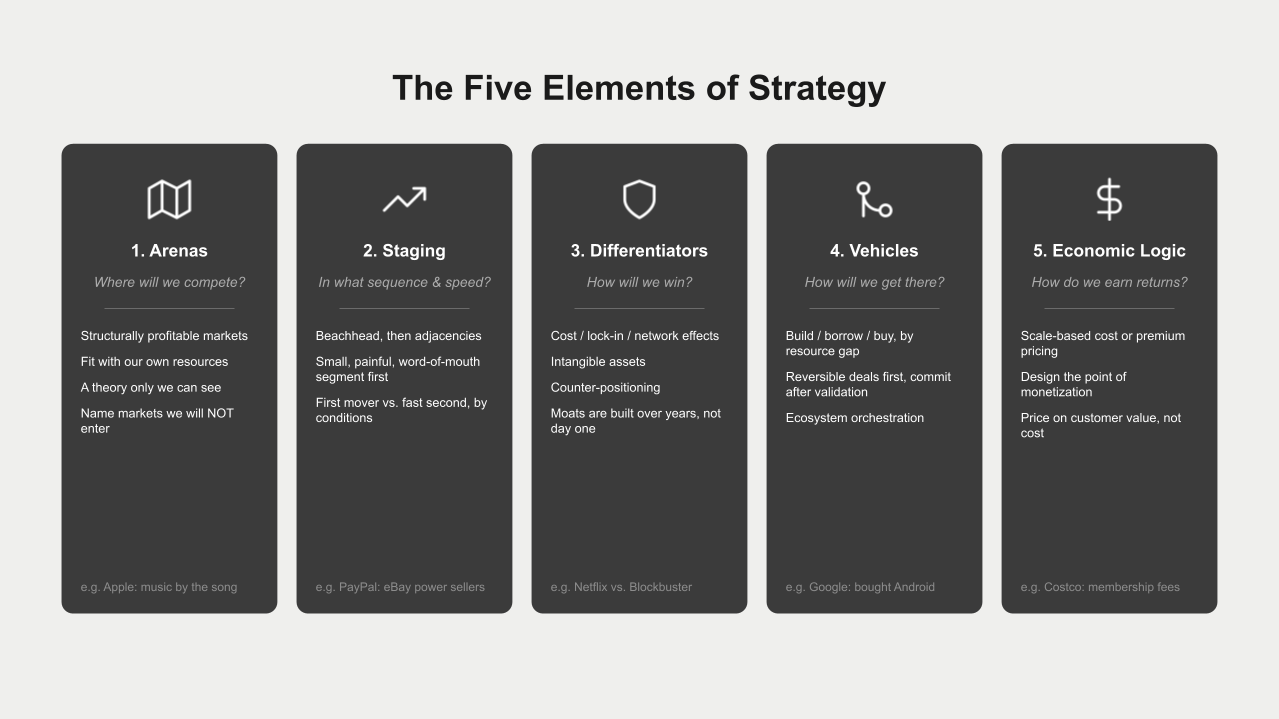
A strategy is the set of answers to five elements In the strategy diamond framework, you have designed a strategy only once you have answered all five elements: (1) Arenas (where will we compete?), (2) Vehicles (how will we get there?), (3) Differentiators (how will we win?), (4) Staging (in what sequence and at what speed?), and (5) Economic Logic (how will we make money?) (Hambrick & Fredrickson, 2001).
Strategy is the "coherence" among the elements The five elements are not to be optimized individually; they are designed as a single system in which each element supports the others. The more tightly the activities interlock (the better they fit), the less competitors can reproduce the whole even if they copy parts of it (Porter, 1996). Example: Southwest Airlines' combination of "short-haul direct flights only, a single aircraft type, minimal in-flight service, and 15-minute turnarounds" consists of individually imitable pieces, but because it is the interlocking of the whole that produces its low-cost structure, the major carriers could not imitate it without breaking their own existing systems.
Putting it into practice: start by writing the five elements on one page The simplest way to use the strategy diamond is to write out the strategy of your company (or your business unit) in one or two lines for each of the five elements, one page in total. The original paper is explicit that a strategy that cannot give clear answers to the five questions is not a strategy (Hambrick & Fredrickson, 2001).
The five elements are laid out in turn below.
4.1 Arenas: Where Will We Compete?
On the choice of which markets, segments, regions, and technology domains to compete in, the research offers the following perspectives.
Choose by the structural attractiveness of the market An industry's profitability is structurally determined by five forces: rivalry among existing competitors, the threat of new entrants, the threat of substitutes, the bargaining power of buyers, and the bargaining power of suppliers. Because it is structure, not the efforts of individual players, that determines profits, the first thing to look at is whether a market is "structurally profitable" (Porter, 1980). Example: in industries with low entry barriers and powerful buyers (much of contract software development, for instance), the ceiling on profit margins stays low no matter how hard you work.
Choose where your own resources come into play Even in the same market, a company that holds resources that are valuable, rare, hard to imitate, and organizationally exploitable (VRIO) has a completely different chance of winning than one that does not. On this view, the choice should rest not only on market attractiveness but on fit with your own resources (Barney, 1991). Example: for a company that owns a logistics network, entering e-commerce is, before it is an "attractive market," a "market where its resources come into play."
Create a market with no competition Other research argues that instead of competing in existing markets (red oceans), you can create markets in which competition does not exist at all (blue oceans) by "reducing, eliminating, raising, and creating" the value elements the industry takes for granted (Kim & Mauborgne, 2005). Example: Cirque du Soleil removed the animals and star performers from the circus and added theatrical elements, creating a market that competes with neither circus nor theater.
Spell out the "markets we will not fight in" as well Designing Arenas is not complete once you have listed the markets you will enter. As discussed earlier, the essence of strategy is choosing and forgoing, so Arenas have been designed only when you have also spelled out the markets that were considered but rejected, together with the reasons (Porter, 1996; Hambrick & Fredrickson, 2001). Example: a single line such as "we will not enter the large-enterprise segment for now, because its long decision cycles would erase our speed advantage" removes the hesitation on the sales floor.
Markets become visible through "your own theory" From the theory-based view introduced earlier, which markets are promising is not something objectively given; they become "visible" only through your company's own theory (hypothesis) (Felin & Zenger, 2017). Example: Apple, holding the theory that "music can be sold by the song," saw a market that others could not. Choosing Arenas is, more than the conclusion of an analysis, the statement of a hypothesis.
Specify Arenas along multiple dimensions, not just the market The original strategy diamond paper holds that Arenas should be specified concretely along several dimensions: product category, customer segment, geography, technology, and stage of the value chain (Hambrick & Fredrickson, 2001). Example: not "we will enter the healthcare market," but "for mid-sized hospitals in Japan (customer and geography), an appointment-management SaaS (product and technology), developed and sold in-house, with implementation support delivered through partners (value-chain stage)." Only at that level of granularity can the next elements, Staging and Vehicles, be designed.
Putting it into practice: score on attractiveness, fit, and theory Score each candidate arena on three points: (1) Is it structurally profitable? (Five Forces); (2) Do our resources give us an edge there? (VRIO); and (3) Do we hold a hypothesis that only we can see? (theory-based view). The third is the most important. A market chosen on (1) and (2) alone will be crowded, because every competitor running the same analysis reaches the same conclusion. Example: a market that everyone can analyze as attractive is, by that very fact, already a red ocean.
4.2 Staging: Which mountain to climb first, and in what order
Even when companies choose the same market (the same mountain), where they begin the climb often decides whether they succeed. The findings from research and practice can be organized as follows.
Break through at one point, then expand to adjacent ground (the beachhead principle) Military operations do not fight along the entire front at once; they secure a single point (a beachhead) and then expand into adjacent territory. The Normandy landings are the classic case: the point secured becomes the base for resupply and for the next advance. In business, the same structure has been formalized as the "bowling pin strategy," in which knocking down the first pin (a niche segment) yields the track record, customers, and product improvements that make the neighboring pins easier to topple (Moore, 1991). Example: Facebook started from a single point, Harvard University, then knocked down the adjacent segment of other universities one by one before opening to the general public.
There is a gap between the early market and the mainstream In the diffusion of new technology, a "chasm" separates early adopters from mainstream customers, and the patterns that succeed in the early market do not carry over to the mainstream. To cross the chasm, the prescription is to pick one specific niche on the mainstream side, dominate it, and use it as a beachhead (Moore, 1991). Example: many startups fall into the chasm through all-directions marketing, which is why "in which single segment do we first win an overwhelming share?" is the first design decision in Staging.
Climb from the low end or from non-consumption (disruptive innovation) Rather than confronting the incumbents head-on, an effective path is to enter through low-end customers the incumbents have abandoned, or through people who do not use the product at all (non-consumption), and then climb into higher segments as the technology improves. The advantage of this route is that incumbents have little motivation to defend the low end, so retaliation is unlikely (Christensen, 1997). Example: Toyota entered the US market with small, low-priced cars and climbed over several decades all the way to Lexus.
The success rate of adjacent expansion depends on distance from the core Empirical research on companies that expanded into adjacent areas in search of growth finds a low success rate of roughly one in four, and shows that the odds depend on how much the new area shares with the core business in customers, channels, cost structure, and organizational capabilities (how close the adjacency is). Successful companies also limit themselves to one adjacent step at a time and possess a "repeatable formula" for expansion (Zook, 2004). Example: Amazon took the logistics, payment, and recommendation formula it built in books and applied it first to the nearest adjacent categories, CDs and DVDs, and outward from there. Even AWS was the external sale of an internal asset, the computing infrastructure that supported its own e-commerce, rather than a leap into unrelated territory.
Growth paths fall into four directions The classic framework uses a matrix of existing/new products against existing/new markets to define four growth vectors: market penetration, product development, market development, and diversification, with risk rising the farther diversification moves from the core (Ansoff, 1957). The empirical research on adjacent expansion can be read as data-driven confirmation of this classic intuition.
The opening moves in Go follow the same principle In Go, because only one stone can be placed per move on a wide board, the efficiency of "where to play first" decides the game. The principle of the opening is corners, then sides, then center: a corner, with two edges already secured, claims territory with the fewest stones (efficiency), and the corner and the strength built around it give an advantage in the fights along the adjacent sides (a foothold). This structure of "start where territory can be secured most efficiently, then use that asset as a foothold to move into adjacent areas" is exactly the same as the beachhead (an indispensable position where a small advance force, at great risk, builds a small foothold on the far shore or beach so that weapons and the main army can later be brought in safely) and the bowling pin strategy (in marketing and business strategy, concentrating on a single first point, winning it, and letting that momentum ripple outward).
Choose the first segment to be "small, in acute pain, and connected by word of mouth" The criterion for selecting the first segment as a beachhead is not market size. The conditions are: (1) it is small enough that even with your own limited resources you can win an overwhelming share (a monopoly); (2) the pain of the problem is acute enough that customers will buy even an imperfect product; and (3) customers within the segment are connected by word of mouth and references, so one success story generates the next order (Moore, 1991). Example: PayPal did not start with "everyone who uses online payments" but with eBay's power sellers (regular sellers who moved large volumes at auction). At the time, payment on eBay was mostly by mailed check, taking more than a week to arrive, and the more transactions a power seller handled, the more this delay became a matter of survival (acute pain). When they displayed "PayPal accepted" on their listings, buyers signed up for PayPal, and those buyers then pressed other sellers to adopt it, so adoption propelled itself within the group (the word-of-mouth chain). And because the group numbered in the tens of thousands, even a cash-strapped startup could dominate it (smallness). From this beachhead PayPal took control of payments across all of eBay, and was ultimately acquired by eBay itself.
Alongside sequence, "speed" is also a design item Staging covers not only the order of expansion but also its pacing: when to invest all at once. In markets with strong network effects, the first mover takes everything, which justifies prioritizing speed; in markets without them, rapid expansion before hypotheses have been tested simply reproduces failure at scale (Hambrick & Fredrickson, 2001). Example: Tesla secured technology, capital, and brand with the high-priced, low-volume Roadster, then moved to the mid-tier with the Model S/X and to the mass market with the Model 3, climbing step by step with validation in between.
Judge the timing of the move to the next segment by "dominance" and "formula" The conditions for moving to an adjacent segment are not revenue growth but two things: (1) you have secured a dominant position in the current segment (a share at which word of mouth propels itself), and (2) the formula for selling and building that you established there can plausibly be reused in the adjacent segment (Moore, 1991; Zook, 2004). Example: moving next door with a 10% share means the beachhead is unfinished, while staying in the same segment after achieving dominance means forfeiting growth opportunities.
Three typical failure patterns Staging failures fall broadly into three types: (1) leapfrog entry (expanding into an area that shares no customers, channels, or capabilities with the core; empirical research shows the success rate drops sharply (Zook, 2004)); (2) simultaneous multi-front expansion (entering several segments at once before securing a beachhead, and dominating none of them); and (3) premature scaling (investing in scale before hypotheses are tested). Example: when early orders trickle in from several unrelated industries, companies tend to misread this as "demand is broad" and move to multi-front expansion, but this amounts to abandoning the beachhead.
Putting it into practice: write the climbing route as hypothesis statements A Staging design can be written as a chain of hypotheses of the form: "First, achieve (the victory condition: a share or a number of reference customers) in (segment A). The (assets: track record, data, product improvements, channels) gained there should lower the cost of capturing (adjacent segment B)." If it cannot be written this way, it is not a climbing route but merely a list of markets. The idea from the first half of this article, that strategy is a testable hypothesis, takes its most concrete form in Staging.
4.3 Differentiators: What you win with
For how to beat competitors in the arena you have chosen, the following design principles apply.
Design sources of advantage as "benefit × barrier to imitation" Sources of advantage such as cost advantage, brand, network effects, and switching costs only work when they deliver both a benefit to customers and a barrier to imitation. A benefit alone is merely a strength; excellent methods quickly become the industry standard, and the difference disappears (Porter, 1980; Barney, 1991; Helmer, 2016).
Five main types Sources of advantage fall broadly into: (1) cost structure (economies of scale and learning; e.g., a latecomer cannot replicate the price and speed of Amazon's logistics network or the scale of AWS); (2) customer lock-in (switching costs and accumulated data; e.g., for core systems, the high cost of migration is itself the defense); (3) networks and platforms (structures whose value grows as users increase); (4) intangible assets (brands, patents, regulatory approvals); and (5) market structure and strategy (such as counter-positioning, where the stronger player cannot follow because imitating would destroy its own existing business) (Porter, 1980; Helmer, 2016).
Empirical evidence: returns persist longest for intangible-asset and network moats A study analyzing 60 years of data on more than 25,000 companies from 1963 to 2023 shows that industries with intangible-asset or network-based moats sustain high return on invested capital (ROIC) over the long term with little additional investment. Companies that layer multiple moats also sustain their advantage longer than those relying on a single moat (Mauboussin & Callahan, 2024). Example: NVIDIA combines "ecosystem + proprietary technology + scale," while Amazon combines "scale + member lock-in + channels."
The moat does not exist on day one Having no moat at founding is normal. A moat is not something to be proven on day one; it forms after years of continuously solving customers' problems (Helmer, 2016). The essence, therefore, is a design over time: not demanding a moat from the outset in a fast-changing market, but layering multiple moats in stages.
The generative AI era: model performance rarely makes a moat In AI businesses, model performance itself commoditizes quickly and rarely becomes a moat, so the center of advantage is shifting to complementary assets: learning loops on industry-specific data, deep embedding in customer workflows, and computing resources and distribution networks. Example: even when the foundation model is updated, the value of having captured an industry's specific procedures and exception handling in the product is not imitated.
4.4 Vehicles: How to get there
On whether to reach the chosen market through in-house development, acquisition, or partnership, the research can be organized as follows.
Choose Build / Borrow / Buy based on the resource gap The framework here is a decision rule: if the gap between the resources you need and the resources you have is small, develop internally (Build); if the resources can be carved out and sourced from outside, use alliances or licensing (Borrow); and if the resources are deeply embedded in another organization and can only be obtained wholesale, acquire (Buy). Choosing the wrong vehicle, above all rushing into an acquisition where an alliance would have sufficed, is identified as one of the leading causes of failed growth (Capron & Mitchell, 2012). Example: Google obtained the deeply embedded capability of a mobile OS not by building it but by acquiring Android (Buy), and then achieved widespread adoption through a network of partnerships with handset manufacturers (Borrow).
Acquisition must never be the default vehicle Meta-analyses of the empirical M&A literature have repeatedly found that acquiring firms' performance does not improve on average after an acquisition, and in fact tends to deteriorate slightly (King et al., 2004). An acquisition is justified only when the required resources are so deeply embedded in the target organization that no other vehicle can secure them; acquisitions motivated by speed alone tend to lose their value to integration costs. Example: paying a premium to acquire a technology that could still have been validated through an alliance or license, simply out of fear that a competitor might grab it first, is a classic failure pattern.
Compete alone, or compete as an ecosystem? Recent research shows that designing and orchestrating an ecosystem that includes complementors (a platform plus its family of complementary products), rather than competing as a standalone firm, has become an important vehicle for reaching your goals. Whether to become the core of a platform (the orchestrator) or to join a strong ecosystem as a complementor is the modern version of the Vehicles choice (Jacobides, Cennamo & Gawer, 2018). Example: through the App Store, Apple organized developers as complementors and achieved a breadth of functionality that in-house development alone could never have reached.
The choice of vehicle is linked to Staging A sensible sequence is to rely on easily reversible vehicles such as alliances and licensing during the validation phase (while hypotheses are still unconfirmed), and to commit deeply through acquisitions or internal investment only once the hypotheses have been confirmed. The view introduced earlier, that strategy is a set of testable hypotheses, thus gives the Vehicles decision a time dimension as well. Example: a staged progression of involvement, from a small equity stake (CVC) to joint development to acquisition, is a Vehicles design that "deepens commitment while learning" in highly uncertain new technology areas.
4.5 Economic Logic: How Will We Make Money?
Finally, we design the logic by which everything above converts into profit.
Design the business model as an "activity system" How revenue is generated is determined not by adding up unit prices and costs, but by the design of the entire activity system: who performs which activities, and where you charge (its content, structure, and governance). Four sources of value in such a design have been identified: novelty, lock-in, complementarities, and efficiency (Zott & Amit, 2010). Example: Costco is designed to earn its profit from membership fees rather than product margins (a relocation of the charging point), so despite being a retailer it runs on a different economic logic from a supermarket.
Profit through scale, or through premium? The original strategy diamond paper cites "low cost through economies of scale" and "premium pricing through unique value" as the archetypal economic logics, and requires you to state explicitly which of the two will generate your profit (Hambrick & Fredrickson, 2001). Example: within the same airline industry, low-cost carriers profit through the logic of scale and turnaround speed while premium carriers profit through the logic of price per seat; a half-hearted mix undermines both.
The charging point can sit outside the product Where you make your money is not limited to charging for the product itself. Selling the core product cheaply and recouping on consumables, giving the product away and recouping from a subset of paying users (freemium), or charging for use rather than ownership (subscription) are all cases where the design of the charging point itself can become a competitive advantage (Zott & Amit, 2010). Example: freemium is a design in which free users deliver network effects and word of mouth (that is, they contribute to Staging and Differentiators); it is not merely a discount.
Design prices from value Both research and practice in pricing hold that prices should be designed on the basis of the economic value the customer receives, rather than by marking up costs (cost-plus) or following competitors' prices (Nagle & Holden, 2002). Example: the reference point for pricing a tool that saves 100 hours of work per month is not its development cost but what those 100 hours are worth to the customer. The strategic hypothesis discussed earlier, "customers will pay for this value, for this reason," is also a pricing hypothesis.
The economic logic must be consistent with Differentiators and Arenas A premium-pricing logic presupposes Differentiators that can support it (brand, proprietary technology) and Arenas (segments) with low price sensitivity. Example: it is far from rare to find companies that choose a low-price segment (Arenas) while designing for premium pricing (Economic Logic), a clear inconsistency.
4.6 A Consistency Test for the Five Elements
What the original strategy diamond paper emphasizes is not the quality of each of the five elements in isolation, but the coherence of the whole (Hambrick & Fredrickson, 2001). You can check the strategy you have designed against the following questions.
Arenas → Differentiators: Is the arena you have chosen a place where your path to victory (your moat) can actually be built? Example: if you are counting on network effects, have you avoided choosing a market in which customers have no connections to one another?
Arenas → Staging: Will the first segment you climb serve as a foothold that lowers the cost of capturing adjacent segments (rather than being an isolated outpost)? Example: can you name specifically which of the track record, data, and channels gained in the beachhead can be reused in the next segment?
Staging → Vehicles: Does the vehicle match the stage of hypothesis validation (are you avoiding deep commitment via acquisition to a hypothesis that is still unproven)? Example: do your vehicles map onto stages, with alliances for unvalidated areas and internal investment for validated ones?
Differentiators → Economic Logic: Does the logic of profit (scale or premium) mesh with the source of your advantage? Example: while proclaiming differentiation, is your revenue plan nonetheless built on the logic of scale (thin margins, high volume)?
Whole → Resources: Can the five elements as a whole be executed with your resources and funding? And can they be reconfigured as the environment changes (dynamic capabilities)? Example: if your funds are insufficient to cover all five elements, what should be cut is the breadth of your Arenas, not the quality of each element.
As an example of a coherent design, IKEA described in terms of the five elements looks like this (Hambrick & Fredrickson, 2001).
Arenas: Young, price-sensitive customers who cannot afford stylish but expensive furniture.
Staging: Perfect the format in Scandinavia, then roll out the same format repeatedly and sequentially to Europe, North America, and Asia.
Differentiators: The combination of good design and low prices, plus a distinctive customer experience of same-day take-home from warehouse-integrated stores.
Vehicles: Organic expansion through directly operated, standardized company-owned stores, rather than acquisitions or alliances.
Economic Logic: A scale-based low-cost structure built on flat-pack furniture (customers transport and assemble it themselves) and global sourcing.
5. Strategic Playbooks
The five elements of strategy we have organized so far need not be worked out from scratch. Just as shogi has its joseki, Go its standard sequences, and the military its doctrine, each of the five strategic decisions has established patterns across fields: "solutions to frequently recurring situations that predecessors have already tested." Interestingly, which pattern to choose is known to depend heavily on whether you are the strong player or the weak player.
5.1 Premise: The Playbook Differs for the Strong and the Weak
The point is that the pattern you should choose is the exact opposite depending on whether you are the strong player in that battlefield (the share leader) or a weak player (everyone else). The clearest demonstration of this asymmetry comes from Lanchester's laws.
The linear law: in one-on-one combat, numerical differences have only a linear effect Originally a mathematical model of warfare, it holds that in localized one-on-one combat, such as sword fighting, the outcome is determined by "weapon effectiveness × number of troops," so differences in troop numbers have only a linear effect (Lanchester, 1916). Example: with forces of 3 versus 5, the difference in attrition also stays at a ratio of 3 to 5.
The square law: in wide-area probabilistic combat, numerical differences have a squared effect By contrast, in wide-area probabilistic combat in which both sides exchange fire with guns, combat power is determined by "weapon effectiveness × the square of the number of troops" (Lanchester, 1916). With forces of 3 versus 5, the effective difference in strength becomes 9 to 25, an overwhelming advantage for the larger side. The principle that follows is clear: the strong should draw the fight into wide-area probabilistic combat (where the square applies), and the weak should draw it into localized one-on-one combat (where only the linear effect applies).
Translation into marketing: the leader's playbook and the challenger's playbook The "marketing warfare" school of the 1980s translated military strategic patterns (offense, defense, flanking, guerrilla warfare) into marketing, distinguishing the market leader's playbook (broad defense and sheer volume) from the challenger's playbook (local concentration, flanking attacks, guerrilla tactics) (Kotler & Singh, 1981; Ries & Trout, 1986). Lanchester's two laws provide the mathematical grounding for this asymmetry: the strong should choose wide-area battles in which numerical differences are squared, while the weak should choose local battles in which numerical differences have only a linear effect.
Strong or weak is judged per battlefield, not per company An important caveat: whether you are a leader or a challenger is determined not by company size but by your position in each battlefield (Arena) you have defined. Example: even a large corporation is a challenger in a market it is newly entering, and the standard move is to begin with the weak player's playbook (local combat, single-point concentration). Conversely, even a small company that ranks first in a particular region or use case can apply the strong player's playbook (neutralization through imitation) in that battlefield.
A note on academic standing One caution: while Lanchester's original work is a mathematical model that continues to be tested in military operations research, its application to business competition does not have the empirical foundation of theories like Porter's or Teece's, and is closer to a structural analogy. In this article we borrow only its core insight, that the optimal playbook is reversed for the strong and the weak.
With this axis of "the strong player's playbook versus the weak player's playbook" in hand, we now turn to the established patterns for each of the five decisions.
5.2 Arenas: Patterns for Choosing Your Battlefield
The weak player's playbook
Local warfare (segment the market and fight only where you can win) The most important pattern for the weaker player is to avoid contesting the market as a whole. Instead, segment it by region, customer group, or use case, and pick a segment where committing your entire force is enough to make you number one (Lanchester, 1916's linear law). The criteria for choosing a beachhead segment—"small, with acute pain, and connected by word of mouth" (Moore, 1991)—are the modern version of this pattern. Example: a regional supermarket competing against a national chain that concentrates every resource on freshness within a single trading area is following this pattern.
Winning without fighting (choose an empty battlefield) The oldest of all strategic principles holds that the best course is to avoid battle with a rival altogether (Sun Tzu, c. 5th century BC). In business, this lineage includes the blue ocean strategy of recombining an industry's value elements to create a market with no competition (Kim & Mauborgne, 2005). Example: Cirque du Soleil created a market in which it competes head-on with neither circuses nor theater.
Avoid positions where the opponent is well prepared In chess, the standard advice is not to play along with an opening your opponent has studied deeply, but to steer the game into territory you have studied yourself. Go has a similar proverb—"don't approach thickness"—and the accepted pattern is to avoid fighting where the opponent's strength is at its peak. The business counterpart is to avoid arenas where the stronger player's scale and brand count (price wars, nationwide distribution) and choose arenas where they don't (speed, specialization, proximity to the customer).
Patterns for the stronger player
Wide-area warfare (broaden the battlefield so mass counts) The stronger player's pattern is the mirror image: widen the front and fight with the combined power of every product, channel, and region. The more the contest becomes a wide-area probabilistic battle, the more the square law makes differences in mass count as their square (Lanchester, 1916). Example: an industry leader assembling an exhaustive product line so that it appears as an option in every comparison is following this pattern.
Grow the whole market The company with the largest share has one more standard move beyond fighting competitors: expanding the market itself. Because it holds the biggest share, it is the largest beneficiary of any market growth, so investing in awareness of the category and in developing new uses is rational (Kotler & Singh, 1981). Example: a food brand that dominates its category spending its budget on recipe ideas (developing new occasions for use) rather than on advertising aimed at competitors is following this pattern.
5.3 Patterns for Staging (how to climb the mountain)
Patterns for the weaker player
Beachhead (take one point completely, then move next door) In this pattern you secure an overwhelming share in an initial niche, then use the assets gained there (track record, data, product improvements, channels) to take adjacent segments one after another. The bowling-pin strategy (Moore, 1991), entry from the low end or from non-consumption (Christensen, 1997), and adjacency expansion (Zook, 2004) all belong to this single lineage, and share the same structure as Lanchester's concentration on a single point. The weaker player's standard staging moves boil down almost entirely to this one family.
Common patterns
Start where territory is cheapest to secure The standard opening sequence in Go (corners, then sides, then center) is a pattern of efficiency: begin where you can secure territory with the fewest stones, then use the thickness you have built as a foothold for the next fight. The principle that "the standard order of ascent, in any field, is determined by efficiency plus what serves as a foothold for the next step" is structurally identical to the beachhead pattern.
"Fortify first, then attack" or "attack fast without fortifying" In chess, one normally castles (securing the king) before launching an attack, but there is also the option of postponing the king's safety and attacking in order to seize a momentary initiative. Which to choose depends on how fast the opponent's attack will arrive. Translated into business, this is a choice of order: build your moat (defense) first, or prioritize the speed of market capture (offense). In markets where competitors enter slowly, it is rational to consolidate your revenue base and entry barriers before expanding; in markets where competitors enter quickly, it is rational to take share first and build the moat afterward. Example: prioritizing a fast attack in a market with network effects corresponds to choosing "speed over the king's safety."
Conditions for first movers, conditions for followers Research shows that first movers gain an advantage when there is a head start in accumulating technology, preemption of scarce resources, or customer switching costs at work; conversely, when market or technological uncertainty is high, followers who can free-ride on the first mover's investments have the advantage (Lieberman & Montgomery, 1988). Furthermore, in radically new markets, it has been empirically shown that the eventual winner is often not the pioneer who created the market but the "second-mover consolidator" who scaled it once it had taken off (Markides & Geroski, 2005). Example: the smartphone market was created by pioneers, but it was captured by the later entrants Apple and Samsung. Whether to lead or to be a fast follower is a pattern chosen by conditions, not by which is superior.
Run your decision loop faster than the opponent In the military, the OODA loop—Observe, Orient, Decide, Act—has been formalized as a pattern: by cycling through it faster than the enemy, you keep the enemy's decisions perpetually too late (Osinga, 2007). The business counterpart is to make the very speed of your decision-making and hypothesis-testing cycles a weapon. Example: against a large company that runs on an annual budget cycle, a startup that tests hypotheses weekly builds its advantage on tempo rather than scale.
Supply lines set the pace of expansion A classic military lesson is the "culminating point of the offensive": an attack stalls once its supply lines are stretched to the limit, and a counterattack at that moment inflicts devastating losses. In business, the supply lines are your capacity to provide capital, hiring, operations, and management, and the pace of your staging must stay within that capacity. Example: if orders are growing but delivery quality starts to break down, that is the sign your supply lines are overstretched, and the standard move is to pause expansion.
Descend in an orderly way from a mountain you cannot climb Retreat has patterns too. In the military, a fighting withdrawal—pulling back the main force under cover of a rearguard—has long been regarded as one of the most difficult operations. The business counterpart is setting exit criteria in advance. By deciding before entry which metrics falling below which thresholds will trigger withdrawal, you prevent the delays in exiting caused by sunk costs. Randomized controlled trials have also shown that entrepreneurs trained in hypothesis-driven decision-making make more accurate decisions to exit ventures with no prospects (Camuffo et al., 2020).
5.4 Patterns for Differentiators (the path to victory)
Patterns for the weaker player
Flanking attacks and guerrilla warfare (fight while avoiding the front) Research translating military patterns into marketing classifies the challenger's options as frontal attack (an all-out battle on the stronger player's own ground—recommended, as a rule, only for the very largest players), flanking attack (striking regions, segments, or price bands where the stronger player is thin), and guerrilla warfare (repeated small-scale surprise raids, withdrawing without pursuing) (Kotler & Singh, 1981). The weaker player's standard moves are the flanking attack and guerrilla warfare; for the frontal attack, the rule of thumb inherited from the military is "don't launch it without a two-to-one advantage in force."
Counter-positioning (differentiation the stronger player can only imitate by hurting itself) The strongest counter to neutralization by imitation is a business design such that "if the stronger player copies it, it destroys its own existing business" (Helmer, 2016). Precisely because the stronger player decides rationally, it cannot follow. Example: Blockbuster, whose late fees on store rentals were a major source of revenue, would have destroyed that revenue by copying Netflix's flat-rate mail-order model, so its response was fatally slow. This structure also explains why disruptive innovation (Christensen, 1997) works.
Patterns for the stronger player
Neutralization by imitation The stronger player's standard move is to copy the weaker player's move immediately and at scale, neutralizing the differentiation before it becomes a threat (Kotler & Singh, 1981). Once the stronger player imitates, customers reason "if the features are the same, buy from the big company," and the weaker player's advantage disappears. The weaker player must design its path to victory on the assumption that this pattern is coming.
Preemption and mobility over position defense For the defender (the stronger player), the classified patterns include position defense (holing up in the existing position), preemptive defense (striking first before a threat materializes), and counteroffensive (hitting back at the attacker's home base when attacked); mere position defense is considered the most fragile of these (Kotler & Singh, 1981). Example: the standard move of "self-disruption" (preemptive defense)—replacing your own core business with your own new product—rests on the logic that it is better than being disrupted by someone else.
Common patterns
Cost, differentiation, focus The basic patterns of competitive advantage are classified as (1) cost leadership (the same thing, cheaper), (2) differentiation (something different, at a higher price), and (3) focus (cost or differentiation within a specific segment), with the warning that failing to choose one clearly—being "stuck in the middle"—yields the lowest profitability (Porter, 1980). Example: picking a fight on cost when you lack scale is a mistake in the choice of pattern.
Match investment in defense to the speed of the attack Chess players adjust the number of moves they spend securing the king according to how quickly the opponent's attack will arrive: over-defend and you lose the initiative; under-defend and you lose the game. The business counterpart is matching the depth of your investment in a moat to the speed of competition. In a market where competition is slow, a thin defense (brand alone, patents alone) is dangerous; conversely, building heavy defenses (deep vertical integration and the like) in a fast-changing market leaves you unable to move when the environment shifts.
5.5 Patterns for Vehicles (the means of getting there)
Patterns for the weaker player
Coalition of the weak (take on the strong through alliance) In this pattern, weaker players who cannot stand up to the stronger one on their own form a coalition. Its archetype is the balance-of-power pattern that runs through military and diplomatic history: weaker powers allying against a dominant one to restore equilibrium. The business counterpart is building camps around industry standards or specifications, and forming coalitions through openness. Example: handset makers that could not take on the iPhone individually did so by joining Google's open Android camp. The pattern's weakness is also as history shows: when interests diverge, the alliance collapses. The standard tactic of the dominant power has always been to break up the alliance by offering favorable terms to its members individually.
Patterns for the stronger player
Orchestrating an ecosystem The stronger player's standard move is to make itself the core of a platform, organize complementors, and compete on a total value that no single company could deliver alone (Jacobides, Cennamo & Gawer, 2018). Example: Apple's App Store and Amazon's Marketplace are the representative cases of this pattern.
Patterns common to both
Choosing between Build, Borrow, and Buy The established rule is this: if the gap between the resources you need and the resources you have is small, develop in-house (Build); if the resource can be carved out and sourced from outside, use alliances or licensing (Borrow); and if the resource is deeply embedded in another organization, acquire it (Buy) (Capron & Mitchell, 2012).
Staged commitment In areas of high uncertainty, a standard pattern for strong and weak players alike is to deepen commitment as validation progresses: a small equity stake first, then joint development, then acquisition.
Be most careful with the means that are hardest to undo A practical yardstick for choosing a Vehicles pattern is reversibility. Licenses and alliances can be dissolved, but a failed acquisition leaves behind a loss on disposal and organizational scars; a meta-analysis of empirical M&A research shows that, on average, acquirers' performance does not improve (King et al., 2004). Hence the rule: validate with reversible means, and use irreversible means only after validation. Example: before rushing into an acquisition in a new technology area, the pattern is to always ask first, "Could an alliance give us the same validation?"
5.6 Patterns for Economic Logic (how you make money)
The design of pricing and monetization also has patterns that have been used again and again.
The razor-and-blades model: don't profit on the device, recoup on consumables Sell the core product (razor, printer, game console) cheaply to build a customer base, then recoup through repeat purchases of consumables and peripherals (blades, ink, software). This pattern is designed hand in hand with a lock-in Moat (switching costs).
Freemium: free users are an asset, not a cost Offer basic functionality for free to attract a large user base, then monetize a subset of paying users. This is not merely a discount: free users contribute to Differentiators and Staging in the form of network effects, word of mouth, and data (Zott & Amit, 2010).
Two-sided market subsidies: favor one side, collect from the other On platforms, the standard pattern is to attract the price-sensitive side (consumers) with free or low prices and to collect from the side that pays for access to that audience (merchants, advertisers). The economics of two-sided markets shows theoretically that the design of this price structure—how much "subsidy" goes to which side—is itself a determinant of competitive advantage (Rochet & Tirole, 2003). Example: credit cards that waive annual fees and hand out reward points to cardholders while recouping through merchant fees follow this pattern.
Subscription: charge for use, not ownership This pattern converts one-time sales into recurring revenue, raising revenue predictability and customer lifetime value. But because customers cancel unless value keeps being delivered, it effectively functions as a "hypothesis that gets tested every month."
Loss leader: draw people in with a headline item, recoup across the basket Sell some items below cost to generate store visits or traffic, then recoup through the other items customers buy alongside them. Example: supermarket specials, or Costco's famously cheap rotisserie chicken, are designed to recover the loss on a single item through overall purchases. The difference from the razor-and-blades model is that recovery comes not from lock-in but from "creating the occasion to visit."
How to choose: the way you make money follows your path to victory and your arena Which pattern to choose is a matter of consistency, not preference (the strategy diamond's coherence test). Example: design a razor-and-blades model without a lock-in Moat, and customers will simply switch to a competitor's consumables, leaving you with nothing to recoup.
5.7 The limits of patterns
Finally, let us summarize the most important caveats for using a catalog of patterns.
A pattern is only "a solution validated in a past environment" It has been pointed out that in markets where competitive advantages last for shorter and shorter periods, yesterday's standard moves (heavy investments premised on sustainable advantage) can become outright blunders (McGrath, 2013). Patterns are a function of the environment; when the environment changes, so does the answer. Example: the "market share above all" pattern, premised on economies of scale, is no longer necessarily the standard move in markets like software, where marginal costs are nearly zero and advantages are short-lived.
AlphaGo overturned centuries of joseki The best illustration of this point is Go. Post-AlphaGo AI showed that ideas humans had spent hundreds of years concluding were "bad moves" (such as the early 3-3 invasion in the opening) were in fact strong, and the standard opening patterns of professional play were rewritten within a few years (Silver et al., 2017). Joseki were never "truths"; they were "hypotheses validated as of that point in time."
Misuse of patterns comes from ignoring their preconditions The weaker player's local-battle pattern depends on the existence of a segment where you can become number one locally; where network effects turn the whole market into a single arena, local battles themselves become hard to sustain. Likewise, the first-mover advantage pattern was conditional on the presence of switching costs (Lieberman & Montgomery, 1988). Always check the preconditions before applying a pattern. Rather than memorizing patterns, understand when they hold, and be prepared to abandon them when they do not.
Patterns work as a "set," not in isolation The patterns for the five decisions are not independent; just as with the strategy diamond's coherence test, they only function once they have been aligned as a set. Example: a full set for the weaker player might be assembled as "local battle (Arenas) × beachhead (Staging) × counter-positioning (Differentiators) × coalition of the weak (Vehicles) × freemium or two-sided market (Economic Logic)." Conversely, mixing patterns—choosing a local battle while making the mass investments suited to a broad front, for instance—means satisfying the preconditions of neither.
6. Strategy in the Age of AI
6.1 Can AI think strategically?
At present, how much of strategy formulation can AI take on? The research findings on AI and strategy can be summarized as follows.
Go: the first domain where strategy was reduced to computation In 2016, AlphaGo (Silver et al., 2016) defeated Lee Sedol, a 9-dan professional and one of the world's top players. What matters is not the result but what it demonstrated: the strategic intuition humans had called "the big picture" (judging the overall balance of the board and the value of thickness) could be reproduced as an evaluation function through deep learning. The following year, AlphaGo Zero went further, learning purely through self-play without any human game records, and surpassed the joseki and strategic understanding humans had accumulated over roughly 3,000 years (Silver et al., 2017).
Poker: computable even when you cannot see the opponent's hand Go is a perfect-information game in which both players can see the entire state. Later AI went on to beat top professionals at poker, an imperfect-information game where the opponent's cards are hidden and bluffing is the essence of play (Brown & Sandholm, 2018). This showed that even in a structure closer to business—maneuvering when you cannot read the other side's moves—strategy is computable as long as the rules and the victory conditions are defined.
Human strategy was updated by AI, too Intriguingly, after AlphaGo the strategic outlook of human players themselves changed. Humans studied the new ideas the AI had revealed (such as the early 3-3 invasion, formerly considered a mistake), and the conventional wisdom of professional openings was rewritten within a few years. Machine strategy did not put an end to human strategy; it became teaching material that expanded the human hypothesis space. This relationship can be seen as a precedent for how AI will be used in business.
LLMs can evaluate business ideas at the level of investors Research has shown that evaluations of business ideas by an LLM (GPT-4) can reach a level comparable to that of experienced investors and entrepreneurs (Csaszar, Ketkar & Kim, 2024).
On par with humans in strategy simulations, too In a benchmark using the market competition simulations employed in business schools, LLMs have been reported to achieve results comparable to human participants in some settings (Allen & McDonald, 2025). The strategy research journal Strategy Science is running a special issue in 2026 titled "Can AI Do Strategy?"—this question is already a central topic in strategy research.
How to use it in practice: assign AI the "breadth" and the "refutation" Based on current research, AI's proper place in strategy formulation lies in (1) exhaustive generation of options (expanding the range of moves and entry modes beyond what humans would think of), (2) generating counterarguments to your own strategy (having it list "where this hypothesis might break down" to detect confirmation bias), and (3) simulating the competitor's perspective (having it play out "how a rival would respond"). Example: handing your strategic hypothesis to an LLM and asking, "If this hypothesis is wrong, list the five most likely reasons," is a way of using AI to accelerate the scientific approach of Camuffo and colleagues.
So as analysis and the generation of moves become mechanized, what strategic work remains for humans? Cross-referenced with the three schools of thought from Chapter 3, it comes down to the following three things.
Framing the problem and defining the victory conditions Go AI is strong because the victory conditions are already defined. In business, defining "which game to play, and what counts as winning" is itself part of strategy (this is the domain of strategy as hypothesis). Example: "Do we win on share, on margin, or by redefining the market altogether?" is a question humans must settle before anything is fed to the AI—and changing this framing changes every optimal move.
Commitment Strategy involves decisions that commit resources and cut off retreat, and responsibility for the outcome can only be borne by people within the organization. Example: even if an AI judges that "entering this market is the most promising option," it is the executives who execute the multi-billion-yen investment and who are held accountable if it fails.
Execution as practice Since strategy exists within day-to-day activity, no analysis, however brilliant, becomes strategy unless the people in the organization actually change how they act (this is the domain of strategy as practice). Example: even an excellent AI-generated strategy document will meet the same fate as an unexecuted medium-term plan if meetings, resource allocation, and priorities on the ground do not change.
6.2 How AI affects strategy
Today, AI agents that autonomously plan and carry out multi-step tasks are entering practical use, and not just analysis but execution itself is being mechanized. The effects of this shift on the definition of strategy and on each of the five elements can be summarized as follows.
Execution advantages become commoditized, and the value of the "bet" rises (a change in the definition) The classic observation that operational efficiency is not in itself strategy grows even more forceful in the age of agents. The more that everyone can obtain high-quality execution cheaply, the more the differences between companies concentrate in the quality of their choices—what to give up and what to bet on (Porter, 1996). Example: when two companies that have both automated sales, development, and analysis with agents stand side by side, what decides the outcome is not how skillfully they automated but which market they chose and which hypothesis they bet on.
Ultra-niche segments become viable arenas (how Arenas change) Once agents drive down the marginal cost of doing the work, segments that were previously "too small to sustain a business" become serviceable. A customer base that would run at a loss if you had to hire people to serve it can pencil out when delivery is agent-led. The smallest unit of arena you can fight in becomes finer-grained, and the range of options for local battles actually widens. Example: specialist advisory services for small businesses that could never before afford a consultant become, for the first time, a profitable Arena thanks to agents.
Validation cycles become orders of magnitude faster (how Staging changes) Agents make it possible to run the hypothesis testing of the scientific approach (3.2) in parallel and at high speed. When market research, prototyping, and the analysis of customer interviews go from taking weeks to taking days, the increments of Staging become finer and each bet becomes smaller. The faster validation gets, however, the more the rate-limiting step shifts to the quality of the theory, that is, to the question of which hypotheses to test in the first place (Felin & Zenger, 2017; Camuffo et al., 2020). Example: even if you can rapidly test 100 hypotheses, if all 100 are mediocre, all you get back are mediocre conclusions.
The moat moves to data loops and workflows (how Differentiators change) Because model performance itself is commoditizing rapidly, the source of advantage shifts to learning loops built on industry-specific data, deep embedding in customer workflows, and complementary assets. The further agent adoption progresses, the faster this trend accelerates.
The boundaries of the firm shift (how Vehicles change) Going back to the classic theory that a firm's boundaries are set by comparing the cost of transacting in the market against the cost of doing things in-house (Coase, 1937), AI agents dramatically lower the costs of coordination and transacting, and thereby move the very line between "do it ourselves" and "leave it to outsiders" (California Management Review, 2025). To Build / Borrow / Buy, a fourth route to capability is being added: composing the capabilities you need on demand as agents. Example: if some of the specialist capabilities that could previously be acquired only through acquisitions or hiring can now be substituted by configuring agents, the optimal answer for Vehicles changes.
Person-month pricing breaks down and billing shifts to outcomes (how Economic Logic changes) As execution moves to agents, the cost structure of service businesses moves away from labor-intensive and toward that of software, where marginal cost is close to zero. The person-month economic logic of "charge for the time spent" then loses its footing, and pressure builds to move to a design that "charges for the results produced." Example: a per-person-month rate cannot hold for work an agent finishes in a few minutes. Redesigning the billing point, deciding what to measure as an outcome and how to charge for it, becomes the central Economic Logic question of this era.
The human role shifts from executor to designer and supervisor of agents (how practice changes) In organizations where agents carry out the work, human jobs move from execution to setting goals for the agent fleet, designing its constraints, and supervising it (MIT Sloan Management Review, 2025). Strategy as practice does not disappear; it shows up as the everyday design decisions of "which agents to entrust with what, and what not to entrust to them" and "which victory conditions and constraints to give the agents." Example: if you simply tell an agent to "maximize revenue," it may well execute moves that destroy the brand or long-term customer relationships (that is, consistency with the other elements). Translating the coherence of the five elements (4.6) into constraints and handing them to the agents is the new form of strategizing.
Strategy in the AI era, then, is the decision-making that still remains with humans in an environment where analysis, execution, and validation have become fast and cheap thanks to machines: defining which game to play and what counts as winning, choosing which hypotheses to test, committing resources, and taking responsibility for the results.
7. Closing Thoughts
In this article we have laid out a comprehensive map of what strategy is and discussed how it is likely to change in the AI era. While the five elements of the strategy diamond are universal, each of them can be expected to be affected by AI, and it is clear that the very shape of the company will need to change substantially as a result.
References
Allen, R., & McDonald, R. (2025). How Well Can AI Do Strategy? Empirical Benchmarking Using Strategy Simulations. Strategy Science. A benchmarking study of LLMs' strategy-formulation capabilities using business strategy simulations.
Ansoff, H. I. (1957). Strategies for Diversification. Harvard Business Review, 35(5), 113–124. The classic that organized four growth vectors in a product × market matrix.
Barney, J. B. (1991). Firm Resources and Sustained Competitive Advantage. Journal of Management, 17(1), 99–120. The foundational text of the resource-based view (RBV) of strategy: resources that satisfy the VRIO conditions yield sustained advantage.
Brown, N., & Sandholm, T. (2018). Superhuman AI for heads-up no-limit poker: Libratus beats top professionals. Science, 359(6374), 418–424. The study showing that AI can outperform top professionals in an imperfect-information game (poker).
California Management Review (2025). From Coase to AI Agents: Why the Economics of the Firm Still Matters in the Age of Automation. An essay on the impact of AI agents on transaction costs and the boundaries of the firm.
Camuffo, A., Cordova, A., Gambardella, A., & Spina, C. (2020). A Scientific Approach to Entrepreneurial Decision Making: Evidence from a Randomized Control Trial. Management Science, 66(2), 564–586. An RCT showing that training entrepreneurs in hypothesis-driven decision making improves both their performance and their decisions to exit.
Camuffo, A., Gambardella, A., Messinese, D., Novelli, E., Paolucci, E., & Spina, C. (2024). A scientific approach to entrepreneurial decision-making: Large-scale replication and extension. Strategic Management Journal, 45(6), 1209–1237. A large-scale replication (754 firms) of the RCT above.
Capron, L., & Mitchell, W. (2012). Build, Borrow, or Buy: Solving the Growth Dilemma. Harvard Business Review Press. Presents a framework for choosing among growth routes (internal development, partnering, acquisition) based on the resource gap.
Casadesus-Masanell, R., & Ricart, J. E. (2010). From Strategy to Business Models and onto Tactics. Long Range Planning, 43(2–3), 195–215. Lays out the three-layer relationship in which strategy is the choice of business model, the business model is the mechanism that operates as a result of that choice, and tactics are the moves available within it.
Chandler, A. D. (1962). Strategy and Structure. MIT Press. Offers the classic management definition of strategy: determining long-term goals, adopting courses of action, and allocating resources.
Christensen, C. M. (1997). The Innovator's Dilemma. Harvard Business School Press.(邦訳『イノベーションのジレンマ』翔泳社):ローエンド・無消費からの参入が大手の反撃を受けにくい構造を解明。
Clausewitz, C. von (1832). Vom Kriege.(邦訳『戦争論』):戦術と戦略を区別し、戦争を政治目的の手段として位置づけた近代戦略論の古典。
Coase, R. H. (1937). The Nature of the Firm. Economica, 4(16), 386–405. The classic showing that the boundaries of the firm are determined by transaction costs; the starting point for thinking about how AI agents shift those boundaries.
Collins, J. C., & Porras, J. I. (1996). Building Your Company's Vision. Harvard Business Review, 74(5), 65–77. The standard article that distinguishes and defines mission (fundamental reason for being) and vision (the envisioned future).
Csaszar, F. A., Ketkar, H., & Kim, H. (2024). Artificial Intelligence and Strategic Decision-Making: Evidence from Entrepreneurs and Investors. Strategy Science, 9(4). A study showing that LLM evaluations of business ideas can rival those of experienced investors and entrepreneurs.
Felin, T., & Zenger, T. R. (2017). The Theory-Based View: Economic Actors as Theorists. Strategy Science, 2(4), 258–271. The foundational text of the theory-based view, which regards managers as builders of theories.
Freedman, L. (2013). Strategy: A History. Oxford University Press.(邦訳『戦略の世界史』日本経済新聞出版):軍事・政治・ビジネスを横断する戦略の通史。戦略を「力の創出術」と定義。
Hambrick, D. C., & Fredrickson, J. W. (2001). Are You Sure You Have a Strategy? Academy of Management Executive, 15(4), 48–59. — The original source of the "strategy diamond," which breaks the substance of a strategy into five elements (Arenas / Vehicles / Differentiators / Staging / Economic Logic) and treats the coherence among them as the strategy itself.
Helmer, H. (2016). 7 Powers: The Foundations of Business Strategy. Deep Strategy LLC. — Defines a moat ("Power") as the combination of a benefit and a barrier, and lays out seven types, including counter-positioning.
Jacobides, M. G., Cennamo, C., & Gawer, A. (2018). Towards a Theory of Ecosystems. Strategic Management Journal, 39(8), 2255–2276. — The paper that lays the theoretical foundation for ecosystem strategy.
経済産業省・厚生労働省・文部科学省(2020)『2020年版ものづくり白書』:不確実性の時代の対応原理としてダイナミック・ケイパビリティを採用。
Kim, W. C., & Mauborgne, R. (2005). Blue Ocean Strategy. Harvard Business School Press. (Japanese edition available.) — Systematizes the creation of uncontested market space.
King, D. R., Dalton, D. R., Daily, C. M., & Covin, J. G. (2004). Meta-analyses of Post-acquisition Performance. Strategic Management Journal, 25(2), 187–200. — A meta-analysis showing that, on average, acquiring firms' performance does not improve after an M&A deal.
Kotler, P., & Singh, R. (1981). Marketing Warfare in the 1980s. Journal of Business Strategy, 1(3), 30–41. — Translates the military concepts of offense, defense, flanking, and guerrilla warfare into marketing strategy.
Lanchester, F. W. (1916). Aircraft in Warfare: The Dawn of the Fourth Arm. Constable. — The original source of the mathematical models of combat (the linear law and the square law), distinguishing battles in which numerical superiority counts linearly from those in which it counts as the square.
Lieberman, M. B., & Montgomery, D. B. (1988). First-Mover Advantages. Strategic Management Journal, 9(S1), 41–58. — A foundational text that lays out the conditions under which first-mover advantage holds, and those under which late entrants come out ahead.
Magretta, J. (2002). Why Business Models Matter. Harvard Business Review, 80(5), 86–92. — The classic paper distinguishing a business model (how the business holds together as a system) from strategy (how to do better than competitors).
Markides, C., & Geroski, P. (2005). Fast Second. Jossey-Bass. — Shows that in radically new markets, the winner is often not the pioneer who created the market but the second mover who consolidates it.
Mauboussin, M. J., & Callahan, D. (2024). Measuring the Moat. Morgan Stanley Counterpoint Global. — A report analyzing the relationship between moat types and the persistence of ROIC, drawing on 60 years of data from more than 25,000 companies.
McGrath, R. G. (2013). The End of Competitive Advantage. Harvard Business Review Press. (Japanese edition published by Nikkei Publishing.) — Argues for a strategy that does not assume sustainable advantage but instead rides a succession of transient advantages.
Mintzberg, H. (1987). The Strategy Concept I: Five Ps for Strategy. California Management Review, 30(1), 11–24. — Sorts out the five distinct senses in which the word "strategy" is used (Plan / Ploy / Pattern / Position / Perspective).
Mintzberg, H., & Waters, J. A. (1985). Of Strategies, Deliberate and Emergent. Strategic Management Journal, 6(3), 257–272. — The paper that distinguishes deliberate strategy from emergent strategy.
MIT Sloan Management Review (2025). The Emerging Agentic Enterprise: How Leaders Must Navigate a New Age of AI. — A feature on how the role of humans changes in organizations where AI agents carry out the work.
Moore, G. A. (1991). Crossing the Chasm. HarperBusiness. (Japanese edition published by Shoeisha.) — Introduces the gap (the "chasm") between the early market and the mainstream market, along with the bowling-pin strategy of dominating a niche and then expanding into adjacent ones.
Nagle, T. T., & Holden, R. K. (2002). The Strategy and Tactics of Pricing (3rd ed.). Prentice Hall. (Japanese edition published by Pearson Education.) — The standard textbook on value-based pricing.
Nash, J. (1950). Equilibrium Points in n-Person Games. Proceedings of the National Academy of Sciences, 36(1), 48–49. — Introduces the equilibrium concept in which each player's choice is a best response to the others'.
Osinga, F. P. B. (2007). Science, Strategy and War: The Strategic Theory of John Boyd. Routledge. — A systematic study of the strategic theory of Boyd, originator of the OODA loop.
Porter, M. E. (1980). Competitive Strategy. Free Press. (Japanese edition published by Diamond, Inc.) — Presents the framework for analyzing the structural attractiveness of an industry through five forces.
Porter, M. E. (1996). What Is Strategy? Harvard Business Review, 74(6), 61–78. — Locates the essence of strategy in building a unique position that involves trade-offs—that is, in choosing what not to do.
Ries, A., & Trout, J. (1986). Marketing Warfare. McGraw-Hill. (Japanese edition available.) — The worldwide bestseller on marketing warfare, which lays out four types of engagement: defensive, offensive, flanking, and guerrilla.
Rochet, J.-C., & Tirole, J. (2003). Platform Competition in Two-Sided Markets. Journal of the European Economic Association, 1(4), 990–1029. — The theoretical foundation for the pricing structure of two-sided markets (which side to subsidize).
Rumelt, R. P. (2011). Good Strategy Bad Strategy: The Difference and Why It Matters. Crown Business. (Japanese edition published by Nikkei Publishing.) — Identifies four hallmarks of bad strategy and the kernel of good strategy: diagnosis, guiding policy, and coherent action.
Schilke, O., Hu, S., & Helfat, C. E. (2018). Quo Vadis, Dynamic Capabilities? Academy of Management Annals, 12(1), 390–439. — A systematic review of 298 studies on dynamic capabilities.
Seidl, D., Ma, S., & Splitter, V. (2024). What makes activities strategic: Toward a new framework for strategy-as-practice research. Strategic Management Journal, 45(12), 2395–2419. — Revisits the question of what makes an activity "strategic" and proposes a new framework for strategy-as-practice research.
Silver, D., et al. (2016). Mastering the game of Go with deep neural networks and tree search. Nature, 529, 484–489. — The AlphaGo paper, in which deep learning and tree search are used to learn an evaluation function for Go—a machine sense of the whole board.
Silver, D., et al. (2017). Mastering the game of Go without human knowledge. Nature, 550, 354–359. — The AlphaGo Zero paper, in which self-play learning without any human game records surpasses the level of human knowledge.
孫子(紀元前5世紀頃)『孫子』(邦訳:岩波文庫ほか):最古の戦略書。戦わずして勝つこと、戦う前の態勢づくりの重要性を説く。
Teece, D. J. (2007). Explicating Dynamic Capabilities. Strategic Management Journal, 28(13), 1319–1350. — Develops the concept into its three components: sensing, seizing, and transforming.
Teece, D. J., Pisano, G., & Shuen, A. (1997). Dynamic Capabilities and Strategic Management. Strategic Management Journal, 18(7), 509–533. — The foundational text on the concept of dynamic capabilities.
von Neumann, J., & Morgenstern, O. (1944). Theory of Games and Economic Behavior. Princeton University Press. — The founding work of game theory. Defines a strategy as a complete specification of what to do in every possible situation.
Zook, C. (2004). Beyond the Core. Harvard Business School Press.(邦訳『本業再強化の戦略』日経BP):隣接領域への拡大の成功率と、コアからの距離・反復可能な型の関係を大規模データで実証。
Zott, C., & Amit, R. (2010). Business Model Design: An Activity System Perspective. Long Range Planning, 43(2–3), 216–226. — Proposes a framework for designing business models as activity systems, organized around four design themes (NICE: Novelty / Lock-in / Complementarities / Efficiency).
The end
Read next ↓