
Articles
Growth Strategies of China's Leading Startup Founders and How They Differ from Silicon Valley
Product
Career
Automatically translated from the Japanese original.
Introduction

Because of my parents' work, I spent part of my childhood in China — in Dalian and Shenyang, in what was once Manchuria. Around the year 2000, when I was about eight, my impression of China was that it lagged far behind Japan in almost every respect, from culture to technology. The streets smelled of garbage, heavy rain left the roads awash, and every hillside turned into a water slide. What I also remember, though, is the tremendous energy of the people. And toward me, a foreign kid, most adults and children were both curious and remarkably kind (although the regional habit of talking as if shouting frightened me at first).
Around 2015, as a university student, I went back to visit the neighborhood where I had lived, and I was stunned to see everyone from small children to the elderly paying with their smartphones. I couldn't even tell when or how the money had changed hands — I didn't own a smartphone myself at the time.
Some time after finishing my PhD, around 2022, I spent a stint as a researcher at Peking University's Shenzhen campus. By then it was not just mobile payments: practically everything around me was at the global cutting edge, and I found it genuinely moving. I had visited San Francisco and Silicon Valley the year before, but Shenzhen struck me as more advanced in both its cityscape and its technology, and the culture and manners of its people felt far more refined than the impressions I had carried with me from childhood.
Between 2000 and 2020, while global GDP grew 2.5-fold, China's grew tenfold. Average annual income in China also rose tenfold. Helped by its accession to the WTO (World Trade Organization), the country grew dramatically into the factory of the world.
Xiaomi, BYD and many others offer products and services that are high in quality by global standards yet low in price, and companies like these have become some of the largest in the world within a few years to a decade of founding. The process behind such rapid growth shares some features with the Silicon Valley startup approach I summarized in an earlier article, but differs in others — and I believe there is a great deal here that many readers will find instructive.
In this article, I draw on nine books written by Chinese entrepreneurs themselves — the founders of companies that stand for China's business landscape, such as Xiaomi (小米), JD.com (京東) and Baidu (百度) — and organize their content by company stage, from pre-founding through IPO.
Books covered
"Sense of Participation: Xiaomi's Internal Handbook on Word-of-Mouth Marketing" (参与感:小米口碑营销内部手册), Li Wanqiang (黎万强, co-founder of Xiaomi), 2014. User-participatory product development, word-of-mouth marketing, and how to cultivate the "Mi Fan" (米粉) community. Xiaomi, founded in 2010, is a major maker of smartphones and IoT devices: it ranks around third in the world in smartphone shipments (roughly 14% share), posted 2024 revenue of about RMB 365.9 billion (around ¥7.6 trillion), has been on the Fortune Global 500 since 2019 (the youngest company on the list at the time), and entered the EV market in 2024 with the SU7 — a flagship of China's hardware industry.
"Heart Like Bodhi" (心若菩提), Cao Dewang (曹德旺, founder of Fuyao Glass), 2015. An autobiography tracing his path from a boyhood of extreme poverty to building a global automotive glass company; honest management, overseas expansion and philanthropy. Fuyao Glass is the world's largest automotive glass maker (over 30% global share), supplying virtually every major automaker including Toyota, VW and GM. Its Ohio plant in the United States was the setting of the Academy Award-winning documentary American Factory (2019), making Fuyao an emblem of Chinese manufacturing.
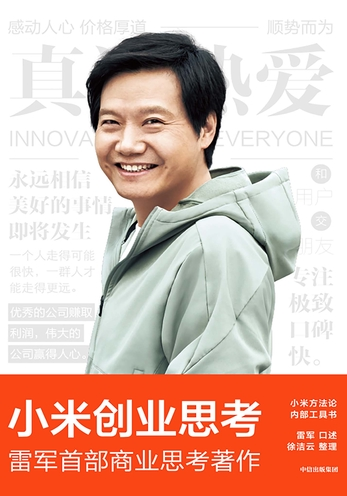
"Xiaomi Entrepreneurial Thinking" (小米创业思考), as told by Lei Jun (雷军, founder of Xiaomi) and compiled by Xu Jieyun (徐洁云), 2022. A systematic account of "focus, extremity, word of mouth, speed" (专注・极致・口碑・快), the high-efficiency model, the single-product blockbuster strategy, and the ecosystem strategy. (For Xiaomi's scale, see the entry on "Sense of Participation" above. This book is the founder's own retrospective on the company's first ten years.)
"Shi Yuzhu in His Own Words: My Marketing Insights" (史玉柱自述:我的营销心得), as told by Shi Yuzhu (史玉柱, founder of Giant Group) and edited by Youmi.com (优米网), 2013. A comeback from a colossal business failure and crushing debt, and practical lessons on consumer psychology, advertising and sales channels. In the 1990s Giant Group fell from the summit of China's private sector to the brink of collapse, then went on to lead single-product sales in China's health supplement market for years with "Naobaijin" (脑白金); its online gaming arm, Giant Interactive, listed on the New York Stock Exchange in 2007 (at the time one of the largest US IPOs ever by a Chinese private company). The company is a byword for "failure and comeback."
"Barbaric Growth" (野蛮生长), Feng Lun (冯仑, co-founder of Vantone), 2007. How private enterprises survived the reform-and-opening era, when institutions were still unformed, and how they evolved into modern corporations. Vantone, a real estate developer founded in 1991, never matched the giants in scale, but it is the archetype of the "Class of '92" (92派) — companies founded around 1992 by officials and researchers who left government to go into business. Its six founders, the "Six Gentlemen of Vantone" (万通六君子), went on to produce many of the executives who would shape China's real estate industry, including SOHO China's Pan Shiyi (潘石屹), making Vantone indispensable to any history of Chinese private enterprise.
"The Way Is As It Should Be: Vanke and Me (2000–2013)" (大道当然:我与万科(2000–2013)), Wang Shi (王石, founder of Vanke), 2014. Handing authority to professional managers, corporate ethics, and separating the founder from the company. Vanke, founded in 1984, is China's largest developer: in 2010 it became the first in the industry to top RMB 100 billion in sales, and at its peak sales exceeded RMB 700 billion, earning it the title of "the world's largest residential developer." A regular on the Fortune Global 500, it is the leader of China's housing industry.
"Zhou Hongyi in His Own Words: My Internet Methodology" (周鸿祎自述:我的互联网方法论), Zhou Hongyi (周鸿祎, founder of 3721 and Qihoo 360), 2014. Disrupting markets with a free model, "micro-innovation" (微创新) — rapidly stacking up small improvements — and user-first thinking. Qihoo 360 is China's largest security company, having captured the majority of Chinese PC users (over 500 million by its own count) with free security software. It listed on the New York Stock Exchange in 2011, was taken private in 2018 and returned to the A-share market in Shanghai — the embodiment of the freemium model in China.
"Liu Qiangdong in His Own Words: My Business Model" (刘强东自述:我的经营模式), Liu Qiangdong (刘强东, founder of JD.com), 2016. Massive investment in in-house logistics, an uncompromising stance on genuine products, and low-cost, high-efficiency management. JD.com is one of the two giants of Chinese e-commerce alongside Alibaba. Its 2024 revenue of about RMB 1.16 trillion (around ¥24 trillion) is among the largest of any Chinese private company, it is a fixture near the top of the Fortune Global 500, and it runs its own logistics network that directly employs hundreds of thousands of delivery workers — hence the nickname "China's Amazon."
"The Intelligent Revolution" (智能革命), Robin Li (李彦宏, founder of Baidu) et al. (co-authored with Qi Lu (陆奇) and others), 2017. Frames AI as the fourth industrial revolution and discusses how large companies should make the transition to AI. Baidu holds 60–70% of China's search market and was one of the "BAT" trio (Baidu, Alibaba, Tencent) that ruled the Chinese internet. Now pivoting from search to AI, it is a standard-bearer of China's AI industry with its Apollo autonomous driving platform and the ERNIE Bot (文心一言) large language model.
Before founding the startup
Finance
If you don't have "more money than you can spend," it isn't time to found a company: Lei Jun (Xiaomi) looks back on his years at Kingsoft (a long-established Chinese software company known for WPS Office, where Lei served as CEO before founding Xiaomi): rampant piracy made it hard to earn money, forcing a hand-to-mouth cycle of "funding the next product with WPS profits," and he was never able to commit to going deep on a single business. At Xiaomi he defined the three conditions for a successful founding as "a huge market, the very best team, and more money than you can spend," and secured ample capital from the outset. (黎万强/Xiaomi, 2014)(雷军/Xiaomi, 2022)
Even with no money, you can raise credit: Shi Yuzhu (Giant Group) started with just RMB 4,000 in hand. He went straight to a newspaper and negotiated to "run the ad now, pay in a month," and borrowed a PC on deferred payment as well. He covered the bills out of his first day's sales and cleared more than RMB 1 million in profit within two months. A shortage of seed capital can be made up for by how you design your credit. (史玉柱/Giant Group, 2013)
Founding on borrowed money breeds "pressure to earn outsized profits": Feng Lun (Vantone) argues that because China's private enterprises had no choice but to start with loans from moneylenders charging upwards of 20–25% a year, they were saddled with an "original sin": a gambler's constitution of high leverage and high risk. The kind of capital you start with shapes the character of the company that follows. (冯仑/Vantone, 2007)
Be suspicious of "great deals" where price diverges sharply from value: The lesson from his father that Cao Dewang (Fuyao Glass) lived by all his life was: "Don't be greedy for things that are too cheap. When a price falls far below value, there is always a problem." (When the factory site was being prepared, a contractor instantly agreed to haul earth for RMB 0.8 per cubic meter against a market rate of RMB 3. Recalling those words, Cao grew suspicious and made the township head who had introduced the contractor guarantee the work with his own shareholding as collateral. Sure enough, the contractor's actual cost was RMB 2.6 — the scheme was to win the contract at a giveaway price and then rewrite it later through gifts and connections.) (曹德旺/Fuyao Glass, 2015)
Organization
Put the failures of your previous job or apprenticeship into words before you found a company: Lei Jun (Xiaomi) spent three years building an ambitious software suite, "Pangu" (盤古), only for it to flop — he ended up standing behind store counters himself. The lesson he drew, "our R&D was first-rate, but we didn't understand the product or the users," became the origin of Xiaomi's methodology. And from the collapse of Sanse (三色公司), the "do-anything company" he ran as a student — it took on everything from PC assembly, contract development and parts reselling to printing, ran into a dead end, and disbanded after a stretch so lean that the founders played cards with the cafeteria chef to win meal tickets — he learned that "a founding without focus is bound to fail." (雷军/Xiaomi, 2022)
Bad examples are first-rate teaching material too: Four of Vantone's six founding members, Feng Lun (Vantone) among them, came out of Nande Group (南德集团), the company of the legendary — and later bankrupt — entrepreneur Mou Qizhong (牟其中). From that boss's utter lack of scruples they took the cautionary lesson that "an entrepreneur needs the power of morality." At the same time, they absorbed intact his insight into the nature of credit: "Commercial credit is not about how much you actually have, but how much people think you have." (冯仑/Vantone, 2007)
Being yelled at by customers shapes your view of products: As a graduate student, Zhou Hongyi (Qihoo 360) scrambled to deal with defects in an antivirus card he had developed, and learned in his bones that "an engineer's pride means nothing to customers; all customers want is their problem solved." Having been "hammered directly by users" before founding a company laid the groundwork for the user-first philosophy he would later champion. (周鸿祎/Qihoo 360, 2014)
Service
Nobody beats a trend — move with the tide: "A company can fight any rival, however strong; the one opponent it can never beat is the trend." (周鸿祎/Qihoo 360, 2014) Lei Jun (Xiaomi) arrived at the same philosophy — 顺势而为, moving with the prevailing current — through a bitter experience in 1998, when he failed to acquire NetEase (网易) for RMB 10 million and then watched its valuation multiply dozens of times over within two months. His formulation: "spot the 风口 — the eye of the typhoon — and, like a pig, keep low and get ready." The choice of which market to enter decides the outcome before effort even comes into play. (雷军/Xiaomi, 2022)
It all starts with 换位思考 — putting yourself in the other person's shoes: Working as a cook at a dam construction site, Cao Dewang (Fuyao Glass) observed the workers' three biggest complaints and eliminated them; he recalls that "the only thing I did more than the other cooks was to think from their position." The customer's perspective can be trained long before you ever start a business. (曹德旺/Fuyao Glass, 2015)
Sweeping institutional change is itself the opportunity: Shi Yuzhu (Giant Group) quit his post at a statistics bureau to start a business after being inspired by a lecture titled "The 'clay bowl' of the private sector is safer than the 'iron bowl' of government"—a talk given at Shenzhen University by Wan Runnan, president of Stone Group. The argument ran: an iron bowl never breaks, but it means entrusting your livelihood to an organization; a clay bowl may break, but you can remake it with your own hands. In other words, locate the source of your security not in an organization but in abilities that hold value in the market. At an institutional turning point, the very definition of career security is inverted. (Shi Yuzhu/Giant Group, 2013)
Seed stage (from founding to PMF)
Finance
Revenue models can wait until last—but validating user value comes first: Zhou Hongyi (Qihoo 360) argues that "nothing a founder says is more pointless than talking about the revenue model first. Even Google couldn't monetize until it stumbled upon search advertising." He reframes the business model as a combination of four models: product, user, distribution, and revenue. What you must build up first is user value. (Zhou Hongyi/Qihoo 360, 2014)
Impose zero marketing spend on yourself as a constraint: When launching MIUI, Lei Jun (Xiaomi) set Li Wanqiang (Xiaomi) a challenge: "Can you acquire one million users without spending a single cent?" Being unable to spend money forced the team to focus on one thing: becoming a product that gets recommended on the strength of the product and service alone—that is, word of mouth. MIUI recruited its first 100 users one by one from other companies' forums and reached 500,000 users a year later with zero ad spend. (Li Wanqiang/Xiaomi, 2014)
Pricing is a declaration of your business model: When the cost of the Mi 1 ballooned from a projected 1,500 yuan to 2,000 yuan, Lei Jun (Xiaomi) agonized over it for three nights. Judging that selling at a loss (cross-subsidization) was not repeatable, he chose "cost-based pricing" at 1,999 yuan. This was the origin of the Xiaomi model: sell hardware at cost, earn on services. (Lei Jun/Xiaomi, 2022) Liu Qiangdong (JD.com) likewise designed thin margins themselves as a barrier to entry: "If others sell for one yuan, we sell for 90 fen. If margins are too high, entrants will flood in." (Liu Qiangdong/JD.com, 2016)
Mistakes in equity and control design blow up at the very beginning: Shi Yuzhu (Giant Group) fell out with his two co-founders over how to use the company's first one million yuan in profit, and states flatly that "a company where five people each hold one-fifth will end up in conflict nine times out of ten." Feng Lun (Vantone) and the other five Vantone founders split their equity six ways; while this initially succeeded in producing "zero infighting over money," their unanimous-consent decision-making later broke down (see the early-stage section). Where control lies must be made clear from the outset. (Shi Yuzhu/Giant Group, 2013)(Feng Lun/Vantone, 2007)
Talk about capital investment in terms of payback speed: Cao Dewang (Fuyao Glass) negotiated Finnish equipment down from $1.9 million to $1.08 million before buying it, then recouped the full amount within six months of operation. "What I gained wasn't money—it was confidence and the trust of the banks," he says. An early track record of recovering your investment becomes the credit for your next round of financing. (Cao Dewang/Fuyao Glass, 2015)
Organization
Hiring is the founder's most important job—pour an unreasonable amount of time into it: Lei Jun (Xiaomi) spent most of the company's first year on recruitment, meeting one engineer ten times over two months (17 times counting the whole core team), with some interviews running to ten hours. Dr. Zhou Guangping, who became head of hardware, decided to join within 15 minutes on the strength of a single line: "a revolution that sells the best phone at cost." "One outstanding engineer is worth not ten people, but a hundred." (Li Wanqiang/Xiaomi, 2014)(Lei Jun/Xiaomi, 2022)
Hiring mistakes show up as product defects: Cao Dewang's (Fuyao Glass) first factory produced nothing but rejects for three years, yet once he brought in a specialist technician from Shanghai, a single night of equipment modification yielded acceptable product. Many problems that look like technical barriers are actually talent problems. (Cao Dewang/Fuyao Glass, 2015)
Refuse nepotistic hiring from the outset, with everything you have: In his hiring examinations, Cao Dewang (Fuyao Glass) held to the rule that "anyone with a letter of introduction is rejected regardless of score," rebuffing even pressure from a deputy county governor. "This fight will have to be fought sooner or later. Fight it now and cut off the root of the trouble." (Cao Dewang/Fuyao Glass, 2015)
Service
Focus on the narrowest possible entry point to validate PMF: MIUI shipped its first version in two months with just four functions—phone, SMS, contacts, and home screen—and grew on word of mouth alone, from 100 to 200 to 400 users per week. Zhou Hongyi's (Qihoo 360) 360 Safeguard likewise won its first 50 million users with simple functionality by hitting the single most pressing pain point of the day: removing malicious software. "The only reason users reject a product is that it doesn't resonate with them." (Lei Jun/Xiaomi, 2022)(Zhou Hongyi/Qihoo 360, 2014)
Put users on the development team (the user model > any engineering model): Through "Orange Friday" (橙色星期五), a new release every Friday, and the "four-panel experience report" (四格体験報告) users submit the following Tuesday, Xiaomi built a "100,000-person development team": 100 in-house engineers, 1,000 certified testers, and 100,000 developer-build users. It contrasts this with Microsoft's meticulous development structure of one planner and one tester for every three engineers—"a model in which the number of users is zero." (Li Wanqiang/Xiaomi, 2014)
A track record of trust catalyzes PMF: From his days running a counter in Zhongguancun, Liu Qiangdong (JD.com) never sold a single counterfeit and issued an official invoice (fapiao) with every item. When SARS pushed the business online in 2003, a forum moderator vouched for JD as "the only company that hasn't sold a fake in three years"—and customers who had never met him wired money up front. (Liu Qiangdong/JD.com, 2016)
Even free, a bad product goes unused: Zhou Hongyi's (Qihoo 360) first free antivirus failed for being "heavy, prone to freezing, and sluggish"; it took a year of rebuilding before it succeeded. "It's not as if something sells just because it's free." (Zhou Hongyi/Qihoo 360, 2014)
The founder personally polishes the details obsessively: Shi Yuzhu (Giant Group) spent 16 days rewriting his first piece of advertising copy—only about a third of a manuscript page. "Only when you've revised it until it moves you yourself can you put it out into the world." (Shi Yuzhu/Giant Group, 2013)
Run a "live-fire test" internally before going live: Before opening its e-commerce store, Xiaomi ran an employee-only "Big Sale Department" selling cola at 10% of list price, putting ordering, billing, and delivery through real operation to stamp out system problems in advance. (Li Wanqiang/Xiaomi, 2014)
Early stage (initial growth)
Finance
Even with money raised, don't retreat into advertising: At the smartphone launch, Li Wanqiang (Xiaomi) drew up a 30 million yuan advertising plan; Lei Jun (Xiaomi) rejected it: "MIUI didn't spend a cent. Can't we do the same with the phone?" With its escape route cut off, the team threw itself desperately into forums and Weibo, and its zero-ad-spend participatory campaign "I'm a Phone Addict" (我是手机控) drew one million participants. (Li Wanqiang/Xiaomi, 2014)
Investments pushed through without internal consensus lose twice over: Vantone forced through its acquisition of Dongbei Hualian while opinion inside the company remained divided, losing 40 million of the 70 million yuan it invested. More fatal than the loss itself was that it triggered "a mutual loss of authority among the co-founders." (Feng Lun/Vantone, 2007)
Rather than haggling over financing terms, hold the one line you can't cross—control: In fundraising, Liu Qiangdong (JD.com) stuck to "one offer, no haggling," and each time spread the investment across multiple firms to secure control. "I'd sooner sell the company and walk away than lose control." (Liu Qiangdong/JD.com, 2016)
Be willing to cut losses to uphold quality standards: Xiaomi scrapped the development units of the first-generation Redmi when they fell short of its quality bar, writing off roughly 40 million yuan already invested. And when a new Qualcomm chip came out right after it had bought 150,000 units of the previous latest model (over $6 million), it abandoned the inventory and switched immediately. Losses taken to protect quality standards are an investment in the brand. (Li Wanqiang/Xiaomi, 2014)(Lei Jun/Xiaomi, 2022)
Organization
Unanimous-consent, single-veto decision-making inevitably breaks down: Vantone's six-person unanimity rule produced investment meetings that dragged on in dispute all day, with "no one able to persuade anyone else," and once the founders were spread across different locations and information gaps opened up, factions formed. This is a regression into a jianghu-style (brotherhood) organization where "equity comes second and control comes first." Governance must be designed before growth. (Feng Lun/Vantone, 2007)
Don't buy executive talent from outside—grow it inside: Liu Qiangdong (JD.com) looks back on the management trainee program (管培生) he launched right after his first round of financing as "a more important move than building our own logistics." Five vice presidents selected a few dozen candidates from tens of thousands, which led to the principle that 80% of executives are promoted from within. Shi Yuzhu (Giant Group) follows the same approach: "I don't use executives headhunted from outside; I give ample authority to managers I've raised in-house for more than a decade." (Liu Qiangdong/JD.com, 2016)(Shi Yuzhu/Giant Group, 2013)
Users' voices rally the team: Late one night, when floods in Thailand had delayed component supplies and the forum was flooded with abuse, an early user sent in a video compiling "Go Xiaomi!" (小米加油!) messages from Mi Fans across the country—and Li Wanqiang (Xiaomi) says he wept. Xiaomi deliberately built structures (the Popcorn Award, engineers stationed on the forum) so that users' praise and criticism reached engineers directly, making users' voices rather than KPIs the driving force of the work. (Li Wanqiang/Xiaomi, 2014)
Service
The single-product blockbuster strategy (爆品): Narrow the product line and land one hit at a time, reliably: in its first three years Xiaomi released only five models, every one of them a smash hit (Mi 1: 7.9 million units; Redmi: 44.6 million units; and so on). Hit products absorb fixed costs and form the backbone of a high-efficiency model that drives distribution and advertising costs toward zero. "At the product planning stage, have the nerve to build only the one product that can be number one in its category." (Lei Jun/Xiaomi, 2022)(Li Wanqiang/Xiaomi, 2014)
Category expansion requires two conditions: demand at the front end, capability at the back end: JD.com carried only five categories in its first seven years, and when it entered books it brought the vice president in charge on board in strict secrecy and spent a year building out the supply chain before going public with it. Even where demand exists, it does not expand until supply capability is in place. (Liu Qiangdong/JD.com, 2016)
Answer user-experience bottlenecks with infrastructure investment, even when it is heavy: "Logistics accounts for 70% of the user experience." JD.com committed to building its own logistics network from its very first round of funding, and in 2009 launched "211限时达" (orders placed by 11 a.m. delivered the same day). Eighty percent of the cost goes to the "last-mile" couriers—the reverse of the industry's usual cost structure. (刘强东/JD.com, 2016)
Small steps, fast iterations (小步快跑) and the "0.8 rule": "Don't buy servers for 100 million users up front. Let 100 people try it first." If each feature is finished to a level of 0.8, a product that stacks three of them delivers an experience of 0.8 × 0.8 × 0.8 = 0.51. The more features you pile on, the faster you fail. (周鸿祎/Qihoo 360, 2014)
Don't rush the test market, don't lag on the national rollout: 史玉柱 (Giant Group) always ran three to six months of test sales in three affluent regional cities and let the data decide before going national. "试销市场快不得,全国市场慢不得 (the test market must not be rushed; the national market must not be delayed)." Advertising was approved by a vote of 50–60 executives requiring a two-thirds majority; he himself held only a veto. (史玉柱/Giant Group, 2013)
Design the act of selling itself as a product: Xiaomi's weekly sales event, "紅色星期二 (Red Tuesday)," was designed as a single product—from reservation, to a time-limited scramble to buy, to users posting their purchases on social media—and continuously refined. A plain sales transaction became a social event that millions of people joined every week. (黎万强/Xiaomi, 2014)
Build the factory next door to the customer: "Packaging and shipping are about 20% of cost. Build your plant next to the automaker," said 曹德旺 (Fuyao Glass)—and in Changchun he did exactly that, at a pace of four days for the site visit, six to secure the land, and ten to break ground. In B2B, customer experience is built from location and lead time. (曹德旺/Fuyao Glass, 2015)
Middle and Later Stages (Rapid Expansion)
Finance
Funding long-term investments with short-term debt is the road to ruin (短債長投): Vantone used short-term money borrowed at roughly 20% annual interest to string together a chain of investments in trust companies, securities firms and banks, building a structure in which "unless we earn a 60% gross margin, we are guaranteed to lose money"—and was pushed to the brink of collapse. From 1996 it sold off asset after asset, shrinking until "there was nothing left to sell and nowhere left to retreat," and lived to tell the tale. (冯仑/Vantone, 2007)
Whether you can bring yourself to "admit defeat" is the difference between life and death: "The only secret to resolving a crisis is sacrifice." Vantone, which admitted defeat at 7 billion in assets and shrank to 1.6 billion, survived; Delong, which kept betting all the way to 60 billion, collapsed. The decision to retreat is the single most important skill of the rapid-expansion phase. (冯仑/Vantone, 2007)
Unprofitable diversification and real estate choke off cash flow: Right after its profits ballooned to 300 million yuan in two years, 史玉柱's Giant Group expanded all at once into 12 health supplements, a dozen or so pharmaceuticals, apparel and cosmetics, while the design of its headquarters tower, the "巨人大厦 (Giant Building)," swelled from 18 to 38 to 64 floors. With an 80% debt ratio and a chain of receivables and payables (so-called "triangular debt"), its cash flow came to a complete halt. After rebuilding from a personal net worth of minus 250 million yuan, he made "miss a hundred opportunities, but never make a single mistake" his investment discipline. (史玉柱/Giant Group, 2013)
Hit the brakes deliberately at the peak of the boom: At the end of 2006, 曹德旺 (Fuyao Glass) issued four directives—halt all expansion investment, compress receivables, close low-efficiency plants, and drill the entire company on cutting costs by 30%—and came through the 2008 financial crisis unscathed (a single falling leaf tells of autumn across the land). Likewise, just before publicly acknowledging in December 2007 that "the housing market has reached a turning point," 王石 (Vanke) put Guangzhou properties on sale at 3,000–4,000 yuan/㎡ below the surrounding market, ultimately cut 2008 construction-start plans by 38%, and declared that "Vanke will not take top-bid land (地王)." He was cursed as "a traitor to the industry," but with a 44.1% debt ratio and rising market share in 2008, Vanke stayed ahead of the market. The guiding principle: "In uncertain conditions, do what is certain." (曹德旺/Fuyao Glass, 2015)(王石/Vanke, 2014)
Give up near-term revenue to capture user assets: By switching entirely to free antivirus, 周鸿祎 (Qihoo 360) gave up roughly 200 million yuan a year in existing revenue, and won over a fiercely opposed board with the argument: "Hold the ground (revenue) and lose the people (users), and you lose both. Lose the ground but keep the people, and you gain both." The result: the No. 1 market share in three months, 100 million users in six, and a market that itself grew a hundredfold. (周鸿祎/Qihoo 360, 2014)
Impose discipline even on losses: JD.com ran losses for years from 2007 onward, but never crossed one line: "Every single item we sell must earn a gross margin. We do not engage in price wars that go below purchase cost." It also practiced "raise money when you don't need it," taking on additional funding while holding about 20 billion yuan in its accounts. The reason: "so that our suppliers can sleep soundly." (刘强东/JD.com, 2016)
Organization
Rapid growth hides a lack of capability: 雷军 (Xiaomi) summed up the internal causes of Xiaomi's 2015–16 slump as "complacency" and insufficient organizational capability (fewer than 300 hardware R&D staff versus 10,000–20,000 at competitors). In 2016 he took personal command of the smartphone division, became chairman of the quality committee, and turned things around with a "one-vote quality veto." This was a return to growth at a time when no smartphone maker anywhere in the world had ever recovered after its sales fell. (雷军/Xiaomi, 2022)
The thicker the rulebook, the less it gets enforced: 史玉柱 (Giant Group) says that "the foot-thick (30 cm) set of rules written by MBAs became a dead letter, while the two pages of rules drafted at rock bottom worked best." 冯仑 (Vantone), seeing data showing that an expense system in which insiders approved one another's claims had a 40% enforcement rate while an investment system decided by a board of outsiders had 100%, introduced a "strangers principle" (生人原则) of not hiring one's own people and kept the share of personal connections inside the company below 10%. "Eliminating the last person who swears loyalty to the owner personally is the proof that a private company has progressed." (史玉柱/Giant Group, 2013)(冯仑/Vantone, 2007)
Part with co-founders "the merchant's way": The split among Vantone's six founders was settled by the principle "以江湖方式进入,以商人方式退出 (enter the way of the jianghu brotherhood, exit the way of merchants)." Those leaving took cash; those staying assumed all the debt; and the process was completed with a single lawyer and an exchange of checks. The assumed debt was paid off in full over ten years. Whether an organization of feelings can be converted into an organization of contracts determines how long a company lives. (冯仑/Vantone, 2007)
Founders prove by experiment that the company runs without them: In 1999, 王石 (Vanke) stepped down as general manager, entrusted management to a team of professional managers led by 郁亮 (Vanke), and framed his long absences—climbing Everest, studying at Harvard—as deliberate "management experiments." 刘强东 (JD.com) likewise went abroad to study for six months in 2013, kept to "no more than five phone calls a week," and called the management team's ability to complete a major reform on its own "proof that we were qualified to go public." (王石/Vanke, 2014)(刘强东/JD.com, 2016)
Investment in frontline employees sets the ceiling on experience: Xiaomi gave its 1,800 frontline customer-support staff the authority to send gifts to customers without a manager's approval, set their pay 20–30% above the industry standard, and granted them stock after six months of service ("people matter more than systems"). JD.com hired every courier directly, providing not only social insurance but private insurance as well, and laid out a career path in which three years of service qualified them to run a delivery station in their hometown. (黎万强/Xiaomi, 2014)(刘强东/JD.com, 2016)
A founder's gaffe becomes a corporate crisis: During the Wenchuan earthquake, 王石 (Vanke) drew a storm of criticism—the so-called "捐款門 (donation scandal)"—for a blog post saying that "employee donations should be capped at 10 yuan." He apologized unconditionally on television, had the shareholders' meeting approve an additional 100 million yuan in reconstruction support with 99.8% in favor, and even set out three conditions under which he would resign—Vanke's stock falling alone against the overall market, weak sales, and employees leaving—to win back trust. An entrepreneur's words are no longer their own. (王石/Vanke, 2014)
Systems outweigh the loss of talent: In 2000, when Vanke's rotation system (a scheme for swapping people out in turn at set intervals) called for the general managers of Beijing and Shanghai to switch posts, both resisted and both ended up resigning. 王石 (Vanke) nonetheless held firm: "We may lose general managers, but we cannot let a system we have built become a dead letter." By year-end, Beijing sales had nearly doubled. (王石/Vanke, 2014)
Service
Enforce channel discipline with public examples and cash: 史玉柱 (Giant Group) had a yellow banner reading "Top 10 Masters of Cross-Territory Selling" hung behind the desks of distributor heads who had undercut prices outside their territories, and insisted on cash settlement for every payment, keeping bad debts at zero. Advertising was concentrated in short bursts during the peak-demand seasons of Spring Festival and Mid-Autumn, and the slogan went unchanged for ten years. "Advertising is an investment in the consumer's brain; changing it constantly is abandoning the investment." (史玉柱/Giant Group, 2013)
Verify before you replicate a rapid channel expansion: Xiaomi's new retail strategy, buoyed by the success of a single store (12 million yuan in monthly sales), rolled out the insufficiently tested "Anyang model" nationwide, producing a chaotic sprawl of 14 different sales channels. Xiaomi then brought home a method proven in India—dividing the country into regions and granting one company exclusive distribution rights in each—consolidated its channels into three lines (directly operated stores, authorized retailers and telecom carriers), and reached 10,000 stores in 2021. It was in this period that the return-on-investment formula "(gross margin rate − expense ratio) × annual inventory turns" shattered the assumption that "per-unit gross margin is everything." (雷军/Xiaomi, 2022)
Users rally behind features that cut off rivals' "bread and butter": 360 won support with features that broke the industry's revenue conventions: search that refused medical advertising, a tool for removing pre-installed apps, and more. "Being cursed is the price I have to pay." (周鸿祎/Qihoo 360, 2014)
Use price disruption to rebuild the market order itself: In an architectural-glass market rife with below-cost selling, 曹德旺 (Fuyao Glass) brought the state-owned plants to the negotiating table with his "800 yuan per ton declaration," averting a race to mutual ruin. Price leadership can be used not only for one's own profit, but to make a market sustainable. (曹德旺/Fuyao Glass, 2015)
Standardize quality through industrialization: Vanke adopted the slogan "build homes the way cars are built." In 2003 it chose the major US homebuilder Pulte as its benchmark and transplanted its customer-service model, then advanced housing industrialization step by step: an experimental building in 2005, a building research center at Songshan Lake in Dongguan in 2006, and the first use of precast concrete (PC) construction in Shanghai in 2007 (a 30% componentization rate). In 2008, mass protests by existing buyers angered by price cuts drove customer satisfaction down to 46%, but Vanke later brought it back up to 83% among the same customer base. Scale becomes compatible with quality only when industrialization overcomes the limits of craftsmanship. (王石/Vanke, 2014)
Put a cap on sales targets too: The year after topping 100 billion yuan in sales in 2010, Vanke deliberately set a ceiling of "no more than 140 billion yuan," declaring a shift from quantity to quality (actual result: 120 billion yuan). Underpinning this was its transformation into a "technology company": more than 40% of its 6,000-plus employees were engineers. (王石/Vanke, 2014)
Post-IPO and Maturity Stage
Finance
Impose a ceiling on your own profit margin and institutionalize it: Just before Xiaomi's 2018 IPO, 雷军 (Xiaomi) had the board pass a resolution permanently capping the overall net profit margin on hardware at 5%. His argument to the investors who objected: "Excellent companies earn profits; great companies win people's hearts." The rule 王石 (Vanke) is said to have set in the 1990s—"never take more than 25% profit" (cited by 冯仑/Vantone, 2007 as an example of managing desire)—is the same kind of self-discipline, carried through in the "大道当然" (following the great way as a matter of course) era as "profits in the sunlight" and "no bidding for overpriced land." The underlying philosophy: renouncing windfall profits builds long-term trust and resilience against market swings. (雷军/Xiaomi, 2022)(王石/Vanke, 2014)
Make the entry point to the core business free or low-margin, and separate the revenue layer: Qihoo 360's free antivirus loses money on its own, but the search, navigation, and games riding on its browser platform earn billions of yuan a year. Xiaomi's "tip model" has the same structure: hardware is sold at cost to acquire customers, and money is made on services, like receiving a tip for good service (internet-services revenue was 28.2 billion yuan in 2021). The model is Costco, which voluntarily caps gross margins on merchandise at roughly 14% or less and earns its profit not from the goods but from annual membership fees—the price of members' trust. (周鸿祎/Qihoo 360, 2014)(雷军/Xiaomi, 2022)(黎万强/Xiaomi, 2014)
After a comeback, debt discipline can be extreme: 史玉柱 (Giant Group) set his own rules—a debt ratio of up to 5% is a green light, 10% yellow, 15% red—and thereafter ran the company with virtually zero debt. "What the well-known private entrepreneurs who ended up in prison had in common was high debt." Surplus cash is parked in bank shares, which are "easy to liquidate and take no effort to manage," keeping a strict line between the business and investments. (史玉柱/Giant Group, 2013)
Make long-term investments in the next technology paradigm "without counting the total": In 2013, at the height of the mobile-internet investment boom, Baidu deliberately made a large-scale bet on AI; when asked about the research budget, 李彦宏 (Baidu) replied, "We spend whatever is needed, so I don't know the total." He advises managing investments across three time horizons: within 18 months, 18–36 months, and beyond 36 months. Xiaomi likewise invested in more than 100 semiconductor and advanced-manufacturing companies through its 12 billion yuan Yangtze industrial fund and announced a plan to spend 100 billion yuan on R&D over five years. (李彦宏/Baidu, 2017)(雷军/Xiaomi, 2022)
Design the exit for wealth (philanthropy) as a scheme too: In 2011, 曹德旺 (Fuyao Glass) established the Heren Charity Foundation with 300 million Fuyao shares (then worth 3.549 billion yuan), creating China's first structure in which a foundation endowed with donated shares keeps generating its own investment returns. "Apart from living expenses, every dividend goes back to society." What a founder does with their wealth is itself a management issue of the maturity stage. (曹德旺/Fuyao Glass, 2015)
Organization
Separate the founder from the company: 王石's (Vanke) conclusion is that "a founder's final job is to build a company that runs without them." He confined the chairman's role to three things—strategy, personnel, and taking responsibility—and defined the division of labor with 郁亮's (Vanke) management team as "I concern myself with the uncertain; he concerns himself with the certain." His long absences—summiting Everest in 2003 (at 52) and 2010 (at 60), and studying at Harvard from 2011—were deliberate experiments to prove that delegation worked. 曹德旺 (Fuyao Glass) likewise groomed his eldest son 曹晖 from the ground up at the US subsidiary and had him take the stage as president at the Hong Kong listing. (王石/Vanke, 2014)(曹德旺/Fuyao Glass, 2015)
Prevent big-company disease through "systems": The eight personnel rules laid down by 刘强东 (JD.com)—the "ABC principle" (decisions about a subordinate are made jointly by their direct manager and that manager's own manager, never unilaterally by a single boss), "8150" (a manager must have at least eight direct reports; a post with fewer is abolished to cut a layer of hierarchy, while in routine frontline operations such as warehousing and delivery a single manager can oversee up to 150 people), the "backup principle" (a manager who fails to develop a successor within two years of taking a post is dismissed on the spot, and no one can be promoted without a successor in place), the "24-hour response principle" (every inquiry or approval request from a subordinate must be answered within 24 hours), and others—are an attempt to hold back the bureaucratization that scale brings by means of institutional design. They also include the hard decision to let veterans who no longer have a place cash out their shares early and leave. (刘强东/JD.com, 2016)
Big companies fail from arrogance, not stupidity: Citing Nokia, which proclaimed a grand platform vision while neglecting the fine details of usability, 周鸿祎 (Qihoo 360) argues for flatter organizations, "small but excellent" teams, and a culture that makes frontline employees such as customer-support staff the drivers of innovation. The habit of the CEO personally remaining a novice user—at the airport, in the store—is part of this. (周鸿祎/Qihoo 360, 2014)
A second founding requires an outside change leader and "unlearning": 陆奇 (Baidu), who led Baidu's pivot to AI, observes that "in transforming a mature company, unlearning the old methods is harder than learning the new ones," and names the CEO's personal commitment and delegation of authority as the first condition. 李彦宏 (Baidu) personally took the post of head of the Institute of Deep Learning—"not because I know the most about it, but as a signal of how seriously we take it"—creating a magnet for talent such as 呉恩達 (Andrew Ng) and 陆奇. His call for every company to appoint a "Chief AI Officer (CAO)" draws an analogy with the "electricity executives" that companies appointed in the age of electrification. (李彦宏/Baidu, 2017)
Re-inject a startup structure into stagnant R&D: When his R&D team's founding passion faded after the IPO, 史玉柱 (Giant Group) spun projects off into independent companies and had the developers put up their own money for 49% stakes, eliminating the "big-pot" mentality (the egalitarianism that rewards everyone the same regardless of contribution). Inside a mature company, you deliberately rebuild small startups. (史玉柱/Giant Group, 2013)
Institutionalize organizational reflection: 冯仑 (Vantone) designated September 13 each year as a company-wide "day of reflection," and in his industry association built a system that rotates the top post through elections every two years. Being "an organization capable of replacing its leader" is itself proof of the evolution from the jianghu—the world of personal bonds and brotherhood—into a modern enterprise. (冯仑/Vantone, 2007)
Service
A mature company's weapon is "proving it in practice": Baidu chose to demonstrate its AI capabilities not through spectacles like Go matches but through practical use, achieving 97% speech recognition and 99.7% facial recognition, and opening its autonomous-driving technology to outsiders only after building it out to HD maps with 10 cm precision and a 0.2-second emergency-braking response (versus 1.2 seconds for a human). Baidu's second founding consists of connecting the "data → knowledge → user experience → new data" flywheel it had been running in its existing search business to AI. (李彦宏/Baidu, 2017)
Do mass advertising with internet thinking too: Only after accumulating tens of millions of online users did Xiaomi run its first TV commercial—a one-minute slot just before the Spring Festival Gala, China's most-watched broadcast, costing 60 million yuan—and even then it showed no product at all, dedicating the spot to its fans, and had it viewed four million times online before it aired. "If you do it, go all the way." Advertising is used not to chase awareness but as an amplifier for the word of mouth already built up. (黎万强/Xiaomi, 2014)
Crisis response is the art of "not getting angry": If 70% of the voices are favorable, leave the 30% of bad press alone. Hit back immediately against organized attacks; answer misunderstandings with tours of factories and logistics centers. When sales figures are doubted, publish the payment screens the same day. Mature-stage PR runs on set response patterns, not on emotion. (黎万强/Xiaomi, 2014)
Discover the monetization model by living among your users: While developing the online game "征途" (Zhengtu), 史玉柱 (Giant Group) lived inside the game 15 hours a day for two years and discovered that "paying players shine only because free players exist." Pricing is the design of consumer psychology—for example, breaking a 1,000-yuan gem into "10 yuan × a 1% success rate" to erase psychological resistance. (史玉柱/Giant Group, 2013)
Environment and ethics come before profit: When 曹德旺 (Fuyao Glass) learned that a company-owned mine was leaving fluoride residues, he shut it down himself—a mine in which he had invested more than 80 million yuan. "What is profit worth if you lose the environment? Is there anything more valuable than peace of mind?" (曹德旺/Fuyao Glass, 2015)
Silicon Valley Entrepreneurs and Chinese Entrepreneurs: Similarities and Differences
Finally, we compare the perspectives of the Silicon Valley entrepreneurs we have surveyed previously (Eric Ries, Peter Thiel, Ben Horowitz, Steve Blank, Paul Graham, Reed Hastings, Eric Schmidt, and others) with those of the Chinese entrepreneurs covered in this article.
Similarities
Focus and dominating a small market: Thiel's "monopolize a small market," 雷军's (Xiaomi) "hit-product strategy (make just one thing and become number one in its category)," and 史玉柱's (Giant Group) "focus, focus, and focus again (聚焦)" all arrive at the same conclusion. The cases of death by diversification (Giant Group, Vantone) are Chinese real-world examples of the point made ever since Good to Great: undisciplined expansion leads to decline.
A fast learning loop with users: MIUI's "Orange Friday" (weekly releases plus user feedback reports) implemented Ries's Build-Measure-Learn and Blank's customer development almost entirely independently. 周鸿祎's (Qihoo 360) approach of "iterate small and fast" and 史玉柱's (Giant Group) test-market doctrine share the lean-startup logic of validating hypotheses before scaling.
Relentless investment in hiring and talent density: The idea that "your first hires define the company" (Schmidt & Rosenberg) lines up with Lei Jun (Xiaomi), who spent most of Xiaomi's first year on recruiting and was willing to sit through ten-hour interviews, and with Liu Qiangdong's (JD.com) management trainee program. Netflix's philosophy of "talent density" has a counterpart in Liu Qiangdong's "ability × values" matrix, in which highly capable people whose values don't fit the company are the very first to be let go.
Word of mouth over advertising, product-led growth: Graham's "Make something people want" and Bezos's emphasis on word of mouth express exactly the same philosophy as Li Wanqiang's (Xiaomi) maxim that "product quality is the 1, and marketing is the zeros that follow it," and Lei Jun's (Xiaomi) achievement of "one million users with zero advertising spend."
Managing through the hard things: Horowitz's view that the CEO's real job is making the hard decisions corresponds to Shi Yuzhu's (Giant Group) observation that "the lessons you draw from success are distorted; only the lessons you draw from failure are true," and to Feng Lun's (Vantone) claim that "the only secret to resolving a crisis is sacrifice." Both the US and China treat learning from failure as the most important source of knowledge.
How founders step back and how organizations endure: Wang Shi's (Vanke) goal of "building a company that runs without its founder" shares the same underlying concern as Silicon Valley's organizational thinking on transitioning to professional management and designing succession (Collins, Hastings, and others).
Differences
The institutional environment and relations with government as the single most important management variable: This is the biggest difference. Silicon Valley books treat the legal system and the government almost entirely as a given, stable backdrop. On the Chinese side, by contrast, the immaturity of institutions and the question of how much distance to keep from government are discussed as matters of corporate life and death: Feng Lun's (Vantone) theory of "original sin" and his phrase "离不开、靠不住" ("you can't get away from the government, but you can't rely on it either"); Cao Dewang's (Fuyao Glass) rule of "no exchange of money or goods with officials"; and Wang Shi's (Vanke) "不行贿" ("no bribes")—"I chose 'no bribes' as my label, not 'entrepreneur' or 'mountaineer.'" In American terms, this is not regulatory compliance but government relations as a survival strategy.
Views on capital: Equity-fueled growth vs. cash and debt discipline: Silicon Valley's premise is to raise large rounds from VCs, then burn through losses to capture the market (Blitzscaling). China's first generation (Cao Dewang/Fuyao Glass, Shi Yuzhu/Giant Group, Feng Lun/Vantone) took the opposite view. Having nearly died from high-interest lending, funding long-term investments with short-term borrowing, and heavy leverage, they place cash discipline at the core: zero debt, retreating when you've lost, and braking during boom times. Xiaomi, JD.com and Qihoo 360 are hybrids that adopted VC-style fundraising, but even so their profitability discipline is more conservative than that of their Silicon Valley contemporaries—"even while running at a loss, earn a gross margin on every single order" (Liu Qiangdong/JD.com), and "sell at cost if you must, but never sell at a loss" (Lei Jun/Xiaomi).
Views on profit: High margins through monopoly vs. winning hearts through thin margins: Thiel preaches that "competition is for losers" and that monopoly profits are a virtue. Yet Lei Jun's (Xiaomi) cap of 5% net margin on hardware, Wang Shi's (Vanke) refusal to take profits above 25%, and Liu Qiangdong's (JD.com) "sell at 9 mao (0.9 yuan) on the yuan" all deliberately give up margin in order to win on trust, scale and efficiency. The structural difference is that they locate the source of profit not in monopoly but in an "efficiency revolution"—squeezing out intermediary costs and passing the savings on to consumers.
Software leverage vs. heavy operations: Silicon Valley's ideal is a business that scales on zero-marginal-cost software. Chinese companies, by contrast, make "heavy" investments the core of their differentiation: in-house logistics (JD.com), manufacturing and factories (Fuyao, Xiaomi's smart factory), physical stores (Xiaomi Home), and directly employed delivery staff. Liu Qiangdong's (JD.com) line, "milk doesn't flow through an internet cable," sums it up.
The place of marketing: Silicon Valley books say relatively little about advertising and channels compared with product and organization. The Chinese side, however, is notable for far richer practical marketing doctrine: consumer psychology, ad copy, channel control and pricing psychology (Shi Yuzhu/Giant Group), and social media operations and participatory design (Li Wanqiang/Xiaomi). In a market where the infrastructure of trust is immature and distribution is multi-layered, a good product alone does not spread.
The personal nature of failure: In the US, a failed startup is handled through limited liability, and "fail fast" is part of the culture. In China, founders such as Shi Yuzhu/Giant Group (who repaid a personal net worth of minus 250 million yuan in full) and Feng Lun/Vantone (who took on the debts of partners who had left and paid them off over ten years) describe shouldering debt and personal credibility to the very end as the precondition for a comeback. "Enduring" (熬)—as in Feng Lun's (Vantone) "greatness is born of endurance" (伟大是熬出来的)—is a philosophy of staying power, in contrast to the Blitzscaling philosophy of speed.
Intellectual soil: Silicon Valley entrepreneurs speak in terms of mission, innovation theory and liberalism. Chinese entrepreneurs build their business ethics from the vocabulary of traditional thought: the Buddhist view of cause and effect (Cao Dewang/Fuyao Glass); Confucian values such as integrity and contributing to the nation through real industry; and the evolution from the chivalric, in-group order of the "jianghu" to the modern enterprise (Feng Lun/Vantone). The destinations are similar—honesty, long-term thinking, altruism—but the justifications differ.
Reference flows in one direction: Zhou Hongyi (Qihoo 360) calls the book "硅谷热" (Silicon Valley Fever) his "bible"; Lei Jun (Xiaomi) explicitly names Jobs and Costco as his models, and Li Wanqiang (Xiaomi) names Google. Chinese entrepreneurs used Silicon Valley as their textbook and then reinvented it for the Chinese market (the free model, the "sense of participation," JD.com's inverted-triangle model), whereas in this generation there is virtually no record of Silicon Valley referencing Chinese methods in return. That said, by the time of "智能革命" (The Intelligence Revolution, 2017), a new self-awareness emerges: in AI, the relationship has shifted from "student of the textbook" to "contemporary competitor."
Summary
Laid out this way, it becomes clear that amid ferocious competition and the risk of abrupt shifts in government policy, what China's entrepreneurs are doing is staying relentlessly user-first and running a rapid cycle of improving their products based on feedback. An approach forged in the world's most competitive market, I believe, holds a great deal of value for other regions as well.
The end
Read next ↓