
Articles
最新研究基础上建筑设计中的AI活用
Product
Career
本文由日语原文自动翻译而成
引言
近年,建筑设计、城市规划和建筑业中AI技术的应用不断推进,但关于AI如何帮助解决现代建筑课题(能源性能、空间优化等)以及如何应用AI的系统性文献并不多见。
此外,自2022年以来,ChatGPT和Midjourney等生成AI(Generative AI)和大规模语言模型(LLM)迅速普及,传统的符号AI(规则型)向神经网络和生成型AI的转变正在进行,因此有必要基于最新的技术趋势(如GPT-5)进行重新评估。
本文关注建筑设计业务,主要整理2010年以后深度学习相关基础研究普及以来的案例。
建筑设计中的AI应用案例分类
本文阐述了AI在建筑设计中的应用方式。建筑设计业务分为六个阶段进行说明:企划·规划阶段、基本设计阶段、实施设计阶段、结构·设备设计阶段、环境设计模拟阶段和保存·改修阶段。
企划·规划阶段
设计
在屋顶桁架形状优化中,除了最小化重量和挠度外,还采用包含用户偏好的AI模型进行优化(Bailey Breanna & Raich Anne M., 2012)
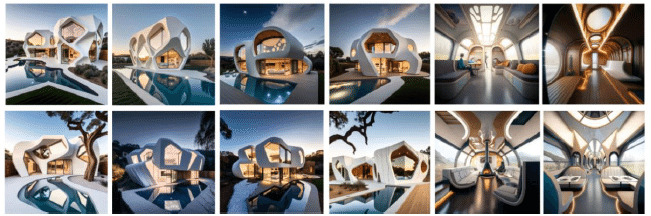
使用Midjourney、DALL-E 2和Stable Diffusion等生成AI工具,从自然语言提示(指令)在数秒内生成建筑效果图、室内设计和立面设计方案。这加快了初期创意开发和客户间的形象共享(Enjellina et al., 2023; Li et al., 2025b; Ploennigs & Berger, 2023; Sourek, 2024)
项目需求制定
倾听客户的模糊需求和要求,LLM将其与过去的项目数据相结合,创建现实且富有创意的项目需求文件(Memon et al., 2025; Onatayo et al., 2024)
基本设计阶段
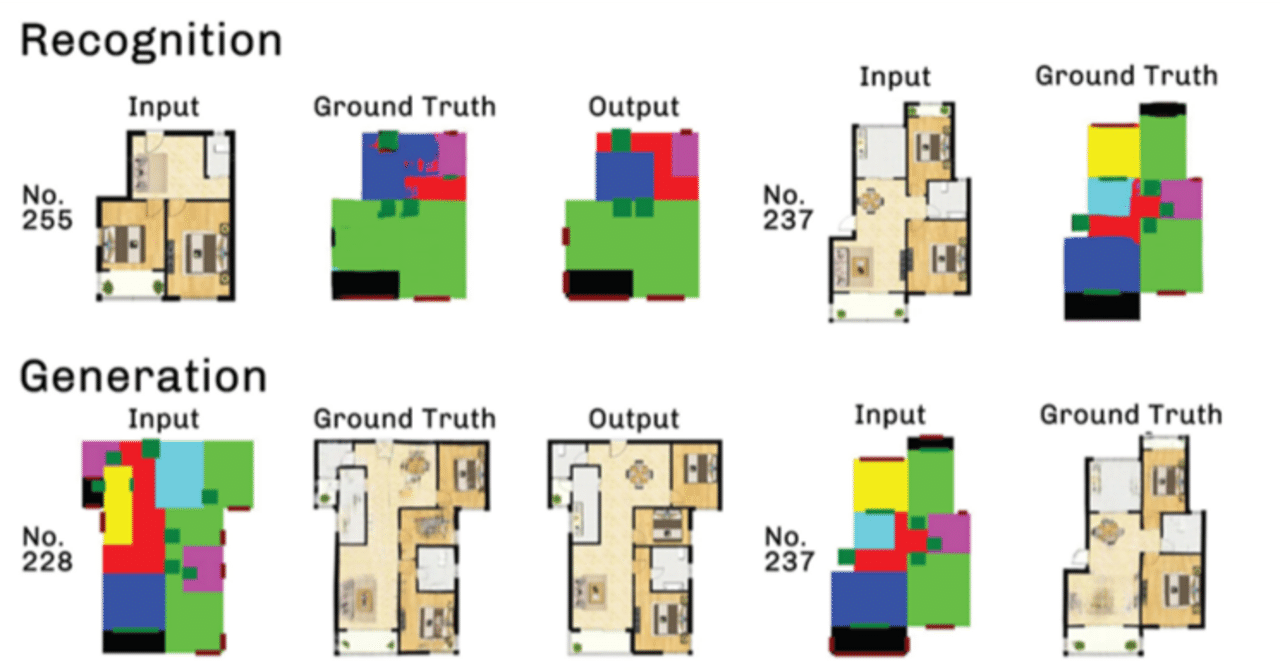
平面图自动生成
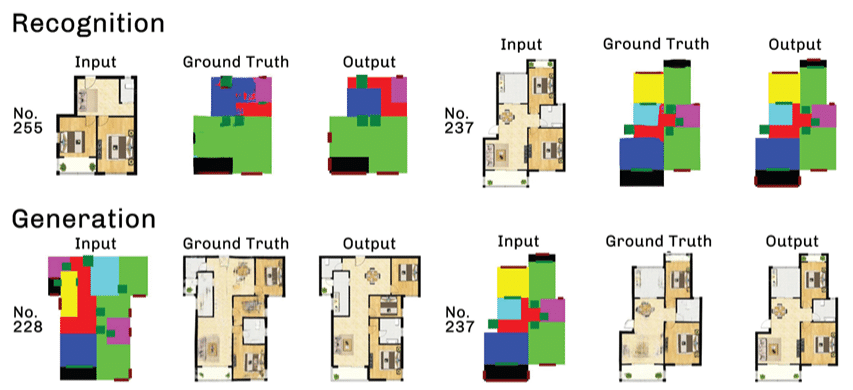
利用GAN和ANN生成公寓等的平面图(Huang & Zheng, 2018; Krausková & Pifko, 2021; Liu et al., 2017; Tamke et al., 2018)
城市·场地规划优化
AI根据地形、风、日照、交通、分区等条件,提出能最大化场地潜力的建筑布置方案(Sourek, 2024)
实施设计阶段
BIM与AI的整合
利用AI进行形状建模和物体识别,自动化从激光扫描数据创建BIM模型的流程(Tang et al., 2010)
利用AI分析BIM日志,分析设计流程的生产率改进措施(Pan & Zhang, 2020)
分析BIM设计中数据的积累和变化(Al Hattab & Hamzeh, 2018)
基于自然语言文本指令的交互式系统正在被研究,可以改变BIM模型中的墙体或房间属性,或添加绝缘材料(Kampelopoulos et al., 2025)
解释建筑法规等法律规制,自动检查BIM模型是否符合标准(Kampelopoulos et al., 2025; Li et al., 2025b)
自适应立面
AI被用于控制根据气候条件和用户舒适度自动开闭和遮阳的立面(Li et al., 2025a)
结构·设备设计阶段
结构设计
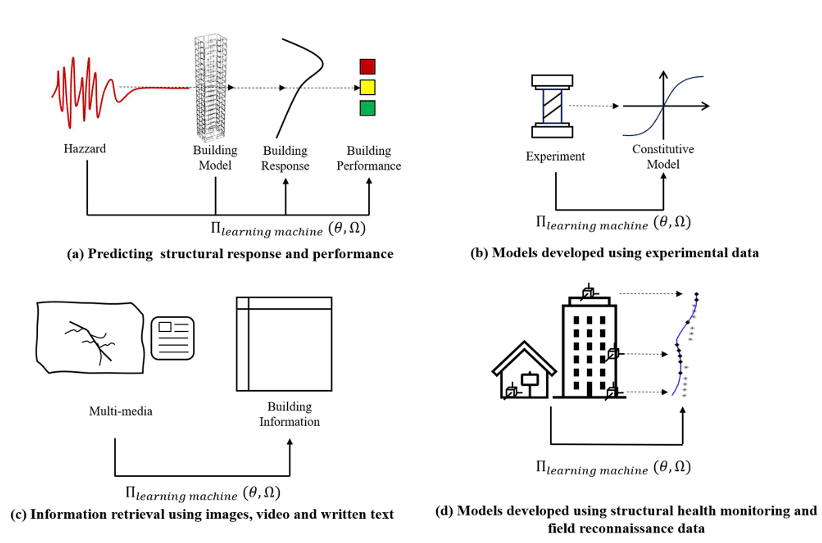
可以预测和评估结构性能,模拟结构状态(Sun et al., 2021; Talebian et al., 2025)
在实验困难的情况下,利用AI确定结构设计参数,减少花在实验上的人力和时间(Salehi & Burgueño, 2018)
使用随机森林等预测模型,模拟地震受损建筑的结构安全状态(Y. Zhang et al., 2018)
环境设计模拟阶段
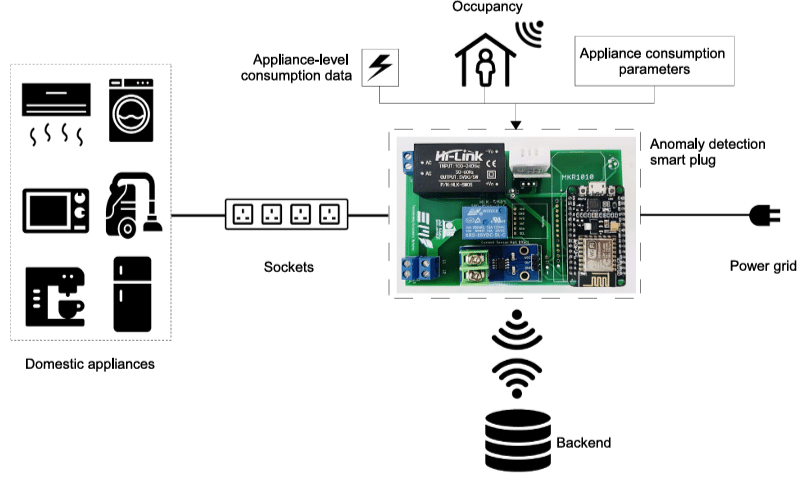
能源消耗量
预测建筑能源使用量(Himeur et al., 2021; Mazlina Zaira & Hadikusumo, 2017; Wang & Srinivasan, 2017; H.-X. Zhao & Magoulès, 2012)
检测和评估建筑物、桥梁、隧道、道路、下水道管等各种社会基础设施上的缺陷和损伤(裂纹、剥离、腐蚀、孔洞、接合处损伤等),验证结构系统的安全性和耐久性(C. Zhang et al., 2020)
面向智能电网应用的电气负荷预测(Raza & Khosravi, 2015)
用于空调设备、系统故障检测和诊断、系统负荷预测、能耗估算、使用情况预测、居住者行为和能源使用趋势等模拟(Hong et al., 2020)
利用AI预测空间内的日光量及相应的能耗削减量(Lorenz et al., 2018)
保存·改修阶段
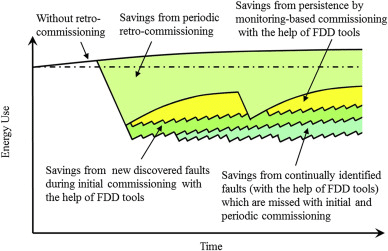
故障检测诊断(FDD)
用AI检测和诊断空调等建筑设备的故障(Y. Zhao et al., 2019)
检测和评估建筑物、桥梁、隧道、道路、下水道管等各基础设施上的缺陷和损伤(裂纹、剥离、腐蚀、孔洞、接合处损伤等),验证结构系统的安全性和耐久性(C. Zhang et al., 2020)
利用深度学习和文本挖掘分析灾害模式以及随时间推移事故危险性的变化(Zhong et al., 2020)
建筑改造
使用光检测和测距(LiDAR)和随机森林预测建筑物的年代(Tooke et al., 2014)
从二维建筑占用地和高度等建筑形状预测建筑物的类型(Henn et al., 2012)
结语
整理这些案例后,可以清楚地感受到技术范式的转变。
从2010年代以后深度学习的普及,到2022年以后生成AI和大规模语言模型(LLM)的扩展,建筑中的AI正在从传统的人通常使用AI的方式转变为交互式使用AI的方式。
建筑设计中的AI应用正在从单纯的工作效率工具迅速演进为提高设计质量和创意的必不可少的伙伴。
参考文献
Al Hattab, M., & Hamzeh, F. (2018). Simulating the dynamics of social agents and information flows in BIM-based design. Automation in Construction, 92, 1–22.
Bailey Breanna, & Raich Anne M. (2012). Modeling of User Design Preferences in Multiobjective Optimization of Roof Trusses. Journal of Computing in Civil Engineering, 26(5), 584–596.
Enjellina, Beyan, E. V. P., & Rossy, A. G. C. (2023). Review of AI Image Generator: Influences, challenges, and future prospects for architectural field. Journal of Artificial Intelligence in Architecture, 2(1), 53–65.
Henn, A., Römer, C., Gröger, G., & Plümer, L. (2012). Automatic classification of building types in 3D city models. GeoInformatica, 16(2), 281–306.
Himeur, Y., Ghanem, K., Alsalemi, A., Bensaali, F., & Amira, A. (2021). Artificial intelligence based anomaly detection of energy consumption in buildings: A review, current trends and new perspectives. Applied Energy, 287, 116601.
Hong, T., Wang, Z., Luo, X., & Zhang, W. (2020). State-of-the-art on research and applications of machine learning in the building life cycle. Energy and Buildings, 212, 109831.
Huang, W., & Zheng, H. (2018). Architectural drawings recognition and generation through machine learning. Of the 38th Annual Conference of the …. http://papers.cumincad.org/data/works/att/acadia18_156
Kampelopoulos, D., Tsanousa, A., Vrochidis, S., & Kompatsiaris, I. (2025). A review of LLMs and their applications in the architecture, engineering and construction industry. Artificial Intelligence Review, 58(8). https://doi.org/10.1007/s10462-025-11241-7
Krausková, V., & Pifko, H. (2021). Use of artificial intelligence in the field of sustainable architecture: Current knowledge. Architecture Papers of the Faculty of Architecture and Design STU, 26(1), 20–29.
Liu, C., Wu, J., Kohli, P., & Furukawa, Y. (2017). Raster-to-vector: Revisiting floorplan transformation. 2017 IEEE International Conference on Computer Vision (ICCV), 2195–2203.
Li, Y., Chen, H., Yu, P., & Yang, L. (2025a). A review of artificial intelligence applications in architectural design: Energy-saving renovations and adaptive building envelopes. Energies, 18(4), 918.
Li, Y., Chen, H., Yu, P., & Yang, L. (2025b). A review of Artificial Intelligence in enhancing architectural design efficiency. Applied Sciences (Basel, Switzerland), 15(3), 1476.
Lorenz, C.-L., Packianather, M., Spaeth, A., & Bleil De Souza, C. (2018). Artificial neural network-based modelling for daylight evaluations. SimAUD 2018, Delft, The Netherlands. https://orca.cardiff.ac.uk/id/eprint/112040/
Mazlina Zaira, M., & Hadikusumo, B. H. W. (2017). Structural equation model of integrated safety intervention practices affecting the safety behaviour of workers in the construction industry. Safety Science, 98, 124–135.
Memon, S. A., Shehata, W., Rowlinson, S., & Sunindijo, R. Y. (2025). Generative artificial intelligence in architecture, engineering, construction, and operations: A systematic review. Buildings, 15(13), 2270.
Onatayo, D., Onososen, A., Oyediran, A. O., Oyediran, H., Arowoiya, V., & Onatayo, E. (2024). Generative AI applications in architecture, engineering, and construction: Trends, implications for practice, education & imperatives for upskilling—A review. Architecture, 4(4), 877–902.
Pan, Y., & Zhang, L. (2020). BIM log mining: Exploring design productivity characteristics. Automation in Construction, 109, 102997.
Ploennigs, J., & Berger, M. (2023). AI art in architecture. AI in Civil Engineering, 2(1). https://doi.org/10.1007/s43503-023-00018-y
Raza, M. Q., & Khosravi, A. (2015). A review on artificial intelligence based load demand forecasting techniques for smart grid and buildings. Renewable and Sustainable Energy Reviews, 50, 1352–1372.
Salehi, H., & Burgueño, R. (2018). Emerging artificial intelligence methods in structural engineering. Engineering Structures, 171, 170–189.
Sourek, M. (2024). Artificial intelligence in architecture and built environment development 2024: A critical review and outlook. https://www.wemakespaces.archi/uploads/Artificial-Intelligence-in-Architecture-and-Built-Environment-Development.pdf
Sun, H., Burton, H. V., & Huang, H. (2021). Machine learning applications for building structural design and performance assessment: State-of-the-art review. Journal of Building Engineering, 33, 101816.
Talebian, S., Golkarieh, A., Eshraghi, S., Naseri, M., & Naseri, S. (2025). Artificial intelligence impacts on architecture and smart built environments: A comprehensive review. Advances in Civil Engineering and Environmental Science, 2(1), 45–56.
Tamke, M., Nicholas, P., & Zwierzycki, M. (2018). Machine learning for architectural design: Practices and infrastructure. International Journal of Architectural Computing, 16(2), 123–143.
Tang, P., Huber, D., Akinci, B., Lipman, R., & Lytle, A. (2010). Automatic reconstruction of as-built building information models from laser-scanned point clouds: A review of related techniques. Automation in Construction, 19(7), 829–843.
Tooke, T. R., Coops, N. C., & Webster, J. (2014). Predicting building ages from LiDAR data with random forests for building energy modeling. Energy and Buildings, 68, 603–610.
Wang, Z., & Srinivasan, R. S. (2017). A review of artificial intelligence based building energy use prediction: Contrasting the capabilities of single and ensemble prediction models. Renewable and Sustainable Energy Reviews, 75, 796–808.
Zhang, C., Chang, C.-C., & Jamshidi, M. (2020). Concrete bridge surface damage detection using a single‐stage detector. Computer-Aided Civil and Infrastructure Engineering, 35(4), 389–409.
Zhang, Y., Burton, H. V., Sun, H., & Shokrabadi, M. (2018). A machine learning framework for assessing post-earthquake structural safety. Structural Safety, 72, 1–16.
Zhao, H.-X., & Magoulès, F. (2012). A review on the prediction of building energy consumption. Renewable and Sustainable Energy Reviews, 16(6), 3586–3592.
Zhao, Y., Li, T., Zhang, X., & Zhang, C. (2019). Artificial intelligence-based fault detection and diagnosis methods for building energy systems: Advantages, challenges and the future. Renewable and Sustainable Energy Reviews, 109, 85–101.
Zhong, B., Pan, X., Love, P. E. D., Sun, J., & Tao, C. (2020). Hazard analysis: A deep learning and text mining framework for accident prevention. Advanced Engineering Informatics, 46, 101152.
已读
接下来阅读 ↓