
Articles
AI in Architectural Design: Latest Research and Applications
Product
Career
Automatically translated from the Japanese original.
Introduction
AI has been making rapid inroads into architectural design, urban planning, and the construction industry in recent years. Yet there is still surprisingly little literature that systematically maps out how AI can help address the challenges facing architecture today—energy performance and spatial optimization among them—and where it might be put to use.
On top of that, since 2022 generative AI and large language models (LLMs) such as ChatGPT and Midjourney have spread at remarkable speed, driving a shift away from traditional symbolic (rule-based) AI toward neural-network-based, generative approaches. That makes a fresh assessment grounded in the latest technology, including models like GPT-5, well overdue.
This article focuses on the day-to-day work of architectural design and systematically organizes case studies from 2010 onward, the period in which foundational research on deep learning became widely established.
How AI Is Being Used in Architectural Design: A Classification
This section looks at how AI is being applied across architectural design. We break the design workflow into six phases and examine each in turn: briefing and planning, schematic design, detailed design, structural and building-services design, environmental simulation, and preservation and renovation.
Briefing and Planning
Design
In optimizing the geometry of roof trusses, AI models have been used to optimize not only for minimum weight and deflection but also for user preferences (Bailey Breanna & Raich Anne M., 2012)
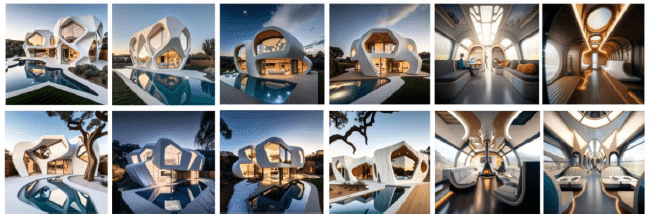
Generative AI tools such as Midjourney, DALL-E 2, and Stable Diffusion are being used to produce architectural renderings and interior and façade design proposals in seconds from natural-language prompts. This dramatically speeds up early ideation and helps designers share a visual direction with clients far more quickly (Enjellina et al., 2023; Li et al., 2025b; Ploennigs & Berger, 2023; Sourek, 2024)
Defining Project Requirements
LLMs can take in a client's vague wishes and requirements, combine them with data from past projects, and draft a project brief that is both realistic and creative (Memon et al., 2025; Onatayo et al., 2024)
Schematic Design
Automated Floor Plan Generation
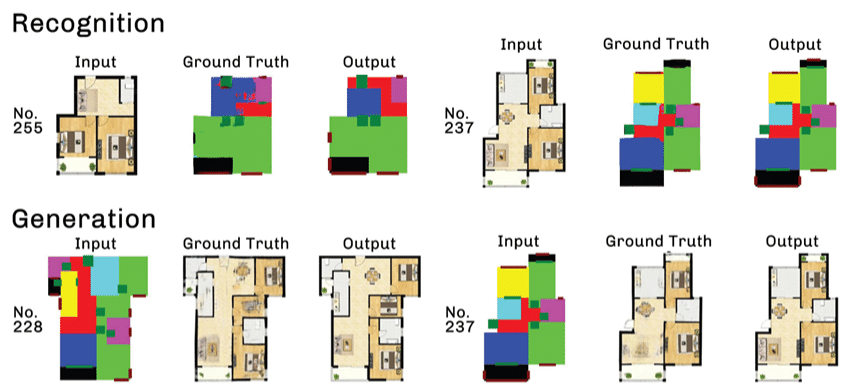
GANs and ANNs are being used to generate floor plans for apartments and other building types (Huang & Zheng, 2018; Krausková & Pifko, 2021; Liu et al., 2017; Tamke et al., 2018)
Optimizing Urban and Site Planning
Taking into account conditions such as topography, wind, solar exposure, traffic, and zoning, AI proposes building layouts that make the most of a site's potential (Sourek, 2024)
Detailed Design
Integrating BIM and AI
AI is used for shape modeling and object recognition, automating the process of creating BIM models from laser-scanner data (Tang et al., 2010)
AI analyzes BIM logs to identify measures for improving productivity in the design process (Pan & Zhang, 2020)
Analyzing how data accumulates and changes over the course of design in BIM (Al Hattab & Hamzeh, 2018)
Researchers are developing conversational systems that, from plain-language text instructions, can modify the attributes of walls and rooms in a BIM model or add insulation (Kampelopoulos et al., 2025)
Interpreting regulations such as the Building Standards Act and automatically checking whether a BIM model complies with them (Kampelopoulos et al., 2025; Li et al., 2025b)
Adaptive Façades
AI is being used to control façades that automatically open, close, or provide shading in response to climate conditions and occupant comfort (Li et al., 2025a)
Structural and Building-Services Design
Structural Design
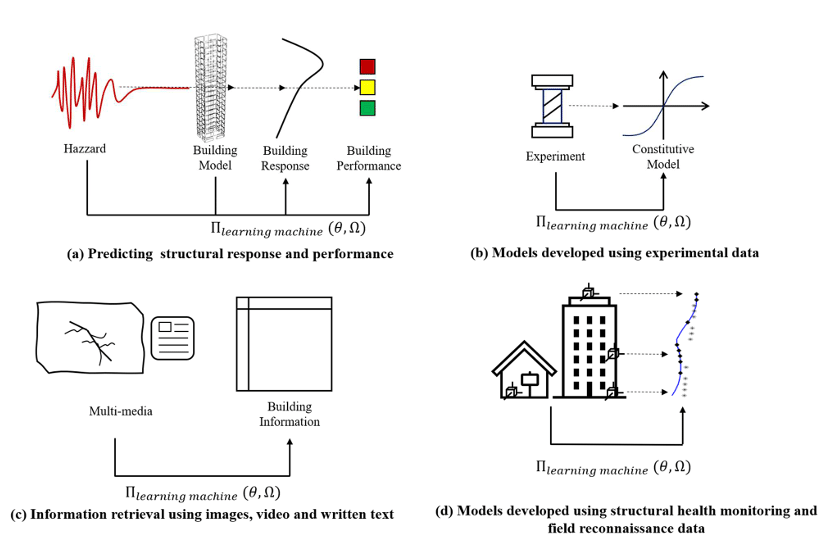
AI can predict and evaluate structural performance and simulate structural conditions (Sun et al., 2021; Talebian et al., 2025)
Where physical testing is difficult, AI is used to determine structural design parameters, cutting the staff hours and effort that would otherwise go into experiments (Salehi & Burgueño, 2018)
Predictive models such as random forests are used to simulate the structural safety of buildings damaged by earthquakes (Y. Zhang et al., 2018)
Environmental Simulation
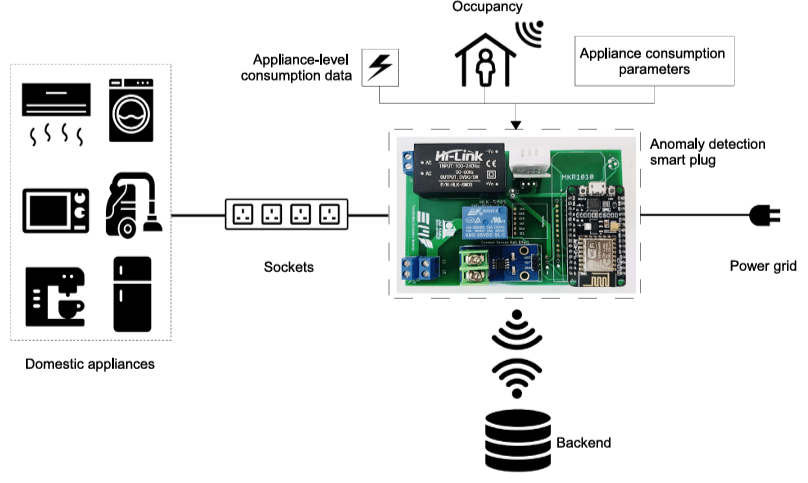
Energy Consumption
Predicting building energy use (Himeur et al., 2021; Mazlina Zaira & Hadikusumo, 2017; Wang & Srinivasan, 2017; H.-X. Zhao & Magoulès, 2012)
Detecting and assessing defects and damage—cracks, delamination, corrosion, holes, joint damage, and so on—in buildings, bridges, tunnels, roads, sewer pipes, and other infrastructure, in order to verify the safety and serviceability of structural systems (C. Zhang et al., 2020)
Electrical load forecasting intended for smart-grid applications (Raza & Khosravi, 2015)
AI is used in simulations covering HVAC equipment, system fault detection and diagnosis, load forecasting, energy-consumption estimation, occupancy prediction, and occupant behavior and energy-use patterns (Hong et al., 2020)
AI is used to predict the amount of daylight in a space and the resulting reduction in energy consumption (Lorenz et al., 2018)
Preservation and Renovation
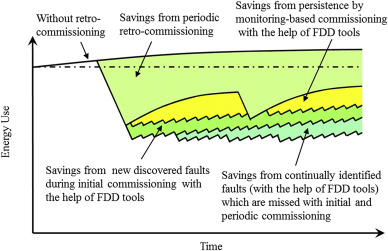
Fault Detection and Diagnosis (FDD)
AI detects and diagnoses faults in building systems such as HVAC (Y. Zhao et al., 2019)
Detecting and assessing defects and damage—cracks, delamination, corrosion, holes, joint damage, and so on—in buildings, bridges, tunnels, roads, sewer pipes, and other infrastructure, in order to verify the safety and serviceability of structural systems (C. Zhang et al., 2020)
Using deep learning and text mining to analyze hazard patterns and how accident risks shift over time (Zhong et al., 2020)
Building Retrofits
Predicting the age of buildings with a random forest model using Light Detection and Ranging (LiDAR) data (Tooke et al., 2014)
Predicting building type from two-dimensional building geometry such as footprint and height (Henn et al., 2012)
Conclusion
Surveying these cases, it becomes clear that a genuine shift in the technological paradigm is under way.
From the spread of deep learning in the 2010s to the rise of generative AI and large language models (LLMs) since 2022, the way architects work with AI is changing: what was once a matter of applying AI as a general-purpose tool is becoming an interactive, conversational collaboration.
In architectural design, AI is rapidly evolving from a mere efficiency tool into an indispensable partner for raising the quality and creativity of design itself.
References
Al Hattab, M., & Hamzeh, F. (2018). Simulating the dynamics of social agents and information flows in BIM-based design. Automation in Construction, 92, 1–22.
Bailey Breanna, & Raich Anne M. (2012). Modeling of User Design Preferences in Multiobjective Optimization of Roof Trusses. Journal of Computing in Civil Engineering, 26(5), 584–596.
Enjellina, Beyan, E. V. P., & Rossy, A. G. C. (2023). Review of AI Image Generator: Influences, challenges, and future prospects for architectural field. Journal of Artificial Intelligence in Architecture, 2(1), 53–65.
Henn, A., Römer, C., Gröger, G., & Plümer, L. (2012). Automatic classification of building types in 3D city models. GeoInformatica, 16(2), 281–306.
Himeur, Y., Ghanem, K., Alsalemi, A., Bensaali, F., & Amira, A. (2021). Artificial intelligence based anomaly detection of energy consumption in buildings: A review, current trends and new perspectives. Applied Energy, 287, 116601.
Hong, T., Wang, Z., Luo, X., & Zhang, W. (2020). State-of-the-art on research and applications of machine learning in the building life cycle. Energy and Buildings, 212, 109831.
Huang, W., & Zheng, H. (2018). Architectural drawings recognition and generation through machine learning. Of the 38th Annual Conference of the …. http://papers.cumincad.org/data/works/att/acadia18_156
Kampelopoulos, D., Tsanousa, A., Vrochidis, S., & Kompatsiaris, I. (2025). A review of LLMs and their applications in the architecture, engineering and construction industry. Artificial Intelligence Review, 58(8). https://doi.org/10.1007/s10462-025-11241-7
Krausková, V., & Pifko, H. (2021). Use of artificial intelligence in the field of sustainable architecture: Current knowledge. Architecture Papers of the Faculty of Architecture and Design STU, 26(1), 20–29.
Liu, C., Wu, J., Kohli, P., & Furukawa, Y. (2017). Raster-to-vector: Revisiting floorplan transformation. 2017 IEEE International Conference on Computer Vision (ICCV), 2195–2203.
Li, Y., Chen, H., Yu, P., & Yang, L. (2025a). A review of artificial intelligence applications in architectural design: Energy-saving renovations and adaptive building envelopes. Energies, 18(4), 918.
Li, Y., Chen, H., Yu, P., & Yang, L. (2025b). A review of Artificial Intelligence in enhancing architectural design efficiency. Applied Sciences (Basel, Switzerland), 15(3), 1476.
Lorenz, C.-L., Packianather, M., Spaeth, A., & Bleil De Souza, C. (2018). Artificial neural network-based modelling for daylight evaluations. SimAUD 2018, Delft, The Netherlands. https://orca.cardiff.ac.uk/id/eprint/112040/
Mazlina Zaira, M., & Hadikusumo, B. H. W. (2017). Structural equation model of integrated safety intervention practices affecting the safety behaviour of workers in the construction industry. Safety Science, 98, 124–135.
Memon, S. A., Shehata, W., Rowlinson, S., & Sunindijo, R. Y. (2025). Generative artificial intelligence in architecture, engineering, construction, and operations: A systematic review. Buildings, 15(13), 2270.
Onatayo, D., Onososen, A., Oyediran, A. O., Oyediran, H., Arowoiya, V., & Onatayo, E. (2024). Generative AI applications in architecture, engineering, and construction: Trends, implications for practice, education & imperatives for upskilling—A review. Architecture, 4(4), 877–902.
Pan, Y., & Zhang, L. (2020). BIM log mining: Exploring design productivity characteristics. Automation in Construction, 109, 102997.
Ploennigs, J., & Berger, M. (2023). AI art in architecture. AI in Civil Engineering, 2(1). https://doi.org/10.1007/s43503-023-00018-y
Raza, M. Q., & Khosravi, A. (2015). A review on artificial intelligence based load demand forecasting techniques for smart grid and buildings. Renewable and Sustainable Energy Reviews, 50, 1352–1372.
Salehi, H., & Burgueño, R. (2018). Emerging artificial intelligence methods in structural engineering. Engineering Structures, 171, 170–189.
Sourek, M. (2024). Artificial intelligence in architecture and built environment development 2024: A critical review and outlook. https://www.wemakespaces.archi/uploads/Artificial-Intelligence-in-Architecture-and-Built-Environment-Development.pdf
Sun, H., Burton, H. V., & Huang, H. (2021). Machine learning applications for building structural design and performance assessment: State-of-the-art review. Journal of Building Engineering, 33, 101816.
Talebian, S., Golkarieh, A., Eshraghi, S., Naseri, M., & Naseri, S. (2025). Artificial intelligence impacts on architecture and smart built environments: A comprehensive review. Advances in Civil Engineering and Environmental Science, 2(1), 45–56.
Tamke, M., Nicholas, P., & Zwierzycki, M. (2018). Machine learning for architectural design: Practices and infrastructure. International Journal of Architectural Computing, 16(2), 123–143.
Tang, P., Huber, D., Akinci, B., Lipman, R., & Lytle, A. (2010). Automatic reconstruction of as-built building information models from laser-scanned point clouds: A review of related techniques. Automation in Construction, 19(7), 829–843.
Tooke, T. R., Coops, N. C., & Webster, J. (2014). Predicting building ages from LiDAR data with random forests for building energy modeling. Energy and Buildings, 68, 603–610.
Wang, Z., & Srinivasan, R. S. (2017). A review of artificial intelligence based building energy use prediction: Contrasting the capabilities of single and ensemble prediction models. Renewable and Sustainable Energy Reviews, 75, 796–808.
Zhang, C., Chang, C.-C., & Jamshidi, M. (2020). Concrete bridge surface damage detection using a single‐stage detector. Computer-Aided Civil and Infrastructure Engineering, 35(4), 389–409.
Zhang, Y., Burton, H. V., Sun, H., & Shokrabadi, M. (2018). A machine learning framework for assessing post-earthquake structural safety. Structural Safety, 72, 1–16.
Zhao, H.-X., & Magoulès, F. (2012). A review on the prediction of building energy consumption. Renewable and Sustainable Energy Reviews, 16(6), 3586–3592.
Zhao, Y., Li, T., Zhang, X., & Zhang, C. (2019). Artificial intelligence-based fault detection and diagnosis methods for building energy systems: Advantages, challenges and the future. Renewable and Sustainable Energy Reviews, 109, 85–101.
Zhong, B., Pan, X., Love, P. E. D., Sun, J., & Tao, C. (2020). Hazard analysis: A deep learning and text mining framework for accident prevention. Advanced Engineering Informatics, 46, 101152.
The end
Read next ↓