
Articles
최신 연구를 통한 건축 설계에서의 AI 활용
Product
Career
일본어 원문으로부터의 자동 번역입니다
서론
근년에 건축설계, 도시계획, 건설업계에서 AI 기술의 도입이 진행되고 있지만, AI가 현대 건축과제(에너지 성능, 공간 최적화 등)에 어떻게 도움이 되는지, 활용될 수 있는지에 대해 체계적으로 정리된 문헌은 많지 않습니다.
또한 2022년 이후 ChatGPT, Midjourney 등의 생성AI(Generative AI)와 대규모언어모델(LLM)이 급속도로 보급되어, 종래의 상징적AI(규칙기반)에서 뉴럴네트워크·생성적AI로의 전환이 일어나고 있으며, 최신 기술동향(GPT-5 등)에 기반한 재평가가 필요하다고 생각됩니다.
여기에서는 건축설계의 업무에 주목하여, 주로 Deep learning에 관한 기초연구가 보급되는 2010년 이후의 사례를 체계적으로 정리합니다.
건축설계에서의 AI 활용 사례의 분류
건축설계에서 어떻게 AI가 활용되는지 기재합니다. 건축설계업무를 기획·계획프로세스, 기본설계프로세스, 실시설계프로세스, 구조·설비설계프로세스, 환경설계시뮬레이션프로세스, 보존·개수프로세스의 6가지로 나누어 설명합니다.
기획·계획 프로세스
디자인
지붕 트러스의 형상 최적화에 있어서, 중량과 처짐의 최소화에 더하여 사용자의 선호도를 포함한 AI 모델에 의한 최적화가 이루어지고 있습니다(Bailey Breanna & Raich Anne M., 2012)
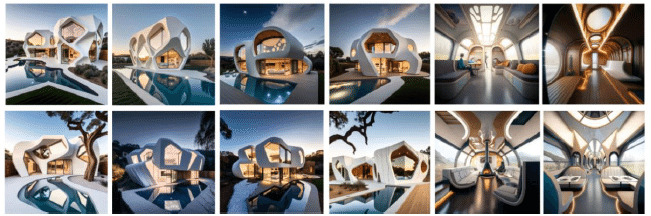
Midjourney, DALL-E 2, Stable Diffusion 등의 생성AI 도구를 사용하여, 자연언어의 프롬프트(지시)로부터 건축 퍼스, 인테리어, 파사드의 디자인안을 수초 내에 생성합니다. 이를 통해 초기 아이디어 출출이나 클라이언트와의 이미지 공유를 신속화하고 있습니다(Enjellina et al., 2023; Li et al., 2025b; Ploennigs & Berger, 2023; Sourek, 2024)
프로젝트 요건 책정
클라이언트의 모호한 요망이나 요건을 청취하여, LLM이 과거 프로젝트 데이터와 결합하여, 현실적이고 창의적인 프로젝트 요건서를 작성합니다(Memon et al., 2025; Onatayo et al., 2024)
기본설계 프로세스
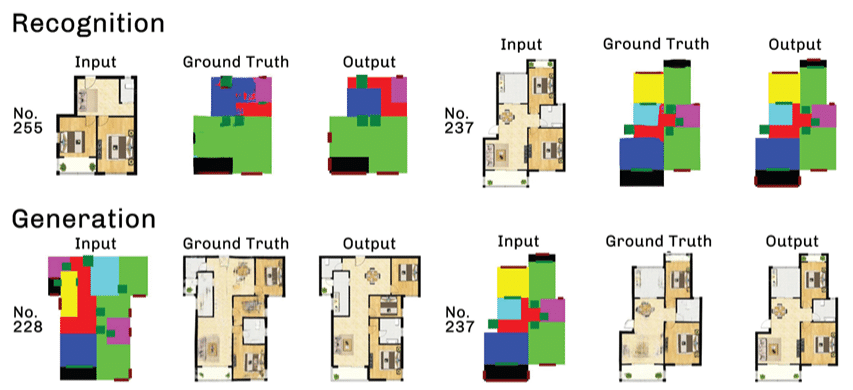
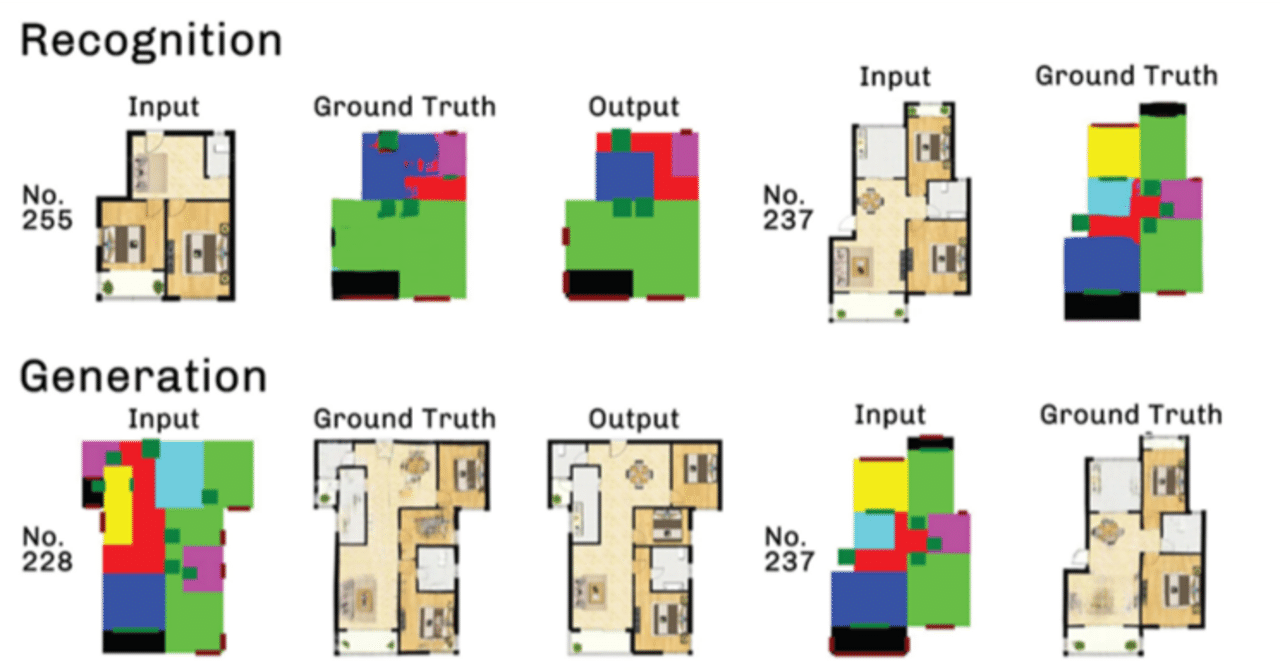
평면도의 자동생성
GAN이나 ANN을 활용하여 아파트 등의 평면도를 생성하고 있습니다(Huang & Zheng, 2018; Krausková & Pifko, 2021; Liu et al., 2017; Tamke et al., 2018)
도시·부지 계획의 최적화
지형, 바람, 일조, 교통, 존닝 등의 조건을 바탕으로, 부지의 포텐셜을 최대화하는 건물 배치를 AI가 제안합니다(Sourek, 2024)
실시설계 프로세스
BIM과 AI의 통합
AI를 활용하여 형상 모델링이나 물체 인식을 하여, 레이저 스캐너 데이터로부터 BIM 모델을 작성하는 프로세스를 자동화합니다(Tang et al., 2010)
BIM의 로그를 AI로 분석하여, 디자인 프로세스의 생산성 개선 시책을 분석합니다(Pan & Zhang, 2020)
BIM에서의 설계에 있어서의 데이터의 축적이나 변화를 분석합니다(Al Hattab & Hamzeh, 2018)
자연언어의 텍스트 지시에 기반하여, BIM 모델 내의 벽이나 방의 속성을 변경하거나, 단열재를 추가하거나 하는 대화형 시스템이 연구되고 있습니다(Kampelopoulos et al., 2025)
건축기준법 등의 법규제를 해석하여, BIM 모델이 기준에 적합하는지를 자동으로 체크합니다(Kampelopoulos et al., 2025; Li et al., 2025b)
적응형 파사드
기후 조건이나 사용자의 쾌적성에 맞추어, 자동으로 개폐나 차광을 행하는 파사드의 제어에 AI가 사용되고 있습니다(Li et al., 2025a)
구조·설비설계 프로세스
구조설계
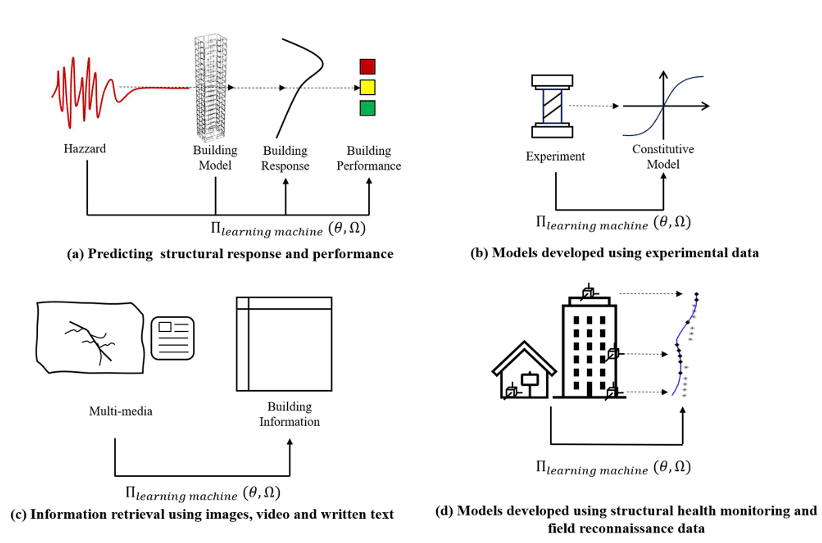
구조 성능의 예측과 평가, 구조 상태의 시뮬레이션이 가능합니다(Sun et al., 2021; Talebian et al., 2025)
실험이 어려운 경우에 구조설계 파라미터를 결정하는 데 AI를 활용하여, 실험에 소비하는 인적 시간과 노력을 삭감합니다(Salehi & Burgueño, 2018)
랜덤포레스트 등의 예측 모델을 사용하여, 지진 피해를 입은 건물의 구조 안전 상태를 시뮬레이션하고 있습니다(Y. Zhang et al., 2018)
환경설계 시뮬레이션 프로세스
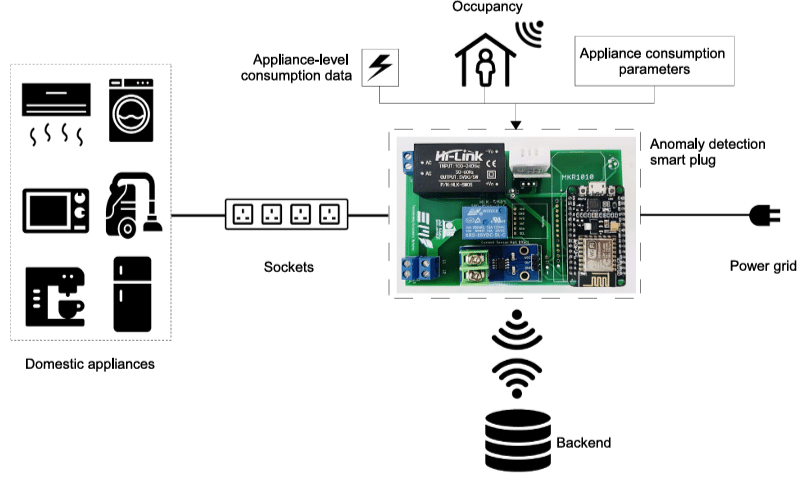
에너지 소비량
건물의 에너지 사용량을 예측합니다(Himeur et al., 2021; Mazlina Zaira & Hadikusumo, 2017; Wang & Srinivasan, 2017; H.-X. Zhao & Magoulès, 2012)
건축물, 교량, 터널, 도로, 하수도관 등의 각종 사회기반에 발생하는 결함이나 손상(균열, 박리, 부식, 구멍, 접합부의 손상 등)을 검출·평가하여, 구조 시스템의 안전성과 내용성을 검증합니다(C. Zhang et al., 2020)
스마트그리드로의 활용을 상정한 전기 부하 예측(Raza & Khosravi, 2015)
공조 기기, 시스템 고장 검출이나 진단, 시스템에 대한 부하 예측, 에너지 소비량 추정, 사용 상황의 예측, 입주자의 행동과 에너지 사용 경향 등의 시뮬레이션에서 활용되고 있습니다(Hong et al., 2020)
공간 내의 일광량과 그에 수반하는 에너지 소비 삭감량을 AI를 활용하여 예측하고 있습니다(Lorenz et al., 2018)
보존·개수 프로세스
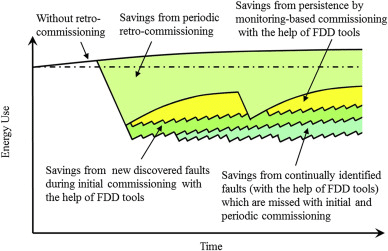
고장 검출 진단(FDD)
공조 등의 건물 설비의 고장을 AI로 검출·진단합니다(Y. Zhao et al., 2019)
건축물, 교량, 터널, 도로, 하수도관 등의 각 인프라에 발생하는 결함이나 손상(균열, 박리, 부식, 구멍, 접합부의 손상 등)을 검출·평가하여, 구조 시스템의 안전성과 내용성을 검증합니다(C. Zhang et al., 2020)
딥러닝과 텍스트 마이닝을 활용하여, 해저드 패턴이나, 시간의 경과에 따른 사고의 위험성의 변천을 분석합니다(Zhong et al., 2020)
빌딩 레트로피팅
Light Detection and Ranging(LiDAR)을 사용하여, 랜덤포레스트로 건물의 경년수를 예측합니다(Tooke et al., 2014)
2차원의 건폐지나 높이 등의 건물의 형상으로부터, 건축물의 타입을 예측합니다(Henn et al., 2012)
맺음말
사례를 정리하면 기술적 패러다임의 전환이 일어나고 있음을 실감할 수 있습니다.
2010년대 이후의 심층학습의 보급으로부터, 그리고 2022년 이후의 생성AI와 대규모언어모델(LLM)의 확대에 이르기까지, 건축에서의 AI는, 종래의 사람이 AI를 일반적으로 활용하는 형태에서, 대화적으로 활용하는 형태로 변화하고 있습니다.
건축설계에서의 AI 활용은, 단순한 업무 효율화의 도구에서, 설계의 품질과 창의성을 높이기 위한 불가결한 파트너로 급속도로 진화하고 있습니다.
참고문헌
Al Hattab, M., & Hamzeh, F. (2018). Simulating the dynamics of social agents and information flows in BIM-based design. Automation in Construction, 92, 1–22.
Bailey Breanna, & Raich Anne M. (2012). Modeling of User Design Preferences in Multiobjective Optimization of Roof Trusses. Journal of Computing in Civil Engineering, 26(5), 584–596.
Enjellina, Beyan, E. V. P., & Rossy, A. G. C. (2023). Review of AI Image Generator: Influences, challenges, and future prospects for architectural field. Journal of Artificial Intelligence in Architecture, 2(1), 53–65.
Henn, A., Römer, C., Gröger, G., & Plümer, L. (2012). Automatic classification of building types in 3D city models. GeoInformatica, 16(2), 281–306.
Himeur, Y., Ghanem, K., Alsalemi, A., Bensaali, F., & Amira, A. (2021). Artificial intelligence based anomaly detection of energy consumption in buildings: A review, current trends and new perspectives. Applied Energy, 287, 116601.
Hong, T., Wang, Z., Luo, X., & Zhang, W. (2020). State-of-the-art on research and applications of machine learning in the building life cycle. Energy and Buildings, 212, 109831.
Huang, W., & Zheng, H. (2018). Architectural drawings recognition and generation through machine learning. Of the 38th Annual Conference of the …. http://papers.cumincad.org/data/works/att/acadia18_156
Kampelopoulos, D., Tsanousa, A., Vrochidis, S., & Kompatsiaris, I. (2025). A review of LLMs and their applications in the architecture, engineering and construction industry. Artificial Intelligence Review, 58(8). https://doi.org/10.1007/s10462-025-11241-7
Krausková, V., & Pifko, H. (2021). Use of artificial intelligence in the field of sustainable architecture: Current knowledge. Architecture Papers of the Faculty of Architecture and Design STU, 26(1), 20–29.
Liu, C., Wu, J., Kohli, P., & Furukawa, Y. (2017). Raster-to-vector: Revisiting floorplan transformation. 2017 IEEE International Conference on Computer Vision (ICCV), 2195–2203.
Li, Y., Chen, H., Yu, P., & Yang, L. (2025a). A review of artificial intelligence applications in architectural design: Energy-saving renovations and adaptive building envelopes. Energies, 18(4), 918.
Li, Y., Chen, H., Yu, P., & Yang, L. (2025b). A review of Artificial Intelligence in enhancing architectural design efficiency. Applied Sciences (Basel, Switzerland), 15(3), 1476.
Lorenz, C.-L., Packianather, M., Spaeth, A., & Bleil De Souza, C. (2018). Artificial neural network-based modelling for daylight evaluations. SimAUD 2018, Delft, The Netherlands. https://orca.cardiff.ac.uk/id/eprint/112040/
Mazlina Zaira, M., & Hadikusumo, B. H. W. (2017). Structural equation model of integrated safety intervention practices affecting the safety behaviour of workers in the construction industry. Safety Science, 98, 124–135.
Memon, S. A., Shehata, W., Rowlinson, S., & Sunindijo, R. Y. (2025). Generative artificial intelligence in architecture, engineering, construction, and operations: A systematic review. Buildings, 15(13), 2270.
Onatayo, D., Onososen, A., Oyediran, A. O., Oyediran, H., Arowoiya, V., & Onatayo, E. (2024). Generative AI applications in architecture, engineering, and construction: Trends, implications for practice, education & imperatives for upskilling—A review. Architecture, 4(4), 877–902.
Pan, Y., & Zhang, L. (2020). BIM log mining: Exploring design productivity characteristics. Automation in Construction, 109, 102997.
Ploennigs, J., & Berger, M. (2023). AI art in architecture. AI in Civil Engineering, 2(1). https://doi.org/10.1007/s43503-023-00018-y
Raza, M. Q., & Khosravi, A. (2015). A review on artificial intelligence based load demand forecasting techniques for smart grid and buildings. Renewable and Sustainable Energy Reviews, 50, 1352–1372.
Salehi, H., & Burgueño, R. (2018). Emerging artificial intelligence methods in structural engineering. Engineering Structures, 171, 170–189.
Sourek, M. (2024). Artificial intelligence in architecture and built environment development 2024: A critical review and outlook. https://www.wemakespaces.archi/uploads/Artificial-Intelligence-in-Architecture-and-Built-Environment-Development.pdf
Sun, H., Burton, H. V., & Huang, H. (2021). Machine learning applications for building structural design and performance assessment: State-of-the-art review. Journal of Building Engineering, 33, 101816.
Talebian, S., Golkarieh, A., Eshraghi, S., Naseri, M., & Naseri, S. (2025). Artificial intelligence impacts on architecture and smart built environments: A comprehensive review. Advances in Civil Engineering and Environmental Science, 2(1), 45–56.
Tamke, M., Nicholas, P., & Zwierzycki, M. (2018). Machine learning for architectural design: Practices and infrastructure. International Journal of Architectural Computing, 16(2), 123–143.
Tang, P., Huber, D., Akinci, B., Lipman, R., & Lytle, A. (2010). Automatic reconstruction of as-built building information models from laser-scanned point clouds: A review of related techniques. Automation in Construction, 19(7), 829–843.
Tooke, T. R., Coops, N. C., & Webster, J. (2014). Predicting building ages from LiDAR data with random forests for building energy modeling. Energy and Buildings, 68, 603–610.
Wang, Z., & Srinivasan, R. S. (2017). A review of artificial intelligence based building energy use prediction: Contrasting the capabilities of single and ensemble prediction models. Renewable and Sustainable Energy Reviews, 75, 796–808.
Zhang, C., Chang, C.-C., & Jamshidi, M. (2020). Concrete bridge surface damage detection using a single‐stage detector. Computer-Aided Civil and Infrastructure Engineering, 35(4), 389–409.
Zhang, Y., Burton, H. V., Sun, H., & Shokrabadi, M. (2018). A machine learning framework for assessing post-earthquake structural safety. Structural Safety, 72, 1–16.
Zhao, H.-X., & Magoulès, F. (2012). A review on the prediction of building energy consumption. Renewable and Sustainable Energy Reviews, 16(6), 3586–3592.
Zhao, Y., Li, T., Zhang, X., & Zhang, C. (2019). Artificial intelligence-based fault detection and diagnosis methods for building energy systems: Advantages, challenges and the future. Renewable and Sustainable Energy Reviews, 109, 85–101.
Zhong, B., Pan, X., Love, P. E. D., Sun, J., & Tao, C. (2020). Hazard analysis: A deep learning and text mining framework for accident prevention. Advanced Engineering Informatics, 46, 101152.
읽음
다음 읽을 글 ↓