
Articles
最新研究による建築設計でのAI活用
Product
Career
はじめに
近年、建築設計、都市計画、建設業界においてAI技術の導入が進んでいますが、AIが現代の建築課題(エネルギー性能、空間最適化など)に対して、どのように役立つか、活用されうるかという点について、体系的に整理された文献は多くないです。
加えて、2022年以降、ChatGPTやMidjourneyなどの生成AI(Generative AI)や大規模言語モデル(LLM)が急速に普及し、従来のシンボリックAI(ルールベース)から、ニューラルネットワーク・生成的AIへの移行が起きており、最新の技術動向(GPT-5など)に基づいた再評価が必要だと考えられます。
ここでは、建築設計の業務に着目し、主にDeep learningに関する基礎研究が普及する2010年以降の事例を体系的に整理します。
建築設計でのAIの活用事例の分類
建築設計においてどのようにAIが活用されるのか記載します。建築設計業務を企画・計画プロセス、基本設計プロセス、実施設計プロセス、構造・設備設計プロセス、環境設計シミュレーションプロセス、保存・改修プロセスの6つにわけて説明します。
企画・計画プロセス
デザイン
屋根トラスの形状の最適化において、重量やたわみの最小化に加えてユーザーの好みを含めたAIモデルによる最適化がされている(Bailey Breanna & Raich Anne M., 2012)
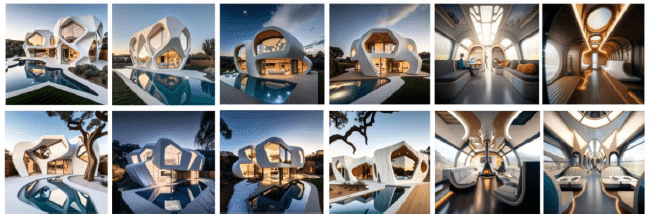
Midjourney、DALL-E 2、Stable Diffusionなどの生成AIツールを使用し、自然言語のプロンプト(指示)から建築パース、インテリア、ファサードのデザイン案を数秒で生成する。これにより、初期のアイデア出しやクライアントとのイメージ共有を迅速化している(Enjellina et al., 2023; Li et al., 2025b; Ploennigs & Berger, 2023; Sourek, 2024)
プロジェクト要件の策定
クライアントの曖昧な要望や要件を聞き取り、LLMが過去のプロジェクトデータと組み合わせて、現実的かつ創造的なプロジェクト要件書を作成する(Memon et al., 2025; Onatayo et al., 2024)
基本設計プロセス
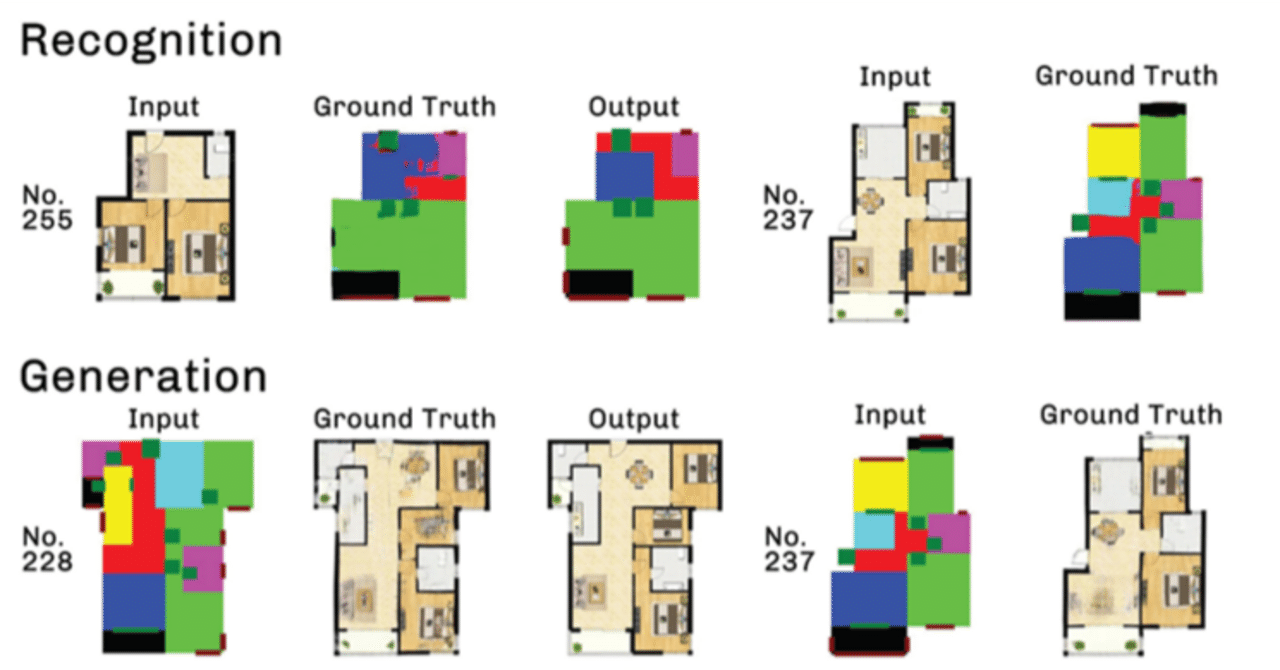
平面図の自動生成
GANやANNを活用してアパートなどの間取り図を生成している(Huang & Zheng, 2018; Krausková & Pifko, 2021; Liu et al., 2017; Tamke et al., 2018)
都市・敷地計画の最適化
地形、風、日照、交通、ゾーニングなどの条件を踏まえ、敷地のポテンシャルを最大化する建物配置をAIが提案する(Sourek, 2024)
実施設計プロセス
BIMとAIの統合
AIを活用して形状モデリングや物体認識をし、レーザースキャナデータからBIMモデルを作成するプロセスを自動化する(Tang et al., 2010)
BIMのログをAIで解析し、デザインプロセスの生産性の改善施策を分析する(Pan & Zhang, 2020)
BIMでの設計におけるデータの蓄積や変化を解析する (Al Hattab & Hamzeh, 2018)
自然言語のテキスト指示に基づいて、BIMモデル内の壁や部屋の属性を変更したり、断熱材を追加したりする対話型システムが研究されている(Kampelopoulos et al., 2025)
建築基準法などの法規制を解釈し、BIMモデルが基準に適合しているかを自動的にチェックする(Kampelopoulos et al., 2025; Li et al., 2025b)
適応型ファサード
気候条件やユーザーの快適性に合わせて、自動で開閉や遮光を行うファサードの制御にAIが用いられている(Li et al., 2025a)
構造・設備設計プロセス
構造設計
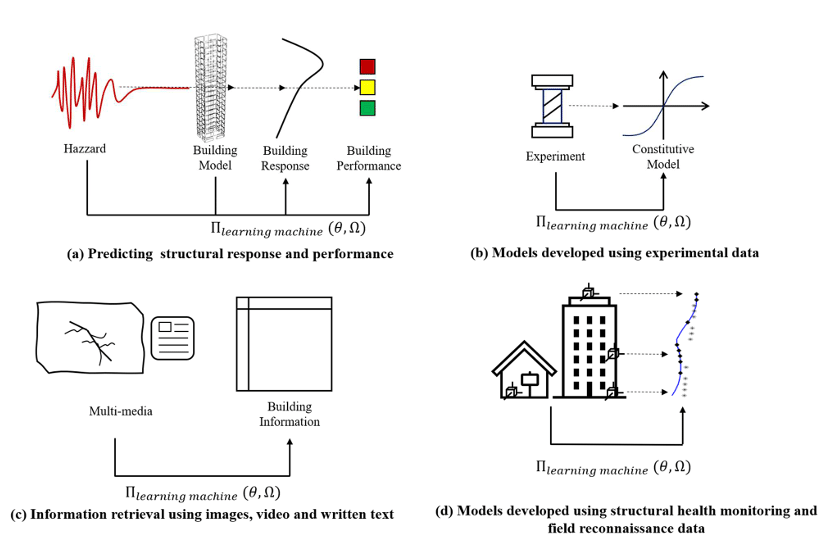
構造性能の予測と評価、構造状態のシミュレーションができる(Sun et al., 2021; Talebian et al., 2025)
実験が困難な場合に構造設計パラメータを決定するにAIを活用し、実験に費やす人的時間と労力を削減する (Salehi & Burgueño, 2018)
ランダムフォレストなどの予測モデルを用いて、地震被害を受けた建物の構造安全状態をシミュレーションしている (Y. Zhang et al., 2018)
環境設計シミュレーションプロセス
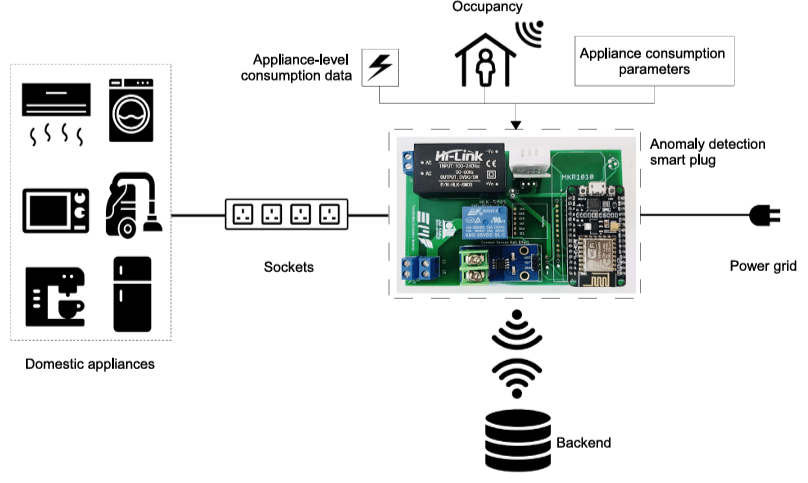
エネルギー消費量
建物のエネルギー使用量を予測 (Himeur et al., 2021; Mazlina Zaira & Hadikusumo, 2017; Wang & Srinivasan, 2017; H.-X. Zhao & Magoulès, 2012)
建築物、橋梁、トンネル、道路、下水道管などの各種社会基盤に発生する欠陥や損傷(亀裂、剥離、腐食、穴、接合部の損傷など)を検出・評価し、構造システムの安全性と耐用性を検証 (C. Zhang et al., 2020)
スマートグリッドへの活用を想定した電気負荷予測(Raza & Khosravi, 2015)
空調機器、システム障害検出や診断、システムに対する負荷予測、エネルギー消費量推定、使用状況の予測、入居者の行動とエネルギー使用傾向などのシミュレーションで活用されている(Hong et al., 2020)
空間内の日光量とそれに伴うエネルギー消費削減量をAIを活用して予測している (Lorenz et al., 2018)
保存・改修プロセス
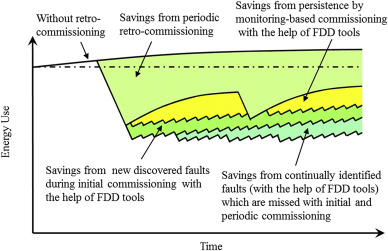
故障検出診断(FDD)
空調などの建物設備の故障をAIで検出・診断する(Y. Zhao et al., 2019)
建築物、橋梁、トンネル、道路、下水道管などの各インフラに発生する欠陥や損傷(亀裂、剥離、腐食、穴、接合部の損傷など)を検出・評価し、構造システムの安全性と耐用性を検証する (C. Zhang et al., 2020)
ディープラーニングとテキストマイニングを活用し、ハザードパターンや、時間の経過とともに事故の危険性の変遷を解析(Zhong et al., 2020)
ビルディングレトロフィット
Light Detection and Ranging(LiDAR)を用いて、ランダムフォレストで建物の築年数を予測(Tooke et al., 2014)
2次元の建ぺい地や高さなどの建物の形状から、建築物のタイプを予測する (Henn et al., 2012)
おわりに
事例を整理すると技術的パラダイムの転換が起きていると実感できます。
2010年代以降の深層学習の普及から、そして2022年以降の生成AIと大規模言語モデル(LLM)の広がりに至るまで、建築におけるAIは、従来の人がAIを一般的に活用する形から、対話的に活用する形に変化しつつあります。
建築設計におけるAI活用は、単なる業務効率化のツールから、設計の質と創造性を高めるための不可欠なパートナーへと急速に進化しています。
参考文献
Al Hattab, M., & Hamzeh, F. (2018). Simulating the dynamics of social agents and information flows in BIM-based design. Automation in Construction, 92, 1–22.
Bailey Breanna, & Raich Anne M. (2012). Modeling of User Design Preferences in Multiobjective Optimization of Roof Trusses. Journal of Computing in Civil Engineering, 26(5), 584–596.
Enjellina, Beyan, E. V. P., & Rossy, A. G. C. (2023). Review of AI Image Generator: Influences, challenges, and future prospects for architectural field. Journal of Artificial Intelligence in Architecture, 2(1), 53–65.
Henn, A., Römer, C., Gröger, G., & Plümer, L. (2012). Automatic classification of building types in 3D city models. GeoInformatica, 16(2), 281–306.
Himeur, Y., Ghanem, K., Alsalemi, A., Bensaali, F., & Amira, A. (2021). Artificial intelligence based anomaly detection of energy consumption in buildings: A review, current trends and new perspectives. Applied Energy, 287, 116601.
Hong, T., Wang, Z., Luo, X., & Zhang, W. (2020). State-of-the-art on research and applications of machine learning in the building life cycle. Energy and Buildings, 212, 109831.
Huang, W., & Zheng, H. (2018). Architectural drawings recognition and generation through machine learning. Of the 38th Annual Conference of the …. http://papers.cumincad.org/data/works/att/acadia18_156
Kampelopoulos, D., Tsanousa, A., Vrochidis, S., & Kompatsiaris, I. (2025). A review of LLMs and their applications in the architecture, engineering and construction industry. Artificial Intelligence Review, 58(8). https://doi.org/10.1007/s10462-025-11241-7
Krausková, V., & Pifko, H. (2021). Use of artificial intelligence in the field of sustainable architecture: Current knowledge. Architecture Papers of the Faculty of Architecture and Design STU, 26(1), 20–29.
Liu, C., Wu, J., Kohli, P., & Furukawa, Y. (2017). Raster-to-vector: Revisiting floorplan transformation. 2017 IEEE International Conference on Computer Vision (ICCV), 2195–2203.
Li, Y., Chen, H., Yu, P., & Yang, L. (2025a). A review of artificial intelligence applications in architectural design: Energy-saving renovations and adaptive building envelopes. Energies, 18(4), 918.
Li, Y., Chen, H., Yu, P., & Yang, L. (2025b). A review of Artificial Intelligence in enhancing architectural design efficiency. Applied Sciences (Basel, Switzerland), 15(3), 1476.
Lorenz, C.-L., Packianather, M., Spaeth, A., & Bleil De Souza, C. (2018). Artificial neural network-based modelling for daylight evaluations. SimAUD 2018, Delft, The Netherlands. https://orca.cardiff.ac.uk/id/eprint/112040/
Mazlina Zaira, M., & Hadikusumo, B. H. W. (2017). Structural equation model of integrated safety intervention practices affecting the safety behaviour of workers in the construction industry. Safety Science, 98, 124–135.
Memon, S. A., Shehata, W., Rowlinson, S., & Sunindijo, R. Y. (2025). Generative artificial intelligence in architecture, engineering, construction, and operations: A systematic review. Buildings, 15(13), 2270.
Onatayo, D., Onososen, A., Oyediran, A. O., Oyediran, H., Arowoiya, V., & Onatayo, E. (2024). Generative AI applications in architecture, engineering, and construction: Trends, implications for practice, education & imperatives for upskilling—A review. Architecture, 4(4), 877–902.
Pan, Y., & Zhang, L. (2020). BIM log mining: Exploring design productivity characteristics. Automation in Construction, 109, 102997.
Ploennigs, J., & Berger, M. (2023). AI art in architecture. AI in Civil Engineering, 2(1). https://doi.org/10.1007/s43503-023-00018-y
Raza, M. Q., & Khosravi, A. (2015). A review on artificial intelligence based load demand forecasting techniques for smart grid and buildings. Renewable and Sustainable Energy Reviews, 50, 1352–1372.
Salehi, H., & Burgueño, R. (2018). Emerging artificial intelligence methods in structural engineering. Engineering Structures, 171, 170–189.
Sourek, M. (2024). Artificial intelligence in architecture and built environment development 2024: A critical review and outlook. https://www.wemakespaces.archi/uploads/Artificial-Intelligence-in-Architecture-and-Built-Environment-Development.pdf
Sun, H., Burton, H. V., & Huang, H. (2021). Machine learning applications for building structural design and performance assessment: State-of-the-art review. Journal of Building Engineering, 33, 101816.
Talebian, S., Golkarieh, A., Eshraghi, S., Naseri, M., & Naseri, S. (2025). Artificial intelligence impacts on architecture and smart built environments: A comprehensive review. Advances in Civil Engineering and Environmental Science, 2(1), 45–56.
Tamke, M., Nicholas, P., & Zwierzycki, M. (2018). Machine learning for architectural design: Practices and infrastructure. International Journal of Architectural Computing, 16(2), 123–143.
Tang, P., Huber, D., Akinci, B., Lipman, R., & Lytle, A. (2010). Automatic reconstruction of as-built building information models from laser-scanned point clouds: A review of related techniques. Automation in Construction, 19(7), 829–843.
Tooke, T. R., Coops, N. C., & Webster, J. (2014). Predicting building ages from LiDAR data with random forests for building energy modeling. Energy and Buildings, 68, 603–610.
Wang, Z., & Srinivasan, R. S. (2017). A review of artificial intelligence based building energy use prediction: Contrasting the capabilities of single and ensemble prediction models. Renewable and Sustainable Energy Reviews, 75, 796–808.
Zhang, C., Chang, C.-C., & Jamshidi, M. (2020). Concrete bridge surface damage detection using a single‐stage detector. Computer-Aided Civil and Infrastructure Engineering, 35(4), 389–409.
Zhang, Y., Burton, H. V., Sun, H., & Shokrabadi, M. (2018). A machine learning framework for assessing post-earthquake structural safety. Structural Safety, 72, 1–16.
Zhao, H.-X., & Magoulès, F. (2012). A review on the prediction of building energy consumption. Renewable and Sustainable Energy Reviews, 16(6), 3586–3592.
Zhao, Y., Li, T., Zhang, X., & Zhang, C. (2019). Artificial intelligence-based fault detection and diagnosis methods for building energy systems: Advantages, challenges and the future. Renewable and Sustainable Energy Reviews, 109, 85–101.
Zhong, B., Pan, X., Love, P. E. D., Sun, J., & Tao, C. (2020). Hazard analysis: A deep learning and text mining framework for accident prevention. Advanced Engineering Informatics, 46, 101152.
読了
次に読む ↓