
Articles
Invention in the Age of AI: The Objects, Methods, Actors, Institutions, and Uses of Invention in Light of Recent Research
Automatically translated from the Japanese original.
Introduction
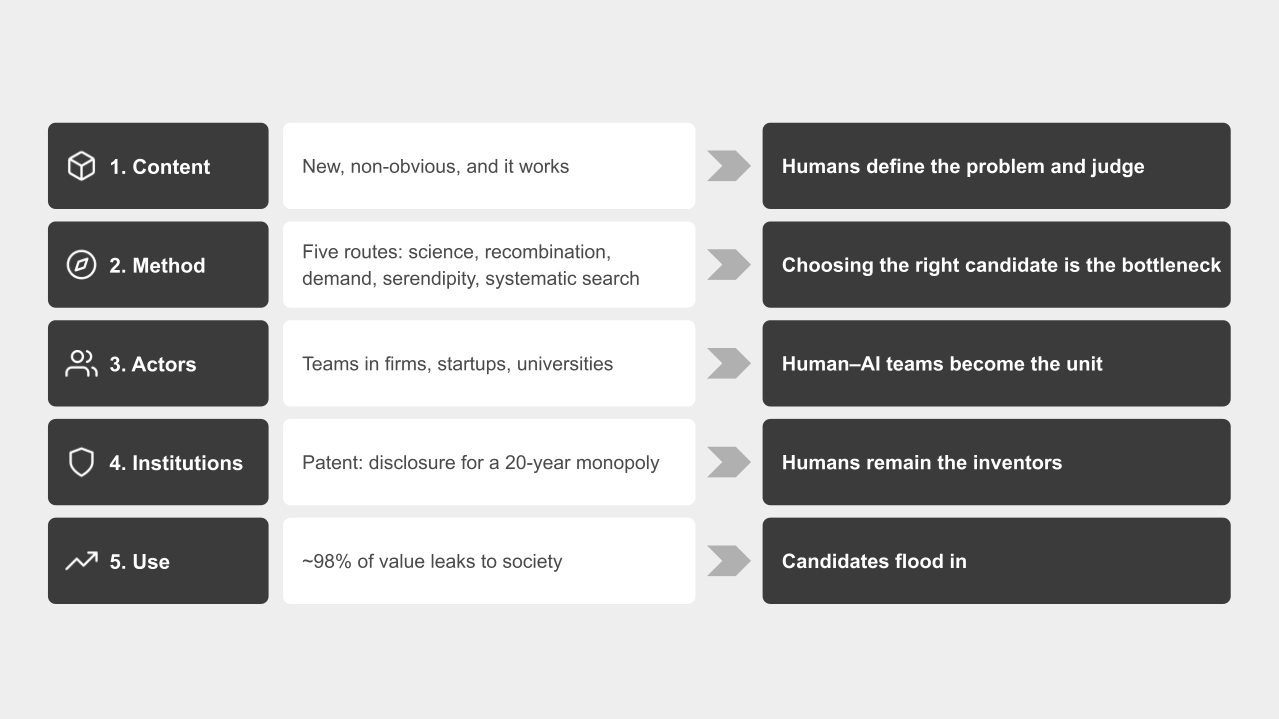
AI has dramatically lowered the barrier to invention—the act of creating something new. So what will inventing look like from here on? In this article we go back to first principles, look back over history, and take stock of how the rapid changes now under way are transforming the act of invention.
This article offers three things that are new.
- A systematic map of invention: We organize the ways great inventions came into being into five pathways—direct descent from science, new combinations, working backward from demand, chance, and systematic search—pairing each with well-known examples and empirical research.
- Comprehensive coverage of theory and methodology: From the adjacent possible to TRIZ and the lead-user method, we bring the descriptive theories that generalize how invention happens and the prescriptive methodologies for "deliberately making invention happen" together in a single overview, showing how they correspond.
- Invention in the age of AI: Drawing on the latest research, we lay out how AI is changing the nature of invention.
What Is Invented
Defining Invention
Let us begin by distinguishing three concepts that everyday language tends to blur together. This distinction underpins the entire article.
- Discovery: finding a fact or law that already existed but was not yet known.
- Examples: the ability of Penicillium mold to kill bacteria, the law of electromagnetic induction, the double-helix structure of DNA. All of these were "already in the world before they were discovered."
- The outputs of research (new theories, new evidence) belong here.
- Invention: using the laws of nature to create a new and useful artifact or method.
- Examples: the process for purifying and mass-producing penicillin, the electric generator, PCR. None of these "existed in the world before they were made."
- The boundary between discovery and invention lies in whether something existed in nature or was made by people. The antibacterial property of Penicillium mold is a discovery; the manufacturing process that turns it into a reliably supplied drug is an invention.
- Innovation: the spread of an invention through the market and society such that it generates economic value.
- Schumpeter drew a sharp line between invention and innovation, holding that an invention is economically meaningless unless it is carried into practice (Schumpeter, 1934). For him, the protagonist of innovation was not the inventor but the entrepreneur who turns an invention into a business.
- Why this distinction matters becomes clear when you consider that both kinds of cases exist: those who invented something but failed to spread it (Xerox PARC, discussed later), and those who invented nothing yet won by handling diffusion alone (many fast followers).
The three form a chain—know, make, spread—but each tests something different. Discovery tests whether something is true; invention tests whether it works; innovation tests whether it "sells (or gets used)."
Invention has a definition that has been in operation for several centuries: the three requirements for patentability.
- Novelty: the invention must not be publicly known anywhere in the world. If it has been made public before filing—in a paper, a product, or a talk—novelty is, as a rule, lost, even if the disclosure was the inventor's own. As with "priority" in research, you must be the first in the world.
- Inventive step / non-obviousness: the invention must not be obvious to an ordinary practitioner in the field. Being new is not enough; something that can be "readily arrived at" from known elements is not regarded as an invention. In terms of the new-combination theory discussed later, even an "unusual combination" lacks an inventive step if it is obvious to a person skilled in the art.
- Industrial applicability / utility: the invention must actually be makeable and usable. Things that cannot work in principle, such as perpetual motion machines, and concepts whose means of implementation have not been specified do not meet this requirement.
Set against the five criteria for research laid out in the Frascati Manual—novelty, creativity, uncertainty, systematicity, and reproducibility (OECD, 2015)—the correspondences become visible. Novelty is shared, and inventive step corresponds to "creativity (based on non-obvious concepts)." Research's "uncertainty," however, is not among the requirements for invention; in its place, industrial applicability is unique to invention. This is where the essential difference between the two lies: research aims at being true, invention at working.
This definition also makes clear what looks like invention but is not.
- A mere idea or notion: it has not taken a working form. The patent system requires disclosure "specific enough that a person skilled in the art could carry it out." The concept of "a machine that flies" is not an invention; the concrete mechanisms for lift and control are.
- Routine improvements: these lack an inventive step. They correspond to "development" in research—changing the size of an existing product, substituting a known material, and the like.
- A discovery in itself: discovering a law of nature is not patentable. E=mc² cannot be patented, but a nuclear reactor that exploits it can. A human gene sequence as such is not an invention, but a method for detecting it can be.
The Four Acts That Make Up Invention
In research, the work could be broken down into four acts: ask, make, verify, and share. Invention, too, can be described—regardless of field—as a combination of the following four acts.
① Define the problem
- Identify what the pain point is and what capability would create value. In the language of TRIZ—a systematic method of thinking and ideation developed in the former Soviet Union, whose name stands for the theory of inventive problem solving—this means finding the "technical contradiction," where improving one thing makes another worse (Altshuller, 1999). For Dyson, the contradiction was that "bag vacuum cleaners lose suction the more you use them"; for the Wright brothers, it was that "stabilizing the wings makes the aircraft uncontrollable."
- This corresponds to "asking a question" in research, but the inventor's question takes the form not of "is it true?" but of "how do we make it work, or make the problem go away?"
② Choose the principle
- Decide which natural law or existing technology to use to solve the problem. Dyson brought the cyclone (centrifugal separation) principle used for dust collection in sawmills into the vacuum cleaner.
③ Make it concrete
- Turn the principle into a form that can actually be built and that works. This act is what separates an invention from an idea. Dyson's 5,127 prototypes and Edison's tests of thousands of filament materials all belong here, and this is where the bulk of the time spent on invention goes.
- C-K theory (Concept-Knowledge Theory) formalized this process as one of "shuttling between concept space (ideas whose truth is not yet determined) and knowledge space (known facts), fleshing out the concept with knowledge" (Hatchuel & Weil, 2009).
④ Show that it works
- Demonstrate, in a reproducible way, that the prototype meets the requirements. This corresponds to "verification" in research, but what is being verified is not whether a claim is true but whether an artifact functions.
- When the patent system requires an "enabling disclosure" and investors ask for a "demo," both are seeking to confirm the outcome of this act.
As with the four acts of research, these form a loop rather than a straight line. If the prototype does not work, you go back to choosing the principle; if it works but the problem was misdefined, you go back to ①.
Classifying Inventions
There are several axes along which an invention—what is new about it, and how—can be classified.
- Classification by object
- The objects of invention are chiefly products and processes.
- US patent law defines patentable subject matter in four categories—process, machine, manufacture, and composition of matter (35 U.S.C. §101)—with the latter three corresponding to "products" and process to "methods." The European Patent Convention covers "inventions in all fields of technology," but in examination practice claims are sorted into the categories of product, process, apparatus, and use (EPC Article 52). Patent laws in many countries, Japan included, adopt this product/process distinction as the basic statutory classification.
- The distinction matters in practice because the acts covered by the right differ by type. A product patent confers exclusive control over making, using, selling, and importing the product, whereas a process patent extends only to use of the process (and, in many jurisdictions, to products obtained directly by that process) (TRIPS Agreement Article 28(1)).
- According to S-curve theory (Utterback & Abernathy, 1975), product inventions dominate the early phase of an industry and process inventions its mature phase. The first question the system asks is "is it a product or a process?"—not "is it radical?"
- Classification by technical field
- The yardstick patent offices actually use to "classify" patents is the technical field. The International Patent Classification (IPC), administered by WIPO, divides all technology into eight sections, from A (human necessities) to H (electricity), and branches hierarchically down to roughly 70,000 subdivisions (WIPO, IPC). The Cooperative Patent Classification (CPC), jointly operated by the US and European patent offices, refines this further into about 250,000.
- Crucially, IPC/CPC only carve up "which technical field"; they do not classify the size of the inventive leap or its economic value. The fundamental transistor patent and its thousandth improvement patent sit side by side under the same classification code.
- Differences in value are approximated after the fact by citation counts. That the number of times a patent is cited correlates with the economic value of the invention was shown early on in an analysis of CT scanner patents (Trajtenberg, 1990), and citation data have also been used to measure how extremely skewed the economic value of patents is—a small number of patents account for most of the total value, while the great majority are nearly worthless (Scherer & Harhoff, 2000).
- Investment in invention therefore follows a distribution close to that of a lottery, and returns can be recovered only through a portfolio (many attempts). Structurally, this mirrors the world of research, where what the system does not classify is instead measured by citations (of papers).
- Classification by degree of advance
- Inventions can be divided into radical and incremental.
- Radical inventions are leaps in performance or principle (e.g., vacuum tube → transistor, film → digital camera).
- Incremental inventions are accumulated improvements within an existing framework.
- Most of the productivity gains in industry are in fact delivered by incremental inventions. The performance gains in semiconductors (Moore's law) are the result of thousands of incremental improvements stacked on top of a single radical invention.
- The patent system does not draw this distinction directly. Examination determines only whether the invention would be obvious to an ordinary practitioner in the field (35 U.S.C. §103; EPC Article 56); it does not grade the size of the leap. Radical or incremental, once an invention clears the threshold it is the same "patent."
- That said, the system does weave this distinction in indirectly, in three ways.
- Basic patents and dependent patents (improvement inventions): When an invention can only be realized by using someone else's patented invention, the improvement can itself be patented, but working it requires a license from the holder of the basic patent. The TRIPS Agreement expressly contemplates this relationship—where "the second patent cannot be exploited without infringing the first patent"—as a dependent patent and sets out the conditions for compulsory licensing to reconcile it (TRIPS Agreement Article 31(l)). This institutionalizes, as a dependency between rights, the cumulative nature of technology—"incremental inventions stand on the radical inventions that preceded them" (see the combinatorial evolution of Arthur (2009), discussed later). The cross-licensing and patent thickets (Shapiro, 2001) discussed later arise from the piling up of these dependencies.
- Utility model ("petty patent") systems: Many countries around the world—Germany (Gebrauchsmuster), China, South Korea, Japan, France, Italy, among others—maintain a separate utility model system that protects "minor inventions" meeting a lower inventive-step threshold than patents (the US and UK have no such system). Examination is typically simplified or dispensed with altogether, the term of protection is 6–10 years, shorter than a patent's 20, and many countries limit coverage to the shape or structure of articles, excluding processes (WIPO, Utility Models). This is a case of the legal system explicitly setting aside a home for incremental inventions.
- The pioneer-invention doctrine: US case law has a tradition of granting broad scope (a wide range of equivalents) to patents on "pioneer inventions" that open up an entirely new field. In an 1898 ruling, the Supreme Court defined a pioneer invention as one that for the first time achieves a function never before known, or that marks a distinct advance over the existing art (Boyden Power-Brake Co. v. Westinghouse, 1898). It is a way of translating radicalness into the breadth of the rights granted.
Methods of Invention
Approaches to Invention
Tracing how the great inventions came about, we can sort them into five broad pathways.
① Direct descent from science
- Analyses of citation chains linking millions of patents and papers show that most patents can be traced back to a scientific paper within a few citation steps, and that a substantial share of papers in turn connect forward to future inventions (Ahmadpoor & Jones, 2017). Inventions with no connection to science are rarer than one might imagine. Moreover, inventions that build directly on scientific papers have been shown to command higher market value (Krieger et al., 2024).
- The conversion from science to invention involves a long lag. Roughly 30% of NIH grants yield papers that are later cited by private-sector patents, but the connection from grant to patent takes many years to form (Li, Azoulay & Sampat, 2017). The middle ground of this lag is the "valley of death" discussed later.
- Examples
- The transistor (1947) emerged from Bell Labs' deliberate research into quantum mechanics—the behavior of electrons in semiconductors. Placing the theorist Bardeen and the experimentalist Brattain in the same group and having them pursue an applied goal ("replace the vacuum tube") and a fundamental question ("the electron theory of solids") simultaneously paid off. It stands as a landmark of Pasteur's-quadrant research (Stokes, 1997), which pursues understanding and utility at once.
- CRISPR-Cas9 (Jinek et al., 2012): a basic-research discovery about the immune mechanism bacteria use to fend off viruses—seemingly unrelated to any application—was converted almost as-is into an invention (a tool) for genome editing. An example of an unusually short distance between discovery and invention.
- mRNA vaccines: Karikó and Weissman's fundamental discovery (2005) that modified nucleosides could evade the immune response bore fruit 15 years later as COVID-19 vaccines. An example of a long distance between discovery and invention.
- Nuclear power, lasers, GPS, MRI: the basic science of the first half of the 20th century—relativity and quantum mechanics—became the parent of the inventions of the second half. Without relativistic time corrections, GPS would be off by several kilometers.
② New combinations of existing elements
- Schumpeter defined innovation as "new combinations" (neue Kombination) (Schumpeter, 1934). Economists have modeled this: because the number of possible combinations grows faster than the number of elements (explosively so), opportunities for invention expand at an accelerating rate as knowledge accumulates (Weitzman, 1998). The implication is an important one: the bottleneck on growth is not the supply of seeds for combination but the processing capacity to try combinations out.
- Empirical patent studies likewise formalize invention as "combinations of existing elements (technology classes) and recombinations of past combinations" (Fleming, 2001). That study quantified the risk-return structure of search: elements combined for the first time fail often but pay off big when they hit, while familiar combinations are safe but mediocre.
- A study analyzing citation combinations across 17.9 million papers found that the highest-impact work has a characteristic composition: mostly conventional combinations plus a single, highly atypical one (Uzzi et al., 2013). Work that is entirely outlandish and work that is entirely conventional both have low impact. The iPhone can be read the same way: an integration of known elements plus one atypical element, the multitouch UI.
- Examples
- Gutenberg's movable-type press (c. 1450) combined existing elements: the wine press (pressure mechanism), metal casting (type), oil-based ink, and paper. Almost none of the parts were new. But the combination cut the cost of copying knowledge by orders of magnitude and became the material foundation of the Reformation and the Scientific Revolution.
- The Wright brothers' airplane (1903) combined the glider (lift), the lightweight gasoline engine (power), and bicycle technology (lightweight structure and a philosophy of control). None of the three was their own invention.
- Container shipping (1956) combined entirely existing elements—boxes, ships, cranes, trucks—by redesigning the whole transport system around a standardized box. McLean's invention was not a part but the manner of combination itself.
- The iPhone (2007) integrated existing technologies: the touchscreen, the mobile phone, the music player, and the internet terminal.
③ Working backward from demand and problems
- A classic empirical finding: 77% of important innovations in scientific instruments were first developed by users, not manufacturers (von Hippel, 2005). The same pattern has been confirmed in semiconductor process equipment.
- The mechanism is information asymmetry. Knowledge of what the real problem is (need information) is concentrated among users; knowledge of how to build a solution (solution information) is concentrated among producers. Need information is tacit and hard to transfer—it is "sticky"—so where stickiness is high, it is faster for users to build things themselves than to convey their needs to producers (von Hippel, 2005).
- The methodology of our commercialization series, which starts from identifying customers' serious problems (customer discovery), can be seen as turning this pathway to invention into a reproducible procedure.
- Examples
- The Haber-Bosch process (1909–13): one of the era's greatest social problems—natural nitrogen fertilizers (Chilean saltpeter, guano) were running out and humanity faced famine—justified concentrated investment in the hard problem of fixing atmospheric nitrogen. Completed after a search through thousands of catalysts (converging with the systematic search discussed below), it today underpins roughly half the food supply of the world's population.
- Radar, mass production of penicillin, electronic computers (codebreaking, ballistics), synthetic rubber, GPS. As we saw in the previous article, large-scale demand concentrates money, talent, and trials on a single point and forces invention into being. Regions and technology fields that received more wartime R&D investment during World War II went on to see inventive activity keep rising for decades after the war (Gross & Sampat, 2023).
- COVID-19 vaccines: pandemic demand compressed the seed of mRNA—a direct descendant of science—into invention and practical deployment in under a year. The latest example of pathways ① and ③ converging.
- The mountain bike was born not from bicycle manufacturers but from young Californians who wanted to ride in the hills and modified existing bikes. Kitesurfing, improvements to heart-lung bypass machines, and many surgical instruments followed the same path. In software, open source (Linux, Git) is the largest example of user innovation: users build what they need and share it.
④ Chance and the prepared mind
- Fleming grasped what the blue mold meant because he was a bacteriologist; Röntgen pursued an "impossible light" because he was an experimental physicist. The same phenomena must have occurred in other laboratories, only to be discarded. This is not simply a matter of good luck—as Pasteur put it, "chance favors the prepared mind." Chance falls on everyone, but only those with deep expertise (an accumulation of Rules, in the terms of the previous article) can read its meaning.
- Instead of discarding an unexpected fact (Result), one forms a hypothesis (Case) that explains it. Serendipity—making valuable discoveries or seizing unexpected good fortune through unforeseen chance, or the capacity to do so—is nothing other than abduction in research (Peirce, 1878). Serendipity can therefore be redefined as "the habit of forming Case hypotheses in response to surprising Results being organizationally sanctioned."
- Chance can be designed. Spaces where people from different fields collide, records that don't throw away failure data, officially sanctioned exploration time (3M's 15% rule)—all are devices for increasing both the number of at-bats chance gets and the probability of noticing.
- Examples
- Penicillin (1928): bacteria had died only around a blue mold that had drifted onto a culture dish. X-rays (1895): during a cathode-ray experiment, Röntgen noticed a fluorescent screen glowing near his shielded apparatus. Vulcanized rubber (1839): Goodyear accidentally dropped a mixture of rubber and sulfur onto a stove and obtained a material that neither melted in heat nor hardened in cold.
- The synthetic dye mauve (1856): 18-year-old Perkin failed to synthesize the antimalarial quinine and, from the purple residue left in his flask, invented the world's first synthetic dye—the starting point of the synthetic chemistry industry itself. The microwave oven (1945): a chocolate bar melted in a pocket in front of a radar magnetron. Post-it Notes (1968→1980): an adhesive that "peeled off easily," born of a failed attempt to develop a strong glue, was combined more than a decade later with an unrelated problem—bookmarks falling out of a hymnal. Viagra: a "side effect" observed in clinical trials of an angina drug became the main effect.
⑤ Systematic search
- TRIZ (the Theory of Inventive Problem Solving) was developed by Soviet patent examiner Altshuller, who analyzed hundreds of thousands of patents and extracted the patterns of invention that recur across fields (Altshuller, 1999). It rests on two core insights. First, invention is the resolution of a technical contradiction (improving one thing makes another worse). Second, the ways of resolving contradictions are not infinite; they converge on "40 inventive principles" (segmentation, asymmetry, nesting, preliminary action, self-service, inversion, and so on). In other words: the contradiction you face has already been solved by someone in another field. TRIZ provides a procedure for abstracting your problem, consulting the catalog of principles, and re-specifying the solution in your own field.
- The success of systematic search is determined by the design of the search space (what range to sweep) and by the cost and time per trial. Whoever drives down the cost of a trial wins.
- Examples
- Edison's Menlo Park laboratory tested thousands of candidate filament materials for the light bulb. "Genius is 1% inspiration and 99% perspiration" is not a motivational slogan but a declaration of search strategy. And it is often said that Edison's greatest invention was not any individual product but the organization that produced inventions industrially—the research laboratory itself.
- The Haber-Bosch process reached its practical (iron-based) catalyst by systematically testing more than 2,500 candidates. Dyson built 5,127 prototypes before its cyclonic vacuum cleaner was ready for market. High-throughput screening in drug discovery is the industrialization of systematic search, with robots mechanically testing hundreds of thousands to millions of compounds.
Theories of Invention
This section organizes the theoretical accounts of invention.
- The adjacent possible
- Invention can only open up the region of possibility space "right next door" (Kauffman, 2000).
- No genius can invent before the parts and the knowledge are in place. Da Vinci conceived of a helicopter, but in an era lacking the adjacent component of a power source he could not invent one. Conversely, the moment the parts come together, several people arrive at the invention at once.
- The telephone (Bell and Gray filed patents on the same day in 1876), calculus (Newton and Leibniz), the discovery of oxygen (Scheele and Priestley), evolution (Darwin and Wallace), the airplane (the Wright brothers and their competitors in various countries)—a classic study documented 148 important inventions and discoveries made independently by multiple people at around the same time (Ogburn & Thomas, 1922), showing that invention is the product not only of individual genius but of the moment when an era's adjacent possible opens up.
- Inventive competition is rarely about "who thinks of it"; more often it is about "who is the first to see an idea through once it becomes adjacent-possible." That is why the patent system needs a mechanism for rigorously determining who filed first.
- Combinatorial evolution of technology
- Every technology is a combination of existing technologies, and every new technology becomes a component of future combinations (Arthur, 2009).
- Technologies "evolve" along family trees much like living organisms. Every invention has ancestors: the steam engine led to the steam turbine, which led to the jet engine (Basalla, 1988). The historian of technology Basalla demonstrated that "no invention is without ancestors" through a vast body of cases spanning from the steam engine to the transistor.
- This is the macro-level counterpart of the new-combinations theory (Weitzman, 1998; Fleming, 2001), and it explains the "compounding" structure whereby invention accelerates as the total stock of technology grows.
- Exaptation (repurposing)
- A technology built for one purpose flourishes in an entirely different use.
- The concept originates in evolutionary biology: feathers evolved for insulation and were later "exapted" for flight (Gould & Vrba, 1982). Technology works the same way: the magnetron (radar) became the microwave oven, sildenafil (angina) became Viagra, Teflon (military and nuclear applications) became the non-stick frying pan, and the internet (a military and academic network) became commercial infrastructure.
- The value of an invention is never confined to its inventor's intentions. This is precisely why publishing inventions without restricting their uses increases the total volume of invention across society.
- Analogical transfer
- Borrowing structures from other fields or from nature
- Velcro imitates the way burdock burrs cling to clothing. The nose of the 500 Series Shinkansen is modeled on a kingfisher's beak (solving the problem of tunnel micro-pressure waves). Biomimetics is the industrialization of this pathway.
- An ethnographic study of the product design firm IDEO showed that the source of its inventive power was not individual genius but an organizational process of "technology brokering": carrying the memory of solutions seen across many industries into the problems of another (Hargadon & Sutton, 1997). Analogy is not a personal talent; it can be accumulated and deployed organizationally.
- The S-curve and dominant design
- The performance of a new technology traces an S-curve—slow, then rapid, then plateauing—and an industry passes through a period of proliferating designs before converging on a single dominant design (Utterback & Abernathy, 1975).
- In the early automobile era, steam, electric, and gasoline cars competed until the Model T became the dominant design. The same happened with IBM PC compatibles in personal computing and the iPhone form factor (full-face touchscreen) in smartphones.
- The opportunity for product invention peaks during the period of proliferation before convergence; afterward, the center of gravity shifts to process invention (improving how things are made). Judging "where we are on the S-curve right now" determines the timing of investment in invention.
- Constraint-driven invention
- The carbon dioxide filter on Apollo 13 was invented within hours under the extreme constraint of "only what is on board the spacecraft." For the shipping container, the self-imposed constraint of "standardization" is the very source of its value. Early Twitter's 140-character limit gave rise to a new form of expression.
- According to a review synthesizing 145 empirical studies, constraints on resources, time, and requirements actually enhance creativity and innovation when kept at moderate levels, whereas in a constraint-free environment people drift toward the solutions they know best (Acar, Tarakci & van Knippenberg, 2019). TRIZ's contradiction resolution (discussed above) rests on the same idea. Rather than avoiding constraints, one can use them as coordinates pointing to the breakthrough.
Methodologies of invention
This section organizes the theories above into procedures that can actually be executed.
- TRIZ (Theory of Inventive Problem Solving)
- Proceduralizing ⑤ systematic search plus analogy (Altshuller, 1999)
- Procedure: identify the contradiction → abstract it using the 39 engineering parameters → look up the applicable inventive principles in the contradiction matrix → re-concretize them for your own field.
- It is most powerful for problems with a clearly defined engineering contradiction, and major manufacturers such as Samsung have built it into their training programs.
- The lead user method
- Proceduralizing ③ user innovation (von Hippel, 1986)
- Procedure: rather than the market's average users, seek out "advanced users whose needs run several years ahead of the market and who have already begun building their own solutions," and use those solutions as seeds for productization.
- Innovations in surgical drapes were inspired by military field hospitals and veterinarians, who were at the cutting edge of infection control.
- It has been empirically shown that projects at 3M using this method produced product concepts with sales forecasts roughly eight times higher than those of projects using conventional methods (Lilien et al., 2002).
- Design thinking
- Proceduralizing ③ working backward from demand plus ④ insight (Brown, 2008)
- Procedure: observe (immerse yourself in the user's environment) → reframe the problem → diverge (brainstorm) → prototype → test, and iterate.
- Its essence lies in making the search for "the right problem" an explicit step that precedes the search for "the right answer."
- GE Healthcare's pediatric MRI (which reframed the scan as an "adventure" and dramatically reduced the use of sedatives)
- Biomimetics
- Proceduralizing analogical transfer (Benyus, 1997)
- It treats living organisms as a catalog of problems that 3.8 billion years of evolution have already solved: Velcro, the kingfisher-nosed Shinkansen, gecko feet (adhesion), the lotus leaf (water-repellent coatings), and termite mounds (natural ventilation in buildings).
- C-K theory (Concept-Knowledge theory)
- Formalizing the logical structure of invention (Hatchuel & Weil, 2009)
- It formalizes design as a back-and-forth between a "knowledge space (K)" of what is already known and a "concept space (C)" of propositions whose truth is not yet determined. By treating the process of "nurturing the definition of something that does not yet exist while fleshing it out with knowledge" as a design science, it has come to be used in curricula for teaching invention.
- First-principles thinking
- Working backward from physical limits
- Rebuild from the fundamentals of physical law and cost structure, rather than from convention or analogy.
- SpaceX's reasoning: a rocket's raw materials account for only a few percent of the price of the finished vehicle, so reusing it should cut costs by an order of magnitude.
- This is the same idea as TRIZ's injunction to "work backward from the ideal solution (Ideality)" (Altshuller, 1999).
What these tools have in common is a philosophy that turns invention from "waiting for a flash of inspiration" into "a process whose number of trials and success rate can be designed." Which tool to use depends on which pathway the problem at hand belongs to.
- It is unclear what should be built (needs have not been articulated) → reframe the problem with design thinking, and use the lead user method to find the solutions of advanced users (von Hippel, 1986; Brown, 2008).
- What should be built is clear, but a technical contradiction is blocking progress → abstract the contradiction with TRIZ and draw on solution principles from other fields (Altshuller, 1999). If nature has faced a similar problem, turn to biomimetics (Benyus, 1997).
- A new scientific seed exists and is looking for a use → searching for uses is the deliberate execution of exaptation (Gould & Vrba, 1982). List the properties of the seed and look for domains where they would "resolve a contradiction."
- The search space is vast and no one knows what will hit → design a systematic search. Invest in lowering the cost and raising the speed of each individual trial (the implication of ⑤ discussed above).
- Existing assumptions are shared across the entire industry → use first-principles thinking to rebuild those assumptions from physical limits. Disruptive innovation (Christensen, 1997) frequently emerges from this pathway.
Who invents
How the agents of invention have shifted
The people and institutions that carry out invention have also changed hands over the course of history.
- Up to the 18th century: artisans and individual inventors
- Inventions accumulated and improved as unwritten skills within the apprenticeship systems of craft trades. Guilds protected the value of those skills by keeping them secret (see the tradition of secrecy discussed below).
- Examples: Gutenberg (a goldsmith), Hargreaves (a weaver; the spinning jenny), Watt (an instrument maker; improvements to the steam engine). Most of the inventors of the Industrial Revolution were artisans, not scientists.
- 19th century: the age of the independent inventor
- With the development of patent systems, the "professional inventor" who made a living by selling inventions came into being. Edison, Bell, Tesla, and Daimler all fit this mold.
- Example: Edison's Menlo Park laboratory (1876) marked the turning point at which the individual inventor was organized into an "invention factory." From here the transition to the corporate research laboratory began.
- 20th century: the age of corporate central laboratories and government
- GE Research Laboratory (1900), DuPont, and Bell Labs (1925) established a system for producing inventions systematically by employing scientists. The transistor, nylon, and the laser all came out of this model.
- Through war and the Cold War, government became the largest commissioner of invention (Gross & Sampat, 2023). The Manhattan Project, the Apollo program, and ARPANET are products of this era.
- Late 20th century to the present: the age of specialization and startups
- As large corporations withdrew from science, the landscape shifted to a division of labor in which "universities do the science, startups do the inventing, and large corporations handle acquisition and scaling" (Arora et al., 2020). Biotech ventures (Genentech, 1976) were the prototype of this division of labor, and AI startups are its latest form.
- In parallel, users came to be recognized as agents of invention in their own right (von Hippel, 2005). Open source is the most extensive institutionalization of this.
Comparing the characteristics of the agents of invention
Here we compare today's principal agents of invention along the same four dimensions used to compare research actors in our previous article.
- Funding source: whose money funds the invention, and at what scale
- Center of gravity: where among the five pathways (direct descent from science, new combinations, demand, serendipity, systematic search) the actor's footing lies, and whether it supplies seeds or concretizes them
- Speed: the agility of decision-making and of the prototype-and-test cycle
- Openness: how far inventions are opened up (the choice among patents, papers, secrecy, and open source)
Using these four dimensions, we compare six types of actors.
- Universities
- MIT, Stanford University, the University of Cambridge, and others
- Their strength is supplying the "seeds" of invention. Inventions descending directly from science (the principle of the transistor, CRISPR, mRNA) come almost exclusively from universities and research institutes. Their constraint is the capacity for concretization (prototyping, mass production, sales); most university inventions are concretized externally, through licensing or the founding of startups (Arora et al., 2020).
- Funding source: government grants and industry-academia collaboration funding. The scale per project is small.
- Center of gravity: direct descent from science (the side closer to discovery). They produce the seeds, but others cultivate them.
- Speed: slow (rate-limited by grant cycles and by teaching duties).
- Openness: the highest. They disclose through both papers and patents, and the paper often comes first (see the paired publication discussed above).
- Government research institutions and the military
- NASA, DARPA, Los Alamos National Laboratory, CERN, and others
- Their strength is shouldering scale and risk that the private sector cannot; regions and fields that received wartime R&D procurement saw a sustained, long-term increase in inventive activity after the war (Gross & Sampat, 2023). Their constraint is distance from the market: the stage of turning inventions into products is left to the private sector (as with the civilian release of GPS and ARPANET).
- Funding source: government budgets. Stable and large-scale.
- Center of gravity: mission-driven (national security, space, energy). Working backward from demand and systematic search.
- Speed: slow in peacetime (bureaucracy), but the fastest of all when a national priority is at stake (Manhattan Project-style mobilization).
- Openness: two-tiered, classified and public. The typical pathway is secrecy for military applications, followed by civilian release once the technology matures.
- Corporate research laboratories and development divisions
- Bell Labs, Xerox PARC, GE Research Laboratory, Google Research, Lockheed's Skunk Works, and others
- Their strength lies in the ability to concretize and scale, along with the absorptive capacity to spot promising inventions from outside (Cohen & Levinthal, 1990). The great corporate laboratories of the past were deliberately designed to make the five pathways converge inside the organization. Bell Labs housed basic researchers and engineers in the same building so they would collide in the corridors (disciplines under one roof + a long time horizon + a clear mission), and turned out the transistor, information theory, and UNIX. The free-time programs at 3M and Google (15–20% of working hours for self-directed research) produced the Post-it Note and Gmail, effectively using policy to buy more "at-bats" for serendipity. Skunk Works isolated a small elite team from the parent company's bureaucracy and invented the U-2 and SR-71 in remarkably short order. The constraints are the structural weakness in the face of architectural and disruptive innovation described earlier (Henderson & Clark, 1990; Christensen, 1997), and the retreat from science under short-term profit pressure. PARC (the Palo Alto Research Center) invented but could not harvest, and large corporations as a whole shifted to a stance of "inventions are something you buy" (Arora et al., 2020)
- Funding source: internal revenue, tied to the business cycle and management priorities
- Center of gravity: applied inventions and process inventions that connect to the company's own products; new combinations and systematic search
- Speed: medium (funding decisions are made entirely in-house, but the pace is set by coordination with existing businesses)
- Openness: selective. Patents are filed, but publications are declining. What is sold (substitutes) is kept closed; what drives adoption (complements) is opened up
- Startups and emerging research companies
- OpenAI, SpaceX, Moderna, Genentech (the pioneer), and others
- Their strength is single-minded focus unencumbered by legacy assets, which lets them take on the role of concretizing competence-destroying, disruptive inventions and creating their initial markets. Their constraint is the lack of complementary assets (manufacturing, distribution networks, regulatory capability), which forces the choice between going it alone and partnering with an incumbent (Gans & Stern, 2003). When they fail, the knowledge they built tends to scatter with them
- Funding source: venture capital and large investors. Risk capital that is both enormous and concentrated on a single bet
- Center of gravity: applied to Pasteur's-quadrant work. Concretization and initial commercialization; working backward from demand, and new combinations
- Speed: the fastest. Decisions are made in days, with no grant cycles and no existing businesses to coordinate with
- Openness: shifts strategically (open early on to attract talent, closing up once an advantage is secured)
- Nonprofits and emerging research organizations
- The Howard Hughes Medical Institute (HHMI), the Allen Institute, the Arc Institute, FROs, and others
- Their strength is long-term, high-risk exploration free from the constraints of the grant system, and the effect has been demonstrated empirically. Comparing researchers of the same caliber, those who received long-term, unconditional, failure-tolerant funding (the HHMI model: five-year renewals, investing in people rather than results) were significantly more likely to produce breakthrough work (the top 1% by citations) than researchers on standard short-term, results-linked grants (the NIH R01 model), and they also failed more often (Azoulay, Graff Zivin & Manso, 2011). Exploration structurally requires "time in which it is acceptable to fail," and management that reduces failures also reduces hits. The constraints are limits of scale and dependence on the wishes of funders
- Funding source: foundation endowments and donations. Freer than government, longer-term than corporations
- Center of gravity: supplying seeds in basic and high-risk domains, taking risks that neither government grants nor corporations will take
- Speed: medium to fast (thin bureaucracy)
- Openness: high (providing databases and tools as public goods is often part of the mission)
- Individual inventors and users
- Independent inventors, open-source developers, users who improve their own tools, and others
- Their strength is direct access to information about needs. Those who know best what the real problem is are the users themselves (von Hippel, 2005), and statistically, households are among the largest inventing entities of all (von Hippel, de Jong & Flowers, 2012; discussed below). Their constraint is the resources needed for concretization, mass production, and securing rights, which gives rise to a "market failure in diffusion": once an invention satisfies its creator's own need, it never reaches the market
- Funding source: personal funds, crowdfunding, small grants
- Center of gravity: solving the problems they themselves face, in domains with light capital requirements (software, tool improvements); working backward from demand
- Speed: the fastest (no organizational coordination whatsoever is required)
- Openness: high (open source, community sharing)
From the above, the following patterns emerge.
- Viewed through these four lenses, it becomes clear that, just as in research, the nature of the funding (whose money it is) largely determines an invention's center of gravity, speed, and openness. Government and foundation money tends toward the long term, the supply of seeds, and openness; market money tends toward the short term, concretization, and selective openness.
- What is unique to the world of invention is that the location of the capacity to concretize (prototyping and mass production) determines the division of labor among actors. The fact that those who hold the seeds (universities, nonprofits, individuals) are different from those who can concretize them (corporations, startups) gives rise to the problems of institutions (licensing, patents) and utilization (complementary assets) discussed later.
- In the United States, since the 1980s, large corporations have withdrawn from science, and a division of labor has taken hold in which universities do the science, startups do the inventing, and large corporations acquire and scale. Researchers warn, however, that this division of labor makes it harder to produce the kind of major inventions that emerged from the Bell Labs model of "science and invention under one roof" (Arora et al., 2020).
Cutting across the types of actors, the following empirical findings have accumulated on the question of who invents.
- The end of the "lone inventor" myth
- Evidence: According to a study analyzing 19.9 million papers and 2.1 million patents over 50 years, production by teams has come to dominate over solo production in both science and invention, and the most highly cited work is increasingly team-generated (Wuchty, Jones & Uzzi, 2007). In patents, the tendency for team-generated patents to earn higher citations than solo patents has grown stronger year by year
- The background is the "burden of knowledge" (Jones, 2009): as the total stock of knowledge has grown, all the knowledge needed to invent no longer fits in a single head. The age at which inventors produce their first invention is rising, specializations are narrowing, and teams are getting larger. One could say that the Edison-style individual inventor was possible only because, in that era, the space of the adjacent possible still fit inside one person's mind
- Knowledge lives in people
- When prominent life scientists died unexpectedly, the publication productivity of their collaborators fell by an average of 5–8% on a lasting basis (Azoulay, Graff Zivin & Wang, 2010). The papers remained, yet productivity dropped. A substantial portion of the knowledge needed for invention and discovery is not written down in papers; it exists as tacit knowledge inside people. The acqui-hires and soaring researcher compensation seen in the research industry can be read as the market pricing in this fact
- Inventors are made by exposure, not by birth
- According to a study linking 1.2 million U.S. inventors to tax records, children who grew up close to inventors (in regions with abundant inventive activity, or with inventor parents or parents' colleagues) were far more likely to become inventors as adults. The exposure effect is field-specific: if a parent's colleague is a medical device inventor, the child is more likely to become an inventor in medical devices too. Even with identical math scores, children from low-income families, girls, and minority children are less likely to become inventors. There exist vast numbers of "Lost Einsteins," people who had the talent but never became inventors because of their environment (Bell et al., 2019)
- The supply of inventors is determined not by the distribution of talent but by the distribution of exposure. Education and role-model policies (initiatives that present learners with, and match them to, concrete "role models" in order to powerfully encourage future career formation, greater motivation to learn, or entry into a specific field) are not only policies of fairness but policies that increase the total amount of invention
- Immigrants and invention
- Immigrants make up 16% of U.S. inventors, yet they account for 23% of inventive output as measured by patents, citations, and economic value, and when spillovers through collaboration are included (the productivity gains of U.S.-born inventors who worked with immigrants), their contribution reaches roughly 36% (Bernstein et al., 2022). This is nation-scale empirical evidence that boundary-crossers carry unusual combinations with them (the "single point of novelty" of Uzzi et al. (2013) discussed earlier)
- Boundary-crossers and brokers: people who carry "answers that already exist" from another field
- Often what blocks invention is not that no solution exists, but that the solution already exists in another field while the people in the field with the problem do not know about it. People in field A know A's problems but not B's solutions; people in field B know B's solutions but not A's problems. Only someone who knows both can connect the two. That is why people with a foot in two or more worlds (boundary-crossers) produce a disproportionate share of inventions
- An ethnographic study of the product design firm IDEO (Hargadon & Sutton, 1997) showed that this boundary-crossing can be built into a company's systems rather than left to individual talent. Because IDEO takes on design work from many industries, including medical devices, toys, computers, and furniture, it structurally has abundant opportunities to carry solutions across industries: a hinge mechanism used in a toy into a medical device, the structure of a bicycle water bottle into a medical pump. And rather than leaving this to chance, IDEO made it happen deliberately through its operating practices: staff always juggle projects from multiple industries, cross-project brainstorming sessions are held frequently, a "Tech Box" of interesting parts and materials serves as a shared memory device, and bringing in other people's ideas is rewarded.
- Example: Daguerre (stage designer → photography) used the camera obscura (an optical device) on a daily basis to paint realistic backdrops, while also dabbling in chemistry. Because he knew both "forming an image with optics" and "fixing an image with chemistry," he could connect the two, and the result was photography. Neither an optician alone nor a chemist alone would have produced that combination
- Example: Dunlop (veterinarian → pneumatic tire) was no bicycle expert. Watching his son's tricycle judder over cobblestones, he brought in a solution, "absorb the shock with a cushion of air," using the rubber tubing and air he was accustomed to handling in his veterinary work. The bicycle industry had been unable to escape the assumption that a tire was a solid mass of rubber
- Example: the Wright brothers (bicycle shop → airplane). Their competitors at the time, thinking in terms of ships and carriages, aimed for a craft that would stabilize itself even when the pilot let go of the controls. The brothers, who saw every day a machine that "falls over if you let go, and is kept stable by the rider's continuous input," arrived at the opposite design philosophy: an airplane may be unstable, so long as the pilot controls it, and they built a mechanism that twisted the wings to control banking (wing warping). The first people to fly with full control were not aviation specialists but boundary-crossers who carried the logic of the bicycle into aviation
- User inventors: the "person with the problem" has already done half the inventing
- The information needed for invention is split across two places. Information about needs, what is missing, exists only among the people using the product in the field, while information about solutions, how it can be built, sits with the manufacturer. Need information is hard to articulate and convey because it is apparent only in the moment of use and often not even consciously registered by the user, and when manufacturers try to elicit it through market research, the average customer cannot describe something that does not yet exist. Users who have a strong need and a modicum of technical skill, on the other hand, do not wait; they build it themselves (von Hippel, 2005)
- von Hippel (1986) coined the term "lead users" for people who confront new needs years ahead of the broader market and who stand to gain substantially once those needs are met. People who satisfy both conditions have usually already built prototypes of their own. For a company, this opens up a method of invention that skips inventing from scratch: find the people who have already half-invented the solution, and turn their solution into a product. That is what it means to say that finding lead users is itself an inventive method.
- Examples: In scientific instruments, 77% of new products originated in devices that user-scientists had built for themselves (von Hippel, 1976). The mountain bike was born when Californian enthusiasts modified off-the-shelf bicycles, and many surgical instruments originate with surgeons. Open-source software can be seen as the largest institutionalization of this pattern.
- Invention clusters geographically
- Historically, invention has concentrated in cities and clusters: Renaissance Florence, Birmingham during the Industrial Revolution, twentieth-century Detroit, Silicon Valley today. Because knowledge spillovers (the flip side of the public-good nature identified by Nelson (1959) and Arrow (1962)) decay with distance, new combinations occur more frequently in places where people mix densely.
- Combine the "exposure" effect of Bell et al. (2019) with the finding of Azoulay et al. (2010) that knowledge resides in people, and geographic clustering also emerges as a mechanism that reproduces itself across generations.
- The optimal composition of an inventing team
- Taken together, these empirical findings yield design principles for inventing teams, whatever kind of actor is involved: work as a team (Wuchty et al., 2007); acquire knowledge by bringing in the people who carry it (Azoulay et al., 2010); include boundary-crossers (Bernstein et al., 2022; Hargadon & Sutton, 1997); include users who hold information about needs (von Hippel, 2005); and allow time in which failure is tolerated (Azoulay et al., 2011).
- For the mix itself, the "conventional core plus one atypical element" pattern from Uzzi et al. (2013), discussed above, applies directly. Build most of the team from deep specialists in the problem domain, then add one or two people from other fields. If everyone comes from outside, there is no foundation; if everyone comes from the same field, no unusual combinations arise.
- This composition is also a staffing plan for running several of the five routes described above in parallel, that is, for engineering their convergence. The specialists cover the direct line from science and systematic search; the boundary-crossers cover new combinations and analogy; the users cover working backward from demand.
The institutions of invention
Where the institutions of research were built to reward disclosure with recognition, the institutions of invention reward disclosure with a temporary monopoly. The two are twins born of the same design philosophy.
Sharing inventions
- Prehistory: the age of secrecy (to the 15th century)
- The structural problem: Disclosing an invention brought no benefit, only the loss of being copied. The more rational the inventor, the more likely they were to keep their invention hidden. As a result, skills died with the craftsmen who held them, and other inventors solved the same problems over and over again.
- Examples: Craft guilds kept skills locked inside the apprenticeship system, never wrote down their recipes, and forbade skills from leaving the city. Venetian glassmakers were confined to the island of Murano, and leaving carried severe criminal penalties.
- 15th–18th centuries: the invention of the patent system (trading disclosure for monopoly)
- The Venetian Patent Statute of 1474 is generally regarded as the world's first systematic patent law: it granted inventors of new and useful devices a ten-year monopoly in exchange for registering, and thus disclosing, the invention. England's Statute of Monopolies of 1624 prohibited the Crown from granting monopolies at its own discretion and permitted only time-limited patents to the "true and first inventor." The line continues to the U.S. Patent Act of 1790 (the U.S. Constitution had given Congress the power to secure exclusive rights to inventors for limited times "to promote the progress of science and useful arts").
- Design philosophy: As we saw in the previous article, science inverted the incentive for secrecy through an institution that rewards disclosure with recognition, in the form of priority (Merton, 1942). The patent is the same kind of bargain: disclosure in exchange for a temporary monopoly. The currency of the reward differs, honor in one case and money in the other, but the design is identical: reward those who disclose rather than hide, and make the disclosed knowledge available to everyone who comes after. Scientific priority and the patent can be regarded as twin institutional inventions for keeping knowledge from being hidden.
- In the process, the patent system acquired the same four functions we identified for the academic journal in the previous article: registration (fixing priority by filing date), certification (guaranteeing novelty and inventive step through examination), dissemination (publication in official gazettes), and archiving (the body of patent literature). TRIZ, discussed above, was born from rereading this archive as a database of human invention (Altshuller, 1999).
- 19th century: internationalization (priority across borders)
- Once the Industrial Revolution set inventions circulating across borders, a new problem arose: an invention filed in one country could become public knowledge in another, making it unpatentable there. The Paris Convention of 1883 created a priority system under which the filing date in one member country is recognized as the priority date in all the others, and it established national treatment, the same protection for foreigners as for nationals, as a basic principle (Paris Convention, 1883). Just as international co-authorship in research created an international community sharing the same norms, the Paris Convention created an international commons of invention sharing the same priority rules.
- As simultaneous invention shows (Ogburn & Thomas, 1922), several people arriving at the same invention at around the same time is the norm, not the exception. Institutions therefore need a mechanical rule for deciding who was first. The first-to-file principle, now adopted almost everywhere in the world, favors whoever filed first (the United States switched from first-to-invent in 2013). Just as priority in research goes to whoever published first, the institution defines "first" not as the moment of having the idea but as the moment of putting it on the public record. This is what creates the incentive to disclose early rather than hide.
- 20th century: unified procedures and global minimum standards
- The Patent Cooperation Treaty (PCT) of 1970 standardized a procedure whereby a single international application secures a filing date in every member state and is published internationally 18 months after filing (PCT, 1970). The rule that an application will, without exception, be published at 18 months fixed a single worldwide balance between secrecy and disclosure.
- The TRIPS Agreement of 1994 obliged all WTO members to meet a minimum standard: 20 years of patent protection in all fields of technology, for products and processes alike (TRIPS Agreement, Articles 27 and 33). In the same period as the international scientific collaborations discussed in the previous article (CERN, the Human Genome Project), the institutions of invention likewise acquired a shared international foundation.
- Late 20th century to the present: opening up, and designing what to open and what to close
- Open source (from Linux in 1991 onward) produced a sharing institution that renounces monopoly through patents and copyright and instead guarantees, by contract, the freedom to disclose and improve. The demand-side economic value of open-source software has been estimated at roughly $8.8 trillion (Hoffmann, Nagle & Zhou, 2024).
- Technical standards (USB, Wi-Fi, 5G) consolidate patents from multiple companies into a single specification and require standard-essential patents to be licensed to all comers on fair, reasonable, and non-discriminatory (FRAND) terms. They are an institutional device that makes monopoly and diffusion coexist, and their economic design has been analyzed theoretically as well (Lerner & Tirole, 2015).
- Patent pledges (such as Tesla opening its electric-vehicle patents in 2014) are a new form of sharing in which a company voluntarily declares that it will not enforce its patent rights. Like the Bermuda Principles (immediate release of human genome sequence data), the design is to turn the pre-competitive knowledge base into a commons.
- The unit of sharing is also expanding, from patent documents to design data, source code, and trained models, in parallel with the shift in research from papers to data and code.
The greatest asset produced by this history of sharing institutions is a commons of invention that transcends national borders. As with research, it rests on two layers: norms and institutions.
- The layer of norms: a shared understanding that those who disclose are rewarded
- A reward (exclusive rights) designed to make disclosure rather than secrecy the rational choice, together with official gazettes in which anyone can read the disclosed knowledge, flipped inventors' behavioral norm from "hide" to "publish."
- Citation data and surveys confirm that published patents are in fact read and used in subsequent inventions. In a survey of nanotechnology researchers, 64% reported reading patent literature, and many of them said they had obtained useful technical information from patents (Ouellette, 2012). The citation chains identified by Ahmadpoor & Jones (2017), discussed above, show that disclosed inventions function as components of the next inventions (the combinatorial evolution described earlier; Arthur, 2009).
- The layer of institutions: a shared international foundation
- The Paris Convention (priority and national treatment), the PCT (unified procedures), TRIPS (minimum standards), and the IPC (a common classification language; WIPO, IPC) together make it possible to share inventions across borders.
- Deciding what to hold in common and what to keep proprietary is the framework of open–closed strategy, and its rule applies directly: close what you sell (substitutes) and open what promotes use (complements). Open source, technical standards, and patent pledges are all designs that open the complement side in order to grow an ecosystem.
- Current challenges for norms and institutions
- In electronics and software, thousands of patents overlap in a single product, and the cost of negotiating with rights holders itself becomes a barrier to invention (Shapiro, 2001). Cross-licensing, patent pools, and technical standards developed as ways through this thicket.
- Just as the openness of research is being renegotiated, tightening export controls and technology-transfer regulations are fragmenting the commons of invention.
- The premises of the system itself are being called into question: must an inventor be a natural person, and how should the inventive step of an AI-generated candidate be assessed?
How inventions are evaluated
Just as journal peer review evaluates research against five criteria, patent office examination evaluates inventions against a shared set of criteria. Those common to the world's major systems boil down to the following five.
- Novelty: the invention must not be publicly known anywhere in the world (TRIPS Agreement, Article 27(1); 35 U.S.C. §102). As with novelty in research, it must be a world first.
- Inventive step / non-obviousness: the invention must not be obvious to a person of ordinary skill in the field (35 U.S.C. §103; European Patent Convention, Article 56). This corresponds to "creativity" in research.
- Industrial applicability / utility: the invention must be capable of actually being made and used (TRIPS Agreement, Article 27(1)). This criterion is unique to invention and has no counterpart among the five criteria for research.
- Enablement / sufficiency of disclosure: the invention must be disclosed in enough detail that a person skilled in the art can reproduce it from the specification (35 U.S.C. §112; European Patent Convention, Article 83). This corresponds to "reproducibility" and "clarity" in research, and it secures the disclosure side of the bargain of monopoly in exchange for disclosure.
- Patentable subject matter: laws of nature, abstract ideas, and natural phenomena as such are excluded (35 U.S.C. §101; European Patent Convention, Article 52). This is the criterion that institutionalizes the principle that a discovery is not an invention.
Mapped onto research peer review, novelty and inventive step sit close to peer review's "novelty and significance," enablement to its "soundness and clarity," and patentable subject matter to its "fit." The decisive difference is that peer review asks whether something is true, whereas patent examination asks whether it works, that is, whether it can be carried out.
This evaluation method, however, has its limits.
- Inventive step is binary; it does not measure value
- Examination only decides whether an invention has cleared the threshold; it does not grade the value of the invention or the size of the leap. As a result, the economic value of patents is extremely skewed: a small number of patents account for the bulk of total value, while the great majority are close to worthless (Scherer & Harhoff, 2000). Value is only approximated after the fact, via citation counts (Trajtenberg, 1990)—the same structure as citations in research.
- Variation in examiner judgment
- The outcome of patent examination depends on who does the examining. U.S. Patent Office data show that more experienced examiners are more likely to grant patents and cite less prior art (Lemley & Sampat, 2012). This noise—whether the same invention becomes a patent can depend on the examiner—is structurally built into the system.
- The patent system does not necessarily promote invention
- The patent system is explained as "promoting invention by granting monopolies," but whether it actually does so is an empirical question, and the answer is "it depends on the field and the conditions."
- Countries without patents still invented, but in skewed fields: A country-by-country analysis of exhibits at the 19th-century world's fairs (London 1851, Philadelphia 1876) shows that Switzerland, the Netherlands and Denmark, none of which had patent laws, also displayed high levels of inventive activity—but their inventions were concentrated in fields that could be protected by secrecy (chemicals, food, scientific instruments), with few in mechanical fields where imitation is easy (Moser, 2005). The patent system affects the direction of invention more than its quantity.
- Rights that are too strong reduce follow-on invention: In the sequencing of the human genome, a comparison of genes published by the public project with genes that a private company temporarily protected as intellectual property shows that the protected genes saw 20–30% less subsequent scientific research and diagnostic product development (Williams, 2013). Although the protection was temporary (around two years), the effect persisted over the long term. Rights that protect an invention can impede the next inventions that use it as a component (the combinatorial evolution described earlier).
- Rather than an "all-purpose device for promoting invention," patents are more accurately understood as a device that "forces disclosure of inventions that cannot be protected by secrecy and sustains investment in fields where imitation is cheap." Given that inventions can only stand on prior inventions, there is an optimal level of rights strength; beyond it, follow-on invention is blocked. Patents carry an inherent contradiction: a system meant to promote invention can end up obstructing it.
- Determining inventorship
- Examination also requires identifying the "inventors." Whose contribution was inventive (a contribution to conception) and whose was mere labor (execution as instructed)—an attribution problem of the same shape as author order and CRediT in research—exists here as a legal question of rights. Misidentifying the inventors can invalidate the patent itself. As AI enters the inventive process, this attribution problem is forcing a renegotiation of the system.
Types of channels for sharing inventions
There are several channels for sharing inventions. We begin by comparing them on a common set of criteria.
- Review: Assurance of accuracy—who checks the content, and how rigorously
- Speed: The time from completion of the invention until it is published or available for use
- Cost: The financial and labor burden on the inventor
- Access: Whom it reaches, and how openly
- Strength of protection: How well it prevents imitation (the reward axis on the invention side, corresponding to "performance evaluation" in research)
- Permanence: Citability—whether it remains permanently as a definitive version that later inventions can reference
We compare the six main channels on these six criteria.
- Patent publications
- Review: Examined by the patent office (novelty, inventive step, enablement). The most systematic form of public certification
- Speed: Slow (18 months from filing to publication, and several more years until rights are finalized)
- Cost: Filing, examination and maintenance fees are high, and they are incurred in each country. Securing rights in multiple countries can run to tens of millions of yen
- Access: Published worldwide, free of charge. As noted above, it is also humanity's largest "database of invention blueprints," read by 64% of researchers (Ouellette, 2012)
- Strength of protection: A legal monopoly (20 years). Its practical effectiveness, however, varies by industry (see below)
- Permanence: Permanently preserved as an official publication and uniquely citable by patent number
- Examples: Bell's telephone patent (U.S. Patent 174,465, 1876), the Wright brothers' flying machine patent (U.S. Patent 821,393, 1906), CRISPR-Cas9, and others.
- Academic papers
- Review: Peer reviewed
- Speed: Months to years
- Cost: Ranges from free submission to publication fees. Note, however, that publishing a paper destroys a patent's novelty, so anyone seeking a patent must file first (grace periods are limited in many jurisdictions)
- Access: Primarily the academic community; anyone, if open access
- Strength of protection: None (the moment it is published, anyone can practice it). Priority (credit), however, is secured
- Permanence: Permanently preserved with a DOI
- Inventions that descend directly from science (new methods and apparatus) are also published as papers. "Paired publication"—disclosing through both a patent and a paper—is the standard form for university inventions
- Example: Bell Labs filed a patent application for the transistor in June 1948 and published a paper in Physical Review the following month (Bardeen & Brattain, 1948)
- Open source and open designs
- Review: None (post-hoc review by the community)
- Speed: Same day
- Cost: Free
- Access: Anyone. The most open of the six channels
- Strength of protection: Monopoly is given up; in exchange, licenses (GPL, Apache, etc.) contractually protect the "freedom to publish and improve." This maximizes the speed of diffusion and improvement
- Permanence: Preserved in repositories, though the risk that maintenance stops remains
- Examples: Linux (1991, GPL) began as a hobby project posted by an individual and today runs the majority of the world's servers, smartphones (via Android) and supercomputers. The Apache HTTP Server (1995) long dominated the web server market, and Android (2008, Apache 2.0 license) leveraged its open design to capture roughly 70% of the world's smartphone OS market.
- Standards
- Review: Technical review and consensus-building by standards bodies (IEEE, 3GPP, ISO, etc.)
- Speed: Slow (consensus takes years)
- Cost: Participating in standardization is expensive
- Access: The entire industry. Once adopted into a standard, the invention is implemented in every product
- Strength of protection: Standard-essential patents carry an obligation to license on FRAND terms, so no monopoly is possible, but licensing fees can be collected from the entire industry (Lerner & Tirole, 2015)
- Permanence: Permanently preserved as standards documents
- Examples: MP3 was a Fraunhofer invention adopted into an ISO/IEC standard (1993). Qualcomm's CDMA technology was built into mobile standards from 3G onward. In Wi-Fi (IEEE 802.11), fundamental patents held by CSIRO, Australia's government research agency, were included in the standard.
- Bringing it to market as a product
- Review: None (the market judges)
- Speed: As fast as productization itself
- Cost: Only the cost of productization; no cost of securing rights
- Access: Customers only. Technical information is, as a rule, not disclosed
- Strength of protection: The lead time until it is reverse engineered. For inventions whose workings can be understood by taking the product apart, this amounts to de facto disclosure
- Permanence: None (the technology survives only inside the product)
- Example: The iPhone (2007) was torn down on launch day, and within days its component makeup and design philosophy were known around the world. Apple held patents, but its real defense was lead time and complementary assets (brand, the App Store, component sourcing power); the Android camp caught up in little more than a year.
- Trade secrets
- Review: None
- Speed: Immediate (nothing needs to be done)
- Cost: The cost of keeping the secret (access restrictions, contracts). The TRIPS Agreement makes "being managed as a secret" a condition of protection (TRIPS Agreement, Article 39)
- Access: Inside the company only
- Strength of protection: Defenseless against leaks, independent invention and reverse engineering, but with no expiry. The Coca-Cola formula and Google's search algorithm have been protected this way for more than a century and more than a quarter century, respectively
- Permanence: Survives only in organizational memory and can be lost when people leave (as noted earlier, "knowledge resides in people"; Azoulay et al., 2010)
- Examples: The formula for Coca-Cola's syrup (1886) was never patented; kept in a vault as a blend that cannot be reproduced through ingredient analysis, it has been protected for nearly 140 years. KFC's "11 herbs and spices" (1940) are protected by having two separate suppliers each produce half of the blend, so that no one knows the whole.
Viewed across the six criteria, the essence of channel choice is, as in research, a matter of trade-offs.
- Strength of protection and reach are inversely related: The channel with the strongest legal monopoly (patents) comes with disclosure, while the channel that is completely closed (trade secrets) has zero reach. Open source and standards are choices that give up monopoly in exchange for reach and speed of diffusion
- Rigor of review and speed are inversely related: Channels with strong public certification (patents, standards) are slow, while fast channels (open source, products) leave evaluation to the market and the community
- In practice, channels are combined: Protect the core with patents → earn scientific credibility with papers → open up complementary goods as open source to grow an ecosystem → keep the manufacturing process closed as a trade secret. This combination is becoming the standard form. What to open and what to close is a design problem of the open/closed strategy discussed in the previous article
The channels that matter most also differ from field to field. This can be explained by the fit between the nature of the invention and the characteristics of the channel (effectiveness of protection, speed, interdependence).
- A large-scale survey of 1,478 R&D labs in U.S. manufacturing found that in most industries, the means firms value most for appropriating product inventions are not patents but secrecy and lead time, and that patents function most effectively only in a limited set of industries such as pharmaceuticals and chemicals (Cohen, Nelson & Walsh, 2000). Firms also seek patents not only to prevent imitation but, to a large extent, for strategic uses: blocking other firms from patenting, using them as bargaining chips, deterring litigation, and building reputation
- How clearly the rights are bounded: In pharmaceuticals, "one molecule = one patent = one product," so the boundaries of the rights are sharp and a patent bites decisively; patent publications are therefore the main channel. In electronics, thousands of patents overlap in a single product (the thicket discussed earlier; Shapiro, 2001), which weakens the defensive value of any single patent; cross-licensing and technical standards become the main channel instead.
- How easy the invention is to copy: Inventions whose workings can be reverse-engineered by taking the product apart (mechanical, electronic) cannot be protected by secrecy, so they are protected by patents, which still work even after disclosure. Inventions that are invisible from the outside, such as chemical processes and algorithms, lose a great deal when disclosed, so they are protected as trade secrets. The pattern documented by Moser (2005), discussed earlier, in which invention in countries without patent systems skewed toward fields that secrecy could protect, is the historical evidence for this choice.
- How fast the field moves: Software changes so quickly that a technology can become obsolete during the several years a patent examination takes; open source and lead time are therefore the main channel. Pharmaceuticals take more than a decade to develop and have long product lifespans, so twenty years of patent protection is meaningful.
- Interdependence: In fields such as telecommunications and electronics, where the technologies of many firms converge in a single product, a monopoly held by any one of them would prevent the product itself from coming into existence. Technical standards and FRAND licensing (Lerner & Tirole, 2015) are the only equilibrium.
Putting Invention to Use
How much does society gain from invention?
- An analysis of the U.S. economy estimates that of the total social surplus generated by innovation, inventors (firms) captured only about 2.2% as Schumpeterian profit (excess returns); the remaining roughly 98% spilled over to consumers and downstream producers (Nordhaus, 2004). For the light bulb, for antibiotics, and for the search engine alike, most of the value went not to the inventor but to society.
- Combine this with the research finding that "one dollar invested in innovation yields, on average, more than five dollars in social benefit" (Jones & Summers, 2020), and invention emerges as an activity that is hard to recoup privately yet extraordinarily lucrative socially. This is why two institutions coexist: patents, which shore up private returns, and public funding, which purchases social benefit directly. Either one alone would result in underinvestment (Nelson, 1959; Arrow, 1962).
How inventions spread through society
An invention does not create value the moment it is born. It takes a long time to spread through (diffuse into) society, and the factors that determine how quickly this happens have been studied empirically.
- The S-curve of diffusion
- A classic state-by-state study of the diffusion of hybrid corn across the American Midwest found that adoption rates trace an S-shaped curve over time, and that when diffusion began in a given region, and how fast it proceeded, could be explained by the size of the gains it offered there (Griliches, 1957). The diffusion of an invention is determined not only by its technical merit but by its economic rationality for those who adopt it.
- Adopters come in successive waves—innovators, early adopters, early majority, late majority, and laggards—and the speed of diffusion is governed by relative advantage, compatibility with existing practice, complexity, trialability, and observability (Rogers, 2003).
- The diffusion lag averages 45 years
- A study of the diffusion of 15 major technologies (steamships, railways, the telephone, electric power, the PC, the internet, and others) across 166 countries found that the adoption lag between an invention and its spread within a given country averaged 45 years, and that the lag varied widely from country to country. Differences in these adoption lags explain roughly a quarter of the income gaps between nations (Comin & Hobijn, 2010). The value of an invention depends less on whether it was invented than on how quickly and widely it was adopted.
- What speeds diffusion up, and what slows it down
- Accelerators: clear and substantial gains for adopters (Griliches, 1957); compatibility with existing practices and infrastructure; ease of trial and ease of observing the results (Rogers, 2003). Hybrid corn spread quickly because its benefit—a 20% higher yield from the same field—was plainly observable.
- Brakes: the absence of complementary infrastructure (electric vehicles need charging networks; the internet needs communication networks); the learning costs borne by adopters; competence-destroying change that renders existing assets and skills worthless (Tushman & Anderson, 1986); and institutions and regulation. The differences in adoption lags across countries reflect differences in these factors (Comin & Hobijn, 2010).
- Inventions that build in, at the design stage, an answer to "how does this connect to what already exists?" and "what will users have to give up?" spread faster. For the same reason that architectural innovation (Henderson & Clark, 1990), discussed earlier, is hard for incumbent firms to see, inventions that change how things are used are hard for users to accept.
How firms put invention to use
From a firm's perspective, there are four routes.
- Embodying one's own inventions in products and processes (internal use)
- This is the most direct form of use. Product inventions become revenue as new products; process inventions become revenue as productivity gains. As noted earlier, the economic impact of process inventions often exceeds that of product inventions: Ford's assembly line cut the price of an automobile to a third within a decade.
- The classic study that first estimated the share of economic growth attributable to technological change found that of the rise in U.S. labor productivity over the first half of the 20th century, only about one-eighth could be explained by capital accumulation; the remaining seven-eighths or so came from technological change—invention and its diffusion (Solow, 1957). The use of inventions at the firm level is the principal driver of growth across the economy as a whole.
- Embodying one's own inventions requires complementary assets—manufacturing, sales, and after-sales service—and inventing firms that lack them must rely on the routes described below (Teece, 1986).
- Bringing in outside inventions (technology markets, licensing, acquisitions)
- Most of the inventions firms use are not their own. Practicing another company's patent under license, acquiring a startup that holds an invention, receiving technology transferred from a university: this "market for technology" has become an industry in its own right (Arora, Fosfuri & Gambardella, 2001). The same study showed that licensing markets developed in chemicals, pharmaceuticals, semiconductors, and other sectors, advancing a division of labor between "firms that invent" and "firms that commercialize."
- From the startup's side, the "cooperative" strategy of licensing or selling to an incumbent, rather than going to market on its own, is rational under two conditions: when appropriability is strong (the invention can be protected by patents) and when the incumbents' complementary assets matter in that industry (Gans & Stern, 2003). The fact that a substantial share of big pharma's pipelines consists of products licensed in from biotech ventures is exactly what this theory predicts.
- Acqui-hires (acquisitions made to obtain talent) and the wholesale transfer of research teams are a route for bringing in inventors rather than inventions, precisely because "inventive capacity resides in people" (Azoulay et al., 2010; Zucker, Darby & Brewer, 1998).
- Using inventions for bargaining and defense (patent portfolios)
- In many industries, patents are used less to prevent imitation than for strategic purposes: blocking rivals from obtaining patents, serving as bargaining chips, and deterring litigation (Cohen, Nelson & Walsh, 2000).
- In the U.S. semiconductor industry from the 1980s onward, patent grants surged even as firms' R&D spending stayed flat. This was not because invention increased. In an industry built on a multitude of mutually dependent patents, "patent firepower" came to determine bargaining power, and each company stockpiled a defensive patent portfolio for cross-licensing negotiations (Hall & Ziedonis, 2001). Inside a patent thicket (Shapiro, 2001), an invention is at once something to use and both shield and currency.
- Maintaining the capacity to find and absorb outside inventions (absorptive capacity and open innovation)
- Absorptive capacity (Cohen & Levinthal, 1990) is at the heart of putting invention to use. Only firms that attempt invention themselves can accurately judge the value of outside inventions and translate them into their own context.
- Across many industries, firms have shifted from the vertically integrated model—invent in your own laboratory, commercialize in-house—to an "open innovation" model that takes in outside inventions and licenses the firm's own inventions out to others (Chesbrough, 2003). The decline of the corporate research laboratory and the rise of specialization discussed earlier (Arora et al., 2020) are the supply-side explanation for this shift.
- Taking in inventions made by users also belongs here. The lead-user method (von Hippel, 1986; Lilien et al., 2002) is a technique by which firms systematically identify "inventions that customers have already built" and turn them into products.
How governments put invention to use
For a government coordinating the economy as a whole, invention wears four faces: something to buy, something to bridge, something to steer, and something to use itself.
- Government as buyer (public procurement creates the initial market)
- Before mass production brings costs down, a new invention is expensive and no private market can form. Governments have carried inventions past this stage by becoming their first major customer. In the 1960s, the U.S. Department of Defense and NASA bought up nearly the entire early output of integrated circuits (for the Apollo Guidance Computer and the Minuteman missile) until prices fell to a level at which consumer products became viable. Jet engines, computers, GPS receivers, and solar cells all traveled the same path.
- Evidence: Regions and technology fields that received more wartime R&D procurement during World War II saw inventive activity keep rising for decades after the war (Gross & Sampat, 2023). Government defense R&D also crowds private R&D investment in rather than out, raising industrial productivity (Moretti, Steinwender & Van Reenen, 2025).
- ② Government as bridge-builder (crossing the valley of death)
- As noted earlier, the stages between prototype and market launch are underfunded if left to the private sector alone. Small government R&D grants (such as the U.S. SBIR program) give inventions at this stage the money to "build a prototype and eliminate the technical risk."
- Evidence: Winning an SBIR grant roughly doubled a startup's probability of subsequently raising venture capital and increased both its patenting and its revenue (Howell, 2017; discussed in detail in the chapter on process below).
- Government as steward of direction (regulation and prices determine where invention goes)
- As the designer of the patent system (Moser, 2005; Williams, 2013) and of technical standards (Lerner & Tirole, 2015), government shapes both the direction of invention and the speed of its diffusion (see the chapter on institutions above).
- Beyond that, regulation itself creates demand for invention. Emissions rules produced the catalytic converter, fuel-economy standards produced the hybrid car, and building codes produced seismic technology. The argument that well-designed environmental regulation pushes firms to invent "the cheapest way to comply" and can thereby enhance their competitiveness (Porter & van der Linde, 1995) sits at the center of the policy debate.
- An analysis of U.S. energy-related patents from 1970 to 1994 showed that when energy prices rise, invention (patenting) in that field increases after a lag of several years (Popp, 2002). Prices and regulation are powerful signals that steer the direction of invention.
- Government as user (implementation in state functions and release to the private sector)
- Government is itself a major user of invention. Defense, space, weather observation, public health, and infrastructure management cannot function without implementing inventions.
- Sometimes the largest diffusion channel of all is a government opening up, for civilian use, a technology it invented and deployed for its own purposes. GPS was developed for the military; civilian use was authorized in 1983 and the deliberate accuracy degradation was switched off in 2000, after which it became the infrastructure underpinning everything from maps and logistics to the time synchronization of financial transactions. The internet (ARPANET) and weather-satellite data followed the same path. These can be seen as the repurposing discussed earlier (Gould & Vrba, 1982) playing out at national scale.
- Government as accelerator of diffusion (shortening the adoption lag)
- The average lag of 45 years between invention and widespread diffusion (Comin & Hobijn, 2010) varies enormously with a country's institutions and policies. Just as agricultural extension agents sped up the adoption of hybrid corn (Griliches, 1957), education, subsidies, infrastructure investment, and standardization are all policy levers that lower the cost of adoption for households and firms.
How households use inventions
Households, as the ultimate consumers, are the largest recipients of the benefits of invention. At the same time, they are the rate-limiting factor that determines how fast inventions spread—and they are inventors in their own right.
- The ultimate recipients of the benefits
- As noted earlier, roughly 98% of the social surplus generated by invention flows not to inventors but to consumers and downstream producers (Nordhaus, 2004). Its final destination is the household.
- If the history of lighting (tallow candles → gas lamps → incandescent bulbs → fluorescent tubes) is measured in "hours of labor per lumen-hour," the real price of light fell by a factor of several thousand between the early nineteenth century and the end of the twentieth. Conventional price statistics capture almost none of this improvement, which means the benefit inventions have delivered to household living standards may be orders of magnitude larger than official figures suggest (Nordhaus, 1997).
- It has been empirically shown that the spread of household appliances such as washing machines, refrigerators, and vacuum cleaners dramatically reduced the time spent on housework and was a major driver of the rise in women's labor force participation over the twentieth century (Greenwood, Seshadri & Yorukoglu, 2005). The use of inventions changes not only what households consume, but how they allocate their time and how society is structured.
- Adoption behavior as the rate-limiting factor in diffusion
- Whether an invention creates value for society depends on whether households adopt it. Diffusion proceeds from innovators to early adopters, then to the majority, and finally to laggards, and its speed is governed by relative advantage, compatibility, complexity, trialability, and observability (Rogers, 2003). Just as the spread of hybrid corn began with "the farmers who could see the profit" (Griliches, 1957), household adoption is ruled by economic rationality and the cost of learning.
- The gap between households that can quickly make use of a new invention and those that cannot—the digital divide—skews how the benefits of invention are distributed. As the research on "exposure to invention" discussed earlier shows (Bell et al., 2019), a household's environment even shapes the probability that the next generation will become inventors. Households are not only consumers of invention; they are also the source of its inventors.
- Households as makers (user innovation)
- Households are not merely on the receiving end of invention. A representative survey in the UK found that 6.1% of consumers (roughly 2.9 million people) had created or modified a product for their own use within the previous three years, and that their combined spending exceeded the total product-development R&D expenditure of all UK consumer-goods manufacturers (von Hippel, de Jong & Flowers, 2012). Mountain bikes and kitesurfing are not exceptions: statistically speaking, households are among the largest inventing agents there are.
- Household inventions, however, struggle to reach the market. Once their own need is met, the people who made them are satisfied; they neither patent nor sell, so the invention never spreads to other households—a "market failure of diffusion" (von Hippel, 2005). Open-source and sharing communities are institutions that compensate for this failure.
- The challenge: safety and verification
- Households cannot verify the quality of an invention themselves. Before inventions in pharmaceuticals, automobiles, food, or financial products reach households, they pass through a layer of verification—regulatory approval, safety standards, certification. When that layer fails to function, what households receive is not the benefit of the invention but its risk.
To sum up, the use of inventions can be organized around the three economic actors—firms (production), government (coordination), and households (consumption)—as follows.
- Firms (production): convert inventions into products and productivity through four channels—internal use, external adoption, negotiation and defense, and absorptive capacity—and secure their share of the returns by designing for appropriability and complementary assets.
- Government (coordination): acting as buyer, bridge-builder, steerer, user, and promoter of diffusion, it creates the early markets and direction for inventions that the private sector alone would not produce, and shapes the speed of diffusion through institutional design.
- Households (consumption): the ultimate recipients of the benefits of invention, they determine the speed of diffusion through their adoption behavior and themselves generate inventions on a scale that is statistically impossible to ignore.
Invention in the AI era
We now map the changes of the AI era one-to-one onto the four perspectives covered so far: the object of invention, its actors, its institutions, and its use.
The object of invention in the AI era
Of the four acts of invention—defining the problem, choosing a principle, giving it concrete form, and showing that it works—AI penetrates most deeply into "choosing a principle" and "giving it concrete form." We examine this along the five pathways.
- Direct descent from science (a shorter distance from knowledge to invention)
- AlphaFold (Jumper et al., 2021) released more than 200 million protein structures, directly accelerating the conversion of basic knowledge into drug discovery (invention). DeepMind went on to found a drug-discovery company, Isomorphic Labs, on this foundation—a vertical integration of the "direct descent from science" pathway, and an attempt to fold the division of labor described earlier, in which "universities do science and startups do invention" (Arora et al., 2020), back into a single organization.
- A machine-learning search discovered halicin, a novel antibiotic whose structure is entirely unlike that of existing antibiotics (Stokes, J. M., et al., 2020). This was an early demonstration that AI can fish out candidates lying outside the "common sense" of its training data, and an example of pathway ① (scientific knowledge) and pathway ⑤ (systematic search) merging inside an AI system.
- New combinations (mechanizing combinatorial search)
- Combinatorial explosion (Weitzman, 1998) was a curse for humans, but for AI it is a resource. DeepMind's GNoME used deep learning to predict 2.2 million new crystal structures, an estimated 380,000 of which are thermodynamically stable. In a single stroke it turned into "candidates" several dozen times the number of stable crystals humanity had discovered up to that point (roughly 48,000) (Merchant et al., 2023).
- In generative design, AI explores the combinatorial space of part geometries, materials, and topologies and outputs shapes that no human would think of—yet that are mechanically optimal. This is already in practical use, for example in lightweighting aircraft components.
- That said, AI also mass-produces candidates that are "novel but poorly conceived" (Si, Yang & Hashimoto, 2024). The value remains in the eye that can tell which combinations are promising—the "conventional core plus one unusual element" identified by Uzzi et al. (2013). Of GNoME's 380,000 candidates, only a small fraction have actually been synthesized and found a use; selection becomes the rate-limiting step.
- Working backward from demand (articulating the problem becomes the starting point of invention)
- The cheaper AI makes the solution side (solution information), the scarcer, in relative terms, becomes "the ability to define precisely what the trouble is" (need information, which, as von Hippel (2005) showed, is sticky to the user). In terms of the four acts described earlier, the cheaper ② and ③ become, the more weight falls on ① (defining the problem).
- The knowledge of lead users (von Hippel, 1986) and the tacit knowledge of the front line (the "knowledge that resides in people" shown by Azoulay et al., 2010) are also the kinds of knowledge least likely to appear in AI training data. The starting point of invention shifts from "people who can produce answers" to "people who can pose questions."
- Chance (engineering serendipity)
- The autonomous laboratory A-Lab synthesized 41 new materials in 17 days without human hands (Szymanski et al., 2023). When the supply of "surprising results" becomes unlimited, the bottleneck moves to deciding which surprises to pursue. The role of the prepared mind (discussed earlier) shifts from "noticing" a chance finding to "choosing which to chase" among countless chance findings.
- Systematic search (closing the loop)
- AI now runs the loop of hypothesis generation → experimental design → robotic execution → interpretation (Boiko et al., 2023; Gottweis et al., 2025). Edison's thousands of trials, Dyson's 5,127 prototypes, and Haber's 2,500 catalysts are being mechanized at speeds and degrees of parallelism that are orders of magnitude greater.
- When the cost of a trial falls by orders of magnitude, the meta-design of the search—"how should the search space be designed?" and "what counts as success?" (in TRIZ terms, the formulation of the contradiction)—becomes the core of human work.
The actors of invention in the AI era
- Polarization: the polarization of actors seen in research—giant organizations with computing resources on one side, individuals augmented by AI on the other—is unfolding the same way in the world of invention. Searches on the scale of GNoME or A-Lab concentrate in organizations that own the compute and the robotic facilities. Meanwhile, generative AI expands the design, prototyping, and implementation abilities of individuals, and the benefit is greatest for the least skilled makers (Noy & Zhang, 2023). For user-inventors (von Hippel, 2005), AI is the strongest tailwind yet for those who held need information but lacked the ability to give it concrete form.
- Reorganization of the division of labor: the division of labor described earlier—"universities = science, startups = invention, large firms = scale-up" (Arora et al., 2020)—is shaken as AI lowers the cost of converting science into invention. Two movements are advancing at once: the reintegration of science and invention within a single organization, as at Isomorphic Labs, and the proliferation of small actors who handle the invention stage with AI tools.
- Division of labor within the inventing team: candidate generation goes to AI; humans take on problem definition, verification, and judgment. The history of teamwork (Wuchty et al., 2007) enters a new phase: the "human + AI" team. CRediT-style records of "who (or which AI) did what" will be needed both for evaluating inventing teams and for determining inventorship on patents.
- Redefining exposure: if the probability of becoming an inventor is determined by childhood exposure (Bell et al., 2019), then early exposure to AI tools will shape the "supply of inventors" in the next generation. If the exposure gap narrows, there will be fewer "lost Einsteins"; if it widens, that loss will be reproduced in a new form.
The institutions of invention in the AI era
- Can an AI be an inventor?: in a case concerning patent applications naming the AI system DABUS as inventor, the U.S. Court of Appeals for the Federal Circuit ruled that "an inventor under the Patent Act must be a natural person" (Thaler v. Vidal, 2022). Authorities in the UK and the EU have reached the same conclusion.
- Recording the human contribution: at the same time, in 2024 the USPTO issued guidance stating that "AI-assisted inventions are patentable provided a human made a significant contribution," and requiring that the human contribution be documented (USPTO, 2024). The provenance of an invention—who did what, and what the AI did—becomes the focal point of the system.
- The bar for inventive step moves: if anyone can generate large numbers of candidates with AI, the threshold of what is "obvious to a person skilled in the art" itself rises. The same dynamic that is collapsing the value of "superficial novelty" in research peer review will operate in patent examination as well. Conversely, the relative value of the kinds of invention AI cannot generate—inventions in which the definition of the problem itself is new—will rise.
- A shift in the means of appropriation: if AI can parse the patent literature and propose design-arounds, the effectiveness of patents as a means of appropriation declines, and the weight shifts further toward secrecy and lead time (Cohen, Nelson & Walsh, 2000) and toward complementary assets (Teece, 1986). In the AI era, defending an invention will rely less on "rights" and more on "speed and assets."
The use of inventions in the AI era
- An oversupply of candidates: When the supply of candidates (new materials, molecules, designs) grows by orders of magnitude, the binding constraint on value shifts from "can we make it?" to "which ones do we verify, and which do we release into the world?" Of GNoME's 380,000 stable candidate materials, what determines their value is how many are actually synthesized, verified, and developed into applications.
- Will the diffusion lag shrink?: As discussed earlier, the lag before an invention has social impact has a two-layer structure: the conversion from science to invention, and the adoption from invention to diffusion. What AI compresses is the former. The latter (which averages 45 years; Comin & Hobijn, 2010) is rate-limited by institutions, infrastructure, human learning, and economic rationality (Griliches, 1957). If invention speeds up but diffusion does not, the result is a growing pile of inventions that were made but never used.
- The risk of false inventions: Plausible-looking "invention candidates" that do not actually work can contaminate the judgments of markets, regulators, and investors. Just as in the world of research, the value of institutions that distinguish what has been verified (standards, certification, clinical trials, TRLs) goes up rather than down.
- The structure of returns does not change: The structure in which most of the benefits of invention leak out to society (Nordhaus, 2004) only strengthens as AI makes invention cheaper. What determines the inventor's share remains appropriability and complementary assets (Teece, 1986). In the AI era, competitive advantage shifts from "being able to invent" to "being able to verify and deliver."
In short, generating candidates (choosing principles, making them concrete, running trials, supplying surprise) becomes cheap, and value concentrates in judgment: which problem to solve, which candidates are promising, whether they really work, and whom to deliver them to.
Research, Invention, and Commercialization as a Single Process
Finally, let me briefly lay out research, invention, and commercialization as one continuous process.
- Research is "adding knowledge that is new to the world, in a verifiable form," and what gets tested is whether it is true. Its principal actors are universities and research institutions, its institutions are peer review and priority, and its output is the paper.
- Invention is "turning knowledge into new and useful artifacts or methods," and what gets tested is whether it works. Its principal actors are companies, startups, and users, its institutions are patents and secrecy, and its outputs are prototypes and patents.
- Commercialization is "turning something that works into something customers keep buying," and what gets tested is whether it sells. Its actors are entrepreneurs, its institutions are the market and capital, and its output is a business.
- These three tests are independent of one another. There is "true but doesn't work" (correct in principle but immature in engineering: nuclear fusion is physically true but incomplete as an invention); "works but doesn't sell" (the technology is finished, the market is absent: Concorde, Segway); and "sells but isn't true" (the market is euphoric, the scientific basis is fiction: Theranos, the service that claimed to visualize your health from a single drop of blood, showed the worst combination of all). Pipeline accidents happen when any one of the three tests is skipped.
Closing Thoughts
The rapid advance of AI is demanding a fundamental rethink of the services and organizational structures of the startups that carry out invention. Precisely in an era when it has become possible to invent in volume, we are reminded of how important it is to make the fullest use of human wisdom in discerning which inventions society truly needs.
References
- Abbott, R. (2019). Everything Is Obvious. UCLA Law Review, 66(1), 2–52.
- Summary: A legal scholarship article arguing that once AI becomes a standard tool of the person having ordinary skill in the art, the very definition of that person in the "obvious to a skilled person" test of the inventive step is redefined, and many inventions could become obvious. The starting point for the debate on inventive step in the AI era. https://www.uclalawreview.org/everything-is-obvious/
- Acar, O. A., Tarakci, M., & van Knippenberg, D. (2019). Creativity and Innovation Under Constraints: A Cross-Disciplinary Integrative Review. Journal of Management, 45(1), 96–121.
- Summary: A review synthesizing 145 empirical studies, showing that moderate constraints actually enhance creativity and innovation. Evidence for constraint-driven invention. https://journals.sagepub.com/doi/abs/10.1177/0149206318805832
- Ahmadpoor, M., & Jones, B. F. (2017). The dual frontier: Patented inventions and prior scientific advance. Science, 357(6351), 583–587.
- Summary: A large-scale analysis of citation chains between patents and scientific papers, showing that the majority of patents can be traced back to a scientific paper within a few steps. https://www.science.org/doi/10.1126/science.aam9527
- Altshuller, G. (1999). The Innovation Algorithm: TRIZ, Systematic Innovation and Technical Creativity. Technical Innovation Center.
- Summary: The principal work on TRIZ, which distilled "40 inventive principles" from an analysis of hundreds of thousands of patents and formalized invention as the resolution of technical contradictions.
- Arora, A., Belenzon, S., Patacconi, A., & Suh, J. (2020). The Changing Structure of American Innovation: Some Cautionary Remarks for Economic Growth. Innovation Policy and the Economy, 20, 39–93.
- Summary: A study documenting the retreat of large US corporations from science and the shift to a division of labor in which universities do science, startups do invention, and large firms do scaling, while warning of the side effects. https://www.journals.uchicago.edu/doi/full/10.1086/705638
- Arora, A., Belenzon, S., & Sheer, L. (2021). Knowledge Spillovers and Corporate Investment in Scientific Research. American Economic Review, 111(3), 871–898.
- Summary: An empirical study tracking the publications of US listed companies over the long run, showing that the decline in corporate investment in science since 1980 was driven by the desire to avoid spillovers to competitors. Evidence on the motives behind corporations' retreat from science. https://www.aeaweb.org/articles?id=10.1257/aer.20171742
- Arora, A., Fosfuri, A., & Gambardella, A. (2001). Markets for Technology: The Economics of Innovation and Corporate Strategy. MIT Press.
- Summary: A study showing that "markets for technology," based on licensing and the buying and selling of technology, have emerged as independent industries in chemicals, pharmaceuticals, semiconductors, and other sectors, advancing the division of labor between firms that invent and firms that commercialize.
- Arrow, K. J. (1962). Economic Welfare and the Allocation of Resources for Invention. In The Rate and Direction of Inventive Activity. Princeton University Press.
- Summary: A classic of economics showing that, because knowledge is a public good, invention will be undersupplied if left to the market.
- Arthur, W. B. (2009). The Nature of Technology: What It Is and How It Evolves. Free Press.
- Summary: A general theory of "how technology evolves," holding that every technology is a combination of existing technologies, and that each combination in turn becomes a building block for the next.
- Azoulay, P., Graff Zivin, J. S., Li, D., & Sampat, B. N. (2019). Public R&D Investments and Private-sector Patenting: Evidence from NIH Funding Rules. Review of Economic Studies, 86(1), 117–152.
- Summary: A causal-inference study exploiting variation in NIH funding allocation rules, showing that $10 million in research funding generates 2.3 private-sector patents on average, half of which are held by third-party firms that received no funding. Evidence of the link from public funding to private invention. https://academic.oup.com/restud/article-abstract/86/1/117/5038510
- Azoulay, P., Graff Zivin, J. S., & Manso, G. (2011). Incentives and creativity: evidence from the academic life sciences. RAND Journal of Economics, 42(3), 527–554.
- Summary: An empirical study showing that researchers with long-term, failure-tolerant funding (the HHMI model) are more likely to produce breakthrough results than those on standard grants. Evidence on the funding design that exploration requires. https://onlinelibrary.wiley.com/doi/abs/10.1111/j.1756-2171.2011.00140.x
- Azoulay, P., Graff Zivin, J. S., & Wang, J. (2010). Superstar Extinction. Quarterly Journal of Economics, 125(2), 549–589.
- Summary: A study showing that collaborators' productivity declines persistently after the unexpected death of an eminent scientist, demonstrating that a substantial part of knowledge resides in people rather than in papers. https://doi.org/10.1162/qjec.2010.125.2.549
- Bardeen, J., & Brattain, W. H. (1948). The Transistor, A Semi-Conductor Triode. Physical Review, 74(2), 230–231.
- Summary: The first academic publication of the point-contact transistor. Bell Labs filed its patent application in June of the same year and published this paper in July, making it the prototype of paired publishing in the "file first, publish later" pattern. https://doi.org/10.1103/PhysRev.74.230
- Basalla, G. (1988). The Evolution of Technology. Cambridge University Press.
- Summary: A classic of the history of technology arguing that technologies evolve systematically from existing ones, demonstrating through a wealth of cases that "no invention is without ancestors."
- Bell, A., Chetty, R., Jaravel, X., Petkova, N., & Van Reenen, J. (2019). Who Becomes an Inventor in America? The Importance of Exposure to Innovation. Quarterly Journal of Economics, 134(2), 647–713.
- Summary: A study drawing on data for 1.2 million inventors, showing that whether someone becomes an inventor is determined less by talent than by childhood "exposure to invention," and empirically establishing the existence of "lost Einsteins." https://academic.oup.com/qje/article/134/2/647/5218522
- Benyus, J. M. (1997). Biomimicry: Innovation Inspired by Nature. William Morrow.
- Summary: The work that formalized and popularized biomimetics, the practice of using living organisms as a "catalog of problems already solved by evolution" for the purpose of invention.
- Bernstein, S., Diamond, R., Jiranaphawiboon, A., McQuade, T., & Pousada, B. (2022). The Contribution of High-Skilled Immigrants to Innovation in the United States. NBER Working Paper 30797.
- Summary: An empirical study showing that immigrants, who make up 16% of US inventors, account for 23% of US inventive output (roughly 36% including spillovers). Evidence that people who cross borders carry new combinations with them. https://www.nber.org/papers/w30797
- Bick, A., Blandin, A., & Deming, D. J. (2024). The Rapid Adoption of Generative AI. NBER Working Paper No. 32966.
- Summary: A study based on a nationally representative US survey, finding that as of August 2024, 39.4% of people aged 18–64 were using generative AI and 28% of employed people were using it at work, and reporting that this represents faster diffusion than either the PC or the internet. https://www.nber.org/papers/w32966
- Bloom, N., Jones, C. I., Van Reenen, J., & Webb, M. (2020). Are Ideas Getting Harder to Find? American Economic Review, 110(4), 1104–1144.
- Summary: A study showing that research output per unit of research input is falling at roughly 5% per year across semiconductors, agriculture, pharmaceuticals, and the economy as a whole, and that sustaining Moore's Law now requires 18 times as many researchers as in the early 1970s. The landmark empirical demonstration that "ideas are getting harder to find." https://www.aeaweb.org/articles?id=10.1257/aer.20180338
- Boiko, D. A., MacKnight, R., Kline, B., & Gomes, G. (2023). Autonomous chemical research with large language models. Nature, 624, 570–578.
- Summary: An early demonstration of the AI invention loop, in which the LLM-driven system "Coscientist" autonomously carried out everything from experimental planning to robotic chemical synthesis. https://www.nature.com/articles/s41586-023-06792-0
- Brown, T. (2008). Design Thinking. Harvard Business Review, 86(6), 84–92.
- Summary: The article that codified design thinking as a management method: an iterative cycle of observation, problem reframing, and prototyping aimed at finding the "right problem." https://hbr.org/2008/06/design-thinking
- Brynjolfsson, E., Li, D., & Raymond, L. (2025). Generative AI at Work. Quarterly Journal of Economics, 140(2), 889–942.
- Summary: A field study analyzing the rollout of generative AI to more than 5,000 customer support agents. Productivity rose by 14% on average, with the least experienced agents benefiting most (up to 34%). https://academic.oup.com/qje/article/140/2/889/7990658
- Chesbrough, H. W. (2003). Open Innovation: The New Imperative for Creating and Profiting from Technology. Harvard Business School Press.
- Summary: The book that formalized the shift from a vertically integrated model, in which companies invent in their own labs and commercialize in-house, to "open innovation," in which they bring in external inventions and license their own inventions out to others.
- Christensen, C. M. (1997). The Innovator's Dilemma. Harvard Business School Press.
- Summary: The classic account of why the best-run companies are structurally unable to respond to disruptive innovation. It theorizes why the value of an invention cannot be measured on existing yardsticks.
- Chu, J. S. G., & Evans, J. A. (2021). Slowed canonical progress in large fields of science. PNAS, 118(41), e2021636118.
- Summary: A study of roughly 90 million papers and 1.8 billion citations showing that in larger fields with more publications, the canon becomes entrenched and new ideas have fewer chances to gain attention. Evidence that the size of a field governs the pace of invention and discovery. https://www.pnas.org/doi/10.1073/pnas.2021636118
- Cockburn, I. M., Henderson, R., & Stern, S. (2019). The Impact of Artificial Intelligence on Innovation: An Exploratory Analysis. In A. Agrawal, J. Gans, & A. Goldfarb (Eds.), The Economics of Artificial Intelligence: An Agenda (pp. 115–146). University of Chicago Press.
- Summary: A foundational economic analysis that frames deep learning both as a general-purpose technology and as an "invention of a method of inventing," arguing that AI will transform the core stages of invention across every field. https://www.nber.org/papers/w24449
- Cohen, W. M., & Levinthal, D. A. (1990). Absorptive Capacity: A New Perspective on Learning and Innovation. Administrative Science Quarterly, 35(1), 128–152.
- Summary: The classic argument that a firm's ability to recognize the value of external knowledge, absorb it, and apply it—its "absorptive capacity"—is formed as a by-product of its own R&D. The theoretical basis for the idea that even to "buy inventions," a company must attempt to invent for itself. https://www.jstor.org/stable/2393553
- Cohen, W. M., Nelson, R. R., & Walsh, J. P. (2000). Protecting Their Intellectual Assets: Appropriability Conditions and Why U.S. Manufacturing Firms Patent (or Not). NBER Working Paper 7552.
- Summary: An empirical study based on a survey of 1,478 US manufacturing labs, showing that in most industries, firms rely more on secrecy and lead time than on patents to appropriate the returns from their inventions. Patents prove effective only in a handful of industries, such as pharmaceuticals and chemicals. https://www.nber.org/papers/w7552
- Comin, D., & Hobijn, B. (2010). An Exploration of Technology Diffusion. American Economic Review, 100(5), 2031–2059.
- Summary: A study of the diffusion of 15 major technologies across 166 countries, finding that the adoption lag between invention and diffusion averages 45 years, and that differences in this lag explain roughly a quarter of the income gap between countries. https://www.aeaweb.org/articles?id=10.1257/aer.100.5.2031
- Dell'Acqua, F., McFowland, E., Mollick, E. R., Lifshitz-Assaf, H., Kellogg, K., Rajendran, S., Krayer, L., Candelon, F., & Lakhani, K. R. (2023). Navigating the Jagged Technological Frontier: Field Experimental Evidence of the Effects of AI on Knowledge Worker Productivity and Quality. Harvard Business School Working Paper 24-013.
- Summary: A field experiment with 758 consultants. On tasks within AI's capabilities, participants completed 12.2% more tasks, 25.1% faster, at 40% higher quality; on tasks outside those capabilities, their accuracy fell by 19 percentage points. The study shows that the boundary between what AI does well and poorly is "jagged." https://www.hbs.edu/faculty/Pages/item.aspx?num=64700
- Doshi, A. R., & Hauser, O. P. (2024). Generative AI enhances individual creativity but reduces the collective diversity of novel content. Science Advances, 10(28), eadn5290.
- Summary: An experiment that gave writers AI-generated ideas. Individual works were rated more highly (especially those by less creative writers), but the stories grew more similar to one another and the diversity of the group's output declined. Evidence that AI works in opposite directions on individuals and on collectives. https://www.science.org/doi/10.1126/sciadv.adn5290
- Fleming, L. (2001). Recombinant Uncertainty in Technological Search. Management Science, 47(1), 117–132.
- Summary: An empirical study using patent data to formalize invention as a "search over combinations of existing elements." The micro-level foundation of the theory of new combinations. https://pubsonline.informs.org/doi/10.1287/mnsc.47.1.117.10671
- Gans, J. S., & Stern, S. (2003). The product market and the market for "ideas": commercialization strategies for technology entrepreneurs. Research Policy, 32(2), 333–350.
- Summary: A theory explaining whether a startup holding an invention will "compete or cooperate" (through licensing or sale) with incumbents, based on appropriability and complementary assets.
- Gottweis, J., et al. (2025). Towards an AI co-scientist. arXiv:2502.18864.
- Summary: A report that Google's multi-agent AI independently proposed mechanistic hypotheses for unsolved problems that were consistent with experimental results. An early demonstration of mechanized hypothesis generation. https://arxiv.org/abs/2502.18864
- Gould, S. J., & Vrba, E. S. (1982). Exaptation—a missing term in the science of form. Paleobiology, 8(1), 4–15.
- Summary: The evolutionary biology classic that formalized "exaptation," in which a trait that evolved for one purpose is repurposed for a new function. The conceptual origin of the idea of technological repurposing. https://doi.org/10.1017/S0094837300004310
- Greenwood, J., Seshadri, A., & Yorukoglu, M. (2005). Engines of Liberation. Review of Economic Studies, 72(1), 109–133.
- Summary: An empirical study showing that the spread of household appliances (washing machines, refrigerators, and the like) reduced time spent on housework and became a major driver of rising female labor-force participation in the twentieth century. Evidence that putting inventions to use reshapes how households allocate their time and, in turn, the structure of society. https://doi.org/10.1111/0034-6527.00326
- Griliches, Z. (1957). Hybrid Corn: An Exploration in the Economics of Technological Change. Econometrica, 25(4), 501–522.
- Summary: The classic of technology-diffusion research, showing that the adoption of hybrid corn followed an S-curve and that the speed of adoption could be explained by the economic gains to adopters. https://www.jstor.org/stable/1905380
- Gross, D. P., & Sampat, B. N. (2023). America, Jump-Started: World War II R&D and the Takeoff of the US Innovation System. American Economic Review, 113(12), 3323–3356.
- Summary: An empirical study showing that regions and fields that received wartime R&D investment saw sustained long-term increases in inventive activity after the war. Evidence that demand drives invention. https://www.aeaweb.org/articles?id=10.1257/aer.20221365
- Hall, B. H., & Ziedonis, R. H. (2001). The Patent Paradox Revisited: An Empirical Study of Patenting in the U.S. Semiconductor Industry, 1979–1995. RAND Journal of Economics, 32(1), 101–128.
- Summary: A study of the US semiconductor industry, where patenting surged even as R&D spending stayed flat. It shows that in industries with strong mutual dependence, patents are stockpiled as "ammunition" for cross-licensing negotiations. https://www.jstor.org/stable/2696400
- Hao, Q., Xu, F., Li, Y., & Evans, J. (2024). AI Expands Scientists' Impact but Contracts Science's Focus. arXiv:2412.07727.
- Summary: An analysis of 41.3 million natural-science papers. Researchers who use AI publish 3.02 times as many papers, receive 4.84 times as many citations, and reach leadership positions 1.37 years sooner, yet across science as a whole, the diversity of topics shrinks by 4.63% and engagement among researchers falls by 22%. https://arxiv.org/abs/2412.07727
- Hargadon, A., & Sutton, R. I. (1997). Technology Brokering and Innovation in a Product Development Firm. Administrative Science Quarterly, 42(4), 716–749.
- Summary: An ethnographic study of IDEO showing that the source of its inventive capacity lies in "technology brokering"—carrying solutions from one industry to another. Evidence for the organized transfer of analogies.
- Hatchuel, A., & Weil, B. (2009). C-K design theory: an advanced formulation. Research in Engineering Design, 19, 181–192.
- Summary: The paper that formalized C-K theory, which models design and invention as a back-and-forth between a concept space and a knowledge space.
- Henderson, R. M., & Clark, K. B. (1990). Architectural Innovation: The Reconfiguration of Existing Product Technologies and the Failure of Established Firms. Administrative Science Quarterly, 35(1), 9–30.
- Summary: The classic study, drawing on the photolithographic alignment equipment industry, of how "architectural innovation"—changing how components are connected while leaving the components themselves unchanged—brings down incumbent firms.
- Hoffmann, M., Nagle, F., & Zhou, Y. (2024). The Value of Open Source Software. Harvard Business School Working Paper 24-038.
- Summary: A study estimating the demand-side economic value of open-source software at roughly $8.8 trillion. Evidence of the economic impact of open channels for sharing inventions. https://www.hbs.edu/faculty/Pages/item.aspx?num=65230
- Howell, S. T. (2017). Financing Innovation: Evidence from R&D Grants. American Economic Review, 107(4), 1136–1164.
- Summary: A quasi-experimental study showing that SBIR grants from the US Department of Energy roughly doubled the probability that startups would go on to raise venture capital. Evidence that public bridges across the "valley of death" work. https://www.aeaweb.org/articles?id=10.1257/aer.20150808
- Jinek, M., et al. (2012). A Programmable Dual-RNA–Guided DNA Endonuclease in Adaptive Bacterial Immunity. Science, 337(6096), 816–821.
- Summary: A textbook example of the "direct lineage from science" — a basic-research discovery about bacterial immune mechanisms led straight to the invention of CRISPR-Cas9 genome editing.
- Jones, B. F. (2009). The Burden of Knowledge and the "Death of the Renaissance Man": Is Innovation Getting Harder? Review of Economic Studies, 76(1), 283–317.
- Summary: The empirical study behind the "burden of knowledge" thesis, showing that as the total stock of knowledge grows, inventors make their first inventions at older ages, specialize more narrowly, and work in larger teams. https://www.kellogg.northwestern.edu/academics-research/research/detail/2009/the-burden-of-knowledge-and-the-death-of-the/
- Jones, B. F., & Summers, L. H. (2020). A Calculation of the Social Returns to Innovation. NBER Working Paper 27863.
- Summary: Estimates that every dollar invested in innovation yields, on average, more than five dollars in social benefit — demonstrating just how large the social returns to research and invention are. https://www.nber.org/system/files/working_papers/w27863/w27863.pdf
- Jumper, J., et al. (2021). Highly accurate protein structure prediction with AlphaFold. Nature, 596, 583–589.
- Summary: Brought protein structure prediction up to a practically useful level and became a public infrastructure that accelerates the conversion of basic knowledge into inventions (drug discovery). Recognized with the Nobel Prize in Chemistry.
- Kaltenberg, M., Jaffe, A. B., & Lachman, M. E. (2023). Invention and the life course: Age differences in patenting. Research Policy, 52(1), 104629.
- Summary: Links U.S. inventors' ages to their patents, finding that inventive output peaks between the mid-30s and early 40s, that patents by younger inventors are more highly cited and more disruptive, and that depth of prior-art knowledge and originality increase with age. https://www.sciencedirect.com/science/article/pii/S0048733322001500
- Kauffman, S. (2000). Investigations. Oxford University Press.
- Summary: The theoretical work that formalized the "adjacent possible" — the idea that a system can only unlock the possibilities lying immediately next to its current state. A framework for explaining simultaneous invention.
- Kelly, B., Papanikolaou, D., Seru, A., & Taddy, M. (2021). Measuring Technological Innovation over the Long Run. American Economic Review: Insights, 3(3), 303–320.
- Summary: Analyzes the full text of U.S. patents since 1840 and establishes a method for detecting breakthrough inventions as documents that "resemble the future but not the past." Identifies waves of invention in the 1880s, the 1920s–30s, the 1960s–70s, and the 1990s–2000s. https://www.aeaweb.org/articles?id=10.1257/aeri.20190499
- Koning, R., Samila, S., & Ferguson, J.-P. (2021). Who do we invent for? Patents by women focus more on women's health, but few women get to invent. Science, 372(6548), 1345–1348.
- Summary: Analyzes 440,000 U.S. biomedical patents and finds that patents from all-female teams are 35% more likely to be inventions related to women's health; it estimates that if women had enjoyed equal patenting opportunities, roughly 6,500 additional inventions would have emerged. Evidence that who the inventors are determines the direction of invention. https://www.science.org/doi/10.1126/science.aba6990
- Krieger, J. L., et al. (2024). Standing on the shoulders of science. Strategic Management Journal, 45(6).
- Summary: Demonstrates empirically that inventions grounded in scientific publications command higher market value. https://sms.onlinelibrary.wiley.com/doi/full/10.1002/smj.3598
- Lemley, M. A., & Sampat, B. (2012). Examiner Characteristics and Patent Office Outcomes. Review of Economics and Statistics, 94(3), 817–827.
- Summary: Using data on U.S. Patent Office examiners, shows that more experienced examiners are more likely to grant patents and cite less prior art — documenting the noise whereby examination outcomes depend on which examiner is assigned. https://direct.mit.edu/rest/article/94/3/817/58098
- Lerner, J., & Tirole, J. (2015). Standard-Essential Patents. Journal of Political Economy, 123(3), 547–586.
- Summary: A theoretical analysis of the economic design of patents embedded in technical standards (standard-essential patents) and FRAND licensing, setting out the institutional conditions under which exclusivity and widespread adoption can coexist. https://www.journals.uchicago.edu/doi/10.1086/680995
- Li, D., Azoulay, P., & Sampat, B. N. (2017). The applied value of public investments in biomedical research. Science, 356(6333), 78–81.
- Summary: Drawing on 27 years of data, shows that roughly 30% of NIH grants produce papers that are later cited in private-sector patents. Evidence for both the pathway and the time lag from science to invention. https://www.science.org/doi/10.1126/science.aal0010
- Lilien, G. L., Morrison, P. D., Searls, K., Sonnack, M., & von Hippel, E. (2002). Performance Assessment of the Lead User Idea-Generation Process for New Product Development. Management Science, 48(8), 1042–1059.
- Summary: An empirical study at 3M showing that projects using the lead-user method generated product concepts with sales forecasts roughly eight times higher than those developed through conventional approaches. https://pubsonline.informs.org/doi/abs/10.1287/mnsc.48.8.1042.171
- Lin, Y., Frey, C. B., & Wu, L. (2023). Remote collaboration fuses fewer breakthrough ideas. Nature, 623, 987–991.
- Summary: Analyzes 20 million papers and 4 million patent applications and finds that geographically dispersed teams are consistently less likely to produce breakthrough results, with the conceptual work of ideation and design concentrated in co-located teams. https://www.nature.com/articles/s41586-023-06767-1
- Macher, J. T., Rutzer, C., & Weder, R. (2023). The Illusive Slump of Disruptive Patents. arXiv:2306.10774.
- Summary: A reanalysis reporting that once you correct for the measurement bias by which rising citation counts mechanically push down the CD index, there is no long-term decline in the share of disruptive patents. The principal rebuttal to Park et al. (2023). https://arxiv.org/abs/2306.10774
- Merchant, A., et al. (2023). Scaling deep learning for materials discovery. Nature, 624, 80–85.
- Summary: Used deep learning (GNoME) to predict 2.2 million new crystal structures, estimating 380,000 of them to be stable. A demonstration of mechanized combinatorial search. https://www.nature.com/articles/s41586-023-06735-9
- Merton, R. K. (1942). The Normative Structure of Science.
- Summary: The classic work that formalized the "ethos of science," including communalism. Foundational to the discussion of the priority rule and patents as twins.
- Messeri, L., & Crockett, M. J. (2024). Artificial intelligence and illusions of understanding in scientific research. Nature, 627, 49–58.
- Summary: Argues from a cognitive-science perspective that using AI as oracle, surrogate, quant, or arbiter leads researchers into illusions of understanding and risks steering the scientific community toward a "monoculture of knowing." https://www.nature.com/articles/s41586-024-07146-0
- Moretti, E., Steinwender, C., & Van Reenen, J. (2025). The Intellectual Spoils of War? Defense R&D, Productivity, and International Spillovers. Review of Economics and Statistics, 107(1), 14–27.
- Summary: Using industry-level data from OECD countries, shows that government defense R&D spending crowds in private R&D investment, raises industry productivity, and spills over to other countries. https://direct.mit.edu/rest/article/107/1/14/114751/
- Moser, P. (2005). How Do Patent Laws Influence Innovation? Evidence from Nineteenth-Century World's Fairs. American Economic Review, 95(4), 1214–1236.
- Summary: Using exhibit data from 19th-century world's fairs, shows that invention flourished even in countries without patent laws, but skewed toward fields where secrecy offered protection — evidence that patent systems change the direction of invention more than its volume. https://www.aeaweb.org/articles?id=10.1257/0002828054825501
- Nelson, R. R. (1959). The Simple Economics of Basic Scientific Research. Journal of Political Economy, 67(3), 297–306.
- Summary: One of the earliest papers to formalize the economic rationale for public support of basic research. Also applicable to explaining the deeper structure of the "valley of death."
- Nordhaus, W. D. (1997). Do Real-Output and Real-Wage Measures Capture Reality? The History of Lighting Suggests Not. In T. F. Bresnahan & R. J. Gordon (Eds.), The Economics of New Goods (pp. 29–66). University of Chicago Press.
- Summary: Measures the history of lighting inventions in "hours of labor per lumen-hour," showing that the real price of light fell by a factor of several thousand over two centuries, and argues that the benefits of invention to households may be orders of magnitude larger than official statistics suggest. https://www.nber.org/chapters/c6064
- Nordhaus, W. D. (2004). Schumpeterian Profits in the American Economy: Theory and Measurement. NBER Working Paper 10433.
- Summary: Estimates that inventors captured only about 2.2% of the social surplus generated by innovation. Evidence that the vast majority of an invention's benefits leak out to society. https://www.nber.org/papers/w10433
- Noy, S., & Zhang, W. (2023). Experimental evidence on the productivity effects of generative artificial intelligence. Science, 381(6654), 187–192.
- Summary: A randomized experiment showing that generative AI raises productivity in knowledge work, with the largest gains going to lower-skilled workers. Evidence that AI can extend individuals' inventive capacity. https://www.science.org/doi/10.1126/science.adh2586
- OECD (2015). Frascati Manual 2015: Guidelines for Collecting and Reporting Data on Research and Experimental Development. OECD Publishing.
- Summary: The manual that establishes the international standard definition of R&D and the five criteria for determining what qualifies as research. It serves as the reference point for mapping research onto invention (the three requirements for patentability).
- Ogburn, W. F., & Thomas, D. (1922). Are Inventions Inevitable? A Note on Social Evolution. Political Science Quarterly, 37(1), 83–98.
- Summary: A classic study documenting 148 inventions and discoveries—including the telephone and calculus—that were made independently by multiple people at around the same time. Evidence that invention is a product of the conditions of its era. https://academic.oup.com/psq/article-abstract/37/1/83/7258140
- Otis, N. G., Clarke, R. P., Delecourt, S., Holtz, D., & Koning, R. (2024). The Uneven Impact of Generative AI on Entrepreneurial Performance. Harvard Business School Working Paper 24-042.
- Summary: In an experiment that gave small business owners in Kenya business advice from generative AI, top performers saw profits rise by roughly 15% while bottom performers saw them fall by roughly 8%—showing that the effect reverses depending on whether the recipient can judge which advice to act on and which to discard. https://papers.ssrn.com/sol3/papers.cfm?abstract_id=4671369
- Ouellette, L. L. (2012). Do Patents Disclose Useful Information? Harvard Journal of Law & Technology, 25(2), 545–607.
- Summary: A survey of nanotechnology researchers found that 64% read patent documents and obtain useful technical information from them, providing empirical evidence that the disclosure function of patents actually works in practice. https://jolt.law.harvard.edu/articles/pdf/v25/25HarvJLTech545.pdf
- Park, M., Leahey, E., & Funk, R. J. (2023). Papers and patents are becoming less disruptive over time. Nature, 613, 138–144.
- Summary: An analysis of the CD index for 45 million papers and 3.9 million patents, showing that the "disruptiveness" of research outputs declined by more than 90% for papers and roughly 78% for patents between 1945 and 2010. https://www.nature.com/articles/s41586-022-05543-x
- Peirce, C. S. (1878). Deduction, Induction, and Hypothesis. Popular Science Monthly, 13, 470–482.
- Summary: The classic work that formalized deduction, induction, and abduction. It provides the foundation for this article's framing of serendipity as abduction.
- Poege, F., Harhoff, D., Gaessler, F., & Baruffaldi, S. (2019). Science quality and the value of inventions. Science Advances, 5(12), eaay7323.
- Summary: A study that linked patent citations to scientific papers and showed that inventions grounded in higher-quality science yield more valuable patents. Quantitative evidence for the "direct descent from science" pathway. https://www.science.org/doi/10.1126/sciadv.aay7323
- Popp, D. (2002). Induced Innovation and Energy Prices. American Economic Review, 92(1), 160–180.
- Summary: An empirical study of US energy-related patents showing that rising energy prices increase invention in the field after a lag of several years. Evidence that prices and regulation steer the direction of invention. https://www.aeaweb.org/articles?id=10.1257/000282802760015658
- Porter, M. E., & van der Linde, C. (1995). Toward a New Conception of the Environment-Competitiveness Relationship. Journal of Economic Perspectives, 9(4), 97–118.
- Summary: The paper that put forward the "Porter Hypothesis"—that well-designed environmental regulation can spur firms to invent and thereby strengthen their competitiveness. A theoretical formulation of how regulation creates demand for invention. https://www.aeaweb.org/articles?id=10.1257/jep.9.4.97
- Rogers, E. M. (2003). Diffusion of Innovations (5th ed.). Free Press. (First edition published 1962.)
- Summary: The classic of diffusion research, which explains how innovations spread in terms of adopter categories (from innovators to laggards) and five factors that govern the rate of diffusion.
- Romera-Paredes, B., et al. (2024). Mathematical discoveries from program search with large language models. Nature, 625, 468–475.
- Summary: Using FunSearch—a method in which a large language model generates programs that are then evolved through an evaluator—this study found constructions for the cap set problem that surpass the best previously known ones, as well as new heuristics for bin packing. An early example of mathematical invention by AI. https://www.nature.com/articles/s41586-023-06924-6
- Scherer, F. M., & Harhoff, D. (2000). Technology policy for a world of skew-distributed outcomes. Research Policy, 29(4-5), 559–566.
- Summary: A study showing that the economic value of patents and inventions follows an extremely skewed distribution (a small number account for most of the value), and arguing that investment in invention can only be recouped at the portfolio level. https://www.sciencedirect.com/science/article/abs/pii/S004873339900089X
- Schumpeter, J. A. (1934). The Theory of Economic Development. Harvard University Press. (Original work published 1911.)
- Summary: The classic that defined innovation as "new combinations" and drew the distinction between invention and innovation.
- Shapiro, C. (2001). Navigating the Patent Thicket: Cross Licenses, Patent Pools, and Standard Setting. Innovation Policy and the Economy, 1, 119–150.
- Summary: A paper that lays out how "patent thickets"—many overlapping patents on a single product—become a barrier to invention and commercialization, and organizes the institutional workarounds: cross-licensing, patent pools, and standardization. https://www.journals.uchicago.edu/doi/10.1086/ipe.1.25056143
- Si, C., Yang, D., & Hashimoto, T. (2024). Can LLMs Generate Novel Research Ideas? A Large-Scale Human Study with 100+ NLP Researchers. arXiv:2409.04109.
- Summary: A blinded experiment showing that ideas generated by LLMs are rated as more novel than human ideas but less feasible. Evidence for the asymmetry between generating candidates and judging which ones are promising. https://arxiv.org/abs/2409.04109
- Solow, R. M. (1957). Technical Change and the Aggregate Production Function. Review of Economics and Statistics, 39(3), 312–320.
- Summary: The classic study that first estimated that capital accumulation accounts for only about one-eighth of US labor productivity growth, with the remaining seven-eighths or so attributable to technological change. Evidence that putting inventions to use is the primary driver of economic growth. https://www.jstor.org/stable/1926047
- Stokes, D. E. (1997). Pasteur's Quadrant: Basic Science and Technological Innovation. Brookings Institution Press.
- Summary: The classic that classified research into four quadrants along two axes: the "quest for fundamental understanding" and "consideration of use." The theoretical background for inventions that descend directly from science.
- Stokes, J. M., et al. (2020). A Deep Learning Approach to Antibiotic Discovery. Cell, 180(4), 688–702.
- Summary: A study that used machine-learning search to discover halicin, a novel antibiotic structurally unlike any existing drug. An early demonstration of AI generating candidate inventions. https://www.cell.com/cell/fulltext/S0092-8674(20)30102-1
- Swanson, K., Wu, W., Bulaong, N. L., Pak, J. E., & Zou, J. (2025). The Virtual Lab of AI agents designs new SARS-CoV-2 nanobodies. Nature, 646, 716–723.
- Summary: A "Virtual Lab" in which multiple AI agents with assigned roles hold research meetings, with humans providing only high-level direction, designed 92 nanobodies that bind to new viral variants, and the binding was confirmed experimentally. A demonstration of closing the loop on invention. https://www.nature.com/articles/s41586-025-09442-9
- Szymanski, N. J., et al. (2023). An autonomous laboratory for the accelerated synthesis of novel materials. Nature, 624, 86–91.
- Summary: Reports that the autonomous laboratory "A-Lab" synthesized 41 new materials on its own in 17 days. A demonstration of closing the loop on systematic exploration. https://www.nature.com/articles/s41586-023-06734-w
- Teece, D. J. (1986). Profiting from technological innovation: Implications for integration, collaboration, licensing and public policy. Research Policy, 15(6), 285–305.
- Summary: The classic showing that whether anyone profits from an invention depends on appropriability and complementary assets. The theoretical formulation of the point that the inventor is not necessarily the one who reaps the rewards. https://www.sciencedirect.com/science/article/abs/pii/0048733386900272
- Trajtenberg, M. (1990). A Penny for Your Quotes: Patent Citations and the Value of Innovations. RAND Journal of Economics, 21(1), 172–187.
- Summary: A study of CT scanner patents showing that the number of citations a patent receives correlates with the economic value of the invention, thereby establishing citations as a proxy measure of value. https://www.jstor.org/stable/2555502
- Tushman, M. L., & Anderson, P. (1986). Technological Discontinuities and Organizational Environments. Administrative Science Quarterly, 31(3), 439–465.
- Summary: The classic that classified discontinuous technological change as either "competence-enhancing" or "competence-destroying," and used data from the cement, airline, and minicomputer industries to show that new entrants are more likely to win under the latter.
- USPTO (2024). Inventorship Guidance for AI-Assisted Inventions. Federal Register.
- Summary: Guidance from the US Patent and Trademark Office on AI-assisted inventions, stating that they are patentable if a human made a significant contribution and requiring that such contributions be documented. https://www.federalregister.gov/documents/2024/02/13/2024-02623/inventorship-guidance-for-ai-assisted-inventions
- Utterback, J. M., & Abernathy, W. J. (1975). A dynamic model of process and product innovation. Omega, 3(6), 639–656.
- Summary: The classic that formalized the progression from an early period of proliferating product innovations to convergence on a dominant design, followed by a shift in emphasis toward process innovation.
- Uzzi, B., Mukherjee, S., Stringer, M., & Jones, B. (2013). Atypical Combinations and Scientific Impact. Science, 342(6157), 468–472.
- Summary: An empirical study of 17.9 million papers showing that the highest-impact work is built from "conventional combinations plus a single unusual combination." Evidence for the optimal form of novel combination. https://www.science.org/doi/10.1126/science.1240474
- von Hippel, E. (1976). The dominant role of users in the scientific instrument innovation process. Research Policy, 5(3), 212–239.
- Summary: The starting point of user innovation research. Tracing 111 important scientific-instrument innovations, it showed that 77% were first developed and prototyped not by manufacturers but by users (scientists). https://doi.org/10.1016/0048-7333(76)90028-7
- von Hippel, E. (1986). Lead Users: A Source of Novel Product Concepts. Management Science, 32(7), 791–805.
- Summary: The paper that formalized the method of using "lead users"—whose needs run several years ahead of the market—as a source of inventions.
- von Hippel, E. (2005). Democratizing Innovation. MIT Press.
- Summary: The culmination of "user innovation" research, showing that a substantial share of inventions originate with users—for example, 77% of important scientific-instrument innovations. Full text freely available. https://web.mit.edu/evhippel/www/books/DI/DemocInn.pdf
- von Hippel, E., de Jong, J. P. J., & Flowers, S. (2012). Comparing Business and Household Sector Innovation in Consumer Products: Findings from a Representative Study in the United Kingdom. Management Science, 58(9), 1669–1681.
- Summary: An empirical study showing that 6.1% of UK consumers (about 2.9 million people) develop or modify products themselves, and that their combined spending exceeds the product-development R&D of consumer-goods manufacturers. Evidence that households are among the largest inventing actors. https://pubsonline.informs.org/doi/10.1287/mnsc.1110.1508
- Weitzman, M. L. (1998). Recombinant Growth. Quarterly Journal of Economics, 113(2), 331–360.
- Summary: An economic growth theory formalizing the idea that, because combinations of knowledge multiply faster than the number of elements, opportunities for invention expand at an accelerating pace as knowledge accumulates. https://academic.oup.com/qje/article-abstract/113/2/331/1915696
- Williams, H. L. (2013). Intellectual Property Rights and Innovation: Evidence from the Human Genome. Journal of Political Economy, 121(1), 1–27.
- Summary: A study showing that genes in the human genome that were temporarily protected by intellectual property saw 20–30% less follow-on research and product development, demonstrating that strong rights can hinder subsequent invention. https://www.journals.uchicago.edu/doi/10.1086/669706
- WIPO (2024). Patent Landscape Report: Generative Artificial Intelligence (GenAI). World Intellectual Property Organization.
- Summary: A patent landscape report showing that generative-AI-related patent families surpassed 54,000 between 2014 and 2023, with roughly a quarter of them concentrated in 2023 alone. https://www.wipo.int/web-publications/patent-landscape-report-generative-artificial-intelligence-genai/en/key-findings-and-insights.html
- Wong, F., Zheng, E. J., Valeri, J. A., et al. (2024). Discovery of a structural class of antibiotics with explainable deep learning. Nature, 626, 177–185.
- Summary: A study that screened 12 million compounds with deep learning and, using a method that extracts the model's reasoning in human-readable form, discovered a structurally new class of antibiotics effective against MRSA. An example of invention through explainable AI. https://www.nature.com/articles/s41586-023-06887-8
- Wu, L., Wang, D., & Evans, J. A. (2019). Large teams develop and small teams disrupt science and technology. Nature, 566, 378–382.
- Summary: An analysis of 65 million papers, patents and software products showing that large teams tend to produce "developmental" work that extends existing branches, while small teams tend to produce "disruptive" work that renders the existing obsolete—a pattern that holds consistently across fields and eras. https://www.nature.com/articles/s41586-019-0941-9
- Wuchty, S., Jones, B. F., & Uzzi, B. (2007). The Increasing Dominance of Teams in Production of Knowledge. Science, 316(5827), 1036–1039.
- Summary: An empirical study drawing on 50 years of papers and patents, showing that knowledge production has shifted toward teams and that the higher the impact of a result, the more likely it is to come from a team. Evidence that dispels the myth of the "lone inventor." https://www.science.org/doi/10.1126/science.1136099
- Zucker, L. G., Darby, M. R., & Brewer, M. B. (1998). Intellectual Human Capital and the Birth of U.S. Biotechnology Enterprises. American Economic Review, 88(1), 290–306.
- Summary: An empirical study showing that where the US biotech industry was born was almost entirely determined by where star scientists were located. Evidence that the movement of talent carries invention with it. https://ideas.repec.org/a/aea/aecrev/v88y1998i1p290-306.html
Statutes, Treaties, and Case Law
- Paris Convention for the Protection of Industrial Property (1883, as amended). WIPO.
- Summary: The treaty that established the priority-right system—under which a filing date in one member country is recognized as the priority date in the others—along with national treatment, creating the foundation for sharing inventions internationally. https://www.wipo.int/treaties/en/ip/paris/
- Patent Cooperation Treaty (PCT) (1970, as amended). WIPO.
- Summary: The treaty that unified the procedure by which a single international application secures a filing date in every member country, with international publication 18 months after filing. https://www.wipo.int/treaties/en/registration/pct/
- WTO (1994). Agreement on Trade-Related Aspects of Intellectual Property Rights (TRIPS), Articles 27, 28, 31, 33, 39.
- Summary: The agreement that forms the common foundation of patent systems worldwide. Article 27 obliges members to make inventions patentable "whether products or processes"; Article 28 establishes that the acts covered differ between product patents and process patents; Article 31(l) governs dependent patents; Article 33 sets a 20-year term of protection; and Article 39 protects trade secrets (undisclosed information). https://www.wto.org/english/docs_e/legal_e/27-trips_04c_e.htm
- 35 U.S.C. §101 (Inventions patentable), §102 (Novelty), §103 (Non-obvious subject matter), §112 (Specification). United States Code, Title 35.
- Summary: The US Patent Act. Section 101 defines patentable subject matter in four categories—process, machine, manufacture, and composition of matter—while Section 102 sets out novelty, Section 103 non-obviousness (inventive step), and Section 112 the enablement requirement (disclosure sufficient for a person skilled in the art to reproduce the invention). https://www.law.cornell.edu/uscode/text/35/101
- European Patent Convention (EPC), Article 52 (Patentable inventions), Article 56 (Inventive step), Article 83 (Disclosure of the invention).
- Summary: The European Patent Convention. Article 52 defines patentable subject matter, Article 56 inventive step, and Article 83 the enablement requirement (sufficiency of disclosure). https://www.epo.org/en/legal/epc/2020/a52.html
- WIPO. International Patent Classification (IPC).
- Summary: The International Patent Classification, which organizes all of technology hierarchically from eight sections (A–H) down to roughly 70,000 subdivisions. It classifies by technical field, not by an invention's value or the size of the leap it represents. https://www.wipo.int/classifications/ipc/en/
- WIPO. Utility Models.
- Summary: An overview of the utility model ("petty patent") systems found in many countries, including Germany, China and Japan, summarizing their shared features: a lower inventive-step threshold than patents, a shorter term of protection, and simplified examination. https://www.wipo.int/web/patents/topics/utility-models
- Thaler v. Vidal, 43 F.4th 1207 (Fed. Cir. 2022).
- Summary: The decision in which the US Court of Appeals for the Federal Circuit, ruling on a patent application that named the AI system DABUS as inventor, held that an inventor under the Patent Act must be a natural person.
- Boyden Power-Brake Co. v. Westinghouse, 170 U.S. 537 (1898).
- Summary: The US Supreme Court decision that defined the "pioneer invention"—one that achieves a function never before known, or marks a distinct step forward over existing technology—and laid the foundation for the doctrine granting such inventions broad claim scope.
- Thaler v Comptroller-General of Patents, Designs and Trade Marks [2023] UKSC 49.
- Summary: The decision in which the UK Supreme Court, ruling on a patent application that named the AI system DABUS as inventor, held that an inventor under patent law must be a natural person. It reaches the same conclusion as the US case Thaler v. Vidal (2022). https://www.supremecourt.uk/cases/uksc-2021-0201
The end
Read next ↓