
Articles
Foundational Theories of AI Agents: Overview, Mechanisms, Evaluation Methods, and Future Prospects
Product
Career
Automatically translated from the Japanese original.
AI agents and agentic AI are attracting worldwide attention, with high expectations for their use across many settings. Drawing on the latest research, this article organizes the theory behind AI agents: an overview, how they work, how they are evaluated, and where they are headed.
An Overview of AI Agents
Defining AI Agents
An AI agent is software or a system that perceives its environment, reasons, and takes autonomous action to achieve specific goals (Akuma et al., 2025; Bandi et al., 2025; Di Maggio, 2025; Liu et al., 2025).
Unlike conventional passive software—programs that simply return a predetermined output for a given input—an AI agent runs a sense–think–act loop, working to complete tasks without continuous human intervention.
How Conventional AI, LLMs, and AI Agents Relate
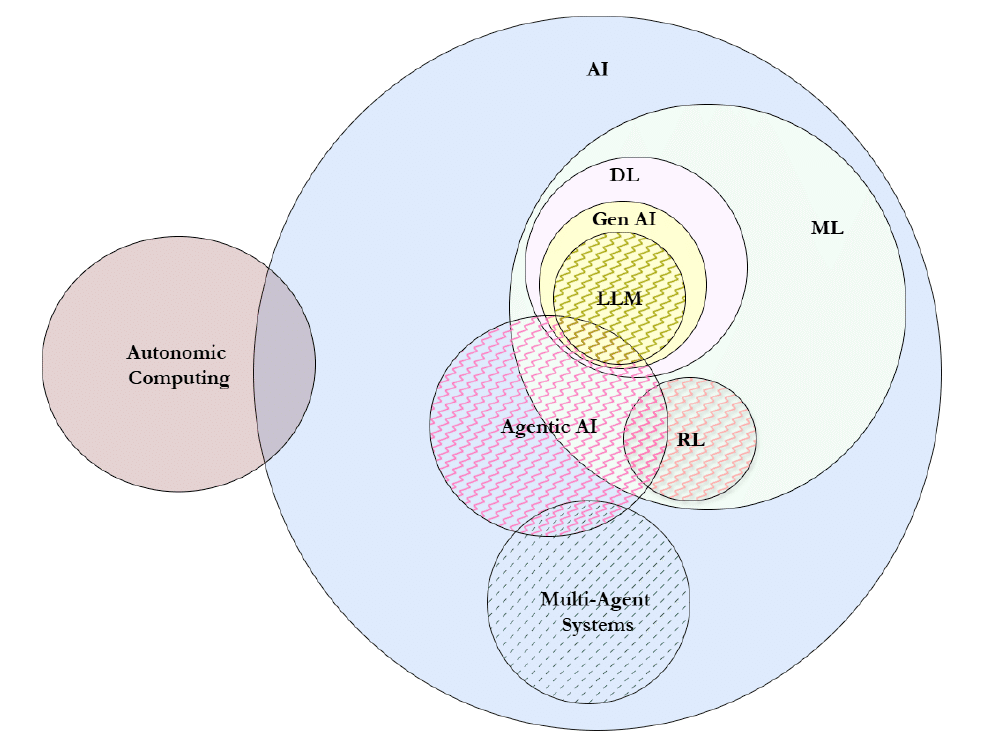
The figure below shows how the various AI-related concepts relate to one another (Bandi et al., 2025).
Within the broader landscape of AI, AI agents (agentic AI) occupy a domain built on large language models (LLMs) and reinforcement learning (RL). LLMs supply the "intelligence"—reasoning and planning—while RL handles autonomous learning and optimization based on experience. Together, they enable AI to act autonomously toward a goal.
AI agents are also closely tied to multi-agent systems (MAS). By incorporating MAS concepts, multiple AIs can cooperate and complement one another to solve complex problems. Combine these with memory systems and planning algorithms, and AI evolves from a mere tool into an intelligent partner that devises and executes its own strategies.
The Difference Between AI Agents and Agentic AI
The terms "AI agent" and "agentic AI" are often used interchangeably, but recent research tends to define them as distinct (Bandi et al., 2025; Sapkota et al., 2025).
An AI agent is an individual autonomous entity that performs a specific task, whereas agentic AI is an advanced system—or paradigm—in which multiple agents coordinate and collaborate to achieve complex goals.
Consider a travel example:
AI agent: Given the instruction "Find me a flight to Chicago," it uses a flight-search tool and presents the options.
Agentic AI: Given the instruction "Plan a three-day trip to Chicago for under $1,500," it breaks the task down (flights, hotel, itinerary); specialized agents search, compare, and book using real-time information; the system syncs with the calendar; and it produces a shareable plan.
Or take a smart-home example:
AI agent: It autonomously controls a single function—like a smart thermostat that adjusts the temperature according to the user's settings.
Agentic AI: Multiple agents managing weather forecasts, energy prices, the user's schedule, appliances, and the security system work in concert, coordinating the entire home toward a high-level goal: optimizing comfort, safety, and energy efficiency.
In short, agentic AI is a system that orchestrates multiple AI agents so they function as distributed intelligence, and it is positioned as the next stage beyond the individual AI agent.
Why AI Agents Became Real—and Widespread—So Quickly
The rapid spread of AI agents is rooted in the dramatic advances in LLMs. Conventional AI was confined to specific tasks (multi-agent simulations, for example) (Akuma et al., 2025), but once it gained a general-purpose "brain" in the form of LLMs, it evolved into something that could think and act autonomously (Liu et al., 2025).
Four factors were key to making this possible:
Reasoning and adaptation: LLMs became powerful reasoning engines, able to handle unfamiliar situations and ambiguous instructions with flexibility.
Planning: Techniques such as Chain-of-Thought allow complex goals to be broken down into smaller steps and turned into executable plans.
Tool use: The ability to select and operate external APIs and search engines on their own (tool use) made practical, real-world work possible, breaking through the digital walls that once confined them.
Memory and autonomy: Equipped with "memory" that retains past context, AI is undergoing a paradigm shift—from "generative AI" that merely waits for user instructions to "agentic AI" that pursues goals on its own.
In sum, the main reason AI agents became a reality is that LLMs came to function as sophisticated "reasoning engines" capable of integrating and controlling an agent's core components: planning, tool operation (action), and memory.
How AI Agents Work
The Four Building Blocks of an AI Agent (Architecture)
Modern AI agents—particularly LLM-based ones—are generally defined as systems made up of the following four main components (Bandi et al., 2025; Di Maggio, 2025; Liu et al., 2025).
① Brain
The center of reasoning and decision-making, a role filled by the LLM. It interprets the user's instructions and information from the environment, retrieves knowledge, formulates a plan for carrying out the task, and makes the final decisions. Advances in LLMs have made it possible not only to generate text but also to reason logically and decompose complex tasks (Akuma et al., 2025; Di Maggio, 2025).
② Perception
Responsible for gathering information about the environment, this component is the equivalent of the human sensory organs—eyes and ears. It collects information from the outside world and converts it into a form the agent (the brain) can understand.
Its ability to process not just text but also images, audio, sensor data, and other modalities is steadily improving (multimodality). This lets an agent read what is on a screen or, as a physical robot, perceive its surroundings (J. Gao et al., 2024).
③ Action & Tools
The equivalent of human hands and feet, this is how the agent intervenes in the outside world. It puts the brain's plan into practice and effects change in the environment. To do things an LLM cannot do on its own, the agent uses "tools"—web search, code execution (Code Interpreter), and API calls (operating a calendar, sending email, querying a database, and so on). Standard protocols such as the Model Context Protocol (MCP) connect agents to a wide range of external data and tools, greatly extending their reach (Di Maggio, 2025; Ganesh et al., 2025).
④ Memory
Stores past actions, user preferences, procedures, and the like, and recalls them when needed.
Memory is divided into short-term and long-term memory, each with the following role:
Short-term memory: Holds the context of the current task or conversation for use in immediate reasoning.
Long-term memory: Uses vector databases and similar technologies to persistently store vast amounts of past experience and knowledge. With retrieval-augmented generation (RAG), the agent retrieves the right information when it is needed, enabling learning over long periods and consistent behavior (Liu et al., 2025).
How an AI Agent Executes a Task
An AI agent completes a task by repeating the cycle below. This process is also known as ReAct (Reason + Act) or the OODA loop (Observe–Orient–Decide–Act) (Akuma et al., 2025; Bandi et al., 2025; Karim, Khan, et al., 2025; Karim, Van, et al., 2025).
Goal setting
The agent receives a high-level goal from the user, such as "Plan a trip to Chicago."Planning
Task decomposition and reasoning.
・Task decomposition: The brain (LLM) breaks the complex goal into smaller subtasks—"search for flights," "book a hotel," "build the schedule."
・Reasoning: It works out logically which tools to use and in what order.Execution/Action
Following the plan, the agent calls specific tools (e.g., a flight-search API).Observation & Reflection
Observation: The agent examines the results of tool execution (e.g., a list of flights or an error message).
Reflection: If the results are not as expected, it revises the plan or tries different search terms.
Completion: Once every subtask is done and the agent judges the goal achieved, it presents the final answer to the user.
Single-Agent vs. Multi-Agent (Agentic AI)
How an agent operates differs depending on whether it works alone (single-agent) or as part of a group (multi-agent) (Bandi et al., 2025).
The differences between single-agent and multi-agent setups are as follows.
Single-agent: One LLM handles every role—planning, execution, and evaluation. This suits simple tasks, but it can become confused when tasks grow too complex.
Multi-agent: Multiple specialized agents—a "planner," a "researcher," a "coder," and so on—work together. This is the architecture behind agentic AI.
Multi-agent systems are realized through orchestration and protocols.
Orchestration: A main agent (the orchestrator) assigns tasks to the other agents and integrates their results.
Protocols: Agents communicate using standardized means such as the Agent-to-Agent (A2A) protocol, conversing and cooperating with one another to solve problems without a human in the loop.
How AI Agents Are Evaluated
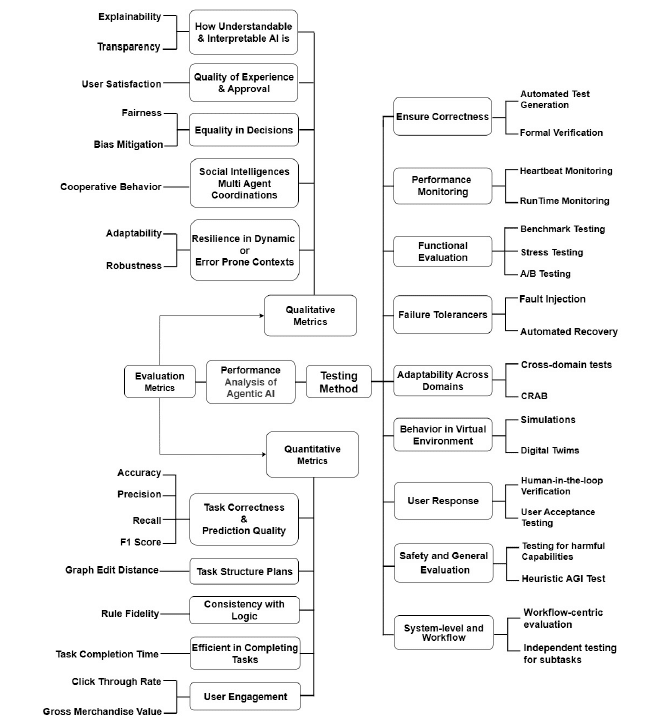
AI agent evaluation can be organized around three areas: quantitative metrics (performance), qualitative metrics (quality and behavior), and evaluation methods, as outlined below.
Quantitative Metrics
These are used to measure an agent's performance objectively (Akuma et al., 2025; Bandi et al., 2025; Liu et al., 2025).
Task success rate and accuracy (Success Rate & Accuracy): Success rate: the proportion of cases in which the agent achieved its goal—for example, whether it reached the final goal in a web-browsing task or an API operation.
Accuracy: How closely the output matches the correct answer. Used for tasks with clear-cut correct answers, such as medical diagnosis or financial forecasting.
Precision and Recall: When an agent performs search or information extraction, these measure how accurately and how completely it retrieves the relevant information.
Efficiency: Task Completion Time (TCT): The time elapsed from planning to finished execution. It indicates how quickly an agent can work through complex workflows compared with conventional AI.
Number of Steps: The number of actions (reasoning steps, tool calls, and so on) required to reach the goal. The fewer steps needed to solve a task, the more efficient the agent is considered to be.
Cost: Evaluates the monetary and computational cost of completing a task, based on the number of API calls and the volume of tokens consumed.
Structural and logical metrics: Graph Edit Distance (GED): A measure of the structural similarity between the task plan (represented as a graph) generated by the agent and a reference solution, such as a plan created by a human. It is used to evaluate planning capability.
Rule Fidelity: Measures how strictly the agent adheres to logical rules and constraints.
Qualitative Metrics
These metrics concern an agent's behavior, trustworthiness, and user experience (Akuma et al., 2025; Bandi et al., 2025; Zhou et al., 2025).
Trust & Safety: Faithfulness/Hallucination: Whether an answer is fully grounded in the sources and facts it was given. In RAG (retrieval-augmented generation) systems, faithfulness, that is, whether the answer is grounded in the referenced documents, is regarded as especially important.
Robustness: Whether the agent keeps functioning in the face of erroneous inputs, unexpected situations, and adversarial attacks.
Fairness & Bias: Whether the agent avoids making unfair decisions about particular groups, and whether its outputs are free of bias.
Transparency & Explainability: Whether the agent can explain why it made a given decision in terms that humans can understand. This is valued particularly highly in high-stakes fields such as healthcare and finance.
Autonomy: The degree to which the agent can complete tasks without human intervention.
Cooperative Behavior: In a multi-agent system, how effectively the agents collaborate and coordinate with one another.
Self-Reflection: The ability to detect and correct its own mistakes.
Evaluation Methods and Benchmarks
A variety of evaluation frameworks have been proposed for measuring these metrics (Akuma et al., 2025; Bandi et al., 2025; Ferrag et al., 2025).
Benchmark datasets:
AgentBench: A comprehensive benchmark that evaluates LLM agents across multiple environments, including operating systems, databases, and knowledge graphs.
GAIA (General AI Assistants benchmark): A collection of real-world questions that require reasoning, tool use, and multimodality. It includes tasks that are easy for humans but difficult for AI.
SWE-bench: Evaluates the ability to resolve real GitHub issues, covering both coding and debugging.
MMLU (Massive Multitask Language Understanding): Tests broad world knowledge and problem-solving ability.
AI-based evaluation (LLM-as-a-Judge / Agent-as-a-Judge):
Because human evaluation is expensive, a widely adopted approach is to use a powerful LLM (such as GPT-4) as a judge that scores the outputs of other agents. Going a step further, the "Agent-as-a-Judge" framework has been proposed, in which an agent evaluates other agents not only on their final outputs but also on their reasoning processes and intermediate artifacts; it has been shown to agree closely with human judgments.
Human-in-the-Loop evaluation:
Evaluation grounded in the end user's actual experience, such as user satisfaction scores and user acceptance testing (UAT), remains indispensable.
The Future of AI Agents
AI agents are rapidly evolving from simple task-execution tools into agentic AI and self-evolving systems: systems that learn and improve autonomously and that cooperate with other agents and with humans to form complex social systems.
The sections below organize the developments ahead from four perspectives.
From AI Agents to Agentic AI
The AI of the future will undergo a paradigm shift, from "AI agents" that carry out individual tasks to "agentic AI" endowed with organizational autonomy (Bandi et al., 2025).
An expanded definition: Whereas today's AI agents are "autonomous entities that perform specific tasks," tomorrow's agentic AI will be systems in which multiple specialized agents cooperate, coordinate, and plan together to achieve complex, high-level goals.
Multi-agent systems (MAS) become the norm: Rather than relying on a single LLM (large language model), the dominant architecture will be a group of agents with divided roles (for example, a planner, an executor, and a critic) working in concert. Through this kind of social division of labor, they will be able to solve complex problems that no single agent could handle alone.
Rapid market growth: Industry interest in agentic AI is surging. The market is projected to expand from roughly USD 3.66 billion in 2023 to roughly USD 139.12 billion by 2033, a compound annual growth rate of more than 43% (Market. us, 2025).
Self-Evolving Agents and Lifelong Learning
AI development to date has depended on model pre-training (MOP), but future agents will acquire the ability to keep learning while in operation (Bandi et al., 2025; Hettiarachchi, 2025).
Self-evolving AI agents: Systems will emerge that, through interaction with their environment, autonomously optimize and update their own prompts, tool-use strategies, memory, and even the topology (connection structure) among agents.
Lifelong learning: Instead of learning only from static datasets, agents will move toward "lifelong learning" systems that continually accumulate experience in order to adapt to new tasks and environments. This removes the need for humans to step in and retrain them each time, enabling sustained performance improvement.
Standardizing Infrastructure and Protocols
A "common language" and supporting infrastructure will be established so that agents can work together across corporate and platform boundaries (Di Maggio, 2025).
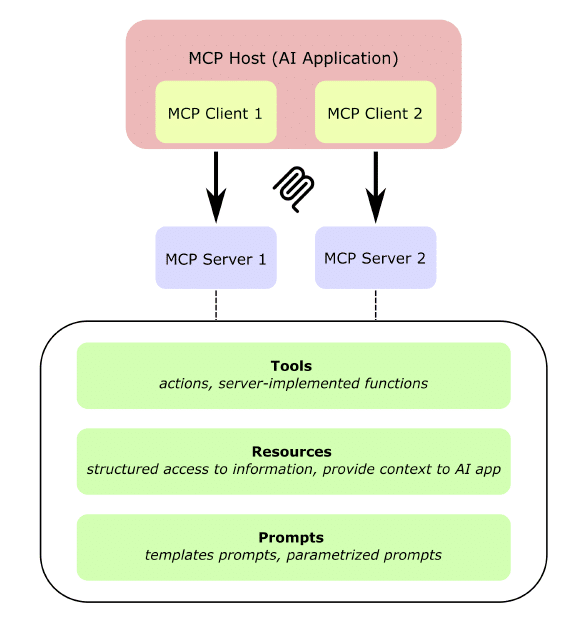
This includes standardized protocols such as MCP (Model Context Protocol) and A2A (Agent-to-Agent) that let agents interoperate and negotiate with one another, along with an Internet of Agents ecosystem in which agents built by different developers can communicate and cooperate securely.
Challenges and Risks Ahead
Alongside this bright outlook, serious challenges remain to be solved (Ganesh et al., 2025; S. Gao et al., 2024; Karim, Van, et al., 2025).
・Causal reasoning and reliability: Today's agents are strong at statistical correlation but weak at understanding causation (the "why"), which makes them prone to failures in reasoning and planning when they encounter unfamiliar situations. In addition, hallucinations (plausible-sounding falsehoods) carry the risk of real-world harm when the agent in question acts autonomously.
・Security and safety: Multi-agent systems present a broad attack surface, raising concerns about vulnerability to prompt injection and to attacks that exploit the interactions between agents, such as the propagation of data poisoning.
・Ethics and governance: New laws and governance frameworks are needed to address questions of liability when agents autonomously enter into contracts or take actions that carry legal responsibility, as well as the problem of alignment, in which an agent's behavior drifts in directions humans never intended.
Closing Thoughts
This article has organized the fundamental theory behind AI agents, a field that has advanced remarkably in recent years. As we put these agents to use and develop them further, we need to do so with a clear view of both where AI is heading and the risks it faces.
References
Akuma, C. F., Hewage, P., Garg, A., & Amaechi, C. V. (2025). AI agents: A comprehensive review of evolution, architectures, applications, and future directions. 2025 12th International Conference on Reliability, Infocom Technologies and Optimization (Trends and Future Directions) (ICRITO), 1–5.
Bandi, A., Kongari, B., Naguru, R., Pasnoor, S., & Vilipala, S. V. (2025). The rise of agentic AI: A review of definitions, frameworks, architectures, applications, evaluation metrics, and challenges. Future Internet, 17(9), 404.
Di Maggio, L. G. (2025). Toward autonomous LLM-based AI agents for Predictive Maintenance: State of the art, challenges, and future perspectives. Applied Sciences (Basel, Switzerland), 15(21), 11515.
Ferrag, M. A., Tihanyi, N., Hamouda, D., Maglaras, L., Lakas, A., & Debbah, M. (2025). From prompt injections to protocol exploits: Threats in LLM-powered AI agents workflows. ICT Express. https://doi.org/10.1016/j.icte.2025.12.001
Ganesh, S., Ardon, L., Borrajo, D., Garg, D., Sehwag, U. M., Narayanan, A. L., Canonaco, G., & Veloso, M. M. (2025). Generative AI agents for knowledge work augmentation in finance. Annual Review of Control, Robotics, and Autonomous Systems, 8(1), 189–210.
Gao, J., Qiao, H., & Zhang, Y. (2024). Intelligent recognition of tool wear with artificial intelligence agent. Coatings, 14(7), 827.
Gao, S., Fang, A., Huang, Y., Giunchiglia, V., Noori, A., Schwarz, J. R., Ektefaie, Y., Kondic, J., & Zitnik, M. (2024). Empowering biomedical discovery with AI agents. Cell, 187(22), 6125–6151.
Hettiarachchi, I. (2025). Exploring Generative AI Agents: Architecture, Applications, and Challenges. Journal of Artificial Intelligence General Science (JAIGS) ISSN:3006-4023, 8(1), 105–127.
Karim, M. M., Khan, S., Van, D. H., Liu, X., Wang, C., & Qu, Q. (2025). Transforming data annotation with AI agents: A review of architectures, reasoning, applications, and impact. Future Internet, 17(8), 353.
Karim, M. M., Van, D. H., Khan, S., Qu, Q., & Kholodov, Y. (2025). AI agents meet blockchain: A survey on secure and scalable collaboration for multi-agents. Future Internet, 17(2), 57.
Liu, F., Niu, Y., Zhang, Q., Wang, K., Dong, Z., Wong, I. N., Cheng, L., Li, T., Duan, L., Li, K., Li, G., Hou, T. W., Fok, M., Luo, H., Chen, X., Zhang, K., & Yin, Y. (2025). A foundational architecture for AI agents in healthcare. Cell Reports. Medicine, 6(10), 102374.
Market. us. (2025). AI Agents Market size, share, trends | CAGR of 43.8% [Dataset]. https://market.us/report/ai-agents-market/
Sapkota, R., Roumeliotis, K. I., & Karkee, M. (2025). AI Agents vs. Agentic AI: A Conceptual Taxonomy, Applications and Challenges. In arXiv [cs.AI]. arXiv. http://arxiv.org/abs/2505.10468
Zhou, Z., Zhang, H., Song, C., Ming, C., & Sun, Y.-Y. (2025). Construction of an artificial-intelligence agent for the discovery of next-generation white-LED phosphors. Physical Chemistry Chemical Physics, 27(43), 22885–22893.
The end
Read next ↓