
Articles
Japan's BIM Review Landscape: A Discussion with Industry, Government, and Academic Leaders
Product
Career
Automatically translated from the Japanese original.
Introduction
On March 18, 2026, at AIS WEEK 2026 KYOTO, hosted by the Architectural Informatics Society at Kyoto University, I had the opportunity to join a four-person discussion on international trends in BIM-based review and where Japan stands, together with leading figures from industry, government, and academia (Japan ERI, the Ministry of Land, Infrastructure, Transport and Tourism, and the University of Tokyo). Below is a transcript of the session, summarized and lightly edited for readability, alongside the slides that were shown on the day.
A video recording of the session is available exclusively to members of the Architectural Informatics Society. If you are interested, please apply through the society's website.
Participants
Organizer
Masahiro Taima (CEO, mign Inc.)
Panelists
Yuri Sekido (BIM Promotion Center, Japan ERI Co., Ltd.)
Yasushi Ikeda (Project Professor, Department of Architecture, Graduate School of Engineering, the University of Tokyo)
Yuji Noguchi (Housing Bureau, Ministry of Land, Infrastructure, Transport and Tourism)
Agenda
Organizer's Presentation

Taima:
Thank you all for joining us today. Let's get started.
Our theme is "International Trends in BIM-Based Review, Japan's Position, and the Technical Challenges on the Road to Fully Automated BIM Review."

Here is how the session will run. I'll spend the first 20 minutes or so presenting the research and analysis I've done on today's theme, and then our panelists will add their perspectives and we'll open up the discussion.
We've also set aside time at the end for questions and discussion from the audience, so I'd very much welcome your comments and participation.
Let me briefly introduce myself. I earned my Ph.D. in the field of urban planning at the University of Tokyo's Department of Urban Engineering.
My undergraduate background is in civil engineering, and during my doctoral studies I also earned a degree in architecture through a dual-enrollment program. I later served as an assistant professor at Keio University, where I also worked as an assistant professor in the laboratory of Professor Ikeda, who is one of our panelists today.
For many years, my research focused on data science in the fields of architecture and civil engineering.
I now run a startup that develops AI agents for the real estate and construction sectors, with a particular focus on automating building review. We are currently hiring, so if you're interested, please do take a look.
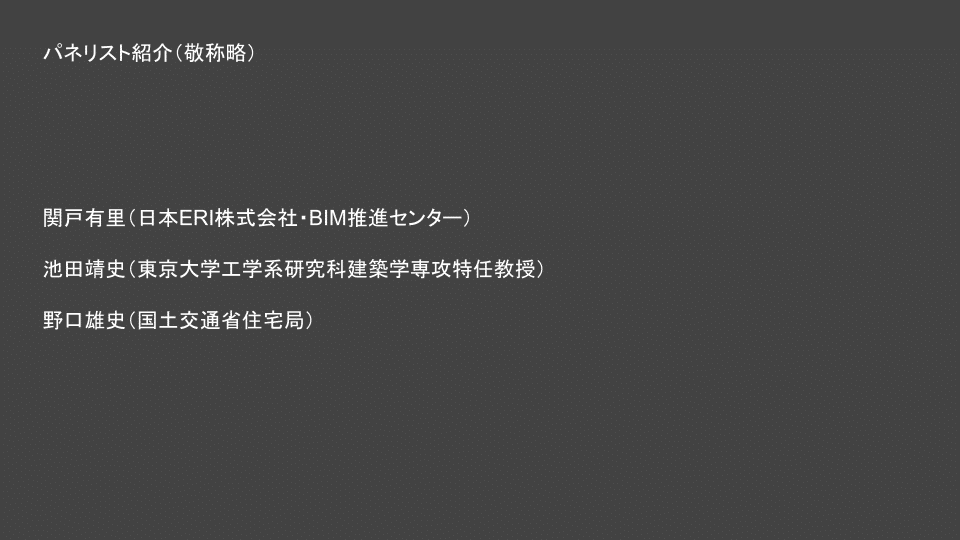
Joining us today are leaders from industry, government, and academia in the areas of BIM adoption and review in Japan: Ms. Sekido from Japan ERI, Professor Ikeda from the University of Tokyo, and Mr. Noguchi from the Ministry of Land, Infrastructure, Transport and Tourism.
Could I ask each of you to introduce yourselves briefly? Ms. Sekido, please go ahead.
Sekido:
My name is Sekido, and I'm with the BIM Promotion Center at Japan ERI. It's a pleasure to be here. I have been working on the use of BIM in building confirmation (Japan's statutory pre-construction review of building plans) since 2017, and I am currently also researching data-based review. Thank you for having me today.
Taima:
Professor Ikeda, please.
Ikeda:
I'm Ikeda from the University of Tokyo, and I serve as president of the Architectural Informatics Society.
I have also long served as a committee member on the use of BIM in building confirmation under the BIM Promotion Council.
I'm here today to bring in a somewhat broader perspective as well. I look forward to the discussion.
Taima:
Mr. Noguchi, could you introduce yourself?
Noguchi:
I'm Noguchi from the Ministry of Land, Infrastructure, Transport and Tourism. It's a pleasure to be here.
Taima:
Mr. Noguchi joins us in his capacity as the Ministry's BIM specialist.
With that, let's move on to the main content.
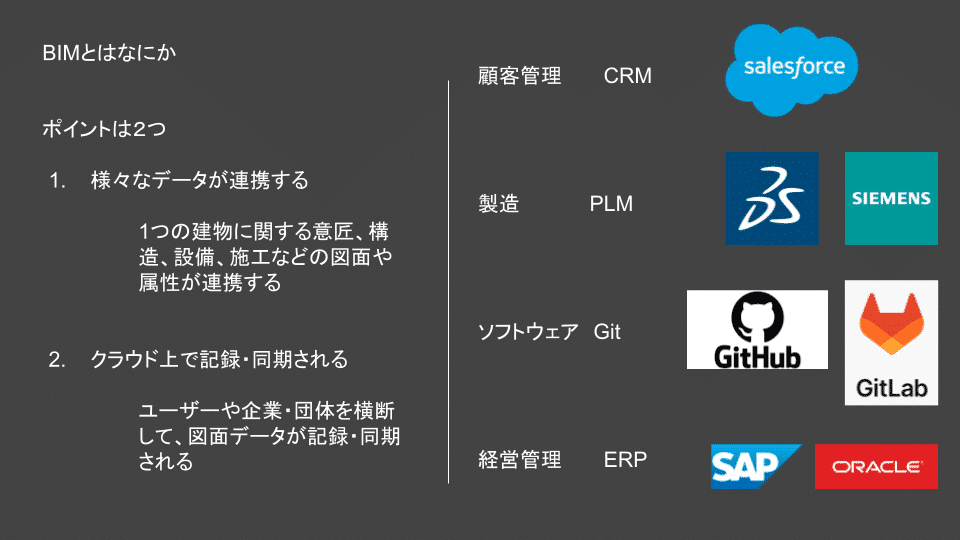
Everyone in this room has probably heard this more times than they can count, but let me start with "what BIM is," framed around two points from my own perspective.
The first is that a wide range of data is linked together: all the data about a single building, including its attributes, is connected.
The second is that this data is recorded in the cloud, complete with its history, and kept in sync for every stakeholder.
Other industries have their equivalents: CRM for customer management, PLM (BIM's predecessor) in manufacturing, along with tools from Siemens, Git for software development, and SAP or Oracle for enterprise management.
Such software has been widely adopted in other industries, so why BIM adoption in the building industry has lagged and proven so difficult is a topic worthy of a paper in its own right—but I'll set it aside here.
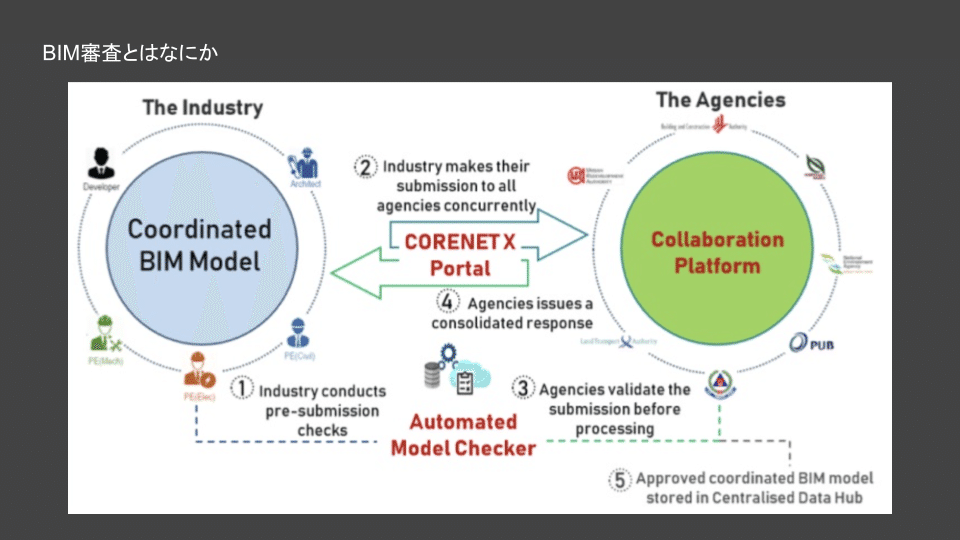
Next, "what BIM-based review is."
What I'm showing here is Singapore's CORENET X system. On the left are the applicants, such as private companies; on the right are the government and the relevant authorities.
BIM files are submitted through the CORENET X platform, where they first undergo an automated preliminary check.
The regulatory authorities then synchronize the data on the platform and carry out discussions and data revisions there.
It is a system designed to review projects with this kind of efficiency.
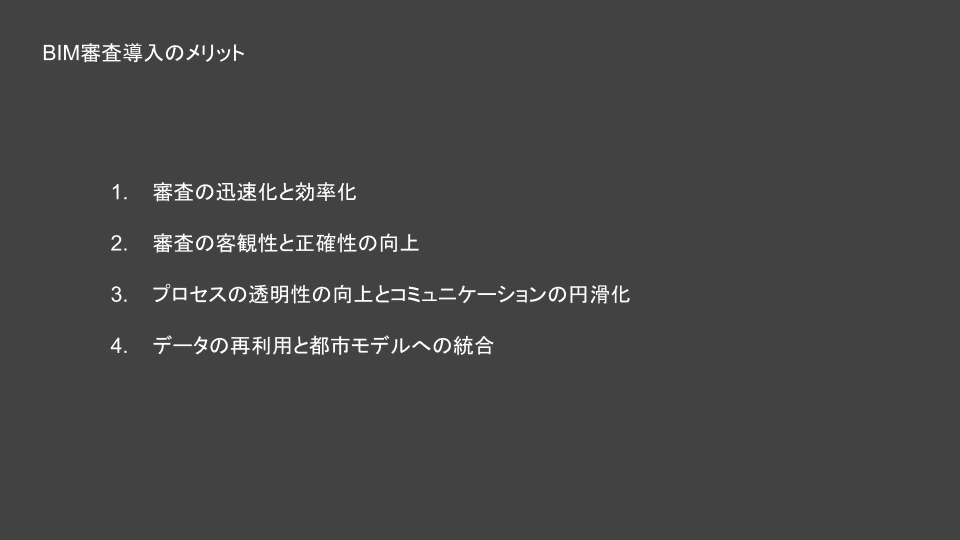
There are four benefits to introducing BIM-based review.
First, review becomes faster. Moving from 2D to 3D reduces the number of items that need to be judged by the human eye.
Second, objectivity, since more items can be assessed mechanically.
Third, process transparency, which makes communication smoother.
Fourth, integration with city models and real estate data.
Until now, reviewed drawings reached a dead end once the review was done. With BIM, they can be linked to platforms such as PLATEAU and accumulated and enriched as national geospatial data.
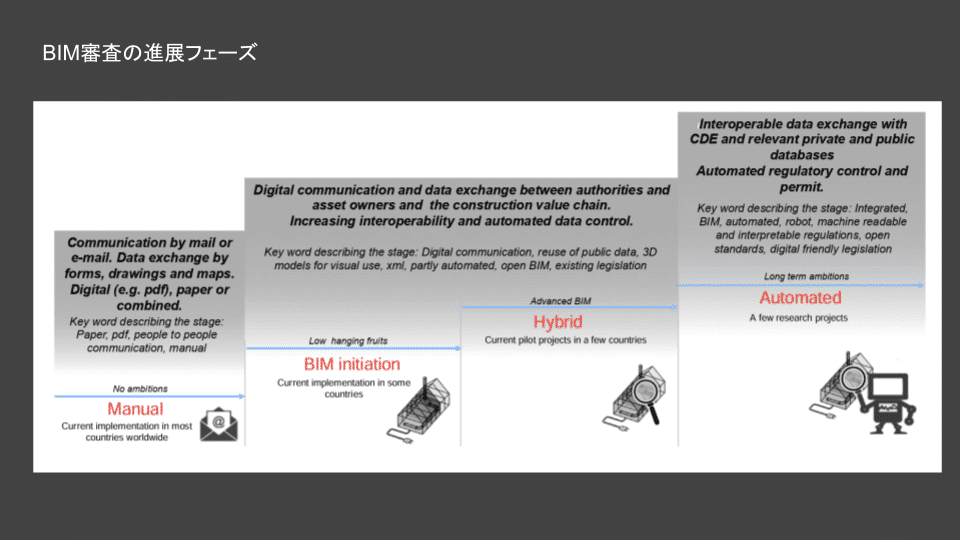
To evaluate international trends in BIM-based review, we first need to define stages of progress.
Several papers have proposed stage frameworks; here I'll use four levels, from Level 0 to Level 3, based on the literature presented by Dr. Muto of the Building Research Institute at building Smart International.
Level 0 is the absence of electronic submission.
Level 1 means electronic submission is possible, Level 2 is partial automation, and Level 3 is full automation.
For this survey of international trends and analysis of Japan's position, I reviewed roughly 100 sources in total: about 70 international journal articles, plus materials on electronic submission systems from Japan's Ministry of Land, Infrastructure, Transport and Tourism, Singapore, and elsewhere.
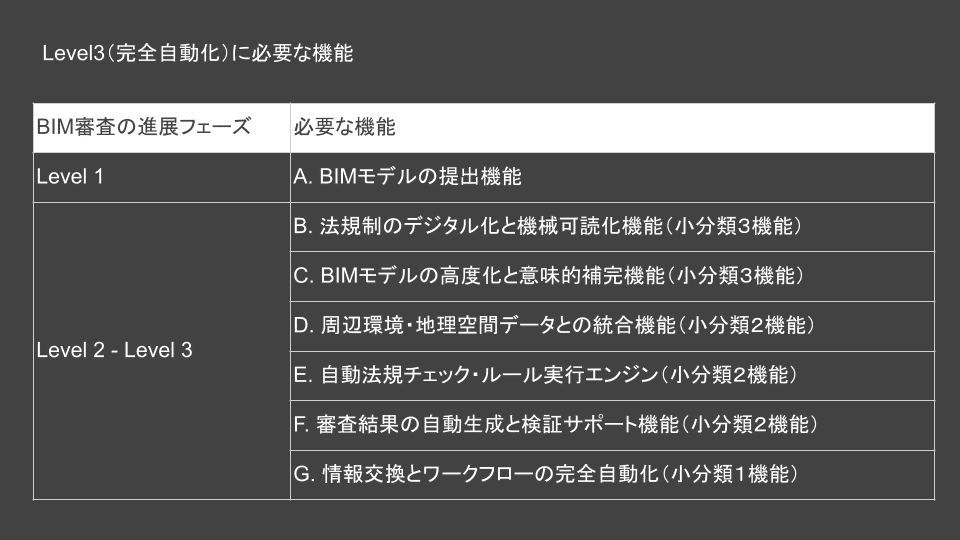
When you distill from the literature the functions needed to reach Level 3—full automation—several groups of functions emerge.
Level 1 centers on electronic submission functions, but moving from Level 2 to Level 3 requires digitizing laws and regulations, standardizing BIM models, integrating with GIS, and more.
Key examples include unifying the specifications that differ from one software package to another, such as Revit, and connecting to GIS systems.
Broken down in detail, and including Level 1, a total of 14 functions are required.
This table is my summary of how far each region has progressed.
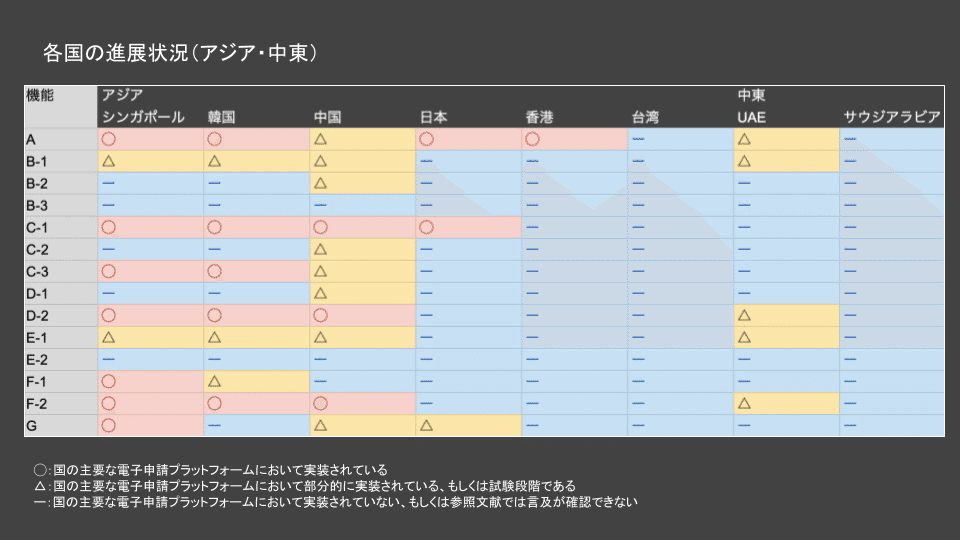
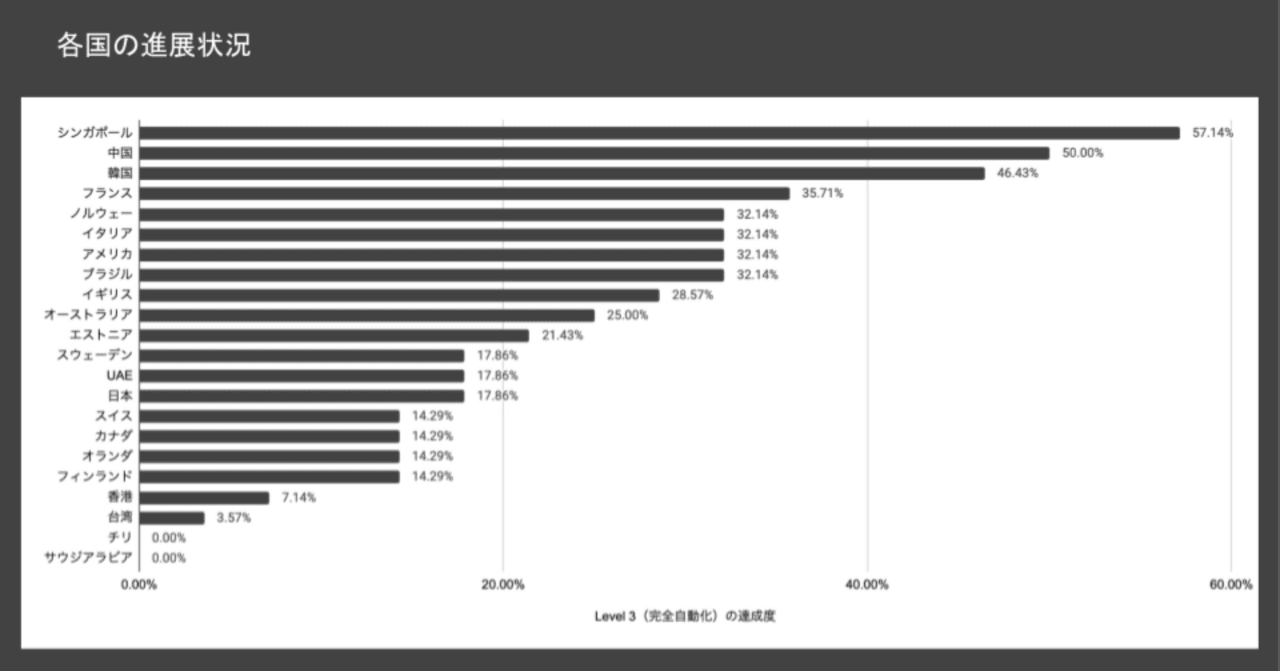
Summarizing progress by region, Singapore is well ahead even within Asia.
South Korea moved early to mandate BIM submission and has also been a front-runner in adoption.
Japan, judged on the basis of the system launching this April, is still at an early stage.
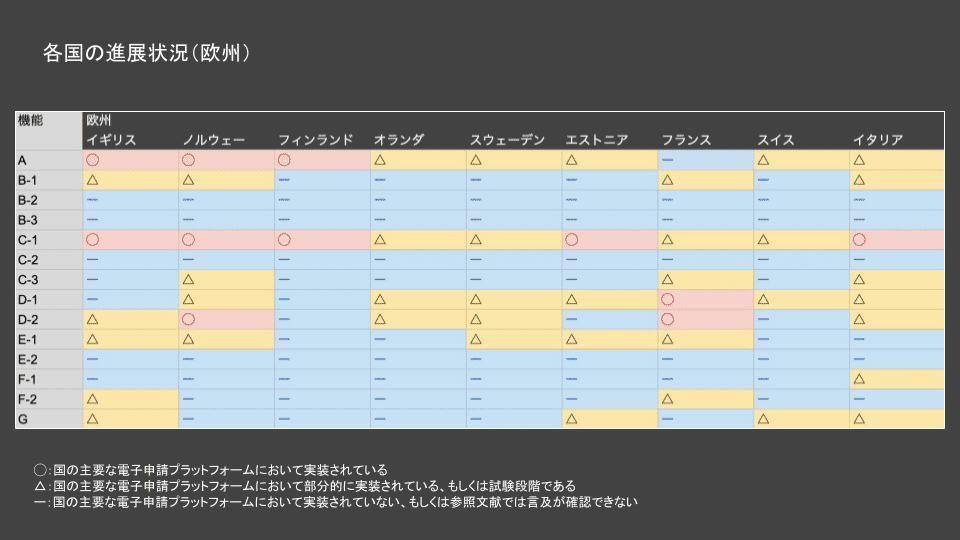
In Europe, the UK and the Nordic countries such as Norway are leading the way.
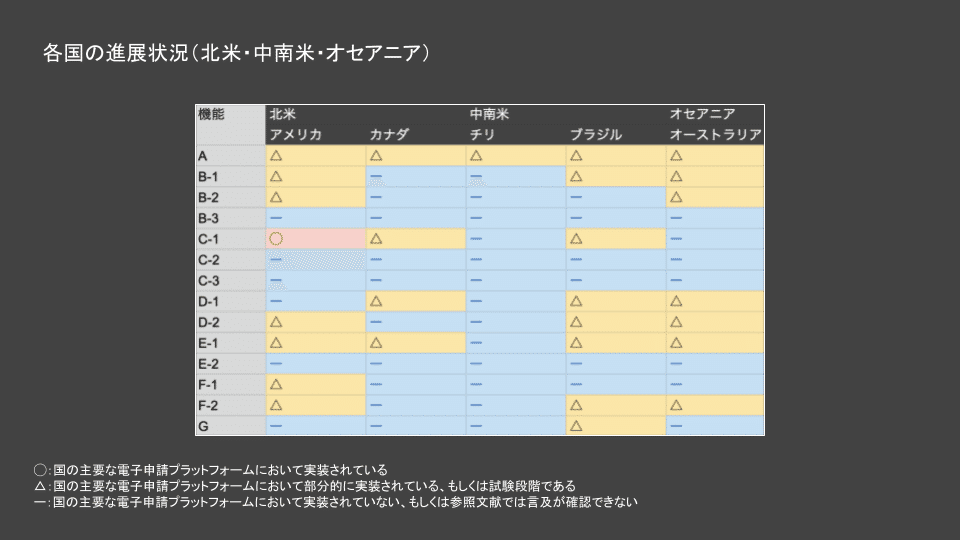
Looking at North America, Latin America, and Oceania, BIM and CAD historically developed with the United States at the center. Yet when it comes to BIM-based review in actual operation, even the US has only partial, state-level initiatives.
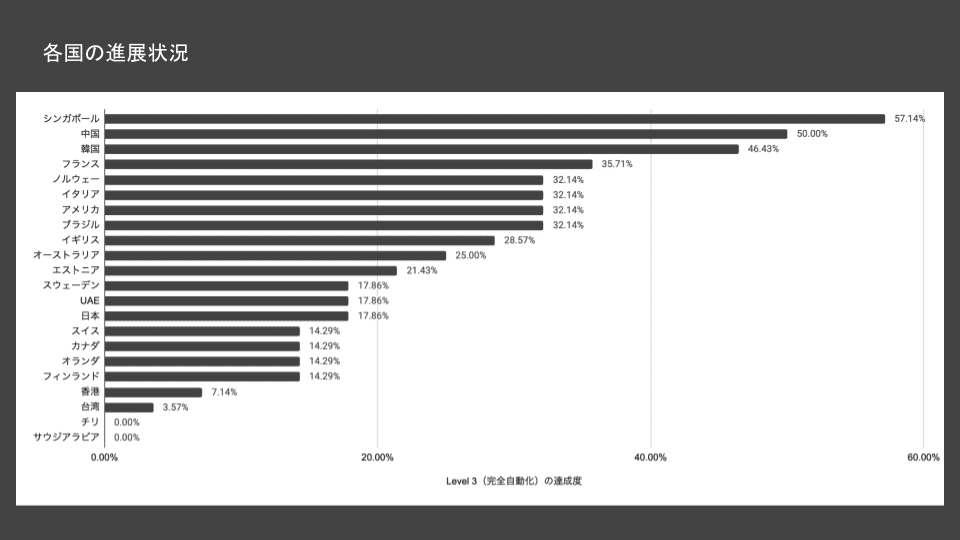
If we quantify this by scoring each of the 14 required functions as 1 point for full implementation and 0.5 for partial implementation, with 100% representing full automation, Singapore and South Korea score highly, while Japan sits at the point of having only just begun electronic submission and acceptance of IFC data.
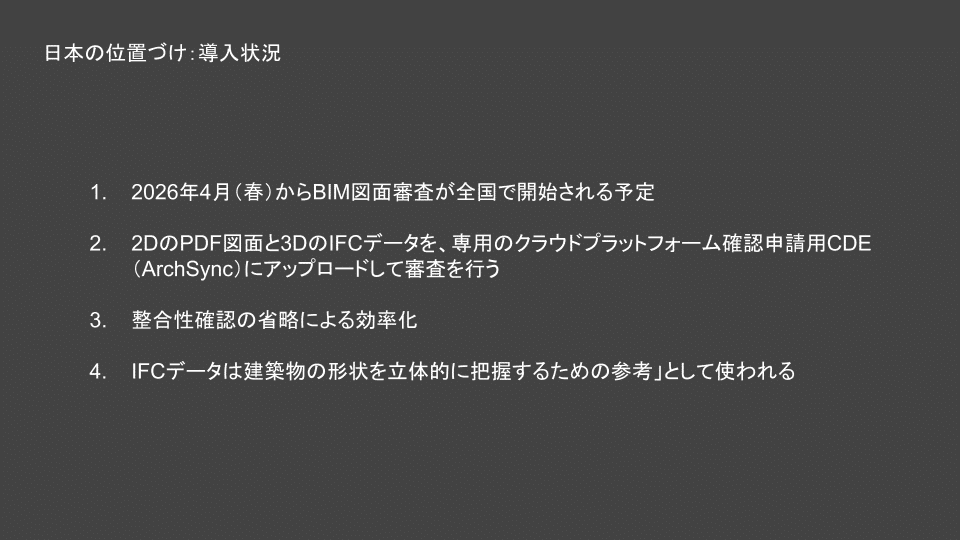
As for the state of BIM-based review in Japan, BIM drawing review begins in April, allowing 3D IFC data to be submitted alongside 2D drawings.
The main expected benefit is a reduction in the effort required for consistency checks.
However, IFC data cannot yet serve as a legal basis for review; for now, it will be used simply to understand the building in three dimensions.
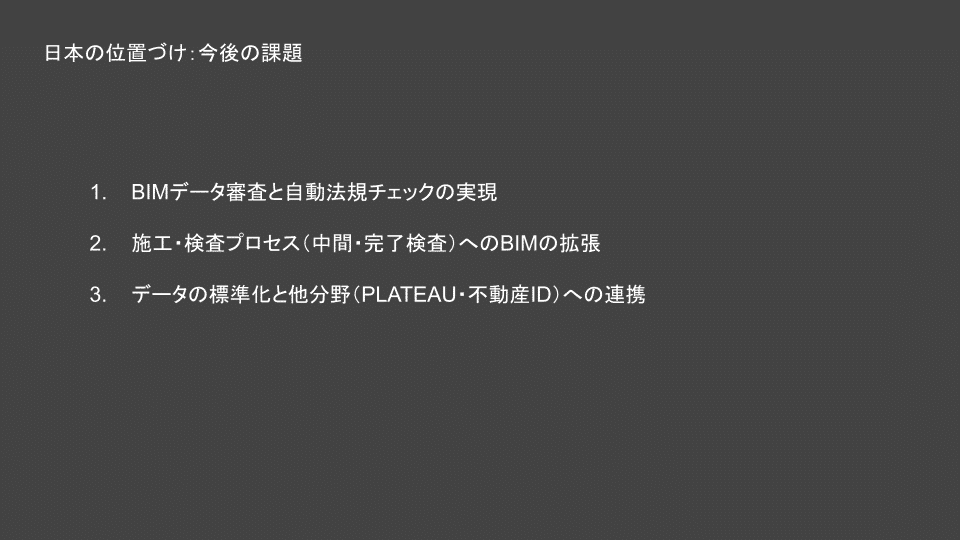
Going forward, the challenges will be realizing automated checks, integrating not only the design stage but also interim and completion inspections, and improving overall efficiency by linking to real estate data.
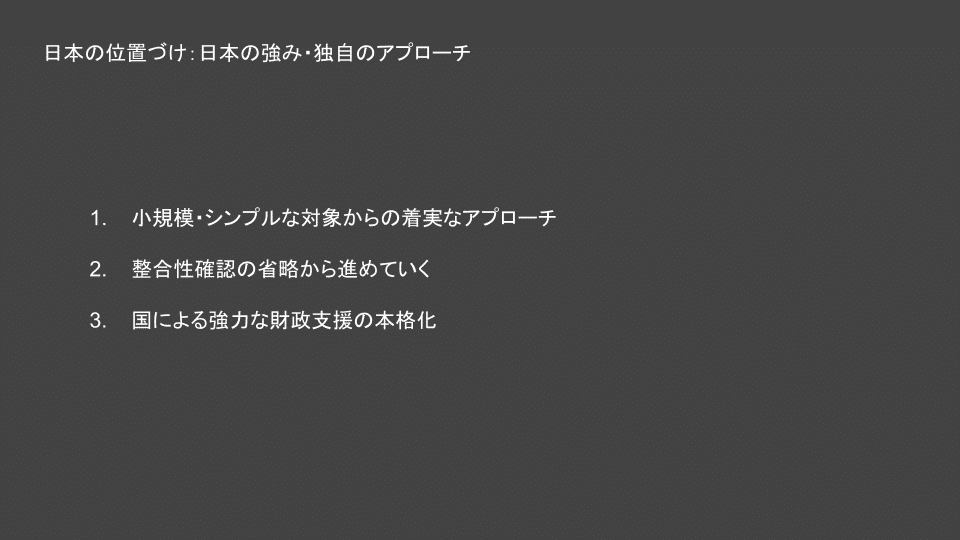
One distinctive feature of Japan's approach is that it is starting with small-scale buildings.
Singapore and the Nordic countries have mandated BIM submission mainly for relatively large buildings, whereas Japan is beginning with smaller projects.
Another feature is that consistency checks have been chosen as the first target for reducing workload.
Government financial support has also ramped up recently, so in that sense Japan is gradually catching up with the leading countries.
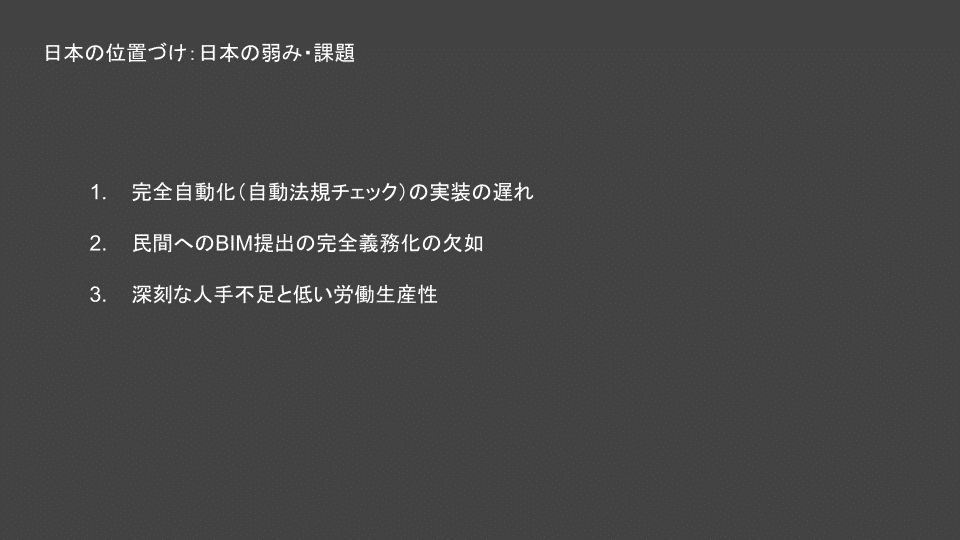
As for weaknesses and challenges, Japan has yet to reach the level of automation already achieved in Singapore and the Nordic countries.
The same goes for mandating BIM submission by private companies: compared with countries like the UK and South Korea, where governments have pushed hard, Japan is still at the starting line.
And amid the industry's labor shortage and low labor productivity, it is an open question how much capacity private companies have to make the necessary upfront investment.
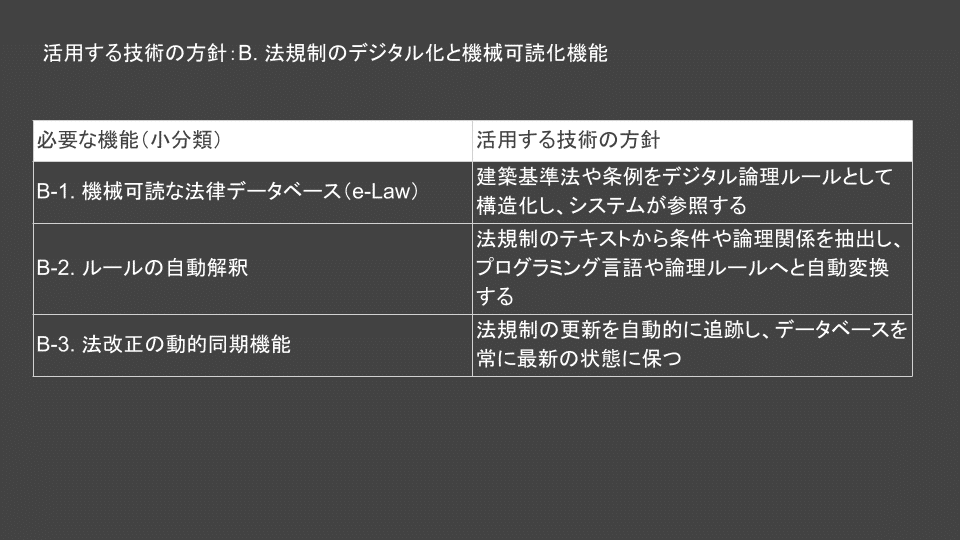
Finally, let me turn to the technical challenges on the road to full automation.
First, laws and regulations need to be digitized and made machine-readable. This calls for a well-organized legal database and the ability to respond dynamically to legislative amendments.
Because legal text is written in natural language, it has to be formalized and structured into logic.
We also need a hybrid approach: handle the parts that can be clearly codified with rule-based processing, and use AI to support human-like judgment on the ambiguous parts.
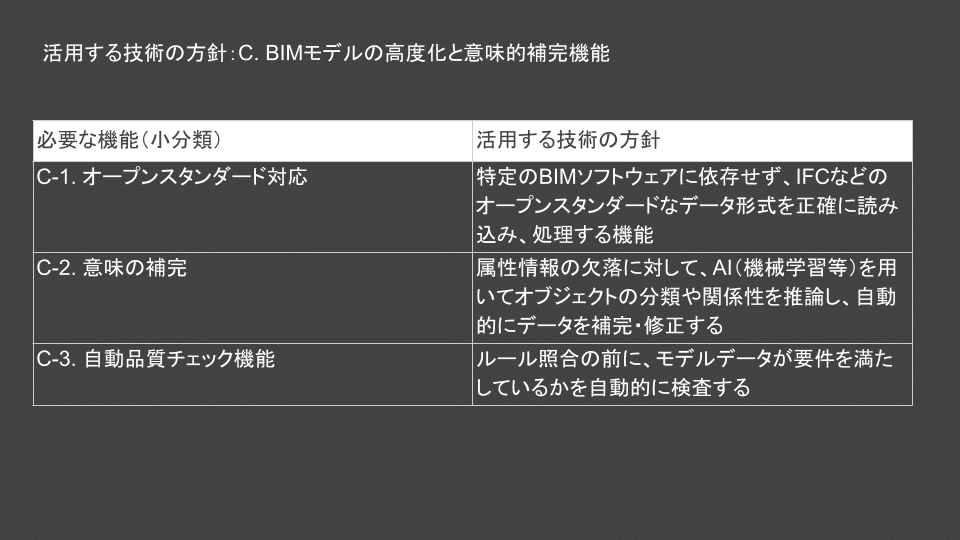
In terms of advancing BIM models, a major challenge is how to standardize the file formats and internal structures that differ from one software package to another.
How to recover attribute information lost during file conversion, and how to automate quality checks, are also important issues.
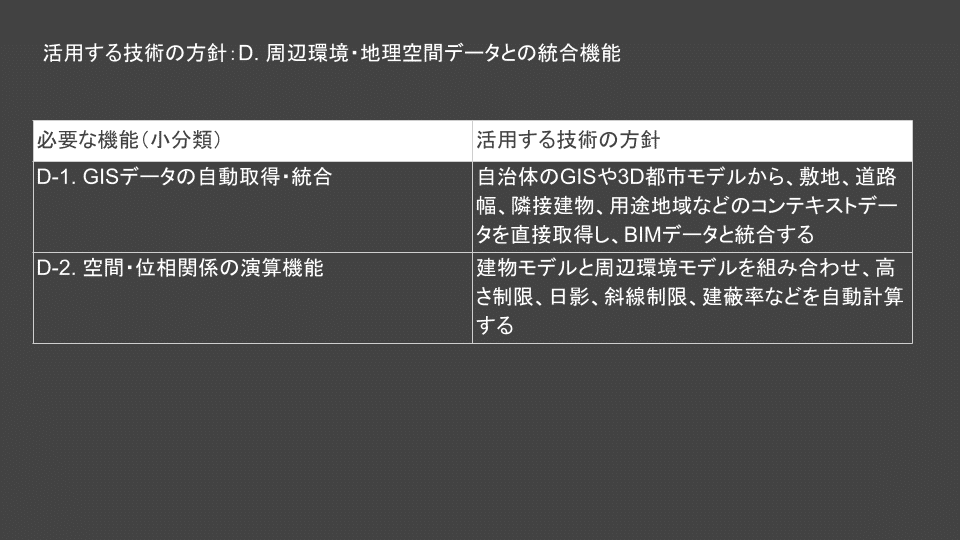
Integration with the surrounding environment and geospatial data is also necessary.
We need technology that links to GIS and real estate data and can assess conformity with spatial conditions such as sunlight shading regulations and setback-plane restrictions.
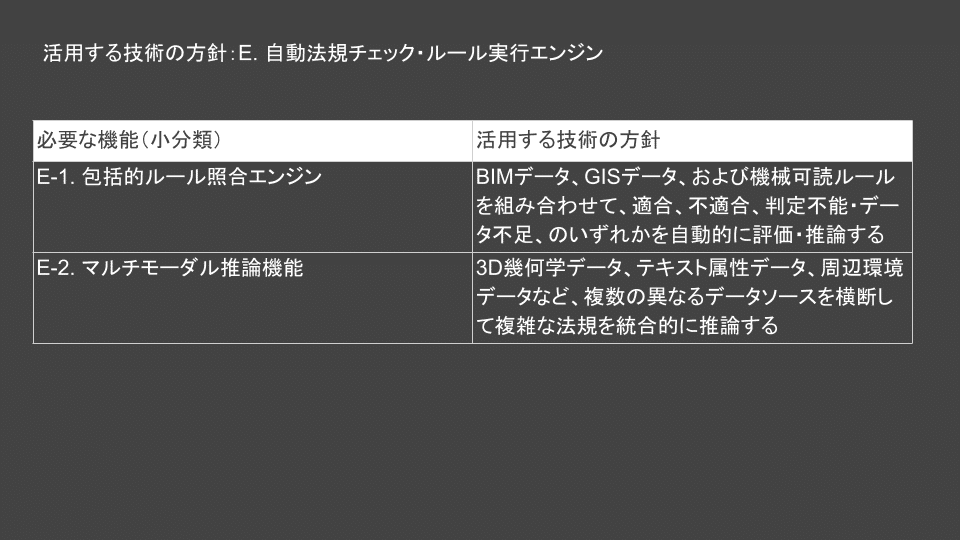
Furthermore, automated code checking requires a mechanism that integrates multiple data sources—legal text, BIM, GIS, and more—to determine compliance or non-compliance.
Multimodal reasoning that can interpret not just text but also images and mathematical formulas will be important.
Here, in addition to conventional rule-based processing, large language models could well provide the breakthrough.
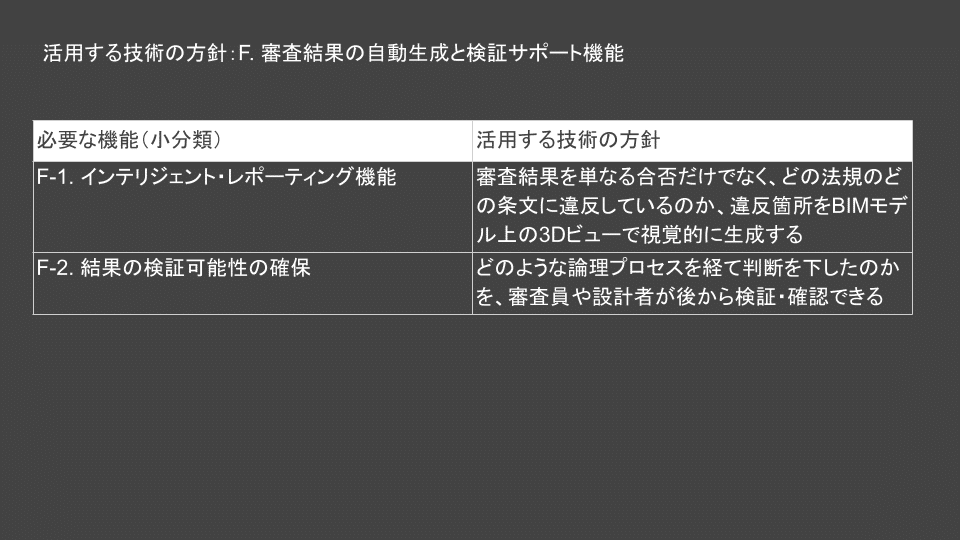
Feedback on review results is another key function.
We need a mechanism that automatically reports to applicants what needs to be corrected and where the non-compliance lies.
It is also essential that humans can verify the basis on which the AI or system arrived at its automated determination.
This calls for implementations that are both explainable and verifiable.
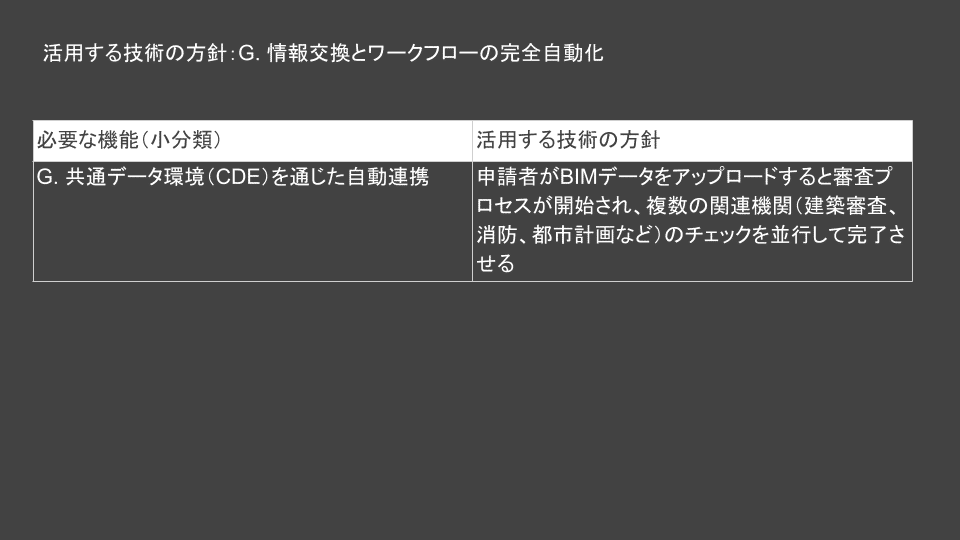
Lastly, automating the exchange of information and workflows between applicants and the authorities is indispensable.
Communication needs to be streamlined through a common data environment.
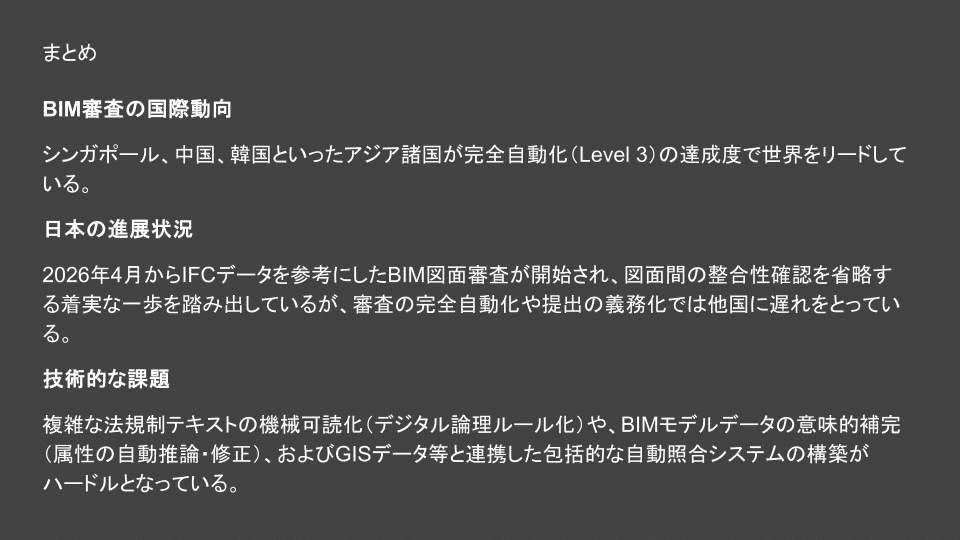
To sum up: internationally, the countries that have pulled ahead—Singapore, China, and South Korea—are those where the government pushed hard to make adoption mandatory.
In Japan, BIM-based review began in earnest this April, and we look forward to seeing how it develops from here.
On the technical side, the two major themes are making complex regulations interpretable by machines and integrating BIM with other data sources such as GIS and real estate data.
That concludes my presentation. Thank you very much.
Supplementary Remarks, Comments, and Q&A from the Panelists
Tsuma:
Next, I'd like to hear thoughts and discussion points from Mr. Sekido, Professor Ikeda, and Mr. Noguchi. Mr. Sekido, would you like to start? I'd be grateful if you could also give us an overview of where CDE stands today.
Sekido:
I've prepared some slides to add a bit of context on how BIM drawing review and BIM data review are taking shape.
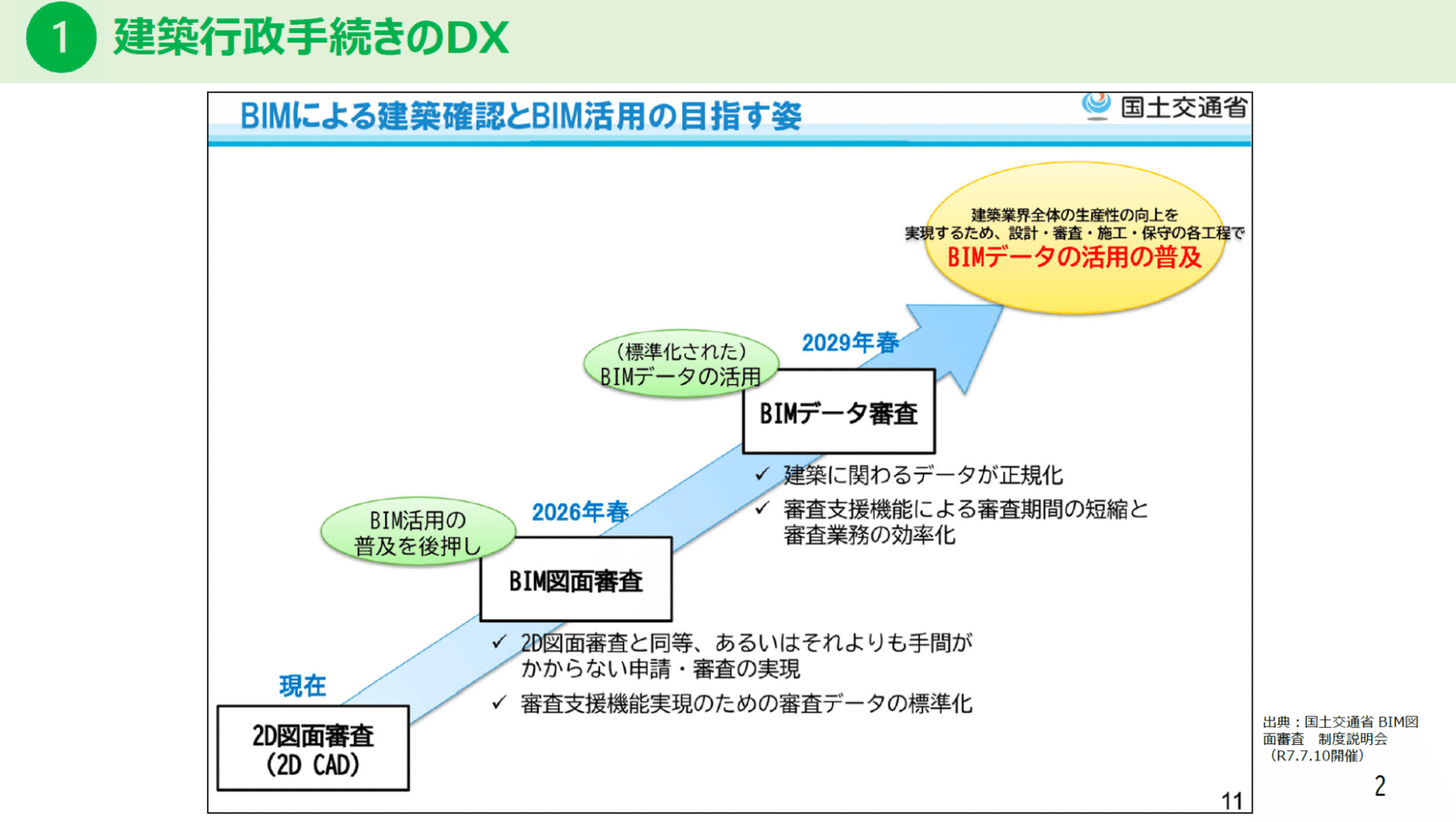
As Mr. Tsuma mentioned earlier, BIM drawing review is set to launch in April 2026.
We see this as a step toward data-based review. It's the first step in putting BIM to use—a transitional stage on the way to data review.
Once that data is in place, we expect data utilization to spread across the entire construction industry. MLIT is driving this initiative because, as noted earlier, data utilization is essential for tackling challenges such as labor shortages.
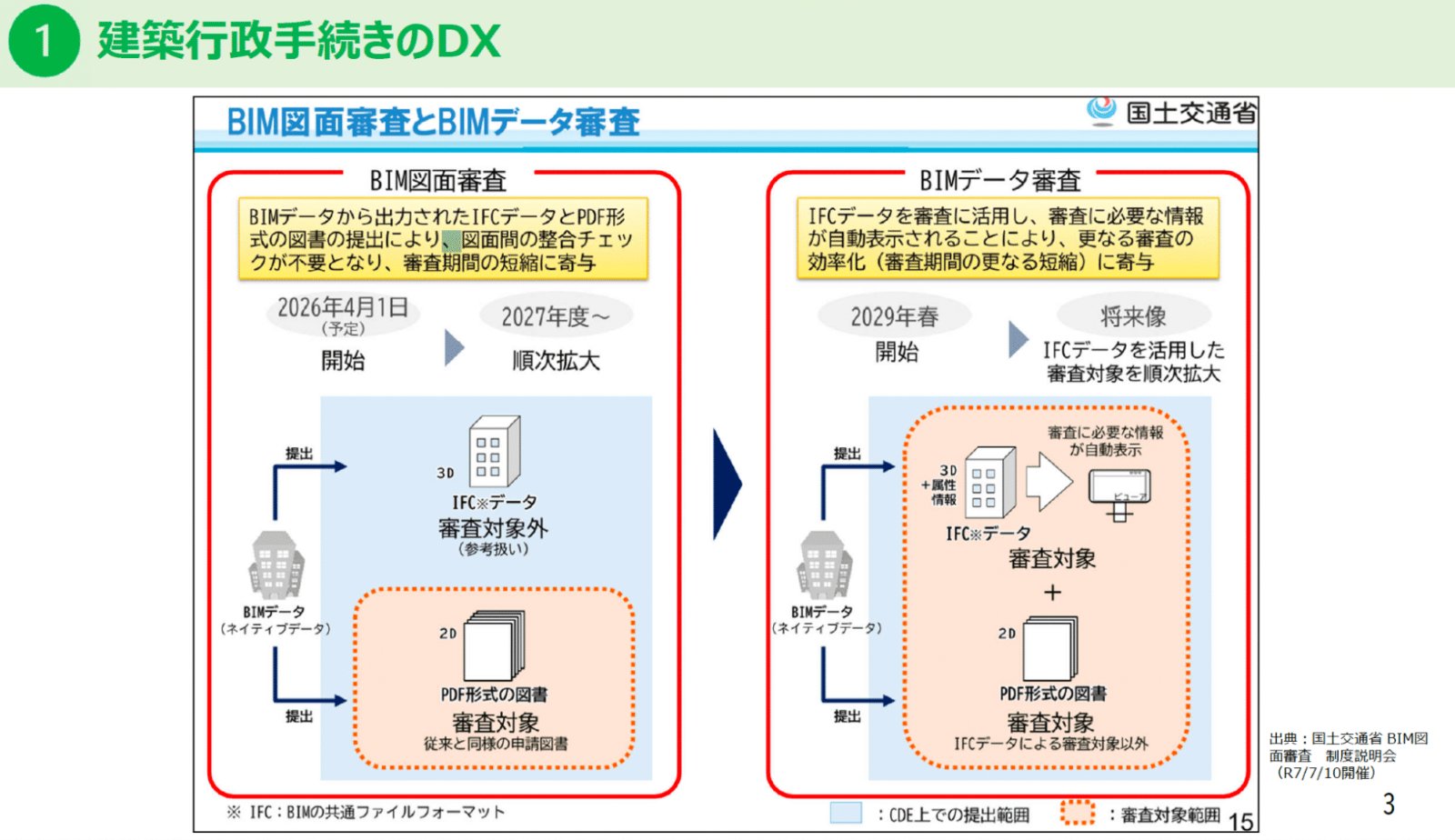
To explain what drawing review and data review actually are: the left side shows drawing review, and the right side shows data review.
Starting this April, BIM data will for the first time be brought into the statutory system, in the form of drawing review. The IFC data shown on the left will now be submitted along with the application.
Data review, as currently positioned, means conducting the review on that data itself.
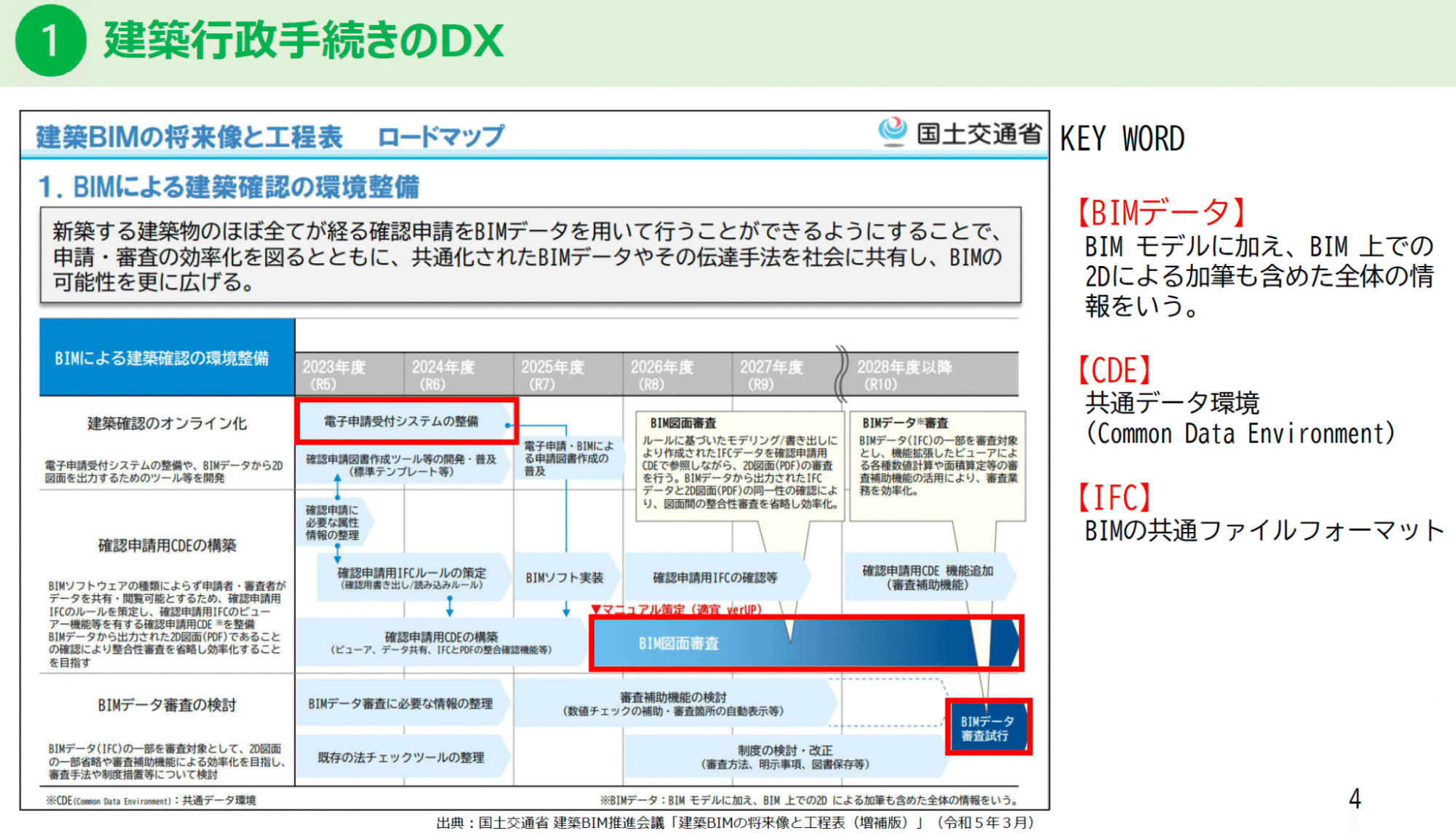
This is the roadmap. BIM drawing review begins in April 2026, with data review targeted for spring 2029—a phased approach.
As I mentioned, MLIT's position on BIM drawing review is that since the drawings are simply extracted from a 3D model, the review step that checks consistency between drawings can be omitted, making the process more efficient.
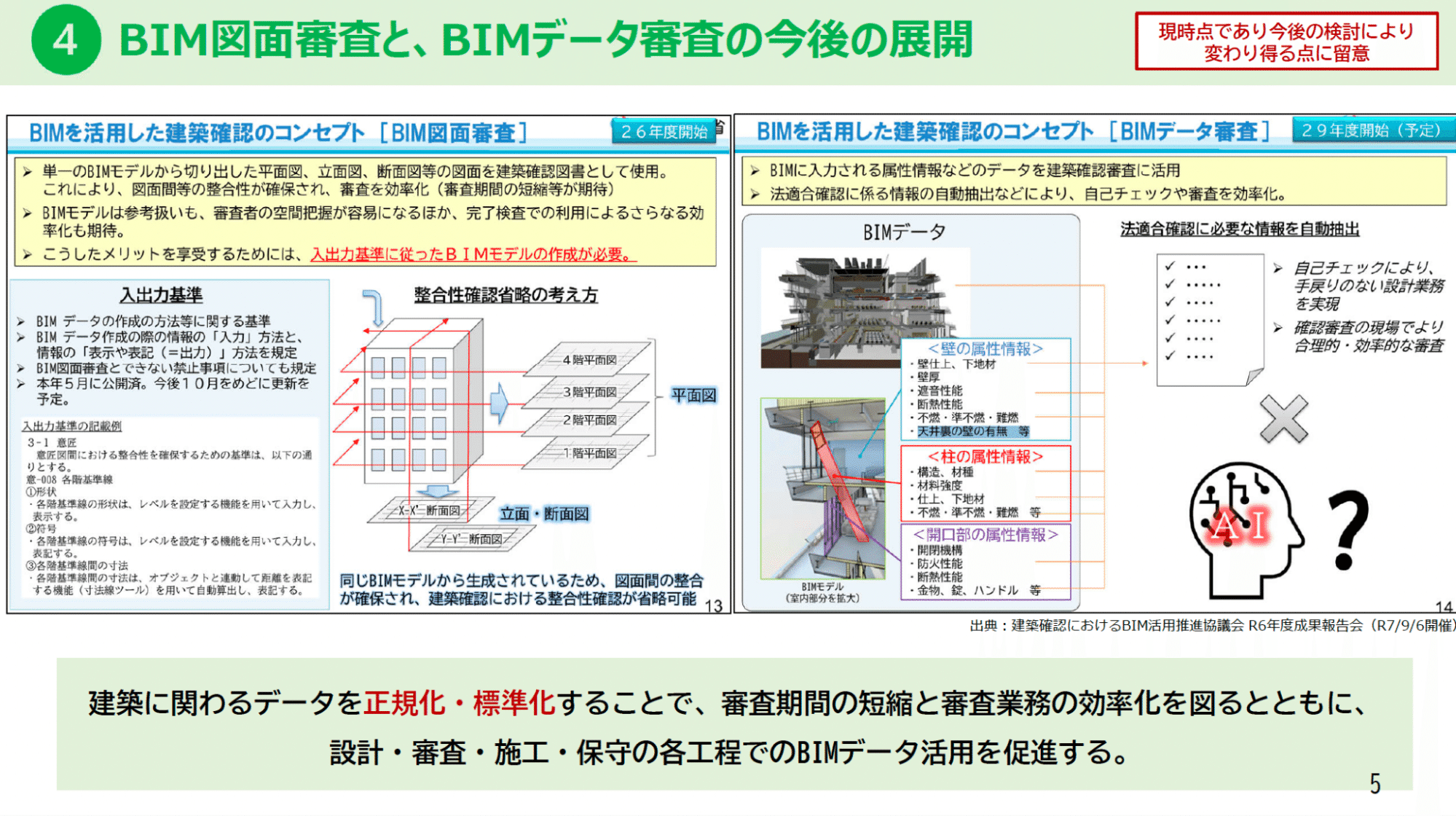
The right side shows the concept of data review, in which the BIM data itself is what gets reviewed. That data is packed with information, and the idea is to pull out whatever is needed as required.
Whether AI will play a role in that, and other specifics, are questions that have not yet been settled.
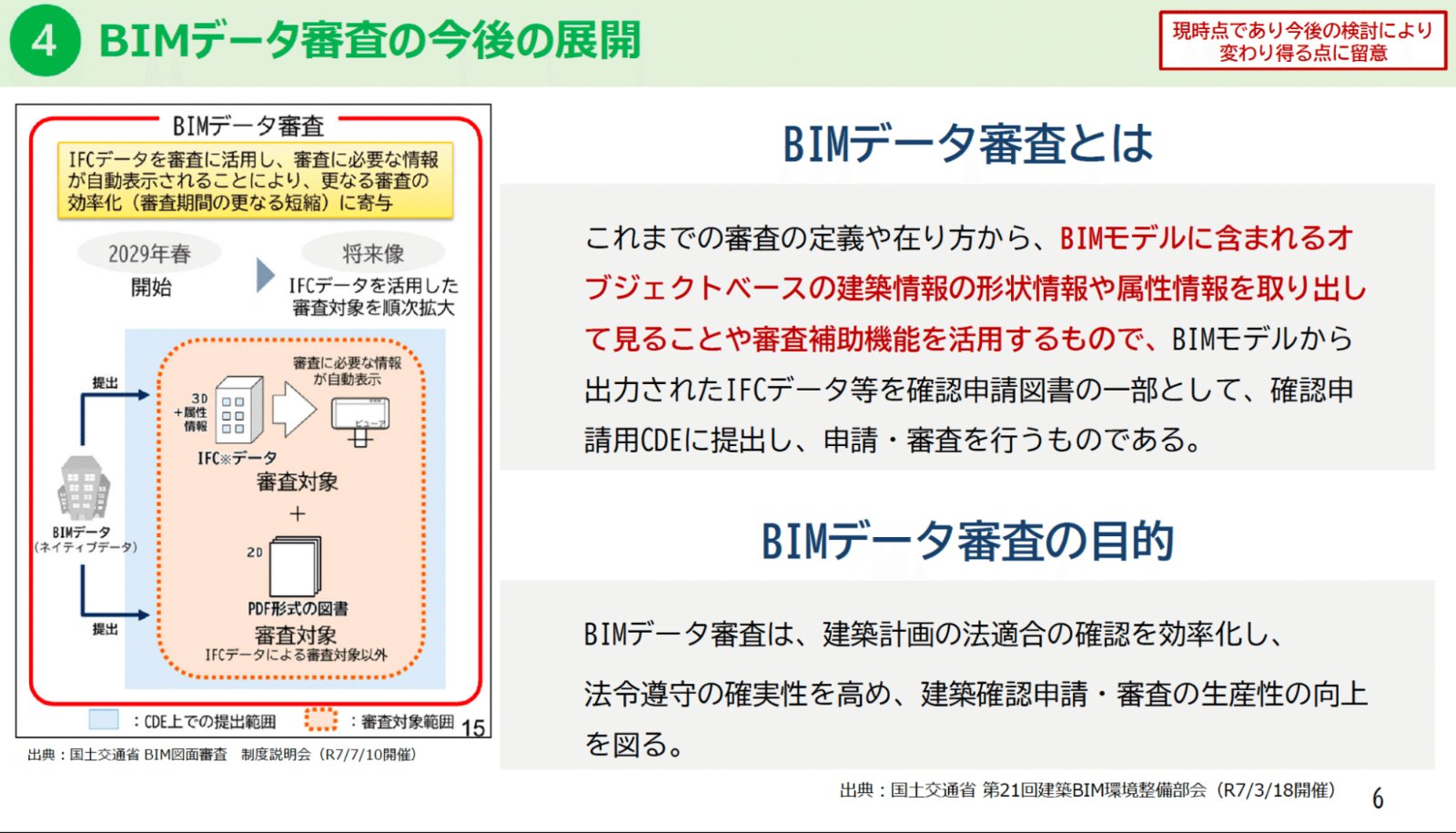
Data review is object-based, working from the BIM model: a single wall, for example, holds a wide range of information, and we extract its geometry and attributes.
There is talk of fully automating review, but at this stage data review is positioned more as a support function for reviewers.
What used to be checked by eye will now be assisted mechanically—that is how BIM data review is defined in Japan.
Moving toward full automation would require sorting out legal questions as well, and the bar is high; at this point I think it's premature.
As for how we define "data": when building confirmation applications moved to PDF, that was a form of digitalization too, but data review is the digitalization of the building confirmation application in the sense that the information itself is put to use.
Currently, BIM data is converted into IFC, a common file format, and that is what gets examined—so it is used directly as application documentation.
BIM drawing review means rendering a 3D model like this into drawings like these; with data review, that shifts to examining the model as a three-dimensional solid.
We divide this into visual "view review" and program-driven "digital review."
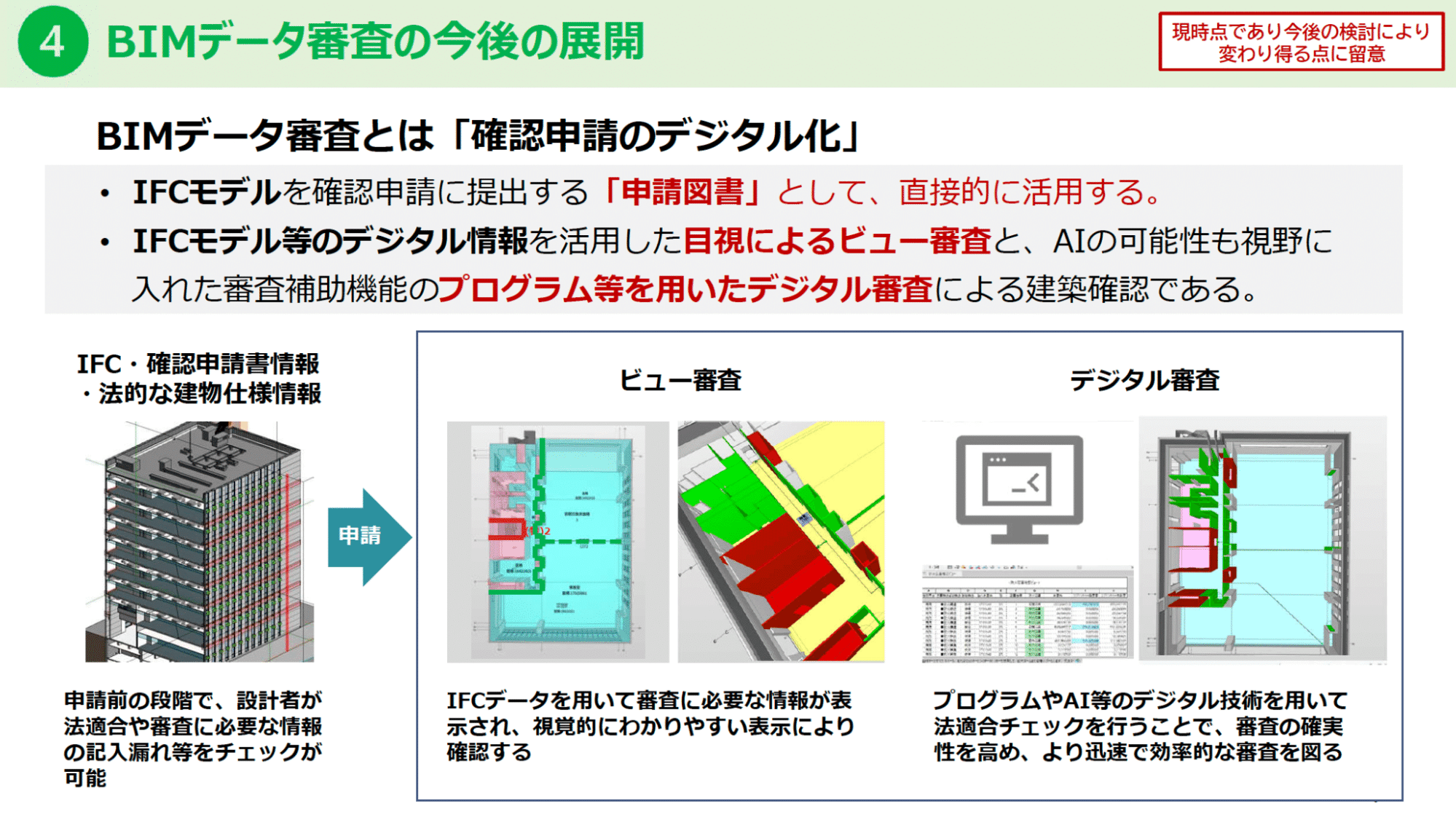
First is view review: examining the model three-dimensionally, in 3D, without producing drawings. Then there's digital review: extracting the information within the model and producing results from arithmetic operations or programs run against it.
Within digital review, there may well be potential for AI and for program development. That, in outline, is how we're proceeding and where our deliberations currently stand.
It would be wonderful if there were a future in which review wasn't needed at all, but I hope this has helped convey that this is not so easy. That's all from me.
Tsuma:
Thank you.
Mr. Sekido, if you'd like, do you have any comments of your own, or anything you'd like to ask Professor Ikeda or Mr. Noguchi at this point?
Sekido:
I feel there is a very significant difference between Japan and other countries.
Japan's building confirmation application is a unique procedure; the systems in other countries are closer to a permit application.
Moreover, overseas there is a strong notion that designers bear the responsibility.
If a defect emerges, the designers are the ones held accountable. It is precisely because of that premise that those countries find it easier to move toward automation.
Japan, on the other hand, has a system open to the private sector, structured around asking someone to "please review this."
There's also an aspect of resolving matters between private parties when something goes wrong.
Legally, the framework places responsibility on the designer, but in practice the allocation of responsibility is somewhat ambiguous.
That makes automating those exchanges far from simple.
Add in local ordinances and questions of legal interpretation, and I sense that advancing automation in Japan is a bit difficult.
Given all that, how far can mechanical checking realistically go through BIM drawing review and automation?
Professor Ikeda, what's your view?
Ikeda:
Overall, I believe we are heading toward automation.
What matters, though, is why we want to automate in the first place.
Fundamentally, there's no point unless using BIM data offers an incentive—making design work and data preparation considerably easier.
I think that's the crux of it.
Up to now, building confirmation applications have tended to increase the workload, because you have to demonstrate legal compliance.
Of course, some items can be checked objectively and easily, but as the system shifts toward performance-based provisions, simple confirmation no longer suffices.
Once a criterion becomes "within so many square meters" or "within so many seconds," simulation is required.
The designer runs the simulation and presents the results, and the reviewer checks them—that's the structure it evolves into.
And that actually adds more work.
When we talk about automation, simply verifying that submitted figures are correct is relatively clear-cut, but it doesn't end there.
Take an item like average ceiling height.
In some cases it's faster to calculate it directly from the model than to look at the value the designer has checked.
The same can happen with other items, such as sunlight (shadow) regulations.
Given the geometry data, the reviewer might be able to calculate directly whether a rule applies and whether the design complies.
Going forward, will the applicant perform the compliance calculations and the reviewer merely verify them?
Or will the reviewer perform the calculations themselves? I think that division is going to become an issue.
Simulation-based items are especially tricky, because results can vary subtly depending on the method used.
At the same time, the heavier the calculation burden of proving compliance, the greater the benefit of automation for both sides.
How we sort all of this out is, I think, a key point in thinking about automation going forward.
Items that can be judged from straightforward wording are relatively easy to understand, but for things like performance values that require proper calculation, the question becomes which side performs that calculation, and to what extent.
Mr. Sekido, what are your thoughts on this?
Sekido:
I think applying these mechanisms to performance-based provisions is a very good thing.
The evacuation safety verification method, for instance, is one area I'm watching closely right now, and as LCA comes within the scope of review, I expect such use cases to grow.
The reviewer's workload is indeed becoming more complex and growing steadily.
We need ways to maintain rigor while improving efficiency, so we're watching this very carefully.
In that sense, data utilization is extremely useful.
It saves time, and when reviewers can check things efficiently, that translates into shorter review times for designers as well.
On that point, I think it offers ample incentive.
On the other hand, with geometry data the challenge is determining how detailed and how accurate the input needs to be.
Take ceiling height alone: from floor finish to ceiling finish, how precisely does it need to be entered?
That still requires discussion, including how much effort is worth investing.
Tsuima:
I may be approaching this from a slightly different angle, but in macro- and microeconomic terms, I think what we're seeing resembles what economists call the "fallacy of composition."
In economics, the idea is that under deflation, when each individual optimizes their own behavior, the situation actually gets worse at the macro level.
During deflation everyone saves, because money held as savings gains value.
Yet if you try to break out of that and look at things macroscopically, the situation would improve if everyone spent—but they can't, because saving is the rationally optimized choice for each individual.
BIM adoption is probably much the same: at the macro level, everyone would be better off if BIM were done properly, but if you try to make it happen through the workings of the private market alone, I see a fallacy of composition on two major fronts.
One is temporal, the other organizational.
On the temporal side, the leaders of large companies serve fixed terms, so if they try to fully implement BIM within about three years, they will most likely post losses.
Over a span of ten or twenty years the benefits would materialize, but from a micro perspective compressed into a short time frame, the optimized conclusion becomes "better not to adopt BIM."
On the organizational side, it would be fine if BIM could be completed within a single company, but it necessarily involves the government as well as every affiliated and partner company.
If it is done properly at a sufficiently macro level, the whole system becomes more efficient, but if your company alone adopts it, your company alone ends up less efficient.
That's why, when you look at international trends, the countries that are ahead are the ones where the government exercised overwhelming leadership and made it mandatory.
Countries with bigger governments, like Singapore and China, have moved quickly, and so has South Korea.
Smaller countries also see greater impact from their decisions, whereas strongly democratic countries—the United States, for example—strike me as comparatively slow.
My impression is that such factors are shaping these international trends.
Mr. Noguchi, do you have anything to add or comment on here? How does this look from the standpoint of the initiatives of the Ministry of Land, Infrastructure, Transport and Tourism (MLIT) or future institutional frameworks?
Noguchi:
As Mr. Sekido mentioned earlier, BIM drawing review launches this April, and as the next stage we have set a goal of launching BIM data review in spring 2029.
As for what that data review should look like, there was discussion earlier about automated review.
If, as Mr. Tayama pointed out, the results also need to be verifiable, then the "digital review" within BIM data review that Mr. Sekido described is probably closer to the automated end of that spectrum.
For the BIM data review framework, Mr. Sekido and his colleagues are leading the study of the component technologies that will make it up.
But when it comes to embedding this in an institutional system, we are still at the stage of mapping out what a realistic and efficient overall framework should look like.
In that sense, today's discussion has been very instructive.
Also, as was mentioned earlier, the building confirmation systems in Singapore, the United States and elsewhere differ somewhat from Japan's.
At the application stage they operate on a "permit" rather than a "confirmation" basis: responsibility is placed fundamentally on the designer, applications are accepted with a degree of flexibility, and the emphasis is on inspection at the completion stage.
In Japan, by contrast, expectations for the accuracy of building administration are extremely high.
In short, the premise is that "mistakes are not allowed."
Under those conditions, if something like fully automated review were introduced, the question of who bears responsibility and how that is guaranteed is, I feel, one of the hardest institutional design challenges.
Among other countries, South Korea's confirmation system strikes me as relatively close to Japan's.
How Korea assigns responsibility and builds verifiability into its system could be a very useful reference for Japan's institutional design.
That is something I'd like to study further.
That's all from me.
Ikeda:
Over the medium to long term, this comes down to whether we automate the current building confirmation application process as it stands, or go as far as revisiting the system itself.
I am also involved in the discussions around MLIT's medium- to long-term vision—that is, rethinking the Building Standards Act itself to some degree.
The current Building Standards Act rests on the premise that the designer bears full responsibility for legal compliance at the point of completion.
Going forward, however, one could argue that if safety can be assured through operation after the building comes into use, there might be room for a bit more latitude there.
BIM should be leveraged precisely to make that kind of shift easier.
Of course, some things have to be done right at the time of construction.
Some things simply cannot be fixed after the fact.
Others, though, can be addressed by adopting certain measures during operation.
In weighing that balance, having a robust BIM model makes it possible to build cases where, for something like evacuation safety, even if the building differs somewhat from the initial design, you can later prove that the intended performance is still secured.
I believe a legal approach that encompasses such possibilities will be called for from here on.
Tsuima:
In that sense, this isn't just a question of the existing Building Standards Act and the building confirmation applications based on it.
It has to be considered over the long term.
Where to locate responsibility is a deeply rooted issue.
More fundamentally, I think it connects to how land ownership itself is conceived.
The UK is a clear example: there is a notion that land ultimately belongs to the state, and that strongly shapes things. The same goes for Singapore and China.
In Japan, by contrast, land is regarded as belonging to the people.
That is what leads to the mindset of "I take responsibility for my own land."
If we move toward designers not bearing legal responsibility, we may have to revisit our fundamental philosophy toward land as well.
Ikeda:
There is also the concept of manufacturer liability.
With a product, the manufacturer is presumed to have handed something safe to the consumer at the outset, so if anything goes wrong, the maker is responsible—that logic holds.
But with buildings, which are used for 50 or 100 years, it is hard to place all the responsibility on the maker.
Unless users also use the building appropriately, long-term safety cannot be maintained.
That being the case, architecture is fundamentally not a purely manufacturer-liability model.
We need to build a framework for sustaining safety management over the long term.
Tsuima:
Today's legal framework has its roots in the era of rapid economic growth, when a huge volume of housing had to be supplied quickly.
To push land development forward, the law was in many ways kept fairly loose so as to encourage development.
But society has now matured, and we've entered an era, much like Europe, in which buildings have to be used for longer.
Seen that way, I think we've reached a point that calls for the major shift in thinking that Professor Ikeda described.
Sekido:
This is a little awkward to say with someone from MLIT present, but as was just said, the Building Standards Act was established during the era of rapid economic growth.
Since its inception in 1950, the law has been built up layer upon layer.
In other words, rather than being fundamentally overhauled, legal provisions have been added on every time something happened.
The result is an extremely thick body of rules today.
But is it really structured in a way suited to automated checking, code compliance checking or rule-based review? It is not.
So if we are serious about pushing that kind of automation forward, I feel it will be difficult unless we also consider transforming the legal framework itself.
Tsuima:
Mr. Noguchi, what is your view on this discussion?
Noguchi:
First, on the legal framework: when the Building Standards Act and the Kenchikushi Act (the law governing licensed architects and building engineers) were enacted, housing quality was low, and the caliber of engineers was not what it is today.
I believe that is why quality was to be assured through the legal framework of the Building Standards Act together with the licensing system for architects.
Because building quality was poor at the time, checking before construction offered greater benefit than fixing things after they were built.
That, I think, is why a system of prior checks was introduced.
But as we have been discussing, the capabilities of today's engineers have risen considerably.
Given that, a Western-style model of ex post checking—verifying after the fact and backing it with mechanisms such as insurance—is conceivable.
This is my personal opinion, but I think such a world is entirely plausible.
Audience Q&A and Discussion
Tsuima:
Thank you.
At this point, I would like to open the floor to everyone in the audience for comments or questions. Anyone?
Audience member A (major general contractor):
When it comes to applying BIM to building confirmation applications, the reality is that the people within design firms and construction companies who decide, project by project, whether to use BIM—or whether to create BIM models at all—don't necessarily see the benefit.
As a result, even when younger staff in their twenties and thirties want to use BIM, the organization sometimes decides against it.
We have had that experience at our own company.
So we need a mechanism that lets the people who don't currently see BIM as beneficial genuinely feel its benefits.
That does, I think, require the kind of big government mentioned earlier.
There are already subsidy schemes of a sort for BIM, but it would help to have something like points awarded when a building confirmation application is submitted, or some other form of recognition.
In fact, at our company, when we obtained something like the DX Certification from the Ministry of Economy, Trade and Industry (METI), executives who had shown little interest in digital suddenly took notice.
They started asking, "So we're pursuing digital initiatives like that?"
In other words, we need a mechanism that can bring those people on board as well.
So I would very much like MLIT to consider something like a points system or a corporate badge.
It would be good to have a framework in which companies that genuinely engage with BIM are recognized with something like a badge, so that it becomes a mark of honor for the company.
Tsuima:
Thank you.
Mr. Noguchi, how does this look from the standpoint of MLIT's initiatives and future institutional frameworks?
Noguchi:
On the subject of subsidies, we launched a subsidy program to support BIM adoption about three years ago, and it is still running.
It is also included in next year's budget.
That said, this is not simply a matter of "doing BIM" for its own sake.
The point of adopting BIM is to make work more efficient, or to create value through more sophisticated practice.
It is precisely because of that value that there is a policy rationale for spending taxpayer money on BIM adoption.
On the other hand, the counterargument is that if companies stand to profit from it, they should simply do it on their own.
In practice, though, even companies that are working on it find the benefits hard to see in the current transitional period.
There is also no consensus on how the costs should be shared across the production process as a whole.
And because the industry as a whole has not yet reached a state where BIM is in universal use, the real gains in efficiency and sophistication have not yet materialized.
We have prepared subsidies on the basis of that explanation, but there are limits to what "simply using BIM" can achieve.
In that sense, it would be worth designing subsidy programs or certification schemes that fit precisely into this "in-between" phase of the BIM rollout.
That is something I would very much like to work through together with all of you.
Attendee A (major general contractor):
Most of today's subsidies are built on the idea of covering, say, a 3 million yen cost so that it comes to zero.
But something like a corporate badge is worth more than 3 million yen: it adds value to the company as a whole.
If the only mechanism is a subsidy that gets reimbursed afterward, many people end up thinking, "Wouldn't it be the same if we just didn't bother?"
That is why I think the key issue going forward is how to bring in people who have no interest in digital, or whose expertise lies elsewhere.
Noguchi:
You are absolutely right.
I think we have not yet managed to convey the difference between immediate value and future value—and what that future value is worth when converted into present terms.
That is why we need a shared understanding, not just on the government's part but among everyone, that this is the state we are aiming for.
And I believe that demonstrating what those benefits actually are, one case study at a time, is what will lead to that value being shared.
Taima:
Thank you.
Does anyone else have a question?
Participant B (major IT vendor):
Thank you for the very interesting points.
I come from a construction background originally, but most of my work has been in the broader area of DX.
Listening to today's discussion—and I admit I am not that familiar with the building confirmation application process itself—I was struck by how closely it resembles digital transformation at large private-sector companies.
I have one question.
My simple impression is that the recurring theme was how to automate work that is extremely labor-intensive and not going well.
To that end, the process is being broken down into its elements and technology is being applied to each of them. But stepping back a little, I did not yet see a discussion of whether the process itself is optimal in the first place.
At the same time, listening to Mr. Noguchi and Professor Ikeda, it became clear that there are many problems embedded in the structure of this industry.
Given a process with so many open questions, including the division of responsibility, I felt that connecting the technology discussion with the process discussion might actually be very difficult.
So, to sharpen my question a little: I imagine that Mr. Tayama's team is planning to overlay AI technology first and experiment from there.
But my concern is that there may be parts of the process that need to change before that can happen.
This ties into the earlier comparison between Singapore and Japan, but how do you see this progressing from here?
And to put a pointed question to Professor Ikeda: what would the ideal form of Japan's building confirmation application process look like?
Ikeda:
That is a difficult question, but I think one major factor is increasing the openness of the data.
At present, each building owner simply submits their application with the data kept closed.
That creates a problem of data reusability.
When you consider things like zoning-type regulations, building confirmation application data generates far more value when a large volume of it is made available and aggregated to some degree.
And as the value of the data increases, so does the incentive to create it, which in turn makes the entire system more efficient.
Seen that way, there is far more room for improvement if we move away from today's closed approach to data and increase its openness as much as possible.
The difficulty, however, is where to strike the balance with the privacy aspects of building data and its character as private property.
Singapore, for one, is moving in the direction of opening up even data that touches on private property, on the premise that the data will be put to use.
In other words, the question comes down to whether we are willing to accept that certain aspects of what we call private property will become open.
Taima:
To dig a little deeper into that, I think this is really a question of where to draw the line between the cooperative domain and the competitive domain.
The larger the competitive domain, the more it contributes to maximizing GDP, but the more readily it produces inequality.
At the same time, technology does not advance where there is no market.
I believe the reason BIM was so slow to be adopted is that the private market struggled to see a benefit in it.
So if we make everything competitive, BIM will not move forward.
That is why the cooperative domain needs to be expanded gradually.
The data standardization Professor Ikeda mentioned is part of that, and subsidies are another such instrument.
But if the cooperative domain swallows everything, there is no longer any incentive to develop new technology.
So I think we are now at the stage of expanding the cooperative domain a little at a time.
Ikeda:
To broaden the discussion of building confirmation applications a little further: even if we convert only new buildings to BIM, that represents just a tiny fraction of Japan's entire building stock being updated each year.
At that rate, BIM adoption will not be complete even in a hundred years.
The real key is not converting new construction projects to BIM, but converting existing buildings.
How we advance BIM for existing buildings is what matters.
And for that, the BIM does not necessarily need to be extremely high-precision.
On the contrary, I think what matters is spreading BIM broadly and shallowly, even if loosely.
Cars are subject to a mandatory inspection system, and any car on the road must meet certain standards.
I think architecture should aim for the same thing: a state in which every building is modeled in BIM to some degree and a set of baseline standards is continuously upheld.
Approached from that side, the very question of what building confirmation needs to guarantee in the first place starts to change.
Taima:
Does anyone else have a question?
Then let's take one final question.
Participant C (major general contractor):
The cooperative and competitive domains came up, and I would like to ask about that.
Could you tell us where exactly the cooperative domain lies, including in relation to standards such as ISO?
And building on that, I would be interested to hear where you think we should focus our efforts to achieve a breakthrough.
Sekido:
The non-competitive—that is, cooperative—domain is, I believe, areas such as data standardization.
Frameworks of that kind need to be decided in common, at least to a certain degree.
What you do with them, on the other hand, is the competitive domain.
For example, once the information itself is defined, there are many different ways to build programs that make review more efficient.
That is an area where private companies and anyone else who wants to can pursue their own approaches in all sorts of ways.
Participant C (major general contractor):
Building confirmation applications, for example, require detailed information about materials, such as fire-protection certification codes.
ISO, however, does not necessarily require such items.
In other words, the data that is required differs from the outset.
The question is where to reconcile that difference.
Once that has been properly sorted out, private companies will be able to bring their strengths to bear in competitive areas such as automation.
And new competition should emerge from there.
I work in the smart grid field, and I believe that using data during the operational phase is especially important.
An ecosystem for that kind of data use does not yet exist, so I hope sessions like this one can serve as a catalyst for it to grow.
Taima:
We have reached the end of our time, so this concludes the session.
Thank you all for taking time out of your busy schedules to join us.
Closing Thoughts
As the organizer, I had the task of pulling together this discussion, and given that both the panelists and the attendees were all far more experienced than I am, it was a humbling role to take on. But I was delighted to see everyone engage with such keen interest that the discussion ran past its scheduled time. Developments in BIM-based review have the potential to fundamentally reshape the construction industry, and I came away determined to continue deepening my understanding of how this field progresses.
The end
Read next ↓