Articles
What We Learn as Knowledge Expands

Automatically translated from the Japanese original.
What is time? None of the laws of physics—from Newton's laws of motion to relativity to quantum theory—rule out time running backward. It is entropy that defines time.
The increase of entropy is what marks the passage of time, and the passage of time means that everything—knowledge, matter, energy—spreads outward and diverges.
Just as the universe expanded from a single, searingly hot body in the Big Bang, and just as a diverse array of animals and plants evolved from a common microbial ancestor, knowledge has a hierarchical structure that branches out from a single, fundamental body of knowledge.
Throughout history, people have uncovered knowledge in both directions—diverging and converging—driven by necessity and curiosity.
If we keep pushing our understanding in the converging direction, we will one day arrive at a single, generalized body of knowledge that captures this entire world: a formula that expresses everything.
Because a person's time is limited by their lifespan, each of us must decide, within that finite time, which knowledge to acquire ourselves and which to have others supply—taking into account where we stand in society, and where we want to stand.
People then offer their knowledge to one another, society takes shape, and it continues to expand as time goes on.
What Is Time?
Time remains a concept with unexplored territory, but one approach to understanding it is through entropy. The direction pointing from past to future—known as the "arrow of time (Eddington, 2012)"—coincides with the direction in which entropy increases.
Entropy is a quantity that measures the degree of randomness or disorder in the state of a given system. High entropy means high randomness; low entropy means an orderly state.
In the direction time moves forward, the law of increasing entropy holds (Clausius, 1854). Also known as the second law of thermodynamics, this law states that the entropy (degree of randomness or disorder) of an isolated system either increases over time or remains constant. It is a fundamental principle expressing the irreversibility of physical processes in the natural world.
Indeed, as time passes, hot coffee cools, the universe expands, and biological evolution multiplies the number of species. As this kind of disorder advances, the number of observable states grows—and knowledge, in the same way, diverges and increases.
The Structure of Knowledge

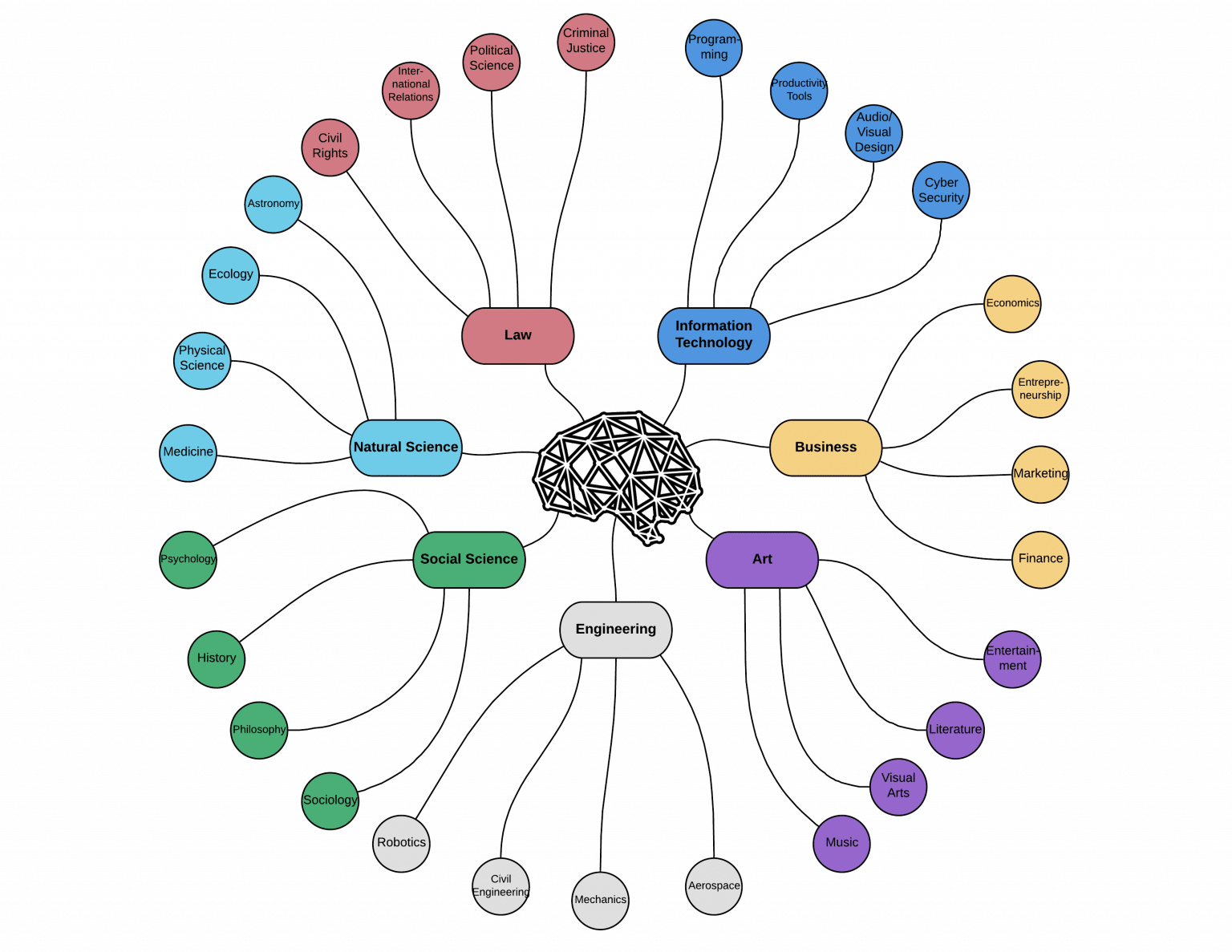
Knowledge is hierarchical. Look at the system of academic disciplines, for instance: a handful of broad fields subdivide into ever finer specializations (Florida International University, 2024).
Knowledge has a diverging direction and a converging direction. Whenever people have acquired new knowledge, they have done so by extending existing knowledge either outward (diverging) or inward (converging).
The diverging direction is exemplified by AI: the mechanism by which neurons fire, discovered in neuroscience, was reproduced with electrical signals in information science, which in turn enabled the development of AI capable of making more human-like judgments than ever before. The converging direction, by contrast, is exemplified by physics: Newtonian mechanics, which describes the motion of objects on Earth, was generalized by Einstein's theory of relativity so that it holds at cosmic scales, and quantum mechanics was then proposed to capture motion at the scale of the smallest units that make up the universe, such as electrons and atoms.
Einstein's theory of relativity encompassed several theories that had existed before it—Newtonian mechanics, Maxwell's equations for electromagnetic fields, astronomy, and more. If the acquisition of knowledge continues to advance in the converging direction, it is conceivable that we will eventually be able to express the entirety of the world with a single theory, a single formula.
At present, physicists are attempting to unify the four fundamental forces—the electromagnetic force, the weak force, the strong force, and gravity—into a single force, and superstring theory is regarded as one of the most promising candidates for achieving this.
In other words, knowledge is structured such that knowledge in the converging direction provides a general explanation for knowledge in the diverging direction. In scientific terms, when a general theory holds under specific conditions, it is described as an effective theory.
The Knowledge We Need
While knowledge diverges and grows over time in this way, the capacity of the human brain and the length of the human lifespan do not, at present, grow along with it. We therefore need to determine what knowledge we should acquire within our limited time, and acquire it efficiently.
Since there is only so much one person can do, we live in society by each contributing the areas we are good at. At the level of a company, roles are divided and people cooperate to build a service; at the level of a nation, companies and government agencies provide services to one another with money as the medium of exchange; and at the international level, regions supply each other with their local specialties and highly productive services through trade. This is how people's lives are sustained.
Cooperation among people is essential, and for it to work, at least one of the parties communicating (whether inside your own organization or outside it, including customers) must understand the other. When two people who speak different languages try to cooperate, for example, they can barely communicate at all unless at least one of them can use the other's language.
To sum up, we can divide roles broadly into experts, who apply specialized knowledge and skills, and managers, who build organizations and operations, and lay out the knowledge each should aim to acquire.
Experts:
• Place the greatest emphasis on mastering knowledge in your own area of specialization
• Acquire the knowledge of those you communicate with
• Acquire knowledge that further generalizes your area of specialization (knowledge in the converging direction)
Managers:
• Acquire broad knowledge related to your company's or organization's services
• Acquire the knowledge of those you communicate with
• Acquire knowledge that further generalizes the knowledge related to your company's or organization's services (knowledge in the converging direction)
Reference
Clausius, R. (1854). Ueber eine veränderte Form des zweiten Hauptsatzes der mechanischen Wärmetheorie. Annalen Der Physik, 169(12), 481–506.
Eddington, A. (2012). The Nature of the Physical World: Gifford Lectures (1927). Cambridge University Press.
Florida International University. (n.d.). Disciplines. Retrieved May 30, 2024, from https://miinds.fiu.edu/?page_id=33
The end
Read next ↓