
Articles
How Will Culture and Civilization Be Passed On in the Age of AI? Handing Down the Knowledge of Companies and Nations, Based on Recent Research
Product
Career
Introduction
As AI advances, a growing number of companies are freezing the hiring of young people or carrying out mass layoffs. In the short term, AI-driven execution of work raises productivity. At the same time, however, a major question has come to the fore: how will companies train the next generation and pass their corporate culture on to it? This article looks back at how humanity has transmitted culture and civilization throughout history, and sets out guidelines for how this accumulated inheritance can be carried forward in the AI era.
The novelty of this article lies in the following three points.
- Treating transmission as a question of "means" and organizing everything from genes to AI as a single history: Starting from the definition of information and the classifications of capital, we identify what is transmitted, define transmission as "the same mechanism continuing to function even after a given individual is gone," and then arrange twelve means of transmission, from genes to AI, in the order in which they were invented, using historical examples and a common set of criteria.
- Synthesizing the latest research: Drawing on findings from cultural evolution theory, cognitive science, organization theory, history, and political science, together with research published between 2023 and 2026, we show from the standpoint of transmission that AI can learn only from records, that it does not cultivate bearers of knowledge, and that, absent instructions, it executes the model's average.
- A design framework for companies in the AI era: For each type of information to be transmitted, such as culture and knowledge, we examine three questions in parallel: what is to be transmitted, how it has been transmitted until now, and how it should be transmitted in the AI era. On that basis, we specify concretely what should be left in human hands in order to develop young talent and pass on culture.
What Does It Mean to Pass On Culture?
We begin by defining what it means to pass on culture and civilization. Here we split the definition in two: "information," the content that is passed on, and "transmission," the state of being passed on.
Defining information
Definitions of information across disciplines
What, in the first place, is information? Various disciplines have offered definitions.
- Information theory: The mathematician Claude Shannon defined information as "that which reduces the receiver's uncertainty" and built a framework for measuring its quantity in a unit called the "bit" (Shannon, 1948). "Uncertainty" here means a state in which one does not know which of several possibilities is true. When a coin is tossed and you do not know whether it landed heads or tails, the receiver faces two possibilities. On receiving the message "it was heads," the possibilities narrow from two to one and the uncertainty disappears. The amount of information in a message that settles which of two equally likely possibilities is the case is one bit. With four possibilities (2 x 2) it is two bits, with eight (2 x 2 x 2) it is three bits, and so on: each doubling of the possibilities adds one bit. The computer bit derives from this. In a computer, a bit is "a single position that holds either a 0 or a 1." It is the smallest unit that represents one of two states, such as a switch being on or off, or current flowing or not, and eight bits grouped together make one byte. Since one byte has 2 to the power of 8, or 256, possible combinations, it is used to represent a single alphanumeric character. This rests on the same idea as Shannon's definition.
- Anthropology: The anthropologist Gregory Bateson defined information as "a difference that makes a difference" (Bateson, 1972). Only a difference that triggers some change on the receiving side (a judgment, an action, a state) counts as information; a record that no one ever reads may exist physically, but it does not function as information.
- Physics: Norbert Wiener, the founder of cybernetics, stated that "information is information, not matter or energy" (Wiener, 1948). At the same time, the physicist Rolf Landauer argued that "information is physical," deriving from the theory of thermodynamics that erasing one bit of information must be accompanied by a minimum release of heat (about 3 x 10^-21 joules at room temperature) (Landauer, 1961). This was initially a theoretical inference rather than an experimental result, but half a century later the lower bound Landauer predicted was confirmed experimentally: a microscopic particle was trapped in one of two wells created with lasers to represent "one bit," and the heat released when the particle was forced into one of the wells (that is, when the information was erased) was measured (Bérut et al., 2012). Information cannot exist unless it is carried on some physical state, and changing that state always requires energy. A means of transmission can thus be restated as a physical "substrate" that carries information, together with the process of copying it onto another substrate. As Landauer's principle shows, information exists as physical and chemical states: the sequence of bases in DNA, the strength of synapses in the brain, the molecules of ink on paper, and electric charge in a computer.
- Management studies: The management scholar Russell Ackoff distinguished "data," sequences of symbols; "information," data given meaning; "knowledge," information systematized so that it can be used; and "wisdom," which can be used for judgment (Ackoff, 1989). The philosopher Luciano Floridi defines meaningful information as "well-formed, meaningful, and truthful data" (Floridi, 2010).
Classifications of capital
Things handed down across generations, information included, have been organized in economics and sociology under the heading of "capital." Each classification gives a different name to the form of capital in which information resides.
- Bourdieu's three forms of capital: The sociologist Pierre Bourdieu divided the capital people inherit into "economic capital" (property, funds), "cultural capital" (education, skills, degrees), and "social capital" (connections, trust), and called the honor and authority obtained when these are recognized "symbolic capital" (Bourdieu, 1986). He further distinguished three states of cultural capital: the embodied state (cultivation and manners), the objectified state (books and tools), and the institutionalized state (degrees and qualifications).
- Human capital and social capital in economics: The economist Gary Becker called the knowledge and skills accumulated in an individual through education and training "human capital," and analyzed them as an object of investment (Becker, 1964). The sociologist James Coleman formalized "social capital" as the resources that exist within relationships between people and make action possible (trust, norms, networks) (Coleman, 1988).
- The four capitals of national wealth: The OECD uses four capitals, "natural capital," "economic capital," "human capital," and "social capital," as a framework for measuring the sustainability of people's well-being (OECD, 2015). The World Bank's estimates in "The Changing Wealth of Nations" likewise break national wealth down into "produced capital," "natural capital," "human capital," and "net foreign assets," with human capital the largest component in many countries (World Bank, 2021).
- Corporate intellectual capital: In management studies, a company's invisible assets are called "intellectual capital," and it has become standard to divide them into three parts: "human capital," which resides in employees' heads; "structural capital (organizational capital)," the mechanisms, documents, systems, and culture that remain with the company after employees go home; and "relational capital," the relationships with customers and business partners (Edvinsson & Malone, 1997; Nahapiet & Ghoshal, 1998).
- Intangible assets in economic statistics: Corrado, Hulten, and Sichel classified corporate intangible assets into three categories, "computerized information" (software, databases), "innovative property" (research and development, design, copyrighted works), and "economic competencies" (brands, organizational structures, employee training), and showed that in advanced economies investment in intangible assets is coming to exceed investment in tangible assets (Corrado, Hulten & Sichel, 2009).
Information that is the object of transmission
Building on the above, the following are the things passed on as information. They divide into those acquired through learning (the process by which an animal, after birth, changes its behavior or acquires new behavior in response to experience and stimuli) and those that are not.
Information transmitted through learning
- Culture: The totality of knowledge, beliefs, techniques, norms, customs, and values that the members of a group acquire through learning and share. The anthropologist Edward Tylor defined culture as "that complex whole which includes knowledge, belief, art, morals, law, custom, and any other capabilities and habits acquired by man as a member of society" (Tylor, 1871).
- Civilization: The largest unit of culture: a cultural complex equipped with cities, writing, institutions, religion, and systems of technology, spanning multiple societies and lasting from several centuries to several millennia. The political scientist Samuel Huntington positioned civilization as "the broadest cultural grouping of people" (Huntington, 1996).
- Knowledge: Information that has been systematized so that it can be used. It divides into "explicit knowledge," which can be expressed in words and numbers and recorded, and "tacit knowledge," which is bodily and experiential and hard to put into words (Polanyi, 1966; Nonaka & Takeuchi, 1995). Techniques and skills are the subset of knowledge consisting of methods and bodily abilities for making or doing something.
- Institutions: Humanly devised constraints that shape human interaction, including formal institutions such as laws and contracts and informal institutions such as customs and codes of conduct (North, 1990). Institutions are both "things that are passed on" and "means" for passing on other things. In the classification of intellectual capital they correspond to structural capital.
- Values: Shared standards of judgment about what is desirable and what is right. In research on organizational culture, values occupy the deepest of three layers: visible artifacts, espoused values, and unconsciously shared basic assumptions (Schein, 2010).
- Collective memory: Memory of the past shared by a group. It divides into "communicative memory," which is conveyed in everyday conversation and fades within three to four generations, and "cultural memory," which is maintained for centuries or more through writing, ritual, and monuments (Assmann, 1992).
Information transmitted without learning
- Genetic information: The blueprint of the body and instinctive behavior. The sequence of the four bases in DNA is a difference that narrows the possibilities for "which proteins are made" (Shannon's definition); that difference produces differences in body and behavior during development (Bateson's definition); and it is carried on matter as a chemical state (Landauer's definition).
The following are passed on as capital other than information.
- Property and capital (economic capital): Land, buildings, funds, and businesses. These are passed on through the institutions of inheritance and business succession. This column deals not with the transmission of property itself but with the institutions that make it possible (inheritance rules, the family headship system, and legal personality).
- Relationships (social capital): Trust with customers and business partners, relationships of mutual aid in the local community, and personal networks (Coleman, 1988; Putnam, 1993). What long-established Japanese businesses have protected under the name of noren (the shop curtain, standing for goodwill and reputation) falls into this category.
- Status and name (symbolic capital): Position and legitimacy within a group, such as a throne, family headship, an office, a company name, or a brand. The successions of monarchs and founders discussed in the chapter of this column on "Theories of the means of transmitting information" are moments at which the transmission of status is bound up with the transmission of culture.
Defining transmission
Prior research on transmission includes the following.
- The difference between transmission and preservation: Information that is merely preserved has not been transmitted. Following Bateson's definition, information can be said to have been transmitted only when a record "makes a difference" to the judgment or action of the next bearer, that is, when it is read, understood, and acted upon. An undecipherable document gathering dust in a library, or a database that no one consults, has been preserved but not transmitted.
- The relationship between transmission and learning: In cultural evolution theory, the passage of information across generations by learning from other individuals rather than through genes is called "cultural transmission," and it is divided into "vertical transmission" from parent to child, "horizontal transmission" among members of the same generation, and "oblique transmission" from elders other than parents to the young (Cavalli-Sforza & Feldman, 1981). "Transmission" as used in this article is a concept that encompasses this cultural transmission.
- Transmission in anthropology: The anthropologists Boyd and Richerson and the geneticists Cavalli-Sforza and Feldman argued that humans have two inheritance systems, genes and culture, and that culture changes and accumulates independently of genes but according to evolutionary principles (Cavalli-Sforza & Feldman, 1981; Boyd & Richerson, 1985). The starting point of this theory is the property of culture that it "accumulates in the group beyond the death of the individual."
- Transmission in biology: The biologists Jablonka and Lamb organized the inheritance of living organisms across generations into four dimensions: genetic, epigenetic, behavioral (social learning), and symbolic (language and writing) (Jablonka & Lamb, 2005). Organisms that preceded humans had the first two; many animals have the third in limited form; only humans have the fourth. The history of the means of culture is the history of how the third and fourth dimensions have been extended.
- Only humans have this mechanism: Chimpanzees, whales, and birds have culture too. Even so, only humans have been able to accumulate knowledge over thousands of years. Modern humans are richer than humans of 100,000 years ago not because individuals have become smarter, but because we acquired a mechanism by which knowledge accumulates beyond the individual.
Building on the above, this article defines transmission as follows.
Definition of transmission:
The same mechanism continues to function even after a given individual is gone
A state in which excellent work is possible only while an excellent craftsman is alive cannot yet be called "transmitted." Only when work of the same quality continues to be reproduced within the organization or the community after that craftsman retires or dies can culture and knowledge be said to have been passed on.
A History of the Transmission of Information
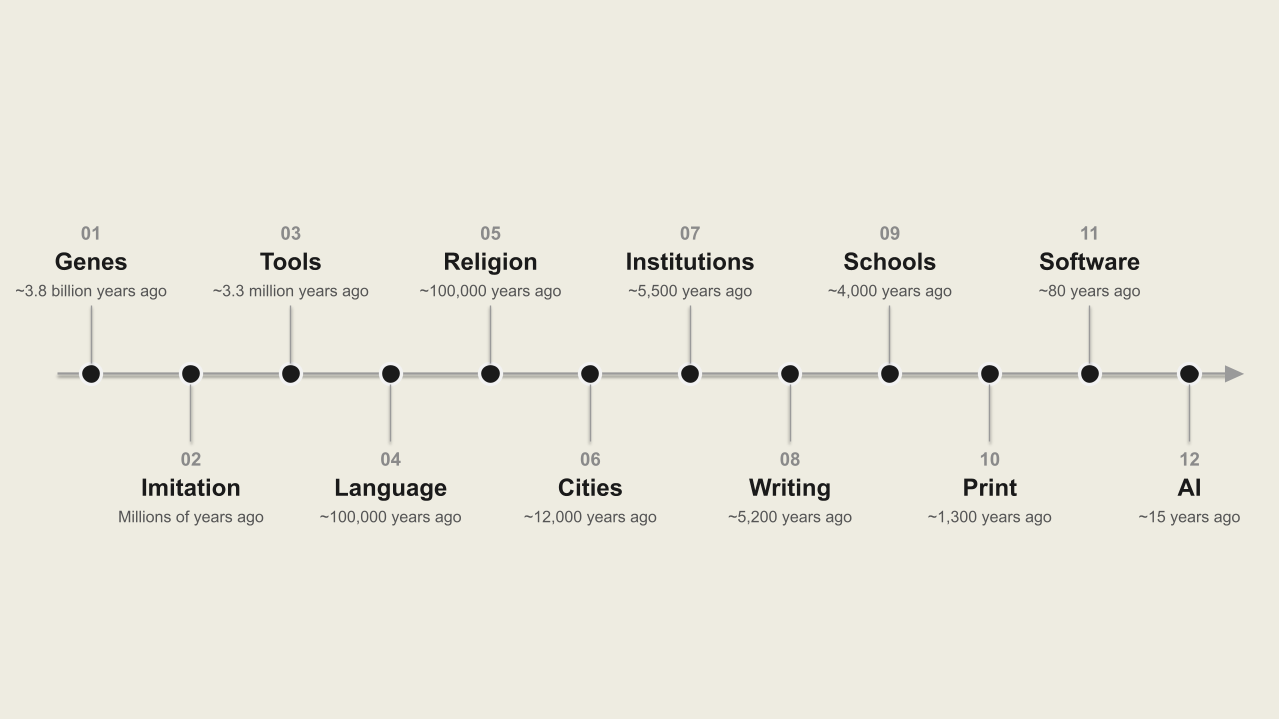
The history of passing on information such as culture and civilization is closely tied to the history of inventing the methods that made such transmission possible. Here we take up, one by one and in the order in which they were invented, the methods that humans (and the organisms that preceded them) have used to take knowledge and culture outside the individual and hand them to the next bearer.
Each means is organized according to the following common criteria.
- Examples
- Physical state in which the information is stored (in what material state the information is fixed)
- What improved on earlier means (what was new)
- What it can preserve (types of knowledge)
- Conditions under which transmission breaks (what stops it)
- Who sustains it, and how many
- Reach (family, community, company, nation)
- Durability and ease of updating
c. 3.8 billion years ago: Genes
Life has genes as a mechanism by which information survives into the next generation even when the individual dies. When self-replicating molecules and cells emerged about 3.8 billion years ago, a mechanism was born by which information outlasts the death of the individual. Epigenetic inheritance, a mechanism that regulates how genes (the information written in DNA) operate without changing the base sequence of the DNA (the material) itself, has existed at least since the appearance of multicellular organisms; in plants, there are known cases in which responses to drought or disease are carried over into seeds.
Examples
- The migratory direction of migratory birds: Among European blackcaps, some populations migrate southwest in autumn and others southeast. When the two are artificially crossbred, the offspring, without being taught by anyone, attempt to fly in an intermediate direction (south). The experiment showed that the "knowledge" of migratory direction is carried in the genes and inherited (Berthold, Helbig, Mohr & Querner, 1992).
- Mice whose coat color changes with the mother's diet: Mice carrying the "agouti" gene normally have yellow fur and a tendency toward obesity. Yet when pregnant mothers are fed a diet rich in folic acid and vitamin B12, their offspring, despite carrying the same gene, grow up with brown fur and are less prone to obesity. This is because components of the diet attach chemical markers (methyl groups) to the agouti gene and weaken its activity. It is a textbook experiment in epigenetic inheritance, in which the parent's environment affects the offspring even though the sequence itself is unchanged (Waterland & Jirtle, 2003).
Physical state in which the information is stored (in what material state the information is fixed)
- The base sequence of DNA: The information is chemically fixed as the sequence of four bases (A, T, G, C) within the macromolecule DNA. One base corresponds to at most two bits, and the roughly 3.1 billion base pairs of the human genome correspond to about 800 megabytes. DNA can store information at a density far exceeding that of today's storage devices, and experiments have encoded an entire book in DNA (Church, Gao & Kosuri, 2012). Epigenetic information exists as methyl groups attached to the DNA and as chemical modifications of the proteins around which the DNA is wound, and it is reset within a few generations.
What improved on earlier means (what was new)
- Omitted, as this is the first means of transmission in living organisms.
What it can preserve (types of knowledge)
- Bodily structure and instinctive behavior: Genes preserve the blueprint of the body and behavior that appears without learning (instinct). Elaborate structures built in the same form generation after generation, such as termite mounds and spider webs, are also the result of behavior encoded in genes. The evolutionary biologist Richard Dawkins called this the "extended phenotype" (Dawkins, 1982).
- Physiological responses to the environment: Epigenetic inheritance passes on to offspring, for a limited number of generations, responses to environments the parents experienced (famine, drought, disease).
Conditions under which transmission breaks (what stops it)
- Cessation of reproduction and extinction of the population: Genetic transmission stops the moment individuals can no longer leave descendants. When a population shrinks and genetic diversity is lost, it becomes vulnerable to environmental change and disease, and the species itself goes extinct.
- The brevity of epigenetic memory: Changes in gene activity that respond to the parents' experience are reset within a few generations. Only the sequence itself persists across generations.
Who sustains it, and how many
- Reproducing individuals: Genetic transmission requires neither teachers nor learners. As long as there are individuals that reproduce, the information passes automatically to the next generation. Of all the means of transmission, it is the one that least requires the will or effort of its bearers.
- Population size determines diversity: When a population becomes small, genetic diversity is lost and the capacity to respond to environmental change declines. The principle that the number of bearers determines the quality of transmission is common to the later cultural means as well.
Reach (family, community, company, nation)
- Blood descendants only: Genes do not reach individuals who are not blood relatives. What broke this constraint was social learning, learning from other individuals beyond the bounds of kinship, which is to say human culture.
Durability and ease of updating
- As long as the species survives: Several million years or more. It is the longest-lasting of all the means of transmission, but also the hardest to change.
- Updates occur only on a generational timescale: Genes are the hardest of all means of transmission to change, and they cannot be updated deliberately. When the environment changes abruptly, they cannot keep up. What emerged to compensate for this slowness was culture, a "second inheritance system" that can be updated any number of times within a single generation (Cavalli-Sforza & Feldman, 1981).
Millions of years ago: Imitation
For the millions of years before writing was invented, and for the great majority of people even after it was, the only means of passing on culture was "the human body and memory." Its oldest form is transmission in which skills pass from body to body without words, by watching, imitating, and being corrected.
Examples
- Acheulean handaxes: For more than a million years, beginning about 1.7 million years ago, teardrop-shaped, bilaterally symmetrical handaxes were knapped in a remarkably consistent form from Africa to Eurasia. With neither blueprints nor words, a complex sequence of manufacturing steps was handed down over tens of thousands of generations solely by watching and imitating the hands of parents and elders.
- Nut-cracking by chimpanzees: Chimpanzees in West Africa crack nuts using stones or wood as anvil and hammer, but some groups have this technique and others do not, and the young learn it by watching their mothers' hands for years. Because troops in different parts of Africa show regional differences in tool use and greeting customs, it was concluded that these are "culture," passed on by imitation rather than heredity (Whiten et al., 1999).
Physical state in which the information is stored
- Synaptic strength and the body's procedural memory: The information is physically inscribed as the strength and number of connections (synapses) between neurons in the brain. Learning is a change in synaptic strength (Hebb, 1949; Kandel, 2001), and the brain has about 86 billion neurons and on the order of 100 trillion synapses. Knowledge "learned by the body," such as skills, is stored in circuits separate from memory recalled in words (the procedural memory system, which includes the cerebellum and basal ganglia), and it often cannot be retrieved in words even by the person who holds it.
What improved on earlier means (what was new)
- What is learned can be passed to the next generation: Through imitation and instruction, it became possible to pass on to the next generation what genes could not preserve: "knowledge an individual acquires during its lifetime."
- It travels beyond kinship: Genes reach only descendants, but social learning allows learning from other individuals who are not kin. The knowledge of individuals with superior skills spreads throughout the group.
- It can be updated within a single generation: Genetic change requires time measured in generations, but knowledge acquired by imitation can be rewritten any number of times within a lifetime in response to environmental change (Boyd & Richerson, 1985).
What it can preserve (types of knowledge)
- Tacit knowledge and skills: The philosopher of science Michael Polanyi observed that "we know more than we can tell," and gave the name "tacit knowledge" to knowledge that cannot be fully explained in words, such as how to ride a bicycle or how to recognize a face (Polanyi, 1966). Tacit knowledge can be conveyed only by being alongside someone, watching, imitating, and being corrected. The body is the only means capable of preserving tacit knowledge.
- Values and habits of judgment: From their research on apprenticeship, the anthropologist Jean Lave and the education scholar Etienne Wenger argued that learning is not the transfer of knowledge but a "deepening of participation in a community of practice" (Lave & Wenger, 1991). Newcomers are entrusted with simple but genuine work on the periphery of the community (legitimate peripheral participation), and in the process of gradually moving toward the center they absorb not only skills but also the community's values and habits of judgment.
Conditions under which transmission breaks (what stops it)
- The bearers die out: As long as knowledge exists only inside human bodies, knowledge shrinks as the number of bearers shrinks. The anthropologist Joseph Henrich explained the loss of technologies such as fishhooks, bone tools, and cold-weather clothing on Tasmania, which was cut off from the mainland about 10,000 years ago, as the result of a shrinking population making the faithful transmission of complex skills difficult (Henrich, 2004). Festivals and traditional performing arts dying out through rural depopulation follow the same principle.
Who sustains it, and how many
- Masters and apprentices, parents and children, the whole community: Humans are animals that not only wait to be imitated but actively "teach." Research on the BaYaka hunter-gatherers of the Republic of the Congo shows that long-term knowledge that takes time to acquire depends more heavily on one-directional instruction from elders to juniors, whereas short-term information is conveyed bidirectionally among peers (Jang & Redhead, 2025).
- In companies, the behavior of leaders: The organizational culture researcher Edgar Schein points out that leaders' "day-to-day behavior," what they pay attention to, what they react to, and how they conduct themselves in a crisis, is the most powerful means of embedding culture (Schein, 2010). However admirable the stated principles, if they conflict with the leaders' behavior, employees imitate the behavior.
Reach (family, community, company, nation)
- Face-to-face range: Bodily transmission does not reach beyond face-to-face range. Its reach centers on the family and the local community; in companies it is limited to the same workplace, and at the national level to rituals that everyone performs bodily.
- Family: Table manners, how to hold chopsticks, the seasoning of dishes, and ways of greeting are conveyed almost entirely by imitation. Children copy what their parents "do" rather than what they "say."
- Community: Local culture, such as festivals, traditional performing arts, and the intuitive know-how of fishing and farming, was long conveyed through practice alone. UNESCO's Convention for the Safeguarding of the Intangible Cultural Heritage (2003) and the intangible cultural property system under Japan's Act on Protection of Cultural Properties emphasize not only "leaving records" but "supporting the bearers (holders)." Behind this lies the recognition that once the bearers are gone, the culture dies out even if records exist.
- Company: OJT (on-the-job training), the sales etiquette and on-site procedures learned by watching senior colleagues, and repeated routines such as morning assemblies and lining up are the bodily transmission of culture within a company.
- Nation: Morning rituals at school, saluting the flag, and the etiquette of cheering at international sporting events are rituals that everyone repeats bodily at the level of the nation.
Durability and ease of updating
- From one bearer's lifetime to a few generations: A skill that lives in the body disappears when its bearer retires and dies. If no apprentice has been trained, the duration is a single craftsman's working life, roughly 40 to 50 years.
- A thousand years or more if placed on a cycle: Rituals repeated periodically, and practices designed so that bearers overlap, such as the shikinen sengu (the periodic rebuilding of Ise Shrine), continue for a thousand years or more as long as the bearers do not die out. The durability of bodily transmission is determined not by content but by the "design of repetition."
- Updating is fast, but leaves no trace of the change: Skills can be improved any number of times within a generation and adapt quickly to environmental change. On the other hand, because there is no record of who changed what and when, unintended drift cannot be distinguished from deliberate updating. It has a dual structure: the parts cast into a fixed form (kata) are hard to change, while everything else changes easily.
c. 3.3 million years ago: Tools
Tools were the first means by which humans placed culture "outside themselves." The oldest stone tools date to about 3.3 million years ago (the Lomekwi site in Kenya), and systematic stone tool production to about 2.6 million years ago (the Oldowan), making tools a far older means than language.
Examples
- Lomekwian and Oldowan stone tools (c. 3.3 to 2.6 million years ago): The roughly 3.3-million-year-old stone tools found at the Lomekwi site in Kenya are older than the appearance of our own genus, Homo. Oldowan tools (from about 2.6 million years ago), named after the Olduvai Gorge in Tanzania, continued to be made in the same way across Africa for more than a million years. That the same form was maintained while makers turned over across tens of thousands of generations shows that the finished stone tool itself served as a "model" guiding the next maker.
- The carpenter's square and kikujutsu (Edo period): The carpenter's square (sashigane) came to Japan from China, and by the Edo period Japanese carpenters had systematized kikujutsu, a technique for working out roof pitches and the angles of structural members without drawings, using only the front and back scales of the square and its right angle. The back of the square is graduated at intervals equal to the square root of 2 times those on the front, so that simply measuring the diameter of a log with the back scale tells you the side length of the square timber that can be cut from it. It is an example of knowledge, the calculation of square roots, embedded in a tool in a form usable even by someone who cannot do the calculation.
Physical state in which the information is stored
- The shape of matter: The information is fixed in matter as the shape of stone, wood, or metal. The angle of a blade, the length of a handle, the spacing of graduations, and the fit of parts hold how the tool is used and made as "form." Stone lasts hundreds of thousands of years; wood lasts decades to centuries.
What improved on earlier means (what was new)
- Independent of human memory and lifespan: Bodily skills survive only while their bearer is alive, but tools remain after their maker dies. Tools were the first means of placing culture "outside the individual."
- Execution need not be entrusted to people: Like a door closer or a jig, a tool can have "the object itself enforce" correct behavior without relying on human attention or goodwill (Latour, 1992). It is the first means of "execution" that requires neither memory nor persuasion.
- Precision can be reproduced without expertise: Measuring instruments, patterns, and jigs embed the expert's judgment in the tool, enabling even the inexperienced to produce a consistent level of quality.
What it can preserve (types of knowledge)
- Procedures and patterns of behavior: Using the example of the "door closer," which shuts a door automatically, the sociologist of science Bruno Latour argued that by "delegating" to a machine an action humans are supposed to perform repeatedly, that action ceases to depend on human attention or goodwill (Latour, 1992). A sign saying "Please close the door" relies on people's memory and conscience, but a door closer reliably shuts the door even when no one is there. This is the most primitive form of transmission at the "execution" stage.
- Forms that teach the body how to use them: The length of a hoe handle, the direction of a saw's teeth, and the single bevel of a Japanese kitchen knife each reproduce a culture's way of working in "the body of the user." As cognitive artifacts (Norman, 1991), tools are devices that convert the maker's knowledge into the user's behavior.
- The precision of expert judgment: Measuring instruments such as the carpenter's square (sashigane) and the ink pot (sumitsubo), together with patterns and jigs, allow a consistent level of precision to be reproduced without expertise. Embedding the expert's judgment in a tool is an early form of "externalizing judgment."
- "Prompts" for stories: Family heirlooms, keepsakes, tools worn by generations of use, and machines from a company's founding days do not themselves narrate knowledge, but they serve as cues that prompt those who stand before them to tell stories. Tools are a means of recording and, at the same time, devices that evoke oral tradition.
What is lost (knowledge it cannot carry)
- How it was made, and why: A finished tool shows "what it can do," but it does not adequately show "how to make it" or "why this shape." As experiments on the transmission of stone tool making show, there are limits to reconstruction from the object alone, and methods of manufacture have been supplemented by the body and language (Morgan et al., 2015). The many excavated artifacts whose purpose is unknown are evidence of this limit.
- Situations the tool does not anticipate: A tool takes over judgment within the uses for which it was designed, but in unanticipated situations it is useless, and the user must reclaim judgment.
Conditions under which transmission breaks (what stops it)
- The absence of anyone who knows how to use it: Even if the tool survives, once there are no craftsmen who know how to use and maintain it, the tool turns from a device for transmitting culture into a mere relic.
- Loss of materials and repair skills: Tools wear out and require repair and reproduction. When materials become unavailable, or the skills of sharpening and repair die out, the lineage of the tool is broken.
- Replacement by a more convenient tool: When a new tool replaces an old one, the skills embedded in the old tool (reading the back scale of the carpenter's square, working an abacus) fall out of use and are lost within a few generations.
Who sustains it, and how many
- Makers and users: A tool survives as long as there is someone to make it, but to function it needs someone who knows how to use it. The further the division of labor advances, from tools like stone tools that anyone can make to tools that only specialist craftsmen can make, the more the number of makers becomes a constraint on transmission.
- Those who repair and sharpen: Blades and machines outlast a generation only if there is someone to maintain them. By "continuously demanding" of their bearers the skills required for their upkeep, tools indirectly compel the transmission of those skills.
Reach (family, community, company, nation)
- As far as those who hold the tool: Because tools can be carried and copied, they are not tied to a place as buildings are. Stone tools of the same form are distributed across continents because tools were carried along with human migration and copied.
- Family: Kitchen knives, farm tools, sewing tools, and musical instruments are handed from parent to child within the home, and the way to care for them is conveyed along with the way to use them. Keepsakes and heirlooms function as "prompts" for telling the family's story.
- Community: Fishing gear, farm tools, looms, and kilns give form to the knowledge of a locality's industry; made by local craftsmen and used by local people, they have maintained a circulation of skills.
- Company: Jigs, molds, standard work sheets, and fixed-position management of tools (5S) physically enforce "correct work." Dedicated tools and proprietary machines hold the company's very way of working.
- Nation: Prototypes of weights and measures, standardized parts, and common tool standards are tools that guarantee "the same dimensions, the same way of doing things" at the level of the nation.
Durability and ease of updating
- From decades to hundreds of thousands of years: Stone tools last hundreds of thousands of years, and metal and wooden tools, depending on maintenance, are used for decades to centuries. However, the period for which a tool survives "in usable condition" equals the period for which the skills of repair persist.
- Traces of improvement remain in the form: Tools are improved by changing their form little by little, and those improvements are carried over into the next generation's tools. Whereas the Acheulean handaxe barely changed over a million years, tools since the modern era have been improved rapidly because means of recording and comparing improvements (writing, drawings, print) were added.
- On to the next means: Tools preserve "what can be done" in their form, but they cannot carry "why it is done this way" or knowledge about things not immediately present. As the means to overcome this limitation, humanity acquired language.
100,000 years ago: Language
Language added to bodily transmission "the power to convey what is not in front of us." Because spoken language leaves no direct trace in fossils or artifacts, its origin remains unsettled: estimates range from more than 500,000 years ago, going back to the common ancestor shared with Neanderthals (Dediu & Levinson, 2013), to a view that it emerged among anatomically modern humans within the last 100,000 years (Berwick & Chomsky, 2016) (Hauser et al., 2014).
Examples
- The Homeric epics: Before the *Iliad* and the *Odyssey* were written down, professional singers passed them on by improvising from combinations of formulaic phrases and meter. Parry and Lord, who studied singers using the same technique in twentieth-century Yugoslavia, revealed the mechanism by which epics thousands of lines long were transmitted across generations without writing (Lord, 1960).
- Aboriginal Australian memories of sea-level rise: Aboriginal peoples across Australia preserve traditions that land now beneath the sea was once dry. Checked against the geological timing of sea-level rise, these stories turn out to have conveyed events of more than 7000 years ago through oral tradition alone (Nunn & Reid, 2016).
Physical state in which the information is stored
- The listener's brain: Spoken words themselves are waves of air pressure, and they vanish the instant they are uttered. The only place they exist durably is inside the brains of speaker and listener, that is, as memory in the form of synaptic strength (Hebb, 1949; Kandel, 2001). Oral tradition can therefore be described as a means that places a new method of encoding, language, on the same substrate as the body (the brain).
What improved on earlier means (what was new)
- Transcending the "here and now": Language made it possible to convey knowledge about places not in view, past events, and dangers that have not yet occurred. Knowledge that previously could not be conveyed without being shown could now be conveyed by telling.
- Conveying not just procedures but "why" and rules: Imitation copies procedures, but language can convey the reason "why it is done this way," the rule "this must not be done," and the genealogy "who is whose child." Because reasons are conveyed, procedures can be adapted when circumstances change.
- Binding values together through stories: Language weaves events into the form of stories and has large numbers of people share, as lessons, values about what is right and what is shameful. Sharing stories of ancestors one has never met made the cohesion of large groups possible.
What it can preserve (types of knowledge)
- Stories and norms cast in formal structures: Stories and norms can be passed on over long periods. The cognitive psychologist David Rubin found the reason that epics and folk songs have been transmitted accurately for generations without writing in "constraints": rhyme, rhythm, formulaic phrases, and chains of imagery (Rubin, 1995). These forms serve as cues for recalling the next words while at the same time making arbitrary changes difficult. The literary scholar Walter Ong argued that because "oral cultures" without writing can retain knowledge only in "memorable form," they developed techniques for compressing knowledge into memorable shapes, such as maxims, proverbs, and heroic tales (Ong, 1982). The classicist Eric Havelock argued that in ancient Greece before the spread of writing, the Homeric epics functioned as society's encyclopedia (Havelock, 1963).
Conditions under which transmission breaks (what stops it)
- A rupture between tellers and listeners: Oral tradition continues only where there are settings in which tellers and listeners share the same time (the dinner table, village gatherings, bedtime stories, the practice hall).
- The extinction of the language itself: Because oral tradition is carried in a particular language, when that language ceases to be spoken, the knowledge carried in it is lost along with it. Of the world's roughly 7000 languages, half are predicted to disappear within this century (Crystal, 2000), and knowledge of the land and of plants and animals is vanishing along with the languages that are dying out.
Who sustains it, and how many
- Storytellers and professional memorizers: Many societies had specialists who recited genealogies, laws, and epics. The bards of ancient Greece, the griots of West Africa, the Celtic druids, and the kataribe storytellers and biwa-playing priests of Japan are examples; communities maintained their memory by supporting them.
- A community of listeners: Telling is repeated only when there are listeners. Settings where people gather regularly to listen, such as storytelling on festival nights, the winter hearth, and sermons at temples, have created the cycle of repetition for oral tradition.
Reach (family, community, company, nation)
- As far as the voice carries: At any one time, oral tradition reaches only as far as the voice carries, but unlike bodily skills it travels by word of mouth when a listener retells it somewhere else. This is why the same folktale types are distributed across continents.
- Family: Lullabies, folktales, household turns of phrase, and the telling of family history are conveyed almost entirely by oral tradition. On the other hand, because the influence of peer groups outweighs that of parents from adolescence onward (Harris, 1995), family oral tradition alone cannot sustain a culture.
- Community: Folk songs, dialects, the origins of place names, lore about past disasters, and sayings tied to the agricultural calendar are oral tradition at the level of the community. Systems for protecting intangible cultural heritage support "holders" because once the tellers are gone, the culture dies out even if records exist.
- Company: Chanting in unison at morning assemblies, in-house "legends" recounting episodes about the founder, and anecdotes about customers and stories of failure told by senior colleagues to junior ones are oral transmission within the company.
- Nation: National anthems, founding narratives, and anecdotes about historical figures are oral tradition repeated at the level of the nation. As the political scientist Benedict Anderson pointed out, the nation as an "imagined community" is maintained by sharing the same stories with people one has never met (Anderson, 1983).
Durability and ease of updating
- From one bearer's lifetime to a few generations: According to the cultural theorist Jan Assmann, "communicative memory," conveyed through everyday conversation, fades within three to four generations, roughly 80 to 100 years (Assmann, 1992). Stories heard directly from grandparents may survive, but stories from the generations before them fade rapidly.
- A thousand years or more if cast in a formal structure: However, epics carried in rhyme and formulaic phrases, and scriptures recited periodically by specialist bearers, continue for a thousand years or more as long as the bearers do not die out. The durability of oral tradition is determined not by content but by the "design of form and repetition."
- Updating is fast, but leaves no trace of the change: Oral tradition can be changed any number of times within a generation and adapts quickly to environmental change. On the other hand, because there is no record of who changed what and when, unintended drift cannot be distinguished from deliberate updating. It has a dual structure: the parts cast in formal structures (rhyme, formulaic phrases) are hard to change, while everything else changes easily.
c. 100,000 years ago: Religion
Religion is not a single medium. It is humanity's first integrated system of transmission, bundling multiple means into one, ritual and oral tradition, temples and sacred images, religious orders and precepts, scriptures, and temple schools, and conveying values and behavior across generations. That many of the organizations that have lasted 2000 or 2500 years are religious organizations shows how extraordinarily powerful the integration of means is for transmission.
Examples
- Gobekli Tepe (c. 11,000 years ago): At Gobekli Tepe in southeastern Turkey, at roughly the same time as the beginning of agriculture, hunter-gatherers who had not yet settled built structures in which stone pillars more than five meters tall, carved with animals, were arranged in rings. It has been suggested that the temple came first, and that agriculture and settlement advanced in order for people to gather there. It is the earliest example of a ritual site organizing the cooperation of large numbers of people beyond the bounds of kinship.
- The oral transmission of the Vedas (c. 3000 years ago onward): India's *Rigveda* was composed more than 3000 years ago and was long transmitted without reliance on writing, without the error of a single syllable, through multiple recitation methods in which the words are chanted in rearranged orders. It is an example of religious motivation raising the fidelity of oral tradition to its limit.
- Benedictine monasteries (6th century onward): The Rule of St. Benedict, laid down in the sixth century, imposed daily labor and reading on monks, and monastic scriptoria preserved many documents, including the Greek and Roman classics, through manuscript copying throughout the Middle Ages. It is an example of precepts (institutions), manuscripts (records), and communal life (memory) bundled together in a single organization.
Physical state in which the information is stored (in what material state the information is fixed)
- A combination of brain, stone, and paper: Religion uses multiple substrates at once. Ritual and doctrine reside in the brains (synapses) of believers and clergy, temples and sacred images in the forms of stone and wood, and scriptures in ink on paper. This layering, in which another substrate survives even if one is lost, is the physical condition of religion's persistence.
What improved on earlier means (what was new)
- Bundling multiple means into one: By integrating oral tradition and ritual, architecture, institutions, and writing, religion achieved redundancy, with another means providing support when one weakened. The persistence over millennia that no single means could achieve is the result of this combination.
- Preserving values and norms: Tools and architecture preserve patterns of behavior, but they cannot preserve the values behind "why one should do so." Through ritual and doctrine, religion became the first means of passing on norms and their grounds across generations (Durkheim, 1912).
- Enabling cooperation with strangers: Belief in "big gods" supported large-scale cooperation beyond the circle of personal acquaintance, expanding the very size of the group that shares a culture (Norenzayan, 2013).
- A mechanism for continuing beyond the founder: Religion was the first to establish the "methods of surviving the founder's death" that later organizations would borrow: fixing the teachings by separating them from the person, training clergy, and defining how successors are chosen.
What it can preserve (types of knowledge)
- Values and norms: The sociologist Emile Durkheim argued that religious ritual is a device that generates in the members of a group the sense that "we are one" (collective effervescence) and makes them reaffirm society's values (Durkheim, 1912). To repeat a ritual is to repeat society itself. Of all the means of transmission, religion is the most adept at preserving values and norms.
- Teachings separated from the leader: On his deathbed, the Buddha taught that "after my death, let the Dharma and the Vinaya be your teacher," and his disciples compiled the teachings, transmitted them orally, and later fixed them in writing. In Islam, the revelations were compiled after the Prophet's death; in Christianity, the apostolic letters and the Gospels were selected as canon. The reason these religions continued beyond their founders is that the work of "fixing the teachings by separating them from the person" was carried out immediately after the founder's death.
Conditions under which transmission breaks (what stops it)
- Transfer of functions through secularization: Since the modern era, many of the transmission functions that religion once performed have shifted to the state, schools, and companies. Even so, the combination religion invented, ritual, scripture, religious community, and education, continues to be used unchanged within these secular organizations.
- Breakdown of clerical training, and persecution: When the system for training clergy (religious practice, seminaries) breaks down, or when persecution dismantles the community of believers, the transmission of ritual and doctrine stops. Conversely, religions whose doctrine had been fixed in writing and translated survived in other regions even as they declined in their birthplace (the spread of Buddhism from India across Asia).
- Immediately after the founder's death: Most religious movements in which the work of separating the teachings from the person and fixing them was not carried out after the founder's death disappeared along with the founder.
Who sustains it, and how many
- Professional clergy and the community of believers: Religion is sustained by specialist bearers, priests, monks, and clerics, together with the community of believers who take part in ritual. The system for training clergy (religious practice, seminaries) is the mechanism that keeps the bearers from dying out. Buddhist monastic orders, Christian religious orders, and the hereditary priestly families of Shinto shrines are humanity's oldest "long-lived organizations," having maintained themselves for more than a thousand years while their members changed.
- The four-part set of rules, ritual, education, and successor selection: What these organizations have in common is that the rules governing behavior (precepts, bylaws), the rituals that are repeated (daily services, prayers), the education that develops newcomers (religious training, apprenticeship), and the method of choosing successors (master-to-disciple lineage, election) are all codified in writing and built into mechanisms that do not depend on individual judgment.
Reach (family, community, company, nation)
- Family: Daily worship at the Buddhist altar or Shinto shelf, observances on death anniversaries and at Obon, grace before meals, and rites of passage such as baptism and Shichi-Go-San are settings in which religion repeats values at the level of the family. Religious habits in the home are among the most durable forms of vertical transmission from parent to child.
- Community: Festivals of the local tutelary deity, parish churches, the danka system of temple parishioners, and pilgrimage routes are mechanisms by which religion binds local communities together. Many of Japan's festivals are organized around shrines and have continued without depending on particular individuals, thanks to institutions such as rotating duty and ko (lay confraternities).
- Company: Many long-established companies keep a Shinto shelf or a monument to the founder on their premises and hold rituals such as founding anniversaries and memorial services for deceased employees. Reciting the corporate philosophy in unison, morning assemblies, company songs, and entrance ceremonies for new hires are means of transmitting culture that borrow the structure of religious ritual. When Collins and Porras described a characteristic of enduring companies as "cult-like cultures," they were pointing to this structural similarity (Collins & Porras, 1994).
- Nation: State religions, State Shinto, the religious legitimation of royal authority, and national holidays are examples of religion integrating values at the level of the nation. Modern states secularized by borrowing many rituals from religion (oaths, coronations, commemorative days).
Durability and ease of updating
- Thousands of years: Of all the organizations humanity has, the longest-lived are religious organizations. The Catholic Church has existed for about 2000 years, and the Buddhist monastic order for about 2500 years.
- The reason for persistence is the layering of means: Religion lasts so long because it uses every stage at once, memory (ritual), records (scripture), and execution (the institutions of the religious community), so that when one means weakens, another supports it. The implication for companies is that religion is the precedent with the longest track record of "institutionalizing transmission by combining means," and the design of corporate culture transmission discussed in the practical section later borrows much from it.
- Hard to update, but updated through interpretation: Canonized teachings cannot easily be changed. Religion has adapted to the times by updating not the teachings themselves but their "interpretation," though divisions in interpretation have repeatedly produced sectarian splits and reform movements (such as the Reformation).
c. 12,000 years ago: Architecture and cities
Whereas tools placed knowledge on portable objects, architecture and cities place knowledge and patterns of behavior on immovable "places." With the beginning of agriculture about 12,000 years ago, permanent settlements emerged, and the form and arrangement of dwellings came to govern behavior across generations.
Examples
- Stonehenge (c. 4500 years ago): The stone circle in southern England is set with its main axis aligned to sunrise at the summer solstice and sunset at the winter solstice. Neither the language nor the names of the people who built it have come down to us, yet the arrangement of the stones alone conveys to us, 4500 years later, the knowledge that they observed the movement of the sun and performed rituals based on a calendar.
- The skeleton of Roman cities: The grid streets and forums of the cities the Roman Empire built across its territories survived the empire's fall as the skeleton of medieval and modern cities, and they determine the shape of the centers of many European cities today. It is an example of a city's form continuing to govern the life of the next civilization even after the civilization that created it had vanished.
Physical state in which the information is stored
- The shape and arrangement of matter: The information is fixed as the shapes of stone, wood, and earth and their spatial arrangement. A building's floor plan holds the sequence of actions, the street network holds the routes of movement, and the position of monuments holds what should be remembered, each as "arrangement." Stone survives for millennia; wood survives on repair cycles of decades.
What improved on earlier means (what was new)
- Governing the behavior of many people at once: A tool guides the behavior of the single person using it, but architecture and cities guide the behavior of everyone who lives in, passes through, and gathers in them, simultaneously and, moreover, unconsciously.
- Transmission without being in the same place: Oral tradition required master and apprentice to share the same time, but a building functions even if maker and user never meet. Residents centuries later live within the street widths and plot divisions their predecessors decided.
- Anchoring collective memory to place: Monuments, temples, and cemeteries tie a group's memory to specific places, and cause the memory to be repeated through the act of visiting them.
What it can preserve (types of knowledge)
- Experiential knowledge of design: In traditional Japanese architecture, kiwari, a system that fixes the dimensional ratios of each structural member relative to the thickness of the columns, was handed down within carpenter lineages in the form of kiwari manuals, compressing experiential knowledge about the beauty and structural safety of buildings into the explicit knowledge of "ratios." The architect Christopher Alexander extracted 253 "patterns" common to pleasant buildings and towns and systematized them as a language for combining them (Alexander et al., 1977).
- Sites of collective memory: The architect Aldo Rossi called the city a "locus of collective memory" and argued that because streets, squares, and monumental buildings survive across generations, the very form of the city continues to govern the memory and behavior of its inhabitants (Rossi, 1966). The sociologist Maurice Halbwachs argued that a group's memory is stabilized by being anchored in space (Halbwachs, 1950), and the historian Pierre Nora called objects that a group deliberately creates in order to hold on to memory, such as monuments and museums, "sites of memory" (lieux de mémoire) (Nora, 1984).
- Patterns of hierarchy and relationship: The layout of a house (the guest room, the earthen-floored entrance, the tokonoma alcove), the arrangement of a shrine's approach and main hall, and the seating of a legislative chamber continuously and unconsciously teach the people in them the patterns of social relations: who ranks above whom, and who faces whom.
Conditions under which transmission breaks (what stops it)
- The object itself, when the skills of maintenance die out: Architecture requires the skills, funds, and will to maintain it. When the bearers die out, the object decays too.
- Destruction and loss of use: Transmission through architecture stops when buildings are destroyed by war, disaster, or redevelopment, or when their use disappears and the will to maintain them is lost. Buildings that survived by changing their use (amphitheaters, former head offices converted into memorial halls) are examples of overcoming the loss of use.
Who sustains it, and how many
- Builders, and the craftsmen who maintain and repair: Because wooden architecture requires periodic repair, craftsmen with repair skills must survive for the buildings to survive. The shikinen sengu and cultural property restoration projects are designed as integrated mechanisms for maintaining buildings and training craftsmen. By "continuously demanding" of their bearers the skills required for their upkeep, buildings indirectly compel the transmission of those skills.
- The community that takes on maintenance: Terraced rice fields and satoyama landscapes reproduce farming skills and relationships of mutual aid by demanding communal work for their maintenance every year. Boundary stones, signposts, and memorial monuments function only when local people continue to read them.
Reach (family, community, company, nation)
- As far as those who use the place: A house's layout reaches the family, a shrine or square reaches the community, a factory layout reaches the company, and the capital and the transport network reach the nation. Unlike tools, buildings cannot be carried, so their reach is limited to those who come to the place, but in return they reach everyone who comes.
- Family: The Buddhist altar and Shinto shelf are devices that make the family repeat the act of daily worship. The layout of the house (the guest room, the earthen-floored entrance, the tokonoma alcove) continuously and unconsciously teaches its residents etiquette such as how to receive guests and the hierarchy within the family.
- Community: The tutelary shrine, the temple, the community hall, and wells and shared water sources generate, from the side of space, the behavior of local people gathering. Festival procession routes and the location of cemeteries are forms in which local memory is tied to place.
- Company: The head office building, the factory layout, the old head office preserved at the founding site, the corporate history office, and the memorial hall are the company's sites of memory. An arrangement that eliminates private offices and has everyone work on the same floor teaches employees "equal and open dialogue" every day, while private offices for executives teach "hierarchy."
- Nation: The parliament building, the imperial palace or royal palace, national museums, memorials to the war dead, and road and rail networks are spaces that govern memory and behavior at the level of the nation. The history of urban planning itself can be described as the practice of handing "what kind of society we want" to the next generation in physical form.
Durability and ease of updating
- From decades to millennia: Stone architecture outlasts civilizations, but wooden architecture requires repair every few decades. Durability is determined by material and by the will to maintain. Just as Roman amphitheaters became housing in the Middle Ages and public squares in the modern era, buildings survive as the skeleton of the city even as their uses change, and that skeleton shapes the lives of new generations.
- Room for change: Because architecture is hard to change, it also locks in hierarchies and customs that no longer fit the times. This is why companies seeking to introduce new ways of working start by changing the office.
c. 5500 years ago: Institutions and organizations
Oral tradition depends on the lifespan of its bearers; objects depend on the skills of maintenance. What humanity invented to overcome these limits was "institutions and organizations." Institutions replace individual judgment with rules, and organizations replace individual roles with positions.
Examples
- The Code of Hammurabi (c. 3800 years ago): In Babylonia around 1750 BCE, the king had some 280 provisions carved into a stone stele more than two meters tall. It is one of the oldest examples of moving judgment from a person to rules, so that the standards of justice would survive the king's death.
- The imperial examinations (late 6th century to 1905): The imperial examination system, begun under China's Sui dynasty, selected officials by examination results rather than family background and lasted about 1300 years until its abolition in the late Qing. However many times the dynasty changed, the selection mechanism was carried over, continuously replenishing the bearers of government from across the country. It is an example of making the very procedure for choosing people into an institution.
- The Dutch East India Company (1602): One of the earliest joint-stock companies, it had a mechanism by which the company itself persisted as a legal person and investors changed through the transfer of shares, even though both investors and managers had finite lifespans. It is the prototype of institutional transmission: the organization continues even as its people change.
Physical state in which the information is stored (in what material state the information is fixed)
- A combination of human brains and documents: The information of an institution exists split between the documents that set out the rules (clay tablets, paper, data) and the brains of the people who operate it. Written law resides in documents; customs and codes of conduct reside in human memory.
What improved on earlier means (what was new)
- Making people interchangeable: By placing authority in the "office" rather than the "person" and judgment in "rules" rather than the "individual," institutions achieved a mechanism that produces the same result even when the person in charge changes (Weber, 1922). This was a decisive advance, in that transmission no longer depended on the existence of a particular individual.
- Turning succession procedures into a mechanism: Through rules such as order of succession, elections, and terms of office, institutions turned the replacement of a leader from an "event" into "one step in an institutional process." In oral tradition and religion, the changeover of bearers was the greatest crisis; institutions make it a scheduled procedure.
- Deliberate design and updating: Whereas oral tradition and ritual form naturally, institutions are codified in writing and can therefore be deliberately designed and revised. It is only from institutions onward that an "updating mechanism" such as double-loop learning (Argyris & Schön, 1978) can be built in.
What it can preserve (types of knowledge)
- Standards of judgment: The economic historian Douglass North defined institutions as "the rules of the game in a society," or more precisely "the humanly devised constraints that shape human interaction" (North, 1990). Institutions include formal ones such as laws and contracts and informal ones such as customs and codes of conduct, and their existence allows people to predict a certain pattern of behavior whoever the counterpart may be. Family precepts such as the Sumitomo family's "do not pursue easy profits," the Omi merchants' sanpo-yoshi ("good for the seller, the buyer, and society"), and the Mitsui family's Sochiku Isho (the testament of Mitsui Takahira) have functioned to maintain consistency in business judgment even as family heads changed. The management philosophies, codes of conduct, and values of modern companies are an extension of this.
- The structure of roles and authority: The modern bureaucracy Weber described has the following features: a clear division of authority, a hierarchical chain of command, the conduct of business through documents, professionally trained staff, and the separation of office from person (Weber, 1922). All of these are designs aimed at "producing the same result even when the person in charge changes."
- Work procedures (routines) and organizational memory: In Walsh and Ungson's framework, organizational memory is distributed across individuals, culture, transformations, structures, ecology, and external archives (Walsh & Ungson, 1991). Transmission through institutions and organizations can be restated as the work of moving memory from "individuals" to "transformations (procedures)," "structures (roles)," and "culture." The transactive memory about "who knows what" discussed by the psychologist Daniel Wegner (Wegner, 1987) is also one of the mechanisms by which organizations retain knowledge beyond the individual.
- The three layers of organizational culture: Schein conceived of organizational culture as three layers: visible "artifacts," espoused "values," and unconsciously shared "basic assumptions" (Schein, 2010). Institutions excel at preserving the first and second layers; the third is conveyed through the behavior and experience of leaders. Schein divided the means by which leaders embed culture into "primary mechanisms," what they pay attention to, how they react to crises, and whom they promote, and "secondary mechanisms," organizational structure, systems, rituals, stories, and statements of philosophy, and stressed that the secondary mechanisms work only when they are consistent with the primary ones.
Conditions under which transmission breaks (what stops it)
- Tacit knowledge that leaves with retirement: Deloitte estimated that more than 30 million Americans will reach age 65 over the next four years, that the outflow of expertise accompanying retirement could lead to economic losses on the order of up to 9 trillion dollars, and pointed out that many organizations are failing to transfer knowledge from employees about to retire (Cahana & Siegel, 2026). Methods systematized by APQC and others, such as pre-retirement interviews and overlap periods (APQC, 2024), also capture only "knowledge the person can articulate," and tend to miss tacit knowledge and habits of judgment.
- Dissolution of the organization itself: While institutions are robust to the replacement of individuals, they are a weak means against the dissolution of the organization through revolution, bankruptcy, or mergers and acquisitions. However, just as the Qin dynasty's commandery-county system was carried over into the Han, and the Napoleonic Civil Code into the present day, an institution can be passed on to a different bearer even when the organization collapses.
- Failed succession and the wall of scale: Institutional transmission breaks when a leader is replaced while succession rules are absent or ambiguous, and when the organization exceeds the scale that can be maintained by oral tradition and imitation (about 150 people) without institutions in place.
Who sustains it, and how many
- All members of the organization, and the mechanism for selecting and developing successors: The organizational psychologist Benjamin Schneider argued that organizational culture is maintained through a cycle of "attraction, selection, attrition" (Schneider, 1987). People who fit the organization are drawn to it, those who fit are selected, and those who do not fit leave, so that the culture preserves its homogeneity even as its people change. Hiring criteria are one of the most powerful means of transmission in a company.
Reach (family, community, company, nation)
- As far as the organization extends: Reach is determined by the size of the organization. There are institutions at each level: the family (the institution of the household), the community (neighborhood associations, shrine parishioner organizations), the company, and the nation (constitution and laws).
- Family: The "institutions of the household," such as rules of family headship and inheritance, marriage customs, family precepts, and the care of the ancestral grave, are mechanisms for perpetuating the family business and family name even as the head of the family changes.
- Community: Neighborhood associations, shrine parishioner organizations, volunteer fire brigades, rotating festival duty (nenban and toya), and rules for managing common land and irrigation water are institutions that keep communal work from depending on particular individuals. The political scientist Elinor Ostrom showed that common-pool resources around the world, such as irrigation systems, fisheries, and forests, have been sustained for hundreds of years by self-governing institutions equipped with "design principles": clear boundaries, rules of use, monitoring by participants, graduated sanctions, and mechanisms for conflict resolution (Ostrom, 1990). The sociologist Robert Putnam called the accumulation of such cooperative relationships "social capital" (Putnam, 1993).
- Company: Hiring criteria, new-employee training, mentoring systems, evaluation and promotion systems, management philosophies and codes of conduct, procedures for ringi approvals and meetings, award systems, corporate histories, and founding anniversaries are all means of moving culture from "people" to "mechanisms." That the Toyota Production System is reproduced in factories around the world, far removed from the founding generation, through words and procedures such as kaizen, "ask why five times," and genchi genbutsu ("go and see for yourself") is a representative example of institutional transmission. Behind Kongo Gumi's survival for more than 1400 years lay the institution of the kumi, the guild of craftsmen, and the existence of customers, temples and shrines, that kept commissioning work over the very long term.
- Nation: Constitutions, laws, bureaucracies, school systems, public records management, and electoral systems are institutions that guarantee, at the level of the nation, that "the same mechanism keeps operating even when leaders change." From a comparative study of medieval Mediterranean traders, the economist Avner Greif described how culture and institutions reinforce each other while producing different paths of development (Greif, 2006), and North pointed out that while formal institutions can be changed overnight, informal institutions (culture) change only over several generations. The historians Hobsbawm and Ranger showed that many national traditions are "invented traditions" deliberately created in the nineteenth century (Hobsbawm & Ranger, 1983).
Durability and ease of updating
- From decades to over a thousand years: Religious organizations have lasted 2000 years, Japan's long-established companies several centuries, and national constitutions several centuries. The lifespan of an institution is determined by whether it has an "updating mechanism" built in.
- The institution survives even when the organization falls: Just as the Qin dynasty's commandery-county system was carried over into the Han, and the Napoleonic Civil Code into the present day, institutions can be passed on to different bearers beyond the lifespan of the organization.
c. 5200 years ago: Writing and paper
Writing was the first full-fledged means by which humanity moved knowledge from "human memory" to "external records." Writing emerged at roughly the same time in Mesopotamia about 5200 years ago (cuneiform) and in Egypt about 5100 years ago (hieroglyphs); China's oracle bone script dates back about 3300 years, and the Maya script of Mesoamerica about 2300 years. Writing materials passed from clay tablets to papyrus (from about 5000 years ago) and parchment (from about 2200 years ago); the method of making paper was established in China about 1900 years ago (the early second century), and it spread to the Islamic world in the eighth century and to Europe in the twelfth.
Examples
- The clay tablets of Uruk (c. 5200 years ago): Most of the clay tablets of Uruk in Mesopotamia, among the oldest surviving written documents, are neither myths nor laws but accounting records of rations of barley and beer. Writing was born from the need to manage quantities that memory could not keep track of (Schmandt-Besserat, 1992).
- The Dead Sea Scrolls (c. 2000 years ago): In 1947, a shepherd boy found scrolls stored in jars in a cave at Qumran on the shore of the Dead Sea. They are some 900 manuscripts written between the third century BCE and the first century CE, including some of the oldest surviving texts of the Old Testament, and they survived for 2000 years thanks to the preservation conditions of dry caves and jars. It is an example of records alone crossing time to reach readers after the community that wrote them had perished.
Physical state in which the information is stored (in what material state the information is fixed)
- Impressions in clay and molecules of ink: The information is fixed as impressions in clay tablets and as molecules of pigment or ink soaked into the fibers of papyrus or paper. Clay tablets last 5000 years; paper lasts from several centuries to over a thousand years. In Innis's classification, heavy and highly durable clay tablets and stone stelae are media biased toward time, while lightweight paper is a medium biased toward space (Innis, 1951).
What improved on earlier means (what was new)
- Surpassing the limits of memory's capacity and accuracy: Knowledge that oral tradition could preserve only in "memorable form" could now be fixed, with precise details and quantities, regardless of the capacity of human memory. The volume of records came to be determined not by the memory of the bearers but by the size of the storage space.
- Giving rise to thinking possible only with writing: Intellectual operations such as making lists and comparing them, finding gaps in a table, searching with an index, and critically rereading what has been written became possible only with writing (Goody, 1977). Law codes, ledgers, calendars, and genealogies are its products.
- Switching civilizations through translation: Recorded knowledge can survive by being translated into another language and another society even when the society of its bearers declines. Just as Greek learning returned to Europe by way of Arabic, writing made possible transmission between civilizations that was impossible for oral tradition.
What it can preserve (types of knowledge)
- Explicit knowledge, and thinking that is possible only in writing: The anthropologist Jack Goody argued that the most important effect of writing was not that it aided memory but that it made possible intellectual operations that are impossible orally (Goody, 1977). Making a list and comparing its entries, arranging items in a table and spotting what is missing, searching by index, and critically rereading what has been written are operations that become possible only once writing exists. Law codes, account books, calendars, genealogies, and dictionaries are "tools for thinking" that writing brought into being.
- Knowledge detached from the person: Ong argued that as writing spread, knowledge no longer had to be kept in a "memorable form," which made abstract, analytical thinking detached from its context possible (Ong, 1982).
- Records that sustain institutions: Mesopotamian cuneiform was born not for myth or literature but to record quantities of grain and livestock. Writing first developed as a means of record-keeping in support of institutions (taxation, trade, contracts), and only later extended its uses to law codes and epics. Government archives, the founding legends and records of temples and shrines, and the daifukucho ledgers of merchant houses were all forms of external memory that allowed an organization to keep making the same judgments even after the person in charge was gone; they made possible what Weber identified as a requirement of bureaucracy, the conduct of business on the basis of written documents.
- Documenting culture itself: In recent years a growing number of companies have documented their "culture itself" and published it inside and outside the organization, as in the culture deck released by Netflix, Amazon's Leadership Principles, and GitLab's company-wide handbook. Writing culture down helps attract the right people at the hiring stage and makes standards of behavior explicit. At the same time, when the written culture and actual behavior diverge, the document becomes a source of distrust instead (Schein, 2010).
Conditions under which transmission breaks (what stops it)
- No one left to read: Writing works only when there are people who possess both literacy and knowledge of the language. Scripts such as Linear A and Rongorongo, whose records survive but cannot be deciphered, show that records depend on the transmission of readers. The dwindling number of people able to read old handwritten documents is a manifestation of a problem peculiar to records as a means of transmission: the records exist, but no one can read them.
- One-of-a-kind records: Paper burns, is eaten by insects, and gets wet. The loss of the holdings of the Library of Alexandria symbolizes the danger of concentrating knowledge in a single place.
- Rupture of language and script: When a language ceases to be spoken, a writing system is abandoned, or translation does not take place, records fall into the state of "surviving but unreadable."
Who sustains it, and how many
- Writers, readers, and custodians: Specialist bearers such as scribes, copyists, and librarians, together with people who can read and write. An institution for training literate bearers (the school) is indispensable, and the literacy rate determines the reach.
- Communities that copy and disperse: Copying and dispersing is the most basic device for compensating for the weakness of records as a means (destruction by fire, deterioration), and it works on the same principle as data backups today. Because manuscripts acquired copying errors, accumulated annotations, and were subject to selection, the judgment of what to copy and what not to copy determined which knowledge survived to later generations. A means of record-keeping is never a neutral storage device; it always involves selection.
Reach (family, community, company, nation)
- As far as those who share the same language and script: Through translation, knowledge can cross over into another civilization. In East Asia, Chinese characters and classical Chinese functioned as a shared medium of record, carrying China's institutions, Buddhism, and Confucianism to Japan, Korea, and Vietnam. Meiji Japan absorbed the modern body of knowledge in a short time by translating Western concepts into Sino-Japanese terms such as shakai (society), keizai (economy), tetsugaku (philosophy), and kenri (rights), and these coinages were in turn exported back to China and Korea.
- Family: Family trees, diaries, letters, household account books, recipe notebooks, photo albums, and wills are means of preserving a family's memory beyond the limit of oral transmission (about 80 years). The recent spread of family-history writing and of autobiographies composed as part of end-of-life planning can be understood as an effort to convert communicative memory into cultural memory before it disappears.
- Community: Local histories, the founding legends and death registers of temples and shrines, documents setting out village rules, records of disasters, and written orders of ceremony for festivals are means of preserving a community's memory in writing. Local history museums and archives across the country are institutions that collect and preserve a community's public and private documents so that its history remains accessible even as the people who sustain it change.
- Company: Company histories, operating manuals, work rules, minutes, design drawings, quality records, contracts, and customer ledgers are a company's external memory.
- Nation: Law codes, official documents, national histories, maps, family registers, textbooks, and national-language dictionaries are means of fixing memory at the level of the nation. The institutions of the national archives and the national library are devices that guarantee records are handed on even when governments change. Conversely, the fact that the burning and falsification of records occur at moments of transition in power shows that records are the linchpin of transmission.
Durability and ease of updating
- From centuries to millennia, depending on the medium: In Innis's classification, clay tablets and stone monuments are "time-biased" media: they have reached us across thousands of years, yet they scarcely spread beyond the society that produced them (Innis, 1951). Paper lasts from several centuries to more than a thousand years, but because unique copies are lost to fire and decay, it is copying and dispersal that determine a record's lifespan.
- Easy to update, but versions must be managed: Rewriting is easy, but in the age of manuscripts the text changed with every copy, until it was no longer clear which version was correct. The idea of keeping a history of updates (editions, colophons, revision records) was invented as the means of writing matured.
c. 4000 years ago: Schooling
The school is an institution that separated transmission, until then the work of the family and the community of practice, into specialist bearers (teachers), a dedicated place (the classroom), and standardized content (subjects and curricula). Schools arose about 4000 years ago because writing, as a means, required bearers who could read and write, and they developed through the training of officials, the university and the degree, and finally modern compulsory education. Behind the spread of compulsory education lay the need of industrial society and the nation-state for a homogeneous, literate citizenry (Gellner, 1983).
Examples
- The edubba (about 4000 years ago): Mesopotamia had scribal schools known as "tablet houses," and excavations have yielded practice tablets on which pupils copied model texts, as well as compositions depicting a pupil being scolded by his teacher (Kramer, 1963). The three elements of a school—teacher, classroom, and fixed teaching materials—were already in place at this point.
- The University of Bologna (1088–): The universities that emerged in Bologna at the end of the 11th century and in Paris and Oxford in the 12th century held legal personality as guilds of teachers and students (universitas), creating a structure in which degrees and curricula continued even when individual teachers departed. The University of Bologna has been teaching under the same name for more than 900 years.
- Compulsory education in Prussia and France (18th–19th centuries): The school regulations Prussia enacted in 1763 made school attendance a national institution, and the model spread across Europe and the Americas in the 19th century. In France, the Ferry Laws of 1881–82 made primary education free, compulsory, and secular, replacing schooling that had varied from church to church and region to region with a single nationwide system. These are examples of standardizing the training of the bearers of transmission on a national scale.
Physical state in which the information is stored (in what material state the information is fixed)
- Textbook paper and pupils' brains: The school joins records—curricula and textbooks (paper, and now data)—with memory—the brains of teachers and pupils—within the space of the classroom. The school's information substrate is both record and memory, and the very process of copying records into memory (teaching) is the school's function.
What improved on earlier means (what was new)
- It made transmission a profession: Transmission that had taken place incidentally, in the course of work within the family or the community of practice, was separated out into specialist bearers (teachers), a dedicated place, and dedicated time, turning transmission itself into an occupation and an institution.
- It can train literate bearers in large numbers: Writing as a means does not work without readers. By training literate people deliberately and in large numbers, schools extended the reach of transmission through writing and print to society as a whole.
- It standardizes content and delivers the same knowledge at national scale: Under apprenticeship, what was taught differed from master to master, but curricula and textbooks made it possible to deliver the same knowledge to children far apart from one another. Culture at the level of a nation could not have come into being without schools (Gellner, 1983).
What it can preserve (types of knowledge)
- Explicit knowledge, efficiently and at volume: Schools convey explicit knowledge—reading and writing, arithmetic, science, history—systematically and detached from the context of practice. The philosopher John Dewey argued that just as living things continue life through reproduction, a society continues itself through education (Dewey, 1916). Because the members of a society inevitably die and new members are born knowing nothing, the deliberate transmission of knowledge, habits, and values is indispensable if a society is to endure. For Dewey, education was the deliberate means to this "continuity of society."
- Culture deemed legitimate: The sociologists Bourdieu and Passeron argued that schools do not transmit knowledge neutrally; by teaching the culture of the dominant class (its speech, its cultivation, its manners) as the "legitimate culture," they reproduce the social hierarchy across generations (Bourdieu & Passeron, 1970). By choosing what to teach, the school is also a device that decides which culture gets passed on.
Conditions under which transmission breaks (what stops it)
- Teacher training and the survival of schools: Transmission through schools stops when the system for training teachers lapses, when schools are closed or merged, or when war or political upheaval interrupts the curriculum. The history of textbooks being rewritten with every change of regime shows that, precisely because the school is the device that decides what is handed on as legitimate, it is strongly exposed to politics.
Who sustains it, and how many
- Professional teachers, and the institutions that train them: The state and educational bodies that set curricula, and the publishers that produce textbooks, are bearers too. Because the training of bearers is institutionalized, this is a means that is robust to the turnover of individual teachers.
Reach (family, community, company, nation)
- Family: Home study, extracurricular lessons, and cram schools bring the institution of the school into the unit of the family. As schooling spread, the range of what parents teach their children directly shrank, and the family's role changed to sending children to school and supporting their learning.
- Community: The terakoya schools of the Edo period, village schools, and courses at local community centers have transmitted literacy and practical knowledge at the level of the community. School closures and mergers are linked to community decline because the school is the center of a community's transmission.
- Company: New-employee training, corporate universities, technical training schools, and qualification systems bring the mechanism of the school into the company.
- Nation: Compulsory education, government-approved textbooks, national-language education, and history education are the most powerful institutions for transmitting culture at the level of the nation. Controversy over textbook content never ceases because the school is the device that decides which culture is handed on to the next generation as legitimate.
Durability and ease of updating
- As an institution, from centuries to more than a thousand years: The university has lasted more than 900 years, and the Chinese civil service examinations lasted 1300 years. The content taught, however, turns over every few decades as curricula are revised.
- Updating is slow: Revising curricula and textbooks takes time, and schooling struggles to keep pace with rapidly changing knowledge.
c. 1300 years ago: Print
Print is the means that mechanized the copying of records. Woodblock printing of Buddhist scriptures began in East Asia about 1300 years ago; movable type was developed in China in the 11th century and metal movable type put to practical use in Goryeo Korea in the 13th–14th centuries; and in the mid-15th century, metal type was combined with the printing press in Europe, after which printing houses spread to several hundred cities within 50 years. Copying and standardization through print then penetrated every corner of society, from periodical newspapers to state-issued textbooks, scientific journals, and industrial standards.
Examples
- The Dunhuang Diamond Sutra (868): The Diamond Sutra discovered at Dunhuang in China and now held by the British Library bears the date 868 at its end, making it the world's oldest explicitly dated printed book. Its woodblock-printed frontispiece and text delivered the same scripture to multiple readers with a uniformity impossible in manuscript. It is an example in which the essence of print—reproducing the same text in quantity and distributing it—was present from the very start.
- The Gutenberg Bible and Luther's 95 Theses (1455 and 1517): Letterpress printing, beginning with the Gutenberg Bible of around 1455, spread Luther's 95 Theses of 1517 across the whole of Germany within a few weeks. It is an example of the same text arriving with a speed and over a range unthinkable in the age of manuscripts (Eisenstein, 1979).
Physical state in which the information is stored (in what material state the information is fixed)
- Mass copies of the same arrangement of ink: Printed information, like writing, is fixed on paper as molecules of ink; the difference is that type and plates reproduce the same arrangement in large quantities. The redundancy whereby the same edition survives elsewhere even if one copy is lost is the physical hallmark of print. The acidic paper of the 19th and 20th centuries deteriorates within decades, so its preservation requires care.
What improved on earlier means (what was new)
- The same content can be copied in quantity and accurately: Manuscripts changed with every copying and differed one from another, but print produces the same edition in quantity. Not only did knowledge become more resistant to the loss of unique copies; readers in different places could now compare copies, find errors, and correct them in the next edition. Only once knowledge was "fixed" could it be cumulatively "improved" (Eisenstein, 1979).
- Reach extended to an entire language community: Records that in handwritten form reached only a few people now reached, through print, everyone who could read the same language, making culture at the level of the "nation" possible for the first time (Anderson, 1983).
What it can preserve (types of knowledge)
- Knowledge that is fixed and therefore improvable: The historian Elizabeth Eisenstein located the greatest effect of print in the fact that the same text exists in large numbers (Eisenstein, 1979). In the age of manuscripts, a text changed each time it was copied, and every copy differed. Once print put the same edition in many places, readers could compare them with one another, find errors, and correct them in the next edition. Only once knowledge was "fixed" could it be cumulatively "improved." Eisenstein argues that print accelerated the Reformation by spreading vernacular translations of the Bible, and that it underpinned the Scientific Revolution by making possible the accurate reproduction of observational data and illustrations.
Conditions under which transmission breaks (what stops it)
- Censorship, book burning, and the loss of the publishing base: Because print exists in many copies it is resistant to the loss of any single one, but it is lost when systematically eliminated, as by censorship or book burning. Transmission through print also stops when the economic base that supports printing and distribution—publishers, bookshops, literate readers—disappears. Because the acidic paper of the 19th and 20th centuries deteriorates within decades, the preservation of printed matter from that period has become a challenge for libraries.
Who sustains it, and how many
- Publishers, editors, education systems, standards bodies: The editorial function that decides what to print, and the education system that produces people able to read what is printed, are the bearers of print as a means. On the readers' side, literacy is a precondition, and the literacy rate determines the reach.
- The state: The sociologist Ernest Gellner argued that, in order to create the mobile, literate workforce industrial society demanded, states used school systems to instill a standard language and a shared culture in their citizens (Gellner, 1983). The textbook, a printed object, became one of the most powerful means of transmitting culture at the level of the nation.
Reach (family, community, company, nation)
- An entire language community: Anderson argued that when printers, in pursuit of profit, published books and newspapers in local vernaculars rather than in Latin, they laid the foundation of national consciousness—people who read the same newspaper in the same language (Anderson, 1983). Print made culture at the level of the "nation" possible for the first time.
- Family: Home medical guides, cookbooks, child-rearing manuals, and household account-book templates replaced oral transmission within the home with printed standards. Recipes once passed from mother to daughter now came into the household from outside, through recipe books, weakening the vertical transmission of culture by the family while bringing a standardization in which anyone can do it by following the book.
- Community: Local newspapers, published local histories, printed instructions for festival rites, and the distribution of maps allowed a community's culture to be shared across the whole community and reproduced even without the bearers of oral tradition. At the same time, the spread of nationally distributed printed matter also worked to weaken dialects and locally specific customs.
- Company: Company newsletters, printed work rules and manuals, product catalogs, and annual reports are means of delivering a company's culture and knowledge uniformly to every employee and every customer. Toyota's standardized work sheets are a practical example of what Eisenstein described as cumulative improvement through fixation: they fix the result of each improvement as a standard everyone follows, which then becomes the foundation for the next improvement.
- Nation: The promulgation of constitutions, compendia of laws and regulations, state-issued and government-approved textbooks, census reports, and national-language dictionaries are means of fixing the memory of the nation in print and distributing it across the country. The process by which the Meiji government formed a standard language and a national consciousness in a short time through its school system and textbooks is a textbook case of Gellner's theory.
Durability and ease of updating
- Several centuries: Because copies are numerous, print is resistant to the loss of any single one, and the lifespan of paper becomes the duration of transmission.
- Immediacy of updating: An error once printed is reproduced in quantity and lingers long before the correction arrives. The problem of manual revisions failing to keep pace with changes on the ground stems from the very nature of print as a means.
c. 80 years ago: Data and software
The computers and software that appeared in the second half of the 20th century brought a qualitative shift in the transmission of culture. Earlier means of record-keeping could "preserve" knowledge, but it was humans who "executed" it. With the arrival of the electronic computer in the 1940s, and the method of storing a program in memory and running it, a means of execution began in which, once a procedure is written down, a machine carries it out. There followed, in turn, platforms for accumulating and searching a company's records as data, networks for sharing records on a global scale, and mechanisms by which a community maintains knowledge and code even when individuals leave.
Examples
- COBOL and banks' core systems (1959–): COBOL, the programming language defined jointly by the US government and industry in 1959, was widely used in the 1960s and 1970s for the core accounting systems of banks and government. Many of those systems still run every day, long after the engineers who wrote them have retired. They are an example of execution that does not stop when the people are gone, because the procedure resides in code rather than in people; and at the same time, an example of the weakness that no one is left who knows why the code was written the way it was.
- Linux and version control (1991–): The Linux kernel, released by a single Finnish student in 1991, has been carried forward for more than 30 years by tens of thousands of developers around the world. The version-control mechanism, which records what was changed and why with every change, serves to preserve context even as developers come and go.
Physical state in which the information is stored (in what material state the information is fixed)
- Orientation of magnetic domains, presence or absence of charge, pits on an optical surface: Information is stored as physical states: the orientation of magnetic domains on a magnetic disk, the presence or absence of electric charge in semiconductor memory, the pits and lands of an optical disc. In every case the medium deteriorates within years to decades, and the devices and formats needed to read it become obsolete within years, so the information survives only if it is continually migrated.
What improved on earlier means (what was new)
- Procedures are not merely "preserved" but "executed": A printed manual works only when someone reads it, but a program keeps running even when neither its author nor any reader remains. Execution as a means, previously confined to tools and institutions, extended to every kind of procedure.
- There is effectively no ceiling on how much can be stored: Paper records were bound by storage space, but data can be accumulated in vast quantities and searched instantly. The capacity of an organization's external archives (Walsh & Ungson, 1991) expanded by leaps and bounds.
- It reaches the whole globe instantly: Print spread within a language community over weeks or months, but records on a network reach the entire world in an instant.
- The full history of changes can be kept: Version control made it possible to record who changed what and when, reconciling two things that print could not: updating while preserving the past. Mechanisms by which a community maintains knowledge even when individuals leave, such as open source and Wikipedia, are also built on this foundation (Benkler, 2006).
What it can preserve (types of knowledge)
- The procedure itself, and its execution: A manual works only when someone reads it, but a program keeps running even when neither its author nor any reader remains. Many core banking systems and air-traffic-control programs continue to operate decades after their designers retired. Software is what extended Latour's "delegation to nonhumans" (Latour, 1992) from physical machines into the world of procedures.
- Code as an institution that governs behavior: The legal scholar Lawrence Lessig argued that what governs people's behavior in cyberspace is not only law and norms but the architecture of software—the code—itself (Lessig, 1999). In corporate business systems, too, approval flows and input rules enforce a culture of "this is how we work in this company" without employees even being aware of it.
- A history of facts and vast explicit knowledge: Business systems accumulate "results"—who decided what, and when. Databases have expanded by leaps and bounds the capacity of an organization's external archives (Walsh & Ungson, 1991).
Conditions under which transmission breaks (what stops it)
- Records that become unreadable as formats go obsolete: The library and information scientist Terry Kuny warned of a "digital dark age," the danger that digital records will become unreadable faster than paper ones through deterioration of the medium, obsolescence of file formats, and the disappearance of playback equipment (Kuny, 1997). Floppy disks from the 1980s, word-processor documents in proprietary formats, and data placed on discontinued cloud services are already hard to access. The average lifespan of a web page is only a few years, and it has been reported again and again that many of the URLs cited in academic papers can no longer be reached after a few years.
- Interpreters: The more automatically records accumulate, the fewer occasions people have to "read" them. What happened to old handwritten documents, which can no longer be read, happens to business data too.
- Absence of maintainers and termination of services: Software runs without the people who wrote it, but without people to maintain it, it stops working within a few years. The termination of a cloud service, the bankruptcy of a company, and the expiry of a license are conditions under which transmission through data stops overnight.
Who sustains it, and how many
- System administrators, developers, and the people who keep the data in order: Software runs without the people who wrote it, but without people to maintain it, it stops working within a few years.
- Archival institutions: The Internet Archive and the web-archiving program of the National Diet Library function as "digital libraries" that preserve a web that is constantly disappearing.
Reach (family, community, company, nation)
- As far as the network reaches, which is to say the whole planet: Language barriers remain, but information can be shared instantly across the entire globe.
- Family: Digital photos, family group chats, videos in the cloud, and the social media accounts of the deceased preserve family memory in vast quantities, but fragilely. More photos may have been lost to smartphone upgrades and service shutdowns than were ever lost from paper albums. The problem of "digital remains," which has spread in recent years, is an example of a means of record-keeping bringing a new challenge to family transmission.
- Community: Digital archives of local photographs and film, video recordings of festivals, audio databases of dialects, and digital preservation of disaster records have become the central means of "preserving the record" in communities where the bearers of oral tradition are dwindling. But records are no substitute for bearers. A festival cannot be recreated merely by watching a video; the video functions only as a clue for restarting the practice.
- Company: ERP, CRM, document management systems, workflow systems, wikis, and chat logs are a company's means of external memory and execution. The vast volume of exchanges accumulated in chat tools such as Slack is a precious record that contains the "reasons" behind corporate decisions, yet it lies buried, neither searched nor summarized. AI is attracting attention as a means of unearthing these buried records.
- Nation: E-government, the basic resident register, electronic official documents, the National Diet Library's digital collections, and web archives are means of preserving the memory of the nation in digital form. Digitizing official documents makes preservation and retrieval easier, but it also creates new challenges: vulnerability to format obsolescence and to deliberate deletion.
Durability and ease of updating
- Years to decades: Paper survives for centuries even if left alone, but digital data survives only by being continually migrated to new formats and new media. In Innis's classification, digital media are extremely space-biased: of all means of record-keeping they reach farthest and fastest, yet they are astonishingly fragile against time (Innis, 1951).
- Fastest to update, and the history can be kept: Data can be updated instantly, and with version control a complete record of who changed what and when can be kept. On the other hand, unless the system is designed to keep history, overwriting erases past versions without a trace. With data, ease of updating and preservation of the past can be either compatible or in conflict, depending on design.
c. 15 years ago: AI
Generative AI, led by the large language models (LLMs) that spread rapidly in the 2020s, has properties as a means of cultural transmission unlike any previous invention. Writing and paper "preserved" knowledge; software "executed" defined procedures. AI learns from vast records everything from writing style to tendencies in judgment to values, and it "executes judgment" even in situations that have not been defined.
Examples
- AlphaGo (2016): Google DeepMind's AlphaGo learned from roughly 160,000 game records of Go that humanity had accumulated over thousands of years, then played itself repeatedly, and in 2016 defeated one of the world's top players (Silver et al., 2016). The following year, AlphaGo Zero used no human game records at all; it learned through self-play from the rules alone and surpassed the earlier version (Silver et al., 2017). It is an example of an AI that "inherits" humanity's accumulated knowledge and an AI that "does not need it" appearing in succession within a single year.
- Morgan Stanley's consolidation of internal knowledge (2023): Morgan Stanley fed more than 100,000 internal research documents and procedural manuals into GPT-4 and introduced a system that lets wealth-management advisors ask questions in natural language. It is an example of making documents that only veterans knew how to find retrievable by newcomers too, through AI (OpenAI, 2023).
- Supporting new call-center agents (2020–21): At a company that introduced a system in which an AI trained on the conversations of skilled operators advises agents during calls, productivity rose by 14% on average, and by 34% among less experienced agents. It is an example of the tacit knowledge of experts being passed to newcomers through AI (Brynjolfsson, Li & Raymond, 2025).
Physical state in which the information is stored (in what material state the information is fixed)
- Billions to trillions of numbers: AI's information is stored as billions to trillions of numerical values (parameters, weights) in electric charges or magnetic domains on semiconductors, and it is retrieved as "knowledge" only through computation. It can be preserved and copied as a record, yet its contents cannot be read and verified by a human, a property midway between memory and record.
What improved on earlier means (what was new)
- It executes judgment even in undefined situations: What software could execute was limited to procedures explicitly defined in advance. AI learns tendencies in judgment from records and renders judgments even on exceptions and unfamiliar situations. The stage of "execution" was extended from procedure to judgment.
- It can handle part of tacit knowledge: Writing, print, and data have always let slip the knowledge that cannot be put into words. AI can learn habits of judgment and writing style from documents, and it can draw tacit knowledge out of experienced people through dialogue (Zuin et al., 2025; Benderoth et al., 2025). This is a mechanical reproduction of the way, in the age of oral tradition, an apprentice absorbed the master's habits.
- It exceeds the limit on how much of the record can be "read": However vast the data that could be accumulated, the time humans had to read and interpret it was finite. AI summarizes quantities of records that no human could read through, retrieves them in response to questions, and circulates them across departmental walls (Dell'Acqua et al., 2025).
What it can preserve (types of knowledge)
- Aggregation and redistribution of human knowledge: The political scientist Henry Farrell, the cognitive scientist Alison Gopnik, the statistician Cosma Shalizi, and the sociologist James Evans argued in Science that large AI models should be understood not as "intelligent agents" but as "cultural and social technologies" in the same lineage as writing, print, markets, bureaucracy, and representative government (Farrell et al., 2025). Each of these technologies has created capabilities for society beyond the limits of any individual by aggregating, summarizing, and redistributing knowledge produced by many people. AI is the latest technology in this lineage, in that it compresses everything humanity has written down so far and makes it retrievable in response to questions.
- Tendencies in judgment, writing style, values: From a large body of documents written by a particular person or organization, an LLM can imitate their writing style, their favorite stock phrases, their criteria for judgment, and even the way they set priorities. This is a mechanical reproduction of the way, in the age of oral tradition, an apprentice absorbed the master's "habits" through imitation. It differs from transmission through institutions and documents in that judgment need not be reduced to rules.
- Tacit knowledge drawn out through dialogue: Zuin and colleagues proposed a framework in which an LLM-based agent, through repeated dialogue with employees, reconstructs the data and operational knowledge scattered across an organization, and demonstrated a high rate of knowledge recovery in simulation (Zuin et al., 2025). Benderoth and colleagues argued that a "social conversational agent" combining an LLM with retrieval-augmented generation (RAG) can take on the role of drawing experiential knowledge out of employees, and preserving and transferring it, in settings such as onboarding and exit interviews (Benderoth et al., 2025). Whereas a human interviewer tires or forgets, an AI can keep asking consistent questions for hours on end.
- Structured organizational knowledge: Bakal argued that the essential challenge in deploying AI agents in a company is not model performance but how to structure the organization's knowledge and hand it to the agent, and proposed a framework in which structured units of knowledge can be referenced directly by both agents and humans (Bakal, 2026). Using AI as a means of transmission requires the work of putting an organization's knowledge into a form AI can read, and this work itself becomes an occasion for making the organization's tacit knowledge explicit.
Conditions under which transmission breaks (what stops it)
- Model discontinuation and external dependence: AI models are updated and discontinued by outside companies. If a company's criteria for judgment and its case examples exist only inside a particular model, transmission stops when that model is discontinued.
- Degradation of the learning loop: If the cycle in which AI learns from data generated by AI continues, the knowledge being transmitted itself degrades through model collapse (Shumailov et al., 2024). A continually growing body of primary records written by humans is the condition for transmission through AI not to break.
Who sustains it, and how many
- People who prepare the data, hand over the criteria for judgment, and verify the output: Because AI learns from records, the people who create and organize records are the first bearers. Next come the people who hand the company's values and judgment cases to the AI, and then the people who verify the AI's output and take responsibility for it.
- Agent bosses: Microsoft predicts that every employee will become an "agent boss" directing AI agents, and that "frontier firms" will emerge in which humans and agents form mixed teams (Microsoft, 2025).
- The outside companies that provide AI: Some AI developers have set out the code of conduct for their own models in writing as a "constitution," adopted a method of training in which the model evaluates and revises its own output against it, and published that document (Anthropic, 2023).
Reach (family, community, company, nation)
- Across language barriers to the world: Because translation is built in, AI transcends the constraint of the language community that bound writing and print. It can reach every scale, from family memory to corporate judgment to national culture; but if given no instructions, what arrives is the model's average judgment.
- Family: "Digital human" and "grief tech" services that create a conversational AI from the writings and voice recordings of a deceased person have appeared, bringing new options and new ethical questions to the transmission of family memory. The spread of AI tutors in the home is also shifting to AI part of the "teaching" role that parents and grandparents used to play.
- Community: Attempts have begun to build AI models from audio data of dialects and folktales so that people can still converse in a dialect after its speakers are gone, and to extract procedures from video recordings of festivals and generate guides. In the field of intangible cultural heritage, there is debate over how to combine "recording" by AI with "practice" by human bearers.
- Company: Companies are beginning to introduce internal AI assistants trained on internal documents, chats, and minutes; AI interviews with employees about to leave; AI tutors for new hires; and AI agents that draw up proposals by referring to past decision cases.
- Nation: Initiatives to make the holdings of national libraries and archives searchable and summarizable by AI, the application of AI to administrative procedures, and moves by countries to develop AI models grounded in their own language and culture show that AI is beginning to take part in cultural transmission at the level of the nation. The bias in the values of AI models has become an international issue precisely because AI has become a means that determines whose culture is transmitted.
Durability and ease of updating
- Unknown: Because models are updated and discontinued by outside companies, the durability of AI itself is indeterminate. What determines the effective duration is whether the criteria for judgment and the case examples are held in a form that does not depend on any particular model.
- Fastest to update, but the initiative lies outside: Rewrite the instructions or the reference knowledge, and the AI's judgment updates instantly. On the other hand, because updates to the model itself are decided by the provider, a company's criteria for judgment may change without its intending them to. The speed of updating and whether a company holds the initiative over updates are separate questions.
Recent Research Trends on the Transmission of Information
This section surveys recent research trends on the transmission of information.
Research on the transmission and inheritance of culture
This is research on the mechanism itself by which information passes from person to person and from generation to generation. It covers channels of transmission, cumulative culture in animals, leadership succession, and the fragility of records.
Cultural evolution theory
- Evidence that the channel of transmission differs by type of knowledge: A social network analysis covering the entire population of a hunter-gatherer community showed that long-term knowledge that takes time to acquire travels through a one-way channel from elders to juniors, while short-term information travels through two-way channels among peers of the same generation (Jang & Redhead, 2025). Hunting skills and how to identify medicinal plants, for example, are taught by parents and grandparents to children, whereas "where the game is today" is something companions tell one another. Translated to a company, judgment and intuition come from seniors, while how to use a new tool comes from one's peers.
- Reexamining cumulative culture in animals: Bumblebees have been shown to learn socially tasks they cannot solve alone (Bridges et al., 2024), reopening the question of whether cumulative culture is unique to humans. The prevailing view, however, remains that cumulative culture in animals is limited, and that what sets humans apart is the fidelity of transmission together with teaching and language (Whiten, 2021; Tennie, Call & Tomasello, 2009). In this experiment, for instance, when a single bee that had been trained to open a two-step puzzle box was returned to the colony, the other bees were able to learn by watching a procedure they could never have discovered on their own.
- Developments in the cultural brain hypothesis: The cultural brain hypothesis, which holds that brain evolution was driven by the accumulation of culture (Muthukrishna et al., 2018), points to a direction of causation in which we did not acquire culture because we were smart but became smart because we had culture. For organizations, it implies that building a mechanism for accumulation comes before gathering talented people. Put ten geniuses together without a handover mechanism and their knowledge departs with each retirement; put ten ordinary people together with a mechanism for recording and teaching one another and their knowledge keeps growing.
The crisis of transmission at leadership succession
- Quantifying the effect of succession rules: Large-scale data have shown that under primogeniture the probability of civil war after a monarch's death was held to less than a third of that under elective and other systems (Kokkonen & Sundell, 2020), and that dictatorships that institutionalized succession rules experience significantly fewer coups (Frantz & Stein, 2017). The finding that what prevents conflict is less the content of the rule than its being obvious to everyone applies directly to corporate succession planning. If it is settled that the eldest son succeeds, there is no room to dispute who comes next even when the king dies suddenly; under a system in which the powerful choose, each candidate gathers allies and the fighting begins.
- Research on founder succession: Since the study that framed founder succession as a "paradox of success" (Wasserman, 2003), researchers have continued to examine the conditions under which founders relinquish authority, the retention rate of successors brought in from outside, and patterns of succession between founding families and professional managers. Practitioner reports estimating the scale of knowledge loss from mass retirements (Cahana & Siegel, 2026; APQC, 2024) show that the problem is beginning to be recognized as a management issue for companies. A typical pattern seen at many companies, for instance, is the cycle in which a successor CEO brought in from outside departs within a year or two after clashing with the founder, and the founder returns to run the company.
The fragility of digital records
- Quantifying link rot and digital disappearance: The Pew Research Center showed that 38% of the web pages that existed in 2013 were no longer accessible as of 2023, that 21% of pages on government sites and 23% on news sites contain broken links, and that 54% of Wikipedia pages have at least one reference link that cannot be reached (Pew Research Center, 2024). The warning of a "digital dark age" (Kuny, 1997) has thus been confirmed statistically a quarter of a century later. Researchers and practitioners agree that paper survives even if left alone, whereas data survives only if it is continually migrated.
Research that treats AI as a means of transmission
This is research that positions AI theoretically as a means of cultural transmission, and research on whether AI can handle tacit knowledge and organizational memory.
The theory that AI is a cultural and social technology
- The framework of AI as a "cultural and social technology": The theoretical starting point of this field is an argument that large AI models should be understood not as intelligent agents but as technologies for aggregating and redistributing human knowledge, in the same lineage as writing, print, markets, and bureaucracy (Farrell et al., 2025), together with the "machine culture" framework in which AI participates in cultural evolution as transmitter, source of variation, and selection pressure (Brinkmann et al., 2023). On this view, just as an encyclopedia selected and rearranged human knowledge according to its editors' judgment, large language models select and rearrange knowledge through the choice and weighting of their training data.
- What happens in transmission between AIs: In "telephone game" experiments in which text is passed in sequence among multiple AIs, small biases were amplified through repetition and the properties of the text converged toward particular states, a phenomenon observed as "cultural attractors" (Perez et al., 2025). Together with "model collapse," in which rare information is lost first when AI is trained repeatedly on AI-generated data (Shumailov et al., 2024), experiments are showing that transmission mediated by AI carries a distortion of its own: convergence toward the average. If, for instance, a passage summarized by one AI is summarized by another, which is then handed to yet another, and so on, the distinctive expressions and exceptional information in the original disappear within a few rounds, and every version settles into a similar, flat text.
- Evidence of homogenization: Experimental findings that individuals using AI become more creative while the diversity of the group declines (Doshi & Hauser, 2024), and an analysis showing that the responses of large language models are skewed toward English-speaking, Western values (Atari et al., 2023), show that AI is a means that determines whose culture is transmitted. The concern that an organization's distinctive character is diluted by AI rests on these two studies. If 100 people ask the same AI for ideas, each person's proposal improves in quality, yet when the 100 are laid side by side they all look alike.
AI, tacit knowledge, and organizational memory
- Extracting tacit knowledge through dialogue: A framework in which an LLM-based agent reconstructs scattered knowledge through dialogue with employees (Zuin et al., 2025), and exit interviews and onboarding conducted by social conversational agents (Benderoth et al., 2025), have been proposed, showing that conversational AI may be able to overcome part of the long-standing limitation that tacit knowledge cannot be captured in writing.
- The recognition that structuring organizational knowledge is the essence of using AI: The argument that the essential challenge in using AI agents lies not in model performance but in how an organization's knowledge is structured and handed over (Bakal, 2026) shows that many of the "our internal AI doesn't work well" problems seen in practice lie not with the AI but with the organization's records. The prediction of "frontier firms" in which every employee directs AI agents (Microsoft, 2025) likewise presupposes that organizational memory has been put into a form AI can reference. When an internal AI cannot answer the question "how do we think about pricing this kind of job?", for instance, it is not because the model is inferior but because the approach to pricing is written down in no document.
The practice of embedding values in AI
- Writing down the model's code of conduct: It has become established practice for AI developers to document and publish the code of conduct for their own models as a "constitution" or a "model spec" (Anthropic, 2023; OpenAI, 2024). These are precedents for writing down, as a document, what judgments one wants the AI to make and embedding it in the AI's behavior, and they serve as a reference for companies seeking to have AI inherit their own values.
Research on AI and the development of junior staff
This is research on how AI affects the humans who are the bearers of transmission, and in particular the learning opportunities and employment of junior staff.
- Conflicting evidence on the effect on youth employment: US payroll data show that employment of 22- to 25-year-olds fell by roughly 13% in relative terms in occupations most exposed to AI (Brynjolfsson, Chandar & Chen, 2025), whereas a study linking Danish administrative records with large-scale surveys found no statistically significant effect on wages or hours worked two years after AI chatbots became widespread, ruling out effects larger than 2% (Humlum & Vestergaard, 2025). Conclusions diverge by country, occupation, and observation period, and the question of whether AI is taking jobs from junior staff remains unsettled.
- Qualitative evidence on the loss of learning opportunities: While the quantitative conclusions diverge, an interview study finding that entry-level tasks are being "absorbed" by the work of seniors and AI, depriving newcomers of opportunities for trial and error (Yu & Moon, 2026), a survey finding that the greater the trust in AI, the lower the critical thinking (Lee et al., 2025), and a study finding that the way AI is used (as substitute or as augmentation) leads to a fork between deskilling and upskilling (Yang et al., 2026) consistently show that the quality of learning is changing, quite apart from the number of jobs.
- The effects of collaboration: The "jagged frontier," in which productivity rises sharply within the range of AI's capabilities and falls outside it (Dell'Acqua et al., 2023), and the "cybernetic teammate," in which individuals using AI produce results equal to a team's and cross the barriers of specialization (Dell'Acqua et al., 2025), show that AI's effect depends on judging how much to delegate to it. AI developers themselves now regularly publish, from usage data, the ratio of automation to augmentation by task (Anthropic, 2026), so it is becoming possible to track over time whether AI is actually substituting for or augmenting human work.
How Companies Transmit Culture and Knowledge in the AI Era
This section takes up the seven kinds of information identified in the definition of information as the objects of transmission—the six that are passed on through learning (culture, civilization, knowledge, institutions, values, and collective memory) and the one that is passed on without learning (genetic information)—and sets out, for each, what specifically companies transmit, by what means humanity and companies have passed it on until now, and how it will be transmitted in the AI era.
Transmitting culture in the AI era
Culture in a company is the totality of the knowledge, beliefs, skills, norms, habits, and values that employees acquire through learning and share. Everything that goes by the name of "what makes our company what it is" falls under this heading, and it is the broadest concept among the six kinds of information below.
What specifically is transmitted
- The totality of the organization's character: In terms of Schein's three levels (Schein, 2010), this is all of the following: visible artifacts such as the look of the office and the way people speak; the espoused philosophy and codes of conduct; and the unconsciously shared basic assumptions, such as whether to protect the customer or the company first, or whether to hide a failure or share it.
- Habits in how work gets done: How meetings are opened, who is brought into decisions, attitudes toward deadlines, standards of quality, the distance kept from customers—patterns of behavior that are written in no manual but that every employee follows.
- Shared stories and language: Anecdotes of how the company was founded, of major failures, and of decisions that changed course, together with the company-specific vocabulary used in telling them (Trice & Beyer, 1993). Stories convey priorities in judgment that cannot be written into rules.
How it has been transmitted until now
- Imitation of leaders' behavior: Culture has been transmitted most powerfully through employees imitating leaders' everyday behavior—what they pay attention to, what they measure, how they react to crises, whom they promote (Schein, 2010). Statements of philosophy work only when they are consistent with this.
- Hiring and selection: Through the cycle in which people who fit the organization are attracted, selected, and retained while those who do not fit leave (Schneider, 1987), culture has maintained its homogeneity even as people change. Whom to admit has been culture's most powerful means of transmission.
- Rituals and stories: Repeated rituals such as morning meetings, all-hands meetings, induction ceremonies, celebrations, and sessions for sharing failures (Whitehouse, 2004), together with the anecdotes told by long-serving employees, have conveyed the deeper layers of culture to newcomers. The cultures of long-lived companies are described as "cult-like" because they borrow the structure of ritual and story that religion invented (Collins & Porras, 1994).
- Documenting culture: In recent years a growing number of companies, such as Netflix, Amazon, and GitLab, have written down their values and priorities in judgment and published them. But when document and behavior diverge, the document becomes a source of distrust instead.
How to transmit it in the AI era
- Write culture in the form of judgments, and make it the foundation of the AI's instructions: AI can learn only from records. Writing culture not as abstract slogans but in the form of judgments—which takes priority when A and B conflict, under what circumstances an exception is allowed—is the form of writing that gets through to employees and AI alike. This document becomes the foundation of the instructions (system prompt) for the company's internal AI agents. The practice by which AI developers wrote down their models' code of conduct as a "constitution" (Anthropic, 2023) is a precedent for a company writing its own constitution.
- Hand the AI your own criteria for judgment, and have it answer the "why": If handed nothing, the AI executes the average of its training data, that is, the standard judgment of a model skewed toward a particular culture (Atari et al., 2023). If a company hands over its values, priorities, prohibitions, and judgment cases as instructions or reference knowledge, and designs the AI to show which criteria it based its judgment on when it carries out a task, the "why" of the culture is repeated in the course of daily work.
- Align leaders' behavior with the AI's instructions: If the culture embedded in the AI and the actual behavior of leaders diverge, employees will imitate the behavior, not the document. Schein's primary mechanisms do not change in the AI era.
- Resist averaging: In an environment where every employee consults the same AI, proposals and judgments come to resemble one another (Doshi & Hauser, 2024). Devices such as setting aside time to think without AI, keeping minority opinions and exceptional judgments in the casebook, and regularly bringing in differing perspectives from outside protect the deviation from the average that is the core of culture.
- Add AI-era criteria to hiring standards: Whether a person can judge how much to delegate to AI, whether they can question AI's output, and whether they have the habit of keeping records are new criteria for selecting people who fit the culture of the AI era. At the same time, choosing and updating the judgment criteria of AI agents with the same rigor as hiring criteria becomes "selection" in a new sense.
Transmitting civilization in the AI era
Civilization, for a company, is the complex of knowledge and systems shared beyond any single firm across an industry or society as a whole, accumulated over decades or centuries. Accounting standards, legal systems, engineering standards, the bodies of knowledge of the professions, technological lineages, and industry practices fall under this heading.
What specifically is transmitted
- The bodies of knowledge of industries and professions: Knowledge that specialized fields such as accounting, law, architecture, medicine, and software engineering have accumulated over generations through education, qualifications, and learned societies. Employees learn it at school before joining, and companies organize their work on the assumption that they have.
- Standards and specifications: Weights and measures, industrial standards, communication protocols, and accounting and quality standards are the shared foundation that allows companies to trade in the same language and to combine components.
- Technological lineages and open knowledge: Accumulated knowledge that sits outside the company and can be consulted by anyone, such as open-source software, published papers and patents, and guides compiled by industry associations (Benkler, 2006).
How it has been transmitted until now
- Schools and qualifications: The bearers of professional bodies of knowledge have been trained outside the company, through universities and vocational schools, qualifying examinations, and continuing education (Gellner, 1983). Companies have absorbed the results of this training through hiring.
- Print and standards bodies: Standards and specifications have been maintained even as companies and individuals change, because print fixed the same content across an entire industry and standards bodies managed the procedures for revision (Eisenstein, 1979).
- Industry communities and mobile people: Learned societies, industry associations, trade fairs, and people who change jobs have carried knowledge between companies. When an industry clusters in a region, knowledge flows across company walls and becomes the competitiveness of the whole region (Porter, 1990).
How to transmit it in the AI era
- Use foundation models as a "compression of civilization": Large language models are cultural and social technologies that aggregate and redistribute the knowledge humanity has written down (Farrell et al., 2025). Much of the standard knowledge of accounting, law, and engineering is already inside the model, and companies can use it as a shared foundation they need not teach from scratch themselves. As knowledge circulates across the barriers of specialization, a single employee becomes able to handle work that used to require a team (Dell'Acqua et al., 2025).
- Manage standard knowledge and company-specific knowledge separately: Distinguish the civilization-level knowledge inside the model from the knowledge that exists only in your company, and prepare only the latter as instructions and reference knowledge. Not trying to hold everything in-house, and using knowledge that sits outside as something outside, is efficient transmission in the AI era.
- Build external dependence into the design: Foundation models are provided, updated, and sometimes discontinued by outside companies. Holding your own judgment criteria, casebook, and instructions in a form that does not depend on any particular model is the condition for protecting your own transmission while relying on the outside for civilization-level knowledge.
Transmitting knowledge in the AI era
Knowledge in a company is information that has been systematized so that it can be used in work, and it divides into explicit knowledge, which can be recorded in words and numbers, and tacit knowledge, which is bodily and experiential and hard to put into words (Polanyi, 1966; Nonaka & Takeuchi, 1995).
What specifically is transmitted
- Explicit knowledge: Knowledge that can be written into documents and data, such as product specifications, work procedures, how prices are set, interpretations of laws and regulations, and customer information.
- Tacit knowledge: Skills and habits of judgment that even their possessor cannot fully put into words, such as where to look first on a drawing, in what order to raise things with a particular customer, or the hunch that a number looks wrong.
- Cases and lessons from failure: Records of excellent responses, failed responses, and responses where people hesitated, kept in the form of what the situation was, how it was judged, and what happened. Cases compensate for two limitations at once: rules are weak on exceptions, and tacit knowledge is hard to put into words.
How it has been transmitted until now
- Explicit knowledge through manuals and systems: Operating manuals, design drawings, quality records, and business systems have carried explicit knowledge. Organizational memory is stored in distributed form across individuals, culture, procedures, roles, the physical environment, and external archives (Walsh & Ungson, 1991).
- Tacit knowledge through on-the-job training and apprenticeship: Tacit knowledge is transmitted only by being alongside someone, watching, imitating, and being corrected. Newcomers have been entrusted with simple but real work at the periphery of the community and have absorbed skills and habits of judgment in the process of gradually moving toward the center (Lave & Wenger, 1991). The cycle of sharing tacit knowledge, putting it into words, combining it, and internalizing it again (Nonaka & Takeuchi, 1995) has been the basis of knowledge creation in companies.
- Cases through stories and meetings: Most cases have lived in the anecdotes told by seniors and in exchanges in meetings and chats, and they have rarely been recorded systematically. The scale of knowledge that departs with retirements is estimated to reach several trillion dollars across the economy as a whole (Cahana & Siegel, 2026).
How to transmit it in the AI era
- Institutionalize a decision log that records the "why": AI cannot learn what is not in the record, and what conventional records have let slip most of all is why a particular judgment was made. A decision log that briefly records the background, the options considered, the reasons for the choice, and the reasons for rejecting the alternatives is the most basic investment in the transmission of knowledge in the AI era. The architecture decision record (ADR) used in software development is a precedent.
- Turn chats and meetings into records: Put buried cases into a form AI can reference, through automatic transcription and summarization of meetings and regular curation of chats. Rather than keeping everything, this requires an editorial role that selects and summarizes the judgments someone will later want to refer to.
- Draw out tacit knowledge through dialogue with AI: The practice of having an AI repeatedly ask experienced people "What do you check first?" and "Why?" before a departure, transfer, or change of role, so as to elicit the order of their judgments (Zuin et al., 2025; Benderoth et al., 2025), is more consistent than a human interviewer and not bound by time constraints. Verifying what has been drawn out and supplying the context is the human's role.
- Structure knowledge into a form AI can read: Most of the reasons an internal AI fails to work well lie not with the model but with the organization's records (Bakal, 2026). The very work of structuring knowledge and handing it to AI becomes an occasion for making the organization's tacit knowledge explicit.
- Make interactions with AI a source of records: In an environment where AI carries out work, the interactions with AI are themselves the record of that work. Designing a cycle in which these are deliberately accumulated and used to update the casebook and the criteria for judgment reduces the extra effort of record-keeping.
- Distinguish primary from secondary records: Managing human-written primary records separately from AI-generated secondary records, and continually growing the primary records, is the condition for preventing model collapse within the organization.
- Make explicit the areas not delegated to AI: Within the range of AI's capabilities productivity rises sharply, and outside it productivity falls (Dell'Acqua et al., 2023). Include in the documentation, as part of the knowledge itself, the line that says "this judgment is always made by a human."
Transmitting institutions in the AI era
Institutions in a company are the humanly devised constraints that shape people's interactions (North, 1990), and they include both formal institutions such as work rules and approval procedures and informal practices—"this is how we do things here." Institutions are both something to be passed on and a means for passing on other information.
What specifically is transmitted
- The structure of roles and authority: Who may decide what, the chain of command, and the definition of duties. By placing authority in the position rather than the person, the same result is produced even when the incumbent changes (Weber, 1922).
- Work procedures (routines): Approval flows, the running of meetings, hiring and evaluation procedures, and quality-control processes. Routines are patterns of behavior that persist even as people change, and they have been likened to an organization's genes (Nelson & Winter, 1982).
- Succession rules: The procedure for who becomes the next executive or person in charge, and how. Large-scale data on monarchies and dictatorships show that the clearer an organization's succession rules, the more easily it survives the crisis of a transition (Kokkonen & Sundell, 2020; Frantz & Stein, 2017).
How it has been transmitted until now
- Documentation and bureaucracy: Institutions became able to withstand the turnover of personnel through bureaucracy, which writes rules into documents, separates the office from the individual, and conducts business on the basis of documents (Weber, 1922).
- Embedding in business systems: Institutions such as approval flows and input rules came to be embedded in the code of business systems and enforced without employees being aware of it. Code is an "architecture" that governs behavior, alongside law and norms (Lessig, 1999).
How to transmit it in the AI era
- Translate institutions into the division of labor and authority of AI agents: The differentiation of positions corresponds to the division of labor among multiple agents; approval procedures correspond to the steps by which an agent seeks human confirmation; and the scope of authority corresponds to the range of tools and operations an agent is permitted to use. The design of "who may do what," which humanity has refined as institutions, can be carried over into the configuration of AI.
- Attach the "reason" to institutions that AI executes: AI executes procedures, but it does not retain why those procedures exist. Designing AI agents to show the grounds when they apply a rule, and writing the reason alongside the rule in its documentation, prevents institutions from becoming hollow in the AI era.
- Build in a mechanism for updating: The lifespan of an institution is determined by whether it has a mechanism for updating. Establish forums for double-loop learning (Argyris & Schön, 1978) that question institutions and criteria for judgment through regular retrospectives, and assign an owner and a review cycle to the AI's instructions and reference knowledge as well.
- Design the rules for records and confidentiality together: Recording the "why" and letting AI reference it means that confidential and personal information enters the AI's scope of reference. Rules on what to record, who may reference it, and which AI it is handed to are designed at the same time as records are institutionalized.
- Manage dependence on AI through institutions: The greater the trust in AI, the lower the critical thinking (Lee et al., 2025). Set the frequency and method by which humans verify the quality of work AI carries out, and have in place, as an institution, a mechanism under which "because the AI said so" does not get a decision through.
Transmitting values in the AI era
Values in a company are the shared criteria for judging what is desirable and what is right. They constitute the deepest of the three levels of culture (Schein, 2010): the core of culture, yet the information that is hardest to put into words and hardest to transmit.
What specifically is transmitted
- Priorities in judgment: The criteria for which of two competing values takes precedence, and in what circumstances: short-term profit versus long-term trust, speed versus accuracy, customers versus employees, individual discretion versus organizational uniformity.
- The line of what not to do: The areas the company will not touch however profitable, and the promises it keeps whatever the circumstances, are the clearest expression of its values.
- Basic assumptions about people and work: Unconscious assumptions such as whether people should be trusted and given latitude or controlled, and whether failure is something to blame or something to learn from.
How it has been transmitted until now
- The founder's actions and words: Values have been transmitted through employees witnessing which way founders and executives chose in difficult decisions, and through those anecdotes being passed down. Statements of philosophy are believed only when backed by such actions (Schein, 2010).
- Ritual and repetition: In the same structure by which religion has repeated its norms through ritual, values have been continually reaffirmed through recurring occasions such as award ceremonies, morning meetings, anniversary events, and the sharing of failures (Durkheim, 1912).
- Written philosophies and family charters: Management philosophies, codes of conduct, and the family charters of long-lived family firms have been used to put values in writing so that judgment stays consistent even when the head of the family or the executive changes. What long-lived companies have in common is that they put their values in writing and pass them on.
How to transmit it in the AI era
- Write values as priorities for when they conflict: Values left as slogans get through neither to AI nor to newcomers. Written in the form of "what do we do when deadline and quality conflict?" or "what do we do when a customer's request conflicts with the law?", they become the code of conduct for AI agents and a guide for employees' judgment.
- Inspect AI output from the standpoint of values: The default values of general-purpose models are skewed toward a particular culture (Atari et al., 2023). A system for regularly sampling AI output and checking for judgments at odds with the company's values prevents those values from being overwritten.
- Deliberately preserve the layer that only humans can pass on: Basic assumptions are still transmitted only through leaders' behavior and participation in the community. An AI can recite the philosophy, but it is no substitute for the experience of witnessing how a leader behaved in a crisis. Because rituals, face-to-face contact, and occasions for storytelling arise less and less naturally the further AI and remote work advance, they must be deliberately designed and protected.
- Leave room for exploration: The transmission of values tends to lean toward "preserving," but when the environment changes, some values need updating (March, 1991). Hold regular forums to reconsider what is the core to be preserved and what is the periphery that may change.
Transmitting collective memory in the AI era
Collective memory in a company is the memory of the past that employees share. It divides into memory that is conveyed in everyday conversation and fades within a few generations, and memory that is maintained over the long term through documents and commemorative occasions (Assmann, 1992). Because the average tenure of employees is short, the turnover of "generations" in a company proceeds far faster than in human society.
What specifically is transmitted
- Memory of events: The founding, the first customer, crises, changes of course, and the course of successes and failures.
- Memory of people: The memory of those who contributed to the organization—who built what, and who made which judgments.
- Memory of reasons: The origins of the present state of things: why this product has this form, why this rule exists. When the memory of reasons is lost, institutions become hollow and past failures are repeated (Merton, 1940).
How it has been transmitted until now
- Storytelling and anecdotes: Most collective memory has been passed on as anecdotes told by long-serving employees. This kind of memory fades within three to four generations once the tellers are gone, or within roughly ten years in a company (Assmann, 1992).
- Company histories and sites of commemoration: Anniversary company histories, memorial halls at the founding site, the preservation of the old head office, and portraits of the founder have been means of anchoring memory in documents and places. A group's memory becomes stable when it is fixed in space (Halbwachs, 1950), and "sites of memory" are created precisely because living memory is being lost (Nora, 1984).
- Accumulated data: Business systems, email, and chat have accumulated a vast store of "results": who decided what, and when. Yet these records lie buried, neither searched nor summarized, and they face the risk of becoming unreadable as formats grow obsolete or services shut down (Kuny, 1997; Pew Research Center, 2024).
How to transmit it in the AI era
- Unearth buried records with AI: Having AI summarize the "why" buried in chat logs and meeting minutes, and retrieve it in response to questions, is the area where AI can contribute most directly to the transmission of collective memory. An in-house AI that can search past decisions becomes a mechanism that spares newcomers from wondering, "Who do I even ask about that?"
- Deliberately preserve the memory of reasons: AI can only unearth what has been recorded. Decision logs and casebooks of judgments are mechanisms for preserving the memory of reasons, not merely the memory of events.
- Keep spaces for storytelling: Records are no substitute for storytelling. Build into training programs opportunities for executives and long-serving employees to tell new hires directly about the founding story and major failures, and use the records as "cues for retelling."
- Design the lifespan of records: Digital records survive only if they are continually migrated. Keeping decision criteria, casebooks, and instructions in formats that do not depend on any particular tool or model, and assigning someone responsibility for backup and migration, is the AI-era version of "replication and distribution."
Transmitting genetic information in the AI era
In companies, genetic information comes directly into play in hereditary succession, when the founder's children or grandchildren become successors. In family firms, the three channels of transmission (Jablonka & Lamb, 2005), namely genes, imitation of behavior in the home, and family precepts and stories, overlap along the same bloodline.
What information is actually transmitted
- What is actually passed on through kinship: Some aspects of temperament and physical constitution are inherited, but management skills, criteria for judgment, customer relationships, and industry knowledge are not. What hereditary succession actually passes on is less the genes themselves than the environment of growing up watching the family business from early childhood (the longest apprenticeship there is, conducted through the body and the spoken word), the family name and standing (symbolic capital), shares and property (economic capital), and a succession rule under which "who will take over" is clear in advance.
- Hereditary succession as a succession rule: Under primogeniture, the probability of civil war following a monarch's death was held to less than a third of that under elective systems and the like (Kokkonen & Sundell, 2020). The greatest value of hereditary succession lies not in the successor's ability but in a succession so clear that it leaves no room for dispute. This finding applies directly to family firms.
How it has been transmitted until now
- Strengths and weaknesses of hereditary succession: Hereditary succession has clarified who comes next, provided a long apprenticeship from childhood, and brought a long-term perspective that spans more than one generation. On the other hand, kinship is no guarantee of ability. Frequently cited figures suggest that only about 30% of family firms are handed down to the second generation, a little over 10% survive to the third, and only a few percent make it to the fourth (Ward, 1987).
- Compensating for kinship through institutions: Long-lived family firms have used institutions to offset the weaknesses of hereditary succession. There is a practice of adopting a capable person as heir when a biological child lacks talent, and family firms run by adopted heirs have been shown to perform better than those run by biological children (Mehrotra, Morck, Shim & Wiwattanakantang, 2013). Many family firms that have lasted more than 200 years use a family charter to set rules on shareholding and participation in management, separating kinship from the qualifications to manage.
- The family as the longest apprenticeship: The real advantage of having a child as successor lies not in genes but in more than 20 years of legitimate peripheral participation (Lave & Wenger, 1991): hearing talk of the family business at the dinner table and growing up watching a parent make hard decisions. Research showing that children who know more of their family's stories cope better with adversity (Duke, Lazarus & Fivush, 2008) demonstrates the power of this channel.
How to transmit it in the AI era
- Separate the founder's judgment from kinship: If the founder's decision criteria and cases are documented and embedded in AI, successors can consult and reproduce the founder's judgment whether or not they are descendants. The function of "continuity of judgment" that hereditary succession has served until now shifts to AI and records, and the role of hereditary succession narrows to clarity of succession, legitimacy, and a long-term perspective spanning more than one generation. For family firms, this means it becomes easier to separate kinship from the qualifications to manage.
- Preserve the founder's records in a form AI can learn from: The founder's decision log and casebook of judgments take over the role once played by family precepts and the clan's oral tradition. Drawing out the founder's habits of judgment and the reasons behind them through dialogue with AI while the founder is still alive (Zuin et al., 2025; Benderoth et al., 2025) is effective not only for family firms but for every company facing a change of founder. That said, fixing the founder's judgment in AI also means fixing it in the past. To maintain the balance between exploration and exploitation (March, 1991), always put in place a mechanism for updating and someone responsible for it.
- Prepare for the same weaknesses as genes: Transmission that does not rely on learning, as with genes, offers high fidelity, but in exchange it cannot keep up with sudden environmental change and does not reflect what is newly learned on the ground. Build an updating mechanism into the AI's instructions and reference knowledge, and design a cycle in which lessons from the field are written in regularly. Just as culture arose to compensate for the slowness of genes, it is human learning and records that compensate for the fixity of AI.
- Keep control of updates in your own hands: Model weights are updated by outside companies. Holding your own decision criteria and cases in a form that does not depend on any particular model, and placing the authority to decide what to update and what to protect outside the AI, is the condition for keeping "transmission that does not rely on learning" in your own hands.
One point runs through all seven of these. As a means of recording, executing, and delivering, AI is the most powerful of all the methods of transmission to date. But it is still executives and employees who decide what to record, what to embed, and what to leave to people. For a company to pass on its culture and knowledge in the AI era means nothing other than making this choice deliberately for each of the seven kinds of information.
Column
This section offers brief notes on some familiar topics.
Do animals have culture too?
Is the transmission of culture unique to humans? This section looks at whether the transmission of information such as culture and civilization also occurs outside our species.
Transmission of information in animals
- Chimpanzee tools and customs: The primatologist Andrew Whiten and colleagues compared records from seven long-term field sites across Africa and showed that 39 behavior patterns, such as cracking nuts with stones, fishing for termites with twigs, and tearing leaves with the teeth to make a sound, differ from group to group in ways that neither genetics nor environment can explain (Whiten et al., 1999). A behavior taken for granted in one group is entirely absent in the neighboring one. In the Tai National Park in West Africa, stone tools that chimpanzees used to crack nuts have been excavated from strata about 4300 years old, suggesting that this behavior has been passed down for more than 100 generations (Mercader et al., 2007).
- Whale songs and hunting techniques: The complex songs sung by male humpback whales spread across populations from the western to the eastern Pacific within a few years, with the song of one region replacing that of another (Garland et al., 2011). Among humpback whales in the northeastern United States, a new technique called "lobtail feeding," in which the whale slaps the surface with its tail before feeding, spread to nearly 40% of the population in about 30 years after it was first observed in a single individual in 1980, as analysis of social networks has shown (Allen et al., 2013). Killer whales have "dialects" and hunting techniques specific to each matrilineal group, and Whitehead and Rendell argue that cetaceans possess the richest culture of any non-human animal (Whitehead & Rendell, 2015).
- Birdsong and avian inventions: Many songbirds learn their songs from parents or neighboring individuals and have regional "dialects." In Britain, from 1921 onward, the behavior of tits opening the caps of milk bottles delivered to doorsteps and drinking the cream spread across the country, and it is known as an early record of diffusion through social learning (Fisher & Hinde, 1949). Aplin and colleagues showed experimentally that when individuals trained to open a feeder in a particular way were released among wild great tits, that method spread through the whole flock, and even individuals that knew a different method "conformed" to the majority's method (Aplin et al., 2015). New Caledonian crows fashion several types of tools from leaves, and because these types vary by region, it has been suggested that limited but cumulative improvement may be taking place (Hunt & Gray, 2003).
- Social learning in bees: Bridges and colleagues showed experimentally that bumblebees can learn from trained individuals how to open a feeder that requires a two-step procedure, a task they never solve alone without such training (Bridges et al., 2024). Even insects, then, have the capacity to socially inherit behaviors that no individual could invent on its own.
Transmission of information in plants
- Elaborate structures built by instinct are not culture: Complex structures such as termite mounds, spider webs, and beehives are built in the same form generation after generation, but this is the result of behavior encoded in genes, not something transmitted through learning. The evolutionary biologist Richard Dawkins called this the "extended phenotype" (Dawkins, 1982). Culture refers to behavior transmitted through learning rather than genes, which differs from group to group and can change over time.
- Plants do not transmit "learning": Plants have no nervous system and cannot learn by observing the behavior of other individuals. Epigenetic phenomena are known in which responses to drought or disease are partly carried over into the next generation's seeds, but this is a different mechanism from culture, in which "an individual learns and teaches other individuals."
Do animals transmit information?
- Animals transmit information through genes and behavior: The biologists Jablonka and Lamb identified four dimensions of transmission across generations in living things: transmission through genes, transmission of how genes are expressed (epigenetics), transmission through the social learning of behavior, and transmission through symbols (language and writing) (Jablonka & Lamb, 2005). Plants have only the first two dimensions, many animals have the first three to a limited degree, and only humans have the fourth. In other words, animals can pass information on to later generations through the imitation of behavior in addition to genetic information, but they are held to be unable to record and transmit information outside the body, in the form of tools, architecture, or data.
Why are humans today richer than humans 100,000 years ago?
This relates to the animal examples above: why is it that only modern humans have been able to live in such abundance?
As a biological species, humans have barely changed
- Anatomically modern humans have existed for more than 100,000 years: According to the fossil evidence, Homo sapiens with the same skeleton as modern humans had appeared in Africa by 200,000 years ago at the latest. Humans of 100,000 years ago are thought to have had the same bodies, brains of the same size, and the same foundations for language ability as we do.
- Our brains did not get bigger: There is no evidence that the modern human brain is larger than that of humans 100,000 years ago. If anything, some researchers have pointed out that brain volume has shrunk slightly since the advent of agriculture. It is hard to believe that individual "intelligence" explains today's prosperity.
Cumulative cultural evolution made prosperous lives possible
- The ratchet effect: As Tomasello pointed out, because human children faithfully imitate the actions of adults, an improvement, once made, is passed on to the next generation without being lost, and further improvements accumulate on top of it (Tomasello, 1999). It is thanks to this "ratchet effect," in which improvements are locked in like a gear that cannot slip backward, that culture can begin from where the previous generation left off rather than starting from zero with each generation. One hundred thousand years is the time it took for this ratchet to turn several thousand times.
- Fidelity and reach determine the speed of accumulation: How fast the ratchet turns depends on how accurately (fidelity), to how many people (reach), and for how long (durability) knowledge is transmitted. In the age of oral tradition, all three were bound by human memory and human lifespans. Each invention of a new means, namely writing, paper, print, and data, dramatically raised fidelity, reach, and durability and accelerated accumulation. The means covered in the history of means of transmitting information are nothing less than the history of how humanity has accelerated cumulative cultural evolution.
- A culture of sharing knowledge produced modern growth: The economic historian Joel Mokyr located the reason the Industrial Revolution of the 18th century happened in Europe, rather than in another era or another region, not in individual inventions such as the steam engine but in the emergence of a culture and institutions (learned societies, academic journals, and networks of intellectuals corresponding by letter) that endorsed the disclosure, sharing, verification, and accumulation of "useful knowledge" (Mokyr, 2016). A society with mechanisms for sharing knowledge rather than hoarding it pulled away from the rest in the speed of accumulation.
- Institutions widened the scale of cooperation: Accumulation requires many people to cooperate and to trust and use the inventions of strangers. Institutions (North, 1990) expanded the size of groups that could cooperate beyond the circle of kin and acquaintances, enlarging the very scale of the collective brain.
Conclusion
This article has traced the history of inventions in the methods by which information such as culture and civilization is transmitted, and described how this accumulated inheritance of the past can be carried forward in the AI era. While AI is a more powerful tool for transmitting information than anything that came before, it also carries the risk of displacing or erasing the roles that properly belong to people. Coexistence with AI holds great potential for humanity to develop further, yet it also calls on people today to adopt a stance that values not only short-term results but long-term outcomes as well.
References
- Ackoff, R. L. (1989). From data to wisdom. Journal of Applied Systems Analysis, 16, 3–9.
Summary: A paper that presents the data-information-knowledge-wisdom (DIKW) hierarchy and lays out the process by which strings of symbols are given meaning, systematized, and made usable for judgment.
- Alexander, C., Ishikawa, S., & Silverstein, M. (1977). A Pattern Language. Oxford University Press.
Summary: A work that extracts 253 patterns common to pleasant buildings and towns, detaching design wisdom from any particular designer and making it shareable; it later influenced software design patterns as well.
- Allen, J., Weinrich, M., Hoppitt, W., & Rendell, L. (2013). Network-based diffusion analysis reveals cultural transmission of lobtail feeding in humpback whales. Science, 340(6131), 485–488.
Summary: A paper that uses social network analysis to track how a new feeding technique spread through a humpback whale population over about 30 years, showing that the diffusion occurred through social learning.
- Anderson, B. (1983). Imagined Communities. Verso.
Summary: A classic of political science that argues the nation is an "imagined community" whose members share the same stories through print, and analyzes how print capitalism shaped national consciousness.
- Anthropic. (2023). Claude's Constitution. Anthropic.
Summary: A document that sets out an AI model's norms of behavior in writing as a "constitution," and publishes the method and principles by which the model is trained to evaluate and revise its own outputs in line with it.
- Anthropic. (2026). Anthropic Economic Index. Anthropic.
Summary: A series of economic analyses, based on usage data from the company's own AI, that continuously publishes the ratio of automation to augmentation by task and usage trends by occupation.
- Aplin, L. M., Farine, D. R., Morand-Ferron, J., et al. (2015). Experimentally induced innovations lead to persistent culture via conformity in wild birds. Nature, 518, 538–541.
Summary: A paper showing experimentally that when individuals taught to open a feeder in a particular way were released among wild great tits, the method spread through the whole flock and birds tended to conform to the majority's method.
- APQC. (2024). The Great Retirement: Knowledge Loss, AI and the Workforce Shift. APQC.
Summary: A report surveying how prepared companies are for knowledge loss from mass retirement and how they are using knowledge-retention methods, including AI.
- Argyris, C., & Schön, D. A. (1978). Organizational Learning. Addison-Wesley.
Summary: A classic of organizational learning theory that distinguishes single-loop learning, which corrects actions within existing goals, from double-loop learning, which questions the underlying assumptions themselves.
- Assmann, J. (1992). Das kulturelle Gedächtnis. C. H. Beck.
Summary: A foundational work of cultural studies that distinguishes "communicative memory," transmitted through everyday conversation and fading within about 80 years, from "cultural memory," maintained for millennia through writing, ritual, and monuments.
- Atari, M., Xue, M. J., Park, P. S., Blasi, D., & Henrich, J. (2023). Which humans? PsyArXiv preprint.
Summary: A study showing, through comparison with the World Values Survey, that the answers of large language models are skewed toward English-speaking, Western values, and pointing out the bias in AI's default values.
- Bakal, G. (2026). Knowledge activation: AI skills as the institutional knowledge primitive for agentic software development. arXiv:2603.14805.
Summary: A study arguing that the essential challenge in corporate use of AI agents lies not in model performance but in structuring organizational knowledge, and proposing and demonstrating a framework in which AI and humans directly reference structured units of knowledge.
- Bateson, G. (1972). Steps to an Ecology of Mind. Chandler.
Summary: A collection of essays in anthropology and epistemology that defines information as "a difference that makes a difference," arguing that only differences that bring about change in the receiver count as information.
- Becker, G. S. (1964). Human Capital. Columbia University Press.
Summary: A classic of economics that names the knowledge and skills accumulated in individuals through education and training "human capital" and establishes a framework for analyzing them as investment.
- Benderoth, M., Gebhard, P., Keller, C., Nakhosteen, C. B., Schaffer, S., & Schneeberger, T. (2025). Socially interactive agents for preserving and transferring tacit knowledge in organizations. arXiv:2508.19942.
Summary: A study arguing that socially interactive agents combining LLMs with RAG can take on the role of eliciting, preserving, and transferring tacit knowledge in settings such as onboarding and exit interviews.
- Benkler, Y. (2006). The Wealth of Networks. Yale University Press.
Summary: A work of law and economics that theorizes "commons-based peer production," in which large numbers of individuals voluntarily cooperate to produce knowledge, as in Wikipedia and open-source software.
- Berthold, P., Helbig, A. J., Mohr, G., & Querner, U. (1992). Rapid microevolution of migratory behaviour in a wild bird species. Nature, 360, 668–670.
Summary: A study showing that migratory behavior is genetically determined and can evolve within a few generations, based on evidence such as the offspring of crossbred blackcap populations with different migratory directions attempting to migrate in an intermediate direction.
- Bérut, A., Arakelyan, A., Petrosyan, A., Ciliberto, S., Dillenschneider, R., & Lutz, E. (2012). Experimental verification of Landauer's principle linking information and thermodynamics. Nature, 483, 187–189.
Summary: A paper that treats a microscopic particle confined in a double well created with optical tweezers as one bit, and confirms experimentally that the heat released when information is erased matches the lower bound predicted by Landauer.
- Berwick, R. C., & Chomsky, N. (2016). Why Only Us: Language and Evolution. MIT Press.
Summary: A work that regards the core of language as the operation that builds hierarchical structure (Merge), and presents the position that it emerged relatively recently within anatomically modern humans (roughly 100,000 years ago or later).
- Bourdieu, P. (1986). The forms of capital. In J. G. Richardson (Ed.), Handbook of Theory and Research for the Sociology of Education (pp. 241–258). Greenwood.
Summary: A sociological paper that divides the capital people inherit into economic, cultural, and social capital, and distinguishes three states of cultural capital: embodied, objectified, and institutionalized.
- Bourdieu, P., & Passeron, J.-C. (1970). La Reproduction. Minuit.
Summary: A landmark work in the sociology of education arguing that schools reproduce society's class structure across generations by teaching the culture of the dominant class as the legitimate culture.
- Boyd, R., & Richerson, P. J. (1985). Culture and the Evolutionary Process. University of Chicago Press.
Summary: A foundational work that systematizes dual inheritance theory, which treats culture as a second inheritance system alongside genes, and theorizes transmission biases such as conformity bias.
- Bridges, A. D., Royka, A., Wilson, T., et al. (2024). Bumblebees socially learn behaviour too complex to innovate alone. Nature, 627, 572–578.
Summary: A paper showing that bumblebees can learn from trained individuals a two-step task they cannot solve alone, revealing that even insects socially transmit behaviors beyond the capacity of any single individual.
- Brinkmann, L., Baumann, F., Bonnefon, J.-F., et al. (2023). Machine culture. Nature Human Behaviour, 7, 1855–1868.
Summary: A paper arguing that an era of "machine culture" has begun, in which AI participates in human cultural evolution as a transmitter, a source of variation, and a selection pressure, and laying out the research agenda this raises.
- Brynjolfsson, E., Chandar, B., & Chen, R. (2025). Canaries in the coal mine? Six facts about the recent employment effects of artificial intelligence. Stanford Digital Economy Lab Working Paper.
Summary: A study using large-scale payroll data to show that, in occupations most exposed to AI, employment of 22- to 25-year-olds fell by about 13% in relative terms while employment of experienced workers remained stable, interpreting this as evidence that the textbook knowledge of young workers is readily substituted.
- Brynjolfsson, E., Li, D., & Raymond, L. (2025). Generative AI at work. Quarterly Journal of Economics, 140(2), 889–942.
Summary: A study using data from a company that introduced generative-AI support for call-center agents, showing that productivity rose by 14% on average and by 34% among less experienced agents, which can be interpreted as the tacit knowledge of veterans being transferred to newcomers.
- Cahana, E., & Siegel, E. (2026). The $9 trillion knowledge exodus: How organizations can turn baby boomer retirements into a competitive advantage. Deloitte Insights.
Summary: A report estimating that more than 30 million Americans will reach age 65 over the next four years, that the outflow of expertise accompanying their retirement could lead to enormous economic losses, and proposing a systematic procedure for knowledge transfer.
- Cavalli-Sforza, L. L., & Feldman, M. W. (1981). Cultural Transmission and Evolution: A Quantitative Approach. Princeton University Press.
Summary: A work that mathematically models cultural transmission by dividing it into vertical, horizontal, and oblique channels, laying the quantitative foundations of cultural evolutionary theory.
- Church, G. M., Gao, Y., & Kosuri, S. (2012). Next-generation digital information storage in DNA. Science, 337(6102), 1628.
Summary: A paper that succeeded in encoding an entire book's worth of digital information in DNA, storing it, and reading it back, demonstrating that DNA can serve as an extremely high-density storage medium.
- Coleman, J. S. (1988). Social capital in the creation of human capital. American Journal of Sociology, 94, S95–S120.
Summary: A paper that formalizes the resources residing in relationships between people that make action possible as "social capital," and discusses its role in the formation of human capital.
- Collins, J. C., & Porras, J. I. (1994). Built to Last. HarperBusiness.
Summary: A management book that identifies what enduringly excellent companies have in common: "preserving the core while stimulating progress," "a culture that translates ideology into institutions," and "developing leaders from within."
- Corrado, C., Hulten, C., & Sichel, D. (2009). Intangible capital and U.S. economic growth. Review of Income and Wealth, 55(3), 661–685.
Summary: A paper that classifies and estimates corporate intangible assets as computerized information, innovative property, and economic competencies, showing that investment in intangibles has reached a scale comparable to investment in tangible assets.
- Crystal, D. (2000). Language Death. Cambridge University Press.
Summary: A work predicting that half of the world's roughly 6000 to 7000 languages will disappear within this century, and arguing that the death of a language means the loss of the knowledge and culture it carried.
- Dawkins, R. (1982). The Extended Phenotype. Oxford University Press.
Summary: A work that names structures in which the influence of genes extends beyond the individual's body, such as termite mounds and birds' nests, the "extended phenotype," and shows that they are distinct from culture acquired through learning.
- Dediu, D., & Levinson, S. C. (2013). On the antiquity of language: The reinterpretation of Neandertal linguistic capacities and its consequences. Frontiers in Psychology, 4, 397.
Summary: A paper that reviews the evidence that Neanderthals possessed language ability and argues that the origin of language should be pushed back to the common ancestor of modern humans and Neanderthals (more than 500,000 years ago).
- Dell'Acqua, F., Ayoubi, C., Lifshitz-Assaf, H., et al. (2025). The cybernetic teammate. Harvard Business School Working Paper, 25-043.
Summary: A study based on an experiment with 776 professionals at P&G, showing that an individual using AI produced results on a par with a two-person team without AI, and was more likely to generate proposals that crossed the boundaries of departmental expertise.
- Dell'Acqua, F., McFowland, E., Mollick, E. R., et al. (2023). Navigating the jagged technological frontier. Harvard Business School Working Paper, 24-013.
Summary: A study based on an experiment with 758 consultants, revealing a "jagged frontier": within the range of AI's capabilities, productivity and quality improved substantially, while outside that range the rate of correct answers declined.
- Dewey, J. (1916). Democracy and Education. Macmillan.
Summary: A classic of educational philosophy arguing that society perpetuates itself not through reproduction but through education, and positioning education as a deliberate means for the continuation of society.
- Doshi, A. R., & Hauser, O. P. (2024). Generative AI enhances individual creativity but reduces the collective diversity of novel content. Science Advances, 10(28), eadn5290.
Summary: A study showing experimentally that writers who used AI-generated ideas became more creative as individuals, while the diversity of their work as a group declined.
- Duke, M. P., Lazarus, A., & Fivush, R. (2008). Knowledge of family history as a clinically useful index of psychological well-being and prognosis. Psychotherapy: Theory, Research, Practice, Training, 45(2), 268–272.
Summary: A study showing that children who know more about their family's history have higher self-esteem and cope better with adversity, demonstrating empirically the power of family stories.
- Durkheim, É. (1912). Les formes élémentaires de la vie religieuse. Alcan.
Summary: A classic of sociology arguing that religious ritual is a device that generates a sense of unity (collective effervescence) among a group's members and reaffirms society's values.
- Edvinsson, L., & Malone, M. S. (1997). Intellectual Capital. HarperBusiness.
Summary: A management book presenting a framework for measuring a company's invisible assets by dividing them into human capital and structural capital (what remains with the company after employees go home).
- Eisenstein, E. L. (1979). The Printing Press as an Agent of Change. Cambridge University Press.
Summary: A landmark work of history arguing that the "existence of the same text in large numbers" made possible by print enabled knowledge to be fixed, compared, and corrected, and underpinned the Reformation and the Scientific Revolution.
- Farrell, H., Gopnik, A., Shalizi, C., & Evans, J. (2025). Large AI models are cultural and social technologies. Science, 387(6739), 1153–1156.
Summary: An essay arguing that large AI models should be understood not as intelligent agents but as "cultural and social technologies that aggregate and redistribute human knowledge," in the same lineage as writing, print, markets, and bureaucracy.
- Fisher, J., & Hinde, R. A. (1949). The opening of milk bottles by birds. British Birds, 42, 347–357.
Summary: A paper documenting the geographic spread of milk-bottle-opening behavior among tits in Britain, providing early evidence of the diffusion of social learning in birds.
- Floridi, L. (2010). Information: A Very Short Introduction. Oxford University Press.
Summary: An introductory text that defines meaningful information as "well-formed, meaningful, and truthful data" and surveys the philosophy of information.
- Frantz, E., & Stein, E. A. (2017). Countering coups: Leadership succession rules in dictatorships. Comparative Political Studies, 50(7), 935–963.
Summary: A paper showing that coups occur significantly less often in dictatorships that have institutionalized succession rules, and arguing that such rules curb elite ambition and hinder coordination among would-be coup plotters.
- Garland, E. C., Goldizen, A. W., Rekdahl, M. L., et al. (2011). Dynamic horizontal cultural transmission of humpback whale song at the ocean basin scale. Current Biology, 21(8), 687–691.
Summary: A paper showing that humpback whale song spreads across populations from the western to the eastern Pacific within a few years, revealing cultural transmission on an oceanic scale.
- Gellner, E. (1983). Nations and Nationalism. Blackwell.
Summary: A work arguing that the state instilled a common culture in its citizens through the school system in order to create the literate, mobile workforce that industrial society demands.
- Goody, J. (1977). The Domestication of the Savage Mind. Cambridge University Press.
Summary: An anthropological work arguing that the greatest effect of writing was not to aid memory but to enable intellectual operations impossible in speech, such as lists, tables, and indexes.
- Greif, A. (2006). Institutions and the Path to the Modern Economy. Cambridge University Press.
Summary: A work of economic history that analyzes, through a comparison of medieval Mediterranean merchants, how cultural beliefs and institutions reinforce one another to produce divergent paths of development.
- Halbwachs, M. (1925). Les cadres sociaux de la mémoire. Alcan. / Halbwachs, M. (1950). La mémoire collective. PUF.
Summary: The origin of the theory of collective memory, arguing that individual memory is formed and retained within social frameworks such as family, religion, and class, and becomes stable by being anchored in space.
- Harris, J. R. (1995). Where is the child's environment? A group socialization theory of development. Psychological Review, 102(3), 458–489.
Summary: A paper in developmental psychology arguing that peer groups of the same generation have a greater influence on children's socialization than parents do, revealing the limits of vertical transmission through the family.
- Hauser, M. D., Yang, C., Berwick, R. C., et al. (2014). The mystery of language evolution. Frontiers in Psychology, 5, 401.
Summary: A paper that examines the evidence on language evolution from comparative zoology, paleoanthropology, archaeology, genetics, and modeling studies, and concludes that almost nothing can be said with confidence about the timing and path of its origin.
- Havelock, E. A. (1963). Preface to Plato. Harvard University Press.
Summary: A work of classical scholarship discussing how the Homeric epics functioned as society's encyclopedia in ancient Greece, and how Plato's philosophy emerged with the spread of writing.
- Hebb, D. O. (1949). The Organization of Behavior. Wiley.
Summary: A classic of neuropsychology that proposed the hypothesis (Hebb's rule) that learning is inscribed in the brain as changes in the strength of connections (synapses) between neurons.
- Henrich, J. (2004). Demography and cultural evolution: How adaptive cultural processes can produce maladaptive losses—the Tasmanian case. American Antiquity, 69(2), 197–214.
Summary: A paper that uses a model of cultural evolution to explain how a shrinking population made faithful transmission of complex skills difficult, leading to the loss of technologies in Tasmania.
- Hobsbawm, E., & Ranger, T. (Eds.). (1983). The Invention of Tradition. Cambridge University Press.
Summary: A collection of historical essays showing that many national traditions were deliberately "invented" in the 19th century, revealing that traditions are passed on through selection and repetition.
- Humlum, A., & Vestergaard, E. (2025). Large language models, small labor market effects. NBER Working Paper, No. 33777.
Summary: A study linking Danish administrative records with a large-scale survey, showing that two years after the spread of AI chatbots there was no statistically significant effect on wages or working hours, and that effects larger than 2% could be ruled out.
- Hunt, G. R., & Gray, R. D. (2003). Diversification and cumulative evolution in New Caledonian crow tool manufacture. Proceedings of the Royal Society B, 270, 867–874.
Summary: A paper showing that the leaf tools made by New Caledonian crows come in region-specific types, and that limited but cumulative improvement may be taking place.
- Huntington, S. P. (1996). The Clash of Civilizations and the Remaking of World Order. Simon & Schuster.
Summary: A work of political science that defines civilization as "the broadest level of cultural grouping of people" and analyzes the post-Cold War world order in units of civilizations.
- Innis, H. A. (1951). The Bias of Communication. University of Toronto Press.
Summary: A pioneering work of media theory arguing that every medium is biased toward either "time" or "space," and that the stability of a civilization requires a balance between the two.
- Jablonka, E., & Lamb, M. J. (2005). Evolution in Four Dimensions. MIT Press.
Summary: A work of evolutionary biology that organizes inheritance across generations into four dimensions, namely genetic, epigenetic, behavioral, and symbolic, and shows that symbolic inheritance is unique to humans.
- Jang, H., & Redhead, D. (2025). Transmission networks of long-term and short-term knowledge in a foraging society. PNAS Nexus, 4(9), pgaf258.
Summary: A recent empirical study covering the entire population of the BaYaka in the Republic of the Congo, showing that long-term knowledge that takes time to acquire flows in one direction from elders to juniors, while short-term information flows in both directions among peers of the same generation.
- Kandel, E. R. (2001). The molecular biology of memory storage: A dialogue between genes and synapses. Science, 294(5544), 1030–1038.
Summary: A review based on the author's Nobel lecture, elucidating the mechanism by which memory is stored at the molecular level as changes in the structure and strength of synapses.
- Kokkonen, A., & Sundell, A. (2020). Leader succession and civil war. Comparative Political Studies, 53(3–4), 434–468.
Summary: A paper showing that the probability of civil war following a monarch's death was 17.7% under elective and similar systems but was held to 5.1% under primogeniture, and arguing that a successor who is obvious to everyone prevents conflict.
- Kramer, S. N. (1963). The Sumerians: Their History, Culture, and Character. University of Chicago Press.
Summary: A work surveying the history and culture of Sumerian civilization, and depicting from excavated materials the realities of scribal education in the "edubba," the tablet school.
- Kuny, T. (1997). A digital dark ages? Challenges in the preservation of electronic information. 63rd IFLA Council and General Conference.
Summary: A paper in library and information science warning of a "digital dark age," the danger that digital records will become unreadable faster than paper through media degradation and format obsolescence.
- Landauer, R. (1961). Irreversibility and heat generation in the computing process. IBM Journal of Research and Development, 5(3), 183–191.
Summary: A physics paper showing that erasing one bit of information entails a minimum release of heat, establishing the principle that "information is physical."
- Latour, B. (1992). Where are the missing masses? The sociology of a few mundane artifacts. In W. E. Bijker & J. Law (Eds.), Shaping Technology / Building Society. MIT Press.
Summary: An essay in the sociology of science that uses the door closer as an example to analyze how "delegating" to machines actions that humans ought to perform frees those actions from dependence on human attention and goodwill.
- Lave, J., & Wenger, E. (1991). Situated Learning: Legitimate Peripheral Participation. Cambridge University Press.
Summary: A foundational work in education and anthropology that, drawing on studies of apprenticeship, argues that learning is not the transfer of knowledge but a deepening of participation in a community of practice, and presents the concept of "legitimate peripheral participation."
- Lee, H.-P., Sarkar, A., Tankelevitch, L., et al. (2025). The impact of generative AI on critical thinking. Proceedings of the CHI Conference on Human Factors in Computing Systems.
Summary: A Microsoft Research study based on a survey of 319 knowledge workers, showing that the greater their trust in AI, the less critical thinking they exercised, while the greater their confidence in their own abilities, the more critical thinking was maintained.
- Lessig, L. (1999). Code and Other Laws of Cyberspace. Basic Books.
Summary: A work of legal scholarship arguing that in cyberspace, not only laws and norms but the architecture of software itself (code) governs people's behavior.
- Lord, A. B. (1960). The Singer of Tales. Harvard University Press.
Summary: A classic that, from fieldwork among singers of oral epic in Yugoslavia, reveals the technique of improvising and passing on lengthy poems by combining formulaic phrases with meter, and argues that the Homeric epics are products of the same oral tradition.
- March, J. G. (1991). Exploration and exploitation in organizational learning. Organization Science, 2(1), 71–87.
Summary: A landmark paper in organizational learning arguing that organizations must balance the "exploitation" of existing knowledge with the "exploration" of new possibilities, and that leaning too far toward either leads to failure in the long run.
- Mehrotra, V., Morck, R., Shim, J., & Wiwattanakantang, Y. (2013). Adoptive expectations: Rising sons in Japanese family firms. Journal of Financial Economics, 108(3), 840–854.
Summary: A study showing that Japanese family firms have a practice of taking in a capable person as an adopted son-in-law to serve as successor, and that firms taken over by adopted heirs tend to perform better than those taken over by biological children.
- Mercader, J., Barton, H., Gillespie, J., et al. (2007). 4,300-year-old chimpanzee sites and the origins of percussive stone technology. PNAS, 104(9), 3043–3048.
Summary: An archaeological study that excavated stone tools about 4300 years old, used by chimpanzees in West Africa to crack nuts, showing that this behavior has been passed down for more than 100 generations.
- Merton, R. K. (1940). Bureaucratic structure and personality. Social Forces, 18(4), 560–568.
Summary: A sociological paper that identifies the "dysfunction" of bureaucracy, in which compliance with rules becomes an end in itself, and analyzes the mechanism by which institutions become hollow formalities.
- Microsoft. (2025). Work Trend Index Annual Report: The Year the Frontier Firm Is Born. Microsoft.
Summary: A survey report predicting the emergence of "frontier firms," in which every employee becomes an "agent boss" directing AI agents and work is done by hybrid teams of humans and agents.
- Mokyr, J. (2016). A Culture of Growth: The Origins of the Modern Economy. Princeton University Press.
Summary: A work of economic history that finds the reason the Industrial Revolution occurred in Europe in the emergence of a culture and institutions that endorsed the disclosure, sharing, verification, and accumulation of useful knowledge.
- Morgan, T. J. H., Uomini, N. T., Rendell, L. E., et al. (2015). Experimental evidence for the co-evolution of hominin tool-making teaching and language. Nature Communications, 6, 6029.
Summary: A study in which participants transmitted how to make Oldowan-style stone tools under different conditions (finished product only, demonstration, gesture, and speech), showing that the richer the condition, the more accurately the technique was transmitted, and arguing that stone-tool making co-evolved with teaching and language.
- Muthukrishna, M., Doebeli, M., Chudek, M., & Henrich, J. (2018). The Cultural Brain Hypothesis. PLOS Computational Biology, 14(11), e1006504.
Summary: A paper that uses a mathematical model to demonstrate the "cultural brain hypothesis," according to which the large human brain evolved in order to absorb accumulated culture.
- Nahapiet, J., & Ghoshal, S. (1998). Social capital, intellectual capital, and the organizational advantage. Academy of Management Review, 23(2), 242–266.
Summary: A paper presenting a framework in which social capital promotes the creation of an organization's intellectual capital, locating the source of organizational competitive advantage in the link between relationships and knowledge.
- Nelson, R. R., & Winter, S. G. (1982). An Evolutionary Theory of Economic Change. Harvard University Press.
Summary: The starting point of evolutionary economics, arguing that a firm's capabilities are stored not in individuals but in "routines," and that routines are replicated and inherited like genes.
- Nonaka, I., & Takeuchi, H. (1995). The Knowledge-Creating Company. Oxford University Press.
Summary: A landmark work of management scholarship that explains organizational knowledge creation through the SECI model, in which tacit and explicit knowledge cycle through socialization, externalization, combination, and internalization.
- Nora, P. (Ed.). (1984–1992). Les lieux de mémoire. Gallimard.
Summary: A monumental work of history analyzing the "sites of memory" that groups deliberately create to hold on to memory, such as monuments, museums, and anniversaries, and arguing that sites of memory become necessary when living memory is lost.
- Norenzayan, A. (2013). Big Gods: How Religion Transformed Cooperation and Conflict. Princeton University Press.
Summary: A work of psychology arguing that belief in "big gods" who watch over and punish humans made cooperation between strangers possible and underpinned the emergence of large-scale societies.
- Norman, D. A. (1991). Cognitive artifacts. In J. M. Carroll (Ed.), Designing Interaction. Cambridge University Press.
Summary: An essay that names tools that supplement and alter human cognition, such as checklists and calculators, "cognitive artifacts," and analyzes how they work.
- North, D. C. (1990). Institutions, Institutional Change and Economic Performance. Cambridge University Press.
Summary: A foundational work of institutional economics that defines institutions as "the rules of the game in a society" and argues that formal institutions and informal institutions (culture) determine long-term economic performance.
- Nunn, P. D., & Reid, N. J. (2016). Aboriginal memories of inundation of the Australian coast dating from more than 7000 years ago. Australian Geographer, 47(1), 11–47.
Summary: A study that matches memories of sea-level rise preserved in Aboriginal oral traditions across Australia against geological dating, showing that oral tradition may have transmitted events from more than 7000 years ago.
- OECD. (2015). How's Life? 2015: Measuring Well-being. OECD Publishing.
Summary: A report presenting a framework for measuring the sustainability of people's well-being through four kinds of capital: natural, economic, human, and social.
- Ong, W. J. (1982). Orality and Literacy. Methuen.
Summary: A foundational work analyzing the differences in modes of thought between "oral cultures" without writing and literate cultures, showing that the means of recording changes thought itself.
- OpenAI. (2023). Morgan Stanley wealth management deploys GPT-4 to organize its vast knowledge base. OpenAI.
Summary: A case study describing how Morgan Stanley built a system that lets GPT-4 search and summarize more than 100,000 internal documents, supporting wealth management advisors in putting their knowledge to use.
- OpenAI. (2024). Model Spec. OpenAI.
Summary: A published document that sets out the desired behavior and priorities of the company's own models as a "model specification," one example of the practice of codifying AI norms of behavior in writing.
- Ostrom, E. (1990). Governing the Commons. Cambridge University Press.
Summary: A landmark work of political science showing that shared resources around the world, such as irrigation systems, fisheries, and forests, have been sustained over long periods by self-governing institutions equipped with design principles such as clearly defined boundaries and monitoring by participants.
- Perez, J., Kovač, G., Léger, C., et al. (2025). When LLMs play the telephone game: Cultural attractors as conceptual tools to evaluate LLMs in multi-turn settings. International Conference on Learning Representations (ICLR).
Summary: A study that, in a telephone-game experiment passing text sequentially among multiple LLMs, observed "cultural attractors," in which small biases are amplified through repetition and converge toward particular states.
- Pew Research Center. (2024). When Online Content Disappears. Pew Research Center.
Summary: A survey report showing, among other findings, that 38% of web pages from 2013 were no longer accessible as of 2023, and that a little over 20% of pages on government and news sites contained broken links.
- Polanyi, M. (1966). The Tacit Dimension. Doubleday.
Summary: A classic of the philosophy of science that states "we can know more than we can tell" and theorizes knowledge that cannot be fully explained in words as "tacit knowledge."
- Porter, M. E. (1990). The Competitive Advantage of Nations. Free Press.
Summary: A work of business strategy that organizes the factors determining the competitiveness of a nation's industries into four elements (the diamond): factor conditions, demand conditions, related industries, and firm strategy and rivalry.
- Putnam, R. D. (1993). Making Democracy Work. Princeton University Press.
Summary: A work of political science showing, through a comparison of Italian regional governments, that "social capital," the accumulated stock of cooperative relationships in a region, determines how well government functions and how the economy develops.
- Rossi, A. (1966). L'architettura della città. Marsilio.
Summary: A classic of architectural theory that views the city as a "locus of collective memory" and argues that streets and monumental buildings continue to shape the behavior and memory of inhabitants across generations.
- Rubin, D. C. (1995). Memory in Oral Traditions. Oxford University Press.
Summary: A work that uses cognitive psychology to elucidate how epics, folk songs, and nursery rhymes have been transmitted accurately without writing, thanks to the formal constraints of rhyme, rhythm, and formulaic phrases.
- Schein, E. H. (2010). Organizational Culture and Leadership (4th ed.). Jossey-Bass.
Summary: A foundational work in the study of organizational culture that conceives of culture in three layers, namely artifacts, values, and basic assumptions, and organizes the primary and secondary mechanisms by which leaders embed culture.
- Schmandt-Besserat, D. (1992). Before Writing: From Counting to Cuneiform. University of Texas Press.
Summary: A study showing that Mesopotamian writing developed from clay tokens used to record quantities of goods, and arguing that the origin of writing lay in the needs of accounting.
- Schneider, B. (1987). The people make the place. Personnel Psychology, 40(3), 437–453.
Summary: A paper in organizational psychology arguing that organizational culture is maintained through a cycle of "attraction, selection, and attrition," showing the role that hiring and departures play in the transmission of culture.
- Shannon, C. E. (1948). A mathematical theory of communication. Bell System Technical Journal, 27, 379–423, 623–656.
Summary: The founding text of information theory, which defines information mathematically as that which reduces the receiver's uncertainty, and establishes the bit as a unit and the theory of channel capacity.
- Shumailov, I., Shumaylov, Z., Zhao, Y., et al. (2024). AI models collapse when trained on recursively generated data. Nature, 631, 755–759.
Summary: A study demonstrating "model collapse," in which repeatedly training AI on AI-generated data causes rare information to be lost first and outputs to become monotonous.
- Silver, D., Huang, A., Maddison, C. J., et al. (2016). Mastering the game of Go with deep neural networks and tree search. Nature, 529, 484–489.
Summary: A paper reporting the methods by which the Go-playing AI "AlphaGo," combining learning from human game records, reinforcement learning through self-play, and search, came to defeat a professional player.
- Silver, D., Schrittwieser, J., Simonyan, K., et al. (2017). Mastering the game of Go without human knowledge. Nature, 550, 354–359.
Summary: A paper reporting that "AlphaGo Zero," which learned solely from the rules and self-play without using any human game records, surpassed the earlier version that had learned from human knowledge.
- Tennie, C., Call, J., & Tomasello, M. (2009). Ratcheting up the ratchet: On the evolution of cumulative culture. Philosophical Transactions of the Royal Society B, 364, 2405–2415.
Summary: A paper arguing that the cultural behaviors of chimpanzees fall within the "zone of latent solutions" that an individual could reinvent on its own, and are therefore qualitatively different from human cumulative culture.
- Tomasello, M. (1999). The Cultural Origins of Human Cognition. Harvard University Press.
Summary: A landmark work of developmental psychology arguing that the faithful imitation of human children produces the "ratchet effect," in which improvements accumulate without being lost.
- Trice, H. M., & Beyer, J. M. (1993). The Cultures of Work Organizations. Prentice Hall.
Summary: A textbook on organizational culture that systematically organizes how cultural forms of expression, such as rites, stories, symbols, and language, convey an organization's values.
- Tylor, E. B. (1871). Primitive Culture. John Murray.
Summary: The classic anthropological definition of culture as "that complex whole which includes knowledge, belief, art, morals, law, custom, and any other capabilities and habits acquired by man as a member of society."
- Walsh, J. P., & Ungson, G. R. (1991). Organizational memory. Academy of Management Review, 16(1), 57–91.
Summary: A paper that provides a framework for the study of organizational memory by showing that it is distributed across six retention bins: individuals, culture, transformation processes, structures, ecology, and external archives.
- Ward, J. L. (1987). Keeping the Family Business Healthy. Jossey-Bass.
Summary: A practitioner-oriented study that presents the long-term survival rates of family businesses (about 30% to the second generation, a little over 10% to the third, and a few percent to the fourth) and discusses planning and governance methods for sustaining a family business across generations.
- Wasserman, N. (2003). Founder-CEO succession and the paradox of entrepreneurial success. Organization Science, 14(2), 149–172.
Summary: A paper in management studies that reveals the paradox that, in startups, the more successful the business, the more likely the founder-CEO is to be pressed to step aside, and analyzes the factors behind founder succession.
- Waterland, R. A., & Jirtle, R. L. (2003). Transposable elements: Targets for early nutritional effects on epigenetic gene regulation. Molecular and Cellular Biology, 23(15), 5293–5300.
Summary: A landmark experiment on the epigenetic effects of nutrition, showing that when pregnant mother mice are fed a diet rich in methyl donors (folic acid, vitamin B12, and so on), methylation of the agouti gene increases in their genetically identical offspring, changing their coat color and physical constitution.
- Weber, M. (1922). Wirtschaft und Gesellschaft. Mohr.
Summary: A classic that divides the legitimacy of authority into three types, charismatic, traditional, and legal, and analyzes how modern bureaucracy, by vesting authority in "offices and rules" rather than "persons," enables an organization to keep functioning even as the people in charge change.
- Wegner, D. M. (1987). Transactive memory: A contemporary analysis of the group mind. In B. Mullen & G. R. Goethals (Eds.), Theories of Group Behavior. Springer.
Summary: A paper presenting the concept of transactive memory, according to which close-knit groups share a memory of "who knows what" and can thereby hold knowledge as a group that exceeds that of any individual.
- Whitehead, H., & Rendell, L. (2015). The Cultural Lives of Whales and Dolphins. University of Chicago Press.
Summary: A work that brings together research on cetacean culture, such as killer whale dialects and sperm whale clans, and argues that cetaceans are the animals with the richest culture outside humans.
- Whitehouse, H. (2004). Modes of Religiosity. AltaMira Press.
Summary: An anthropological theory that divides religious ritual into a high-frequency, low-arousal "doctrinal mode" and a low-frequency, high-arousal "imagistic mode," arguing that the former contributes to the accurate transmission of doctrine and the latter to strong cohesion.
- Whiten, A. (2021). The burgeoning reach of animal culture. Science, 372(6537), eabe6514.
Summary: A review summarizing research on animal culture extending across mammals, birds, fish, and even insects, concluding that while culture is widespread in the animal kingdom, cumulative culture is limited.
- Whiten, A., Goodall, J., McGrew, W. C., et al. (1999). Cultures in chimpanzees. Nature, 399, 682–685.
Summary: A paper that established the existence of culture in chimpanzees by comparing seven long-term field sites in Africa and showing that 39 patterns of tool use and social behavior differ from group to group in ways that neither genetics nor environment can explain.
- Wiener, N. (1948). Cybernetics: Or Control and Communication in the Animal and the Machine. MIT Press.
Summary: The founding work of cybernetics, which proposed a theory of control and communication common to living things and machines, and stated that "information is information, not matter or energy."
- World Bank. (2021). The Changing Wealth of Nations 2021: Managing Assets for the Future. World Bank.
Summary: A report that decomposes and estimates national wealth as produced capital, natural capital, human capital, and net foreign assets, showing that human capital is the largest component in most countries.
- Yang, B., Sun, Y., Zeng, Z., & Li, Q. (2026). Deskilling, reskilling, or upskilling? Unpacking the pathways of student adaptation to generative artificial intelligence. International Journal of Information Management, 87.
Summary: A study showing through surveys and experiments that reliance on generative AI branches into three pathways, deskilling, reskilling, and upskilling, and that the outcome differs depending on whether the AI is used in a substitutive or an augmentative way.
- Yu, S., & Moon, T. (2026). Who will become the next senior? How generative AI erodes the development pathway in software engineering. arXiv:2607.17067.
Summary: A study based on interviews with engineers in South Korea, revealing a structure in which entry-level tasks meant for newcomers are being "absorbed" into the work of seniors and AI, depriving newcomers of the trial-and-error opportunities through which they develop expertise.
- Zuin, G., Mastelini, S., Loures, T., & Veloso, A. (2025). Leveraging large language models for tacit knowledge discovery in organizational contexts. arXiv:2507.03811.
Summary: A study proposing a framework in which LLM agents reconstruct tacit knowledge scattered across an organization through dialogue with employees, and demonstrating a high rate of knowledge recovery in simulations.
The end
Read next ↓