
Articles
Building Competitive Moats: What Creates Defensibility for General and Specialized AI Agents
Product
Career
Automatically translated from the Japanese original.
Introduction
The greater the need for a service (high demand) and the fewer competing services there are—for instance because it relies on technology that is hard to master (low supply)—the larger its profits. Over time, however, margins gradually erode: needs shift as the external environment changes, and competitors multiply as the technology spreads or becomes commoditized. The market drifts toward something resembling perfect competition, where (economic) profit approaches zero—a state in which revenue and costs almost exactly cancel out.
To keep a service's margins high, and to extend the period over which those margins can be sustained, companies design and build a Moat (an economic moat). Look at the companies that reached world-leading scale within a single generation—Microsoft, Amazon, Google, NVIDIA and others—and, product excellence aside, a major driver of their explosive growth was that they spent years building structures other firms simply could not break into. Buffett likened this structure to the moat that protects a castle, coined the term "Moat," and made it a cornerstone of his investment decisions.
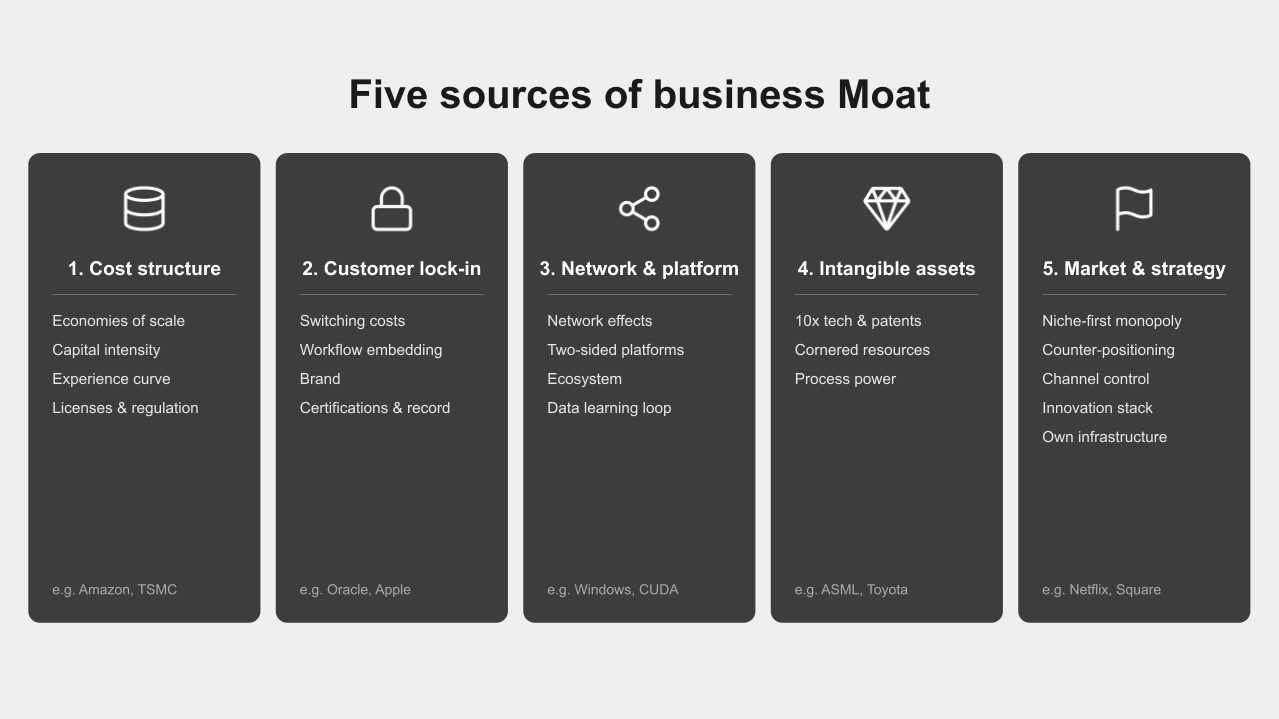
In this article, drawing on the latest academic research and the views of practitioners, we organize Moats into 5 categories and 19 items. We also examine the Moats available to today's general-purpose AI and vertical AI agents.
Defining a Moat
Research and practice frame the concept of a Moat in the following ways.
Structural factors that prevent new entrants from competing on the same terms as incumbents: Porter identified seven barriers to entry—economies of scale, product differentiation, capital requirements, switching costs, distribution channels, cost advantages, and government policy (Porter, 1980).
Conditions that generate sustainably higher returns than competitors and cannot be imitated: Helmer defines a Moat (or "Power," in his terminology) as something that delivers both a benefit and a barrier. A benefit alone is merely a strength; a barrier alone is defense without profit. Only when both are present does it become a Moat (Helmer, 2016).
Resources that satisfy the criteria of value, rarity, inimitability, and organization: The resource-based view (RBV) holds that only resources meeting all four VRIO conditions yield a sustained competitive advantage (Barney, 1991).
From the investor's perspective, "the durability of high ROIC": In practice, the presence of a Moat is measured by how long a company can keep its return on invested capital (ROIC) above its cost of capital (Mauboussin & Callahan, 2024; Morningstar/VanEck, 2025).
A Moat can therefore be defined as "a mechanism that structurally impedes imitation and entry by competitors, and sustains above-average returns over the long term."
Types of Moats and Examples
Moats Based on Cost Structure
These are barriers that prevent new entrants from operating at the same cost as incumbents.
Economies of scale: Expanding the scale of production, procurement, and logistics drives down unit costs to a level latecomers cannot match on price (Porter, 1980; Helmer, 2016). Example: Thanks to the world's largest logistics network and the scale of AWS, no latecomer can replicate Amazon's prices and delivery speed.
Massive upfront investment (capital barriers): Entry requires enormous upfront investment, and the risk of never recouping it deters newcomers (Porter, 1980). Example: A single TSMC leading-edge fab costs more than ¥2 trillion, and virtually no challenger has emerged—even among deep-pocketed companies. In generative AI, foundation-model development, which demands compute investments running to hundreds of billions of yen, is becoming the same kind of barrier (Azoulay et al., 2024).
Cost advantages unrelated to scale (experience curve, proprietary resources): Cost advantages that money cannot buy—learning gained through cumulative production volume, proprietary raw materials, locations, or preferential treatment (Porter, 1980). Example: Through its accumulated experience with rocket reusability (recovering a launched rocket, refurbishing it, and flying it again), SpaceX has brought launch costs down to a fraction of its competitors'.
Government policy, regulation, and licensing: Licenses, permits, radio spectrum, pharmaceutical approvals—the system itself caps the number of players (Porter, 1980). Example: Telecom carriers are shielded by finite spectrum licenses, and in virtually every country the market remains an oligopoly of just a few companies.
Moats Based on Customer Lock-In
These are barriers that leave customers wanting to switch but unable to.
Switching costs: Customers cannot move to another vendor without the pain of data migration, retraining, and business disruption (Klemperer, 1995; Helmer, 2016). Example: The migration risk of Oracle's mission-critical databases is so great that customers keep paying premium prices for decades rather than cancel.
Embedding in operations and workflows: Your product sits at the core of customers' day-to-day business processes, so that "if you pull it out, work stops." Example: Salesforce is woven into the entire workflow of sales organizations, which means it can no longer be displaced by a simple feature-by-feature comparison. In its 2026 report, a16z cites this "workflow depth" as one source of Moats for AI applications (a16z, 2026).
Brand and product differentiation: A psychological asset that leads customers to buy by name without comparing prices (Porter, 1980; Masters & Thiel, 2014). Example: Apple is chosen over rivals with equivalent specs even at higher prices, and captures the lion's share of the smartphone industry's profits.
Long-term contracts, certifications, and track-record requirements: Industry procurement practice mandates long-term contracts, certifications, or a record of prior deployments, so new entrants cannot even get onto the bidding shortlist. Example: In aviation and medical devices, obtaining certification takes years, so incumbents with established track records keep winning orders almost indefinitely.
Moats Based on Networks and Platforms
These are barriers where value rises with every additional user, and demand snowballs toward the first mover.
Network effects (direct): The more users there are, the more valuable the product itself becomes, so demand accumulates self-reinforcingly around the first mover (Katz & Shapiro, 1985; Masters & Thiel, 2014). Example: Facebook fended off later social networks with superior features through the direct network effect of "I use it because my friends are on it."
Two-sided network effects (platforms): A loop in which the supply side (developers, sellers) and the demand side (users) continually attract each other (Parker & Van Alstyne, 2005). Example: Windows has held over 90% OS market share through the two-sided loop of "many users attract software, and abundant software attracts more users," and in the US antitrust case this "applications barrier to entry" was found to be the very core of its monopoly.
Ecosystem and complementary-goods lock-in: An ecosystem of tools, talent, training, and peripheral products grows up around your product, and the whole becomes impossible to switch away from (Azoulay et al., 2024). Example: NVIDIA's CUDA has become the very skill set and code base of AI developers worldwide, a barrier that transcends competition on standalone GPU performance.
Data accumulation and learning loops: The more a product is used, the more proprietary data it accumulates, the more accurate it becomes, and the wider the gap with latecomers grows—automatically (Hagiu & Wright, 2023). Example: Google Search keeps refining its accuracy on decades of search-behavior data, a quality level latecomers cannot reach. That said, as discussed later, recent research has made clear that what really matters is not how much data you hold but whether a learning loop is actually running.
Moats Based on Intangible Assets
These are barriers built on invisible assets such as legal rights and organizational capabilities.
Proprietary technology and patents (the 10x advantage): A Moat built on proprietary technology that is 10x better than existing alternatives—in cost, execution time, or the like—or on patents that legally prohibit imitation (Masters & Thiel, 2014). Example: For the life of a patent, a drug developer can earn trillions of yen a year from a single drug under a legally protected monopoly.
Control of scarce resources and talent (cornered resources): Your company alone controls a resource, supplier, or pool of talent essential to the business (Helmer, 2016). Example: ASML is the world's only manufacturer of EUV lithography systems, and the entire semiconductor industry has no choice but to depend on it (owing to the technical difficulty, enormous upfront investment, monopoly over the supply chain, and so on). In generative AI, cornering top researchers and large-scale compute (top talent, GPUs, and massive cloud contracts) functions as the same type of Moat (Azoulay et al., 2024).
Process power (organizational capability): Business processes ingrained in an organization through years of refinement that cannot be replicated even when fully documented (Helmer, 2016; Barney, 1991). Example: The Toyota Production System is so open that it offers factory tours, yet decades later no other company has matched its performance.
Moats Based on Market Structure and Strategy
These are cases where the choice of market and the design of the business model themselves become the barrier.
First-mover monopoly in a niche: The strategy of seizing a market that is too small for large companies to bother with, yet becomes a springboard for expansion once you dominate it (Masters & Thiel, 2014). Example: Amazon first achieved total dominance of the narrow market of online book sales before expanding into every product category.
Counter-positioning: A business model that established players cannot follow because copying it would cannibalize their existing business (Helmer, 2016; Christensen, 1997). Example: Blockbuster, whose late fees were its main profit driver, could not follow Netflix into subscription streaming.
Control of distribution channels: Locking up the routes to the customer—shelf space, agents, app stores, search results—so that latecomers never reach them (Porter, 1980). Example: Coca-Cola controls vending machines, restaurants, and retail shelves worldwide, so newcomers never even reach the customer's eye, regardless of how they taste.
Innovation stack (compound Moat): Rather than a single clever idea, a "bundle" of mutually reinforcing innovations that cannot function if only partially copied (McKelvey, 2020). Example: Square (a service that lets stores and online merchants easily accept credit-card payments via smartphones and dedicated readers) repelled even Amazon's entry with a bundle of a dozen-plus innovations, including proprietary hardware, its fee structure, and instant approval.
Building your own infrastructure in emerging markets: In markets lacking infrastructure, building payments, logistics, and the like yourself—an asset that in turn becomes a wall against latecomers (Hoffman & Yeh, 2018). Example: MercadoLibre built its own payment and logistics networks across South America, creating a barrier that even Amazon cannot easily breach.
Moats in AI Businesses
Moats for General-Purpose AI (Foundation Models)
The general-purpose foundation models built by OpenAI, Anthropic, Google and others compete in a harsh environment in which "model performance itself is unlikely to become a moat" (Bornstein et al., 2023). Because these models are trained on similar architectures and similar data, their performance tends to converge, and open-source models close the gap quickly. Analyses from innovation economics conclude that the moat for general-purpose AI lies not in the model but in the "complementary assets" surrounding it (Azoulay et al., 2024).
Massive upfront investment (capital barriers): Training a frontier model requires investment in compute infrastructure on the order of hundreds of billions to trillions of yen, which is a traditional capital barrier in its purest form (Azoulay et al., 2024). Example: only a handful of companies worldwide can secure GPU clusters capable of training frontier models, and both financial muscle and supply-chain access act as walls.
Economies of scale: The more users a provider has, the higher the utilization of its inference infrastructure and the lower its unit costs, giving first movers the upper hand in price competition. Example: the major foundation-model companies can offer inference of equal quality more cheaply than latecomers, turning the race to cut API prices into a war of attrition they are equipped to win.
Data accumulation and learning loops: A structure in which feedback from user interactions (RLHF and the like) flows back into model improvement is a candidate for a data-learning-loop moat. That said, the NBER paper is careful to note that whether this loop truly generates durable data network effects "cannot yet be determined" (Azoulay et al., 2024).
Brand and product differentiation: Owning the slot in consumers' minds where "AI = this product" is a classic brand moat. Example: ChatGPT has become synonymous with generative AI and continues to hold top-of-mind awareness even when rivals match it on performance.
Control of distribution channels: Whoever locks in default placement inside operating systems, browsers and business software ensures that latecomers cannot even reach users, regardless of how good their models are. Example: Google embeds its AI into Android and Search, and Microsoft into Windows and Office, turning distribution power itself into the barrier.
Ecosystem and complement lock-in: Once third-party developers have built up assets on top of a provider's APIs, tooling and plugins, switching models comes to mean migrating the entire ecosystem. Example: as NVIDIA's CUDA demonstrated, accumulated developer skills and code assets become a barrier that outweighs standalone performance.
Cornered resources (scarce assets and talent): Frontier researchers number only in the hundreds worldwide, and locking them up corresponds to what Helmer calls a cornered resource (Helmer, 2016; Azoulay et al., 2024). Example: the major AI labs offer researchers compensation packages in the hundreds of millions of yen, cornering the talent itself.
Government policy, regulation and licensing: Compliance systems for national AI regulations and established relationships with governments are becoming an entry cost for latecomers. Example: in heavily regulated markets such as finance, healthcare and government, the companies that put audit readiness and compliance frameworks in place first are the ones that get chosen.
The moat for general-purpose AI, then, is not "model weights" but a bundle of complementary assets: capital barriers, economies of scale, data loops, brand, distribution, ecosystems and talent. Structurally, the same dynamics (the old moats) that decided past battles for dominance in operating systems and cloud computing are at work here (Azoulay et al., 2024).
Moats for Specialized (Vertical, Industry-Specific) AI Agents
Specialized AI agents that take over tasks in a particular industry (legal, healthcare, construction, finance and so on) live side by side with the risk of being "swallowed" by improvements in general-purpose models: the so-called GPT-wrapper problem. Yet practitioner analyses increasingly show that by placing the source of defensibility outside the model, such agents can build moats that are, if anything, stronger than those of SaaS (a16z, 2026; VC Cafe, 2026).
Embedding in operations and workflows: When a product captures an industry's specific procedures, exception handling and stakeholder coordination, value comes to reside in the "workflow" rather than the "model," so it cannot be copied even when the underlying foundation model is updated (a16z, 2026). Example: legal AI company Harvey abandoned development of its own model and pivoted to competing on the depth of its integration into law-firm workflows.
Data accumulation and learning loops: Industry-specific data accumulated through day-to-day processing does not exist in the training data of general-purpose models, and if the loop of "use → accumulation → higher accuracy → more use" keeps turning, it becomes a durable moat (Hagiu & Wright, 2023). Example: for a product whose automation rate and accuracy keep improving through this loop, the time it would take a latecomer to reach the same accuracy is itself the barrier.
Counter-positioning: Specialized agents are "Service as Software," competing against labor budgets rather than IT budgets. Incumbent SaaS giants that earn revenue through per-seat pricing cannot shift to outcome-based pricing (charging for work completed or hours saved) without destroying their own revenue model (Helmer, 2016; VC Cafe, 2026). Example: what law firms pay EvenUp, which serves personal-injury litigation, is not a license fee but payment for paralegal-grade deliverables; pricing tied to hours saved aligns the vendor's revenue with the effect on the customer's P&L and builds resistance to downward price pressure.
Switching costs: If a vendor can make its product the authoritative store (system of record) for a customer's operational data, switching comes to mean migrating the entire operational foundation, and the product grows beyond agent features to become the industry's data infrastructure itself. Example: in the history of vertical SaaS, the companies that captured the system of record for payments or ledgers (Toast, Veeva and others) built the most robust moats, and specialized agents are expected to follow the same path.
Long-term contracts, certifications and track-record requirements: In regulated industries, non-technical entry costs loom large: audit readiness, liability, relationships with professional bodies, deployment track record. These become the specialist's defense. Example: to be used in real medical, architectural or financial practice, a product must comply with industry-specific regulations and have a proven track record, a bar that general-purpose apps cannot clear simply by expanding horizontally.
First-mover monopoly in a niche: Dominating a market too narrow for big players to bother with (a specific task in a specific industry) and then expanding into adjacent tasks from that base is precisely what Thiel describes as a niche monopoly (Masters & Thiel, 2014). Example: legal AI company Legora focused on the legal sector alone and reached $100 million in ARR within 18 months, which Bessemer described as the fastest growth in the history of enterprise software.
Capital markets, too, have begun to price in the presence or absence of this moat. Practitioners observe that specialized agents with proprietary workflow data are valued at 15–20x ARR, while general-purpose apps that could be rendered obsolete overnight by a model update stay at 3–4x (VC Cafe, 2026).
A Survey of Recent Research and Practitioner Perspectives
Recent research on moats is advancing along four main lines.
Empirical research: do moats actually sustain profits?
Intangible-asset moats sustain returns the longest: A study analyzing 60 years of data on more than 25,000 companies from 1963 to 2023 showed that industries with intangible-asset and network-based moats maintain a high return on invested capital (ROIC) over the long run with little additional investment. Companies that layer multiple moats also sustain their advantage longer than those relying on a single moat (Mauboussin & Callahan, 2024).
The investment payoff from moats holds only conditionally: A series of studies examining companies designated "wide moat" by Morningstar consistently confirms the persistence of business returns (ROIC) at moated firms, but shows that excess stock-market returns arise only "when the market has not yet priced the moat in" (Boyd, 2005; VanEck, 2025). It is worth remembering that business quality and investment returns are separate questions.
Digital platforms and competition policy
"Moat building" has become a formal issue in competition policy: The OECD Competition Committee has set out that the deeper a market's moats, such as economies of scale and network effects, the more easily dominant firms can sustain market power over the long term, and it has positioned deliberate moat-building and defensive strategies (entrenchment) by dominant platforms as something regulators should monitor (OECD, 2024). A moat thus has two faces: a defense for the business, and a target of scrutiny for regulators.
The balance of power between switching costs and network effects decides competition: Theoretical research on platform competition has modeled how the stronger users' switching costs are relative to network effects, the more durable the incumbent's advantage, and the weaker they are, the more likely a latecomer can overturn it (He & Li, 2023). In other words, when switching costs outweigh network effects, users stay put even if a latecomer offers a better product at a lower price, because the personal pain of migrating is too great; core databases, bank accounts and ERP systems are examples. Conversely, when network effects are relatively strong and individual switching costs are light, a latecomer that uses subsidies or new features to peel off one segment (say, younger users or a particular community) and gain a foothold can trigger a reversal of expectations ("everyone is moving over there"), and the whole market tips at once. The migrations from MySpace to Facebook, and of younger users from Facebook to TikTok, are textbook cases: with social networks, switching means little more than creating a new account, so individual migration costs are low and avalanches happen easily.
Empirical work is beginning to measure the "strength" of network effects: Studies have emerged that use platform mergers as natural experiments to quantitatively estimate the strength of network effects, alongside measurement studies on social networks. We have entered a stage in which network effects should be evaluated not by "whether they exist" but by "how strong they are" (Chen et al., 2021; Gregory et al., 2021).
The moat debate in the generative AI era
The provocation that "there are no systematic moats in generative AI": In 2023, a16z analyzed the generative AI market and argued that no systematic moat was yet visible: "apps use the same models, so differentiation is weak; models are trained on similar data, so long-term differentiation is unclear; even the hardware is manufactured in the same factories" (Bornstein et al., 2023). This essay became the starting point for the debate over moats in the AI era.
Innovation economics finds that "old moats still work for new models": An NBER paper by researchers at MIT and Harvard analyzes the competitive landscape of generative AI through the classic lens of appropriability (can knowledge be kept exclusive?) and complementary assets (do incumbents control the resources needed to enter, such as compute, data, and distribution?). Its conclusion: while the models themselves are easy to imitate, the complementary assets—computing resources, proprietary data, and customer touchpoints—are what constitute a real moat (Azoulay et al., 2024).
The illusion of the "data moat" and what learning loops really require: Casado and colleagues at a16z warned that because data itself can be copied and its value decays quickly, sheer "data volume" is far less of a moat than commonly assumed (Casado & Lauten, 2019). Theoretical work backs this up: data-enabled learning becomes a moat only when the loop of "usage → data accumulation → product improvement → more usage" keeps turning (Hagiu & Wright, 2023).
AI application moats are shifting to "workflow, context, and ecosystem": In its 2026 report, a16z argued that as models commoditize, the moats of AI applications come from three sources: (1) deep embedding in customers' operations (workflow), (2) accumulation of customer-specific context and data, and (3) integration with the surrounding ecosystem (a16z, 2026). The emphasis is no longer on winning the foundation-model performance race but on building classic switching costs and embeddedness—a renewed appreciation of long-established ideas.
A practitioner's dissent: "permanence over moats": The VC firm SignalFire contends that in an AI market changing this fast, the very idea of proving a moat on day one is broken; moats form after the fact, in the course of running the business. It therefore advocates optimizing for "continuing to exist by continuing to solve customers' problems" rather than for defensibility (SignalFire, 2025). This is consistent with Helmer's framework, which holds that the moats a company can build differ by business phase—counter-positioning during takeoff, process power at maturity, and so on (Helmer, 2016).
How Strategy Theory Systematizes Moats
From Porter's seven barriers to Helmer's 7 Powers: Where Porter (1980) catalogued industry-level barriers to entry (economies of scale, product differentiation, capital requirements, switching costs, distribution, cost advantages, and government policy), Helmer (2016) reorganized sustained advantage at the firm level into seven types (scale economies, network effects, counter-positioning, switching costs, branding, cornered resources, and process power) and added a time dimension: which moat can be built in which phase of a business.
The resource-based view (RBV) provides the theoretical foundation: The durability of a moat is explained by whether a resource meets the VRIO criteria—value, rarity, inimitability, and organizational exploitation (Barney, 1991). Moats with "causal ambiguity," such as organizational capabilities, are known to be harder to imitate than legal barriers such as patents.
Conclusion
A business with none of the 19 moats described here is likely to see its profits imitated away even if it succeeds. Strong businesses layer multiple moats: NVIDIA combines "ecosystem + proprietary technology + scale," while Amazon combines "scale + Prime lock-in + channels." Empirical research also shows that the more moats a company stacks, the longer its advantage persists (Mauboussin & Callahan, 2024).
It is normal for no moat to exist at founding. A moat is not something to be proven on day one; it takes shape over years of solving a problem. In the AI era in particular, model performance itself rarely becomes a moat (it commoditizes too quickly). The center of gravity has moved to learning loops built on industry-specific data, deep embedding in customer workflows, and complementary assets such as computing resources and distribution networks. At the same time, in fast-moving markets the essential task is not to demand a moat on day one but to design a trajectory over time—what Thiel calls intelligent design—in which multiple moats are layered step by step while continuing to solve customers' problems.
References
a16z (Andreessen Horowitz). (2026). Where the moats are: AI application report. (A practitioner report that, taking model commoditization as its premise, organizes the moats of AI applications into three elements: workflow, contextual data, and ecosystem.)
Azoulay, P., Krieger, J. L., & Nagaraj, A. (2024). Old moats for new models: Openness, control, and competition in generative AI. NBER Working Paper 32474. (A paper that analyzes the competitive landscape of generative AI through the classic framework of appropriability and complementary assets, arguing that compute, data, and customer touchpoints constitute the real moats.)
Barney, J. B. (1991). Firm resources and sustained competitive advantage. Journal of Management, 17(1), 99-120. (The foundational paper of the resource-based view, explaining sustained competitive advantage through the value, rarity, inimitability, and organizational exploitation (VRIO) of resources.)
Bornstein, M., Appenzeller, G., & Casado, M. (2023). Who owns the generative AI platform? Andreessen Horowitz. (An essay analyzing the generative AI value chain and observing that "no systematic moats are visible at present"; it became the starting point of the AI-era moat debate.)
Boyd, D. (2005). Financial performance of wide-moat companies. (One of the earliest empirical studies examining the financial performance of companies that Morningstar rated as having a "wide moat.")
Casado, M., & Lauten, P. (2019). The empty promise of data moats. Andreessen Horowitz. (An essay warning that data volume alone rarely constitutes a moat, and that what matters is the shape of the scale-economics curve and the design of the learning loop.)
Chen, T., et al. (2021). Measuring network effects using a digital platform merger. NBER Working Paper 28047. (An empirical paper that quantifies the strength of network effects using a platform merger as a natural experiment.)
Christensen, C. M. (1997). The innovator's dilemma. Harvard Business School Press. (The classic that showed why the best-run companies are the least able to respond to disruptive technologies, providing the theoretical foundation for counter-positioning.)
Gregory, R. W., Henfridsson, O., Kaganer, E., & Kyriakou, H. (2021). Data network effects. HBS Working Paper 21-086. (A study that attempted to measure the strength of network effects in social networks.)
Hagiu, A., & Wright, J. (2023). Data-enabled learning, network effects, and competitive advantage. RAND Journal of Economics, 54(4). (A paper that theoretically clarifies when data-enabled learning becomes a sustained competitive advantage, i.e., a moat.)
He, S., & Li, M. (2023). Switching cost, network externality and platform competition. International Review of Economics & Finance, 84, 428-443. (A paper modeling how the relative strength of switching costs and network effects determines incumbent advantage in platform competition.)
Helmer, H. (2016). 7 Powers: The foundations of business strategy. Deep Strategy LLC. (A strategy book that defines a moat as the combination of "benefit and barrier," classifies sustained competitive advantage into seven powers, and maps when each can be built across the phases of a business.)
Hoffman, R., & Yeh, C. (2018). Blitzscaling. Currency. (A book on hyper-growth strategy in winner-take-all markets, arguing that building one's own infrastructure in emerging markets can itself become a moat.)
Katz, M. L., & Shapiro, C. (1985). Network externalities, competition, and compatibility. American Economic Review, 75(3), 424-440. (The foundational paper that launched the economic analysis of network externalities.)
Klemperer, P. (1995). Competition when consumers have switching costs. Review of Economic Studies, 62(4), 515-539. (The seminal economics paper systematizing how switching costs affect market competition and entry.)
Masters, B., & Thiel, P. (2014). Zero to one: Notes on startups, or how to build the future. Crown Business. (A book for entrepreneurs presenting the four elements of monopoly—proprietary technology, network effects, economies of scale, and brand—and the strategy of dominating a niche first.)
Mauboussin, M. J., & Callahan, D. (2024). Measuring moats. Morgan Stanley Counterpoint Global Insights. (A large-scale empirical report analyzing the relationship between moat types and the persistence of ROIC, drawing on 60 years of data covering more than 25,000 companies.)
McKelvey, J. (2020). The innovation stack. Portfolio. (A book in which the co-founder of Square recounts how an inimitable "stack of innovations" repelled even Amazon's entry into the market.)
OECD. (2024). Monopolisation, moat building and entrenchment strategies. OECD Competition Policy Papers. (A report examining "moat building" and the entrenchment of market power in digital markets from a competition-policy perspective.)
Parker, G. G., & Van Alstyne, M. W. (2005). Two-sided network effects: A theory of information product design. Management Science, 51(10), 1494-1504. (The foundational paper that formalized network effects in two-sided markets and their implications for platform design.)
Porter, M. E. (1980). Competitive strategy: Techniques for analyzing industries and competitors. Free Press. (The seminal work on competitive strategy, which systematized the five competitive forces and seven barriers to entry.)
SignalFire. (2025). Moats are for castles: A new argument for permanence over defensibility in AI startups. (A VC essay arguing that in the fast-moving AI market, demanding proof of a moat from day one no longer works, and that founders should instead optimize for the long-term permanence of the business.)
VanEck. (2025). What makes a moat? Morningstar's five sources of moat. (A white paper examining how Morningstar's five moat categories—intangible assets, switching costs, network effects, cost advantages, and efficient scale—relate to investment performance.)
The end
Read next ↓