
Articles
Corporate Negotiation: Processes, Theory, and Methodology Based on Latest Research
Product
Career
Automatically translated from the Japanese original.
Introduction
Negotiation is a process in which the parties involved work together to maximize their gains. Yet few people ever get the chance to see the full picture of the theory and methodology behind it.
In practice, negotiation is still often talked about as a matter of personal experience and intuition—a skill that lives inside individual negotiators. In reality, however, negotiation is an established field of scholarship, with more than half a century of research accumulated across economics, psychology, management, international relations and other disciplines (Walton & McKersie, 1965; Bazerman et al., 2000).
This article offers a comprehensive overview, drawing on the latest research and the practitioner literature.
Defining Negotiation
Academic research approaches the question of what negotiation is from a number of different angles, outlined below.
- Negotiation happens when interests partly clash and partly align — Negotiation is the back-and-forth between parties who hold both shared and conflicting interests as they work toward an agreement. If interests were perfectly aligned, there would be nothing to negotiate; if they were perfectly opposed, agreement would be almost impossible. Negotiation lives in the space between (for example, a company that wants to sell a product and a company that wants to buy it agree on wanting to close the deal, but disagree on price) (Fisher & Ury, 1981).
- Negotiation is a decision-making process between interdependent parties — A leading negotiation textbook defines it as "a decision-making process in which two or more parties, depending on one another, seek agreement over the allocation of limited resources or the resolution of a conflict." The premise is that neither side can achieve the outcome it wants alone (interdependence), and this is precisely the source of negotiating leverage (for example, an IT vendor wants the contract and the customer wants its problem solved; neither can reach its goal without the other) (Lewicki et al., 2020).
- Negotiation has two faces: growing the pie and dividing it — One is "value creation" (integrative negotiation), which enlarges the pie itself; the other is "value distribution" (distributive negotiation), which contests how the pie is split. Sharing information enables cooperation that increases value, but sharing too much weakens your position when it comes to dividing it. This tension is known as the "negotiator's dilemma." (For example, if the buyer cares most about early deployment and the seller cares most about installment payments, each side can concede on the issue it values less, leaving both more satisfied and the pie larger. Or consider a used-car negotiation: if the buyer is willing to pay up to ¥600,000 and the seller is willing to let the car go for anything above ¥400,000, the total gain the deal can generate is ¥600,000 − ¥400,000 = ¥200,000. That ¥200,000 pie gets divided between the two as they negotiate a price somewhere between ¥400,000 and ¥600,000: at ¥500,000, buyer and seller each gain ¥100,000; at ¥450,000, the buyer gains ¥150,000 and the seller ¥50,000.) (Walton & McKersie, 1965; Lax & Sebenius, 1986).
- Negotiation is both a science and an art — Raiffa saw negotiation as an activity that bridges two perspectives: the normative side, which works out the rational optimum in theory, and the descriptive side, which accounts for how people actually behave. It is the art of acting as wisely as possible in a world where the other party is not necessarily rational (for example, you may understand on paper a service price derived from a sound ROI calculation, but reading the other side's reactions and adjusting how you offer price concessions is a matter of skill) (Raiffa, 1982).
Taken together, a definition of negotiation can be understood to include the following elements:
- Two or more parties are involved
- Their interests partly conflict and partly overlap (neither perfectly aligned nor perfectly opposed)
- It is a process of seeking agreement through the creation and distribution of value
Types of Negotiation
Negotiation is present in every corner of society. Organizing it by the nature of the parties involved—individuals, organizations, states—makes the overall landscape easier to grasp.
- Negotiations between individuals — Buying and selling used goods or real estate, settling disputes with neighbors, and so on. These are the most common in daily life, and emotions and personal relationships weigh heavily on them (Lewicki et al., 2020).
- Negotiations within families and close relationships — Marriage, the division of housework and childcare, household finances, divorce (property division and custody), inheritance, elder care and the like. Because these relationships are long-term, preserving the relationship tends to take priority over distribution (Macneil, 1980).
- Negotiations between individuals and organizations — Job offers and salary negotiations, consumer complaints against companies, loan negotiations and so on. This is a category where imbalances (asymmetries) in bargaining power readily appear (Lewicki et al., 2020).
- Negotiations between companies (inter-organizational) — The subject of this article. Contracts for trade, procurement and sales; alliances, joint ventures and M&A; supply-chain price negotiations; licensing; resolution of disputes between companies; and more (Williamson, 1985).
- Negotiations within organizations — Labor–management (collective) bargaining, budget allocation between departments, coordination of roles within a team, and so on. Negotiation is constantly taking place inside organizations as well (Walton & McKersie, 1965).
- Negotiations between states and international negotiations — Multilateral negotiations over treaties, trade (FTAs and tariffs), security, climate change and more. Here a "two-level game" is at work: negotiating with the other country while simultaneously managing coordination at home (Putnam, 1988).
- Negotiations between states and non-state actors — Governments and companies (regulation, licensing and permits, public procurement), governments and citizens or civic groups (policy formation), crisis and hostage negotiations, and other pairings of parties of fundamentally different kinds (Lewicki et al., 2020).
- Public and societal negotiations — Consensus-building around public works, environmental assessments and similar matters: negotiations that involve many stakeholders and aim at collective agreement (Susskind & Field, 1996).
Key point: all of these can be analyzed with the same theoretical framework, but the dynamics that matter most shift with the parties involved. In families and long-term business relationships, preserving the relationship comes first; between states, domestic legitimacy takes center stage; between individuals and organizations, the power gap dominates. Negotiation between companies—where negotiators act on behalf of an organization, interactions repeat over the long term, and multiple parties contend over multiple issues all at once—is among the most structurally complex types of all (Brett, 2014).
Who You Can and Cannot Negotiate With
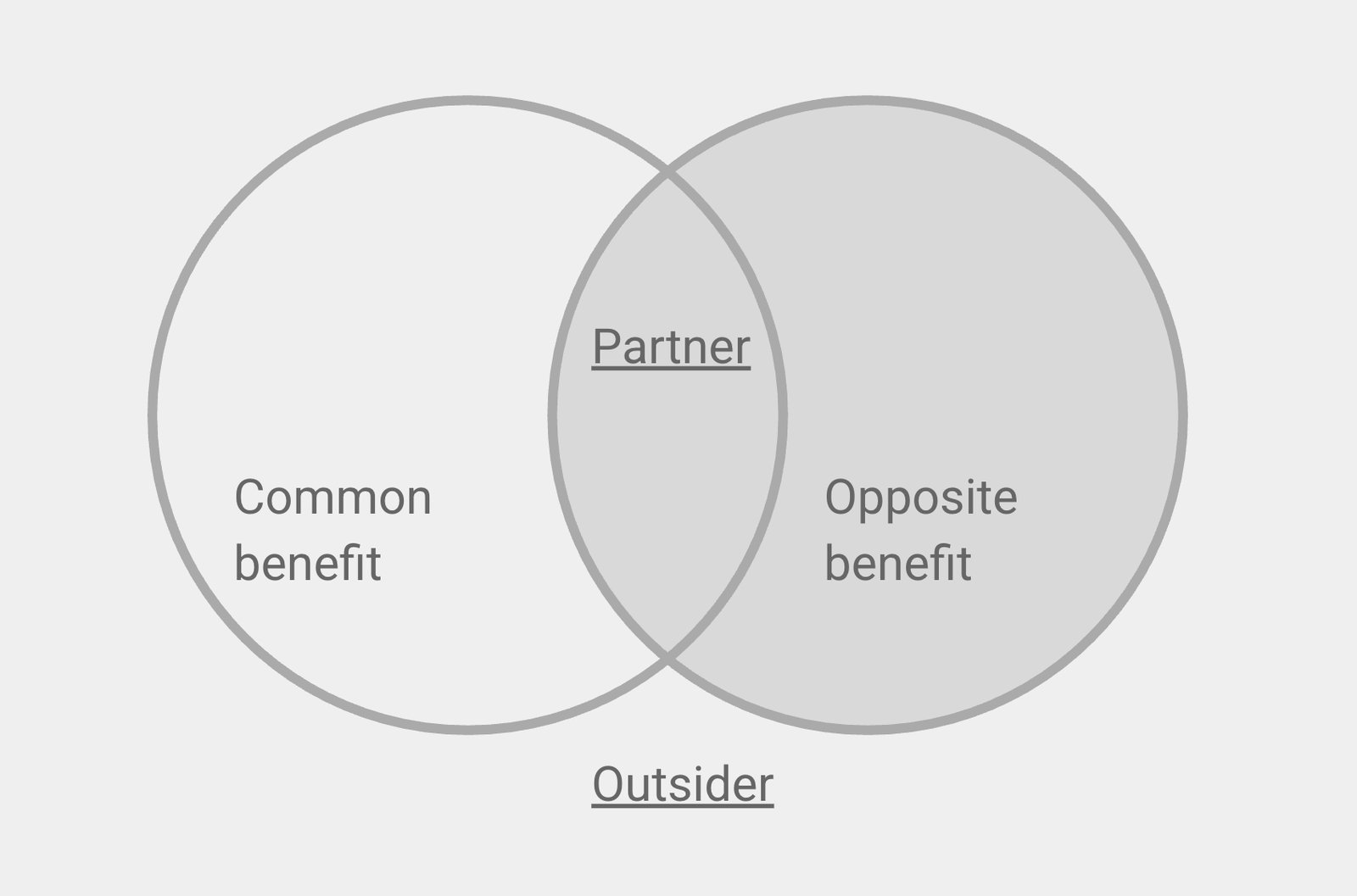
Whether a counterpart can be negotiated with at all depends on whether both shared interests and conflicting interests are present. Using these two axes, we can sort every potential counterpart into four types.
- Type 1: Shared interests × Conflicting interests = A counterpart you can negotiate with (the true negotiating partner) — This is where negotiation is most likely to succeed. Examples: sellers and buyers (aligned on wanting to trade, opposed on price), companies and their suppliers, companies and their employees, alliance and joint-venture partners, and trade negotiations between states. AI vendors and their customers fall here too (Fisher & Ury, 1981; Lax & Sebenius, 1986).
- Type 2: Shared interests × No conflicting interests = Unlikely to become a negotiating counterpart (collaboration and coordination) — Because interests are almost fully aligned, what takes place is less "negotiation" than dividing up roles and coordinating. Examples: team members pursuing the same goal, co-founders with a shared vision, or a parent company and subsidiary whose interests coincide. In reality, though, small conflicts arise over the allocation of limited resources such as budgets and time, giving rise to light negotiation (Walton & McKersie, 1965).
- Type 3: No shared interests × Conflicting interests = A counterpart that is hard to negotiate with (adversarial, zero-sum) — There is little room for agreement (a narrow ZOPA), and talks tend to break down. Examples: direct competitors fighting over the same customers, or winner-take-all rivalries. Moreover, agreements between competitors on prices or volumes are prohibited under antitrust law (as cartels), so there are areas where negotiation must not take place in the first place (Lax & Sebenius, 1986).
- Type 4: No shared interests × No conflicting interests = No negotiation arises (unrelated parties) — Because the parties do not affect one another (no interdependence), the question of negotiation never comes up. Example: two parties with no trading or competitive relationship whatsoever. This type exists for the sake of completeness but falls outside the scope of negotiation theory (Lewicki et al., 2020).
Process, Theory and Methodology of Business-to-Business Negotiation
Business-to-business negotiation becomes far more reproducible when it is treated as a process designed phase by phase. Four- or five-stage models are common in the research; here we divide it into six steps based on Shell's framework (Shell, 2006; Lewicki et al., 2020). For each step, we also cover the relevant theories and methodologies.
Step 1: Preparation
The outcome of most negotiations is largely decided here. This is the stage for securing your own footing and sizing up the other side.
- Task 1: Set your target and your walk-away line — Put numbers on both the level you want to achieve (your target) and the line beyond which you will not concede (your reservation price) (Lewicki et al., 2020). Example: decide in advance that "the ideal is ¥800,000 a month, and we will not take the order below ¥550,000."
- Task 2: Prepare your BATNA — Your BATNA is your Best Alternative To a Negotiated Agreement—what you will do if talks collapse. The stronger it is, the greater your negotiating power (Fisher & Ury, 1981). Example: if you have other prospective customers lined up, you are in a position where "losing this one deal is no disaster."
- Task 3: Estimate the ZOPA — The ZOPA is the Zone of Possible Agreement—the range of prices both sides could accept. You estimate it by inferring the other side's BATNA, interests and constraints (Lewicki et al., 2020). Example: if the customer's budget ceiling is ¥700,000 a month and your floor is ¥550,000, you estimate the ZOPA at ¥550,000–700,000.
- Task 4: Identify interests, not positions — Mapping out the real concerns (interests) behind the stated demands (positions) makes it much easier to create value later on (Fisher & Ury, 1981). Example: if you can read that "lower the price" really means "we need to fit this into this year's budget," you can respond with installment payments.
Related theory: Game theory and the bargaining solution — Nash gave a mathematical answer to the question of where parties should settle. He formalized negotiation as a cooperative game and, taking the disagreement point (the BATNA) as the starting point, derived a unique solution satisfying a set of conditions. The preparatory habit of "fixing the breakdown point and estimating the surplus above it" has its roots in this theory (Nash, 1950). Example: if you set the disagreement point as "if talks fail, the customer builds in-house for ¥500,000 a month and we move on to other projects," the price range you should settle within—and how to split it—comes into view.
Related methodologies
- Managing your BATNA and the ZOPA — Building up and strengthening your own BATNA while accurately estimating the other side's is the most reliable way to increase your negotiating power. For an AI vendor, the moment you are seen as "replaceable by another provider," you are at a disadvantage—so demonstrate value that cannot be substituted, such as proprietary data, domain specialization or operational support, and shift the ZOPA in your favor (Fisher & Ury, 1981; Lewicki et al., 2020). Example: if you advance talks with two other prospective customers in parallel before the meeting, you will not have to give in to unreasonable discount demands.
- Principled negotiation (focusing on interests) — Put the principle of focusing on interests rather than positions into practice already during preparation (Fisher & Ury, 1981). Example: If you recognize that a customer's "make it cheaper" really means "we need to fit this within this quarter's budget," you can reach agreement by splitting payments across the next fiscal period instead of cutting the price.
- The "setup" in 3-D negotiation — Before anyone sits down at the table, design who to involve and in what order. In multi-party B2B negotiations, this advance design is often what decides the outcome (Lax & Sebenius, 2006; Sebenius, 2001). Example: Rather than talking only with the frontline contact, bring the budget-holding executive and the security department into the very first meeting so the deal doesn't get sent back later.
Step 2: Relationship Building
B2B negotiations presuppose a long-term relationship. The trust you build at the outset determines how much information the other side discloses and how cooperative they are from then on.
- What to do: Position the other party as a partner in solving a shared problem, not as an adversary — Framing the relationship this way is especially important at a first meeting or when negotiating online (Thompson, 2015). Example: Open the first meeting with "Let's start by mapping out your challenges together," putting shared problem definition ahead of the sales pitch.
Related theories
- Relational contract theory: trust and norms underpin transactions — Much real-world B2B business runs not on the contract alone but on trust and relational norms. Macaulay showed that in disputes, firms prioritize preserving the relationship over enforcing contract clauses, and Macneil placed transactions on a continuum from discrete to relational (Macaulay, 1963; Macneil, 1980). Example: Signaling "we'll stay alongside you after delivery" reassures the other party enough to open up about their internal circumstances.
- Dual concern model: choose your stance along two axes — Using two axes — concern for your own outcomes and concern for the other party's outcomes — you choose among competing, collaborating, yielding, avoiding and compromising. In long-term relationships, collaboration (problem-solving) tends to be the best fit (Pruitt & Rubin, 1986). Example: Convey that both winning the order and the customer's success matter to you, shifting the conversation from pure haggling into problem-solving mode.
Related methodologies
- Mutual Gains Approach — A method that explicitly manages each stage: preparation, value creation, distribution and relationship maintenance. It is a practical guide to consensus-building negotiation that leads to agreement without damaging the relationship (Susskind & Field, 1996). Example: Agree on how the session will run before getting into substance — "Today, let's each lay out our goals and constraints."
Step 3: Information Exchange
This is the stage where both sides probe each other's interests, priorities and constraints. What you discover here becomes the starting point for value creation.
- What to do: Use questions to draw out the other side's real interests — If you can find issues that matter greatly to the other side but cost your company little, both parties can gain through the issue trades described below (Thompson, 2015). Example: Ask "Which is the priority this time — budget or delivery date?" to pinpoint what matters most to them.
Related theories
- Behavioral theory of distributive and integrative bargaining — Walton and McKersie formalized negotiation as a composite of distributive, integrative, intra-organizational and relationship-building activities. Integrative bargaining (value creation) becomes possible only once the parties exchange information about their respective priorities (Walton & McKersie, 1965). Example: If you learn the other side values early deployment, you can raise their satisfaction through implementation speed without lowering the price.
Related methodologies
- Logrolling (trading across issues) and multi-issue packaging — Trade issues on which your priorities differ (concede on what you care less about, win what you care more about) and bundle multiple issues into a single negotiation to craft agreements where both sides gain (Lewicki et al., 2020). Example: If your company cares about payment timing and the other side about deployment timing, each yielding on the other's priority leaves both better off.
Step 4: Proposals and Bargaining
This is the stage where concrete terms are put on the table and concessions are exchanged. It is also where the quirks of human judgment show up most clearly.
- What to do: Don't let it become a tug-of-war over a single issue — Package multiple issues together and use differences in priorities to search for the best overall outcome (Lewicki et al., 2020). Example: Propose not just the price but the contract term, support scope and data terms as a bundle, creating room for trades.
Related theories
- Behavioral decision theory: biases distort outcomes — Bazerman and Neale showed that the fixed-pie illusion, anchoring, overconfidence, framing and similar effects systematically distort negotiations. It is essential to rein in your own biases and to go in mindful of the other side's (Bazerman & Neale, 1992; Kahneman, 2011). Example: When the other party claims "another vendor is cheaper," check whether it's true by asking for evidence (the quote) so you aren't dragged along by the anchor.
Related methodologies
- Anchoring and concession design — The first offer becomes an "anchor" that defines the range of the negotiation. An ambitious, well-grounded first offer works in your favor, but one that lacks fairness can cause the talks to collapse, so make concessions in small increments, each with a reason attached (Galinsky & Mussweiler, 2001). Example: Start by presenting the list price with its justification, then release discounts in small, conditional steps — "if you commit to a multi-year contract, then..."
- MESO (Multiple Equivalent Simultaneous Offers) — Present several offers of equal value at the same time, drawing out the other side's preferences while setting your own anchor. This lets you keep the initiative while holding down the risk of a breakdown (Malhotra & Bazerman, 2007). Example: Present three equivalent options simultaneously — such as "higher monthly fee, shorter term" and "lower monthly fee, longer term" — to probe what the other side prefers.
- Separating value creation from value distribution — Manage the negotiator's dilemma through sequencing: first cooperate to enlarge the pie, then divide it (Lax & Sebenius, 1986). Example: First work together on a plan that maximizes the benefits of deployment, and only afterward settle how those gains are shared (i.e., the price).
- Using objective criteria — Grounding your price in market rates, industry standards or third-party assessments lets you frame concessions as "following a fair standard" rather than "caving in," which protects the relationship (Fisher & Ury, 1981). Example: Back up your pricing with performance data from deployments of similar scale or with industry benchmarks.
Step 5: Reaching Agreement and Closing (Closing & Commitment)
This is the stage where terms are finalized and put in writing (letter of intent, contract). In B2B deals, you also need to look ahead to whether the agreement will clear internal approval on the other side.
- What to do: Check the prospects for internal approval in parallel — This avoids the "ratification problem," where the counterpart fails to secure head-office approval and the agreement is overturned (Lewicki et al., 2020). Example: Ask your counterpart, "Is this likely to pass the board?" and adjust the terms into a form that will.
Related theories
- Principal–agent theory — Your counterpart is an agent of their organization, and gaps in interests and information arise between them and the principal (senior management). The agent's authority, incentives and ratification process shape the negotiation (Lewicki et al., 2020). Example: Once you learn that the point of contact can't decide alone, prepare a separate briefing document aimed at the decision-maker.
- Two-level game theory — Negotiators are simultaneously conducting an external negotiation with the other party and an internal negotiation to secure buy-in at home; an external agreement doesn't stand unless it is ratified internally (Putnam, 1988). Example: Hand the other side an impact estimate they can use in their internal approval paperwork, making it easier for them to persuade their own organization.
Related methodologies
- Contingent contracts — When the parties' forecasts of the future diverge, agree conditionally: "if X, then A; otherwise B." For AI, this takes forms such as performance-based pricing or SLA adjustments tied to accuracy or uptime, turning differing forecasts from a point of contention into a "bet" that makes agreement easier (Lax & Sebenius, 2006). Example: Stipulate that "if accuracy falls short of the target, the fee is reduced," dispelling the other side's worries and closing the deal.
Step 6: Execution and Relationship Management
Negotiation doesn't end with a signature. Its scope extends to execution, day-to-day operation, handling problems, and renewals and follow-on proposals.
- What to do: Deliver faithfully and lay the groundwork for the next negotiation — Winning too big once damages long-term trust and renewals, so deliver in good faith, including support to help the solution take root in the field (Poppo & Zenger, 2002). Example: Provide post-deployment adoption support exactly as promised, so that at renewal time you are chosen out of trust rather than pressured on price.
Related theories
- Transaction cost economics — Frames B2B transactions as the problem of how to design and govern contracts under opportunism and bounded rationality. The higher the asset specificity and uncertainty, the greater the contracting and negotiation costs, and the more important governance becomes at the execution stage (Williamson, 1985). Example: Spell out the procedures for handling problems in the contract to head off later "you said / we said" disputes.
Related methodologies
- Run on the "twin wheels" of contract and trust — Combine the formal contract (rules) with trust and norms (relational governance). A stance of prioritizing the relationship even when problems arise lays the groundwork for the next negotiation — renewal and expansion (Susskind & Field, 1996; Poppo & Zenger, 2002). Example: Define roles clearly in the contract, while handling small unanticipated requests flexibly to build up trust.
How Negotiation Differs Depending on Whether Pricing Is Fixed (SIer vs. Product Models)
Here we sort out how negotiation differs depending on whether pricing is predetermined. For instance, between the SIer (system integrator) model — custom development without set pricing — and the IT product model such as SaaS, where pricing is set, the center of gravity of the negotiation shifts considerably. Theoretically, this can be explained through transaction cost economics as a difference in the degree of asset specificity and uncertainty (Williamson, 1985).
Differences within the negotiation process
- Step 1, Preparation: the biggest difference — For an SIer, the price itself is undetermined, so scope definition and effort estimation form the heart of the negotiation; the zone of possible agreement (ZOPA) is wide, and competing quotes (competitive bidding) work powerfully as a BATNA. For a product, the list price serves as the anchor, so the price ZOPA is narrow, and preparation centers less on justifying discounts than on sorting out volume, contract term and non-price conditions (Fisher & Ury, 1981; Lewicki et al., 2020).
- Step 2, Relationship building: largely the same — Both models assume a long-term relationship. The time horizon differs, however: for an SIer the relationship is framed project by project, whereas for a product it rests on ongoing subscription renewals (Macneil, 1980).
- Step 3, Information exchange: the issues differ in kind — For an SIer, requirements definition is itself the information exchange and the main arena for value creation, with scope ambiguity (how much to build) as the biggest point of contention. For a product, requirements are dictated by the product specification, so information exchange centers on a fit-and-gap analysis (how well the customer's requirements match the product's features) (Walton & McKersie, 1965).
- Step 4, Proposal and negotiation: the emphasis is reversed — An SIer negotiates across many issues at once (scope × effort × unit rates × contract form × risk allocation), and because pricing is settled through negotiation, the range for value distribution is very wide and the estimate serves as the anchor. For a product, the price anchor is fixed, so the discussion shifts to volume discounts, contract term, SLAs, customization/APIs, data terms and payment terms, and logrolling—trading off non-price conditions—becomes effective (Lax & Sebenius, 1986; Lewicki et al., 2020).
- Step 5, Agreement and closing: the contractual issues differ — For an SIer, the heavy questions are whether the contract is fixed-deliverable or quasi-mandate (time-and-materials), acceptance criteria, liability for non-conformity, and how additional requirements are handled. For a product, the baseline is acceptance of standard terms (terms of use, an MSA), but in enterprise deals negotiation of individual clauses—security, data use, audit rights, termination conditions—comes back into play. Internal ratification (the principal–agent problem and the two-level game) is common to both (Putnam, 1988).
- Step 6, Performance: the milestones differ — For an SIer, delivery and acceptance mark a natural break, and maintenance and operations are often a separate contract. For a product, continued use, renewals and upsells are the core of the business, and customer success lays the groundwork for the next negotiation (Poppo & Zenger, 2002).
Cases with almost no negotiation
- Pure product × published pricing (SMB self-serve) = virtually no negotiation process — The customer simply accepts the price or walks away, which is close to a take-it-or-leave-it situation. The negotiation steps of preparation, proposal and distribution are reduced to a minimum (Lax & Sebenius, 2006).
Trends in the latest academic research
Recent negotiation research is advancing along four broad fronts.
Behavior, psychology and bias
- The effect of the first offer (anchoring) is being refined — Studies show that the effect changes depending on whether the first offer is framed as a gain or as loss avoidance, and that other anchors, such as the counterpart's aspiration level, also matter. More recently, a "choice mindset"—the sense of actively choosing—has been reported to weaken the anchoring effect (Galinsky & Mussweiler, 2001).
- The case for measuring "subjective value" — Negotiation outcomes, it is argued, should be measured not only in money but also in emotional and social terms—the relationship, the process, and one's self-assessment—collectively known as subjective value. Even with an identical share of the pie, low subjective value harms future dealings (Curhan et al., 2006).
AI and digital negotiation
- A surge in research evaluating LLMs as negotiators — Researchers have pitted LLMs against one another in ultimatum games and Nash bargaining tasks and scored them from the standpoint of principled negotiation, observing distinct "personalities" by model, such as fairness-oriented versus aggressive (Bhattacharya et al., 2025).
- LLMs exhibit human-like biases too — Studies quantifying inequity aversion, loss aversion and time discounting find, for instance, that LLMs are more altruistic than humans but less loss-averse. Agents perceived as "warmer" have also been reported to reach agreement more readily (Bhattacharya et al., 2025).
- Automated supply-chain negotiation is becoming realistic — Research using LLMs as contract negotiation agents has shown that they display human-like negotiating behavior with simple heuristics, and that the quantity and quality of information determine outcomes. At the same time, ensuring fairness and reliability has emerged as a new challenge (Kirshner, 2026).
Relational governance and long-term relationships
- Contracts and trust are complements, not substitutes — Poppo and Zenger demonstrated empirically that firms combining customized contracts with high levels of relational governance achieve better exchange performance (Poppo & Zenger, 2002).
- A large-scale meta-analysis also supports complementarity — An analysis pooling 149 studies covering roughly 33,000 interfirm relationships showed that contracts, trust and relational norms work together to improve performance and curb opportunism. There is also a substitution effect, however—the higher the trust, the more informal governance tends to be chosen—moderated by the institutional environment and the length of the relationship (Cao & Lumineau, 2015).
Cross-cultural and multiparty negotiation
- Cultural intelligence (CQ) shapes outcomes — Across cultures, gauging a counterpart's trustworthiness is harder and trust tends to be lower; the ability to understand and adapt to cultural differences (CQ) is held to influence both negotiation strategy and results (Brett, 2014; Gelfand & Brett, 2004).
- Culture shifts the preference for distributive versus integrative bargaining — Cultures high in power distance or masculinity tend to prefer distributive approaches, while those high in uncertainty avoidance or collectivism tend to favor integrative ones (Gelfand & Brett, 2004).
- Extending research to online and multilingual settings remains a challenge — Building trust in non-face-to-face environments, and broadening negotiation dialogue research—long centered on English—to multicultural and multilingual contexts, are both called for (Brett, 2014).
Conclusion
This article has laid out the overall landscape of negotiation theory and methodology in light of the latest academic research. With this framework in hand, it should become clearer what to do in any given negotiating situation, helping both parties communicate more smoothly.
References
- Bazerman, M. H., Curhan, J. R., Moore, D. A., & Valley, K. L. (2000). Negotiation. Annual Review of Psychology, 51, 279-314. Summary: A review article surveying negotiation research from a psychological perspective, organizing decision-making, social and contextual factors.
- Bazerman, M. H., & Neale, M. A. (1992). Negotiating rationally. Free Press. Summary: A book documenting negotiators' cognitive biases, such as the fixed-pie illusion and anchoring, and prescribing how to negotiate rationally.
- Bhattacharya, A., Svedas, G., Lyskov, A., Strasser, M., & Barberis Canonico, L. (2025). Evaluating negotiation capabilities of large language models: From ultimatum games to Nash bargaining. Summary: A study evaluating LLMs' negotiation capabilities within a game-theoretic framework and revealing differences between models, such as fairness-oriented versus aggressive tendencies.
- Brett, J. M. (2014). Negotiating globally (3rd ed.). Jossey-Bass. Summary: A leading work that systematizes how culture affects interests, power and information sharing in negotiation, offering practical guidance for cross-cultural negotiation.
- Cao, Z., & Lumineau, F. (2015). Revisiting the interplay between contractual and relational governance: A qualitative and meta-analytic investigation. Journal of Operations Management, 33-34, 15-42. Summary: A large-scale meta-analysis pooling 149 studies and roughly 33,000 interfirm relationships, demonstrating the complementarity of contractual and relational governance.
- Curhan, J. R., Elfenbein, H. A., & Xu, H. (2006). What do people value when they negotiate? Mapping the domain of subjective value in negotiation. Journal of Personality and Social Psychology, 91(3), 493-512. Summary: A paper arguing that negotiation outcomes should be measured in terms of "subjective value" and empirically mapping its components.
- Fisher, R., & Ury, W. (1981). Getting to yes: Negotiating agreement without giving in. Houghton Mifflin. Summary: A classic of negotiation research that introduced principled negotiation and the concept of BATNA.
- Galinsky, A. D., & Mussweiler, T. (2001). First offers as anchors. Journal of Personality and Social Psychology, 81(4), 657-669. Summary: A seminal paper experimentally demonstrating that the first offer in a negotiation acts as an anchor that shapes the outcome.
- Gelfand, M. J., & Brett, J. M. (Eds.). (2004). The handbook of negotiation and culture. Stanford University Press. Summary: A handbook comprehensively covering the relationship between culture and negotiation from both theoretical and empirical angles.
- Kahneman, D. (2011). Thinking, fast and slow. Farrar, Straus and Giroux. Summary: A book explaining systematic biases in decision-making through the lens of intuitive "fast" thinking and deliberative "slow" thinking.
- Kirshner, S. (2026). Talking terms: Agent information in LLM supply chain bargaining. Decision Sciences. Summary: A study using LLMs as supply-chain contract negotiation agents to analyze their human-like negotiating behavior and the influence of information.
- Lax, D. A., & Sebenius, J. K. (1986). The manager as negotiator. Free Press. Summary: A book formalizing the tension between value creation and value claiming (the negotiator's dilemma) and examining negotiation from the manager's standpoint.
- Lax, D. A., & Sebenius, J. K. (2006). 3-D negotiation. Harvard Business School Press. Summary: A practitioner's guide presenting a framework that views negotiation across three dimensions: tactics, deal design and setup.
- Lewicki, R. J., Saunders, D. M., & Barry, B. (2020). Negotiation (8th ed.). McGraw-Hill. Summary: The leading textbook on negotiation, covering its definition, process, strategies, and psychology.
- Macaulay, S. (1963). Non-contractual relations in business: A preliminary study. American Sociological Review, 28(1), 55-67. Summary: Showed that, when resolving disputes, firms prioritize preserving relationships over enforcing contracts; the study became the starting point for relational contract theory.
- Macneil, I. R. (1980). The new social contract. Yale University Press. Summary: Systematized "relational contract theory," which views transactions along a continuum from discrete, one-off exchanges to ongoing relationships.
- Malhotra, D., & Bazerman, M. H. (2007). Negotiation genius. Bantam Books. Summary: Codifies practical tactics such as MESOs that allow negotiators to create value and claim value at the same time.
- Nash, J. F. (1950). The bargaining problem. Econometrica, 18(2), 155-162. Summary: The foundational paper in the game theory of negotiation, which formalized bargaining as a cooperative game and derived a unique solution axiomatically.
- Poppo, L., & Zenger, T. (2002). Do formal contracts and relational governance function as substitutes or complements? Strategic Management Journal, 23(8), 707-725. Summary: Provided empirical evidence that formal contracts and relational governance function as complements, and that combining the two improves exchange performance.
- Pruitt, D. G., & Rubin, J. Z. (1986). Social conflict: Escalation, stalemate, and settlement. Random House. Summary: Introduced the "dual concern model," which classifies negotiation strategies along two axes: concern for one's own outcomes and concern for the other party's.
- Putnam, R. D. (1988). Diplomacy and domestic politics: The logic of two-level games. International Organization, 42(3), 427-460. Summary: Theorized the structure of "two-level games," in which negotiators must simultaneously bargain with the other side and secure agreement at home.
- Raiffa, H. (1982). The art and science of negotiation. Harvard University Press. Summary: A classic of negotiation analysis that bridges normative analysis and real-world human behavior.
- Sebenius, J. K. (2001). Six habits of merely effective negotiators. Harvard Business Review, 79(4), 87-95. Summary: A practitioner-oriented article that lays out six common patterns of failure in negotiation.
- Shell, G. R. (2006). Bargaining for advantage (2nd ed.). Penguin. Summary: Offers a practical stage model of the negotiation process: preparation, information exchange, bargaining, and closing.
- Susskind, L., & Field, P. (1996). Dealing with an angry public: The mutual gains approach to resolving disputes. Free Press. Summary: Presents the "mutual gains approach," a systematic method for building consensus among many stakeholders.
- Thompson, L. L. (2015). The mind and heart of the negotiator (6th ed.). Pearson. Summary: A standard text that systematically explains the psychology and practice of negotiation through the lenses of preparation, information exchange, and relationship building.
- Walton, R. E., & McKersie, R. B. (1965). A behavioral theory of labor negotiations. McGraw-Hill. Summary: A classic that formalized negotiation as a composite of distributive, integrative, intra-organizational, and relationship-building activities, and established the concept of the mixed-motive game.
- Williamson, O. E. (1985). The economic institutions of capitalism. Free Press. Summary: A foundational work in transaction cost economics that examines how firms choose governance structures for inter-firm transactions under conditions of opportunism and bounded rationality.
The end
Read next ↓