
Articles
How will the startup ecosystem evolve after AGI?
Product
Career
Automatically translated from the Japanese original.
3
May 18, 2026, 02:37
Introduction
Today's AI models (ChatGPT, Gemini, Claude, and the like) can already be said to know more than the average human expert. But once that capability is generalized even further into AGI (Artificial General Intelligence), people's everyday lives are expected to change dramatically.
This article looks at what those changes will mean for the startup world.
References
A great deal has been written about AGI. To keep this overview reliable, we have drawn only on highly credible sources from authors such as the following:
- Leading AI developers: OpenAI, Google, and others
- Leading consulting firms: McKinsey & Company, BCG, and others
- Leading securities and investment firms: Goldman Sachs, Sequoia Capital, and others
- Leading research institutions: Harvard University, Stanford University, and others
- Leading academic journals: Nature, Science, and others
- International organizations: World Economic Forum, OECD, and others
The discussion below is based on the sources listed here. For full details, please refer to the original publications.
- Accel. (2025). Accel 2025 Globalscape.
- Acemoglu, D. (2024). The simple macroeconomics of AI (NBER Working Paper No. 32487). National Bureau of Economic Research.
- Bengio, Y., Mindermann, S., Privitera, D., et al. (2025). The international scientific report on the safety of advanced AI. Department for Science, Innovation and Technology.
- Robb, N. (2026). The AI-driven SaaS industry shift in mid-2026: From point solutions to platforms. BetterCloud.
- CB Insights. (2025). State of Venture 2025.
- Cahn, D. (2024). AI in 2024: From big bang to primordial soup. Sequoia Capital.
- Crunchbase. (2025). Crunchbase 2025.
- Davenport. (2025). Davenport 2025.
- Deloitte. (2025). TMT predictions 2026. Deloitte Center for Technology, Media & Telecommunications.
- Founders Fund. (2026). Founders Fund 2026.
- Gartner. (2026). Gartner top 10 strategic technology trends for 2026.
- Gates, B. (2023). The age of AI has begun.
- Grady, P., & Huang, S. (2026). 2026: This is AGI. Sequoia Capital.
- Graham, P. (2005). How to start a startup.
- Huang, S., Grady, P., & o1. (2024). Generative AI's act o1. Sequoia Capital.
- ICONIQ Growth. (2025). 2025 state of AI report: The builder's playbook.
- Korinek, A. (2024). Economic policy challenges for the age of AI (NBER Working Paper No. 32980). National Bureau of Economic Research.
- Levy-Weiss, G. (2024). Guided AI agents: Turbocharging the SMB. NFX.
- Levy-Weiss, G. (2026). What comes next is bigger than SaaS ever was. NFX.
- Makarov, I., & da Costa, J. (2024). CFO roundtable: AI growth, pricing, and forecasting. Andreessen Horowitz.
- Tully, T., Redfern, J., Das, D., & Xiao, D. (2025). 2025: The state of generative AI in the enterprise. Menlo Ventures.
- Mohamed, N. A., Rahma, M. M. S., & Al Hemairy, M. (2025). Challenges and prospects in granting patent rights to AI-generated inventions: a global legal study with special reference to the UAE. Humanities & Social Sciences Communications, 12(1851).
- Moore, O. (2025). The path to series A: Revenue benchmarks for enterprise Gen AI startups. Andreessen Horowitz.
- OECD. (2026). Venture capital investments in artificial intelligence through 2025.
- OECD. (2026). Venture capital investments in artificial intelligence through 2025.
- Ord, T. (2024). The precipice revisited.
- Poo, M. (2026). The enchanted loom of artificial general intelligence. National Science Review, 13(nwag040).
- Ropes & Gray. (2025). Artificial intelligence H1 2025 global report.
- Schmidt, J. (2025). How will my agent pay for things? Andreessen Horowitz.
- Cahn, D. (2024). AI's $600B question. Sequoia Capital.
- Sinofsky, S. (2026). (Article on media and technology). Andreessen Horowitz.
- Strange, A., & da Costa, J. (2024). (Article on B2B software and AI). Andreessen Horowitz.
- Suleyman, M., & Bhaskar, M. (2023). The coming wave: Technology, power, and the twenty-first century's greatest dilemma. Crown.
- Tan, K. (2025). Where enterprises are actually adopting AI. Andreessen Horowitz.
- Toner-Rodgers, A. (2024). Artificial intelligence, scientific discovery, and product innovation. MIT.
- Wang, S., & Xu, S. (2025). 16 changes to the way enterprises are building and buying generative AI. Andreessen Horowitz.
- Y Combinator. (2024). Vertical AI agents could be 10X bigger than SaaS. Lightcone Podcast.
How Services and Business Models Will Change
1. A shift in the value delivered: from software to "labor and outcomes" (Service-as-a-Software)
Until now, SaaS startups have sold tools that help humans do their jobs more efficiently. In the AGI era, however, the software itself becomes the worker, autonomously executing tasks and seeing them through to completion. This shift dramatically expands the market startups can address. The traditional enterprise software market has been valued at roughly $1 trillion, but what AI companies are targeting is the global human labor market itself, worth an estimated $50–60 trillion. Rather than selling software licenses, AI startups will evolve into companies that sell the work itself, delivered through AI, and lead a new paradigm known as "Service-as-a-Software."
2. A fundamental overhaul of pricing: from per-seat to usage- and outcome-based models
As the offering shifts from tools to labor, revenue models and pricing will change just as radically. The flat per-user (per-ID or per-seat) pricing that has dominated SaaS loses its meaning in an environment where AI does the work instead of people. Seat-based pricing was designed around the assumption that human employees would be operating the software, so the seat count as a metric can no longer capture the value of an AI agent performing tasks on a person's behalf. In its place, new pricing models such as the following are emerging.
- Outcome-based (or value-based) pricing: Customers are charged directly for the concrete business results the AI achieves, such as the number of tickets resolved by a customer support AI or the number of meetings booked by a sales AI.
- Usage-based (or token-based) pricing: Customers are charged according to the compute consumed by the AI model, the number of tokens used, or the number of API calls made. While this makes pricing more flexible, it also makes costs and revenue extremely hard to forecast, so startups will need FinOps expertise (the financial management of cloud costs) and strong governance.
3. Disrupting and replacing the BPO (business process outsourcing) market
Going forward, a startup's biggest competitor will not be other software companies. It will be the massive BPO industry that has long handled call centers, data entry, accounting, HR, IT administration, and similar functions, and that industry is now squarely in AI's crosshairs for direct disruption. Traditional BPO, dependent on human labor, has struggled with limited scalability, human error, and slow response times, and its labor-intensive business model relied on marking up personnel costs to turn a profit. AI-native startups will deploy autonomous AI agents that run 24/7, work across multiple languages, and remain compliant, capturing budgets from legacy BPO providers and rolling out high-margin, scalable solutions in their place.
4. Expanding the addressable market: Vertical AI turns niche markets into giants
In the traditional world of SaaS investing, software built for narrow niche industries (Vertical SaaS), such as veterinarians, laundry services, or chiropractors, tended to be passed over because its total addressable market (TAM) was considered too small. AI overturns that assumption. When AI agents take over a customer's entire back office and workforce, the revenue earned per customer (lifetime value, or LTV) can jump by as much as tenfold. On top of that, AI-driven automation of sales and marketing lowers customer acquisition costs (CAC), making it possible to build businesses with enormous valuations even in small markets that were previously unattractive. Giant companies are already emerging in extremely specialized domains, such as AI agents dedicated to medical billing for dental clinics.
5. A dramatic change in organizations and growth speed: the rise of ultra-lean teams and the "one-person unicorn"
The benefits of AGI will also reshape the very structure of startup organizations. With AI handling coding, marketing content generation, and customer interactions, companies no longer need to hire large numbers of people to keep pace with revenue growth. Slack and Dropbox, for instance, needed hundreds of employees and several years to reach $100 million in ARR (annual recurring revenue), whereas AI-native companies such as Cursor and Lovable have reached comparable revenue with teams of just a few dozen people, and at the extraordinary speed of a few months to under two years from founding. Looking ahead, the "one-person unicorn," a company worth $1 billion built by a tiny handful of engineers or even a single founder, is becoming a realistic prospect, and it will fundamentally change how venture capital is raised.
6. "Services-Led Growth" and the value of hands-on implementation support
Paradoxically, the more capable AI agents become at handling complex, highly autonomous tasks, the more valuable hands-on implementation support from human experts becomes. Safely integrating AI into a company's core workflows and proprietary databases (its systems of record) demands rigorous attention to security requirements and painstaking alignment of context. As a result, rather than relying solely on the easy-to-try "product-led growth" (PLG) approach, companies are placing growing emphasis on "Services-Led Growth": deploying Forward Deployed Engineers who work alongside customers in the early stages to wire up systems and redesign workflows. Even at the cost of temporarily lower gross margins, doing this unglamorous implementation work and thereby securing a hold on the customer's "System of Work" and data pipelines ultimately becomes a powerful moat that keeps customers from switching to a competitor's AI.
How Team Structures Will Change
1. A dramatic shrinking of organizations and the reality of the "one-person unicorn"
Thanks to AI adoption, the amount of human resources a startup needs in order to grow has fallen to unprecedented lows.
- Huge revenue from tiny teams: Traditional SaaS companies such as Dropbox and Slack needed several years and hundreds of employees to reach $100 million in annual recurring revenue (ARR). The AI-native startups emerging today are hitting that milestone with astonishingly few people and in remarkably little time. AI voice synthesis company ElevenLabs, for example, reached $100 million in revenue in 23 months with a team of roughly 20, and AI coding assistant maker Anysphere (Cursor) did so in 21 months with fewer than 50 people.
- The birth of the "one-person unicorn": Many venture capitalists are convinced that in the near future (as early as 2026, by some forecasts) we will see a company reach a $1 billion valuation (unicorn status) with a single founder or an extremely small team.
- Fewer engineers and marketers: Powerful AI tools allow startups to sharply reduce the technical staff needed to launch and scale. Increasingly, development is completed with one-third the number of engineers it once took, and some companies find they no longer need a full-time marketer at all.
2. From "tool" to "colleague": AI agents replacing entire departments
AI is evolving from a tool that assists human work into a "doer" that autonomously completes tasks, and it is becoming something that companies "hire," much as they would a human employee.
- Employees become "AI managers": From 2026 onward, AI applications will feel like colleagues who work alongside us every day. As a result, the way people work will shift from being individual contributors (ICs) who do the work themselves to managing and supervising teams of AI agents.
- Full automation of QA and customer support: Until now, the norm was software that assisted human quality assurance (QA) staff. Today, AI products such as UMuch are beginning to replace QA staff outright. Their pitch is not "make QA faster" but "eliminate the need for a QA team altogether." Likewise, in customer support, AI such as Sierra is resolving cases end to end with no human involvement.
- Shrinking DevRel and recruiting teams: At companies building developer tools, the DevRel (developer relations) teams that field technical questions are being drastically downsized, because advanced chatbots such as Capped AI can ingest documentation and YouTube videos and answer those questions flawlessly. Recruiting, too, is being handled by AI recruiters such as Juicebox.
- Professional roles handled by Vertical AI agents: Even functions that demand deep specialist expertise are being taken over by AI agents, from legal (Harvey) and medical data analysis (OpenEvidence) to penetration testing in cybersecurity (XBOW), and even chip design (Ricursive) and mathematical research (Harmonic).
3. The evolving role of humans: from generating ideas to exercising judgment
As AI takes over the execution of tasks, the core skills demanded of the humans who remain on the team will change dramatically.
- Work shifts from "generating ideas" to "evaluating AI output": Data from an AI adoption experiment in the R&D department of a major corporation illustrates this shift vividly. Before AI was introduced, scientists spent 39% of their working hours generating new ideas; once AI began auto-generating material recipes, that share fell to under 16%. Meanwhile, the time spent judging whether AI-proposed materials were worth testing jumped from 23% to 40%.
- The absolute value of judgment grounded in domain knowledge: Filtering out false positives from the flood of AI-generated output and identifying what is genuinely valuable requires human judgment rooted in deep domain expertise. A widening, hard-to-close gap will open up between those who can properly evaluate AI's proposals and those who cannot, and organizations will come to prize "people who can correctly evaluate AI output" above all else.
- Humans become "AI orchestrators": Going forward, the human role will increasingly resemble that of an orchestrator—training AI, setting goals, and overseeing exception handling. What will be tested is the creative capacity to direct: which instructions (prompts) to give, and how to coordinate multiple agents working together.
4. The rise of a critical new role: the Forward Deployed Engineer (deployment support team)
Ironically, even as AI automates a great deal of work, the team that does the hands-on, unglamorous work of supporting deployment has never been more important inside startups.
- Human support for replacing legacy systems: For AI agents to wrest control from incumbent systems such as Salesforce and Workday, simply offering an AI model is not enough. Unless the AI is implemented accurately and safely within complex enterprise workflows and data environments, it will quickly break down.
- Building competitive advantage through professional services teams: To solve this problem, AI startups are building dedicated teams—known as "Forward Deployed Engineers" or "Agent Product Managers"—who work closely with customers to customize and deploy AI (Decagon, which provides customer support AI, is one example). As the performance of AI models themselves becomes increasingly commoditized, it is precisely this human team—one that deeply understands customer problems and integrates AI into real business processes—that becomes a durable competitive advantage, or moat, for a startup.
5. Redefining the "human qualities" required of founders and leaders
With the spread of AI, the criteria venture capitalists use to evaluate founders are also shifting from technical skills to distinctly human qualities.
- Exceptional learning agility: Because AI technology and the market are changing at breakneck speed, what you know today may no longer apply six months from now. The ability to adapt to unfamiliar situations and absorb new technologies and concepts faster than anyone else therefore becomes the most important quality a founder can have.
- Deep customer empathy and hands-on experience: With AI, anyone can now easily produce a polished business plan or generic market research (which is why the "noise" in VC pitches has hit an all-time high). That is exactly why deep customer empathy—talking directly with customers and understanding the target market's pain points firsthand, rather than relying on surface-level, AI-generated information—becomes the true differentiator.
- Not ideas, but gritty execution ability: Now that a prototype can be built in a matter of hours, the value of an idea in itself has declined in relative terms. Investors place a premium on teams with high-resolution execution ability: a clear grasp of how to integrate the idea into real customers' systems and how to scale it.
Changes in target markets
1. From the "software market" to the multi-trillion-dollar "services and labor market" (Service-as-a-Software)
- Until now, SaaS startups have targeted the "software market," worth hundreds of billions of dollars. In the age of AGI, however, AI companies will provide not software but labor itself, expanding their target to the vast, multi-trillion-dollar "services market."
- The cloud era was defined by SaaS (Software-as-a-Service), delivering software as a service. The AI era shifts to "Service-as-a-Software," turning labor itself into software.
- The sales model will change dramatically, from the traditional seat-based monthly subscription per user to outcome-based pricing that charges directly for the volume of tasks executed or the results of the work.
- Startups will enter the market not merely as tool providers but as "digital colleagues and doers" that carry out tasks autonomously.
2. Directly disrupting the massive BPO (business process outsourcing) market
- With the arrival of AGI, the BPO market is being transformed into an extremely attractive target for startups.
- The BPO industry is enormous: its market size exceeded $300 billion as of 2024 and is projected to reach $525 billion by 2030.
- Companies have long outsourced repetitive, high-volume work—customer support, IT operations, data processing, HR, accounting—to BPO firms. But conventional BPO is labor-intensive and plagued by problems such as slow response times and human error.
- Because the latest AI models can handle data extraction, complex reasoning, browser operation and more at software speed, 24 hours a day, 365 days a year, startups can now go directly after this massive pool of outsourcing spend (BPO budgets).
3. The TAM (total addressable market) explosion in ultra-niche markets (micro-verticals)
- Vertical SaaS focused on a specific narrow industry has traditionally been shunned by investors as having "too small a market (TAM)." The arrival of AI completely overturns this conventional wisdom. Industries once dismissed as niche—chiropractors, dry cleaners, laundromats, veterinarians—are being transformed into attractive target markets where huge businesses can be built.
- The reason is that by leveraging AI, startups can dramatically cut their customers' internal and external labor costs, and as a result raise the lifetime value (LTV) per customer by as much as tenfold.
- On top of that, AI-driven automation of sales and marketing lowers customer acquisition cost (CAC), turning every small industry into fertile ground for a giant business.
- Discussions at Y Combinator likewise predict that the vertical AI agent category alone could give rise to "a $300 billion company."
4. Replacing the "System of Record (SoR)" with the "System of Work"
- Until now, the enterprise software market has been dominated by giants known as "systems of record"—Salesforce, ServiceNow, Workday and the like. But as AI agents start to carry out tasks autonomously like employees, the point where data enters a company and the starting point of its workflows shift to AI.
- Rather than aiming to be mere wrappers (tools) layered on top of existing systems, startups will aim to become the "System of Work"—generating and storing valuable data and owning the company's core workflows themselves.
- Achieving this means providing hands-on service capabilities, such as Forward Deployed Engineers who work alongside customers to safely embed AI into complex business workflows—a strategy that ultimately creates a powerful barrier to entry, or moat.
5. Penetrating the enterprise market by starting with the prosumer market
- The route to market (GTM strategy) is changing as well. Much of the growth in the early AI application market was driven by enthusiasm in the "prosumer" (professional consumer) segment.
- Startups such as ChatGPT, the coding AI Cursor, and the AI voice generator ElevenLabs first built strong brands and loyal followings among individual users and independent developers, and that in turn generated powerful demand (pull) from the enterprise market.
- Just as in the early days of the internet, the boundary between consumer and enterprise markets is blurring, and winning end users' support from the bottom up has become the fastest route to capturing large enterprise budgets.
6. Creating a market that democratizes advanced expertise (white-collar work)
- As we approach AGI, AI is moving beyond mere pattern recognition and beginning to acquire logical thinking, problem solving and advanced reasoning capabilities (System 2 Thinking: a thought process involving conscious focus and logical analysis). This opens up markets that until now depended on highly skilled human experts as new targets.
- Examples include diagnostic and research support in medicine (OpenEvidence), legal work performed by lawyers (Harvey), and penetration testing in cybersecurity (XBOW). Traditionally, work such as penetration testing was expensive to commission from specialists, so companies outsourced it only on a limited basis, when compliance required it.
- But once AI can deliver performance on par with human experts at low cost, every company will be able to run advanced tests on an ongoing basis, and the market itself will expand many times over—in other words, it will be democratized.
7. Extending into real-world markets through "Embodied AI" and robotics
- AI with AGI-class cognitive capabilities will not remain confined to software in the digital realm; by merging with robotics, it will extend into real-world markets as "Embodied AI."
- With the emergence of AI models that can analyze sensor data in real time and make decisions and act autonomously, the evolution from conventional robots specialized for particular tasks to general-purpose robots that adapt to their environment and handle any kind of work is accelerating.
- As a result, not only manufacturing and construction but also labor-intensive physical domains such as caregiving and housework become target markets for startups, and the general-purpose robotics market is projected to grow into a giant worth $370 billion by 2040.
8. The rise of ultra-lean teams (the "one-person unicorn") and the multi-agent management market
- Because AI agents will autonomously handle every kind of work—from writing code to marketing, sales and customer support—the long-standing assumption that a company must hire large numbers of engineers and salespeople as it grows will collapse.
- The "solo unicorn"—a company founded by a single person, or a very small team, that generates enormous revenue and reaches a $1 billion valuation—will become a reality. Alongside this shift, a new target market is emerging: platforms for orchestrating (managing) AI agents.
- Enterprise demand will surge for foundational tools that seamlessly coordinate multiple autonomous AI agents and manage complex business workflows while guaranteeing security and governance.
9. The declining value of "labor" in the macroeconomy and the concentration of investment in computing resources
- In an AGI world, AI and robots will be able to fully substitute for human labor in both cognitive and physical tasks. From a macroeconomic perspective, this means that the value and scarcity of "human labor" as a factor of production will decline in relative terms, while the importance of computing resources and algorithms will rise to the extreme.
- For startups, the game will be won or lost on how efficiently they can secure AI computing resources—without carrying a large headcount—and deploy them to the market as a "digital workforce."
- Going forward, the largest target market for startups will be a business model built on continuously training autonomous AI agents and "dispatching" them into the core operations of every industry.
Changes in product development
1. Fundamental changes in development processes and team structure: automated coding and the ultra-lean elite team as the norm
- Software engineering by autonomous AI agents: Until now, AI has been a tool that "assists" engineers with coding. In the AGI era, AI itself will autonomously plan, find bugs, and write and fix code. On SWE-bench, the benchmark for software development tasks, the resolution rate of AI agents has improved dramatically in a short period, and a substantial share of complex coding work is already being automated by AI.
- Natural-language development and the spread of "vibe coding": A development approach known as "vibe coding," in which systems are built and modified through natural-language instructions alone, is gaining traction. It allows domain experts and business staff with no programming background to implement and deploy products that match their own needs directly—in a matter of hours.
- Enormous value created by tiny teams: By leveraging AI agents, startups will no longer need to hire large numbers of engineers as they grow. Coding itself will cease to be the bottleneck in development. Teams consisting of just a few engineers who can build and evaluate systems using AI—and, in extreme cases, companies with fewer than ten employees or "solo unicorns" run by a single founder—are being seriously viewed as the next-generation standard.
2. The evolution of product architecture: from "single-model wrappers" to building "cognitive architectures"
- The importance of "cognitive architecture": "Wrapper" apps that merely call a large language model (LLM) API no longer offer any competitive advantage. Going forward, the core value of a product will lie in designing and building one's own "cognitive architecture"—one that mimics human thought processes and complex workflows by combining multiple AI models, databases, and external tools.
- A focus on agentic workflows: According to actual survey data, roughly 80% of AI-native companies are already focused on developing "agentic workflows." Rather than simply returning an answer to a user's input, these systems autonomously plan behind the scenes and make full use of the necessary tools (web search, code execution, API integrations, and so on) to complete tasks end to end. Building such systems will be at the center of development.
- A "multi-model approach" that fits the tool to the job: Instead of relying on a single giant model for every task, it will become standard practice to build multi-model environments that flexibly combine the best-suited model for each job—the latest reasoning models, open-source models specialized for particular tasks, and so on—depending on the nature of the task and its cost and security requirements.
3. A shift in technical approach: from pre-training to maximizing inference-time compute
- Higher accuracy through "chain-of-thought" reasoning at inference time: "Inference-time compute" is drawing attention as a new scaling law for improving AI performance. In product development, the key will be designing systems that, rather than having the model answer instantly, let it run a long internal "chain of thought"—dramatically improving accuracy on complex problem-solving and sophisticated logic construction.
- Iteration in test environments and long-horizon execution: The mainstream of future development will be "long-horizon agents": agents that, instead of finishing a task in seconds, autonomously carry out work on the user's behalf over hours or even days, and that, when errors occur, correct them on their own and keep going.
4. A paradigm shift in the human role: from "idea generation" to "evaluating and judging outputs"
- Automating "idea generation" in R&D: The adoption of AI will dramatically change the role humans play in research and product development. Experimental data from a materials science lab, studied by MIT researchers, shows that after AI tools were introduced, the time scientists spent on "idea generation" fell dramatically, with roughly 57% of that process automated by AI.
- The soaring value of "judgment" and domain knowledge: The human role, meanwhile, shifts to the task of evaluating and judging—selecting the most promising and accurate options from the vast number of candidates, code, and solutions that AI generates. Doing this well requires deep expertise (domain knowledge), intuition, and extensive experience. Within development teams, therefore, **the value of people who can discern the quality and validity of AI outputs will rise as never before—more so than the ability to write code oneself**.
5. A transformation in the value products deliver and in UI/UX: from "talkers" to "doers"
- Software becomes a workforce (Service-as-a-Software): AI apps to date have been little more than "talkers"—capable of sophisticated conversation. From here on, they will evolve into "doers" that autonomously take over real work. Products will shift from tools that assist users to digital colleagues that deliver outcomes directly.
- A fundamental change in UI/UX and the "human in the loop": Product interfaces will evolve from chat boxes into something more like dashboards for managing and monitoring "agent delegation." Initially, the dominant pattern will be "human in the loop," with people monitoring and approving the AI's outputs and actions; over time, however, the level of autonomy will rise to a stage where humans handle only the exceptions.
6. More sophisticated evaluation (evals) and governance in development
- Rigorous benchmarks and custom evals: The more autonomously AI agents operate, the greater the risk of unexpected behavior. One of the most critical jobs for engineers going forward will be to build custom evaluation metrics (evals) and test sets that precisely match their own use cases, and to continuously evaluate agent behavior against them.
- Implementing guardrails and transparency: For a product to be accepted in the enterprise market, high performance alone is not enough. It will be essential to make the AI's decision-making process explainable and to build "guardrails" that safeguard data privacy and security into the very foundation of the system architecture.
Changes in sales and adoption
1. Rapid bottom-up growth and dramatically higher conversion rates (the evolution of PLG)
- Bottom-up adoption starting with prosumers (product-led growth): Much as in the early days of the internet and the cloud, the initial growth of enterprise AI apps is being driven bottom-up by strong pull from individual users and the prosumer market. At many companies, strong consumer brand awareness translates directly into enterprise demand, and these products are spreading through organizations far faster than traditional SaaS.
- Overwhelming conversion rates—roughly double the traditional norm: Because AI products can prove their value through actual use before a formal contract is signed, the transition from pilot to production is remarkably smooth. According to one survey, the conversion rate among AI buyers reaches about 47%—roughly double the conversion rate for traditional software procurement (about 25%). By delivering immediately visible value (ROI), AI has proven able to shortcut the cumbersome software procurement processes of the past.
2. The shift to outcome-based pricing and the changing role of sales
- From "tasks" to "outputs (outcomes)": Once AI agents execute workflows autonomously, the value software delivers shifts from "getting tasks done" to "producing final outcomes." As a result, the traditional seat-based model of a flat fee per user ceases to make sense. In its place, pricing is moving toward outcome-based models tied to actual results—the number of new customers acquired, articles produced, or customer support tickets resolved, for example.
- The new role of salespeople (educating on value and working alongside customers): As pricing models grow more complex, the role of sellers changes significantly as well. Rather than simply selling feature specs, salespeople must educate and persuade customers on what concrete business value (outcomes) AI agents will generate, and on why moving away from flat-rate pricing will not drive up costs. Performance metrics and compensation structures themselves will be rebuilt, and sales will be expected to build deeper, longer-term relationships with customers.
- The "value attribution" barrier during the transition: At the same time, today's CIOs (Chief Information Officers) remain wary of outcome-based pricing, citing concerns such as "outcomes are hard to define," "costs are difficult to forecast," and "value attribution is unclear (is the result the AI's doing or a human's?)." Startup sales teams will need to dispel these customer anxieties by demonstrating overwhelming ROI.
3. Hands-on Implementation Support Becomes Mandatory: The Rise of Services-Led Growth
- Adopting AI is "like handing your grandmother an iPhone": When an enterprise buys AI, it is a bit like a grandmother getting her hands on the latest iPhone: the desire to use it is there, but extensive support with initial setup and system configuration is indispensable.
- The importance of implementation: In contrast to the frictionless, self-service product-led growth (PLG) celebrated in the SaaS era, safely connecting complex AI agents to a company's internal databases and existing systems requires hands-on, unglamorous implementation work by humans. For an AI agent to function as an autonomous "colleague," professional services are essential: someone has to give it context, much as a human manager would, and tune it to the organization's unique workflows.
- Building a moat with Forward Deployed Engineers: To solve this challenge, leading AI startups are building customer-embedded specialist teams known as "Forward Deployed Engineers" or "Agent Product Managers." By working closely with client companies to build their systems and taking fundamental control of the "System of Work" that ingests the company's data, these teams create a powerful barrier to entry (moat) that prevents customers from switching to rival AI, ultimately delivering high gross margins over the long term.
4. Rapid Value Delivery to SMBs and the Opening Up of Vertical AI
- Faster adoption among SMBs than large enterprises: AI agent adoption is expected to advance far more quickly among small and medium-sized businesses (SMBs) than among large enterprises burdened with complex legacy systems and rigid approval processes. For an SMB, being able to cheaply hire a "virtual freelancer" (an AI agent) to serve as the dedicated accountant or marketing agency it previously could not afford is a pure gain, and with no existing systems to rip out and replace, the barrier to adoption is extremely low.
- Niche markets (Vertical SaaS) become huge markets: As AI becomes capable of replacing entire labor functions, Vertical AI aimed at niche industries once dismissed as having "too small a total addressable market (TAM)"—laundry services, veterinarians, chiropractors—is transforming into an enormous business opportunity. Automating labor-intensive work sends lifetime value (LTV) per customer soaring, while AI-powered sales support drives down customer acquisition cost (CAC), so AI agent adoption is likely to spread across every specialized industry.
5. Changes in Enterprise Procurement and the Shift Toward "Buy"
- The shift from "Build" to "Buy": In the early days of the AI boom, many enterprises tried to train their own models and build their own AI applications in-house. As the AI application ecosystem has matured, however, the momentum has shifted toward "buying" superior third-party applications from specialized AI startups. "AI-native" startups designed from the ground up around AI are beginning to outpace incumbent SaaS companies that merely bolted AI onto existing products, both in speed of innovation and in product quality.
- The return of rigorous software procurement: As enterprise adoption enters full swing, corporate AI procurement is reverting to a rigor that closely resembles traditional enterprise software purchasing. Security, cost, and external benchmark evaluations are being adopted as key filtering criteria when selecting models and AI applications.
- Rising switching costs: Once a company has built a complex, multi-step workflow around an "autonomous AI agent" rather than a one-off task, the cost of switching to a different AI model or application rises rapidly. Because prompts and system integrations have been optimized for a specific environment, a startup that manages to embed itself deeply in the customer's systems during the sales process can build a solid customer base and durable lock-in.
Changes in Fundraising
1. Macro Trend: Extreme Concentration of Capital and the Normalization of "Mega-Rounds"
Startup investment capital is concentrating overwhelmingly in the AI space, producing a "top-heavy" structure in which vast sums are poured into a small number of companies.
- A majority of VC investment goes to AI: In 2025, roughly 61% of all global venture capital (VC) investment (about $258.7 billion) went to AI companies, doubling AI's share from 30% in 2022 in just three years. Another data set reports that $202.3 billion, roughly 50% of total global investment in 2025, was concentrated in the AI sector.
- Capital monopolized by "mega-rounds": The fundraising landscape is dominated by a handful of giant deals. "Mega-rounds" exceeding $100 million accounted for more than 70% of AI VC investment in 2025 (73%–79%, depending on the study). Moreover, ultra-large raises exceeding $1 billion (roughly ¥150 billion) alone made up about half of all investment.
2. Polarization by Layer: Infrastructure and Foundation Models vs. Applications
Within the AI technology stack, the fundraising hurdles and the players involved are completely divided depending on which layer a company competes in.
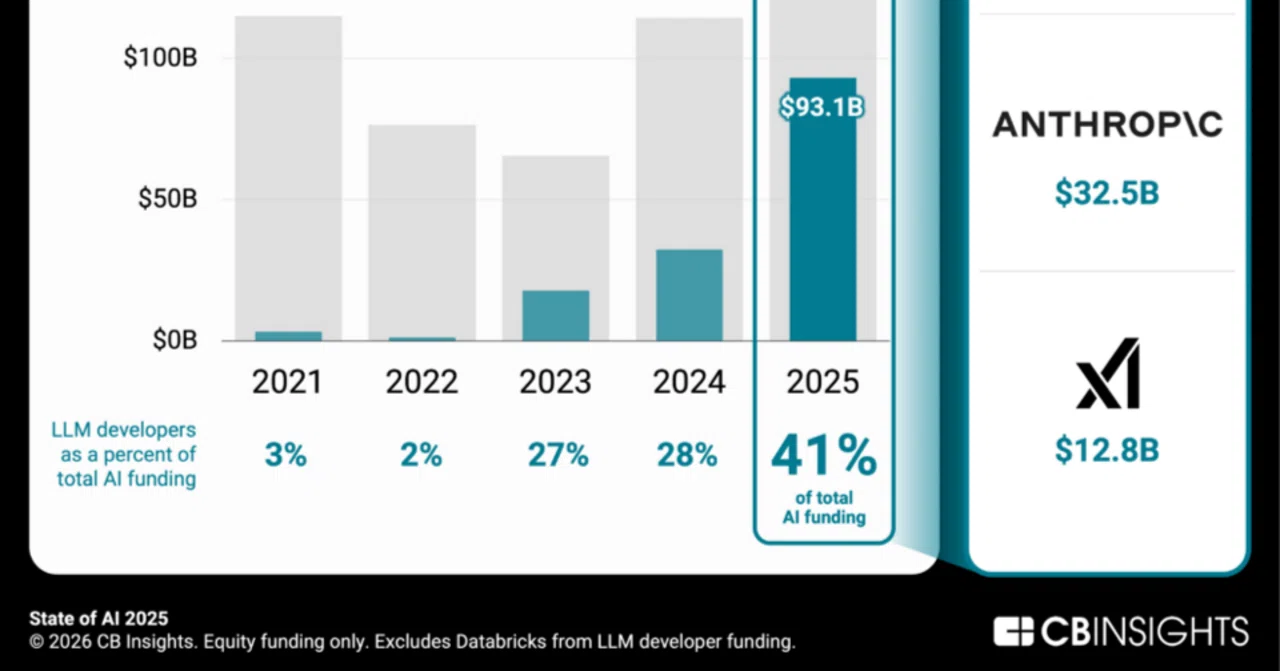
- The foundation model and infrastructure layer (a divide between the capital-rich "haves" and "have-nots"): A handful of foundation model developers such as OpenAI and Anthropic alone absorb roughly 40% of all AI funding (tens of billions of dollars). Investment in "IT infrastructure and hosting," essential for training and running models, also surged to $109.3 billion in 2025, accounting for over 42% of AI VC investment. This layer has become a game of securing massive computing resources (compute), and companies without deep pockets face a growing risk of being weeded out.
- The application layer (the startups' main battleground): While developing general-purpose foundation models demands enormous capital, the most attractive and highest-return opportunities for VCs lie in the "application layer," where companies leverage that infrastructure to solve the problems of specific jobs and industries. Indeed, nearly half of all funding is spread across the application layer, including industry-specific Vertical AI and developer tools.
3. A Paradigm Shift in Scaling: "Faster, with Less Capital"
By leveraging AI tools, startups can dramatically cut the time and headcount needed for product development and go-to-market (GTM), which has changed the very nature of fundraising.
- "Skipping the middle rounds" with seed capital and bootstrapping: Because even small teams can now build sophisticated software with the help of AI, a combination of early seed funding and bootstrapping (operating on self-generated funds) is enough to put a company on a strong growth trajectory. As a result, some companies are now skipping the once-obligatory intermediate rounds such as Series A and Series B.
- Unicorns at unprecedented speed: AI-native companies such as Cursor are growing at a pace unimaginable for software companies of the past, reaching $100 million in ARR (annual recurring revenue) within just one to two years of founding. Of the unicorns (private companies valued at $1 billion or more) born in 2025, 61% were AI companies, and what sets them apart is that they have already moved beyond the proof-of-concept stage and are generating revenue at commercial scale.
4. The Rise of New Sources of Capital: CVCs, Private Equity, and Sovereign Capital
Alongside traditional venture capital, Big Tech companies, private equity (PE) funds, and state-backed funds are now driving the market.
- Big Tech's growing dominance through CVC (corporate venture capital): The share of US AI VC deal rounds involving CVCs, led by Big Tech companies, jumped from 54% in 2022 to 75% in 2025. These Big Tech players are making massive investments with an eye to driving usage of their own cloud assets, building relationships within the AI ecosystem, and positioning for future M&A and talent acquisition.
- PE funds investing in "infrastructure" and "add-on acquisitions": Private equity (PE) funds have been cautious about investing directly in high-risk AI startups. Instead, they are rapidly expanding investment in the digital infrastructure that underpins AI—data centers, power supply, and the like—as the "picks and shovels of the gold rush." They are also pursuing a strategy of having their existing portfolio companies make add-on acquisitions of AI-capable firms to strengthen their competitiveness.
- State funds enter the fray under the banner of "technological sovereignty": Geopolitical competition for AI supremacy is intensifying, led by the United States and China. As exemplified by China's National AI Industry Investment Fund (roughly $8.2 billion), state-backed funds that pour huge sums into the AI ecosystem as a matter of national policy, driven by security and industrial competitiveness concerns, are gaining prominence.
5. Changes in the M&A and Exit Environment: The Rise of the "Quasi-Acquisition"
The number of AI startup M&A deals hit a record high in 2025 (1.5 times the previous year), with AI agent and infrastructure companies in particular commanding steep acquisition prices. Yet a shifting regulatory environment is giving rise to new forms of exit.
- "Quasi-acquisitions" that sidestep antitrust law: With antitrust scrutiny of Big Tech tightening, a new approach is trending: rather than acquiring a company outright, buyers combine an "exclusive technology license" with "poaching the founders and key engineering team" in what is known as a "quasi-acquisition." Meta's investment in Scale AI and absorption of its team is a textbook example, and the model gives investors a new path to recoup their capital (exit) while avoiding legal risk.
6. A Shift in What Investors Value: From Ideas to the "Human Element" and "Gritty Execution"
Generative AI now lets anyone produce pitch decks, business plans, and software demos quickly and to a high standard. In this environment, the criteria VCs use to evaluate startups are shifting dramatically.
- Uncompromising evaluation of "people" and "judgment": With the "noise" of polished-but-superficial pitches at an all-time high, what investors weigh most heavily are the human qualities AI cannot replicate: the founders' character, their vision, and their "learning agility"—the ability to adapt to unfamiliar situations.
- The gritty execution needed to build a "system of work": Now that ideas themselves have become relatively less valuable, investors place a premium on execution—the ability to actually embed a technology into complex, real-world operations. As AI proliferates, capital is flowing to teams that go beyond simply shipping a tool and instead, through hands-on professional deployment support (Forward Deployed Engineers), work their way deep into customers' core operations, building a robust moat that competitors cannot easily replicate.
Closing Thoughts
Advances in AI are fundamentally changing what is expected of startups. Companies now need to anticipate what lies ahead and quickly reassess and adjust their strategies accordingly.
The end
Read next ↓