Research
Building an Organization: A Process Guided by the Latest Research and Real-World Cases
Product
Career
Automatically translated from the Japanese original.
Overview
When launching a business, which roles you hire, in what order, and when can decide whether the venture succeeds or fails. This article begins with academic definitions of the organization and derives eight elements from them: strategy, division of labor, hiring and allocation, integration, decision-making, motivation, culture, and alignment, explaining each through research and real-world practice. It then lays out, for each of the four stages (customer discovery, customer validation, customer creation, and company building) and for each type of business model, which roles to hire and in what order, which roles to hold off on, and the conditions for advancing to the next stage. Next, it examines which roles have become more or less necessary in the AI era, along with research and practical insights on hiring early-career talent. Finally, it summarizes 13 failure patterns and the insights gathered up to that point, closing with a framework for organization building.
Introduction
Organization building determines most of what a business or company becomes, and yet most of us probably rely largely on our own personal experience when we do it.
This article aims to draw together the latest research and practical insights in order to arrive at general knowledge about organization building.
The novelty of this article lies in the following three points.
It specifies which roles to hire, and in what order, for each phase of the business: For each stage from customer discovery to company building, we organize five points: the state of the organization, which roles to hire and in what order, which roles not to hire yet, the case of new businesses within large companies, and the conditions for advancing to the next stage. This is based on research using job-posting and employment data and on statistics on headcount composition by role. For example, by combining the finding that companies that post management and sales positions earlier are more likely to fail (Lee & Kim, 2024) with role composition by ARR scale (Kuramoto, 2026), we specify the conditions for when to hire the first salesperson.
It compares how organization building differs by business model and business form: We laid out seven models, from sales-led SaaS to industry-specific AI, together with the differences between startups and new businesses within large companies, using a common set of items: the first roles to hire, the roles to hire later, and target role composition. For example, in a single table you can confirm that industry-specific AI companies hire implementation engineers and people with hands-on industry experience before salespeople, and that new businesses within large companies should end dual-hatting and appoint a dedicated leader.
It shows how organization building is changing in the AI era: On smaller headcounts, hiring early-career talent, and shifts in which roles are needed, we distinguish between what the data confirms, where researchers disagree, and what remains anecdotal, and summarize the findings in 13 failure patterns and eight steps. For example, we set a study finding that employment of young workers is 19% lower (Brynjolfsson et al., 2026) alongside one finding that the impact on income and working hours is under 2% and that the employment share of young workers is unchanged (Humlum & Vestergaard, 2025), and explain why the two diverge.
What Is Organization Building?
This chapter defines the scope of the term "organization building" and then explains, in turn, the eight elements that follow from that definition.
Defining Organization Building
In management studies, organizations and organizational design have been defined in research such as the following.
Definitions of the organization
A system of cooperation: Barnard (1938) defined an organization as "a system of consciously coordinated activities or forces of two or more persons," and identified three conditions for its existence: a common purpose, willingness to contribute, and communication. For example, ten people gathered in the same place do not constitute an organization unless they share a purpose and communicate information.
A system of multiple agents with a goal: Puranam et al. (2014) defined an organization as a system made up of multiple agents, with a clearly defined membership, that has a goal as a whole and in which members' efforts are expected to contribute to that goal. For example, under this definition, contractors and AI agents become part of the organization, and therefore objects of design, as long as their boundaries and their contribution to the goal are defined.
A coordination mechanism that replaces the market: Coase (1937) argued that because market transactions incur the costs of finding counterparties and contracting with them, a firm is what results when those transactions are brought in-house and replaced with coordination by managerial direction. For example, this provides the rationale for keeping in-house the work that is cheaper and more reliable to do with employees than by finding and contracting a vendor each time, and for sending the rest outside.
Definitions of organizational design
Structure follows strategy: Chandler (1962) defined structure as "the design of organization through which the enterprise is administered" and advanced the proposition that structure follows strategy. For example, a company selling a single product in one region and a company selling multiple products across multiple regions require different organizational forms.
Division of labor and coordination: Mintzberg (1979) defined organizational structure as "the sum total of the ways in which it divides its labor into distinct tasks and then achieves coordination among them," and identified five coordinating mechanisms: mutual adjustment, direct supervision, standardization of work processes, standardization of outputs, and standardization of skills. For example, a five-person company can run on mutual adjustment alone, but at 50 people, supervision and standardization become necessary.
Differentiation and integration: Lawrence & Lorsch (1967) used "differentiation" for the way departmental goals and time horizons diverge in response to differences in their environments, and "integration" for the quality of collaboration between departments, and showed that high-performing companies achieve both the differentiation and the integration their environment demands. For example, separating sales and development into different departments deepens each one's expertise, but it then requires roles and meetings to connect the two.
Matching information-processing demands to capacity: Galbraith (1974) held that the greater the uncertainty of a task, the more information must be processed, and framed organizational design as the problem of balancing the amount of information that needs processing with the organization's capacity to process it. For example, because exceptions arise frequently in a business whose hypotheses have not yet been validated, a small group talking things through directly is better suited than handling them through rules or hierarchy.
Elements of organizational design: Galbraith's (2014) Star Model takes strategy, structure, processes, rewards, and people as the five objects of organizational design and requires that they be aligned with one another. For example, changing only the org chart will not change how people behave if the evaluation and reward systems stay as they were. Waterman et al. (1980), likewise holding that structure alone is not the organization, identified seven elements: strategy, structure, systems, style, staff, skills, and superordinate goals. For example, two companies with the same org chart will produce different results if their leaders behave differently and their shared goals differ.
Fit among four components: Nadler & Tushman (1980) viewed the organization as a system of four components (tasks, individuals, the formal organization, and the informal organization) and held that the higher the degree of fit among them, the more effectively it functions. For example, imposing formal mechanisms of detailed procedures and approvals on a team doing exploratory work breaks that fit.
Solving four problems: Puranam et al. (2014) argued that every organization must solve four problems—task division, task allocation, reward provision, and information provision—with the first two constituting the division of labor and the latter two the integration of effort. For example, hiring is one method of task allocation, and role design corresponds to task division.
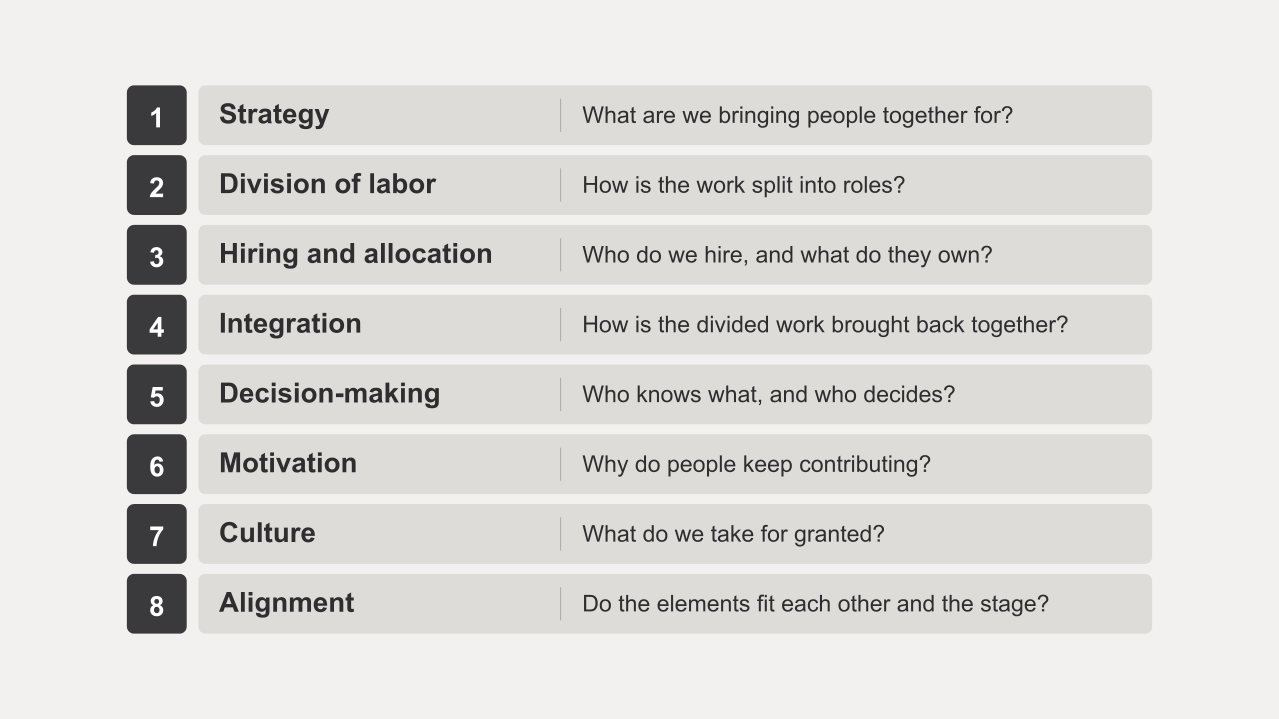
Extracting the elements common to these definitions yields the following eight. The sections that follow explain them in this order.
Strategy: What are we bringing people together for?
Division of labor: Into which roles do we divide the work?
Hiring and allocation: Whom do we hire, and what do we have them take on?
Integration: How do we bring the divided work back together?
Decision-making: Who knows what, and who decides?
Motivation: Why do people contribute?
Culture: What do we take for granted?
Alignment: Do the elements fit one another and the stage of the business?
1. Strategy
An organization is a means of executing strategy. The people you should bring together and the shape the organization should take depend on what you are trying to verify and what you are trying to grow.
Strategy determines the organization
Structure follows strategy: Chandler (1962) showed from the history of large corporations that when strategy changes, so does the shape of the organization. In a new business, the strategy itself is still a hypothesis, so the organization should be shaped to test that hypothesis. For example, a company that has decided to sell to small and medium-sized businesses at low prices and one that has decided to sell to large enterprises with tailored support will need different people at the outset, even if the product is the same.
Match the founding team's composition to the strategy: A study of 2,067 companies found that companies whose founding teams included people with sales or management experience, not just engineers, tended to perform better overall. The effect, however, depended on the commercialization approach. For companies that sold their own products and competed in the market against incumbents, teams with diverse backgrounds had the advantage. For companies that commercialized by supplying new technology to incumbents or by partnering with them, engineer-centered teams were the better fit. When a team's composition does not match its strategy, hiring experienced managers later will not necessarily make up for it (Eesley et al., 2014). For example, a drug discovery company that licenses its technology to pharmaceutical companies proceeds in its early days with a team centered on researchers, whereas a company that sells its own software directly to customers brings in people with sales or business development experience from the founding stage.
Learning precedes scaling: Companies that add staff before their business hypotheses have been validated tend to be more likely to fail. Lee & Kim (2024) analyzed 6.3 million job postings from more than 38,000 U.S. startups and showed that the earlier a company posted management and sales positions, the more likely it was to fail, with no evidence that doing so raised the probability of a successful outcome such as acquisition or IPO. Note, however, that this result is a correlation and does not establish causation. Relatedly, companies that adopted A/B testing had 30–100% higher performance after one year (Koning et al., 2022), and entrepreneurs trained in hypothesis testing performed better and pivoted more often (Camuffo et al., 2020). For example, when you have only a handful of paying customers, the priority is for the founders to sell on their own and verify "to whom, what, and why it sells" rather than hire a head of sales.
The four business stages and the organization
This article divides business maturity into four stages, which correspond to the stages of Blank's (2020) customer development model.
Stage
Typical funding stage
Business question
Most important metric
Shape of the organization
Typical headcount
1 Customer discovery & product discovery
Pre-founding / pre-seed
Is there a problem customers would pay to solve?
Problem validation rate
Founders plus an exploration team of a few people
2–5 people
2 Customer validation
Seed
Are there customers who can't do without the product?
Retention
A small team that handles both development and customer support
5–15 people
3 Customer creation
Series A
Can we add customers in a repeatable way?
ARR growth rate
Specialized sales and customer support roles, plus the first managers
15–60 people
4 Company building
Series B and beyond
Can we achieve growth and profitability at the same time?
Rule of 40
Functional departments and an executive team
60+ people
Headcounts are rough guides; what determines the stage is how far validation has progressed: The figures above are ranges drawn from an average of roughly six employees at seed stage and roughly 14 at the time of a Series A raise (Dowd & Walker, 2025; Walker, 2025), together with median headcount by ARR band (nine at under $1M, 22 at $1M–$5M, and 66 at $5M–$20M) (Kuramoto, 2026). A company with 30 people that has not yet confirmed retention, for example, is still at Stage 2 and should not start Stage 3 hiring.
Build departments last: In Blank's (2020) model, creating functional departments is the fourth stage; until then, everyone is a member of the customer development team. Blank (2010) notes that titles such as VP of Sales describe roles that "execute a known business model" and do not fit a company that is still searching for one. In Stages 1–2, for example, what you need are people who can change how they work every day amid ambiguity, not people whose strength is running an established process at scale.
Corporate new ventures go through the same stages: O'Reilly & Binns (2019) divide new ventures inside established companies into three stages—ideation, incubation (validation in the market), and scaling—and point out that scaling is where most companies are weakest. An internal venture that builds out a sales organization before validation, or keeps going with a handful of people in dual roles after validation, for example, will fail in exactly the same ways a startup does.
2. Division of Labor
Division of labor means deciding how work is split into roles. The finer the split, the greater the specialization—but also the greater the effort needed to connect the pieces.
The Benefits and Costs of Splitting Work
Specialization raises efficiency but creates a need for coordination: Mintzberg (1979) framed organizational structure in terms of two things: how work is divided and how those divided parts are coordinated. The more differentiated an organization becomes, the more integrating mechanisms it needs (Lawrence & Lorsch, 1967). Splitting development into front end and back end, for example, speeds up each side's work but requires meetings to align on specifications.
Choose early members for breadth: Lazear (2005) argued that entrepreneurs need not excel at any single skill but must be competent across many, and showed with data on Stanford University graduates that people with broader work histories and coursework are more likely to start companies. For the first few hires, for example, the right fit is someone who can handle customer support while developing, or read a contract while selling.
Don't leave roles too vague: A study of internet startups found that ventures whose founding teams had clearly defined roles, with distinct functional responsibilities and a certain number of people engaged in management, performed better (Sine et al., 2006). The interpretation is that because new organizations must learn their roles from scratch (Stinchcombe, 1965), a degree of formal structure helps even in fast-changing fields. Even in a five-person company, for example, designating one person as ultimately responsible for customer inquiries reduces the number that fall through the cracks.
The Order of Specialization
There is no single order: Which function to specialize first depends on the company's market position. DeSantola et al. (2023) tracked 3,748 venture-backed companies in the United States and found that firms targeting new markets outside existing categories tended to specialize externally facing functions such as sales and marketing first, while firms competing in existing markets tended to build out internal functions such as accounting and HR first. The hiring sequence given in "Hiring Procedures by Stage" should therefore be read as the standard pattern. A company selling a product in an entirely new category, for example, has to explain to customers what the product even means, so it puts dedicated sales and marketing people in place early.
Move from generalists to specialists: Until the business is validated you need people who can fill multiple roles; in the growth phase you need specialists with deep knowledge of a specific function (Hoffman & Yeh, 2018; Gulati & DeSantola, 2016). There will be moments when work handled by early members is handed over to specialists who join later. For example, the accounting and recruiting that employee number three had been covering are passed to a specialist in each.
How This Changes by Stage
Stage 1, customer discovery and product discovery: define roles, but don't separate them: Everyone faces customers, and each person holds several roles (Blank, 2020). Engineers, for example, sit in on customer interviews.
Stage 2, customer validation: combine development and customer-facing work: No departments yet—just name the person responsible for each area. An engineer, for example, also handles onboarding and support inquiries.
Stage 3, customer creation: specialize the customer-facing functions first: Separate sales, onboarding, and support, and assign an owner to each. In B2B SaaS companies with $1M–$5M in ARR, customer-facing work is the largest function after engineering (Kuramoto, 2026). For example, split the role of a dedicated onboarding lead from that of someone responsible for expanding usage among existing customers.
Stage 4, company building: create functional departments and specialist roles: Transition the customer development team into functional departments (Blank, 2020). For example, add specialists in data analytics, security, and business planning.
3. Hiring and Allocation
Hiring and allocation is about deciding who takes on the work once it has been divided.
Hiring Principles
Early members are irreplaceable: Employees who join in the first year shape performance for longer than those who join later. Using data on all employer firms in the United States, Choi et al. (2025) showed that companies that unexpectedly lost a first-year employee had roughly 8% lower employment and roughly 12% lower revenue over the following five years, with the effects persisting for more than a decade. The impact of losing an employee who joined in the second year was small and temporary. Spending months on the first five hires, for example, is not slowness—it is a rational investment.
Hiring is an investment that is hard to reverse: Like capital expenditure, a hire locks in future fixed costs and should be treated as part of capital allocation. The cost of replacing a departing employee is estimated at about 21% of annual salary (median) (Boushey & Glynn, 2012), and an analysis of more than 33,000 sole-founder firms in Denmark found that hiring the first employee increased revenue but produced no significant difference in profit, while widening the dispersion of profits (Coad et al., 2017). With every hire, for example, you need to calculate how many months of runway each additional person's monthly salary cost takes away.
Talent density, not headcount, determines results: Keeping out a bad fit does more good than adding an average performer. Using data on 58,000 employees at 11 companies, Housman & Minor (2015) estimated that the savings from avoiding a single employee who has a toxic effect on those around them (about $12,500) are more than double the gain from hiring one top-1% performer (about $5,300). Hastings & Meyer (2020) call the concentration of excellent people "talent density" and prescribe raising it first, then reducing controls. One person hired in a rush with lowered standards, for example, can drag down the productivity of the five people already there.
Ways to Staff the Work
There are four ways to staff a piece of work. Which one to choose depends on whether the work is core to the business and how quickly results are needed.
Hiring full-time employees: This is how you accumulate the business's core knowledge inside the company. Hiring takes time and becomes a fixed cost, but the assets early members leave in the organization are large (Choi et al., 2025). Sourcing channels have trade-offs of their own: reaching out directly to candidates raises the likelihood of a hire, but people who come in through that channel are reported to leave more readily (Kim & Pergler, 2025). For example, the engineers who build the product's core and the domain experts who understand customers' work are the people to secure as full-time employees from the start.
Contractors and outsourcing: This borrows expertise for only as long as it is needed. It works well for non-core functions, but outsourcing a core function means the learning never stays in-house. Weigelt (2009) analyzed U.S. banks and showed that the more they relied on outsourcing to adopt new technology, the weaker their ability to integrate that technology into their own operations became, and the worse they performed. The Marmer et al. (2011) survey likewise found that companies that scaled prematurely had an outsourcing ratio for product development four to five times higher. The basic line, for example, is to outsource accounting, legal, and payroll while keeping product development and customer conversations in-house.
AI agents: This handles routine, easily verifiable work without hiring. In 2025, Shopify required all employees to show why AI could not do a job before requesting additional headcount (Lütke, 2025). That said, in a survey of roughly 300 executives at companies building AI products, about half reported that more than 30% of the work handled by agents frequently requires human intervention (ICONIQ, 2026a), so someone still has to supervise. First-line inquiry handling, prospect research, and writing test code, for example, are the first things to try with AI.
Internal transfers and dual roles: This is unique to new ventures inside large companies. People who move from within the company become productive in about half the time of external hires (Rollag et al., 2005), but there is a risk they bring the existing business's ways of working with them wholesale. Govindarajan & Trimble (2010) recommend giving the new venture a dedicated team, with people from the parent organization cooperating as "shared staff" only to the extent needed, and argue that the dedicated team should include outside hires. Make the head of the new venture double as a division head in the existing business, for example, and the new venture gets pushed aside at every quarter-end.
How This Changes by Stage
Stage 1, customer discovery and product discovery: hire from the founders' network: Hiring founders' former colleagues improves early profitability and survival rates (Rocha & Brymer, 2025). For example, a founder reaches out to an engineer they worked with at a previous job.
Stage 2, customer validation: core roles full-time, everything else outsourced: Keep development and customer-facing work in-house and borrow specialist functions only for as long as needed. Accounting and legal, for example, are entrusted to outside professionals.
Stage 3, customer creation: make hiring a system: As hiring volume grows, put a dedicated recruiter in place and use the same questions and scoring criteria for every candidate (Sackett et al., 2022). For example, prepare questions and scoring rubrics for each role and train the interviewers.
Stage 4: Organization building — bring in functional specialists from outside: In the scaling phase, hiring functional specialists becomes necessary (Gulati & DeSantola, 2016). For example, the head of finance is recruited from outside, while engineering managers are promoted from within.
4. Integration
Integration means tying divided work back together into a single outcome. While headcount is small, conversation is enough; as it grows, managers and systems become necessary.
Means of coordination
The means change with headcount: In a small group, the people involved can coordinate by talking directly with one another, but as numbers grow, supervision and standardization become necessary (Mintzberg, 1979). The more uncertain the work, the better suited direct dialogue is than rules (Galbraith, 1974). For example, an eight-person company can get by with a short meeting every morning, but at 40 people it needs per-team goals and a weekly reporting format.
Removing hierarchy does not necessarily make things faster: Flatter organizations help with generating ideas but disrupt execution, and adding a few layers of management raises the odds of commercial success and survival (Lee, 2022). The successful examples of manager-less organizations instead defined roles and procedures rigorously (Lee & Edmondson, 2017). For example, a company that decides to go without managers needs to document who decides what and have a mechanism for revisiting it regularly.
The first managers
The trigger is information piling up on the founder: What prompts the appointment of the first middle managers is the founder becoming unable to process all the information (Colombo & Grilli, 2013). Greiner (1998) framed this as the first crisis of growth. For example, when the founder is spending most of the day fielding everyone's questions, it is time to put managers in place.
A great individual contributor is not necessarily a great manager: In data on salespeople at 214 companies, the higher a person's sales performance, the more likely they were to be promoted to manager, yet other traits were better predictors of managerial performance, and the authors estimate that this approach to promotion carries a cost (Benson et al., 2019). For example, rather than automatically making the top seller the sales manager, choose based on a track record of advising and collaborating with colleagues.
Manager quality drives retention: Google's internal research found that teams under highly rated managers had lower turnover. A link to business performance, however, has not been confirmed (Garvin, 2013). For example, include the retention and development of direct reports in how managers are evaluated.
Integration through systems
Put planning and budgeting systems in place early: A study of 78 companies less than ten years old found that budgeting systems were introduced on average about a year and a half after founding, and sooner at venture-capital-backed firms and those with experienced CEOs. Companies that adopted them earlier saw greater growth in revenue and headcount, though the direction of causality was not established (Davila & Foster, 2007). For example, at the 15-person stage, consolidate monthly budget versus actuals, the hiring plan and the revenue forecast into a single spreadsheet.
Founders tend to underrate management systems: In an international survey measuring management practices, founder-led companies scored lowest, and the founders themselves were unaware of the weakness (Bennett et al., 2017). For example, set goals and check progress through fixed meetings and documents rather than relying on the founder's memory.
Changes by stage
Stage 1: Customer discovery & product discovery — daily conversation is enough: Because everyone is looking at the same customer information, no systems are needed. For example, share what came out of a customer meeting with the whole team the same day.
Stage 2: Customer validation — align in a weekly all-hands: Everyone reports directly to the founder. For example, share customer reactions in the weekly all-hands and set that week's priorities.
Stage 3: Customer creation — appoint the first managers and put goal and budget systems in place: Around 20 to 30 employees is cited as the point at which to start appointing managers (Lee, 2022). For example, put one person in charge of sales and another in charge of engineering, and set quarterly goals.
Stage 4: Organization building — connect the departments: Too many layers slow decisions down, so keep management layers to the number actually needed (Zuckerberg, 2023). For example, the heads of sales, engineering and customer support meet weekly to resolve issues that cut across departments.
5. Decision-making
Designing decision-making means defining who holds which information and who decides what. In the founding period, the founder knows everything and decides everything, but that arrangement reaches its limits as headcount grows.
Where to place decision authority
Place authority where the knowledge is: Jensen & Meckling (1995) argued that either the knowledge needed for a decision must be moved to the decision-maker or decision authority must be moved to those who have the knowledge, and that the harder the knowledge is to transfer, the more authority should be delegated to the front line. For example, decisions on customer-specific discounts are left, within set limits, to the salesperson who knows the customer best.
Delegate reversible decisions; make irreversible ones carefully: Amazon's Bezos (2016) distinguished between decisions that are hard to reverse and those that can be reversed, arguing that the latter should be made quickly by individuals or small teams with good judgment. He also noted that as organizations grow, they start applying heavyweight processes to reversible decisions too, leading to slowness and too little experimentation. For example, the team in charge decides on a trial release of a feature, while the leadership team takes its time over fundraising or executive hires.
Concentration in the founder hampers scaling: One analysis found that the more dominant positions a founder retains, the lower the company's valuation (Wasserman, 2017). Wasserman (2008) called this the choice between being "rich" and being "king." For example, if the founder keeps conducting every hiring interview and approving every discount, the founder's calendar becomes the ceiling on the company's speed.
Speed and quality of decisions
Fast decisions do not mean using less information: A study of eight firms in the microcomputer industry found that the faster-deciding executive teams used more real-time information, considered multiple alternatives simultaneously, and actively resolved conflict. The faster-deciding firms also performed better (Eisenhardt, 1989). For example, a leadership team that reviews orders, churn and usage figures every week does not have to start with an investigation when a problem arises.
Decide without waiting for consensus, and commit once decided: Bezos (2017) states that most decisions should be made with roughly 70% of the information you wish you had, and that when consensus cannot be reached, people should be asked to commit to the decision even if they disagree. Disagreements are escalated early so they can be resolved. For example, if sales and engineering are split over development priorities, the responsible lead decides within the week, and the side that disagreed cooperates in carrying it out.
Changes by stage
Stage 1: Customer discovery & product discovery — the founder decides, and everyone is in the know: Both information and decisions converge on the founder. For example, keep the records of customer conversations somewhere everyone can read them.
Stage 2: Customer validation — share the reasoning behind decisions: Enable the early team members to make the same calls the founder would. For example, when deciding on pricing or priorities, write down the reasoning briefly and keep it on record.
Stage 3: Customer creation — spell out the scope of delegation: Decide what to entrust to managers. For example, draw up a table showing who decides—the person in charge, a manager or the founder—according to the amount of money and the scope of impact involved.
Stage 4: Organization building — decide as a leadership team and revisit the founder's role: Among 50 companies that went public, the share with a founder as CEO fell from 66% at the business-plan stage to 38% about three years after the IPO (Kaplan et al., 2009). For example, the board considers the option of having the founder focus on product and hand day-to-day management to an experienced CEO.
6. Motivation
Designing motivation means answering the question of why people keep contributing to this organization. A new venture often cannot match established companies on salary or job security, so it needs to offer other reasons.
What keeps people on board
Choose a source and stay consistent: Baron & Hannan (2002) sorted the foundations founders rely on to keep people into three: interesting work, attachment to the organization and colleagues, and money. Which one serves as the axis is tied to hiring criteria and methods of control. For example, a company built around the chance to tackle hard technical problems puts technical challenge front and center in both hiring and evaluation.
People who choose startups value autonomy over security and pay: A survey of more than 10,000 R&D workers in the US found that startup employees placed less weight on job security and salary than employees of established firms, and more on independence and responsibility. Part of their higher patent output was explained by this difference in motivation (Sauermann, 2018). For example, ask candidates in interviews what they want from their work, and tell those who put security and high pay first, frankly, that it may not be a fit.
Compensation and equity
Explain the pay gap with equity and breadth of work: Danish data from 1991 to 2006 showed that larger firms paid higher wages for comparable talent (Burton et al., 2018). For example, if a ten-person company cannot match big-company pay, be ready to explain the difference in terms of equity and the breadth of work entrusted.
Equity compensation loses its effect as headcount grows: Small employee stock ownership plans of under 5% of outstanding shares raise productivity at firms with mid-sized headcounts, but at larger headcounts more people free-ride on others' efforts and the effect weakens (Kim & Ouimet, 2014). Even among US venture-backed companies, 27% did not grant equity to all employees (Hand, 2008). For example, at a 20-person company, granting equity to everyone fosters a sense of ownership, but at 500 people, combine it with rewards tied to team results.
Decide the split among founders by talking it through: Founding teams that split equity equally were less likely to raise outside funding, which the authors interpret as equal splits being a hallmark of teams that avoided negotiation (Hellmann & Wasserman, 2017). For example, settle the allocation only after discussing each founder's role, time commitment and contributions to date.
Evaluation and promotion
Align what you reward with the behavior you want: Kerr (1975) observed that many organizations have mechanisms that end up rewarding behavior other than what they actually want. If you ask for teamwork but base bonuses solely on individual bookings, for example, people will stop sharing information about prospective customers.
Don't make promotion the only reward: When the only reward for strong performance is promotion into management, people who are ill-suited to management end up becoming managers (Benson et al., 2019). One remedy is a specialist track in which grade and pay rise without a move into management.
How this changes by stage
Stage 1 (customer discovery and product discovery): attract people with the mission and equity. Individuals drawn to startups have been found to accept jobs at roughly 17% lower pay than at established companies (Roach & Sauermann, 2024). For example, be concrete about the problem you are trying to solve and the scope of what you will entrust to each person.
Stage 2 (customer validation): make breadth of work and learning the reward. At this stage, the sheer range of what a single person gets to own is the draw. For instance, let an engineer handle everything from customer conversations through to design.
Stage 3 (customer creation): establish pay bands and an evaluation framework. Venture capital investment is associated with the formalization of HR systems and the introduction of stock options (Hellmann & Puri, 2002). For example, set a salary range for each role and grade to reduce inequities that arise from when someone happened to join.
Stage 4 (company building): preserve fairness and opportunities for growth. Voluntary turnover rises after layoffs (Trevor & Nyberg, 2008), so procedural fairness becomes critical. For example, publish the expectations for each grade and the criteria for advancement.
7. Culture
In the section on hiring and allocation, we noted that talent density, not headcount, determines outcomes, and that keeping out people who don't fit has an outsized effect. But what does "fit" actually mean? Culture is the yardstick.
Defining culture
Shared assumptions: Schein (2010) defined organizational culture as the pattern of basic assumptions a group learns and comes to share as it solves its problems of external adaptation and internal integration. In a company where choosing quality over the deadline has paid off time and again, for instance, that choice becomes an assumption nobody questions.
Control through norms: Chatman & O'Reilly (2016) defined culture as the norms that characterize a group, arguing that when norms are widely shared and strongly held, they function as a form of social control. They further broke down what had conventionally been lumped together as "strong culture" into three dimensions: content (what is valued), consensus (how widely it is shared), and intensity (how firmly those who deviate are corrected). A company where everyone professes the same values but nobody calls out behavior that contradicts them, for example, has consensus but no intensity.
Shared beliefs: Van den Steen (2010) viewed culture as shared beliefs and values, and argued that it emerges even without intent, through screening at hiring, applicants' own self-selection, and joint learning under a manager. If a founder strongly believes "you should go and meet customers," for example, people who share that view apply and get hired, and the belief is reinforced as they accumulate shared successes.
How culture differs from climate and from stated values: Climate is the shared perception of policies and practices, whereas culture is the behavior expected of you in order to be accepted by those around you (Chatman & O'Reilly, 2016). The values a company publicly espouses are something else again. A study comparing more than 1.2 million employee reviews with the official values of over 500 companies found the correlation between the two to be very weak or nonexistent (Sull et al., 2020). Having "integrity" on your website and being able to report an inconvenient number to your boss, for instance, are two different things.
The typology view: Cameron & Quinn (2011) classified cultures into four types: clan, adhocracy, market, and hierarchy. However, a meta-analysis integrating 84 studies showed that these types are not mutually exclusive and tend to appear together (Hartnell et al., 2011). Rather than debating "are we a clan or a market culture?", for example, it is more practical to decide concretely which behaviors are taken for granted.
In summary: Taken together, we can define culture as the standard of behavior that is taken for granted in an organization and that others will correct you for violating. This view locates culture in actual behavior and in how people respond to it, not in stated words. To understand your own culture, for instance, it is more reliable to look at who got promoted, who got reprimanded, and who left than to read a list of values.
How culture affects outcomes
Stated values are unrelated to performance: 85% of S&P 500 companies post their values on their websites, yet there was no significant relationship between stated values and performance. By contrast, the degree to which employees perceived senior management as acting with integrity was linked to higher firm value and profitability (Guiso et al., 2015). In other words, executives keeping their promises is closer to results than polishing the wording of a values statement.
The effect on retention is unambiguous: An analysis using career data on 34 million employees found that a toxic culture predicted industry-adjusted attrition 10.4 times more strongly than compensation did (Sull et al., 2022). If raising pay fails to stem departures, for example, you should suspect that culture is the cause.
The benefit of a "strong culture" depends on the environment: Firms with strong cultures show less variance in performance and more stability in stable environments, but that advantage disappears in volatile ones (Sørensen, 2002). Meanwhile, an analysis of 39 high-tech firms found that those with both a high degree of consensus and strong norms favoring adaptability outperformed the others on performance three years later (Chatman et al., 2014). In a new business, for example, "change course as soon as you spot a mistake" is a better norm to hold strongly than "stick to what was decided."
The founding approach to people has lasting effects: A study tracking 177 Silicon Valley startups found that companies founded on the "commitment" model (retaining people through attachment to the company, selecting on values fit, and controlling through peer norms) suffered not a single failure during the observation period, and their probability of going public was more than three times that of the reference model. Companies that switched their founding model midway were roughly three times as likely to fail (Hannan et al., 2006). Note, however, that the sample was 1990s Silicon Valley and the number of qualifying firms was small. For example, an organization assembled in its founding period on a "hire anyone, just hire fast" basis is very hard to later transform into one that runs on attachment and norms.
Consensus and diversity can coexist: An analysis of employee reviews at roughly 500 listed companies found that firms where employees disagreed about what the culture was had lower profitability, while firms where individual employees each held a broad range of perspectives had higher patent quality and firm value (Corritore et al., 2020). The winning combination, for example, is alignment on "what we take for granted" paired with a wide range of backgrounds and ways of thinking.
Evaluation and rewards override culture: In a survey of 1,348 North American executives, 92% said improving culture would raise firm value, yet misalignment with the compensation system was cited as an obstacle (Graham et al., 2022). The board report investigating Wells Fargo's sales-practices scandal identified distortions in the sales culture and performance-management system as the root cause, noting that the company's stated values were in conflict with its emphasis on sales targets (Wells Fargo & Company, 2017). If you proclaim "customer first" but evaluate people solely on units sold, for instance, they will choose the behavior that gets rewarded.
Be careful about causality: The correlation between culture and performance may include reverse causation: successful companies are more likely to develop shared beliefs (Van den Steen, 2010). Copying a successful company's culture, for example, does not guarantee the same results.
How culture is built
It is set by the founders' behavior and the first hires: Schneider (1987) argued that, through a cycle of attraction, selection, and attrition, organizations become places where similar people gather, and the people there determine the culture. The founders' mindset and the initial composition of the team have a long-lasting effect on how dependent the company later becomes on managers (Baron et al., 1999). For example, how the first 10 people work becomes "normal" for employee number 11 onward.
Write values as behaviors: If norms stay implicit, they stop getting transmitted as headcount grows. Practitioners recommend that, starting at around 25 employees and no later than 50, you spell out each value as two or three observable behaviors (First Round Review, 2015; CRV, 2026). HubSpot treats its culture like a product and has revised its written culture document more than 30 times (Shah, 2013). Instead of writing "ownership," for example, write "whoever finds a problem follows it through to resolution, even if it isn't their job."
Don't borrow other companies' words: Many competitively valuable practices rest on an accumulation of unwritten promises, and both the trust that those promises will be kept and clarity about what is being promised must be built up over time (Gibbons & Henderson, 2012). Adopting a famous company's values verbatim, for example, won't work without a track record of behavior to back them up.
Convey culture through touchpoints after joining: A study tracking 171 new hires at accounting firms found that what improved fit one year in was not formal training but time spent with a mentor and participation in social events within the firm (Chatman, 1991). Another study likewise found that onboarding with clear procedures and experienced employees serving as role models increased perceived fit (Cable & Parsons, 2001). For example, set up a weekly one-hour conversation during the first month with a senior colleague who embodies the values.
Keep evaluation, promotion, and exits consistent: Whom you promote and whom you ask to leave communicates your standards far more powerfully than any document. Netflix adopted a policy of paying generous severance to let go of people who are adequate but not exceptional, and has a mechanism whereby managers ask themselves, "If this person said they were quitting, would I fight to keep them?" (McCord, 2014; Netflix, n.d.). If you promote someone with high sales who treats colleagues with contempt, for instance, your values document loses all credibility.
Lead by the executive's own behavior: Horowitz (2019) frames culture as the set of assumptions employees draw on in their day-to-day decisions, and argues that because it will be shaped by accident if left alone, it must be designed deliberately. This is consistent with the finding that employees' perception of senior management's integrity is linked to performance (Guiso et al., 2015). For example, whether a founder admits their own mistakes in an all-hands meeting determines whether the norm "it is safe to report failures" is genuine or not.
How to tell who fits your company and who does not
Fit predicts retention, not performance: A meta-analysis synthesizing 172 studies found that person–organization fit is strongly related to job satisfaction (0.44), organizational commitment (0.51), and intention to leave (−0.35), but only weakly related to actual turnover (−0.14) and barely related to overall job performance (0.07) (Kristof-Brown et al., 2005). Another analysis put the validity of fit for predicting performance at just 0.15, and its authors note that if fit is used as a hiring criterion, it needs the same validation as any other selection method (Arthur et al., 2006). In practice, fit can inform the judgment "will this person stay and stay motivated?", but "can this person do the job?" must be verified separately through skills assessment.
"Fit" does not mean resembling the interviewer: In interviews with 120 hiring professionals at investment banks, law firms, and consulting firms, more than half named "fit" as the criterion they weighted most heavily in interviews—but what they meant by it was that the candidate's hobbies, background, and manner of speaking resembled their own (Rivera, 2012). Because perceived fit is strongly linked to interviewers' intention to hire (Kristof-Brown et al., 2005), leaving the definition vague lets it heavily sway hiring decisions. For example, if fit is judged solely by the question "would I want to work with this person?", you end up with nothing but people from the same schools and the same previous employers.
Separate value fit from the ability to read norms: There are two kinds of fit. Alignment between one's own values and the organization's values drives voluntary turnover through commitment, while the ability to accurately read the organization's norms drives day-to-day collaboration (Lu et al., 2024). The latter can be learned after joining. For example, if values are aligned, small differences in how work gets done can be closed after the hire.
Look at the ability to adapt rather than fit at entry: A study that analyzed the emails of 601 employees at one technology company found that those who were later dismissed started with low fit that never rose, while those who stayed showed steady increases. The authors conclude that the ability to adapt to norms is at least as important as fit at the time of hiring (Srivastava et al., 2018). Note that this result is based on data from a single company. For example, ask candidates concretely how they adjusted to an environment different from their previous employer in past job changes.
Align on standards, widen the range of people: An analysis at the same company found that people with high cultural fit performed best when they occupied positions bridging multiple groups, whereas people with high fit who stayed within closed social circles were more likely to be dismissed (Goldberg et al., 2016). Distinguishing shared values from similar backgrounds is also a precondition for avoiding the failure mode of the homogeneous team (Ruef et al., 2003). Our research did not find any study directly testing the recently popular idea of hiring for "culture add." For example, have everyone agree on the behavioral standards, and then deliberately vary the industries and specialties people come from.
Combine methods for telling fit apart: Judge fit through several structured methods rather than leaving it to interviewers' impressions. Structured interviews reduce both rating differences driven by demographic attributes and the influence of impression-management behavior (Levashina et al., 2014). Amazon adds one interviewer from outside the hiring team and tasks them with judging fit with the company as a whole rather than with the role (Amazon, 2019). For example, prepare in advance a question for each value asking about "a past situation where you acted this way," along with scoring criteria for the answers.
Method
What it assesses
Evidence
Limitations
Structured interview mapped to values
Whether past behavior matches the company's behavioral standards
Reduces rating differences by attributes and the influence of impression management (Levashina et al., 2014)
Candidates tend to find it demanding
Interviewer from outside the hiring team
Fit with the company as a whole rather than the role
Amazon's practice (Amazon, 2019). No outcome data has been published
Requires selecting and training interviewers
Work sample task
Skills and how the person approaches work
Correlation with job performance of 0.33 (Roth et al., 2005)
Not validated as a measure of value fit
Realistic job preview
Self-selection by the candidate
Reduces turnover (Phillips, 1998). The effect arises through the perception that the company is honest (Earnest et al., 2011)
Effect is modest
Structured reference check
Past behavior related to integrity and cooperativeness
Correlation with supervisor ratings of 0.25 (Taylor et al., 2004)
Based on a single study
Observing adaptation after joining
How quickly the person reads and adjusts to norms
Speed of adaptation predicts dismissal (Srivastava et al., 2018)
Based on data from a single company
Show candidates what the company is really like up front: Telling candidates both the good and the bad about the job and the company in advance reduces turnover after they join (Phillips, 1998). This effect arises mainly through the perception that the company is honest (Earnest et al., 2011). For example, before extending an offer, explain the aspects that will weigh on anyone who is not a good match—such as long hours of customer support or blunt performance feedback.
Decide quickly when it does not work out: Because every method has limited predictive accuracy (Sackett et al., 2022), combine them with checks after the hire. For example, at 30, 60, and 90 days after joining, hold reviews that look not only at skills but at behavior against the company's standards, and if no improvement is seen, consider reassignment or exit.
How this changes by stage
How you approach culture changes with headcount. However, how culture changes as a company grows has been identified as a gap in the research (DeSantola & Gulati, 2017), so the headcount thresholds below are based on practitioners' rules of thumb.
Stage 1: In customer discovery and product discovery, the founders' behavior simply becomes the culture: What sets the standard is not documents but what the founders spend their time on and what they refuse to tolerate. An analysis of 8,312 Danish startups found that companies that hired the founders' former colleagues and fellow alumni had higher profitability and survival rates; former colleagues were effective in the early period, while more distantly connected hires became effective as the company matured (Rocha & Brymer, 2025). For example, build the first few hires from people who know each other well, and in return deliberately fill the missing functions and perspectives from the second wave of hiring onward.
Stage 2: In customer validation, write it down before the next hire: Once headcount reaches 30 to 50, informal communication no longer reaches everyone (First Round Review, 2015), so put the standards into words before that point. For example, at 15 people, have the founding members write down five behaviors "that are valued at this company" and five "that are not tolerated," and map them to interview questions.
Stage 3: In customer creation, managers become the carriers of culture: At around 50 people, the first layer of managers becomes the main channel through which norms are transmitted, and sub-cultures emerge by function (CRV, 2026). For example, include not just results but the embodiment of behavioral standards in the criteria for selecting and evaluating managers, and start structured values interviews and onboarding with assigned mentors.
Stage 4: In company building, measure agreement and align it with the systems: At several hundred people, most employees will never have spoken with the founders. Research shows that remote-first work reduces connections across groups (Yang et al., 2022). Junior employees receive more guidance the closer they sit to their colleagues (Emanuel et al., 2023), yet two days of working from home per week cut turnover by about a third without reducing performance (Bloom et al., 2024). For example, rather than assuming the culture has taken hold, regularly measure gaps in perception through employee surveys, and check that the evaluation and compensation systems do not contradict the standards.
8. Alignment
Alignment refers to a state in which the seven elements described so far do not contradict one another and also suit the stage of the business. Even if each element is excellent on its own, the organization will not function if the combination does not fit.
Alignment among the elements
The elements work in combination: The higher the degree of fit among its elements, the more effectively an organization functions (Nadler & Tushman, 1980; Galbraith, 2014). Milgrom & Roberts (1995) showed that when practices complement one another, changing just one of them does not improve results; they must be changed together. For example, if you delegate authority to the front line while basing evaluations solely on a manager's subjective judgment, people on the front line will start avoiding making decisions themselves.
The initial design persists: The employment philosophy and functional composition chosen at founding are hard to change later, and changing them comes at a cost. Baron & Hannan (2002) and Baron et al. (2001) tracked Silicon Valley startups and showed that companies that changed their founding HR model midway saw higher turnover and lower performance. Beckman & Burton (2008) showed that teams with a narrow functional range at founding struggle to add the missing expertise later. For example, a company founded by engineers alone that decided "we'll think about sales later" runs into the problem, when it comes time to bring on a head of sales, that no one inside the company can evaluate a sales leader in the first place.
Match the organization to the business's activities: An analysis of apps shows that companies whose business activities match the way they earn revenue perform better (Tidhar & Eisenhardt, 2020). The organization that carries out those activities also needs to be matched to the business model (mign, 2026c). For example, for a product that users start using on their own, staff product and data analytics more heavily than sales.
Alignment with the stage
Growth breaks alignment: Greiner (1998) argued that the management approach suited to one stage becomes the cause of a crisis in the next. For example, deciding everything as a group, which worked at 10 people, becomes the reason decisions slow down at 50.
Do not get too far ahead of the next stage's shape: The finding that companies that post job openings for managers and salespeople earlier are more likely to fail (Lee & Kim, 2024) points to the danger of the organization's structure running ahead of the stage of the business. For example, when a Stage 2 company fills out a full set of department heads, it not only raises fixed costs but also loses the flexibility it needs for validation.
Re-check at every milestone: Alignment is not a one-time exercise; it has to be revisited continually. After a funding round, for instance, or once headcount has doubled, go through all eight elements one by one.
Hiring Sequence by Stage
For each of the four stages, this chapter covers five points: what the organization looks like, which roles to hire and in what order, which roles to hold off on, how things differ for a new business inside a large company, and the conditions for moving on to the next stage. The sequence presented here is the standard pattern for enterprise software; differences driven by business model are addressed in the next chapter.
Stage 1: Customer Discovery & Product Discovery
This is the stage for confirming that there are customers whose problem is serious enough that they will pay to solve it. The organization's purpose is neither to sell nor to build, but to learn.
What the organization looks like
The founders cover every function: The team consists of two or three founders and, at most, a handful of early members. Investors, too, are looking at the team at this stage. In a randomized experiment on AngelList, investors responded strongly to information about the founding team but not to information about business traction or existing investors (Bernstein et al., 2017). A survey of 885 venture capitalists likewise found that the management team is the factor they weigh most heavily in investment decisions (Gompers et al., 2020). For example, a founding pair combining one technically strong founder with one customer-focused founder has been reported to be 19% less likely to fall into premature scaling (Marmer et al., 2011).
Everyone meets customers: There are no departments and no titles; everyone operates as the customer development team (Blank, 2020). An engineer sits in on a customer interview, fixes the prototype that night, and shows it again the next day—that kind of speed is what gives you an edge at this stage.
Which roles to hire, and in what order
Hire an engineer first: In interviews with founders of enterprise software companies, more than two-thirds hired an engineer first, and not a single company lacked an engineer among its first three hires (Rachitsky, 2023a). Even when one of the founders can handle development, it is common practice to bring on a second developer as the very first hire in order to speed up validation.
After that, people who accelerate prototyping and validation: Add a designer, or a generalist who can handle both development and customer-facing work. The selection criterion is speed of learning rather than job title. A designer who can rebuild a screen prototype in a single day, for instance, adds more validation cycles at this stage than an additional engineer would.
Bring in industry knowledge early: If you are targeting a highly specialized industry, secure someone who knows how that industry actually operates—as a co-founder, as one of the very first hires, or at minimum as an advisor. An analysis of technology-based manufacturing found that startups paid a wage premium to hire people with industry experience, and that even when the founders themselves lacked such experience, a larger team was able to attract experienced hires (Honoré & Ganco, 2023). In fields with complex operational rules such as healthcare, law, or architecture, having a practitioner involved for even a few hours a week changes the precision of the hypotheses you test.
Select for motivation over pay: A study tracking 2,394 PhDs in science and engineering found that the more capable a person was and the more they wanted to work at a startup, the more likely they were to actually join one—at compensation roughly 17% below what established companies paid (Roach & Sauermann, 2024). In other words, even if you cannot match big-company pay, you can still hire talented people who value autonomy and are genuinely interested in the business.
Roles to hold off on
Sales: The first customers are won by the founders themselves. Graham (2013) argues that this cannot be avoided by delegating sales to someone else, and that at least one founder has to spend a great deal of time selling. It is only after being turned down by 20 companies that a founder learns exactly where the pricing and the pitch went wrong.
Management and executive titles: Positions designed to execute a known business do not fit a company that is still searching for one (Blank, 2010). This is consistent with Lee & Kim's (2024) finding that companies that posted managerial and sales job openings early were more likely to fail. If a five-person company hires a "VP of Sales," that person will keep selling the same product to their existing network and is likely to resist a pivot.
Dedicated corporate staff: Among startups valued at $1 million to $25 million, only about 11% have a dedicated HR person, fewer than 7% have dedicated accounting staff, and roughly 3% have in-house legal (Walker, 2023). Accounting, payroll, and contract review are outsourced to external specialists, and the founders simply check the numbers once a month.
For a new business inside a large company
Appoint a single dedicated leader: Former Amazon executives Bryar & Carr (2021) describe how Amazon assigns a leader and team to work on one thing only, and note that new ventures run as side responsibilities failed to make progress. Garvin & Levesque (2006) argue that the leader should not be a young maverick but a manager who has already run a large business, knows where the company's resources are, and has the credibility to draw on them. IBM, too, found that its earlier practice of entrusting new businesses to junior staff produced many failures and switched to assigning them to seasoned executives (O'Reilly et al., 2009). When a division head from the core business oversees the new venture only one day a week, there simply are not enough customer conversations for validation to move forward.
Separate evaluation from the parent company: IBM reviewed its new businesses on the basis of milestones rather than financial plans (Garvin & Levesque, 2006). For example, make the first-year evaluation criteria "the number of customers whose problem has been confirmed" and "the number of customers who have agreed to a paid pilot," rather than revenue.
Conditions for advancing to the next stage
The problem has been confirmed: As a rule of thumb, at least 60% of respondents across a cumulative total of 30 or more customer interviews should acknowledge the problem (mign, 2026b). In the enterprise setting, a further condition is having at least five prospects actively considering adoption (mign, 2026a). What counts is not customers who say "that's interesting," but customers who spend time with the prototype and are willing to discuss budget.
The founders are selling and building themselves: Hiring at the next stage means bringing in people to replicate what the founders have done. If the founders have not yet closed a single deal themselves, there is no pattern for a salesperson to replicate.
Stage 2: Customer Validation
This is the stage for confirming that there are customers who cannot do without the product, and that those customers will pay full price for it. The organization is still small, and results are determined by how fast it can cycle between development and customer contact.
What the organization looks like
Five to fifteen people, centered on development: At enterprise SaaS companies with ARR under $1 million, 41% of employees are engineers, 15% work in product and design, 16% in sales, 11% in customer success and support, 7% in marketing, and 6% in administration (Kuramoto, 2026). For a nine-person company, that means something close to the median would be four engineers, one or two in product and design, and two or three in sales and customer-facing roles.
Still no hierarchy: Everyone reports directly to the founders. At the weekly all-hands, for instance, everyone shares customer feedback and the development priorities for that week are set.
Which roles to hire, and in what order
First, add a few more engineers: How fast customer requests make it into the product determines retention. Build a team that can implement the common requests from the first five paying customers within two weeks.
Next, a customer-facing generalist: Hire one person to handle onboarding, support, and adoption single-handedly. The single most important metric at this stage is retention (mign, 2026b), and this is the role that moves it directly. Instead of a founder traveling to the customer's site for every implementation, this first hire takes that over.
Later in the stage, the first few salespeople: Leslie & Holloway (2006) divided the learning of a sales organization into three phases—initiation, transition, and execution—and argued that the size and type of the sales team should change with each phase. What the initiation phase calls for is three or four versatile sales reps who can work alongside product, marketing, and engineering (Leslie, 2016). Sales professionals are good at selling a validated product using a validated approach, but discovering the approach itself is not their job (Kazanjy, 2020). The founders close ten deals and document how they did it; only then do they bring on the first sales hire.
Fill specialized functions through outsourcing: Marketing and legal are outsourced at this stage, and a sales specialist may be brought in on a fixed-term basis to help close the first deals (mign, 2026a). Trade show exhibits and case study production, for example, are commissioned externally without adding to internal headcount.
Roles to hold off on
A head of sales and a large sales team: Do not expand the sales team until you have confirmed that the revenue generated by a single rep exceeds the total cost of employing them (Leslie & Holloway, 2006). Companies that scaled prematurely had roughly three times the headcount of companies at the same stage (Marmer et al., 2011). If you grow to five reps while neither of your first two has hit quota, the money runs out before the sales approach has solidified.
Product manager: A founder doubles as head of product. In interviews with 30 companies, the first product manager was typically hired two to three years after founding, when the company had 10 to 15 engineers and 15 to 25 employees (Rachitsky, 2023b). At this stage, it is faster and more accurate for the founder who is talking directly with customers to set priorities.
Managers: Organizations with few layers generate new ideas more readily, but execution tends to become disorderly (Lee, 2022). Lee notes that successful companies typically start putting managers in place at around 20 to 30 employees. Adding a manager to a twelve-person company only creates work that exists for the sake of reporting.
For a new business inside a large company
Mix outside talent into the dedicated team: A team made up solely of transfers from the parent company becomes a miniature version of the parent. Govindarajan & Trimble (2010) recommend designing the dedicated team as if founding a new company, with new job descriptions and new ways of working. In a case study of eight newspaper companies, the one that successfully responded to the shift to digital had separated the unit organizationally and brought in people from outside (Gilbert, 2005). For example, hire the head of product from outside, and transfer salespeople who know the customer base from the parent company.
Keep compensation and HR separate from the parent company: Companies experienced in building new businesses were more likely than inexperienced ones to pay new-venture talent more than the parent company does (25% vs. 13%), and twice as likely to give the new venture a high degree of decision-making independence (Vasquez-McCall et al., 2024). For example, an engineer who could not be hired under the parent company's pay grades is hired under a separate compensation band.
Conditions for moving to the next stage
Retention has been confirmed: The benchmarks are a retention curve that flattens out rather than continuing to decline, three to five deals closed at list price, six customers willing to act as references, and more than 40% of users saying they would be "very disappointed" if they could no longer use the product (mign, 2026a; mign, 2026b). Contracts won through discounts or the founder's personal relationships, for example, do not count toward this condition.
Someone other than the founder can sell and onboard customers: The prerequisites for scaling are that the first salesperson can close deals without the founder in the room and that onboarding can be completed without the founder. For example, use whether a single salesperson's annual revenue reaches twice their fully loaded cost (their own compensation plus the cost of accompanying technical staff and managers, and travel expenses) as the criterion for adding headcount (Leslie, 2016).
Stage 3: Customer Creation
This is the stage where a validated way of selling is turned into a repeatable system and scaled up. The organization's central challenges are specialization and bringing in the first managers.
State of the organization
Customer-facing roles become the second-largest function: In B2B SaaS companies with ARR of $1–5 million, engineering accounts for 31% of headcount, customer success and support 19%, sales 18%, product and design 10%, G&A 9%, and marketing 7% (Kuramoto, 2026). A 22-person company, for example, would have four people in sales, four in customer-facing roles, and one or two in marketing.
The founder can no longer keep an eye on everyone: The trigger for appointing the first manager is that information piles up on the founder faster than they can process it (Colombo & Grilli, 2013). Investors also push for specialization around this time. An analysis of Silicon Valley startups found that venture capital funding was associated with establishing HR policies, introducing stock option plans, and hiring a marketing executive (Hellmann & Puri, 2002). For example, once deals start stalling for a week while waiting on the founder's sign-off, it is time to delegate authority.
Roles to hire, and in what order
Adding salespeople and dividing the work: Once a single salesperson's annual revenue reaches roughly twice their fully loaded cost, add salespeople who are good at running an established playbook at volume (Leslie, 2016). Next, separate prospecting from closing by assigning them to different people (Ross & Tyler, 2011). For example, once two of four salespeople are consistently beating their targets, add four more and dedicate two of them to prospecting.
Building customer success and onboarding teams: As the customer base grows, split onboarding from adoption. For example, assign two people exclusively to onboarding and two to expanding usage among existing customers.
Marketing: Alongside the expansion of sales, hire people to generate demand. Roberge (2015), who led HubSpot's sales organization, recommends designing sales hiring, training, and management together with demand generation as a single system. For example, hire a content lead and a paid-advertising manager, with the goal of having 40% of deals originate from the company's own content and outreach.
The first managers and functional heads: Appoint a head of sales and an engineering manager. Adding a small number of management layers may slightly dampen creativity, but it substantially raises the odds of commercial success and survival (Lee, 2022). Choose executives who fit the company's size over the next 12–18 months, not its eventual final form (Gil, 2018). For example, a company with 20 engineers is better served by someone who has led 50–100 people than by someone who has led 10,000.
The first product manager: Once the engineering team reaches 10–15 people, hire someone to take over product prioritization from the founder (Rachitsky, 2023b). For example, the first hire should be a hands-on practitioner who writes specs themselves, not a department head.
Recruiting and finance: As hiring volume grows, bring on a dedicated recruiter. Recruiters are frequently cited as a surprisingly early hire (Rachitsky, 2023a). On the finance side, appoint a head of accounting once spending becomes hard to track. For example, if the plan is to hire 20 people a year, one recruiter costs less than external agency fees.
Roles not to hire yet
Big-company executives: Horowitz (2010) points out that executives from large companies are used to responding to work that comes to them, which is out of step with the rhythm of a startup, where you have to create the work yourself; he also notes that the skills for running an organization are different from those for building one from scratch. For example, ask candidates what they would do in their first month, and be wary of the answer "First, I'd learn."
Over-specialized roles: When Shopify cut roughly 10% of its workforce in 2022, the cuts included roles that had become overly specialized or duplicative (Lütke, 2022). For example, at the 40-salesperson stage there is no need for dedicated sales operations, sales training, and sales analytics staff.
Headcount sized to temporary demand: In 2022, Meta and Stripe both acknowledged that they had over-hired on the assumption that a surge in demand would continue, and cut 13% and 14% of their staff respectively (Zuckerberg, 2022; Collison, 2022). For example, don't take the growth rate from a windfall quarter and apply it directly to next year's hiring plan.
For new ventures inside large companies
Keep the venture separate but integrate it at the executive level: O'Reilly & Tushman (2004) compared 35 breakthrough ventures across 15 business units and reported that "ambidextrous" designs—a separate organization integrated at the senior management team level—met their goals in over 90% of cases, compared with about 25% for ventures handed to the existing functional organization, and no successes at all for cross-functional teams or unsupported independent teams. For example, give the head of the new venture the same rank as a division head and a seat at the same executive meeting.
Build mechanisms for transferring the parent company's assets: When Infosys launched its consulting business, it gave the dedicated team its own compensation structure while letting it draw on the parent company's customer relationships, and it also credited revenue to the parent businesses that made referrals (Kinni, 2011). For example, when a parent-company salesperson refers a deal to the new venture, count the result toward that salesperson's targets as well.
Expect scaling to be hard: In a survey of 1,178 executives, more than 80% of new businesses launched four or more years earlier had not surpassed $50 million in annual revenue (Beard et al., 2021). For example, once validation is complete, re-estimate the headcount and budget needed to scale, and secure funding for multiple years outside the parent company's annual budget.
Conditions for moving to the next stage
Growth is repeatable: The benchmarks are ARR growing two- to threefold year over year, positive gross margin per unit of product, and bookings that can be reliably forecast from the sales pipeline. For example, check whether newly hired salespeople reach their targets in the same amount of time as earlier hires did.
Managers are functioning: Day-to-day decisions get made without going through the founder. For example, confirm that deals, hiring, and shipping continue even when the founder is away for two weeks.
Stage 4: Company Building
This is the stage of balancing growth with profitability and shaping the company into something that lasts. The organization divides into functional departments, and the founder's role changes as well.
State of the organization
Functional departments take shape: In Blank's (2020) model, this is the first stage at which the customer development team transitions into functional departments. Median headcount for B2B SaaS companies is 66 at ARR of $5–20 million, 131 at $20–50 million, and 361 above $50 million (Kuramoto, 2026). For example, a company with ARR of $20–50 million would be made up of 30% engineering, 20% customer success and support, 13% sales, and 11% G&A.
Founders and executive teams turn over: A study tracking 50 venture-backed companies through to IPO found that the founder held the CEO role at 66% of them at the business-plan stage, 58% at IPO, and 38% about three years after IPO (Kaplan et al., 2009). Founder-CEO succession is more likely to occur at the completion of product development and at fundraising milestones (Wasserman, 2003). Hoffman & Yeh (2018) describe this transition as going "from pirates to navy" and "from generalists to specialists." One common pattern, for example, is for the founder to move from CEO to head of product while bringing in a CEO who has run a company through its scale-up phase.
Roles to hire, and in what order
Functional heads: Bring in heads of finance, HR, legal, and marketing. Gulati & DeSantola (2016) identify four activities that scaling companies need: hiring functional experts, adding management structure, building planning and forecasting systems, and maintaining culture. Adding executives was associated with a higher probability of IPO, while departures of non-founder executives were associated with a lower one (Beckman et al., 2007). For example, once fundraising and budget management become complex, hire a head of finance separate from the head of accounting.
Middle managers: Manager quality is linked to team retention. Google eliminated its engineering managers in 2002, but everything from expense reports to interpersonal conflicts ended up on the founders' desks, and the change was reversed within months. Subsequent internal research found that teams with highly rated managers had lower turnover, though a link to performance has not been confirmed (Garvin, 2013). For example, don't appoint managers as a reward for excellent individual contributors; choose people who can devote time to developing their reports.
Specialists and planning functions: Add specialists in areas such as data analytics, security, business planning, and sales operations. For example, put in place a business planning lead who can explain the monthly variance between forecasts and actuals, and tie the hiring plan to the revenue outlook.
Consider replacing the CEO if necessary: An analysis of roughly 12,000 venture-backed companies found that founder replacement is associated with weaker performance in simple correlations, but once causality is identified, it actually improved performance (Ewens & Marx, 2018). For example, even if the founder stays on as CEO, put experienced leaders in charge of the functions the founder is weak in, and hand over authority clearly.
Roles not to hire yet
Managers with few reports and surplus layers: In 2023, Meta announced a policy of flattening its management hierarchy and moving many managers back into individual-contributor roles (Zuckerberg, 2023). In 2024, Amazon asked each of its organizations to raise the ratio of individual contributors to managers by at least 15% (Jassy, 2024). For example, check whether managers who were appointed early during a growth spurt "for the reports they would eventually have" are still sitting there with only two or three direct reports.
Administrative functions out of proportion to the size of the business: The share of headcount in administrative functions rises from 6% at under $1M ARR to 11% at $20M–50M (Kuramoto, 2026). If you are well above these levels, the first question to ask is whether routine work can be outsourced or handed to AI.
For new ventures inside large companies
Decide in advance the conditions for becoming an independent business unit: At IBM, the criteria for a new venture to transfer into one of the core business units were agreed up front. Of the 25 ventures pursued over five years, only 3 failed, and in 2003 alone 14 graduated from the incubation program (Garvin & Levesque, 2006). The program generated more than $15 billion in revenue growth between 2000 and 2005 (O'Reilly et al., 2009). For example, once a venture's revenue and customer count reach the thresholds, put it on the same evaluation system and budget treatment as the core business units.
Build a structure that can launch ventures repeatedly: Companies that launched three or more new businesses within five years earned more revenue per dollar invested to reach break-even than those that launched only one or two (1.9x versus 1.3x) (Aminetzah et al., 2025). For example, instead of disbanding the leader and team behind the first venture, redeploy them to launch the next one.
What this stage should reach
Growth and profitability together: The benchmark is that revenue growth rate plus profit margin adds up to 40% or more—the "Rule of 40" (mign, 2026b). For example, even if growth slows to 25%, a 15% margin means the organization is in a sustainable position.
Operations that don't depend on any one person: The finished form of an organization at this stage is one where the business keeps running even if a specific individual leaves. For example, once a year, check whether there is an internal successor candidate for every key role.
Differences by business model
The sequence described in the previous chapter is the standard form; in practice, the order varies with the business model. Research shows that companies whose activities are aligned with how they earn revenue perform better (Tidhar & Eisenhardt, 2020), so the organization carrying out those activities also needs to be tailored to the model.
Enterprise SaaS (sales-led)
What the business looks like: Contract values are high, deals take time, and it is salespeople who generate the orders. An analysis of cloud companies found that sales and marketing spend exceeded 50% of revenue even at maturity (D'Onofrio & Ding, 2021). An example would be a product with a $100,000 annual contract that requires sign-off from both the IT department and the business unit before it can be sold.
First hires: The order is engineers, founder-led sales, then customer-facing generalists, and after that three or four versatile salespeople who can also work alongside product and engineering (Leslie, 2016; Kazanjy, 2020). For example, no sales hires are made until the founders have closed the first 10 customers themselves.
How it differs from the standard sequence: The standard form in the previous chapter is closest to this model; the difference lies in how deeply sales work is divided. Prospecting and closing are separated (Ross & Tyler, 2011), and in sales-led companies, deal owners account for roughly 45% of headcount across the sales, marketing, and customer-facing functions (ICONIQ, 2026b). For example, by Stage 3 the work splits into four roles: prospecting, running deals, answering technical questions, and managing the account after the contract is signed.
Rough headcount mix: At $1M+ ARR, the medians are roughly 30% engineers, roughly 20% customer success and support, and 13–18% sales (Kuramoto, 2026). For a 50-person company, that works out to about 15 engineers, 10 customer-facing staff, and around 8 salespeople.
Product-led (PLG) SaaS
What the business looks like: Users start on their own, and the product itself handles acquisition, conversion, and retention (Bush, 2019). At the time of its IPO, Atlassian's sales and marketing spend was only 12–21% of revenue, while R&D exceeded 40% (Tunguz, 2015). As of 2017, Dropbox earned more than 90% of its revenue through self-serve channels (Janz, 2018). An example would be a business where individuals start using the product for free and move to a paid plan when they roll it out to their team.
First hires: After engineers, product managers, and designers, the next hire is someone who uses usage data to improve acquisition and conversion. In a survey of more than 450 software companies, the most common first sales- or marketing-related hire at companies with a free plan was growth marketing, at 49% (Poyar, 2022). For example, before hiring anyone in sales, bring on someone whose job is to reduce drop-off between sign-up and the first success moment, week by week.
How it differs from the standard sequence: Sales hiring is delayed, but it does not disappear. As of 2025, Figma's sales-assisted upper-tier plans accounted for 70% of its revenue (Gustafson, 2025). "Having no sales team" is a temporary state; as the company grows, sales comes to make up a large share of headcount (Grabell, 2021). For example, the first salesperson's job is not to prospect for new accounts but to propose company-wide contracts to organizations where the product is already in use.
Rough headcount mix: Early on, engineers and product make up the large majority, with sales growing from the second half of Stage 3. For example, at 30 people, the mix might be 20 in engineering and product, 4 in growth and marketing, and 2 in sales.
Marketplaces
What the business looks like: You have to attract both the supply side and the demand side, and in most cases securing supply is the hard part. In interviews with 17 marketplaces, all but one had started by narrowing their focus to a specific region or category (Rachitsky, 2019). An example would be a business that signs up 30 drivers in a single city before it starts recruiting riders.
First hires: Salespeople to build out the supply side, and people to run on-the-ground operations. In the same interviews, roughly 60% of companies had used direct sales to acquire supply—twice the share of any other method (Rachitsky, 2019). Uber created a dedicated role for launching new cities; that person hired the local team and built partnerships with operators (Chen, 2017). For example, the first hires, alongside engineers, are the people who visit merchants or drivers one at a time.
How it differs from the standard sequence: The unit of expansion is not a functional department but a small team per city or category. A former Uber employee recalls that each city was launched with three people: a city lead, a supply-side operations lead, and a demand-side lead (Gorlick, 2020). Demand-side marketing comes later: OpenTable, Lyft, Uber, and DoorDash spent almost none of their early resources on stimulating demand, and for the majority of companies the largest demand channel was word of mouth (Rachitsky, 2019). Note that the tendency for premature scaling to end in failure is especially pronounced in platform businesses (Lee & Kim, 2024). For example, expanding to five cities at once before the first city is profitable leaves every one of them short on supply.
Rough headcount mix: Operations and supply-side sales make up a larger share. Our research did not turn up reliable role-by-role statistics for this model. As an example, a 40-person company operating in three cities might have around 15 people on its city teams.
Consumer
What the business looks like: No sales team is needed; the product spreads on quality and word of mouth. When WhatsApp was acquired in 2014, it had 450 million users and 55 employees, 32 of them engineers, and spent nothing on marketing (Goetz, 2014; NPR, 2014). Instagram had 13 employees when it was acquired in 2012 (CNBC, 2019). An example would be an app that individuals use for free and that is monetized through advertising or small payments.
First hires: Engineers and designers. For example, nearly all of the first 10 people are there to build the product.
How it differs from the standard sequence: There is almost no hiring in sales or customer support; once the user base has grown, roles in monetization, user safety, and community management are added. For example, once users pass one million, hire people to handle abuse and to automate inquiry responses.
Rough headcount mix: This is the area where teams have become the leanest. In the consumer category, average headcount at the time of a Series A raise fell by 57% over five years (Dowd & Walker, 2025). It is not unusual, for example, for a team of fewer than 10 to support several hundred thousand users.
Deep tech and hardware
What the business looks like: Establishing the technology takes time, and it is a long road to first revenue. Eighty-three percent of deep tech companies make physical products (Gourévitch et al., 2021), and in a survey of more than 400 companies, over 20% expected it to take three years or more to reach the market, while half had underestimated the time required (Soussan & de la Tour, 2017). Examples include new materials and medical devices, where regulatory approval and mass-production capability must be secured before the product is complete.
First hires: Researchers and engineers. Among PhD holders there is a group who do not want to found a company themselves but do want to work at a startup (Roach & Sauermann, 2015), and they are the main source of early technical talent. When the founders are researchers, pairing them early with external management talent to run the business side has been shown to be effective (Franklin et al., 2001). A university spin-out, for example, might start with three people from the lab and one person with business development experience in the same industry.
How it differs from the standard sequence: Manufacturing, procurement, and field deployment roles are needed before sales. Elmgren (2026) lists seven critical hires for hardware companies—manufacturing, deployment, procurement, finance, sales, policy, and marketing—and recommends hiring a head of deployment once the first roughly 10 deployments are in sight, and hiring sales only after the founders understand how to sell. For example, once the prototype is complete, hire a head of manufacturing who has led a production ramp before bringing on anyone in sales.
Typical team composition: Headcount is higher than at the same stage elsewhere. The average company raising a Series A has about 14 employees overall, but hardware companies average 29.8, a figure that has more than doubled in five years (Dowd & Walker, 2025; Walker, 2025). In a 30-person company, for example, more than 20 people sit in R&D and manufacturing, while sales consists of the founders plus one or two others.
General-purpose AI
What the business looks like: This category covers lab-style companies that develop foundation models, and companies that build industry-agnostic products on top of those models. For the former, the binding constraint is not headcount but the competition for talent. OpenAI's stock-based compensation in 2025 was reported to average roughly $1.5 million per employee (Bastian, 2025), and two-year retention rates vary from 64% to 80% depending on the company (Bantock, 2025). When a handful of companies worldwide are fighting over a few hundred researchers, compensation design and retention become the core of organization building.
The first roles to hire: At lab-style companies, these are researchers, engineers who turn research into working systems, and people responsible for safety and policy. Most of Anthropic's eight co-founders came from research, safety, or policy backgrounds (Contrary Research, 2026). At product-style companies, a small group of engineers and designers grows the business through self-service adoption. In July 2025, when Lovable passed $100 million in ARR just eight months after launch, it had 45 full-time employees (Heim, 2025). At a product-style company, for example, the first ten people are all building the product and watching how users react to it firsthand.
How this differs from the standard playbook: Sales and implementation functions are added rapidly once revenue takes off. Anysphere, the company behind Cursor, had more than 300 employees in November 2025, when its annualized revenue exceeded $1 billion (Anysphere, 2025). Anthropic brought on its first head of commercial operations in 2025 and announced plans to grow its applied team, which implements solutions for customers, fivefold within the year (Contrary Research, 2026; Deutscher, 2025). Lovable, too, had grown to 146 people by February 2026 and was reported to have hired a head of sales (Lemkin, 2026b). The pattern: once individual usage has spread inside enterprises, companies hire enterprise-contract and implementation-support staff in one big push.
Typical team composition: A comparison based on compensation data found that engineers make up 47% of staff at fast-growing AI companies, compared with 33.9% at other technology companies. The share of sales is almost identical at 18.4% versus 20.7%, while customer support is less than half, at 1.8% versus 4.4% (Lemkin, 2026a). In a 100-person company, that works out to 47 engineers, 18 salespeople, and 2 support staff.
Industry-specific AI
What the business looks like: These companies deliver work in a specific industry as finished outcomes rather than as software. Where traditional software charged by the number of users, AI companies charge for results (Huang & Grady, 2024), and the responsibility for delivering those results shifts from the customer to the provider (Chen & Gupta, 2024). The trade-off is a gross margin of roughly 56% to 65%, lower than traditional software (Bennett et al., 2024; Dholakia et al., 2025). Examples include businesses that take on contract review, the drafting of medical records, or the review of application documents for a per-item fee.
The first roles to hire: People who know how the industry actually works, and engineers who embed themselves at customer sites. Industry-specific AI is a field where insider knowledge of the industry pays off even more than in general-purpose software; there are examples of companies founded by a cardiologist and by a former auditor (Bessemer Venture Partners, 2026). At the stage of roughly ten engineers and a handful of enterprise contracts, the guidance is that every one of them should operate as an implementation lead embedded with customers (ICONIQ, 2026d). In practice, that means including a licensed professional from the industry among the founding team and having every engineer observe customers' work on site.
How this differs from the standard playbook: Implementation and quality functions fill out before sales does. The "forward-deployed engineer" (referred to below as a deployment engineer), who embeds with customers to implement the product, is a role that emerged at Palantir in the early 2010s (Orosz, 2025). Even at the time of its IPO, Palantir had only a limited direct sales organization and relied on this role to expand usage within customers (Palantir Technologies, 2020). At AI-native companies, post-sale staff account for roughly 31% to 34% of the sales, marketing, and customer-facing functions, higher than the roughly 23% at fast-growing non-AI-native companies (ICONIQ, 2025b). Having practitioners check the output is also part of the product itself: at EvenUp, a legal operations team reviews every document (Dholakia et al., 2025). So the Stage 2 hires, for example, are two deployment engineers and one practitioner to inspect the output, ahead of a single salesperson.
Typical team composition: Practitioners with hands-on industry experience make up a large share of staff. Harvey, which serves the legal sector, was reported to have about 960 employees as of June 2026, roughly 25% of whom have legal backgrounds (O'Shea, 2026). The health of the business is tracked through metrics specific to this model, such as automation rate, accuracy, and the ratio of AI costs to revenue. If headcount grows while the share of output that humans must check and correct does not fall, the business in practice drifts toward a labor-intensive services company, and no profit is left.
How organization building is changing in the AI era
Generative AI and AI agents have added a new question to organization building that comes before "whom to hire": whether to hire at all. The strength of the evidence on how large this shift is, however, varies considerably.
The reality of smaller teams
Early teams are getting smaller: The average seed-stage headcount fell from 11.1 for companies that raised in 2021 to 6.2 in the first half of 2025, and the average at the time of a Series A fell from 22 in 2022 to 14 in 2025 (Dowd & Walker, 2025; Walker, 2025). Of the companies founded in 2025, 36% have a single founder (Walker & Dowd, 2026). That said, the shrinkage began alongside the deterioration of the funding environment in 2022, and the people who compiled the data themselves note that it is hard to tell whether the cause is AI or cost pressure. A company that would once have hired ten people on the same seed round, for example, now plans to cover the same period with six.
Companies with AI at the core of their product are smaller still: Kim & Koning (2026) analyzed 2,891 Y Combinator companies and found that AI companies have about 25% fewer employees than non-AI companies in the same industry and period (about 12% in a broader sample of roughly 47,000 companies). They also have a junior share 4 percentage points lower, a senior share 5 points higher, a management share 3.7 points lower, and about half a layer less hierarchy. What drives the difference is building AI into the product; whether a company uses AI tools for internal work showed no relationship to its size or hierarchy. The authors note that these findings are correlational. In industries where AI performs the service delivery itself, for example, AI companies are about 70% smaller than their non-AI counterparts.
Revenue per employee is rising: A survey of more than 1,000 private SaaS companies put median ARR per employee at roughly $141,000, up from roughly $130,000 the year before (Perry, 2026). A survey of executives at companies building AI products projects ARR per employee at high-growth companies to rise from $270,000 in 2025 to $369,000 in 2026 (ICONIQ, 2026a). Gamma, for example, was reported to have reached $100 million in ARR with about 50 employees (Lemkin, 2026b).
But the functional mix has not changed much: Operating data from 137 software companies shows the split of headcount across sales, R&D, and G&A as "largely unchanged," and among companies growing more than 100% a year, median headcount growth actually rose from 115% in 2025 to 146% in 2026 (ICONIQ, 2026e). When asked how internal AI use would affect their 2026 headcount plans, the most common answer, at 42%, was "no significant impact" (ICONIQ, 2026c). A survey of US businesses likewise found that about 95% report AI has had no net effect on employment (Eckhardt & Goldschlag, 2025). Even at fast-growing AI companies, for example, sales accounts for about 18% of headcount, not far from the roughly 21% at other technology companies (Lemkin, 2026a).
Even companies that start small hire fast once revenue arrives: Lovable grew from 45 people in July 2025 to 146 by February 2026, and Anthropic's startup sales team reportedly went from fewer than 10 people to more than 150 in 18 months (Heim, 2025; Lemkin, 2026b). The prediction that "one person could build a billion-dollar company" has been widely discussed (Confino, 2024), but we could not identify any company that fits it. Once a company moves past the stage of organic product growth and large-enterprise contracts begin to pile up, it ends up hiring dozens of sales and implementation staff within a matter of months.
The debate over hiring junior talent
Studies pointing to a hiring decline: An analysis of US payroll data covering 3.5 to 5 million people per month finds that employment of 22- to 25-year-olds in occupations highly exposed to AI is 19% below where it would have been had it kept pace with the same age group in less-exposed occupations. The decline comes from reduced hiring rather than layoffs, and no comparable gap appears for experienced workers (Brynjolfsson et al., 2026). At the firm level, roughly 10,000 companies that posted jobs for people to lead generative AI adoption saw junior employment fall about 9% relative to other firms, with no change among senior staff (Hosseini & Lichtinger, 2026). Job-posting data shows openings for junior software developers down 14% to 15% relative to senior roles (Westby et al., 2026). One tally, for example, finds that hiring of new graduates and inexperienced candidates by early-stage startups is down about 76% compared with 2019 (Cranz & Bantock, 2026).
Studies finding little effect: A study using Danish administrative data on workplaces that adopted AI chatbots rules out effects on earnings and hours of more than 2%, and finds no change in the share of junior staff (Humlum & Vestergaard, 2025). Studies using US household survey data report that shifts in occupational composition began before AI (Gimbel et al., 2025), and that the unemployment rate of summer 2026 graduates shows no significant difference by degree of AI exposure (Fairlie & Wu, 2026). Youth unemployment, for example, has risen in much the same way in occupations both highly and less exposed to AI (Eckhardt & Goldschlag, 2025).
Why the findings conflict: Studies differ in the data they use (payroll records, household surveys, job postings), in how they measure AI's impact, and in which countries they cover (Kolko, 2026). Timing is also an issue: hiring in AI-exposed occupations began to fall after interest rate hikes started in March 2022, before ChatGPT was released, and once conditions are controlled for, the decline among early-career workers only becomes pronounced from 2024 onward (Mahoney et al., 2026). The fact that "junior hiring has fallen" and the claim that "AI caused it to fall" need to be treated separately. For example, payroll records may show a drop in junior employment, while a household survey with a small sample cannot statistically confirm any change in the same age group.
Whose productivity does AI raise? AI used as an assistant helps less experienced workers the most. An analysis of 5,172 customer support agents found that introducing AI raised the number of issues resolved per hour by an average of 15%, with the largest gains among the least experienced agents (Brynjolfsson et al., 2025). An experiment with 4,867 developers likewise showed completed work rising by about 26%, again with larger effects for less experienced developers (Cui et al., 2025). Theoretical work, however, indicates that AI operating autonomously mainly benefits the most knowledgeable workers, while assistive AI mainly benefits those with less knowledge (Ide & Talamàs, 2025). For example, as AI shifts from assistant to agent, the group that benefits may shift from junior staff to senior staff.
The broken training pipeline: Junior staff have traditionally paid for their own training by taking on routine work, but AI is now absorbing that work. Garicano & Rayo (2025) present a theory in which apprenticeship-style development only remains viable if the value of an AI-augmented expert exceeds roughly 2.7 times what AI produces on its own. Beane (2019) reports that in surgery and finance, intelligent machines are pushing trainees away from hands-on practice and cutting off the route by which they learn from experts. For example, if all the research and drafting once assigned to junior staff is handed over to AI, a company may find five years later that it has no mid-career people capable of exercising judgment.
Implications for organization building: What the evidence shows is not that "junior staff are no longer needed" but that "the content of the work assigned to junior staff has changed." Wage data tell the same story: in AI-exposed occupations, wages have risen where experience is highly valued and stagnated where it is not (Davis, 2026). For example, one plausible sequence is to build a senior-heavy team in Stages 1–2, when no one has capacity for training, and then deliberately hire AI-fluent junior staff from Stage 3 onward, once management and training structures are in place.
Roles whose importance has grown
Forward-deployed engineers: These engineers implement the product on site with customers and feed customer requirements back into the product. Among companies building AI products, 37% already have this role, 14% are hiring for it, and 28% plan to hire within six months to a year (ICONIQ, 2026a). At companies with this role, the median share of customers served by it is expected to rise from 20% in 2024 to 32% in 2026 (ICONIQ, 2026c). Job postings were reported to have grown by more than 800% between January and September 2025 (Bregel, 2025), but that growth was from a very small base, and one tally found only 224 confirmed openings across 39 companies as of May 2026 (Mayo, 2026). For example, OpenAI's forward-deployed team started with two people in 2025 and grew to more than ten people across eight cities within the same year (Orosz, 2025).
AI and machine learning engineers: As a share of all engineers, AI/ML engineers have grown 39% and research engineers 28% since 2022 (Cranz & Bantock, 2026). Hiring takes an average of more than 70 days, the longest of any AI-related role (ICONIQ, 2025a). For example, at a company embedding AI into its product, delays in filling this role translate directly into delays in the development schedule.
Evaluation and reliability specialists: This role measures whether AI outputs are correct and works to reduce errors. Engineers responsible for AI safety and reliability are already in place at 24% of companies, with 15% hiring and 23% planning to (ICONIQ, 2026a). For example, in industry-specific AI, building evaluation datasets in which practitioners grade the outputs has a greater effect on quality than the choice of model.
Domain experts: These are people who understand how the industry actually works and can judge whether AI output is good or bad. In industry-specific AI, founders and early team members with insider knowledge are said to be an advantage (Bessemer Venture Partners, 2026), though we could not find job-posting statistics demonstrating demand for this role. For example, new job titles that combine practitioner and engineer are emerging, such as the "legal engineer" who handles both legal work and development (Hollands, 2026).
Senior staff who exercise judgment: The ability to tell where AI performs well and where it does not is becoming scarce. In an experiment with 758 consultants, performance improved on tasks within AI's capabilities, but on tasks outside them, those who used AI were 19 percentage points less likely to answer correctly (Dell'Acqua et al., 2023). For example, the person who can decide how far to trust an AI-drafted contract and which parts to verify personally sets the ceiling on the team's quality.
AI product managers and solutions engineers: Among companies building AI products, 55% already have AI product managers and 53% have AI solutions engineers (ICONIQ, 2026a). For example, some companies have created a dedicated role for configuring and launching agents for each customer (Schmidt, 2025).
Roles whose importance has declined
First-line customer support: At fast-growing AI companies, support accounts for 1.8% of headcount, less than half the 4.4% at other technology companies (Lemkin, 2026a). Support and administrative functions are also cited as the areas expected to shrink over the next one to two years (ICONIQ, 2026a). The case examples come with caveats, however. Salesforce's CEO said the company had cut its support staff from 9,000 to about 5,000 (Clark, 2025), but the company was later reported to have explained that this was a reassignment to sales rather than a reduction. For example, even if AI can handle half of all inquiries, the remaining half are harder cases than before, and the people handling them need greater skill.
Routine implementation and testing: In addition to the decline in job postings for junior developers (Westby et al., 2026), the share of engineers specializing in front-end work has fallen by about 25% since 2022 (Cranz & Bantock, 2026). Dedicated quality assurance roles are also cited as shrinking (ICONIQ, 2026e). For example, a division of labor in which AI handles screen implementation and test code while engineers spend their time on design and review is becoming widespread.
Inside sales: Opinions are divided on this role. While there are reports of a company that cut a ten-person prospecting team to roughly one person (Lemkin, 2026b), surveys show the share of prospecting roles within sales organizations holding roughly steady at 19–22%. Where the difference shows up is in ratios: at AI-native companies, there are fewer prospecting reps per deal-closing rep (ICONIQ, 2026b). For example, with AI handling prospect research and email drafting, one prospecting rep covers the territory that previously required two or three.
Routine back-office work: The share of operations roles among new hires at startups fell from 12.4% in 2019 to 5.2% in the first half of 2025 (Dowd & Walker, 2025). For example, a growing number of companies handle invoice processing, expense report checks, and scheduling through AI and outsourcing rather than dedicated staff.
Managers whose main job is coordination: At startups, the number of engineers per engineering manager has risen 34% to about 15 (Cranz & Bantock, 2026). An analysis of more than 187,000 developers found that AI use increased coding activity and decreased project management activity (Hoffmann et al., 2024). That said, the move to flatten hierarchies began as an efficiency drive before generative AI became widespread (Zuckerberg, 2023; Jassy, 2024), so AI is best seen as one accelerating factor among several. Gartner (2024) predicted that by 2026, 20% of organizations would use AI to eliminate more than half of their middle management positions, but this is a forecast, and we found no survey confirming that it has come to pass. For example, the work of managers who did nothing but aggregate and report on progress is being replaced by automated AI summaries.
Redefining roles
A return to generalists: In an experiment with 776 professionals at P&G, an individual using AI produced results on par with a two-person team working without AI, and the bias in solutions stemming from the participants' home department, R&D or sales, also shrank (Dell'Acqua et al., 2025). For example, prototypes that once required a trio of engineer, designer, and product manager are increasingly being built end to end by a single person.
Wider spans of control: In top-performing sales organizations, each manager oversees eight to nine individual contributors, compared with four to five elsewhere, and managers make up 12% of headcount versus 17%. The same study, however, warns of the risk of spans widening by drift rather than by design (ICONIQ, 2026b). For example, when a manager has 15 direct reports, check whether they still have the time they need for coaching and evaluation.
Player-coaches: Although many observers note that managers are increasingly doing hands-on work themselves, our research found no statistics to back this up. For example, Meta's stated policy of returning many of its managers to individual contributor roles (Zuckerberg, 2023) is one case pointing in this direction.
Changing hiring criteria: The ability to use AI effectively is becoming a formal criterion in hiring and evaluation. Shopify announced that it would add questions about AI use to performance reviews and peer reviews (Lütke, 2025). For example, in an interview exercise, check how the candidate used AI and which parts of its output they questioned.
The "try AI before you hire" principle and its limits
The principle: Before adding headcount, test whether the work can be handled by AI. In 2025, Shopify made everyday AI use a baseline expectation for all employees and required teams requesting additional headcount or resources to show why AI could not get the job done (Lütke, 2025). For example, add fields to the hiring request form for "results of trying AI" and "why a person is needed."
Limitation 1: Gains only materialize when paired with redesigning the work. In a survey of roughly 2,000 respondents, 88% of organizations were using AI routinely in at least one function, yet only 39% reported any impact on profit, and only about 6% derived 5% or more of their profit from AI. That top tier was roughly three times as likely to have fundamentally rebuilt its workflows (Singla et al., 2025). Simply swapping AI into parts of an existing process, for instance, will not produce gains large enough to reduce headcount.
Limitation 2: Supervision carries a cost. Thirty-nine percent of companies say frequent human intervention is needed on 30–60% of the work their agents handle, and 9% say it is needed on more than 60% (ICONIQ, 2026a). There are also reports of people who receive low-quality AI output losing time to rework (Niederhoffer et al., 2025). Nor can self-assessments of the gains be trusted: in an experiment with 16 experienced developers, using AI extended task time by 19%, yet the participants themselves felt they had been 20% faster (Becker et al., 2025). The same research team has since noted, based on a later experiment, that this result most likely no longer holds (Becker et al., 2026). In practice, when judging "how many people's worth of work AI has eliminated," subtract the time spent on rework and checking.
Limitation 3: Looking only at cost erodes quality. Klarna had announced that its AI assistant was doing the work of 700 agents, but in 2025 its CEO acknowledged that an excessive focus on cost had degraded quality, and the company began recruiting human support staff again (Ivanova, 2025). When evaluating a shift to AI, for instance, always examine cost metrics and quality metrics side by side.
Limitation 4: Policies get walked back. In 2025 Duolingo declared itself "AI-first" and announced it would phase out contractors for work AI could handle, but after a backlash it clarified that it had never laid off full-time employees and would continue hiring (Coacci, 2025). Announcing AI substitution as a headcount-reduction policy, for example, hurts both recruiting and retention.
Limitation 5: Knowledge stops accumulating inside the company. Work handed to AI no longer offers people a chance to learn (Beane, 2019). If customer support is turned over entirely to AI, for example, no one in the company will have heard customer complaints firsthand, and the signals pointing to product improvements will go unnoticed.
Recent Developments in Research and Practice
This chapter summarizes new insights that have emerged from research and practice since the start of the 2020s.
Recent developments in research
Scaling before validation tends to fail. Lee & Kim (2024) showed that early scaling is associated with failure, and that the risk of locking in resources outweighs the benefit of deterring imitators. The view that companies should grab scale first even while uncertainty remains (Hoffman & Yeh, 2018) assumes a winner-take-most market. Neither line of work establishes strict causality. In practice, prioritize speed in winner-take-most businesses and validation everywhere else.
Early members shape performance for years, while executives turn over by stage. Losing employees hired in the founding year depresses performance over the long term (Choi et al., 2025), and changing the founding HR model increases turnover (Baron et al., 2001). Executives are a different story: among companies that reached IPO, the business itself changed little even when most of the leadership team was replaced (Kaplan et al., 2009), and some findings show founder replacement improving performance (Ewens & Marx, 2018). The practical implication is to rotate executives as each stage demands, while deliberately carrying forward the tacit knowledge held by early members.
Assign responsibilities early; hire dedicated specialists after validation. Teams with broad functional coverage from day one raise funding and reach IPO faster (Beckman & Burton, 2008). It has also been shown that hires that add new roles are less likely to fail when made after validation (Lee & Kim, 2024). Taken together, the sound approach is to assign responsibilities within the founding team early and delay hiring dedicated specialists. For example, three co-founders each own engineering, sales, and finance, and no dedicated sales or finance hires are made until Stage 3.
The order of specialization depends on market positioning. DeSantola et al. (2023) showed that paths to specialization do not converge on a single pattern. Companies pursuing a new market category build external-facing roles first, while those competing in an existing market build internal functions first. A company creating a product category that does not yet have a name, for instance, hires a head of marketing before a head of accounting.
Removing hierarchy requires defined roles and procedures. Organizations with fewer layers foster idea generation but disrupt execution (Lee, 2022). Research on self-managing organizations that eliminated managerial authority found that the successful cases replaced managers with strictly defined roles and procedures. The effect on performance remains unknown (Lee & Edmondson, 2017). If you choose not to have managers, for example, you need to document who decides what.
AI-centered companies are small, flat, and senior-heavy. Using a large sample, Kim & Koning (2026) showed that AI companies are smaller, flatter, and skewed toward senior staff. Combined with experimental evidence that an individual using AI performs on par with a two-person team (Dell'Acqua et al., 2025), this suggests the minimum unit of a team may be shrinking. Machine-learning investment in the 2010s raised the share of junior staff and lowered the share of middle managers and senior staff (Babina et al., 2023), so generative AI appears to be pushing in the opposite direction from earlier technologies. One conceivable arrangement, for example, is to have development work once handled by five people carried out by two or three experienced people who are fluent with AI.
Structured interviews have the highest validity in selection. A reassessment of selection methods found structured interviews to have the highest validity (0.42), followed by job-knowledge tests (0.40), both ahead of general cognitive ability (0.31), which had previously been ranked alongside structured interviews at the top (Sackett et al., 2022). Simply abandoning interviews in which each interviewer asks different questions, and using the same questions and scoring criteria instead, improves hiring accuracy.
Recent developments in practice
Even companies that grew lean eventually build a sales organization. Among AI companies, there are now cases of reaching $100 million in ARR with only a few dozen employees. Lemkin (2026b) points out that these companies, too, build sales organizations as revenue grows; what has changed is that the timing has shifted later. In effect, the first $100 million comes from the strength of the product, and the next several hundred million from the strength of sales.
Staff implementation engineers early. Schmidt (2025) argues that enterprise AI companies are deliberately staffing implementation engineers from an early stage, sacrificing gross margin to build a competitive advantage, and cites ServiceNow and Workday, whose low gross margins at IPO later improved, as precedents. This departs from the traditional software playbook of protecting gross margin by avoiding labor-intensive services. The key, for example, is not to repeat implementation work by hand each time, but to fold what is learned from each deployment back into the product.
Reduce managers with few direct reports. Following Meta and Amazon, Google is reported to have cut the number of managers leading small teams by 35% in a single year (Zuckerberg, 2023; Jassy, 2024; CNBC, 2025). Google tried eliminating managers altogether in 2002 and reversed course within months (Garvin, 2013), so the target of these cuts is not management itself. What gets reexamined, for instance, are managers with only two or three reports and layers that exist solely for reporting.
Founders stay on top of the details. Graham (2024) argues that the standard advice to hire great people and let them run things has led founders to fail, and proposes "founder mode," in which founders stay engaged with layers below their direct reports. Graham himself acknowledges the risk that this becomes an excuse for not delegating what should be delegated. An analysis of more than 6,000 companies is cited as finding that for each additional position of control a founder retained, company value was roughly 17–22% lower (Wasserman, 2017), so staying on top of the details must be kept separate from holding on to decision rights. For example, founders talk directly with frontline staff to understand the situation while leaving day-to-day decisions to managers.
Treat AI substitution as a try-before-you-hire procedure. The policy of trying AI before adding headcount is spreading (Lütke, 2025). Klarna and Duolingo later revised their initial positions (Ivanova, 2025; Coacci, 2025). Rather than declaring that headcount will be cut, for example, make it a procedure in which anyone requesting additional staff first shows the results of trying AI.
New ventures inside large companies need dedicated structures and a narrowly defined purpose. Companies experienced at building new businesses are 1.5 times as likely to have a dedicated team and 2.3 times as likely to have a dedicated leader (Vasquez-McCall et al., 2024), and the more repeatedly a company launches new businesses, the higher its return on investment (Aminetzah et al., 2025). A study of about 100 corporate venturing units found no successful model built on the broad aim of nurturing multiple businesses to create a new pillar for the company (Campbell et al., 2003). Before creating a new-business unit, for example, narrow its purpose and then choose a dedicated leader who fits it.
Failure Patterns in Organization Building
Failures in organization building arise in one of five decisions: when to hire, whom to hire, what structure to operate under, which means to use to acquire talent, and how to sustain the organization.
Timing failures
These are failures that occur when the timing of hiring falls out of step with how far the business has been validated.
Scaling before validation
Overview: This is the failure of adding sales, marketing, and managers before confirming product-market fit. In a survey of more than 3,200 high-growth internet companies, roughly 70% had scaled prematurely in some respect, and 93% of those companies never exceeded $100,000 in monthly revenue (Marmer et al., 2011). A company with three paying customers hires five salespeople, for example, and six months later runs out of money with none of them having hit their targets.
Causes: Immediately after a large funding round, pressure mounts to add people. Companies that scaled prematurely had raised about three times as much capital before scaling (Marmer et al., 2011). Mistaking temporary demand for permanent demand is another cause (Zuckerberg, 2022; Lütke, 2022). If headcount is set by working backward from a plan to spend the raised capital over 18 months, for example, hiring grows regardless of how far validation has progressed.
Signs: There are three: headcount far exceeds the benchmarks for companies at the same stage, the retention curve never flattens, and bookings per salesperson fall short of what that salesperson costs. In an analysis of 431 venture-backed companies that shut down from 2023 onward, the most common root cause was weak product-market fit (43%) (CB Insights, 2026). A classic sign, for example, is adding new-customer acquisition staff while churn continues unabated.
Countermeasure: Tie the start of hiring to validation milestones rather than to elapsed time or funds raised. For example, write a condition such as "The second salesperson is hired only once the first generates annual revenue equal to twice their fully loaded cost" directly into the hiring plan.
Hiring too late
Overview: This is the failure in which the founder keeps every decision in their own hands while headcount grows, and execution grinds to a halt. Eisenmann (2021) lists fast-growing companies that stall for lack of management talent as one of the late-stage failure patterns. Picture, for example, a company where all 40 employees report to the founder and there are always 20 items waiting for approval.
Cause: Founders tend to have difficulty recognizing weak management in their own companies. In an international survey measuring management practices, firms led by founder-CEOs scored lowest among all forms of ownership and management (Bennett et al., 2017). For example, while the founder thinks "we're a small, elite team, so we don't need management," conflicts over priorities keep multiplying on the ground.
Signs: Even minor day-to-day issues get escalated to the founder (Garvin, 2013), and aimless exploration and internal conflict increase (Lee, 2022). For example, expense approvals and vacation scheduling fill the founder's calendar.
Countermeasure: Plan the introduction of the first managers in advance. The author of Lee (2022) states that successful companies begin putting managers in place at around 20–30 employees, and that early employees should be told of this plan well ahead of time. Greiner (1998) identifies the "crisis of leadership," the point at which the founder's direct control reaches its limit, as the first turning point in growth. For example, at 15 people, tell everyone: "When we reach 25, we'll appoint heads of engineering and sales."
Hiring the wrong people
These are failures that occur when the people hired do not match the stage of the business or the caliber it requires.
People who don't fit the stage
Overview: This is the failure of hiring big-company executives or narrow specialists too early, or of early generalists no longer fitting the roles required in the scaling phase. For example, a 15-person company hires a sales director from a large corporation, who, with no team and no budget, fails to deliver and leaves within six months.
Cause: The skills needed to run a large organization and the skills needed to build one from scratch are entirely different (Horowitz, 2010). Selecting on titles and résumés overlooks this difference (Blank, 2010). A track record of "leading 100 people at a well-known company," for example, does not mean the person can recruit the first five people themselves.
Signs: There are three: the plan for the first month is "to learn," the person waits for work to come to them, and there are no results after 30 days (Horowitz, 2010). For example, if the first things a new hire asks for are someone to prepare their materials and a set of recurring meetings, that is a warning sign.
Countermeasure: Choose people whose experience matches the scale you expect to reach in the next 12–18 months (Gil, 2018), and set concrete daily, weekly, and monthly deliverables from the moment they join (Horowitz, 2010). For example, have the new head of sales personally advance three deals in their first 30 days.
Compromising on hiring standards
Overview: This is the failure of lowering the bar just to fill a seat quickly. In a survey of 2,257 hiring managers in the United States, 74% had made a bad hire, and the self-reported average loss per bad hire was roughly $14,900 (CareerBuilder, 2017). For example, a role that has been vacant for three months gets filled by a candidate who raised concerns in the interview.
Cause: The reasons cited in the same survey were believing the candidate could learn despite lacking the skills (35%), taking a chance on someone they liked (32%), pressure to fill the position quickly (30%), and ignoring warning signs (25%) (CareerBuilder, 2017). If, for example, the only hiring metric in a manager's evaluation is the number of hires made, standards will inevitably slip.
Signs: Each interviewer asks different questions, the rationale for a decision is "they seemed nice," and dissenting opinions are not recorded. For example, a selection process that cannot explain afterward why a candidate was rejected also cannot explain why one was hired.
Countermeasure: Use structured interviews and practical work assignments. Research on selection methods shows that structured interviews have higher validity than unstructured ones (Schmidt & Hunter, 1998), and they still rank at the top in revised estimates (Sackett et al., 2022). After the hire, regularly ask, "If this person said they were leaving, would we fight to keep them?" (Netflix, n.d.). For example, give every candidate the same practical assignment and define the scoring criteria in advance.
Homogeneous teams
Overview: This is the failure of a team made up solely of people with similar backgrounds, lacking the functions and perspectives it needs. In an analysis of 816 nascent entrepreneurs in the United States, the strongest determinant of team composition was similarity of personal attributes, and functional diversity was no higher than would be expected by chance (Ruef et al., 2003). For example, four people from the same research lab found a company, and not one of them has ever met a customer.
Cause: Early hiring relies on friends and former colleagues. Interviews with B2B software companies likewise found that the most common hiring channel was friends and former colleagues (Rachitsky, 2023a). The result, for example, is a team in which eight of the first ten employees are colleagues from the founder's previous job.
Signs: There are two: the team is skewed by alma mater, previous employer, or job function, and key functions have no one responsible for them. For example, no one raises objections in meetings, and everyone draws on the same sources of information.
Countermeasure: Deliberately add people who cover the missing functions and who come from different previous employers. Companies with functionally diverse management teams were significantly more likely to obtain venture funding (Beckman et al., 2007). In the investment world, deals made by partners who attended the same school were found to have an 11.5% lower success rate (Gompers & Kovvali, 2018).
Structural failures
These are failures that occur when the design of roles, authority, and hierarchy does not fit the company's headcount or stage.
Ambiguous roles and authority
Overview: This is the failure in which overconfidence in a flat organization leaves it unclear who decides what. Zappos introduced a self-management system across the entire company, but the number of roles per employee rose from 1 to 7.4 in two years (Lee & Edmondson, 2017). For example, no one has been designated to set product pricing, so three people quote three different prices to customers.
Cause: The starting point is that the founders never discussed their roles and contributions. Founding teams that split equity equally were found to be less likely to raise outside funding, which the authors interpret as a sign that equal splits are characteristic of teams that avoided negotiation (Hellmann & Wasserman, 2017). For example, two co-founders both call themselves "CEO," and every final hiring decision ends in a split.
Signs: There are three: decisions get postponed, the same discussions recur, and only the number of role titles grows. For example, meetings end without ever settling "so who's going to do it?"
Countermeasure: Document the decision-making authority for each role, and revisit it every time headcount grows. If you choose not to have managers, you need a formal mechanism to take their place (Lee & Edmondson, 2017). For example, draw up a list of who proposes, who decides, and who is consulted on hiring, pricing, and product priorities.
Mistiming the introduction of managers
Overview: There are two versions of this failure: appointing managers too late, and appointing too many during a period of rapid growth. The same Google that reversed its elimination of managers within months in 2002 (Garvin, 2013) was reported in 2025 to have cut the number of managers overseeing small teams by 35% (CNBC, 2025). Picture, for example, an 80-person company with 20 managers, half of whom have three or fewer direct reports.
Cause: During rapid growth, managers are appointed ahead of time in anticipation of future headcount. Amazon's chief executive has described how, as the company grew, managers and layers multiplied, and pre-meetings began piling up ahead of the meetings where decisions were actually made (Jassy, 2024). If, for example, hiring stalls at half of plan, what remains is a set of managers with no one to manage.
Signs: There are three: many managers have only two or three direct reports, there are meetings to prepare for meetings, and team size has become the yardstick for evaluation and status. For example, more than five people have to sign off on a single decision.
Countermeasure: Appoint the first managers at the point when the founder can no longer respond to everyone who needs their input (Colombo & Grilli, 2013). After that, hold down the number of managers, increase the number of direct reports each one has, and reduce the layers. Even among more than 300 large US companies, the number of positions reporting directly to the CEO increased while the layers between the CEO and division heads decreased (Rajan & Wulf, 2006). For example, do not create new management positions for fewer than five direct reports; instead, have the manager of a neighboring team cover them.
Failure to delegate
Overview: This is the failure in which the founder refuses to let go of decision-making authority, so the organization's growth is capped by the founder's own capacity. In an analysis of 212 US companies, 50% of founders had stepped down as CEO by the company's third year, and fewer than 25% of founders were still CEO at the time of IPO (Wasserman, 2008). For example, in a 100-person company, every expenditure over $500 requires the founder's approval.
Cause: Founders are forced to choose between maximizing the company's value and retaining control. Wasserman (2008) calls this the "rich versus king" dilemma and finds that founders who gave up more equity and control built more valuable companies. For example, bringing in a top-tier head of sales requires handing over authority on pricing and hiring.
Signs: There are three: work stalls while waiting for the founder's approval, senior executives leave after short tenures, and decision-making stops whenever the founder takes time off. For example, departing executives all give the same reason: "I had no authority."
Remedy: Be explicit about what you decide yourself and what you delegate, and widen the scope of delegation as people build a track record. Delegating is not the same as losing interest; it is fully compatible with a founder staying on top of the details of day-to-day work (Graham, 2024). For instance, keep sitting in on final-round hiring interviews, but leave the hire/no-hire decision to the person responsible.
Failures in how work is sourced
These failures stem from choosing the wrong people, or the wrong kind of resource, to do the work.
Outsourcing core functions
Overview: Functions that are the source of your competitive advantage get pushed outside the company, and the learning never accumulates in-house. Boeing entrusted the design and manufacture of major sections of the 787 to its tier-one suppliers; after delaying the first flight five times, it ended up buying one supplier's operation for roughly $580 million (Bowman, 2009). A typical example: product development is outsourced wholesale to an external development firm, and soon nobody inside the company understands the specifications.
Cause: Being able to use a technology and being able to integrate it into your own operations are two different capabilities (Weigelt, 2009). For instance, every time you try to adapt an externally built system to a customer's request, you need a new estimate and a contract amendment.
Warning signs: There are two: a high share of product development is outsourced, and outside parties are effectively setting the product's direction. Companies that scaled prematurely outsourced 15–19% of their product development, far above the 3–4% at companies that did not (Marmer et al., 2011). For instance, when an outage occurs, no employee can explain its cause.
Remedy: Keep in-house the capabilities that open the door to a wide range of markets, contribute substantially to the value customers perceive, and are hard for competitors to imitate (Prahalad & Hamel, 1990). The downsides of outsourcing are smaller at companies that already have experience with the relevant technology (Weigelt, 2009). For instance, even when work is outsourced, design decisions and integration remain the job of in-house staff.
Overconfidence in replacing people with AI
Overview: People are replaced with AI, and the result is lower quality, or the loss of institutional knowledge and the pathways for developing talent. After shifting its customer service to AI, Klarna acknowledged that quality had declined and began recruiting human support agents again (Ivanova, 2025). A typical example: inquiry handling is switched entirely to AI, and the cause only becomes apparent after churn rises.
Cause: When results are measured by cost alone, the decline in quality is invisible. For instance, the cost per inquiry has halved, but the number of exchanges needed to reach a resolution has doubled.
Warning signs: There are three: cost metrics improve while quality metrics deteriorate; there is no path for handing off from AI to a human; and junior staff have no opportunity to gain hands-on experience. For instance, a year goes by without a new hire ever speaking directly to a customer.
Remedy: Track cost and quality metrics side by side, keep a handoff path to humans, and deliberately design opportunities for junior staff to learn the work (Beane, 2019). For instance, have a person review a sample of AI-handled cases every week and feed the patterns of errors back into both the product and training.
Part-time staffing and importing the parent business's systems
Overview: In a large company's new venture, the people assigned keep their existing roles alongside the new one, and the parent's rules for evaluation, budgeting and HR are applied unchanged. At IBM, before it built a dedicated system for new ventures, those ventures depended on part-time help from people in other departments (Garvin & Levesque, 2006). For instance, everyone on the new venture still carries 70% of their regular workload, so customer visits happen only once a month.
Cause: The operating routines of the existing business constrain a new venture even when funding is ample. Gilbert (2005) showed that while perceiving a threat prompts the commitment of funds, it also leads to centralized authority and less experimentation. IBM's own internal review found that one reason it had missed out on 29 technologies and businesses it developed itself was a management system that rewarded short-term results (O'Reilly et al., 2009). For instance, the venture is held to the same profit-margin standard as the parent from its first year, and experiments to validate the business are not approved.
Warning signs: There are three: the new venture is somebody's side job; it is slotted into the parent's grade and pay bands; and it is the first thing cut when results deteriorate. For instance, 90% of the venture leader's performance review is determined by the existing business's numbers.
Remedy: Appoint a dedicated leader and team, separate evaluation and compensation from the parent, and have senior management support the venture directly. At companies where the CEO personally took steps such as ring-fencing investment and accepting sacrifices to short-term profit, new ventures were 1.9 times as likely to succeed (Beard et al., 2021). For instance, have the venture leader report directly to the CEO and separate the budget from the parent's annual budget.
Failures of retention
These failures come from neglecting onboarding after a hire, and from not dealing with people who no longer fit.
Insufficient onboarding
Overview: All the effort goes into hiring, and getting the new person up to speed is left to them. A meta-analysis of 70 samples found that three factors—role clarity, self-efficacy, and social acceptance—determined new hires' performance, retention and satisfaction (Bauer et al., 2007). For instance, on day one the new hire is handed a laptop and a list of documents, but is never told what the goals for the first month are.
Cause: The time it takes to become fully productive is underestimated. External hires are estimated to need about 8 weeks to reach full productivity in clerical roles, about 20 weeks in professional roles, and over 26 weeks in executive roles (Rollag et al., 2005). For instance, a salesperson two weeks into the job is given the same monthly target as the established reps.
Warning signs: There are three: the results expected at 30–90 days after joining are vague; new hires have nobody inside the company to turn to; and departures within six months keep happening. Half of people who felt they had taken a job that was not a fit left within six months (CareerBuilder, 2017). For instance, when you ask new hires, the answer you get is "I don't know who to ask."
Remedy: Assign relationships rather than documents. The key to a fast start is building information links with colleagues from the outset (Rollag et al., 2005). For instance, give new hires a list of ten people to meet in their first week, and agree on 30-, 60- and 90-day goals in writing.
Putting off exits and reassignments
Overview: Decisions about people who no longer fit their roles are postponed, and the company later ends up with large-scale layoffs. When Stripe's leadership cut 14% of its workforce in 2022, it admitted that it had overhired relative to the environment it was in (Collison, 2022). For instance, a problem that would have involved a few people a year if handled case by case turns into a company-wide 10% cut three years later.
Cause: Individual decisions carry a heavy psychological burden, and while the company is growing the problem stays hidden. For instance, while revenue is doubling every year, an underperforming team never comes up for review.
Warning signs: There are two: operating expenses are growing faster than the revenue forecast, and when you ask managers, they say, "If I were hiring today, I wouldn't hire this person."
Remedy: Make individual reviews part of routine work, and consider reassignment and retraining before cutting headcount (Sucher & Gupta, 2018). Because voluntary turnover rises after layoffs (Trevor & Nyberg, 2008), the fairness of the process matters. For instance, check with managers every quarter whether each person's aptitude still matches their role.
A framework for building the organization
This chapter condenses everything so far into eight steps. Cycle through Steps 1 to 8 once every quarter, feeding the results of Step 8 back into Step 1 of the next cycle. The examples for each step use a single running scenario: Company X, a hypothetical industry-specific AI company.
Step 1: Determine your stage
Judge by validation metrics, not headcount or funds raised: Determine the stage by how far you have met the key metric for each stage (problem validation rate, retention, ARR growth rate, Rule of 40) (mign, 2026b). For instance, Company X has five customers paying full list price, and its retention curve flattens out six months after onboarding, so it is in the latter half of Stage 2.
Align with the least-validated hypothesis: If any of the metrics remain unvalidated, you stay at that stage. For instance, all of Company X's deals were closed by the founders, and it has not yet been confirmed that anyone other than a founder can sell—so it does not yet begin the Stage 3 hiring (adding salespeople and dividing up roles).
Apply the same criteria to new ventures inside large companies: Judge by progress in market validation, not by the venture's standing within the company or the size of its budget (O'Reilly & Binns, 2019). For instance, a venture approved by the board with a $10 million budget is still at Stage 1 if it has no paying customers.
Step 2: Identify the business bottleneck
Narrow it down to the single constraint blocking the next milestone: Hiring is done to remove that constraint. For instance, at Company X, every implementation ties up a founder for six weeks, only two customers can be onboarded at once, and beyond the five paying customers, three more that have signed contracts are waiting for implementation. The constraint is not winning deals but implementation capacity.
Take stock of how the founders spend their time: Check whether information and decisions are concentrated too heavily in the founders. An overload of information that cannot be processed is the trigger for appointing the first manager (Colombo & Grilli, 2013). For instance, Company X's founder from the industry spends 60% of the week working on-site at customers' implementations, leaving no time for new sales conversations.
Solve what can be solved without adding people first: Constraints that can be removed by documenting procedures or improving the product are taken off the hiring list. For instance, by documenting its implementation procedure and building the initial setup into the product, Company X expects to shorten implementation from six weeks to four.
Step 3: Sort the work into hires, outsourcing, AI and internal transfers
Keep core work in-house: Work that is directly tied to the value customers perceive and to capabilities that are hard to imitate is done by full-time employees (Prahalad & Hamel, 1990; Weigelt, 2009). For instance, at Company X, implementation and inspection of deliverables determine quality, so they are handled by employees, while accounting, payroll and contract review are outsourced.
Try AI before hiring for routine, easily verifiable work: Before requesting additional headcount, check whether AI can do the job (Lütke, 2025). Set the trial period and both cost and quality metrics in advance. Because agents often require human intervention (ICONIQ, 2026a), also designate someone to supervise them. For instance, Company X runs a two-week AI trial for first-line inquiry responses, prospect research and writing test code, recording the accuracy of the output and the time spent on corrections.
For new ventures inside a large company, mix internal transfers with external hires: People who move over from within the company get up to speed quickly (Rollag et al., 2005), while people hired from outside do not bring the parent company's ways of working with them (Govindarajan & Trimble, 2010). For example, a salesperson who knows the customer base and a lead responsible for internal coordination are transferred full-time from the parent company, while the product lead and engineers are hired from outside.
Step 4: Prioritize the roles
Hire first for the roles that directly resolve the bottleneck: The first positions to fill are those that address the constraint identified in Step 2. For example, Company X's order is two implementation engineers, then one experienced practitioner to inspect deliverables, and only after that the first salesperson. The salesperson is hired once the founders have documented how the product is sold.
Check against the standard pattern for your stage and business model: If you deviate from the standard pattern, confirm why. For industry-specific AI, the norm is for implementation and quality functions to grow before sales does. For example, if Company X were about to hire a head of marketing at this stage, it should reconsider whether demand is really the constraint.
Spell out which roles you are deferring: Deciding in advance which roles you will not hire for prevents ad hoc hiring. For example, Company X decides not to hire a dedicated marketer, inside sales, or a dedicated HR person until it reaches Stage 3.
Step 5: Set the hiring criteria
Choose senior or junior based on whether anyone can devote time to developing people: Junior staff have traditionally paid for the cost of their own training by handling routine work, but AI is increasingly taking over that work (Garicano & Rayo, 2025), so developing them now requires those who teach to deliberately set aside time. Companies that put AI at the core of their product have a higher proportion of senior staff (Kim & Koning, 2026). For example, Company X has no managers, so everyone it hires is an experienced person who can act without being told what to do.
Choose generalists or specialists based on stage: In Stages 1 and 2, pick people who can handle multiple roles; from Stage 3 onward, pick specialists (Leslie, 2016; Hoffman & Yeh, 2018). Match the scale of experience to what the company will look like in the next 12 to 18 months (Gil, 2018). For example, Company X's first salesperson is someone who can also contribute to improving the product and accompany implementations.
Select through structured interviews and practical assignments: Use the same questions and scoring criteria for every candidate (Sackett et al., 2022). Verify culture fit too, not by interviewer impression but through questions mapped to behavioral criteria (Levashina et al., 2014). Also check how candidates use AI and which parts of its output they question. For example, Company X gives implementation engineer candidates materials resembling real customer data and a two-hour assignment to complete the setup and verification.
Fill the gaps in functions and backgrounds: Rather than people who resemble those already on the team, prioritize people who cover a missing function and come from a different previous employer (Beckman et al., 2007). For example, only one of Company X's founders has hands-on experience in the target industry, so for the inspection role it chooses someone with ten years of practical experience in that industry.
Step 6: Check the hiring plan against financial discipline
Calculate the impact on runway: With every hire, check how much it shortens the time until the money runs out. For example, if Company X hires three people—two implementation engineers and one inspector—at a fully loaded cost of $17,000 per person per month, monthly net burn rises from $150,000 to about $200,000, and runway shrinks from 20 months to about 15.
Check the margin to the next milestone: Compare your runway with when you expect to reach the level needed for the next fundraise. For example, if Company X expects to reach $1.5 million in ARR in 12 months, the margin is about three months. Because that margin is small, it decides to hire these three people first and bring on the fourth—the first salesperson—once ARR reaches $1 million.
Cross-check with revenue per employee: Compare against the benchmark for companies of the same size. The median ARR per employee for companies with $1 million to $5 million in ARR is about $136,000 (Kuramoto, 2026). For example, if Company X reaches $1.5 million in ARR with 10 people, that is $150,000 per employee, above the median. With 11 people including the salesperson, it is about $136,000, on par with the median.
Tie hiring triggers to milestones: Start hiring based on conditions, not dates. For example, write into the plan: "The second salesperson is hired once the first generates annual revenue equal to twice their fully loaded cost."
Step 7: Put the organizational design in order
Define reporting lines: Re-decide who reports to whom as headcount changes. For example, at 10 people, Company X has development and implementation report to the technical founder, and customer support and inspection report to the founder from the industry.
Document decision rights: List who proposes and who decides on hiring, pricing, and product priorities. For example, Company X states explicitly that the founder from the industry decides on discounts and the technical founder decides on product priorities.
Signal in advance when managers will be introduced: The author of Lee (2022) argues that plans to add managers should be communicated to early employees early on. For example, Company X tells everyone, "Before we exceed 20 people, we will appoint a lead for the implementation team."
For new ventures inside a large company, design separation and integration at the same time: Keep the organization, evaluation, and compensation separate from the parent company, and integrate at the executive level (O'Reilly & Tushman, 2004; Vasquez-McCall et al., 2024). For example, have the venture lead report directly to the CEO, and credit the parent company's sales division for deals it refers.
Step 8: Review regularly
Re-run the assessment from Step 1 every quarter: Stages and bottlenecks change. For example, three months later Company X finds that the implementation backlog has cleared and the constraint is now a shortage of new deals.
Check how new hires are ramping up: At 30, 60, and 90 days after joining, check role clarity and results (Bauer et al., 2007; Horowitz, 2010). For example, Company X gives its implementation engineers these goals: accompany one customer implementation by day 30, handle one customer independently by day 60, and propose improvements to the implementation procedure by day 90.
Review the fit between roles and people: When the fit is no longer there, consider a reassignment or departure without putting it off (Sucher & Gupta, 2018; Netflix, n.d.). For example, every six months the two founders of Company X confirm whether each member is still the best fit for their current role.
Inspect the quality of work handed over to AI: Review cost and quality metrics side by side, and also check whether people are losing opportunities to learn (Ivanova, 2025; Beane, 2019). For example, every week Company X has a person re-read 10% of the inquiries handled by AI and feeds the patterns of errors back into the product.
Limitations of the framework
Much of the evidence comes from U.S. software companies: Many of the studies and statistics this article draws on cover U.S. venture-backed companies or Silicon Valley firms. For example, in countries with strict regulations on dismissal, the cost of redoing a hire that did not work out is higher, so even greater caution in hiring is required.
Many of the studies show correlation: Neither the relationship between early scaling and failure (Lee & Kim, 2024) nor the small size of AI companies (Kim & Koning, 2026) has been shown to be causal. For example, it remains possible that companies did not fail because they scaled early, but that companies with overly optimistic outlooks were the ones scaling early in the first place.
Case studies of successful companies are biased: The interviews on the order of first hires (Rachitsky, 2023a) cover only companies that succeeded. For example, companies that hired in the same order and failed are not in the sample.
Findings on AI are changing quickly: Estimates of junior employment change with every revision (Brynjolfsson et al., 2026), and experimental results on developer productivity were revised within a year (Becker et al., 2026). The figures in this article are as of November 2026. For example, the statements about the need for implementation engineers and inside sales should be checked against the latest research every six months.
The order is a standard pattern, not the only right answer: The path to specialization varies with market positioning (DeSantola et al., 2023), and in winner-take-most businesses speed can take priority over validation (Hoffman & Yeh, 2018). For example, in a business with strong network effects where competitors are launching at the same time, hiring faster than this article's standard pattern may be the rational choice.
Quantitative research on new ventures inside large companies is scarce: We found no rigorous studies comparing part-time with full-time assignments, or internal transfers with external hires; the evidence consists mainly of case studies and surveys based on executives' self-reports. Treat the guidance for large companies in this article as less certain than the guidance for startups. For example, figures such as how many times more likely success becomes with full-time staffing are not available from studies comparing like with like.
Closing thoughts
In this article, we have drawn on the latest research and the views of practitioners to organize the general body of knowledge on building organizations as comprehensively as possible. We hope it serves as a useful reference for how each company's organization is built and updated, taking into account both the organizational knowledge accumulated over many decades and the ways organization-building is changing dramatically in the age of AI.
References
Amazon. (2019, October 30). What is an Amazon Bar Raiser? About Amazon. https://www.aboutamazon.com/news/workplace/amazon-bar-raiser Summary: An official page describing the mechanism by which an interviewer from outside the hiring team objectively assesses a candidate's long-term fit with the company as a whole, rather than with the specific job, and makes the hiring decision together with the hiring manager.
Aminetzah, D., Bello, J., Königsfeld, J., Jenkins, P., Leist, C., & Martens, R. (2025, October 28). The way to win in corporate venturing: Serial building and AI. McKinsey & Company. https://www.mckinsey.com/capabilities/business-building/our-insights/the-way-to-win-in-corporate-venturing-serial-building-and-ai Summary: Drawing on a survey of 715 executives, this report shows that companies launching three or more new ventures over five years achieve higher capital efficiency than those launching only one or two ($1.90 in revenue per dollar invested before breakeven, versus $1.30).
Anysphere. (2025, November 13). Past, present, and future. Cursor. https://cursor.com/blog/series-d Summary: The announcement in which the maker of the AI coding tool Cursor disclosed a $2.3 billion Series D round, at a point when the company had surpassed $1 billion in annualized revenue with more than 300 employees.
Arthur, W., Jr., Bell, S. T., Villado, A. J., & Doverspike, D. (2006). The use of person–organization fit in employment decision making: An assessment of its criterion-related validity. Journal of Applied Psychology, 91(4), 786–801. https://doi.org/10.1037/0021-9010.91.4.786 Summary: This study estimates that the validity of person–organization fit is modest, at 0.15 for job performance, 0.24 for turnover, and 0.31 for work attitudes, and argues that when used as a hiring criterion it must be validated to the same standard as any other selection method.
Babina, T., Fedyk, A., He, A. X., & Hodson, J. (2023). Firm investments in artificial intelligence technologies and changes in workforce composition (NBER Working Paper No. 31325). National Bureau of Economic Research. https://doi.org/10.3386/w31325 Summary: Using U.S. résumé and job-posting data from 2010 to 2018, this paper shows that firms investing in AI saw a rising share of highly educated and STEM-trained employees, along with a flattening of hierarchies: the share of junior staff grew while the shares of middle managers and senior employees declined.
Bantock, A. (2025, May 20). The SignalFire state of tech talent report — 2025. SignalFire. https://www.signalfire.com/blog/signalfire-state-of-talent-report-2025 Summary: This report documents a sharp decline in new-graduate hiring at both major tech companies and startups compared with 2019, and examines retention rates across AI labs (64–80% after two years) as well as the uneven flow of talent between them.
Barnard, C. I. (1938). The functions of the executive. Harvard University Press. Summary: Barnard defines an organization as a system of consciously coordinated activities of two or more people, and identifies three conditions for its existence: a common purpose, willingness to contribute, and communication.
Baron, J. N., Burton, M. D., & Hannan, M. T. (1999). Engineering bureaucracy: The genesis of formal policies, positions, and structures in high-technology firms. Journal of Law, Economics, & Organization, 15(1), 1–41. https://doi.org/10.1093/jleo/15.1.1 Summary: Studying Silicon Valley startups, the authors show that a founder's organizational model and the firm's early workforce composition have a lasting effect on its later reliance on managers, whereas the formalization of policies and procedures is driven more by company size and investor pressure.
Baron, J. N., & Hannan, M. T. (2002). Organizational blueprints for success in high-tech start-ups: Lessons from the Stanford Project on Emerging Companies. California Management Review, 44(3), 8–36. https://doi.org/10.2307/41166130 Summary: Tracking Silicon Valley startups over time, this article shows that the HR model chosen at founding shapes subsequent administrative bloat, turnover, and performance, and that changing the model midstream destabilizes the organization.
Baron, J. N., Hannan, M. T., & Burton, M. D. (2001). Labor pains: Change in organizational models and employee turnover in young, high-tech firms. American Journal of Sociology, 106(4), 960–1012. https://doi.org/10.1086/320296 Summary: This study finds that when young high-tech firms change their employment model, turnover rises and subsequently depresses performance, with departures concentrated among longer-tenured employees.
Bastian, M. (2025, December 31). OpenAI's stock compensation averages $1.5 million per employee, dwarfing every tech startup in history. The Decoder. https://the-decoder.com/openais-stock-compensation-averages-1-5-million-per-employee-dwarfing-every-tech-startup-in-history/ Summary: Citing investor materials, this article reports that OpenAI's stock-based compensation averages roughly $1.5 million per employee across its approximately 4,000 staff, amounting to 46% of revenue.
Bauer, T. N., Bodner, T., Erdogan, B., Truxillo, D. M., & Tucker, J. S. (2007). Newcomer adjustment during organizational socialization: A meta-analytic review of antecedents, outcomes, and methods. Journal of Applied Psychology, 92(3), 707–721. https://doi.org/10.1037/0021-9010.92.3.707 Summary: Synthesizing 70 samples, this meta-analysis shows that three indicators of adjustment—role clarity, self-efficacy, and social acceptance—determine new hires' performance, satisfaction, and retention.
Beane, M. (2019, September–October). Learning to work with intelligent machines. Harvard Business Review. https://hbr.org/2019/09/learning-to-work-with-intelligent-machines Summary: Drawing on field research in surgery and finance, Beane shows how AI and robotics are pushing trainees away from hands-on work and severing the traditional path of learning from experts, and proposes a redesign of how skills are developed.
Beard, L., Berger-de León, M., Collins, S., Devani, B., Dreischmeier, R., Fairbairn, W., Janewit, N., Lambeck, T., Libarikian, A., Schatz, D., Unni, U., & Vasquez-McCall, B. (2021, December 6). 2021 global report: The state of new-business building. McKinsey & Company. https://www.mckinsey.com/capabilities/tech-and-ai/our-insights/2021-global-report-the-state-of-new-business-building Summary: Based on a survey of 1,178 respondents, this report finds that more than 80% of new businesses launched four or more years earlier had yet to reach $50 million in revenue, and that companies whose CEOs took four specific actions, such as ring-fencing investment budgets, were 1.9 times as likely to succeed.
Becker, J., Rush, N., Barnes, E., & Rein, D. (2025). Measuring the impact of early-2025 AI on experienced open-source developer productivity (arXiv:2507.09089). arXiv. https://arxiv.org/abs/2507.09089 Summary: In a randomized experiment with 16 experienced developers, using AI increased task completion time by 19%, even though the participants themselves believed they had been 20% faster.
Becker, J., Rush, N., Cunningham, T., Rein, D., & Mahamud, K. (2026, February 24). We are changing our developer productivity experiment design. METR. https://metr.org/blog/2026-02-24-uplift-update/ Summary: In a follow-up study conducted in late 2025 with 57 developers, the estimated speedup turned positive, although the confidence interval still included zero; the authors conclude that the previous year's "AI slows developers down" finding most likely no longer applies.
Beckman, C. M., & Burton, M. D. (2008). Founding the future: Path dependence in the evolution of top management teams from founding to IPO. Organization Science, 19(1), 3–24. https://doi.org/10.1287/orsc.1070.0311 Summary: This study shows that the functional experience of the founding team and the firm's early functional structure shape its later top management team and organizational design, and that teams with a narrow range of functions struggle to fill the missing expertise afterward.
Beckman, C. M., Burton, M. D., & O'Reilly, C. (2007). Early teams: The impact of team demography on VC financing and going public. Journal of Business Venturing, 22(2), 147–173. Summary: Tracking 161 Silicon Valley firms, the study found that founding teams with diverse functional backgrounds and diverse prior employers secured venture financing and reached IPO faster; adding executives was associated with a higher probability of going public, while the departure of non-founder executives was associated with a lower one.
Bennett, K., Deeter, B., Droesch, M., Malik, M., Bondy, S., Feinstein, B., Dholakia, S., Rea, C., Yuditski, A., & Sarycheva, A. (2024, September 3). Part I: The future of AI is vertical. Bessemer Venture Partners. https://www.bvp.com/atlas/part-i-the-future-of-ai-is-vertical Summary: Drawing on data from its portfolio, the firm reports that vertical AI companies, compared with traditional vertical SaaS companies, have contract values roughly 80% as large, growth rates of around 400% per year, and gross margins of about 65%.
Bennett, V. M., Lawrence, M., & Sadun, R. (2017). Are founder CEOs good managers? In J. Haltiwanger, E. Hurst, J. Miranda, & A. Schoar (Eds.), Measuring entrepreneurial businesses: Current knowledge and challenges. University of Chicago Press. https://www.nber.org/books-and-chapters/measuring-entrepreneurial-businesses-current-knowledge-and-challenges/are-founder-ceos-good-managers Summary: Using an international survey that measures management practices, the authors show that founder-led firms receive the lowest management scores of any ownership or governance type, and that founders are unaware of this weakness.
Benson, A., Li, D., & Shue, K. (2019). Promotions and the Peter Principle. The Quarterly Journal of Economics, 134(4), 2085–2134. https://doi.org/10.1093/qje/qjz022 Summary: Using data on sales employees at 214 firms, the authors show that companies base promotion decisions primarily on performance in the current role, neglecting traits that better predict managerial success, and that this comes at a substantial cost.
Bernstein, S., Korteweg, A., & Laws, K. (2017). Attracting early-stage investors: Evidence from a randomized field experiment. The Journal of Finance, 72(2), 509–538. https://doi.org/10.1111/jofi.12470 Summary: Through a randomized experiment on AngelList, the authors show that early-stage investors respond strongly to information about the founding team but not to information about business traction or existing investors.
Bessemer Venture Partners. (2026). Building vertical AI: An early stage playbook for founders. https://www.bvp.com/assets/uploads/2026/01/BUILDING-VERTICAL-AI_PDF_BESSEMER_VENTURE_PARTNERS_BOOK_JANUARY_2026.pdf Summary: A guide for founders of vertical AI companies, arguing with case examples that insider industry knowledge is rewarded even more than in horizontal SaaS, and that the role of domain professionals shifts toward quality control and evaluation.
Bezos, J. P. (2016). 2015 letter to shareholders. Amazon.com. https://www.sec.gov/Archives/edgar/data/1018724/000119312516530910/d168744dex991.htm Summary: A shareholder letter that distinguishes between irreversible and reversible decisions, arguing that the latter should be made quickly by high-judgment individuals or small teams, whereas large organizations tend to apply the same heavyweight process to both.
Bezos, J. P. (2017). 2016 letter to shareholders. Amazon.com. https://www.sec.gov/Archives/edgar/data/1018724/000119312517120198/d373368dex991.htm Summary: A shareholder letter that lays out the conditions for fast decision-making: most decisions should be made with roughly 70% of the information you wish you had, people should commit to decisions even without consensus, and disagreements should be escalated quickly.
Blank, S. (2010, September 13). Job titles that can sink your startup. Steve Blank. https://steveblank.com/2010/09/13/job-titles-that-can-sink-your-startup Summary: Argues that titles such as "VP of Sales" presuppose the execution of a known business model, whereas a startup still in search mode needs people who can learn amid ambiguity.
Blank, S. (2020). The four steps to the epiphany: Successful strategies for products that win. Wiley. (Original work published 2005) Summary: Presents the customer development model, consisting of four stages—customer discovery, customer validation, customer creation, and company building—and argues that functional departments should be created only in the final stage.
Bloom, N., Han, R., & Liang, J. (2024). Hybrid working from home improves retention without damaging performance. Nature, 630(8018), 920–925. https://doi.org/10.1038/s41586-024-07500-2 Summary: A six-month randomized experiment with 1,612 employees at a Chinese technology company showed that working from home two days a week reduced attrition by about one-third without lowering performance.
Boushey, H., & Glynn, S. J. (2012, November 16). There are significant business costs to replacing employees. Center for American Progress. https://www.americanprogress.org/article/there-are-significant-business-costs-to-replacing-employees/ Summary: Reviewing 30 case studies, the authors find that the median cost of replacing a single employee is about 21% of annual salary, rising to as much as 213% for executives and similar positions.
Bowman, R. J. (2009, August 28). Building Boeing's Dreamliner: Why all the delays? SupplyChainBrain. https://www.supplychainbrain.com/blogs/1-think-tank/post/6024-building-boeings-dreamliner-why-all-the-delays-1 Summary: Attributes the repeated delays of the 787 to a sourcing approach that handed the design and manufacture of major sections to tier-one suppliers, and recounts how Boeing bought out supplier operations to bring the work back in-house.
Bregel, S. (2025, November 5). Postings for this AI job are up 800%. Fast Company. https://www.fastcompany.com/91435680/postings-for-this-ai-job-are-up-800 Summary: An article reporting, based on job-board data, that postings for forward-deployed engineers rose by more than 800% between January and September 2025.
Bryar, C., & Carr, B. (2021). Working backwards: Insights, stories, and secrets from inside Amazon. St. Martin's Press. Summary: Two former Amazon executives explain the company's mechanisms for building new businesses, including the practice of assigning a leader and team dedicated to a single business.
Brynjolfsson, E., Chandar, B., & Chen, R. (2026). Canaries in the coal mine? Six facts about the recent employment effects of artificial intelligence (Working paper, August 2026 revision). Stanford Digital Economy Lab. https://digitaleconomy.stanford.edu/app/uploads/2026/08/Canaries_August2026.pdf Summary: Using US payroll data, the authors show that employment of 22- to 25-year-olds in occupations highly exposed to AI is 19% lower than in other occupations for the same age group, and that the cause is reduced hiring.
Brynjolfsson, E., Li, D., & Raymond, L. (2025). Generative AI at work. The Quarterly Journal of Economics, 140(2), 889–942. https://doi.org/10.1093/qje/qjae044 Summary: Rolling out AI to 5,172 customer support agents increased the number of issues resolved per hour by an average of 15%, with the largest gains among less experienced agents.
Burton, M. D., Dahl, M. S., & Sorenson, O. (2018). Do start-ups pay less? ILR Review, 71(5), 1179–1200. Summary: Using Danish data from 1991 to 2006, the authors show that for comparable workers, larger firms pay more and younger firms pay more, but the size effect dominates, so the typical startup pays less on average.
Bush, W. (2019). Product-led growth: How to build a product that sells itself. Product-Led Institute. Summary: Explains the product-led growth philosophy, in which the product itself serves as the vehicle for acquisition, conversion, and retention, and how to choose between free plans and free trials.
Cable, D. M., & Parsons, C. K. (2001). Socialization tactics and person–organization fit. Personnel Psychology, 54(1), 1–23. https://doi.org/10.1111/j.1744-6570.2001.tb00083.x Summary: Drawing on a two-year longitudinal study, shows that onboarding approaches with clear procedures and experienced employees serving as role models strengthen newcomers' perceived fit and bring their values closer to those of the organization.
Cameron, K. S., & Quinn, R. E. (2011). Diagnosing and changing organizational culture: Based on the competing values framework (3rd ed.). Jossey-Bass. Summary: Presents the Competing Values Framework, which classifies organizational cultures into four types—clan, adhocracy, market, and hierarchy—along with a method for diagnosing them.
Campbell, A., Birkinshaw, J., Morrison, A., & van Basten Batenburg, R. (2003, October 15). The future of corporate venturing. MIT Sloan Management Review. https://shop.sloanreview.mit.edu/the-future-of-corporate-venturing Summary: Based on a study of roughly 100 corporate venturing units, reports that four narrowly focused models can work, but that no successful examples were found of the model that aims to nurture multiple businesses into new pillars of the company.
Camuffo, A., Cordova, A., Gambardella, A., & Spina, C. (2020). A scientific approach to entrepreneurial decision making: Evidence from a randomized control trial. Management Science, 66(2), 564–586. https://doi.org/10.1287/mnsc.2018.3249 Summary: In a randomized experiment with 116 Italian startups, shows that entrepreneurs trained to formulate and test hypotheses achieved stronger performance and pivoted more often.
CareerBuilder. (2017, December 7). Nearly three in four employers affected by a bad hire, according to a recent CareerBuilder survey [Press release]. PR Newswire. https://www.prnewswire.com/news-releases/nearly-three-in-four-employers-affected-by-a-bad-hire-according-to-a-recent-careerbuilder-survey-300567056.html Summary: Reports on a survey of 2,257 hiring managers in which 74% had made a bad hire, with a self-reported average loss of roughly $14,900 per bad hire, citing causes such as pressure to fill positions quickly.
CB Insights. (2026, March 5). The top 9 reasons startups fail. https://www.cbinsights.com/research/startup-failure-reasons-top/ Summary: Analyzes 431 venture-backed companies that shut down from 2023 onward and reports that the most common final cause was running out of cash (70%), while the most common root cause was weak product-market fit (43%).
Chandler, A. D., Jr. (1962). Strategy and structure: Chapters in the history of the industrial enterprise. MIT Press. Summary: Derives from the history of large American corporations the proposition that structure follows strategy, tracing how the multidivisional structure emerged in response to diversification strategies.
Chatman, J. A. (1991). Matching people and organizations: Selection and socialization in public accounting firms. Administrative Science Quarterly, 36(3), 459–484. https://doi.org/10.2307/2393204 Summary: Following 171 new recruits at accounting firms, shows that post-entry fit is strengthened not by formal training but by time spent with mentors and social interaction within the firm, and that fit predicts satisfaction and retention.
Chatman, J. A., Caldwell, D. F., O'Reilly, C. A., & Doerr, B. (2014). Parsing organizational culture: How the norm for adaptability influences the relationship between culture consensus and financial performance in high-technology firms. Journal of Organizational Behavior, 35(6), 785–808. https://doi.org/10.1002/job.1928 Summary: An analysis of 39 high-technology firms shows that companies with both high consensus about their culture and a strong norm for adaptability outperformed others three years later.
Chatman, J. A., & O'Reilly, C. A. (2016). Paradigm lost: Reinvigorating the study of organizational culture. Research in Organizational Behavior, 36, 199–224. https://doi.org/10.1016/j.riob.2016.11.004 Summary: Defines culture as the norms that characterize a group, proposes analyzing it along three dimensions—content, consensus, and intensity—and argues for distinguishing culture from climate.
Chen, A. (2017). How to build a billion dollar digital marketplace — examples from Uber, eBay, Craigslist, and more. andrewchen.com. https://andrewchen.com/how-to-build-a-billion-dollar-digital-marketplace-examples-from-uber-ebay-craigslist-and-more/ Summary: Uses the example of Uber to explain the role of the dedicated operations staff that marketplaces deploy when launching in a new city.
Chen, J., & Gupta, J. (2024, April 19). AI leads a service as software paradigm shift. Foundation Capital. https://foundationcapital.com/ai-service-as-software/ Summary: Discusses the shift toward "service as software," in which AI delivers outcomes rather than software, and estimates the addressable market at $4.6 trillion, the combined total of labor costs and outsourcing spend.
Choi, J., Goldschlag, N., Haltiwanger, J., & Kim, J. D. (2025). Early joiners and startup performance. The Review of Economics and Statistics, 107(6), 1485–1500. https://doi.org/10.1162/rest_a_01386 Summary: Using U.S. administrative data, shows that firms which unexpectedly lose a first-year employee have roughly 8% lower employment and roughly 12% lower revenue over the following five years, with effects persisting for more than a decade.
Clark, L. (2025, September 2). Salesforce sacrifices 4,000 support jobs on the altar of AI. The Register. https://www.theregister.com/2025/09/02/salesforce_4000_jobs_ai Summary: Reports that Salesforce's CEO said the company had reduced its support headcount from 9,000 to around 5,000.
CNBC. (2019, September 24). Facebook bought Instagram because it was scared of Twitter and Google. https://www.cnbc.com/2019/09/24/facebook-bought-instagram-because-it-was-scared-of-twitter-and-google.html Summary: Recounts the background to the 2012 acquisition of Instagram, noting that the company had 13 employees at the time.
CNBC. (2025, August 27). Google has eliminated 35% of managers overseeing small teams in past year, exec says. https://www.cnbc.com/2025/08/27/google-executive-says-company-has-cut-a-third-of-its-managers.html Summary: Reports that a Google HR executive told an all-hands meeting that the company had 35% fewer managers overseeing small teams than a year earlier.
Coacci, J. (2025, August 18). Duolingo CEO admits his controversial AI memo "did not give enough context" and insists the company never laid off full-time employees. Fortune. https://fortune.com/2025/08/18/duolingo-ceo-admits-controversial-ai-memo-did-not-give-enough-context-insists-company-never-laid-off-full-time-employees/ Summary: Reports that after an internal memo declaring the company "AI-first" drew backlash, Duolingo's CEO acknowledged it lacked sufficient context and stated that no full-time employees had been laid off.
Coad, A., Nielsen, K., & Timmermans, B. (2017). My first employee: An empirical investigation. Small Business Economics, 48(1), 25–45. https://doi.org/10.1007/s11187-016-9748-3 Summary: An analysis of 33,297 Danish sole-founder firms showing that sales growth precedes the first hire, and that while sales rise after hiring, profits show no significant difference.
Coase, R. H. (1937). The nature of the firm. Economica, 4(16), 386–405. Summary: Argues that when transacting in the market is costly, a firm is what emerges when those transactions are brought in-house and replaced by coordination through direction, thereby explaining where the boundaries of the firm lie.
Collison, P. (2022, November 3). CEO Patrick Collison's email to Stripe employees. Stripe. https://stripe.com/newsroom/news/ceo-patrick-collisons-email-to-stripe-employees Summary: The internal email sent when Stripe cut roughly 14% of its workforce, acknowledging two mistakes—overestimating growth prospects and letting costs expand too quickly—and admitting that the company had overhired.
Colombo, M. G., & Grilli, L. (2013). The creation of a middle-management level by entrepreneurial ventures: Testing economic theories of organizational design. Journal of Economics & Management Strategy, 22(2), 390–422. https://doi.org/10.1111/jems.12010 Summary: An analysis of Italian high-tech startups showing that the appointment of the first middle manager is driven by information overload on the founders, while frictions in the managerial labor market hold it back.
Confino, P. (2024, February 4). Could AI create a one-person unicorn? Sam Altman thinks so—and Silicon Valley sees the technology "waiting for us". Fortune. https://fortune.com/2024/02/04/sam-altman-one-person-unicorn-silicon-valley-founder-myth/ Summary: An article reporting that OpenAI's Altman said he and fellow executives have a bet going on which year the first one-person billion-dollar company will emerge.
Contrary Research. (2026, February 6). Anthropic. https://research.contrary.com/report/anthropic Summary: A company research report covering Anthropic's founding story, its research organization, the trajectory of its headcount, and when it hired the head of its commercial division.
Corritore, M., Goldberg, A., & Srivastava, S. B. (2020). Duality in diversity: How intrapersonal and interpersonal cultural heterogeneity relate to firm performance. Administrative Science Quarterly, 65(2), 359–394. https://doi.org/10.1177/0001839219844175 Summary: An analysis of employee reviews at roughly 500 listed companies showing that firms where employees' perceptions of the culture diverge are less profitable, whereas firms whose individual employees hold a broad range of mindsets have higher patent quality and firm value.
Cranz, T., & Bantock, A. (2026, June 22). SignalFire's state of talent report — 2026: Flatter, leaner, more technical: The new shape of tech companies in 2026. SignalFire. https://www.signalfire.com/blog/signalfire-state-of-talent-report-2026 Summary: Reports that new-graduate hiring at early-stage startups has fallen about 76% compared with 2019, that the share of AI/machine learning and deployment engineers has risen, and that the number of engineers per manager has grown to roughly 15.
CRV. (2026, September 28). Scaling company culture: A stage by stage guide for founders. https://www.crv.com/content/scaling-company-culture Summary: A venture firm's guide that lays out how the way culture spreads changes at each headcount stage, recommending, for instance, that at the 20–50 person stage, values be written down as observable behaviors.
Cui, Z., Demirer, M., Jaffe, S., Musolff, L., Peng, S., & Salz, T. (2025). The effects of generative AI on high-skilled work: Evidence from three field experiments with software developers. Management Science. Advance online publication. https://doi.org/10.1287/mnsc.2025.00535 Summary: Field experiments with 4,867 developers at three companies showing that AI coding assistance increased completed work by about 26%, with the largest gains among less experienced developers.
Davila, A., & Foster, G. (2007). Management control systems in early-stage startup companies. The Accounting Review, 82(4), 907–937. Summary: A study of 78 companies less than ten years old showing that planning systems such as budgets are the first to be adopted, that the experience of investors and executives speeds up adoption, and that earlier adoption is linked to growth.
Davis, J. S. (2026, February 24). AI is simultaneously aiding and replacing workers, wage data suggest. Federal Reserve Bank of Dallas. https://www.dallasfed.org/research/economics/2026/0224 Summary: Shows that while employment among younger workers is declining in industries most exposed to AI, wages are rising in occupations where experience is highly valued and stagnating in those where it is not.
Dell'Acqua, F., Ayoubi, C., Lifshitz, H., Sadun, R., Mollick, E., Mollick, L., Han, Y., Goldman, J., Nair, H., Taub, S., & Lakhani, K. (2025). The cybernetic teammate: A field experiment on generative AI reshaping teamwork and expertise (NBER Working Paper No. 33641). National Bureau of Economic Research. https://doi.org/10.3386/w33641 Summary: An experiment with 776 professionals at P&G showing that individuals working with AI produced results on par with two-person teams working without it, and that the solutions were less skewed toward the participants' home departments.
Dell'Acqua, F., McFowland, E., III, Mollick, E., Lifshitz-Assaf, H., Kellogg, K. C., Rajendran, S., Krayer, L., Candelon, F., & Lakhani, K. R. (2023). Navigating the jagged technological frontier: Field experimental evidence of the effects of AI on knowledge worker productivity and quality (Harvard Business School Working Paper No. 24-013). https://www.hbs.edu/faculty/Pages/item.aspx?num=64700 Summary: An experiment with 758 consultants showing that on tasks within AI's capabilities, both productivity and quality improved, whereas on tasks beyond them, the probability of a correct answer fell by 19 percentage points.
DeSantola, A., & Gulati, R. (2017). Scaling: Organizing and growth in entrepreneurial ventures. Academy of Management Annals, 11(2), 640–668. Summary: A review article that synthesizes research on the relationship between venture growth and internal organizing, framing scaling as an organizational phenomenon.
DeSantola, A., Gulati, R., & Zhelyazkov, P. I. (2023). External interfaces or internal processes? Market positioning and divergent professionalization paths in young ventures. Organization Science, 34(1), 1–23. https://doi.org/10.1287/orsc.2021.1561 Summary: Tracks 3,748 US venture-backed companies and shows that firms targeting new markets professionalize external-facing functions such as sales first, while firms in existing markets start with internal functions such as accounting.
Deutscher, M. (2025, September 26). Anthropic to triple international headcount, add offices following latest funding round. SiliconANGLE. https://siliconangle.com/2025/09/26/anthropic-triple-international-headcount-add-offices-following-latest-funding-round/ Summary: An article reporting Anthropic's plans to triple its headcount outside the US and to grow its applied AI team, which handles implementations for customers, fivefold by the end of the year.
Dholakia, S., Rea, C., Yuditski, A., Feinstein, B., Deeter, B., Bennett, K., Droesch, M., Malik, M., Bondy, S., & Sarycheva, A. (2025, January 28). Part IV: Ten principles for building strong vertical AI businesses. Bessemer Venture Partners. https://www.bvp.com/atlas/part-iv-ten-principles-for-building-strong-vertical-ai-businesses Summary: Sets out ten principles for vertical AI companies, noting that portfolio companies average gross margins of roughly 56%, and presents examples of products that build practitioner verification of outputs directly into the product.
D'Onofrio, M., & Ding, E. (2021, September 21). Scaling to $100 million. Bessemer Venture Partners. https://www.bvp.com/atlas/scaling-to-100-million Summary: Drawing on data from cloud-company portfolio investments, shows that R&D and general-and-administrative spending as a share of revenue fall as companies grow, whereas sales and marketing spending still exceeds 50% of revenue even at maturity.
Dowd, K., & Walker, P. (2025, August 26). H1 2025 state of startup compensation. Carta. https://carta.com/data/startup-compensation-h1-2025-full-report/ Summary: Based on data from 53,000 companies, reports that average headcount at the seed stage has fallen from 11.1 to 6.2 employees, that at Series A hardware hiring has risen while consumer hiring has dropped 57%, and that the mix of roles being hired has shifted.
Earnest, D. R., Allen, D. G., & Landis, R. S. (2011). Mechanisms linking realistic job previews with turnover: A meta-analytic path analysis. Personnel Psychology, 64(4), 865–897. https://doi.org/10.1111/j.1744-6570.2011.01230.x Summary: Synthesizing 52 studies, shows that the main pathway by which giving candidates a realistic picture of the job reduces turnover is the perception that the company is honest.
Eckhardt, S., & Goldschlag, N. (2025, August 10). AI and jobs: The final word (until the next one). Economic Innovation Group. https://eig.org/ai-and-jobs-the-final-word/ Summary: Using U.S. household and business surveys, shows that unemployment has risen less in occupations more exposed to AI, and that roughly 95% of firms report no net effect of AI on their employment.
Eesley, C. E., Hsu, D. H., & Roberts, E. B. (2014). The contingent effects of top management teams on venture performance: Aligning founding team composition with innovation strategy and commercialization environment. Strategic Management Journal, 35(12), 1798–1817. https://doi.org/10.1002/smj.2183 Summary: From a study of 2,067 companies, shows that functionally diverse founding teams perform better in competitive environments, while technically focused teams perform better in cooperative environments when their strategy centers on innovative technology.
Eisenhardt, K. M. (1989). Making fast strategic decisions in high-velocity environments. Academy of Management Journal, 32(3), 543–576. Summary: Through case studies of eight firms in the microcomputer industry, shows that fast-deciding management teams use more information and more alternatives and actively resolve conflict, and that decision speed is associated with higher performance.
Eisenmann, T. (2021). Why startups fail: A new roadmap for entrepreneurial success. Currency. Summary: Based on surveys of founders and investors, identifies six failure patterns—three early-stage and three late-stage—including, among the late-stage patterns, fast-growing companies that stall for lack of management talent.
Elmgren, Z. (2026, July 20). The 7 hires a hardware startup needs to get right. Andreessen Horowitz. https://a16z.com/the-7-hires-a-hardware-startup-needs-to-get-right/ Summary: Identifies seven critical hires for hardware companies—manufacturing, deployment, procurement, finance, sales, policy, and marketing—and offers guidance on when to make each one.
Emanuel, N., Harrington, E., & Pallais, A. (2023). The power of proximity to coworkers: Training for tomorrow or productivity today? (NBER Working Paper No. 31880). National Bureau of Economic Research. https://doi.org/10.3386/w31880 Summary: Shows that when software engineers sit near their colleagues, the advice they receive increases by 18.3%, with the benefit concentrated among junior staff, while the output of experienced engineers declines.
Ewens, M., & Marx, M. (2018). Founder replacement and startup performance. The Review of Financial Studies, 31(4), 1532–1565. https://doi.org/10.1093/rfs/hhx130 Summary: Analyzing 11,929 venture-backed companies, shows that although founder replacement correlates with weaker performance in a simple comparison, it actually improves performance once causal effects are identified.
Fairlie, R. W., & Wu, J. (2026). The early impacts of AI on employment among recent college graduates (NBER Working Paper No. 35796). National Bureau of Economic Research. https://www.nber.org/system/files/working_papers/w35796/w35796.pdf Summary: Using U.S. household survey data, reports that as of summer 2026 there is no significant difference in unemployment rates among recent college graduates by degree of exposure to AI.
First Round Review. (2015, September 9). "Give away your Legos" and other commandments for scaling startups. https://review.firstround.com/give-away-your-legos-and-other-commandments-for-scaling-startups/ Summary: An interview with a practitioner that maps, stage by stage, the organizational changes that occur as a company grows from 30 to 750 people, and recommends writing down what the company stands for before rapid growth begins.
Franklin, S. J., Wright, M., & Lockett, A. (2001). Academic and surrogate entrepreneurs in university spin-out companies. The Journal of Technology Transfer, 26(1–2), 127–141. Summary: Based on a survey of 57 UK universities, suggests that universities producing more spin-outs are more open to bringing in outside management talent, and that pairing researchers with external managers is effective.
Galbraith, J. R. (1974). Organization design: An information processing view. Interfaces, 4(3), 28–36. Summary: Argues that the greater the uncertainty of a task, the more information must be processed, and formulates organization design as the problem of matching information-processing requirements with information-processing capacity.
Galbraith, J. R. (2014). Designing organizations: Strategy, structure, and process at the business unit and enterprise levels (3rd ed.). Jossey-Bass. Summary: Explains the Star Model, which defines five elements of organization design—strategy, structure, processes, rewards, and people—and calls for alignment among them.
Garicano, L., & Rayo, L. (2025). Training in the age of AI: A theory of apprenticeship viability (CEPR Discussion Paper No. 20634). Centre for Economic Policy Research. https://ideas.repec.org/p/cpr/ceprdp/20634.html Summary: Develops a theory of the conditions under which AI undermines apprenticeship-style development, in which junior staff cover the cost of their training through routine work, and identifies the tipping point as whether an expert's value exceeds roughly 2.7 times that of AI operating alone.
Gartner. (2024, October 22). Gartner unveils top predictions for IT organizations and users in 2025 and beyond [Press release]. https://www.gartner.com/en/newsroom/press-releases/2024-10-22-gartner-unveils-top-predictions-for-it-organizations-and-users-in-2025-and-beyond Summary: Predicts that by 2026, 20% of organizations will use AI to flatten their hierarchies, eliminating more than half of their middle-management positions.
Garvin, D. A. (2013, December). How Google sold its engineers on management. Harvard Business Review. https://hbr.org/2013/12/how-google-sold-its-engineers-on-management Summary: Describes how Google tried to eliminate managers in 2002 only to reverse course within months, and presents the internal research that identified the behaviors of good managers.
Garvin, D. A., & Levesque, L. C. (2006, October). Meeting the challenge of corporate entrepreneurship. Harvard Business Review. https://store.hbr.org/product/meeting-the-challenge-of-corporate-entrepreneurship/R0610G Summary: Discusses the balance of strategy, operations, and organization that new ventures inside large companies require, drawing on IBM's experience to show the importance of appointing managers with proven track records, reviewing progress against milestones, and setting clear criteria for handing ventures over to the core business.
Gibbons, R., & Henderson, R. (2012). Relational contracts and organizational capabilities. Organization Science, 23(5), 1350–1364. https://doi.org/10.1287/orsc.1110.0715 Summary: Argues that many competitively valuable management practices rest on unwritten promises, and that because building the necessary trust and clarity takes time, these practices are not easily imitated by other firms.
Gil, E. (2018). High growth handbook. Stripe Press. Summary: Addresses the management challenges of hypergrowth companies, recommending that executives be hired for the scale the company will reach in the next 12–18 months and that organizational structure be designed with the next six to twelve months in mind.
Gilbert, C. G. (2005). Unbundling the structure of inertia: Resource versus routine rigidity. Academy of Management Journal, 48(5), 741–763. Summary: Based on case studies of eight newspaper companies, shows that perceiving a threat prompts firms to commit funding but also makes their operating routines more rigid, and that the successful cases relied on organizational separation and talent brought in from outside.
Gimbel, M., Kinder, M., Kendall, J., & Lee, M. (2025, October 1). Evaluating the impact of AI on the labor market: Current state of affairs. The Budget Lab at Yale. https://budgetlab.yale.edu/research/evaluating-impact-ai-labor-market-current-state-affairs Summary: Analyzes U.S. household survey data for the 33 months following the release of ChatGPT and reports that shifts in the occupational mix predate AI, and that no relationship is found between a job's exposure to AI and changes in employment or unemployment.
Goetz, J. (2014, February 19). Four numbers that explain why Facebook acquired WhatsApp. Sequoia Capital. https://sequoiacap.com/article/four-numbers-that-explain Summary: An investor's account of how WhatsApp supported 450 million users with 32 engineers and spent nothing on marketing.
Goldberg, A., Srivastava, S. B., Manian, V. G., Monroe, W., & Potts, C. (2016). Fitting in or standing out? The tradeoffs of structural and cultural embeddedness. American Sociological Review, 81(6), 1190–1222. https://doi.org/10.1177/0003122416671873 Summary: Analyzes 10.24 million emails from 601 employees of a technology company and finds that cultural fit pays off most for people who bridge multiple groups, while those who score high on both cultural fit and closed social networks are more likely to be let go.
Gompers, P., & Kovvali, S. (2018). The other diversity dividend. Harvard Business Review, 96(4), 72–77. Summary: Uses venture capital data to show that investments made by partners who attended the same school or share the same ethnicity have lower success rates, and discusses the cost of homogeneity.
Gompers, P. A., Gornall, W., Kaplan, S. N., & Strebulaev, I. A. (2020). How do venture capitalists make decisions? Journal of Financial Economics, 135(1), 169–190. https://doi.org/10.1016/j.jfineco.2019.06.011 Summary: A survey of 885 venture capitalists showing that the management team is weighted more heavily than the product or technology, both in investment decisions and in explaining why investments succeed or fail.
Gorlick, S. (2020, August 26). Why did Uber open hundreds of offices in cities around the world? https://scottgorlick.substack.com/p/why-did-uber-open-hundreds-of-offices Summary: A former Uber employee recalls how each city was launched by a three-person team: a general manager, an operations lead for the supply side, and a lead for the demand side.
Gourévitch, A., Portincaso, M., de la Tour, A., Goeldel, N., & Chaudhry, U. (2021, March 11). Deep tech and the great wave of innovation. Boston Consulting Group & Hello Tomorrow. https://www.bcg.com/publications/2021/deep-tech-innovation Summary: Reports that 83% of deep tech companies build physical products, and that the successful ones combine scientists, engineers, and entrepreneurs.
Govindarajan, V., & Trimble, C. (2010). The other side of innovation: Solving the execution challenge. Harvard Business Review Press. Summary: Argues that executing a new venture requires coordination between a dedicated team and shared staff from the core business, and that the dedicated team should be designed as a new company, with outside hires mixed in.
Grabell, A. (2021, July 26). The myth of "no sales" at product-led growth companies. Pocus. https://pocus.com/post/the-myth-of-no-sales-at-product-led-growth-companies Summary: Uses data to show that even at product-led companies, sales accounts for a large share of headcount, and that having "no sales team" is only a passing phase in a company's growth.
Graham, J. R., Grennan, J., Harvey, C. R., & Rajgopal, S. (2022). Corporate culture: Evidence from the field. Journal of Financial Economics, 146(2), 552–593. https://doi.org/10.1016/j.jfineco.2022.07.008 Summary: A survey of 1,348 North American executives in which 92% said improving culture would raise firm value, citing insufficient attention from top management and misalignment with compensation systems as the main obstacles.
Graham, P. (2013, July). Do things that don't scale. https://paulgraham.com/ds.html Summary: Argues that founders must recruit their first users themselves, and that this cannot be avoided by delegating sales to others.
Graham, P. (2024, September). Founder mode. https://paulgraham.com/foundermode.html Summary: Argues that the standard advice to hire good people and let them do their jobs has led founders to fail, and proposes a management style in which founders stay involved in the details of day-to-day work.
Greiner, L. E. (1998, May–June). Evolution and revolution as organizations grow. Harvard Business Review. (Original work published 1972) https://hbr.org/1998/05/evolution-and-revolution-as-organizations-grow Summary: Divides organizational growth into five phases, each of which ends in a crisis brought on by the very management approach suited to that phase, with the first being a crisis of leadership.
Guiso, L., Sapienza, P., & Zingales, L. (2015). The value of corporate culture. Journal of Financial Economics, 117(1), 60–76. https://doi.org/10.1016/j.jfineco.2014.05.010 Summary: Shows that the values a company advertises bear no relationship to its performance, whereas employees' perceptions of top management's integrity are associated with higher firm value and profitability.
Gulati, R., & DeSantola, A. (2016). Start-ups that last: How to scale your business. Harvard Business Review, 94(3), 54–61. Summary: Identifies four activities that scaling start-ups need: hiring functional experts, adding management structure, building planning and forecasting systems, and preserving the culture.
Gustafson, C. J. (2025, July 2). Figma IPO: S-1 breakdown. Mostly Metrics. https://cjgustafson.substack.com/p/figma-ipo-s1-breakdown Summary: Analyzes Figma's IPO filing and shows that the higher-tier plans sold by its sales team accounted for 70% of revenue as of the first quarter of 2025.
Hand, J. R. M. (2008). Give everyone a prize? Employee stock options in private venture-backed firms. Journal of Business Venturing, 23(4), 385–404. Summary: Shows that 27% of U.S. venture-backed companies do not grant stock options to all employees, and that firms vary the scope of grants according to their costs and benefits.
Hannan, M. T., Baron, J. N., Hsu, G., & Koçak, Ö. (2006). Organizational identities and the hazard of change. Industrial and Corporate Change, 15(5), 755–784. https://doi.org/10.1093/icc/dtl020 Summary: Tracking 177 Silicon Valley startups, the study found that companies founded on the commitment model had no failures and a higher probability of going public, while changing the founding model roughly tripled the probability of failure.
Hartnell, C. A., Ou, A. Y., & Kinicki, A. (2011). Organizational culture and organizational effectiveness: A meta-analytic investigation of the competing values framework's theoretical suppositions. Journal of Applied Psychology, 96(4), 677–694. https://doi.org/10.1037/a0021987 Summary: Synthesizing 84 studies, the authors show that every culture type is positively related to organizational outcomes, and that the types do not conflict with one another but tend to appear together.
Hastings, R., & Meyer, E. (2020). No rules rules: Netflix and the culture of reinvention. Penguin Press. Summary: Netflix's chief executive explains the company's management philosophy: raise talent density—the concentration of outstanding people—and then, on that foundation, reduce controls and rules.
Heim, A. (2025, July 23). Eight months in, Swedish unicorn Lovable crosses the $100M ARR milestone. TechCrunch. https://techcrunch.com/2025/07/23/eight-months-in-swedish-unicorn-lovable-crosses-the-100m-arr-milestone Summary: Reports that Lovable, an AI development tool, surpassed $100 million in ARR eight months after launch, with 45 full-time employees at the time.
Hellmann, T., & Puri, M. (2002). Venture capital and the professionalization of start-up firms: Empirical evidence. The Journal of Finance, 57(1), 169–197. https://doi.org/10.1111/1540-6261.00419 Summary: Analyzing Silicon Valley startups, the authors show that venture capital funding is associated with the establishment of HR policies, the adoption of stock option plans, the hiring of a marketing executive, and the replacement of founders.
Hellmann, T., & Wasserman, N. (2017). The first deal: The division of founder equity in new ventures. Management Science, 63(8), 2647–2666. https://doi.org/10.1287/mnsc.2016.2474 Summary: Shows that founding teams that split equity equally are less likely to raise outside funding, and interprets this not as a causal effect but as a symptom of teams that avoid negotiation.
Hoffman, R., & Yeh, C. (2018). Blitzscaling: The lightning-fast path to building massively valuable companies. Currency. Summary: Discusses the strategy of prioritizing speed to capture scale even while uncertainty remains, laying out five stages defined by headcount and the transitions from pirates to navy and from generalists to specialists.
Hoffmann, M., Boysel, S., Nagle, F., Peng, S., & Xu, K. (2024). Generative AI and the nature of work (Harvard Business School Working Paper No. 25-021). https://www.hbs.edu/faculty/Pages/item.aspx?num=66593 Summary: Analyzing more than 187,000 open-source developers, the study shows that using AI coding assistants increases coding activity and reduces project management activity.
Hollands, T. (2026, January 27). Forward-deployed job titles. Andreessen Horowitz. https://a16z.com/forward-deployed-job-titles/ Summary: Traces the origin of the "forward-deployed engineer" job title and the spread of new titles, such as legal engineer, that combine domain practice with engineering.
Honoré, F., & Ganco, M. (2023). Entrepreneurial teams' acquisition of talent: Evidence from technology manufacturing industries using a two-sided approach. Strategic Management Journal, 44(1), 141–170. https://doi.org/10.1002/smj.3127 Summary: Shows that technology manufacturing startups pay a wage premium to hire people with industry experience, and that a larger founding team allows even inexperienced founders to attract experienced hires.
Horowitz, B. (2010, April 21). Why is it hard to bring big company execs into little companies? Andreessen Horowitz. https://a16z.com/why-is-it-hard-to-bring-big-company-execs-into-little-companies/ Summary: Attributes the failure of big-company executives at startups to a mismatch in working rhythm and skills, and lays out how to screen for this in interviews and how to integrate new hires during their first 30 days.
Horowitz, B. (2019). What you do is who you are: How to create your business culture. HarperBusiness. Summary: Frames culture as the set of assumptions employees draw on in their daily decisions, and argues that it should be deliberately designed through leaders' actions rather than through stated slogans.
Hosseini, S. M., & Lichtinger, G. (2026). Generative AI as seniority-biased technological change: Evidence from U.S. résumé and job posting data (SSRN Working Paper No. 5425555). https://papers.ssrn.com/abstract=5425555 Summary: Using résumé and job posting data from 280,000 U.S. companies, the study shows that firms adopting generative AI saw junior employment fall by roughly 9% relative to other firms, with no change for senior employees.
Housman, M., & Minor, D. (2015). Toxic workers (Harvard Business School Working Paper No. 16-057). https://www.hbs.edu/ris/Publication%20Files/16-057_d45c0b4f-fa19-49de-8f1b-4b12fe054fea.pdf Summary: Using data on 58,542 employees at 11 companies, the authors estimate that avoiding a single employee who harms those around them is worth more than twice as much as hiring a single top-1% performer.
Huang, S., & Grady, P. (2024, October 9). Generative AI's act o1: The reasoning era begins. Sequoia Capital. https://sequoiacap.com/article/generative-ais-act-o1 Summary: Argues that AI with reasoning capabilities will shift software companies from charging per user to charging for work outcomes.
Humlum, A., & Vestergaard, E. (2025). Still waters, rapid currents: Early labor market transformation under generative AI (NBER Working Paper No. 33777). National Bureau of Economic Research. https://doi.org/10.3386/w33777 Summary: Drawing on a survey of roughly 25,000 people in Denmark and administrative data, the study rules out effects on earnings and working hours larger than 2% two years after ChatGPT's release, and finds no change in the share of junior employment.
ICONIQ. (2025a). 2025 state of AI report: The builder's playbook. ICONIQ Capital. https://www.iconiq.com/growth/reports/2025-state-of-ai Summary: Based on a survey of 300 software company executives, reports that hiring AI/machine learning engineers takes more than 70 days on average, the longest of any AI-related role, among other findings.
ICONIQ. (2025b). The state of go-to-market in 2025. ICONIQ Capital. https://www.iconiq.com/growth/reports/state-of-go-to-market-2025 Summary: Based on a survey of 205 B2B SaaS companies, reports headcount in sales, marketing, and customer-facing functions by level of AI adoption, and finds that AI-native companies have a higher share of staff in post-sale roles.
ICONIQ. (2026a). 2026 state of AI: The builder's economy. ICONIQ Capital. https://www.iconiq.com/growth/reports/state-of-ai-2026 Summary: Drawing on a survey of roughly 300 executives at companies building AI products, this report covers the adoption rate of new roles such as forward-deployed engineers, how often agents require human intervention, and projected ARR per employee.
ICONIQ. (2026b). Building the modern GTM org. ICONIQ Capital. https://www.iconiq.com/growth/reports/gtm-org-structure-ai-2026 Summary: Based on a survey of more than 150 B2B software companies, this report finds that companies with high AI adoption have 20–30% smaller sales, marketing, and customer-facing teams, and that top-performing sales organizations have more reps per manager.
ICONIQ. (2026c). The execution era of AI: State of AI bi-annual snapshot. ICONIQ Capital. https://cdn.prod.website-files.com/65d0d38fc4ec8ce8a8921654/6979532decf89bd3df2163b0_ICONIQ_Analytics_Insights_2026_State_of_AI_Bi-Annual_Snapshot.pdf Summary: A survey of roughly 300 executives in which the most common response was that internal AI adoption has not significantly affected headcount planning; the report also tracks how the share of customers served by forward-deployed engineers has changed over time.
ICONIQ. (2026d). The FDE advantage: Turning deployment into compounding value. ICONIQ Capital. https://www.iconiq.com/growth/reports/the-fde-advantage-turning-deployment-into-compounding-value Summary: Examines the role, compensation, and billing models of forward-deployed engineers, and presents practitioners' view that at a company with around ten engineers, every one of them should take on this role.
ICONIQ. (2026e). State of scaling: The great sorting. ICONIQ Capital. https://www.iconiq.com/growth/reports/2026-state-of-scaling Summary: Using operating data from 137 software companies, this report finds that headcount growth at high-growth companies has actually accelerated, and that the functional mix of headcount has remained largely unchanged.
Ide, E., & Talamàs, E. (2025). Artificial intelligence in the knowledge economy. Journal of Political Economy, 133(12), 3762–3800. https://doi.org/10.1086/737233 Summary: Using a hierarchical model of knowledge, this paper shows theoretically that autonomous AI primarily benefits the most knowledgeable workers, whereas assistive AI primarily benefits those with less knowledge.
Ivanova, I. (2025, May 9). As Klarna flips from AI-first to hiring people again, a new landmark survey reveals most AI projects fail to deliver. Fortune. https://fortune.com/2025/05/09/klarna-ai-humans-return-on-investment/ Summary: Reports that Klarna's CEO, after pushing to automate customer service with AI, admitted that an excessive focus on cost had degraded quality, and that the company has begun recruiting human customer service staff again.
Janz, C. (2018, May 13). 10 observations from Dropbox's S1. Point Nine Land. https://medium.com/point-nine-news/10-observations-from-dropboxs-s1-d28f5bc24d87 Summary: An analysis of Dropbox's IPO filing showing that more than 90% of its revenue came through self-service channels and that its revenue per employee was high.
Jassy, A. (2024, September 16). Message from CEO Andy Jassy: Strengthening our culture and teams. Amazon. https://www.aboutamazon.com/news/company-news/ceo-andy-jassy-latest-update-on-amazon-return-to-office-manager-team-ratio Summary: An internal memo in which Amazon's CEO asked each organization to raise the ratio of individual contributors to managers by at least 15%, in order to reduce the layers of management and hierarchy that had accumulated during the company's growth.
Jensen, M. C., & Meckling, W. H. (1995). Specific and general knowledge, and organizational structure. Journal of Applied Corporate Finance, 8(2), 4–18. Summary: Argues that the central problem of organizational design is colocating decision rights with the knowledge needed to make those decisions, and that the harder knowledge is to transfer, the more authority must be delegated.
Kaplan, S. N., Sensoy, B. A., & Strömberg, P. (2009). Should investors bet on the jockey or the horse? Evidence from the evolution of firms from early business plans to public companies. The Journal of Finance, 64(1), 75–115. https://doi.org/10.1111/j.1540-6261.2008.01429.x Summary: Tracks 50 venture-backed companies from their initial business plans through to after their IPOs, showing that while the core business remained largely the same, the management teams turned over substantially.
Kazanjy, P. (2020). Founding sales: The early-stage go-to-market handbook. Holloway. https://www.holloway.com/g/founding-sales Summary: Explains an approach to early-stage sales in which founders first sell the product themselves to validate the customer problem and willingness to pay, and only then expand the sales team.
Kerr, S. (1975). On the folly of rewarding A, while hoping for B. Academy of Management Journal, 18(4), 769–783. Summary: Uses case examples to show how many organizations have reward systems that end up rewarding behaviors other than the ones they actually want.
Kim, E. H., & Ouimet, P. (2014). Broad-based employee stock ownership: Motives and outcomes. The Journal of Finance, 69(3), 1273–1319. https://doi.org/10.1111/jofi.12150 Summary: Shows that small employee stock ownership plans (under 5% of shares outstanding) raise productivity at mid-sized companies, but that the effect weakens as headcount grows, and that large plans have a small effect on average.
Kim, H., & Koning, R. (2026). AI-native firms (Harvard Business School Working Paper No. 26-090). Harvard Business School. https://www.hbs.edu/ris/Publication%20Files/26-090_96f92aa0-37d9-4789-beaa-5c0cb87a4032.pdf Summary: Analyzing 2,891 Y Combinator alumni companies and other data, this paper finds a correlation in which AI companies have roughly 25% fewer employees, a lower ratio of junior staff to managers, and fewer layers of hierarchy.
Kim, J. D., & Pergler, M. J. (2025). Startup hiring through firm-driven search: Evidence from Venture for America. Strategic Management Journal, 46(8), 1973–2018. https://doi.org/10.1002/smj.3710 Summary: Identifies a trade-off: when startups proactively reach out to candidates, the hire is more likely to close, but people hired through that channel are also more likely to leave.
Kinni, T. (2011, January 14). How to bring innovations to market. strategy+business. https://www.strategy-business.com/article/00059 Summary: An interview with Govindarajan describing how Infosys launched its consulting business with a dedicated team, leveraging the parent company's customer relationships while managing the conflicts of interest between the two.
Kolko, J. (2026, March 10). Research on AI and the labor market is still in the first inning. Brookings Institution. https://www.brookings.edu/articles/research-on-ai-and-the-labor-market-is-still-in-the-first-inning Summary: Explains why research findings on AI and employment conflict with one another, attributing the discrepancies to differences in data sources, how impact is measured, timing, and confounding factors.
Koning, R., Hasan, S., & Chatterji, A. (2022). Experimentation and start-up performance: Evidence from A/B testing. Management Science, 68(9), 6434–6453. https://doi.org/10.1287/mnsc.2021.4209 Summary: Finds that startups that adopted A/B testing performed 30–100% better one year later, and that they were faster both to scale promising ideas and to abandon unpromising ones.
Kristof-Brown, A. L., Zimmerman, R. D., & Johnson, E. C. (2005). Consequences of individuals' fit at work: A meta-analysis of person–job, person–organization, person–group, and person–supervisor fit. Personnel Psychology, 58(2), 281–342. https://doi.org/10.1111/j.1744-6570.2005.00672.x Summary: Synthesizing 172 studies, this meta-analysis found that person–organization fit is strongly related to satisfaction and commitment, only weakly related to actual turnover, and barely related to job performance at all.
Kuramoto, M. (2026, March 25). Is your team overstaffed for the AI era? High Alpha. https://www.highalpha.com/blog/is-your-team-overstaffed-for-the-ai-era-b2b-saas-company-benchmarks Summary: Drawing on a survey of more than 800 founders and executives at B2B SaaS companies, this report presents median headcount by ARR band, ARR per employee, and the breakdown of staff by department.
Lawrence, P. R., & Lorsch, J. W. (1967). Differentiation and integration in complex organizations. Administrative Science Quarterly, 12(1), 1–47. Summary: This paper defines differentiation (the differing orientations of individual departments) and integration (collaboration across departments), and shows that high-performing companies achieve both to the degree their environment demands.
Lazear, E. P. (2005). Entrepreneurship. Journal of Labor Economics, 23(4), 649–680. https://doi.org/10.1086/491605 Summary: This paper proposes the theory that entrepreneurs need to be reasonably competent across many skills, and confirms it with data on Stanford University alumni: people with a broader range of work experience and coursework were more likely to become entrepreneurs.
Lee, M. Y., & Edmondson, A. C. (2017). Self-managing organizations: Exploring the limits of less-hierarchical organizing. Research in Organizational Behavior, 37, 35–58. https://doi.org/10.1016/j.riob.2017.10.002 Summary: Reviewing 95 studies of self-managing organizations that have eliminated managerial authority, this paper finds that the successful cases define roles and procedures rigorously, and that the effect on performance remains unresolved.
Lee, S. (2022). The myth of the flat start-up: Reconsidering the organizational structure of start-ups. Strategic Management Journal, 43(1), 58–92. https://doi.org/10.1002/smj.3333 Summary: Based on an analysis of game development startups, this paper shows that organizations with little hierarchy aid idea generation but disrupt execution, and that adding a small number of management layers raises the odds of commercial success and survival.
Lee, S., & Kim, J. D. (2024). When do startups scale? Large-scale evidence from job postings. Strategic Management Journal, 45(9), 1633–1669. https://doi.org/10.1002/smj.3596 Summary: Using job posting data from more than 38,000 US startups, this paper shows that companies that begin hiring managers and salespeople earlier are more likely to fail, and finds no evidence that doing so improves the odds of success.
Lemkin, J. (2025, July 11). AI-native GTM teams run 38% leaner: The new normal? SaaStr. https://www.saastr.com/ai-native-gtm-teams-run-38-leaner-the-data-behind-the-new-operating-model Summary: Citing ICONIQ research, this article reports that companies with high AI adoption run sales, marketing, and customer-facing departments that are 38% smaller. The claim spread in a form broader than the scope of the original research.
Lemkin, J. (2026a, November 10). AI startups may have fewer sales reps. But not as a percent of the team. Has the playbook really changed all that much? SaaStr. https://saastr.com/ai-startups-may-have-fewer-sales-reps-but-not-as-a-percent-of-the-team-has-the-playbook-really-changed-all-that-much Summary: Citing compensation data, this article points out that fast-growing AI companies have a higher share of engineers and a lower share of support staff, but that their share of sales staff is roughly the same as at other technology companies.
Lemkin, J. (2026b, August 22). Everyone ends up with a sales team. Even in the AI era. The team just scales later now. SaaStr. https://www.saastr.com/everyone-ends-up-with-a-sales-team-even-in-the-ai-era-the-team-just-scales-later-now/ Summary: Drawing on examples from several companies, this article argues that even AI companies that grew rapidly with small teams build sales organizations once revenue takes off; the timing has simply shifted later.
Leslie, M. (2016, July 12). The sales learning curve. Sequoia Capital. https://sequoiacap.com/article/the-sales-learning-curve Summary: In this restatement of his own concept of the sales learning curve, the author recommends staffing the initiation phase with three or four broadly skilled salespeople who can also work alongside product and engineering, and expanding only once the revenue generated per salesperson reaches roughly twice their fully loaded cost.
Leslie, M., & Holloway, C. A. (2006, July–August). The sales learning curve. Harvard Business Review. https://hbr.org/2006/07/the-sales-learning-curve Summary: This article divides the learning process of a new product's sales organization into three phases—initiation, transition, and execution—and argues that the size and type of the sales organization should change with each phase, since adding headcount too early wastes capital.
Levashina, J., Hartwell, C. J., Morgeson, F. P., & Campion, M. A. (2014). The structured employment interview: Narrative and quantitative review of the research literature. Personnel Psychology, 67(1), 241–293. https://doi.org/10.1111/peps.12052 Summary: Reviewing the research on structured interviews, this paper shows that structure reduces both differences in ratings by demographic attributes and the influence of impression management, and that making rating scales explicit improves validity.
Lu, R., Chatman, J. A., Goldberg, A., & Srivastava, S. B. (2024). Two-sided cultural fit: The differing behavioral consequences of cultural congruence based on values versus perceptions. Organization Science, 35(1), 71–91. https://doi.org/10.1287/orsc.2023.1659 Summary: This paper identifies two distinct facets of fit: alignment of values, which affects voluntary turnover through commitment, and the ability to accurately read the organization's norms, which shapes day-to-day collaboration.
Lütke, T. (2022, July 26). Changes to Shopify's team. Shopify. https://www.shopify.com/news/changes-to-shopify-s-team Summary: Issued when Shopify cut roughly 10% of its workforce, this statement acknowledges that the company had wrongly bet on continued demand growth and explains that overly specialized and duplicated roles were among those targeted.
Lütke, T. (2025). Reflexive AI usage is now a baseline expectation at Shopify [Internal memo]. Shopify. https://www.shopify.com/nz/careers/candidate-guide/ai-usage Summary: This internal memo establishes everyday use of AI as a baseline expectation for all employees, requires teams to demonstrate why AI cannot do the job before requesting additional headcount, and makes AI usage part of performance reviews.
Mahoney, N., McEntarfer, E., & Wahal, K. (2026, July). What is really happening to jobs? Separating AI hype from reality (Policy brief). Stanford Institute for Economic Policy Research. https://siepr.stanford.edu/publications/policy-brief/what-really-happening-jobs-separating-ai-hype-reality Summary: Reviewing the research on AI and employment, this policy brief finds that the overall impact is small, that the decline in hiring for the most exposed occupations began after interest rate hikes, and that, once conditions are controlled for, the drop among early-career workers becomes noticeable only from 2024 onward.
Marmer, M., Herrmann, B. L., Dogrultan, E., & Berman, R. (2011). Startup Genome report extra on premature scaling: A deep dive into why most high growth startups fail. Startup Genome. https://startupgenome.com/report/why-startups-fail-premature-scaling/why-startups-fail-premature-scaling Summary: Drawing on self-reported data from more than 3,200 high-growth internet companies, the report found that roughly 70% scaled prematurely, and that these companies had about three times as many staff and rarely exceeded $100,000 in monthly revenue.
Mayo, M. (2026, October 2). Forward deployed engineer: AI's hottest new career, or consulting with a better title? KDnuggets. https://www.kdnuggets.com/forward-deployed-engineer-ais-hottest-new-career-or-consulting-with-a-better-title Summary: Points out that the surge in forward deployed engineer job postings is growth from a small base, with only 224 openings at 39 companies identifiable as of May 2026.
McCord, P. (2014, January–February). How Netflix reinvented HR. Harvard Business Review. https://hbr.org/2014/01/how-netflix-reinvented-hr Summary: Netflix's former chief talent officer explains the company's HR philosophy: hire only fully formed adults, be candid about performance, and give merely adequate performers a generous severance package.
Milgrom, P., & Roberts, J. (1995). Complementarities and fit: Strategy, structure, and organizational change in manufacturing. Journal of Accounting and Economics, 19(2–3), 179–208. Summary: Demonstrates theoretically that when strategy, structure, and management systems are complementary, changing only some of them yields no gains; they must be changed together as a whole.
Mintzberg, H. (1979). The structuring of organizations: A synthesis of the research. Prentice-Hall. Summary: Defines organizational structure as the sum of the ways in which work is divided and tasks are coordinated, and systematizes five coordinating mechanisms and the basic organizational configurations.
Nadler, D. A., & Tushman, M. L. (1980). A model for diagnosing organizational behavior. Organizational Dynamics, 9(2), 35–51. Summary: Presents the congruence model, which views the organization as a system composed of tasks, individuals, the formal organization, and the informal organization, and holds that effectiveness is determined by the degree of fit among these components.
Netflix. (n.d.). Netflix culture memo. Retrieved November 15, 2026, from https://jobs.netflix.com/culture Summary: The company's culture document, which commits to a team made up solely of high performers and sets out the "keeper test," in which managers ask whether they would fight to keep a person who said they were leaving.
Niederhoffer, K., Kellerman, G. R., Lee, A., Liebscher, A., Rapuano, K., & Hancock, J. T. (2025, September 22). AI-generated "workslop" is destroying productivity. Harvard Business Review. https://hbr.org/2025/09/ai-generated-workslop-is-destroying-productivity Summary: Reports survey findings that AI output which looks polished but lacks substance creates rework for colleagues, undermining both productivity and trust.
NPR. (2014, February 19). Facebook will buy WhatsApp message service for $19 billion. https://www.npr.org/sections/thetwo-way/2014/02/19/279763675/facebook-will-buy-whatsapp-message-service-for-19-billion Summary: News report on Facebook's acquisition of WhatsApp, noting that at the time of the deal WhatsApp had 55 employees and more than 450 million monthly users.
O'Reilly, C., & Binns, A. (2019). The three stages of disruptive innovation: Idea generation, incubation, and scaling. California Management Review, 61(3), 49–71. https://doi.org/10.1177/0008125619841878 Summary: Divides new-business creation in established companies into three stages—idea generation, incubation, and scaling—and argues that scaling is where most companies are weakest.
O'Reilly, C. A., III, Harreld, J. B., & Tushman, M. L. (2009). Organizational ambidexterity: IBM and emerging business opportunities. California Management Review, 51(4), 75–99. https://doi.org/10.2307/41166506 Summary: Analyzes how IBM built a system for nurturing new businesses and shifted to entrusting them to experienced executives, generating more than $15 billion in revenue growth between 2000 and 2005.
O'Reilly, C. A., III, & Tushman, M. L. (2004, April). The ambidextrous organization. Harvard Business Review, 74–81. https://hbr.org/2004/04/the-ambidextrous-organization Summary: Compares 35 innovative new ventures and shows that the ambidextrous design—an independent unit integrated at the level of the senior management team—achieved its goals in more than 90% of cases, far outperforming other designs.
Orosz, G. (2025, August 12). What are forward deployed engineers, and why are they so in demand? The Pragmatic Engineer. https://newsletter.pragmaticengineer.com/p/forward-deployed-engineers Summary: Explains how the forward deployed engineer role originated at Palantir and how AI companies such as OpenAI are now building and expanding teams in this role.
O'Shea, M. (2026, June 16). Breaking: $11B Harvey hits $300M ARR & 13 trillion tokens. Sourcery. https://www.sourcery.vc/p/breaking-11b-harvey-hits-300m-arr Summary: Reports that legal AI company Harvey has reached roughly $300 million in ARR and about 960 employees, with around 25% of its staff coming from legal backgrounds.
Palantir Technologies Inc. (2020). Amendment to Form S-1 registration statement. U.S. Securities and Exchange Commission. https://www.sec.gov/Archives/edgar/data/1321655/000119312520249544/d904406ds1a.htm Summary: Palantir's IPO filing, which discloses that the company has only a limited direct sales organization and relies on forward deployed engineers to expand usage within customer accounts.
Perry, N. (2026, July 30). 2026 revenue per employee benchmarks for private SaaS companies. SaaS Capital. https://www.saas-capital.com/blog-posts/revenue-per-employee-benchmarks-for-private-saas-companies/ Summary: Reports from a survey of more than 1,000 private SaaS companies that median ARR per employee was approximately $141,000, up from the previous year.
Phillips, J. M. (1998). Effects of realistic job previews on multiple organizational outcomes: A meta-analysis. Academy of Management Journal, 41(6), 673–690. https://doi.org/10.2307/256964 Summary: A synthesis of 40 studies showing that giving candidates a realistic picture of the job in advance is associated with fewer withdrawals during hiring, lower post-hire turnover, and better performance.
Poyar, K. (2022, August 10). Your guide to the first PLG sales hire. Growth Unhinged. https://www.growthunhinged.com/p/your-guide-to-your-first-gtm-hire Summary: Based on a survey of more than 450 software companies, shows that among companies with a free plan, the most common first sales- or marketing-related hire is in growth marketing (49%).
Prahalad, C. K., & Hamel, G. (1990, May–June). The core competence of the corporation. Harvard Business Review. https://hbr.org/1990/05/the-core-competence-of-the-corporation Summary: Defines the source of competitive advantage as core competence—the collective learning of the organization—and sets out three tests for identifying it: applicability across diverse markets, contribution to customer value, and difficulty of imitation.
Puranam, P., Alexy, O., & Reitzig, M. (2014). What's "new" about new forms of organizing? Academy of Management Review, 39(2), 162–180. https://doi.org/10.5465/amr.2011.0436 Summary: Defines an organization as a system of multiple goal-directed agents and identifies four universal problems every organization must solve: dividing tasks, allocating tasks, providing rewards, and providing information.
Rachitsky, L. (2019, November 20). How to kickstart and scale a marketplace business [Parts 1–4]. Lenny's Newsletter. https://www.lennysnewsletter.com/p/how-to-kickstart-and-scale-a-marketplace Summary: Drawing on interviews with 17 marketplace companies, shows that nearly all of them launched by narrowing their focus to a single region or category, and that direct sales was the most common method for acquiring the supply side.
Rachitsky, L. (2023a, October 3). Hiring your early team. Lenny's Newsletter. https://www.lennysnewsletter.com/p/hiring-your-early-team-b2b Summary: Based on interviews with founders of B2B software companies, shows that more than two-thirds hired an engineer first, and that salespeople were almost never among the first three hires but began to appear by the tenth.
Rachitsky, L. (2023b, November 14). When they hired their first PM. Lenny's Newsletter. https://lennysnewsletter.com/p/when-they-hired-their-first-pm Summary: Based on interviews with 30 companies, shows that the first product manager is typically hired two to three years after founding, once the company has 10–15 engineers and 15–25 employees.
Rajan, R. G., & Wulf, J. (2006). The flattening firm: Evidence from panel data on the changing nature of corporate hierarchies. The Review of Economics and Statistics, 88(4), 759–773. https://doi.org/10.1162/rest.88.4.759 Summary: Using data from more than 300 large US companies, documents a trend toward more positions reporting directly to the CEO and fewer layers between division heads and the CEO.
Rivera, L. A. (2012). Hiring as cultural matching: The case of elite professional service firms. American Sociological Review, 77(6), 999–1022. https://doi.org/10.1177/0003122412463213 Summary: Based on interviews with 120 interviewers at professional service firms, shows that "fit" in practice means having hobbies and experiences similar to the interviewer's own, and that this often outweighs assessments of productivity.
Roach, M., & Sauermann, H. (2015). Founder or joiner? The role of preferences and context in shaping different entrepreneurial interests. Management Science, 61(9), 2160–2184. https://doi.org/10.1287/mnsc.2014.2100 Summary: Studying scientists and engineers, identifies a distinct group of people who have no desire to found a company themselves but do want to work at a startup, and examines the factors that shape that interest.
Roach, M., & Sauermann, H. (2024). Can technology startups hire talented early employees? Ability, preferences, and employee first job choice. Management Science, 70(6), 3619–3644. https://doi.org/10.1287/mnsc.2023.4868 Summary: Tracking 2,394 PhDs in science and engineering, shows that high-ability individuals who prefer startups do in fact go on to join them, and that they earn roughly 17% less than their peers at established firms.
Roberge, M. (2015). The sales acceleration formula: Using data, technology, and inbound selling to go from $0 to $100 million. Wiley. Summary: The author, who led HubSpot's sales organization, explains how to design sales hiring, training, management, and demand generation as four data-driven systems.
Rocha, V., & Brymer, R. A. (2025). We go way back: Affiliation-based hiring and young firm performance. Strategic Management Journal, 46(3), 723–749. https://doi.org/10.1002/smj.3673 Summary: Analyzing 8,312 young Danish firms, shows that hiring founders' former colleagues and fellow alumni improves profitability and survival rates, with former colleagues proving most effective in the early stage and more distant connections becoming more effective as the firm matures.
Rollag, K., Parise, S., & Cross, R. (2005). Getting new hires up to speed quickly. MIT Sloan Management Review, 46(2), 35–41. https://sloanreview.mit.edu/article/getting-new-hires-up-to-speed-quickly/ Summary: Argues that the key to getting new hires productive is helping them quickly build information-sharing relationships with colleagues; reports ramp-up times by role and shows that internal transfers get up to speed in roughly half the time.
Ross, A., & Tyler, M. (2011). Predictable revenue: Turn your business into a sales machine with the $100 million best practices of Salesforce.com. PebbleStorm. Summary: Based on the authors' experience at Salesforce, describes a specialized sales model in which prospecting and closing deals are handled by separate roles.
Roth, P. L., Bobko, P., & McFarland, L. A. (2005). A meta-analysis of work sample test validity: Updating and integrating some classic literature. Personnel Psychology, 58(4), 1009–1037. https://doi.org/10.1111/j.1744-6570.2005.00714.x Summary: Finds that the corrected correlation between work sample tests and job performance is 0.33, roughly one-third lower than earlier estimates.
Ruef, M., Aldrich, H. E., & Carter, N. M. (2003). The structure of founding teams: Homophily, strong ties, and isolation among U.S. entrepreneurs. American Sociological Review, 68(2), 195–222. https://doi.org/10.1177/000312240306800202 Summary: Analyzing 816 nascent entrepreneurs in the US, shows that the strongest determinant of founding team composition is similarity of personal attributes, and that functional diversity is no greater than would be expected by chance.
Sackett, P. R., Zhang, C., Berry, C. M., & Lievens, F. (2022). Revisiting meta-analytic estimates of validity in personnel selection: Addressing systematic overcorrection for restriction of range. Journal of Applied Psychology, 107(11), 2040–2068. https://doi.org/10.1037/apl0000994 Summary: Re-estimates the validity of selection methods and finds that structured interviews (0.42) and job knowledge tests (0.40) rank highest, while general cognitive ability (0.31) is lower than previously estimated.
Sauermann, H. (2018). Fire in the belly? Employee motives and innovative performance in start-ups versus established firms. Strategic Entrepreneurship Journal, 12(4), 423–454. https://doi.org/10.1002/sej.1267 Summary: Based on a survey of more than 10,000 R&D professionals in the US, shows that startup employees place less weight on job security and pay and more on independence and responsibility, and that this difference in motives partly explains their higher patent output.
Schein, E. H. (2010). Organizational culture and leadership (4th ed.). Jossey-Bass. Summary: Defines organizational culture as the pattern of shared basic assumptions a group learns as it solves its problems of external adaptation and internal integration, and discusses how culture forms and how it can be changed.
Schmidt, F. L., & Hunter, J. E. (1998). The validity and utility of selection methods in personnel psychology: Practical and theoretical implications of 85 years of research findings. Psychological Bulletin, 124(2), 262–274. Summary: Synthesizing 85 years of research, shows that work sample tests, cognitive ability tests, and structured interviews have high validity, while unstructured interviews and years of experience have low validity.
Schmidt, J. (2025, June 4). Trading margin for moat: Why the forward deployed engineer is the hottest job in startups. Andreessen Horowitz. https://a16z.com/services-led-growth/ Summary: Argues that enterprise AI companies are hiring deployment engineers early, sacrificing gross margin to build a competitive moat, and cites earlier companies whose gross margins later improved.
Schneider, B. (1987). The people make the place. Personnel Psychology, 40(3), 437–453. https://doi.org/10.1111/j.1744-6570.1987.tb00609.x Summary: Presents a framework in which organizations, through a cycle of attraction, selection, and attrition, come to be populated by similar people, and those people in turn determine the organization's structure and culture.
Shah, D. (2013, March 9). Culture code: Creating a company you love. OnStartups. https://www.onstartups.com/tabid/3339/bid/96107/Culture-Code-Creating-A-Company-YOU-Love.aspx Summary: HubSpot's co-founder frames culture as something to be designed and revised just like a product, and introduces the idea that hiring people who don't fit creates a form of debt.
Sine, W. D., Mitsuhashi, H., & Kirsch, D. A. (2006). Revisiting Burns and Stalker: Formal structure and new venture performance in emerging economic sectors. Academy of Management Journal, 49(1), 121–132. Summary: Analyzes startups in the internet sector and shows that companies perform better when founding-team roles are clearly defined, functions are differentiated, and a larger share of people are engaged in management.
Singla, A., Sukharevsky, A., Hall, B., Yee, L., Chui, M., & Balakrishnan, T. (2025, November 5). The state of AI in 2025: Agents, innovation, and transformation. McKinsey & Company. https://www.mckinsey.com/capabilities/quantumblack/our-insights/the-state-of-ai-2025 Summary: Based on a survey of 1,993 respondents, shows that AI use has spread to 88% of organizations, yet only 39% report an impact on profits, and that the minority achieving results are redesigning their workflows.
Soussan, P., & de la Tour, A. (2017, April 3). What deep-tech startups want from corporate partners. Boston Consulting Group & Hello Tomorrow. https://www.bcg.com/publications/2017/technology-digital-joint-ventures-alliances-what-deep-tech-startups-corporate-partners Summary: Reports on a survey of more than 400 deep-tech companies, finding that over 20% expect to take three years or more to reach market and that half underestimate the time required.
Sørensen, J. B. (2002). The strength of corporate culture and the reliability of firm performance. Administrative Science Quarterly, 47(1), 70–91. https://doi.org/10.2307/3094891 Summary: Shows that companies with strong cultures exhibit less variability in performance in stable environments, but that this advantage disappears in highly volatile ones.
Srivastava, S. B., Goldberg, A., Manian, V. G., & Potts, C. (2018). Enculturation trajectories: Language, cultural adaptation, and individual outcomes in organizations. Management Science, 64(3), 1348–1364. https://doi.org/10.1287/mnsc.2016.2671 Summary: Analyzes the emails of 601 employees at a technology company and shows that the speed at which people adapt to organizational norms predicts termination at least as strongly as their fit at the time of hiring.
Stinchcombe, A. L. (1965). Social structure and organizations. In J. G. March (Ed.), Handbook of organizations (pp. 142–193). Rand McNally. Summary: Introduces the "liability of newness"—the idea that new organizations are prone to failure because they depend on people learning new roles and on relationships among strangers.
Sucher, S. J., & Gupta, S. (2018, May–June). Layoffs that don't break your company. Harvard Business Review. https://hbr.org/2018/05/layoffs-that-dont-break-your-company Summary: Argues that layoffs rarely achieve their goals and instead lead to lost knowledge and higher voluntary turnover, and proposes workforce planning that considers redeployment and retraining before cutting staff.
Sull, D., Sull, C., & Zweig, B. (2022, January 11). Toxic culture is driving the Great Resignation. MIT Sloan Management Review. https://sloanreview.mit.edu/article/toxic-culture-is-driving-the-great-resignation/ Summary: Drawing on data from 34 million employees, shows that a toxic culture predicts industry-adjusted attrition 10.4 times more strongly than compensation does.
Sull, D., Turconi, S., & Sull, C. (2020). When it comes to culture, does your company walk the talk? MIT Sloan Management Review. https://sloanreview.mit.edu/article/when-it-comes-to-culture-does-your-company-walk-the-talk/ Summary: Compares the official values of more than 500 companies with over 1.2 million employee reviews and finds that the correlation between the two is extremely weak or nonexistent.
Taylor, P. J., Pajo, K., Cheung, G. W., & Stringfield, P. (2004). Dimensionality and validity of a structured telephone reference check procedure. Personnel Psychology, 57(3), 745–772. https://doi.org/10.1111/j.1744-6570.2004.00006.x Summary: Shows that structured telephone reference checks asking about conscientiousness and agreeableness predict supervisors' post-hire performance ratings (correlation of 0.25).
Tidhar, R., & Eisenhardt, K. M. (2020). Get rich or die trying… finding revenue model fit using machine learning and multiple cases. Strategic Management Journal, 41(7), 1245–1273. https://doi.org/10.1002/smj.3142 Summary: Analyzes the revenue models of apps and shows that high-performing companies achieve a fit between how they earn revenue and the activities that create value.
Trevor, C. O., & Nyberg, A. J. (2008). Keeping your headcount when all about you are losing theirs: Downsizing, voluntary turnover rates, and the moderating role of HR practices. Academy of Management Journal, 51(2), 259–276. https://doi.org/10.5465/AMJ.2008.31767250 Summary: Shows that downsizing raises subsequent voluntary turnover rates, and that HR practices signaling procedural fairness weaken this effect.
Tunguz, T. (2015, November 10). Benchmarking Atlassian's S-1 — How 7 key SaaS metrics stack up. https://tomtunguz.com/atlassian-s-1/ Summary: Analyzes Atlassian's IPO filing and shows that its sales and marketing spend, at 12–21% of revenue, is far below the median for its peers, while R&D spend exceeds 40%.
Van den Steen, E. (2010). On the origin of shared beliefs (and corporate culture). RAND Journal of Economics, 41(4), 617–648. https://doi.org/10.1111/j.1756-2171.2010.00114.x Summary: Treats culture as a set of shared beliefs and demonstrates theoretically that it can emerge unintentionally through screening, self-selection, and joint learning, and that the causality may run in reverse, with success strengthening culture.
Vasquez-McCall, B., Aminetzah, D., Berger-de León, M., Jenkins, P., & Collins, S. (2024, October 22). How CEOs are turning corporate venture building into outsize growth. McKinsey & Company. https://www.mckinsey.com/capabilities/business-building/our-insights/how-ceos-are-turning-corporate-venture-building-into-outsize-growth Summary: Drawing on a survey of 1,176 respondents, this report shows that companies experienced in building new businesses are more likely to have a dedicated team and a designated leader, more likely to be able to pay higher compensation than the parent company (25% versus 13%), and more likely to grant the venture greater independence.
Walker, P. (2023, February 22). Who becomes the first 10 employees? Carta. https://carta.com/data/newsletter-who-becomes-the-first-10-employees/ Summary: This report finds that among early-stage startups, only around 11% have a dedicated HR hire, fewer than 7% a dedicated accounting hire, and roughly 3% a dedicated legal hire.
Walker, P. (2025, May 15). Startup headcount is in a deep freeze across all sectors. Carta. https://carta.com/data/linkedin-startup-headcount-frozen-2025/ Summary: Based on data from more than 45,000 U.S. startups, this report shows that the average headcount at the time of a Series A raise fell from 22 employees in 2022 to 14 in 2025.
Walker, P., & Dowd, K. (2026, March 12). Founder ownership report 2026. Carta. https://carta.com/data/founder-ownership-2026/ Summary: This report finds that 36% of startups founded in 2025 had a single founder, a share that has nearly doubled over the past decade.
Wasserman, N. (2003). Founder-CEO succession and the paradox of entrepreneurial success. Organization Science, 14(2), 149–172. https://doi.org/10.1287/orsc.14.2.149.14995 Summary: Analyzing 202 internet companies, this study shows that founder-CEOs become more likely to be replaced precisely at milestones of success, namely the completion of product development and the raising of capital.
Wasserman, N. (2008, February). The founder's dilemma. Harvard Business Review. https://hbr.org/2008/02/the-founders-dilemma Summary: Analyzing 212 U.S. companies, this article shows that half of all founders had stepped down as CEO by their company's third year, and frames the trade-off between maximizing company value and retaining control as a choice between being "rich" or being "king."
Wasserman, N. (2017). The throne vs. the kingdom: Founder control and value creation in startups. Strategic Management Journal, 38(2), 255–277. https://doi.org/10.1002/smj.2478 Summary: Analyzing more than 6,000 U.S. companies, this study shows that each additional position of control retained by the founder is associated with lower company value.
Waterman, R. H., Jr., Peters, T. J., & Phillips, J. R. (1980). Structure is not organization. Business Horizons, 23(3), 14–26. Summary: Arguing that an organization is more than its structure, this article presents a framework of seven elements: strategy, structure, systems, style, staff, skills, and superordinate goals.
Weigelt, C. (2009). The impact of outsourcing new technologies on integrative capabilities and performance. Strategic Management Journal, 30(6), 595–616. https://doi.org/10.1002/smj.760 Summary: Analyzing the adoption of internet banking by U.S. banks, this study shows that reliance on outsourcing weakens a firm's ability to integrate the technology into its operations and lowers performance.
Wells Fargo & Company. (2017, April 10). Sales practices investigation report [Report of the independent directors of the board]. https://www.sec.gov/Archives/edgar/data/72971/000119312517118654/d375947ddefa14a.htm Summary: This investigative report into the fraudulent sales practices scandal identifies distortions in the sales culture and performance management system as the root cause, and points to the conflict between the company's stated values and its emphasis on sales targets.
Westby, S., Modestino, A. S., & Cheng, P. (2026). Generative AI and the redefinition of entry-level software work (IZA Discussion Paper No. 18723). IZA Institute of Labor Economics. https://www.iza.org/publications/dp/18723 Summary: Using U.S. job posting data, this paper shows that after the public release of ChatGPT, postings for junior software developers fell by 14–15% relative to postings for senior roles.
Yang, L., Holtz, D., Jaffe, S., Suri, S., Sinha, S., Weston, J., Joyce, C., Shah, N., Sherman, K., Hecht, B., & Teevan, J. (2022). The effects of remote work on collaboration among information workers. Nature Human Behaviour, 6(1), 43–54. https://doi.org/10.1038/s41562-021-01196-4 Summary: Using data on 61,182 Microsoft employees, this study shows that company-wide remote work made collaboration networks more static and siloed, reducing connections that bridge different groups.
Zuckerberg, M. (2022, November 9). Mark Zuckerberg's message to Meta employees. Meta. https://about.fb.com/news/2022/11/mark-zuckerberg-layoff-message-to-employees/ Summary: In this message announcing the layoff of roughly 13% of Meta's workforce (more than 11,000 people), Zuckerberg acknowledged the mistake of ramping up investment on the assumption that a temporary surge in demand would continue.
Zuckerberg, M. (2023, March 14). Update on Meta's year of efficiency. Meta. https://about.fb.com/news/2023/03/mark-zuckerberg-meta-year-of-efficiency/ Summary: This message lays out Meta's plan to reduce layers of management and move many managers back into individual contributor roles.
The end
Read next ↓