
Articles
What makes design beautiful? Scientific insights into aesthetic perception
Product
Career
Automatically translated from the Japanese original.
Beauty is generally thought of as something we judge subjectively. Yet science, using objective methods, is gradually uncovering how this feeling actually works.
I wanted to be an architectural designer from a young age, so my first university entrance exam was for the architecture department of an art college. The exam included drawing and model-making tests, and every time an instructor at my art-school prep course critiqued a piece I had made, I found myself agonizing over what separates good work from bad. That experience later led me into research in data science and analytics, driven by a desire to understand human psychology and behavior objectively.
For anyone working in design or other creative fields, I hope this article offers some food for thought on what beauty—and good design—really is.
What role does beauty play for humans? An evolutionary psychology approach
The sense of beauty is classified as one of our emotions, alongside feelings such as joy and sadness. From a biological and behavioral standpoint, emotions are not mere states; they are explained as responses to stimuli from the environment—in particular, rapid responses to emergencies (LeDoux, 2012; Mechner, 2018).
For humans, the sense of beauty served as a signal that helped us choose what was beneficial for survival and reproduction and avoid what was harmful. Below are the main factors that made it necessary for humans to develop this function—this signaling capacity—for perceiving beauty.
Adapting to the environment and avoiding threats
Humans evolved to prefer colors associated with things beneficial to survival, such as blue for clear skies and clean water, and to dislike colors associated with harmful things, such as excrement or rotten food. Likewise, our tendency to prefer curved objects over those with sharp contours is interpreted as an adaptive response for avoiding the threat posed by sharp things (Palmer et al., 2013).
Mate selection
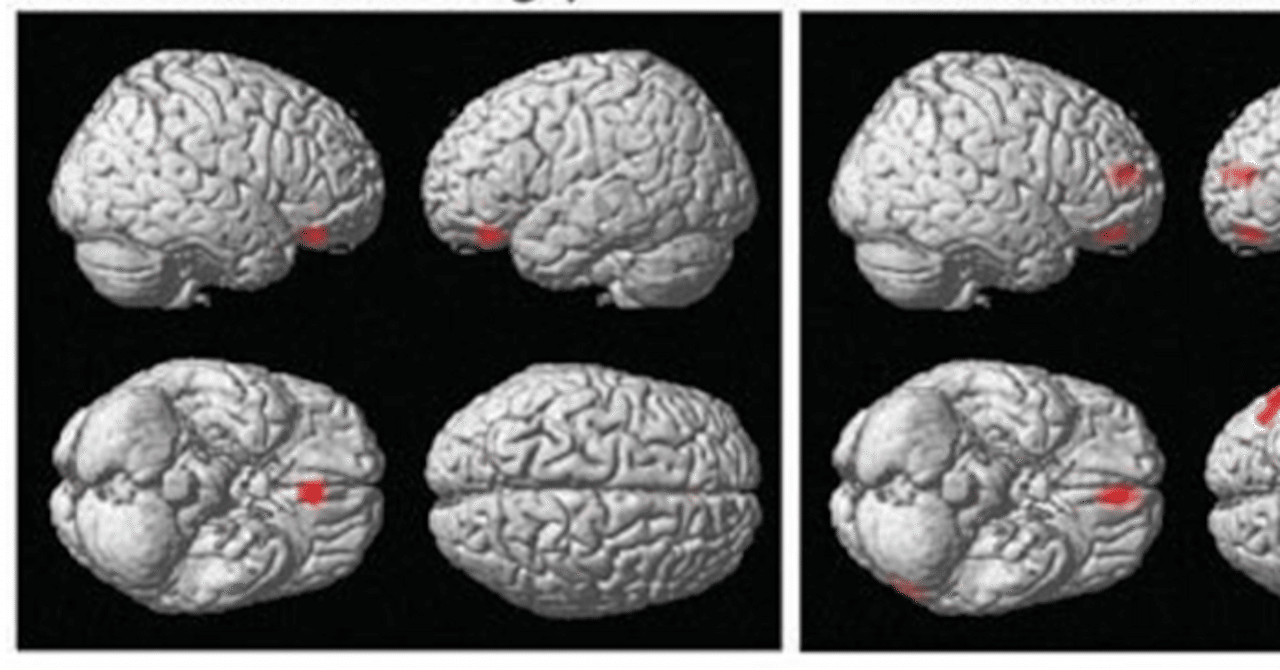
Beauty in the human face—features such as averageness, bilateral symmetry, and sexual dimorphism—is thought to have evolved as an indicator of an individual's health, resistance to parasites, developmental stability, and good genes, thereby increasing reproductive success (Rhodes, 2006).
Displaying aesthetic fitness to potential mates
One theory holds that our aesthetic appreciation of artistic skill and creativity functioned as a display of the artist's own intelligence, integrity, and other physical and mental qualities that make someone a desirable mate—what is called aesthetic fitness (Leder & Nadal, 2014). An individual who could craft symmetrical pottery or weapons, for example, was able to demonstrate their superior abilities to the opposite sex.
Predicting and controlling the environment
The reason we find beauty in the laws of physics or mathematical theorems is their concision: they explain a great many phenomena with very little information. Because order makes the environment easier to predict and control than disorder does, a preference for simplicity and order—that is, a tendency to perceive them as beautiful—is thought to have conferred a survival advantage (Mechner, 2018).
An offshoot of the alarm function
Emotional responses originally evolved as rapid reactions to emergencies—dodging an imminent threat or seizing a sudden opportunity. In the primitive environments our ancestors inhabited, even a minor discrepancy in the surroundings—a slight change in the landscape, the snap of a twig, an unfamiliar object—could serve as an alarm signaling a critical, life-or-death emergency.
Over the course of evolution, stimuli that once functioned as alarm signals gradually lost their urgency and their power to demand specific actions. As a result, the emotional component is said to have transformed into aesthetic feeling: less an alarm than one form of response to surprise and novel stimuli (Mechner, 2018).
The mechanisms behind perceiving beauty: neuroscience and cognitive science approaches
This section looks at what happens in the brain when we experience beauty, and at the process (cognitive model) behind it.
Responses in the brain
Several techniques for quantitatively visualizing brain activity already existed, such as PET (positron emission tomography) and EEG (electroencephalography). But with the arrival in 1992 of fMRI (functional magnetic resonance imaging), which visualizes the brain in cross-sectional slices, it became possible to see brain activity while a person is feeling happy, doing arithmetic, telling a lie, and so on.
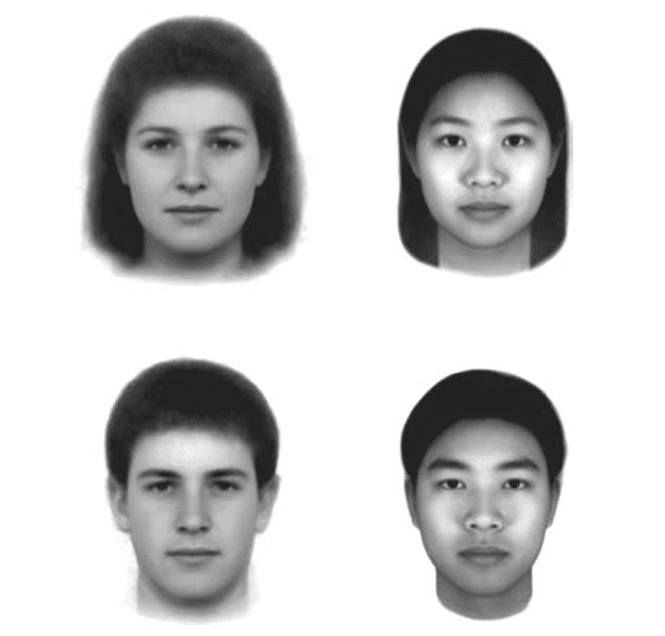
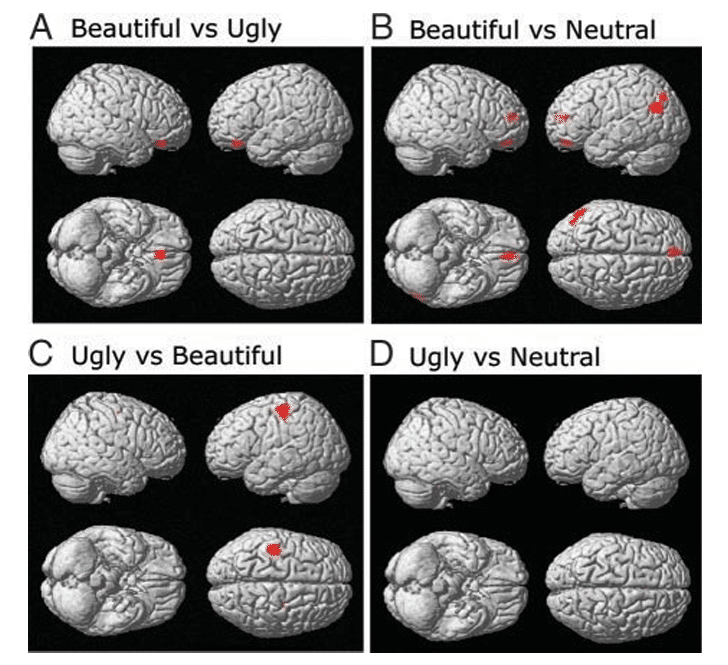
When a person looks at a painting or listens to music and finds it beautiful, the region that activates most consistently and strongly is the medial orbito-frontal cortex (mOFC), located in the brain's frontal lobe. This is also the region that processes rewards, such as those we get from money or delicious food. Crucially, this same region activates whether the beauty is visual or auditory. Moreover, the strength of its activity increases linearly in proportion to the subjective intensity of beauty reported by experimental participants (Ishizu & Zeki, 2011; Kawabata & Zeki, 2004).
Before beauty is evaluated, specialized regions of the brain first work to correctly recognize the object. When we look at a beautiful face, for instance, the fusiform face area (FFA), which specializes in face processing, becomes active; when we view a beautiful landscape, the parahippocampal place area (PPA) does. The evaluation of beauty builds on the processing in these visually specialized regions, after which signals are sent on to the reward system (Kawabata & Zeki, 2004).
Cognitive models
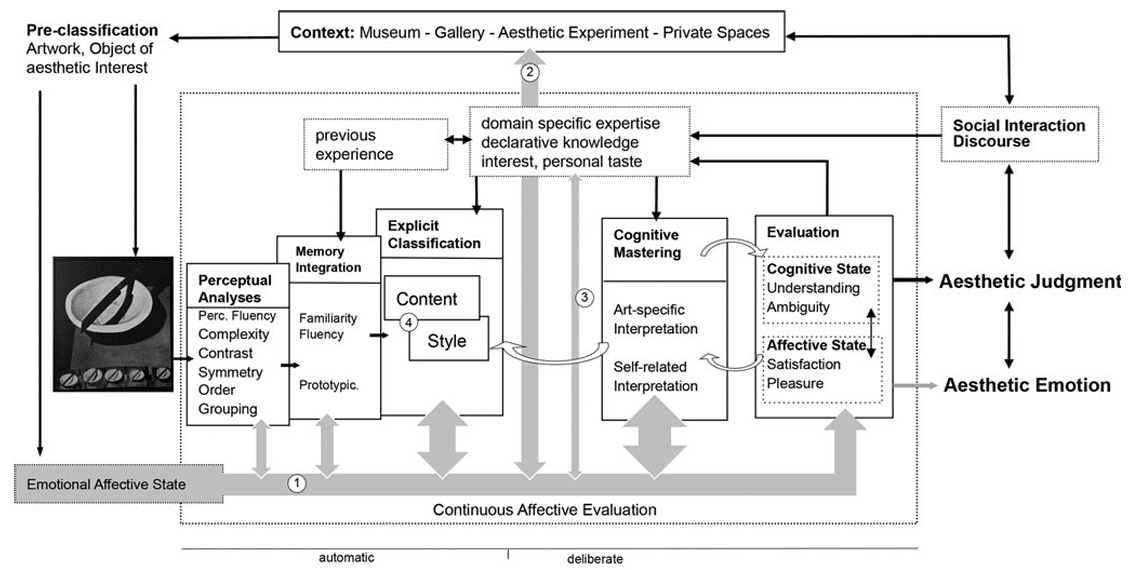
There are several cognitive models of beauty, including the Vienna Integrated Model of Art Perception (Pelowski et al., 2017) and Appraisal Theory (Palmer et al., 2013; Silvia, 2005). Here, we focus on Leder's information-processing model, the most influential cognitive model for explaining how people appreciate works of art, particularly contemporary art (Cebral-Loureda et al., 2023).
This model describes the aesthetic experience as a sequence of five information-processing stages (Leder & Nadal, 2014).
Perception: Processing the physical features of the stimulus, such as complexity, symmetry, and contrast.
Integration with memory: Matching the stimulus against memory—for example, its familiarity or prototypicality based on past experience.
Explicit classification: Deliberately categorizing the object's content and the style in which it is rendered.
Cognition: Trying to understand the object's style and content by relating them to one's own knowledge and finding personal meaning in them.
Evaluation: Assessing how successful these processes have been—for instance, whether understanding was achieved or ambiguity was resolved.
What distinguishes this model is that it posits two independent final outputs: an aesthetic judgment grounded in cognition, and an aesthetic emotion arising from continuous affective evaluation.
What do humans find beautiful? Approaches from cognitive science, psychology, and sociology
Finally, let's look at the main elements that make humans perceive something as beautiful.
Elements related to color
Color preferences are strongly shaped by ecological survival value and by the social meanings attached to colors.
Universal tendencies in hue: Across many cultures, cool colors such as blue and cyan tend to be preferred, while dark yellows, olive, and browns tend to be disliked. The explanation is that blue is associated with ecologically beneficial things such as clear skies and clean water, whereas dark yellow is associated with harmful ones such as excrement and decay (Palmer et al., 2013).
Saturation and lightness: In general, people tend to prefer colors that are highly saturated (vivid) and high in lightness (bright) (Palmer et al., 2013).
Harmony and contrast in color combinations: When colors are combined, figure-ground pairings with similar hues (harmony of analogous colors) or with strong contrast in lightness are judged to be beautiful and pleasing (Palmer et al., 2013).
Elements of form and geometry
Our sense of beauty in shapes rests on how easily the brain can process them (perceptual fluency) and on signals of safety.
Symmetry: Shapes with vertical (left–right) symmetry carry less information and can be processed more efficiently by the brain, so they are judged as beautiful and pleasing (Reber et al., 2004).
Curved contours: Objects with curved outlines are preferred over those with sharp, angular ones. This is thought to be an adaptive response that steers us away from the physical threat posed by sharp objects (Palmer et al., 2013).
Moderate complexity: Rather than things that are overly simple, we prefer those with a moderate degree of variety and complexity, where richness of information and regularity coexist (Palmer et al., 2013; Reber et al., 2004).
Prototypicality: Forms that are close to the average or typical example of their category (animals, foods, buildings, and so on) are ones we encounter frequently. Because they place a low processing load on the brain and feel familiar, they strike us as beautiful (Martindale, 1984).
Parsimony: The economy and order found in the laws of physics or mathematical theorems—where a minimal set of elements explains a great many phenomena—makes the environment easier to predict and control, and so it is experienced as beautiful (Mechner, 2018).
Spatial Arrangement and Composition
How elements are arranged within the frame of an image or photograph also shapes our sense of its beauty.
Balance and center of gravity: Compositions are judged beautiful when they are balanced, with the physical weight and color of elements distributed evenly around the center (red, for instance, feels heavy, while blue and yellow feel light) (Palmer et al., 2013).
Center bias and inward bias: We prefer arrangements in which the subject sits at the center of the frame and in which its front faces toward the interior of the frame (Palmer et al., 2013).
Canonical viewpoint and size: We prefer angles we commonly see in everyday life (such as a view from diagonally above) and sizes within the frame that reflect real-world scale (a butterfly shown small, an elephant shown large) (Palmer et al., 2013).
The statistical structure of the natural world (horizontal and vertical lines, 1/f fluctuation): Images containing more horizontal and vertical lines than diagonal ones, and images whose spatial-frequency spectrum shows the same 1/f fluctuation found in natural scenes, are experienced as visually comfortable and beautiful (Palmer et al., 2013).
The Human Face and Body
Our standards of beauty for human appearance are rooted in biological signals of health, good genes, and reproductive success—that is, in sexual selection.
Averageness: A composite face averaged from many individual faces appears highly attractive, because it signals resilience to stress during development (developmental stability) and genetic diversity (Rhodes, 2006).
Symmetry: Symmetry of the face and body is likewise judged beautiful, serving as a "good genes" signal of resistance to parasites and disease (Rhodes, 2006).
Sexual dimorphism: Feminine features in a female face (a small jaw, full lips) and masculine features in a male face (a well-developed jaw and brow ridge) are considered attractive because they reflect the action of sex hormones and indicate strong immune function (Rhodes, 2006).
Skin color and evenness: An even facial skin tone, a healthy redness derived from blood flow (oxygenated blood), and a yellowish tint derived from carotenoids all signal cardiovascular health and a diet rich in fruits and vegetables, making a face look beautiful and healthy (Elliot & Maier, 2014).
Social Identity, Culture, and Context
Beauty is determined not only by physical attributes but also by an individual's knowledge, the groups they belong to, and the social context.
Social identity and group membership: Emotional investment in a particular object (a positive attachment) can shift our aesthetic preferences. People tend, for example, to come to prefer their own university's school colors as more beautiful than those of other universities (Palmer et al., 2013).
The "this is art" context: Even for the very same image or object, simply believing that it is a genuine work of art on display in a museum increases activity in the brain's reward system (such as the orbitofrontal cortex) and raises ratings of beauty and appeal (Leder & Nadal, 2014).
Titles and semantic fit: Aesthetic ratings rise when a work is given a metaphorical or elaborate title that supplies hidden meaning or context, rather than a merely descriptive one, or when its arrangement fits that meaning perfectly (Palmer et al., 2013).
Cultural memes: Artistic styles, music, ornamentation, and the like that are shared within a culture function as memes that strengthen group cohesion and define cultural identity, and so they evoke aesthetic responses specific to the members of that culture (Mechner, 2018).
Cognitive and Emotional Processes
The very process of information handling that takes place in the human brain gives rise to the feeling of beauty.
Perceptual and conceptual fluency: The mere-exposure effect (familiarity) and the smoothness of cognitive processing itself trigger a positive feeling of pleasure in the brain, which is then judged as "beautiful" (Reber et al., 2004).
Violated expectations, surprise, and novelty: In art and music, building up the viewer's or listener's "expectations" through repeated patterns and then deliberately violating them (prediction mismatch) creates surprise and an intellectual challenge; when we manage to resolve it (insight), a powerful aesthetic pleasure results (Mechner, 2018).
Emotional mirroring: Resonating and synchronizing with the emotions depicted in an artwork, a performer's expression, or the cheers of an audience (empathic engagement) evokes and amplifies the sense of beauty (Mechner, 2018).
Conclusion
We have surveyed the background, processes, and tendencies behind how humans perceive beauty and good design. The emotion of beauty is one of the functions of the human being as a biological organism. We hope this overview deepens our understanding of people and serves as a useful reference when thinking about design.
References
Ishizu, T., & Zeki, S. (2011). Toward a brain-based theory of beauty. PloS One, 6(7), e21852.
Pelowski, M., Markey, P. S., Forster, M., & Gerger, G. (2017). Move me, astonish me… delight my eyes and brain: The Vienna Integrated Model of top-down and bottom-up processes in Art Perception (VIMAP) and …. Physics of Life Reviews. https://www.sciencedirect.com/science/article/pii/S1571064517300325
The end
Read next ↓