
Articles
Why Games Are Addictive: Latest Research on Human Behavior Principles and Applications
Product
Career
Automatically translated from the Japanese original.
1. Introduction
Why can't we put a game down? Why do some people love studying while others hate it? What separates the things we can lose ourselves in from the things we can't? These questions about human motivation and behavior can be explained within the framework of motivation theory. In short, human behavior is driven by rewards that come from outside (extrinsic rewards, such as money and recognition) and rewards that arise from within the activity itself (intrinsic rewards, such as curiosity and connection with others). The medium that implements nearly every element of this reward design in its purest form is the video game, whether on a TV or a smartphone, and that is why people become so absorbed in them (and, in some cases, addicted). I myself was a huge fan of games like Dragon Quest and The Legend of Zelda.
Reward design is extremely important when building an organization or planning an event, and the same way of thinking can be applied there as well.
Measured against the existing literature, this article offers two novel contributions:
No cross-domain comparison exists: Academic research is siloed by domain, and popular books generally follow a "one domain per book" formula. Even though they all rest on the same body of theory, a side-by-side comparison of games, gambling, drugs, studying, sports, music and work from a single, consistent perspective is almost nowhere to be found, in either the academic or the popular literature.
The bright side and the dark side are treated separately: Books on engagement (Eyal, 2014) deal only with "how to create absorption," while books on addiction (Alter, 2017) deal only with "the dangers." Few works treat the two as opposite faces of the same mechanism within a single framework that also covers the conditions under which one tips into the other.
The article is structured as follows: an overview of motivation theory, a method for reward design as its practical application, and an examination of how these rewards are actually designed in cases such as games, gambling and work.
2. An Overview of Motivation Theories
The major theories of motivation can be broadly grouped into three lineages. In this chapter, we arrange the theories within each lineage chronologically, from the classics to the latest research, and organize every theory under a common set of headings: research background, methods, findings and implications, and concrete examples.
Lineage A: Reward and learning: How do rewards given from the outside (extrinsic rewards) change behavior?
Lineage B: Intrinsic motivation: Why do people act even when there is no reward?
Lineage C: How value and pleasure are perceived: The same reward can feel different
2.1 Lineage A: Reward and Learning — How Do External Rewards (Extrinsic Rewards) Change Behavior?
This lineage traces a progression in which the same phenomenon is brought into ever sharper focus: from the observation of behavior (1938), to the mechanism in the brain (1997), to the actual computation involved (2020 onward).
Operant conditioning (Skinner, 1938; Ferster & Skinner, 1957): When a reward (reinforcer) immediately follows a behavior, that behavior increases
Research background: The central research program of behaviorism, which sought to build a science on the observable "relationship between behavior and outcomes" rather than on speculation about the inner workings of the mind
Methods: Pigeons and rats were placed in an experimental apparatus fitted with a lever (the Skinner box), and the frequency of their behavior was recorded while the way food was dispensed (the schedule) was varied
Findings and implications: Behavior persists longer when rewards come "occasionally" rather than "every time." The most powerful arrangement is the "variable ratio" schedule, in which you never know which attempt will pay off; behavior becomes hard to stop even after the rewards cease. The explanation at the time was "because it only pays off occasionally, you can't help but keep going." Why it actually works would be elucidated by the two studies that follow
Concrete example: Gacha and lotteries. You can't predict which pull will win—and precisely because of that, you keep pulling
Reward prediction error (Schultz et al., 1997): Dopamine responds not to the reward itself but to the "gap between prediction and outcome"
Research background: Dopamine had been regarded as a "pleasure chemical." This study set out to test whether that was really true
Methods: The activity of dopamine neurons in monkeys was recorded one cell at a time while the timing of cues and rewards (juice) was manipulated
Findings and implications: Dopamine neurons fire when the outcome is better than predicted, show no response when it matches the prediction, and dip when it is worse than predicted. What determined the response was not the size of the reward but the "gap from prediction." This means that when the same reward arrives the same way every time, the brain eventually predicts it perfectly and the gap shrinks to zero; at that point, dopamine no longer responds even when the reward is delivered. In other words, "a fully predictable reward ceases to be a reward for the brain." Moreover, this computational form—"learn in proportion to the gap"—turned out to be almost identical to the equation used in an algorithm for training AI through trial and error (TD learning: Temporal Difference Learning, one of the representative methods of reinforcement learning). The brain and AI, it turns out, were learning from rewards using the same computation
Concrete example: A salary that arrives in the same amount on the same day every month stirs no emotion. The "hit" at a restaurant you're trying for the first time delights you, yet the same lunch every week leaves you feeling nothing
Distributional reinforcement learning (Dabney et al., 2020): The brain learns not just the average reward but its "spread (probability distribution)"
Research background: In AI research, algorithms that "learn the distribution rather than the mean" had been delivering better performance. This prompted the reverse hypothesis: perhaps the brain performs the same computation
Methods: The firing patterns predicted by that algorithm were compared against recordings from dopamine neurons in mice
Findings and implications: Optimistic cells and pessimistic cells were found to operate in parallel, together representing the full picture (distribution) of possible outcomes. In 2025 it was further shown that the brain holds a map that also encodes "when" the reward will arrive (Sousa et al., 2025). This updated the explanation behind the 1938 finding that "occasional wins are powerful": because the brain processes variability itself as information, a fluctuating reward keeps sending signals to the learning system. Notably, a mechanism first invented for AI was later discovered in the brain—AI research and brain research have begun to share the same equations (a point we return to in the conclusion)
Concrete example: You can keep fishing all day precisely because you don't know when a fish will bite or how big it will be. The brain is learning that very "not knowing"
2.2 Lineage B: Intrinsic Motivation — Why Do People Act Even Without Rewards?
This lineage follows a path along which our understanding of intrinsic motivation deepens from psychological observation to brain mechanisms: discovery of the phenomenon (1975), theorization (1985 onward), discovery of a backfire effect (1999), and elucidation of the neural basis (2009 onward).
Flow (Csikszentmihalyi, 1975): When the difficulty of a challenge matches one's skill, people become so absorbed that they lose track of time
Research background: It began with a question about why artists and mountaineers immerse themselves in an activity for hours on end with no reward in sight
Methods: In addition to interviews, the experience sampling method—prompting participants at random several times a day to record what they were doing and how they felt—was used to identify the conditions under which absorption occurs
Findings and implications: Absorption occurs only within a narrow band where challenge and skill are in balance. Too hard produces anxiety; too easy produces boredom. In other words, whether we can become absorbed is determined not by the activity alone but by how it balances against our own skill
Concrete example: Cooking, knitting or preparing a presentation and suddenly realizing that two hours have gone by. This happens only when the difficulty is just right
Self-determination theory (SDT) (Deci & Ryan, 1985; Ryan & Deci, 2000): Motivation that wells up from within (intrinsic motivation) increases when three needs are met: competence, autonomy and relatedness
Research background: A challenge to the behaviorist view that "the more rewards, the better." People keep playing and exploring even when no reward is on offer
Methods: Experiments observing how behavior during free time changes depending on whether a reward is present, together with an accumulated body of questionnaire studies. In recent years the theory has been tested through large-scale meta-analyses
Findings and implications: Intrinsic motivation rests on (1) competence (a felt sense of getting better), (2) autonomy (a sense of choosing for oneself), and (3) relatedness (a sense of connection with others). Extrinsic rewards (money, evaluation) get behavior "started," while intrinsic motivation keeps it "going." The theory has been consistently supported by large-scale meta-analyses (Ryan et al., 2023) and is one of the most robust survivors among the classic theories
Concrete example: Jogging taken up on a doctor's orders doesn't last, whereas tennis—with friends to play with and a tangible sense of improvement—does
The undermining effect (Deci, Koestner & Ryan, 1999): Attaching a reward to an activity people were doing for fun actually lowers their intrinsic motivation
Research background: A paradoxical phenomenon uncovered in early SDT research: adding a reward can backfire
Methods: In a puzzle-solving experiment, participants were split into rewarded and unrewarded groups, and researchers observed whether they voluntarily kept working on the puzzles during free time after the experiment ended. Results from 128 experiments of the same design were combined in a meta-analysis
Findings and implications: Once the rewards stopped, the rewarded group no longer continued of their own accord. The effect is more likely when the reward is perceived as "control" and less likely when it is perceived as "recognition of improvement." Introducing a reward has also been shown to reduce the brain activity associated with voluntary motivation (Murayama et al., 2010)
Concrete example: Drawing you used to do for the love of it stops being fun the moment it becomes commissioned work
The neuroscience of curiosity (Bromberg-Martin & Hikosaka, 2009; Monosov, 2024): Acquiring information is itself processed as a reward
Research background: Psychology already had a theory that "a gap in knowledge (an information gap) gives rise to curiosity" (Loewenstein, 1994). But what this actually corresponded to in the brain remained unknown (for a review bridging psychology and neuroscience, see Kidd & Hayden, 2015)
Methods: Monkeys were given a choice between options that "yield the same amount of reward but differ only in whether the outcome can be learned in advance," and the activity of their dopamine neurons was recorded
Findings and implications: The monkeys consistently chose the option that let them "find out in advance," and dopamine neurons encoded that preference. In humans, memory retention has been shown to improve when curiosity is high (Gruber et al., 2014). The loop of "knowing feels good → we learn → the next question arises" is one of the few mechanisms that sustains behavior without any reward, and it is a pillar of the "healthy absorption" discussed later
Concrete example: Staying up far too late because you have to know what happens next, moving on to the next video or the next chapter
2.3 Lineage C: How Value and Pleasure Are Perceived — The Same Reward Can Feel Different, in Predictable Ways
This lineage traces how the laws governing the gap between a reward's "objective size" and "how it feels" were identified one by one: the discovery of biases in judgment (1979), the separation of "wanting" from "liking" (2016), and the elucidation of satiation (1999–2018).
Loss aversion (Kahneman & Tversky, 1979): The pain of losing something feels greater than the pleasure of gaining the same amount.
Research background: The work began as a challenge to the prevailing economic assumption of the time—that people choose rationally, in line with expected value.
Method: Large numbers of participants were presented with choices between "lotteries" involving potential gains or losses, and the systematic biases in their choices were analyzed.
Findings and implications: Human judgment responds to gains and losses relative to a reference point, and losses hurt more than equivalent gains feel good (prospect theory). "Not wanting to lose what you've built up" can be a stronger driver than adding a new reward.
Examples: Heading out for a walk at night because your step-tracking app's streak is about to break. Rushing to make a purchase after a notification warns that your points are about to expire.
Wanting vs. liking (Berridge & Robinson, 2016): "Wanting" something and "liking" it are handled by separate circuits in the brain.
Research background: How do we explain the contradiction that people with addictions describe—"It isn't fun anymore, but I can't stop"?
Method: Researchers manipulated specific regions of rats' brains to raise or lower dopamine levels, then separately measured "wanting" behaviors (pursuit) and hedonic facial reactions (the expressions that signal something tastes good).
Findings and implications: "Wanting" is driven mainly by the dopamine system and "liking" mainly by the opioid system—two distinct processes. They normally move together but can become decoupled, and a state in which wanting persists while liking has disappeared is the core of addiction.
Example: Opening email or chat notifications brings little real enjoyment, yet you can't help opening them.
Habituation (hedonic adaptation and boredom) (Frederick & Loewenstein, 1999; Westgate & Wilson, 2018): When the same reward or the same object keeps recurring, the pleasure fades.
Research background: Sparked by observations such as the way big lottery winners' happiness drifts back to its previous baseline over time.
Method: Longitudinal surveys tracking happiness before and after major life changes, and experimental investigations into the conditions under which boredom arises.
Findings and implications: Repetition raises our baseline for pleasure until the same reward produces no feeling at all (hedonic adaptation). Another cause of boredom is that once we have fully learned an object's patterns, it stops yielding new information (Koster, 2013). A leading recent theory treats boredom as a functional signal: "There is nothing left to learn here—redirect your attention" (Westgate & Wilson, 2018). Boredom isn't a malfunction; it's a notification that learning is complete.
Examples: Even a song you loved stops moving you if you listen to it every day. The thrill of a pay raise wears off within a few months.
3. Applying Motivation Theory: Reward Design
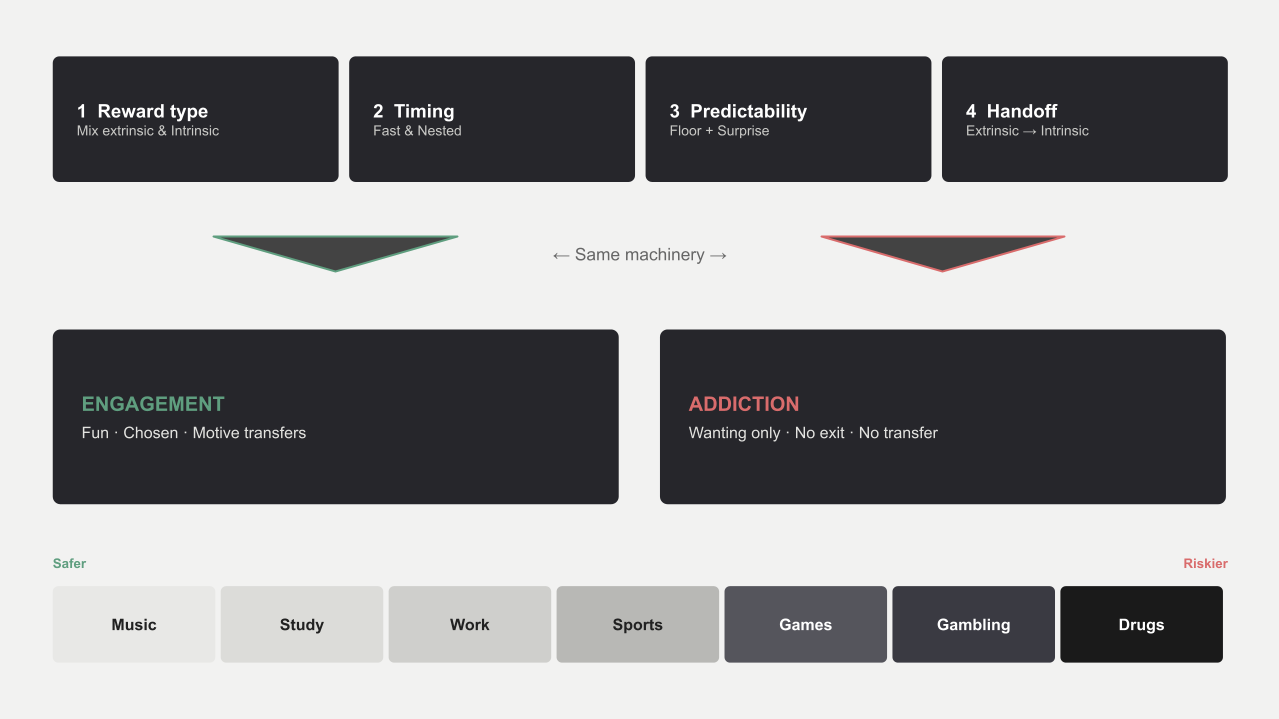
This chapter translates the theories of Chapter 2 into a form that can be used in actual design. Whether a person keeps up an activity ultimately comes down to how that activity handles rewards. This article breaks that down into four questions, which will serve as a common yardstick for everything that follows: the design principles in this chapter, the analysis of the engagement–addiction divide in Chapter 4, and the case studies in Chapter 5.
① Type of reward: Not just money or goods—praise, new opportunities, and expanded capabilities all register as rewards to the brain.
② Timing of reward: The faster the result follows the action, the more powerful the effect. It also matters that the next enjoyable thing is placed at every distance—something to look forward to today, this week, and this month.
③ Predictability of reward: If the reward is identical every time, the brain stops responding; if it is left entirely to chance, it breeds anxiety and distrust. Behavior is best encouraged when "a foundation you can count on" is topped with "the occasional pleasant surprise."
④ Does the reward shift from extrinsic to intrinsic?: This is a question of the source of motivation (extrinsic vs. intrinsic). We look at whether a behavior that started for an external reward is eventually taken over by the person's own internal motivation (intrinsic reward)—"because it's fun" or "because I want to get better." If that handoff doesn't happen, the only option is to keep piling on more external rewards.
In the case studies of Chapter 5, we add a fifth item to these four: ⑤ Addiction risk. Drawing on the answers to the four questions, this closing item judges whether the activity tends to tip toward engagement or toward addiction using the three conditions from Section 1.3 (enjoyment, alternatives to switch to, and freedom to quit), and reviews the current state of its safeguards and regulation.
Each of the sections below is organized under the same headings: underlying theory, principle, examples, and caveats.
3.1 ① Type of Reward
Underlying theory: Competence, relatedness, and curiosity from Lineage B; loss aversion from Lineage C. Each type of reward works for a different theoretical reason.
Principles
Extrinsic rewards: Rewards given from outside (extrinsic rewards) can be sorted into four types (Hallford & Hallford, 2001). The standard approach is to mix all four; leaning too heavily on any one of them doesn't last.
Recognition: rewards that confer no material benefit but signal acknowledgment (awards, titles, praise). They satisfy the need for competence directly, and they work despite costing almost nothing.
Retention: rewards that hurt to lose (status, perks, an accumulated track record). These work through loss aversion.
Opportunity: rewards that open new doors (a new project, an invitation to a new arena). These work through curiosity.
Capability: rewards that expand what you can do (skills, authority, tools). These are the substance of competence and the most powerful of the four.
Intrinsic rewards: Rewards that arise from within the activity itself (intrinsic rewards) can likewise be sorted into four types based on the theories in Chapter 2. These cannot be handed out directly; all you can design are the conditions under which they emerge.
Competence: the felt sense of improving, of being able to do something you couldn't before.
Curiosity: the pleasure of finding out what you wanted to know, of gaining new information.
Relatedness: the sense of being connected to others and of being useful to someone.
Sensory pleasure: stimuli that feel good in themselves, such as sounds or tactile feedback (liking).
Example: A promotion is gratifying not only because of the title (recognition) but because it expands what you can do (capability). A title-only promotion feels hollow precisely because there is no substance of capability behind it.
Design pointers: Overusing a single type doesn't work. Overusing recognition in particular dilutes its very value. Chapter 5 uses these eight types—four extrinsic and four intrinsic—to compare the cases.
3.2 ② Timing of Reward
Underlying theory: Reward prediction error from Lineage A. Because prediction error occurs immediately after an action, on-the-spot feedback is what sends signals to the brain most frequently.
Principle: Nest rewards across multiple time scales so that, at whichever scale you look, "something is coming soon." The bottom layer—immediate feedback—matters most; if it is weak, none of the higher layers work well.
Examples: In a fitness app: each logged workout (on the spot) → today's goal (daily) → streak (weekly) → monthly record (monthly). At work: day-to-day recognition → weekly progress → quarterly evaluation.
Design pointer: People drop off wherever a layer is missing. A workplace with nothing but annual reviews has lost the entire daily-to-weekly layer.
3.3 ③ Predictability of Reward
Underlying theory: Variable-ratio schedules (the most durable of all) and distributional learning (the brain processes variance itself as information) from Lineage A; habituation from Lineage C (once a reward is fully predictable, it stops working).
Principle: A perfectly predictable reward doesn't work. But making everything uncertain breeds distrust and a sense of unfairness. The standard approach is a two-layer structure.
Baseline: rewards you can count on. These secure trust and a sense of security.
Spikes: unpredictable good things that happen from time to time. These keep the learning system running.
Examples: The ideal is a foundation of fixed pay (certain) with unexpected good news and small surprises (variable) layered on top. Checking email or social media dozens of times a day is also driven by this variable-reward structure—"you never know when good news might arrive."
Design pointer: Never shake the foundation itself. Making pay variable destroys the sense of fairness at a cost that outweighs any motivational gain.
3.4 ④ Does the Reward Shift from Extrinsic to Intrinsic?
Underlying theory: From Lineage B, SDT (what sustains behavior is intrinsic motivation), the undermining effect (imposing extrinsic motivators on intrinsic motivation destroys it), and curiosity (one of the few loops that runs without any external reward); from Lineage C, habituation (relying on extrinsic rewards alone leads to reward inflation).
Principle: Get people started with extrinsic rewards, cultivate competence, curiosity, and relatedness while they keep going, and then hand the leading role to intrinsic motivation. This sequence cannot be reversed.
Example: With exercise, start by building the habit through app logging and rewards; once the felt benefit of better health (intrinsic motivation) begins to emerge, let that take the lead.
Design pointers: Layering rewards onto an activity people already enjoy sets up the conditions for the undermining effect (an activity that used to be fun stops being fun, and people quit). And a system that never generates intrinsic rewards has no choice but to keep piling on extrinsic ones.
4. Addiction vs. Engagement: What Decides Which Way It Tips
Chapter 3 laid out principles for "designing things people keep doing." But the same principles can produce either healthy engagement or addiction. This chapter sorts out which factors push toward one or the other.
4.1 Engagement and Addiction as Distinct States
The ingredients are shared: variable rewards, loss aversion, wanting (Chapter 2). Seen from outside, the behavior looks the same too—long stretches of absorption and high retention rates. That is why engagement metrics cannot tell them apart.
Addiction is not an extension of engagement: Empirically, when "high engagement" and "pathological use" (addiction) are measured separately, they correlate but load onto distinct factors (Charlton & Danforth, 2007). Addiction is not engagement taken further (a more intense version); it is a different state that shares some components.
The two states:
Engagement: "I'm doing this because it's fun, by my own choice, and I keep at it." Wanting and liking move together.
Addiction: "It isn't fun, I'm not choosing it, and it keeps going anyway." Only wanting remains; liking is gone.
4.2 What Promotes Engagement, and What Promotes Addiction
The promoting factors can be contrasted along the four questions from Chapter 3.
① Type of reward
Promotes engagement: a wide variety of types, especially a rich supply of the four intrinsic ones (competence, curiosity, relatedness, sensory pleasure).
Promotes addiction: a single type, concentrated on extrinsic rewards (such as money) or direct pleasure.
② Timing of reward
Promotes engagement: immediate feedback plus a nested structure spanning days to years.
Promotes addiction: immediacy alone, with no nesting (nothing but "the next one").
③ Predictability of reward
Promotes engagement: moderate variability layered on a dependable foundation.
Promotes addiction: variability alone with no foundation, plus amplifiers such as near misses and the illusion of control.
④ Does the reward shift from extrinsic to intrinsic?
Fosters engagement: there is somewhere to transfer to (skill, knowledge, companions)
Fosters dependence: there is nowhere to transfer to; only controlling extrinsic rewards keep coming
Beyond the design-side factors, there are also factors on the side of the individual and their situation. Under the very same design, heavy stress or isolation can turn an activity from "a means of obtaining pleasure" into "a means of escaping discomfort," tipping it toward dependence. Addiction research formalizes this as a transition from the stage of seeking reward (impulsivity) to the stage of eliminating distress (compulsivity) (Koob & Volkow, 2016).
4.3 Signs that engagement is turning into dependence
Engagement does not become dependence by deepening. No matter how deeply absorbed you are, as long as enjoyment and the freedom to choose remain, it is still engagement. The danger lies not in depth but in the conditions that supported the engagement falling away. When the behavior stays the same but the reasons for continuing are swapped out one by one, engagement turns into dependence.
There are three signs. Sign 1 alone falls within ordinary "boredom" that happens to everyone; when sign 2 is added, that is a yellow light; and when all three are present, you are in the territory of dependence.
1. Erosion of enjoyment: "I do it because it's fun" gives way to "I do it because I feel unsettled if I don't"
What is happening: With repetition, "liking" fades (hedonic adaptation) while only "wanting" remains. The purpose of the behavior shifts from obtaining pleasure to eliminating discomfort such as restlessness or guilt. Addiction research treats this switch from "pursuit of pleasure" to "relief of discomfort" as the gateway to dependence (Koob & Volkow, 2016)
Example: You are already bored the moment you launch the app, yet the day does not feel finished until you have cleared your daily routine
How to tell: Recall whether a sense of satisfaction lingers right after you finish. If all you feel is "got it done" rather than "that was fun," the erosion has begun
2. Fixation of motivation: The only reason left to continue is "I don't want to lose it"
What is happening: Motivation that should be shifting toward skill, curiosity, and companions (intrinsic drivers) becomes fixed on loss aversion alone, such as maintaining a streak or recouping losses. You keep going not to move forward, but to avoid slipping backward
Example: You log in not because you want to play but because you don't want to break your streak. You keep betting solely to win back what you lost
How to tell: Ask yourself, "If I quit right now and lost nothing, would I still want to continue?" If the answer is no, your motivation is running on loss aversion alone
3. Encroachment on daily life: The freedom to stop is genuinely lost
What is happening: The behavior continues even at the expense of other areas such as sleep, work, and relationships, and you can no longer keep to the limits you set for yourself. At this point it is no longer a matter of willpower. The criteria the WHO and DSM-5 use to diagnose addiction (impaired control, distorted life priorities, and continuation despite negative consequences) point precisely to this stage
Example: You know you have an early start tomorrow, yet "just one more" won't stop. You set limits on time or money, and you exceed them every time
How to tell: Set your own cap on frequency, time, or spending and see whether you can stick to it for a week. If you can't, control has already begun to slip away
These three signs serve as the criteria for judging "addictive potential" in each case in Chapter 5.
5. Case studies
From here, we turn to case studies, applying the perspectives developed so far to each example.
5.1 Why do games hook us?
Key point: An "everything included" design—eight types of reward, complete nesting, and two-layer variability—that also provides a destination for the shift to intrinsic motivation. This is exactly why, depending on design, games can swing toward either engagement or dependence
Reward design
① Types of reward
Extrinsic
Recognition: titles, achievements, clear celebrations
Maintenance: recovery items and streaks
Opportunity: unlocking new areas
Ability: new weapons and skills
Intrinsic
Competence: a tangible sense of improvement
Curiosity: what happens next, exploring uncharted areas
Relatedness: co-op play and guild mates
Sensory pleasure: the responsiveness of controls, game feel (Swink, 2008)
② Timing of reward
Immediate: the feel of a hit, sound effects, experience points
Daily: daily bonuses and daily missions
Weekly: weekly missions and events
Monthly: seasons and ranking resets
Yearly: major updates and anniversary events
③ Predictability of reward
Baseline (fixed): experience points that reliably accumulate as you play, login rewards, pity systems (guaranteeing the highest rarity after a set number of pulls)
Spikes (variable): gacha hits, rare drops
④ Does the reward shift from extrinsic to intrinsic?
Yes: Daily rewards build the habit, and in the meantime players are guided toward the enjoyment of improving, exploring, and playing with others. The practitioner's insight that "the real source of fun in games is learning" (Koster, 2013) pinpoints curiosity as the destination of that shift
Addictive potential
Level of addictive potential
Medium to high: An ambivalent domain that can swing toward either engagement or dependence depending on design; retention rates and playtime alone cannot distinguish the two
Countermeasures against dependence
Regulation is taking shape—Belgium's finding of a gambling-law violation (2018; Xiao, 2023) and the WHO's inclusion of "gaming disorder" (2019, ICD-11)—but judicial rulings are split, as when a fine in the Netherlands was overturned in court in 2022 (Drummond & Sauer, 2018; Zagal et al., 2013)
Cycles that intensify engagement and dependence
Engagement cycle: take on a challenge → get tangible feedback (prediction error) → improve a little (competence) → harder challenges and new areas unlock (opportunity, curiosity) → take on further challenges. The better you get, the more interesting the next challenge becomes: a self-sustaining flow loop
Dependence cycle: clear dailies and streaks → the accumulation grows → you don't want to lose it (loss aversion) → you log in out of obligation → even after the enjoyment wears away, you keep going to protect what you've built up. In gacha, a further layer overlaps: "miss → feel that the next one will hit (variable ratio) → want to recoup what you've spent"
5.2 Why can't people stop gambling?
Key point: The structure offers only money as reward, no nesting, and pure variability with no baseline, so there is no intrinsic destination to transfer to. The structure itself leans toward dependence
Reward design
① Types of reward
Extrinsic
Recognition: −
Maintenance: winnings, money
Opportunity: −
Ability: −
Intrinsic
Competence: −
Curiosity: −
Relatedness: −
Sensory pleasure: the thrill of the wager, the rush of a near miss (driven by wanting)
② Timing of reward
Immediate: the outcome of a spin or race comes back on the spot
Daily: −
Weekly: −
Monthly: −
Yearly: −
③ Predictability of reward
Baseline (fixed): −
Spikes (variable): winnings only. The variable ratio appears here in its purest form, amplified by the near-miss effect (a losing outcome that "almost hit" triggers a brain response close to that of a win) (Clark et al., 2009)
④ Does the reward shift from extrinsic to intrinsic?
No: However long you continue, improving never changes your odds, and there is structurally no destination to transfer to. Motivation concentrates entirely on wanting while liking wastes away (tolerance sets in so that the same win no longer excites, and there is structurally no improvement or discovery to replenish the enjoyment)
Addictive potential
Level of addictive potential
High: The structure itself leans toward dependence; in 2013, DSM-5 placed gambling disorder in the same category as substance addiction (American Psychiatric Association, 2013)
Countermeasures against dependence
Deposit limits and self-exclusion programs are the main tools, but because the core structure—the variable ratio—remains intact, their effectiveness continues to be judged as limited
Cycles that intensify engagement and dependence
Engagement cycle: − (rarely forms. With no improvement and no exploration, there is nothing to renew the enjoyment once the initial excitement fades)
Dependence cycle: place a bet → occasionally win, or feel "so close" on a near miss → the "next time for sure" feeling intensifies (variable ratio + near-miss effect) → losses pile up → stakes rise to win it back (loss aversion + tolerance) → lose even more. People don't stop even when they win, because a win has become "recovery" rather than "joy"
5.3 Why do drugs create dependence?
Key point: The very question of reward design disappears; a chemical substance acts directly on the brain. There is no destination to transfer to, and the room for the path to fork is structurally minimal
Reward design
① Types of reward
Extrinsic
Recognition: −
Maintenance: −
Opportunity: −
Ability: −
Intrinsic
Competence: −
Curiosity: −
Relatedness: −
Sensory pleasure: pharmacological pleasure (though it diminishes with tolerance)
② Timing of reward
Immediate: on intake, dopamine is released faster, more reliably, and in greater quantity than for any natural reward
Daily to yearly: −
③ Predictability of reward
Baseline (fixed): −
Spikes (variable): − (variability itself becomes unnecessary. Because drugs act directly on neurons, they keep arriving in the brain as a "reward that always exceeds prediction," so the value assigned to the behavior keeps rising regardless of the quality of the experience)
④ Does the reward shift from extrinsic to intrinsic?
No: There is no destination to hand off to; tolerance builds against "liking" while "wanting" alone grows (Berridge & Robinson, 2016). As it progresses, the functioning of the prefrontal cortex—the brain's brake—is itself impaired (Koob & Volkow, 2016)
Addictive potential
Level of addictive potential
Extremely high: All three conditions swing to their most extreme, leaving structurally almost no room for the path to fork—a "direct occupation of the circuitry"
Countermeasures against dependence
Treatment and public health are the primary approaches; modern medicine treats addiction not as weakness of will but as a disease of the brain (Koob & Volkow, 2016)
Cycles that intensify engagement and dependence
Engagement cycle: −
Dependence cycle: take the drug → intense pleasure → tolerance builds and the same dose stops working → dose and frequency increase → wanting becomes sensitized, and withdrawal brings discomfort → take the drug to eliminate the discomfort (from pursuit of pleasure to relief of discomfort) → receptors decline in response to excess dopamine, and the prefrontal brake that depends on that input itself weakens → escaping the loop becomes harder
5.4 What separates people who love studying from those who hate it?
Key point: The design has slow feedback and leans heavily on extrinsic rewards, yet it has the finest intrinsic reward of all—curiosity—built in. Whether the self-sustaining loop of "learn → enjoy → next question" gets started is what separates love from hate
Reward design
① Types of reward
Extrinsic
Recognition: grades, rankings, praise
Maintenance: −
Opportunity: wider options through further education and qualifications
Ability: acquiring academic ability and skills
Intrinsic
Competence: the feeling of "now I can do this"
Curiosity: the pleasure of "I get it!" and the next question (Bromberg-Martin & Hikosaka, 2009; Monosov, 2024)
Relatedness: − (weak in whole-class instruction)
Sensory pleasure: −
② Timing of reward
Immediate: − (almost no on-the-spot feedback)
Daily: little more than getting homework marked
Weekly: quizzes
Monthly: term exams and grades
Yearly: entrance exams and moving up a grade
③ Predictability of reward
Baseline (fixed): − (no guarantee that effort will reliably pay off)
Spikes (variable): − (there is no designed variability, only the kind of fluctuation that breeds helplessness: "grades that won't go up no matter how hard I try")
④ Does the reward shift from extrinsic to intrinsic?
It can shift — and this is exactly where those who love studying part ways with those who hate it. Once the self-propelling loop of "learn → enjoy → next question" (Murayama, 2022) kicks in, memories consolidate more easily (Gruber et al., 2014) and grades become a by-product. If it never starts and only controlling extrinsic pressures (grades, scolding, comparison) keep coming, all the conditions for undermining are in place (Deci, Koestner & Ryan, 1999)
Addictiveness
Level of addictiveness
Low: the problem here is not addiction but that a failed handoff gets locked in as "I hate this"
Countermeasures against addiction
— (What is needed is support in getting the loop started. Autonomy-supportive interventions improve both motivation and grades. Wang et al., 2024)
The cycles that deepen absorption or addiction
Absorption cycle: a question arises → you look into it and "get it!" (the pleasure of information) → you can do more than before (competence) → the outline of what you don't yet know comes into view → the next question surfaces. A self-propelling loop in which the more you know, the more interesting it gets (Murayama, 2022)
Addiction cycle: — (Addiction is unlikely here. Instead there is a vicious circle that locks in dislike: moving on without understanding → falling behind and seeing grades drop → controlling extrinsic pressures such as scolding and comparison intensifying → the link between studying and discomfort growing stronger → finding it ever harder to get started)
5.5 Why do people get so passionate about sports?
Key point: Unscripted variability and the intrinsic rewards of belonging and vicarious reward take center stage. A rare, safe form of passion that lasts a lifetime even though you yourself never get any better (though it changes abruptly the moment gambling is bolted on)
Reward design
① Types of reward
Extrinsic
Recognition: —
Maintenance: —
Opportunity: —
Capability: —
Intrinsic
Competence: — (because you yourself don't improve)
Curiosity: the fun of reading tactics and how the game unfolds
Relatedness: watching with friends, a sense of belonging to the team. People treat the groups they belong to as part of themselves (Tajfel & Turner, 1979), saying "we won" the day after a victory and "they lost" after a defeat (BIRGing; Cialdini et al., 1976)
Sensory pleasure: the excitement of the match, the high of victory. Vicarious reward, in which your own reward system responds to your team's success or a rival's failure (Cikara et al., 2011)
② Timing of rewards
Immediate: cheers and excitement with every single play
Daily: the match
Weekly: each round of league play
Monthly: the battle for position in the season standings
Yearly: the title race, the long-awaited championship (sometimes measured in decades)
③ Predictability of rewards
Baseline (fixed): — (no victory is ever guaranteed)
Spikes (variable): unscripted variability. Outcomes are inherently uncertain, and classic matches come along "only once in a while" — a genuine variable-ratio schedule
④ Do rewards shift from extrinsic to intrinsic?
Largely intrinsic from the outset: it broadens from the pleasure of winning and losing to the enjoyment of knowledge and companionship. This broadening is why it lasts a lifetime even though you yourself don't improve by a single millimeter
Addictiveness
Level of addictiveness
Low: but once sports betting is bolted on, the structure of gambling (5.2) gets connected and it swings sharply toward addiction
Countermeasures against addiction
The global expansion of betting is dissolving the boundary between spectating and gambling, and regulatory debates are under way in many countries
The cycles that deepen absorption or addiction
Absorption cycle: watch a match → witness dramatic moments (unscripted variability) → attachment to the team and tactical knowledge deepen → the more context you know, the more interesting the next match becomes → keep following the season's story. The deeper the knowledge and the sense of belonging, the more reward you can draw from the very same match
Addiction cycle: — (Hard to form from spectating alone. But the moment betting is attached, the gambling cycle connects wholesale)
5.6 Why do people keep listening to the same music?
Key point: Zero extrinsic reward, liking-driven — the safest domain of all. The structure in which "anticipatory pleasure runs even when you already know what's coming" is why we can keep listening without tiring of it
Reward design
① Types of reward
Extrinsic
Recognition: —
Maintenance: —
Opportunity: —
Capability: —
Intrinsic
Competence: —
Curiosity: anticipation of what comes next (Huron, 2006)
Relatedness: —
Sensory pleasure: the pleasure of the sound itself, the chills (Salimpoor et al., 2011)
② Timing of rewards
Immediate: tension and resolution every few seconds (the densest of all our cases)
Daily: —
Weekly: —
Monthly: new single and album releases
Yearly: concerts and festivals
③ Predictability of rewards
Baseline (fixed): the way a familiar song unfolds. Repeated exposure in itself increases liking (the mere-exposure effect; Zajonc, 1968)
Spikes (variable): pleasure peaks with the right combination of moderate uncertainty and surprise (Cheung et al., 2019). "Knowing" and "predicting" are two different things: dopamine is released in the brain regions responsible for anticipation several seconds before the peak of pleasure (Salimpoor et al., 2011) — which resolves what looks at first like a counterexample to the theory of boredom (2.3)
④ Do rewards shift from extrinsic to intrinsic?
No shift needed: intrinsic from the start, which is also why there is no reward inflation
Addictiveness
Level of addictiveness
Extremely low: liking leads and wanting is never inflamed — the safest of the seven cases, the polar opposite of drugs
Countermeasures against addiction
— (If anything, streaming autoplay bolts on the variable reward of "the next track," subtly changing the character of listening)
The cycles that deepen absorption or addiction
Absorption cycle: listen → the pleasure of anticipation and resolution runs → liking grows with every repetition (mere-exposure effect) → you want to listen again. In parallel, an exploration loop also turns: a song you love → curiosity about similar songs → new discoveries → an ever-expanding repertoire
Addiction cycle: —
5.7 What separates people who love their work from those who don't?
Key point: The types of reward are plentiful, but a fixed salary generates no prediction error, and the speed of feedback depends on the role. Whether you can hand off from pay to a felt sense of growth, autonomy and contribution is what separates the people who love their work from those who don't
Reward design
① Types of reward
Extrinsic
Recognition: appraisals, awards, thanks
Maintenance: salary and status
Opportunity: new projects, being singled out for advancement
Capability: expanding skills and authority
Intrinsic
Competence: the felt sense of being able to do more than before
Curiosity: new challenges and learning (depends on the role)
Relatedness: the satisfaction of being useful to customers and colleagues (the three needs of SDT apply here directly. Ryan & Deci, 2000)
Sensory pleasure: —
② Timing of rewards
Immediate: depends on the role (some jobs return results daily; others give a sense of payoff only on a yearly basis)
Daily: everyday recognition, small completions
Weekly: weekly progress
Monthly: monthly review of results
Yearly: appraisals, bonuses, promotions (in a workplace with nothing but an annual review, the daily-to-weekly layers are missing entirely)
③ Predictability of rewards
Baseline (fixed): a fixed salary. Being entirely predictable, it produces no prediction error, but as a foundation it is ideal
Spikes (variable): recognition, a sense of growth, unexpected good news. Whether these sit on top of the foundation is what makes the difference
④ Do rewards shift from extrinsic to intrinsic?
It can shift — and this is exactly where those who love their work part ways with those who don't: does it begin with pay and then get handed off to a felt sense of growth, autonomy and contribution? As a precondition, unless pay and job security (hygiene factors) are met, the rest of the conversation never even begins (Herzberg, 1959). In an environment with no autonomy and nothing but controlling management and appraisal, all the conditions for undermining are in place
Addictiveness
Level of addictiveness
Low: the main problem is not addiction but motivational depletion, and much of whether people like their jobs is a function of structure (speed of feedback, autonomy, felt growth, quality of relationships)
Countermeasures against addiction
— (The remedies focus on depletion. On the organization's side, see 3.5; on the individual's side there is job crafting, reshaping your own role to reclaim autonomy. Wrzesniewski & Dutton, 2001)
The cycles that deepen absorption or addiction
Absorption cycle: be entrusted with something → see it through (the satisfaction of completion) → felt growth and the trust of those around you increase (competence, relatedness) → greater autonomy and bigger projects follow (opportunity) → take on further challenges. A virtuous circle in which work becomes more interesting as trust and discretion grow
Addiction cycle: — (The typical vicious circle here is one of "depletion" rather than addiction: results aren't visible → you aren't recognized → motivation drops → results fall further. The remedy is to reverse this backward spin into the forward spin of the cycle above)
6. Closing thoughts
Laid out this way, it becomes clear why we get absorbed in the things we do, why we can become dependent on things we don't even enjoy yet struggle to quit, and what lies behind addiction as a social problem. To keep ourselves, our organizations and our society healthy and growing, we need to design rewards appropriately.
References
Alter, A. (2017). Irresistible: The Rise of Addictive Technology and the Business of Keeping Us Hooked. Penguin. Summary: A leading popular book on behavioral addiction to technology. It focuses on the dangers of addiction and does not take as its theme the conditions that separate healthy absorption from addiction.
American Psychiatric Association (2013). Diagnostic and Statistical Manual of Mental Disorders (5th ed.). Summary: The first edition to list gambling disorder in the same category as substance-related disorders. The official turning point at which addiction to a behavior came to be treated within the same framework as drug addiction.
Berridge, K. C., & Robinson, T. E. (2016). Liking, wanting, and the incentive-sensitization theory of addiction. American Psychologist, 71(8), 670–679. Summary: A review that lays out how "wanting" and "liking" are distinct neural processes and explains addiction as incentive sensitization, in which only wanting becomes heightened.
Bromberg-Martin, E. S., & Hikosaka, O. (2009). Midbrain dopamine neurons signal preference for advance information about upcoming rewards. Neuron, 63(1), 119–126. Summary: Showed that monkeys choose the option that lets them "learn the outcome in advance" even when the amount of reward is unchanged, and that dopamine neurons encode this preference — direct evidence that information itself is a reward.
Charlton, J. P., & Danforth, I. D. W. (2007). Distinguishing addiction and high engagement in the context of online game playing. Computers in Human Behavior, 23(3), 1531–1548. Summary: A study showing that when "high engagement" and "addiction" are measured separately among online game players, the two are correlated but load onto distinct factors. The empirical basis for the claim that absorption and addiction are not merely points along a single axis.
Cheung, V. K. M., Harrison, P. M. C., Meyer, L., Pearce, M. T., Haynes, J.-D., & Koelsch, S. (2019). Uncertainty and surprise jointly predict musical pleasure and amygdala, hippocampus, and auditory cortex activity. Current Biology, 29(23), 4084–4092. Summary: A statistical analysis of chord progressions in pop music showing that musical pleasure peaks when there is a combination of moderate uncertainty and surprise. Empirical evidence that the pleasure of music can be explained by the science of prediction.
Cialdini, R. B., Borden, R. J., Thorne, A., Walker, M. R., Freeman, S., & Sloan, L. R. (1976). Basking in Reflected Glory: Three (Football) Field Studies. Journal of Personality and Social Psychology, 34(3), 366–375. Summary: A classic study showing that more students wore team-logo apparel the day after their team won, and that they shifted their language between "we won" and "they lost." The original source on BIRGing—the phenomenon of absorbing a group's glory as one's own reward.
Cikara, M., Botvinick, M. M., & Fiske, S. T. (2011). Us Versus Them: Social Identity Shapes Neural Responses to Intergroup Competition and Harm. Psychological Science, 22(3), 306–313. Summary: An fMRI study showing that in devoted fans, the reward system (ventral striatum) responds not only to their own team's success but also to a rival's failure. Evidence that the vicarious experience of spectating is processed as a reward.
Clark, L., Lawrence, A. J., Astley-Jones, F., & Gray, N. (2009). Gambling near-misses enhance motivation to gamble and recruit win-related brain circuitry. Neuron, 61(3), 481–490. Summary: An fMRI study showing that near-misses—"almost winning"—trigger reward-system responses resembling those of an actual win and increase the urge to keep playing, even though they are objectively losses.
Csikszentmihalyi, M. (1975). Beyond Boredom and Anxiety. Jossey-Bass. Summary: The original work that first introduced the concept of "flow," the state of absorption that arises when challenge and skill are balanced. The theoretical backbone of game difficulty design.
Dabney, W., Kurth-Nelson, Z., Uchida, N., Starkweather, C. K., Hassabis, D., Munos, R., & Botvinick, M. (2020). A distributional code for value in dopamine-based reinforcement learning. Nature, 577, 671–675. Summary: A collaboration between DeepMind and neuroscientists. It showed that populations of dopamine neurons encode, in parallel, the full probability distribution of reward rather than just its expected value—discovering that distributional reinforcement learning, an idea born in AI, is implemented in the brain.
Deci, E. L., & Ryan, R. M. (1985). Intrinsic Motivation and Self-Determination in Human Behavior. Plenum. Summary: The foundational text of Self-Determination Theory (SDT). It systematized the relationship between intrinsic and extrinsic motivation.
Deci, E. L., Koestner, R., & Ryan, R. M. (1999). A meta-analytic review of experiments examining the effects of extrinsic rewards on intrinsic motivation. Psychological Bulletin, 125(6), 627–668. Summary: A meta-analysis of the undermining effect, in which extrinsic rewards reduce intrinsic motivation. It identified the key condition: the effect is strongest when rewards are perceived as controlling.
Deterding, S., Dixon, D., Khaled, R., & Nacke, L. (2011). From game design elements to gamefulness: defining "gamification". Proceedings of MindTrek. Summary: The paper that established the standard definition of gamification as "the use of game design elements in non-game contexts."
Drummond, A., & Sauer, J. D. (2018). Video game loot boxes are psychologically akin to gambling. Nature Human Behaviour, 2, 530–532. Summary: An analysis of loot boxes in major titles against the psychological definition of gambling, showing that most share the same structure as gambling.
Eyal, N. (2014). Hooked: How to Build Habit-Forming Products. Portfolio. Summary: The standard reference on how products create habits, organized around a four-stage model: trigger → action → variable reward → investment. A representative synthesis within the single domain of product design, based on knowledge that predates distributional reinforcement learning.
Ferster, C. B., & Skinner, B. F. (1957). Schedules of Reinforcement. Appleton-Century-Crofts. Summary: The original work that comprehensively demonstrated the effects of reinforcement schedules (fixed vs. variable × ratio vs. interval). It showed how strongly variable-ratio schedules resist extinction.
Frederick, S., & Loewenstein, G. (1999). Hedonic Adaptation. In D. Kahneman, E. Diener, & N. Schwarz (Eds.), Well-Being: The Foundations of Hedonic Psychology. Russell Sage Foundation. Summary: The definitive treatment of "hedonic adaptation," in which responses to pleasure and displeasure fade as repetition and the passage of time reset our baseline. The psychological basis for why we grow bored of the same reward.
Gruber, M. J., Gelman, B. D., & Ranganath, C. (2014). States of curiosity modulate hippocampus-dependent learning via the dopaminergic circuit. Neuron, 84(2), 486–496. Summary: An experimental study showing that in a heightened state of curiosity, coupling between the dopamine system and the hippocampus strengthens—and that memory is enhanced even for incidental information presented at that moment.
Hallford, N., & Hallford, J. (2001). Swords & Circuitry: A Designer's Guide to Computer Role-Playing Games. Prima Tech. Summary: A practitioner's handbook that classified in-game rewards into four types: Glory, Sustenance, Access, and Facility. Still widely referenced as a vocabulary for reward design.
Hamari, J., Koivisto, J., & Sarsa, H. (2014). Does Gamification Work? A Literature Review of Empirical Studies on Gamification. Proceedings of HICSS. Summary: A landmark systematic review of empirical gamification research, concluding that its effects are context-dependent and heavily influenced by novelty effects.
Herzberg, F. (1959). The Motivation to Work. Wiley. Summary: A classic that divided the determinants of job satisfaction into hygiene factors (which prevent dissatisfaction) and motivators (which generate satisfaction). It shows that motivational design cannot work while hygiene factors remain unmet.
Huron, D. (2006). Sweet Anticipation: Music and the Psychology of Expectation. MIT Press. Summary: A theoretical work that systematized musical pleasure as the psychology of expectation—its violation and its fulfillment. It explains why phrase-by-phrase predictive responses fire every time, even for a piece you already know.
Kahneman, D., & Tversky, A. (1979). Prospect Theory: An Analysis of Decision under Risk. Econometrica, 47(2), 263–291. Summary: The original paper on prospect theory, describing decision-making under uncertainty with reference dependence and loss aversion as its pillars. The starting point of behavioral economics.
Kidd, C., & Hayden, B. Y. (2015). The psychology and neuroscience of curiosity. Neuron, 88(3), 449–460. Summary: A review of curiosity research from both psychological and neuroscientific perspectives, offering an integrated framework that treats information-seeking within the reward system.
Koob, G. F., & Volkow, N. D. (2016). Neurobiology of addiction: a neurocircuitry analysis. The Lancet Psychiatry, 3(8), 760–773. Summary: The standard review of the neurobiology of addiction, framing it as a three-stage cycle—the pleasure of intake → the discomfort of withdrawal → craving—each accompanied by corresponding changes in neural circuitry.
Koster, R. (2013). A Theory of Fun for Game Design (2nd ed.). O'Reilly. Summary: A theoretical work by a practitioner arguing that the true nature of fun in games is learning. It explains the pleasure of games as the pleasure of mastering patterns, resonating with curiosity research.
Langer, E. J. (1975). The Illusion of Control. Journal of Personality and Social Psychology, 32(2), 311–328. Summary: The classic study showing that meaningless forms of involvement, such as picking one's own lottery ticket, create the illusion of having control over the outcome. The original source on the psychological amplifiers behind gambling.
Loewenstein, G. (1994). The Psychology of Curiosity: A Review and Reinterpretation. Psychological Bulletin, 116(1), 75–98. Summary: A review that formalized curiosity as a response to a gap in knowledge—an "information gap." It became the conceptual foundation for the neuroscientific research on curiosity that followed.
McGonigal, J. (2011). Reality Is Broken: Why Games Make Us Better and How They Can Change the World. Penguin. Summary: A bestseller on the value of the voluntary challenges that games provide. It popularized the view of games as an observation instrument for human motivation.
Monosov, I. E. (2024). Curiosity: primate neural circuits for novelty and information seeking. Nature Reviews Neuroscience, 25, 195–208. Summary: A recent review mapping the neural circuits for novelty seeking and information seeking in primates. It shows that the circuitry underlying curiosity partly overlaps with the reward system while having a structure of its own.
Murayama, K. (2022). A reward-learning framework of knowledge acquisition: An integrated account of curiosity, interest, and intrinsic–extrinsic rewards. Psychological Review, 129(1), 175–198. Summary: A theoretical paper that models curiosity and interest in an integrated way, as a learning loop in which acquiring knowledge is itself the reward. A theoretical account of how "loving to learn" becomes self-sustaining.
Murayama, K., Matsumoto, M., Izuma, K., & Matsumoto, K. (2010). Neural basis of the undermining effect of monetary reward on intrinsic motivation. PNAS, 107(49), 20911–20916. Summary: The first study to visualize the neural basis of the undermining effect, showing that introducing monetary rewards reduces activity in the striatum and prefrontal cortex associated with intrinsic motivation.
Newzoo (2025). Global Games Market Report 2025. Summary: The standard market research report on the global games market. It estimates the 2025 player population at roughly 3.58 billion (61.5% of the world's population) and the market size at $188.8 billion.
Pink, D. H. (2009). Drive: The Surprising Truth About What Motivates Us. Riverhead. Summary: A practitioner-oriented book that builds on SDT to present autonomy, mastery, and purpose as the three pillars of motivational design in organizations.
Ryan, R. M., & Deci, E. L. (2000). Self-Determination Theory and the Facilitation of Intrinsic Motivation, Social Development, and Well-Being. American Psychologist, 55(1), 68–78. Summary: The most widely cited overview of SDT, organized around the three basic psychological needs of competence, autonomy, and relatedness.
Ryan, R. M., Duineveld, J. J., Di Domenico, S. I., et al. (2023). We know this much is (meta-analytically) true: A meta-review of meta-analyses on self-determination theory. Psychological Bulletin, 149(11-12). Summary: A meta-review pooling the meta-analyses on SDT. It confirms the robustness of the theory's core hypothesis: that satisfying basic psychological needs predicts both motivation and well-being.
Salimpoor, V. N., Benovoy, M., Larcher, K., Dagher, A., & Zatorre, R. J. (2011). Anatomically distinct dopamine release during anticipation and experience of peak emotion to music. Nature Neuroscience, 14(2), 257–262. Summary: A study showing that dopamine is released during "chills" experienced while listening to music, and that different brain regions are active at the moment of peak pleasure and during the anticipation a few seconds beforehand. The neural basis for why the "pleasure of anticipation" fires even for songs we already know.
Schell, J. (2019). The Art of Game Design: A Book of Lenses (3rd ed.). CRC Press. Summary: The leading textbook that systematizes game design through more than 100 "lenses." It covers the connection between motivation theory and game design practice in depth.
Schultz, W., Dayan, P., & Montague, P. R. (1997). A Neural Substrate of Prediction and Reward. Science, 275(5306), 1593–1599. Summary: A landmark paper showing that dopamine neurons encode not reward itself but the gap between prediction and outcome (reward prediction error), and establishing its mathematical correspondence with TD learning in AI.
Skinner, B. F. (1938). The Behavior of Organisms. Appleton-Century. Summary: The original work that laid the theoretical foundations of operant conditioning. It systematized the process by which the frequency of a behavior changes according to its consequences (reinforcement).
Sousa, M., Bujalski, P., Cruz, B. F., et al. & Paton, J. J. (2025). A multidimensional distributional map of future reward in dopamine neurons. Nature, 642. Summary: A recent study showing that dopamine neurons maintain a multidimensional probability-distribution map of reward, covering both its magnitude and its timing—extending the picture of distributional reinforcement learning along the time axis.
Swink, S. (2008). Game Feel: A Game Designer's Guide to Virtual Sensation. CRC Press. Summary: A practitioner's book that systematizes the tactile "feel" created by immediate feedback to player input. It deals with the smallest units of reward, on timescales of less than a second.
Tajfel, H., & Turner, J. C. (1979). An Integrative Theory of Intergroup Conflict. In W. G. Austin & S. Worchel (Eds.), The Social Psychology of Intergroup Relations. Brooks/Cole. Summary: The original source of social identity theory, which holds that people treat the groups they belong to as part of the self, giving rise to in-group favoritism. The theoretical basis for the sense of "we" among sports fans.
Wang, Y., Wang, H., et al. (2024). A systematic review and meta-analysis of self-determination-theory-based interventions in the education context. (Version published on the official SDT website) Summary: A meta-analysis of SDT-based interventions in educational settings. It shows that autonomy-supportive interventions improve both motivation to learn and academic outcomes.
Westgate, E. C., & Wilson, T. D. (2018). Boring thoughts and bored minds: The MAC model of boredom and cognitive engagement. Psychological Review, 125(5), 689–713. Summary: A theory that formalizes boredom as a functional signal indicating a mismatch in attention (poor fit of difficulty) or a lack of meaning. It offers a modern perspective on boredom as a signal for reallocating cognitive resources.
World Health Organization (2019). Gaming disorder. In International Classification of Diseases, 11th Revision (ICD-11). Summary: The classification that added gaming disorder to the disease catalog, with impaired control, gaming taking precedence over other priorities, and continuation despite negative consequences as its defining criteria. The official reference point in debates about games and addiction.
Wrzesniewski, A., & Dutton, J. E. (2001). Crafting a Job: Revisioning Employees as Active Crafters of Their Work. Academy of Management Review, 26(2), 179–201. Summary: The paper that conceptualized "job crafting"—employees reshaping the boundaries, relationships, and meaning of their own work. It showed a path for restoring autonomy within assigned work.
Xiao, L. Y. (2023). Breaking Ban: Belgium's Ineffective Gambling Law Regulation of Video Game Loot Boxes. Collabra: Psychology, 9(1). Summary: A study providing empirical evidence that Belgium's ban on loot boxes has not, in practice, been adequately enforced, raising questions about the real-world effectiveness of regulation.
Zagal, J. P., Björk, S., & Lewis, C. (2013). Dark Patterns in the Design of Games. Proceedings of FDG. Summary: The paper that categorized design working against players' interests as "dark patterns in games." The starting point for the debate on design ethics.
Zajonc, R. B. (1968). Attitudinal Effects of Mere Exposure. Journal of Personality and Social Psychology, 9(2, Pt.2), 1–27. Summary: The original paper on the "mere exposure effect," the finding that repeated contact with something is enough to make us like it more. It is the classic foundation for the phenomenon of growing fonder of a piece of music the more often we hear it.
The end
Read next ↓