
Articles
What startups are global leading VCs investing in? Seed-stage companies from the past year
Product
Career
Automatically translated from the Japanese original.
In 2025, AI advanced and spread rapidly around the world, even as geopolitical fragmentation and prolonged wars continued in many regions. Against this backdrop, we set out to map which new industries are emerging. Our analysis covers nine leading global VCs and 120 startups. We hope it serves as a useful reference for anyone weighing new business ventures or startup investments.
The Investment Environment
First, let's review the 2025 investment environment, since it shapes the context in which VCs decide to back startups.
Economy
Cash returns (DPI) now matter most for VCs: After global inflation took hold in 2022, the Federal Reserve responded with aggressive rate hikes to bring it under control. Since then, institutional investors (LPs) have been pressing VCs hard for actual cash returns (DPI = distributions divided by paid-in capital) rather than portfolio valuations or unrealized gains. In practice, this means VCs now invest only in startups that can reliably turn a profit or be sold at a high price.
A polarized exit market (IPOs and M&A): IPOs are increasingly reserved for a small elite of exceptional startups, while acquisitions by Big Tech are picking up again.
Politics
Deregulation and an M&A revival: Under the new US administration, antitrust enforcement has shifted toward a more permissive stance. This has made it easier for large corporations to acquire startups, widening the exit options available to VCs.
National security and the rise of defense tech: Driven by the wars in Ukraine and the Middle East and by US–China rivalry, the US Department of Defense and Silicon Valley are closer than they have ever been. Massive government funding is now flowing into startups working on autonomous drones, cybersecurity, and space.
Technology
Generative AI is giving way to agentic AI: The technology is evolving from AI that merely produces text (LLMs) to AI agents that autonomously carry out tasks to completion. Vertical AI agents specialized for particular industries—legal, construction, healthcare, and so on—are a particularly strong trend.
The convergence of robotics and AI: As AI matures, the "bodies" (robots) that house it are evolving faster too. R&D is advancing on general-purpose humanoid robots and on fully automating factories and construction sites.
Society
A shift toward building products with a few brilliant people plus AI: With AI agents now handling most coding, design, and marketing work, products that once required teams of dozens can be built by a handful of exceptional people working alongside AI. As a result, startups are being judged more on their "AI adoption plan" than on their "hiring plan."
Aging populations and falling birth rates worldwide: Declining birth rates and aging societies are becoming visible not only in developed countries but in emerging markets as well. This is raising demand for blue-collar automation to fill labor shortages, and for health tech that can rein in soaring medical and long-term care costs.
Data Collection Method

To identify the startups backed by leading global VCs, we collected data as follows.
VCs Covered
We selected the following globally renowned VCs (not limited to firms that specialize in seed investing).
Sequoia Capital: The most famous VC in Silicon Valley, an early backer of the defining companies of each era, including Apple, Google, and NVIDIA.
Y Combinator: The world's premier seed-stage accelerator, which has produced companies such as Airbnb and Stripe and is the gateway that founders around the world aspire to pass through.
Andreessen Horowitz (a16z): An innovative VC that coined "software is eating the world" and leads in AI and Web3 through its powerful voice and extensive founder support. Investments include Facebook and Airbnb.
Benchmark: With a small, elite team of partners, it has generated extraordinary returns from early-stage investments in companies like Uber and Snap.
Kleiner Perkins: A VC that helped build the early internet through investments in Amazon and Google, and has shaped the history of Silicon Valley.
Founders Fund: Co-founded by Peter Thiel, this VC favors hard-to-achieve deep tech such as space and defense. Investments include SpaceX and Stripe.
Index Ventures: European in origin but firmly in Silicon Valley's top tier, with particular strength in helping companies scale across the US and Europe. Investments include Figma and Discord.
Accel: Famous for the enormous returns from its early investment in Facebook, and a consistently strong global investor in SaaS and consumer tech.
New Enterprise Associates (NEA): One of the largest VCs in the world by assets under management, covering every stage from technology to biotech and healthcare. Investments include Salesforce and Tableau.
Startups Covered
We selected the startups for analysis using the following procedure.
Used Crunchbase to research each VC's portfolio companies
Limited the investment window to January 1 through December 31, 2025
Restricted the investment stage to Seed only (an initial product nearing completion, with paying customers already on board)
For VCs with too many seed investments, took the 20 most recent deals counting back from December 31
This yielded a total of 120 startups (the full list appears at the end of this article)
Analysis Method
New services and new value are created when a specific stage (a step in the value chain, such as manufacturing, sales, or service) within a domain of human wants and needs (an industry, such as healthcare, education, or real estate) is made more efficient through a new approach (a technology such as AI or IoT).
Accordingly, we categorize each startup along the following dimensions.
Which industry does it serve?
Which part of the value chain does it make more efficient?
What technology or approach does it use?
Results
This section summarizes our findings.
Which industry does it serve?
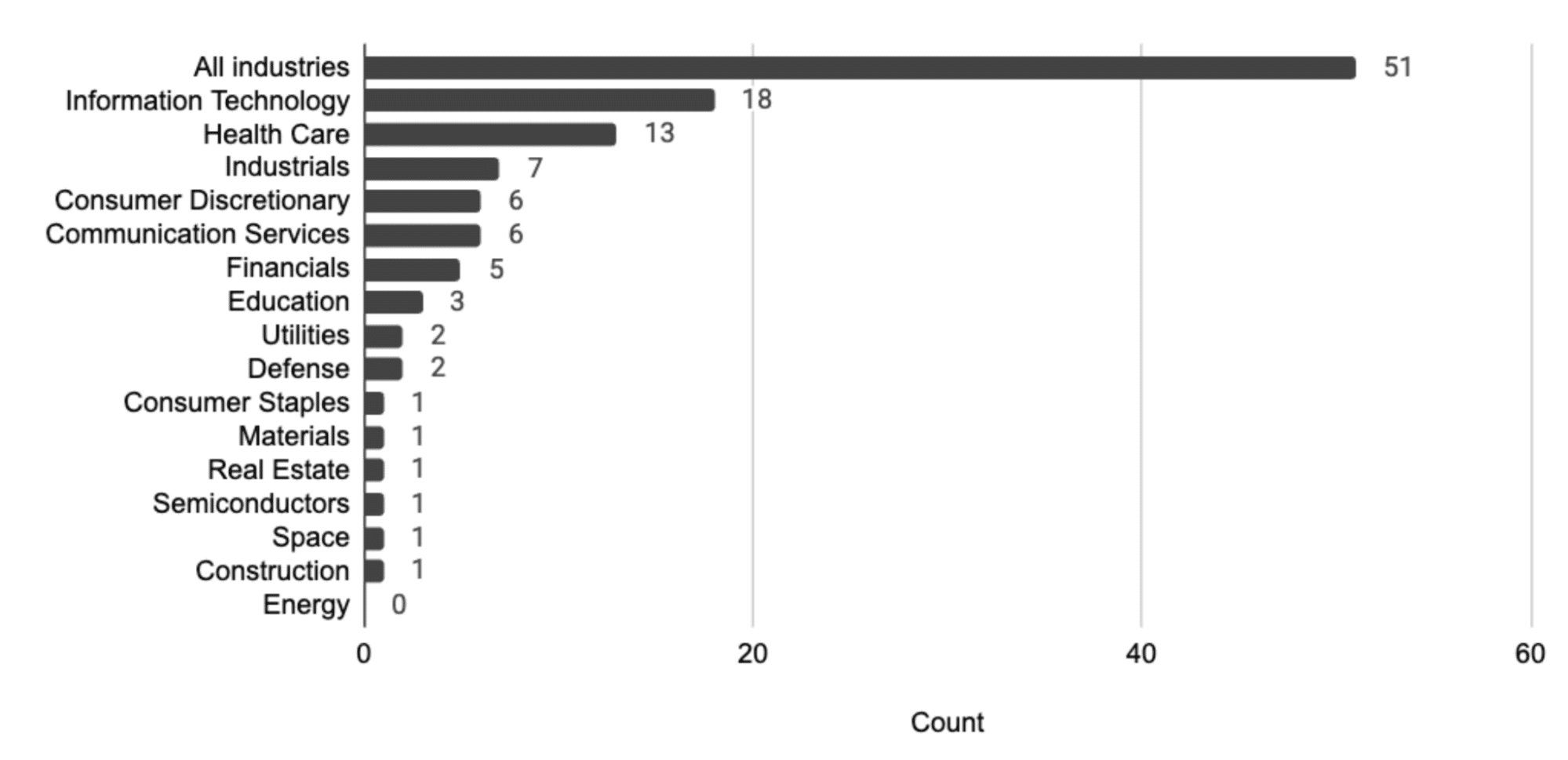
Here we look at which industries each startup delivers value to.
The results are as follows.
Startups targeting all industries were the largest group, at 51 companies—confirming that leading VCs fundamentally back startups going after large markets.
Lemonslice provides translation and localization services that help companies adapt their content to multiple languages and markets.
Mirelo AI offers an AI-powered tool that generates custom sound effects and music tailored to video content, via upload or API integration.
A sizable group of 25 companies works on the foundational materials and technologies underpinning software and hardware, in categories such as Information Technology, Communication Services, and Semiconductors. They supply the base technology for AI-powered applications, which are expected to grow explosively in the years ahead.
Thinking Machines Lab focuses on building multimodal systems that adapt to diverse forms of human expertise, aiming to make AI systems more understandable, more customizable, and more general-purpose.
Unconventional AI is building a new foundation for running AI models by integrating the principles of biological neural systems into silicon-based circuits and the accompanying software interfaces, with an emphasis on energy consumption and computational efficiency.
Eighteen companies target large markets such as Health Care and Financials, showing that many startups are pursuing value creation by applying new technologies to legacy industries.
Generation Lab aims to improve people's health by developing the first test that assesses the progression of a person's biological age and their disease risk, based on clinically applicable biological evidence.
PortfolioPilot delivers fintech solutions to millions of people through its API and customized insights, with more than $30 billion in assets on its platform.
Several startups contribute to national security in areas such as Defense and Space, which we take as a sign of rising demand for defense capabilities.
Amca acquires, develops, and scales critical products in the aerospace and defense sector. It focuses on rapidly prototyping and delivering new products so it can supply what the industry needs next and respond quickly to customer requirements.
* Industry categories are based primarily on the sector classification used in the US stock market, supplemented with the additional categories listed below.
All industries
All Industries: Services that are not limited to any particular field and target every industry.
Information Technology
Information Technology: Services for industries that provide digital technology in general, including software, hardware, and IT services.
Health Care
Health Care: Services for industries that support people's health, such as drug discovery, medical device manufacturing, and the provision of medical and long-term care.
Financials
Financials: Services for industries that handle the flow of money, asset management, and risk management, such as banking, securities, and insurance.
Consumer Discretionary
Consumer Discretionary: Services for industries that offer discretionary, preference-driven goods and services sensitive to economic cycles, such as automobiles, apparel, and entertainment.
Communication Services
Communication Services: Services for industries that deliver information and content, including telecom networks, social media, media, and entertainment.
Industrials
Industrials: Services for industries that provide the equipment and services supporting other companies' operations and manufacturing, such as construction machinery, aerospace, and logistics.
Consumer Staples
Consumer Staples: Services for industries that supply goods essential to daily life regardless of economic conditions, such as food, beverages, and household products.
Energy
Energy: Services for industries that develop and supply the power sources that drive society and industry, such as oil, natural gas, and renewable energy.
Utilities
Utilities: Services for industries that reliably supply the infrastructure underpinning daily life, such as electricity, gas, and water.
Materials
Materials: Services for industries that manufacture the basic raw materials behind all industrial products, such as chemicals, steel, and paper.
Real Estate
Real Estate: Services for industries involved in developing, leasing, and managing housing and office buildings, as well as real estate investment trusts (REITs).
Defense
Defense: Services for industries that develop and manufacture the weapons, military vehicles, and defense and cyber systems essential to national security.
Semiconductors
Semiconductors: Services for industries that design and manufacture the chips that serve as the brains of all electronic devices and AI, forming the bedrock of today's digital society.
Education
Education: Services for industries that support learning and skills development, including schools, online learning (EdTech), and corporate training.
Space
Space: Services for the cutting-edge industries that make use of outer space, such as rocket launches and satellite-based data communications and observation.
Construction
Construction: Services for industries that design and build housing, commercial facilities, and infrastructure such as roads and bridges—the industries that physically shape our cities.
Which part of the value chain does it make more efficient?
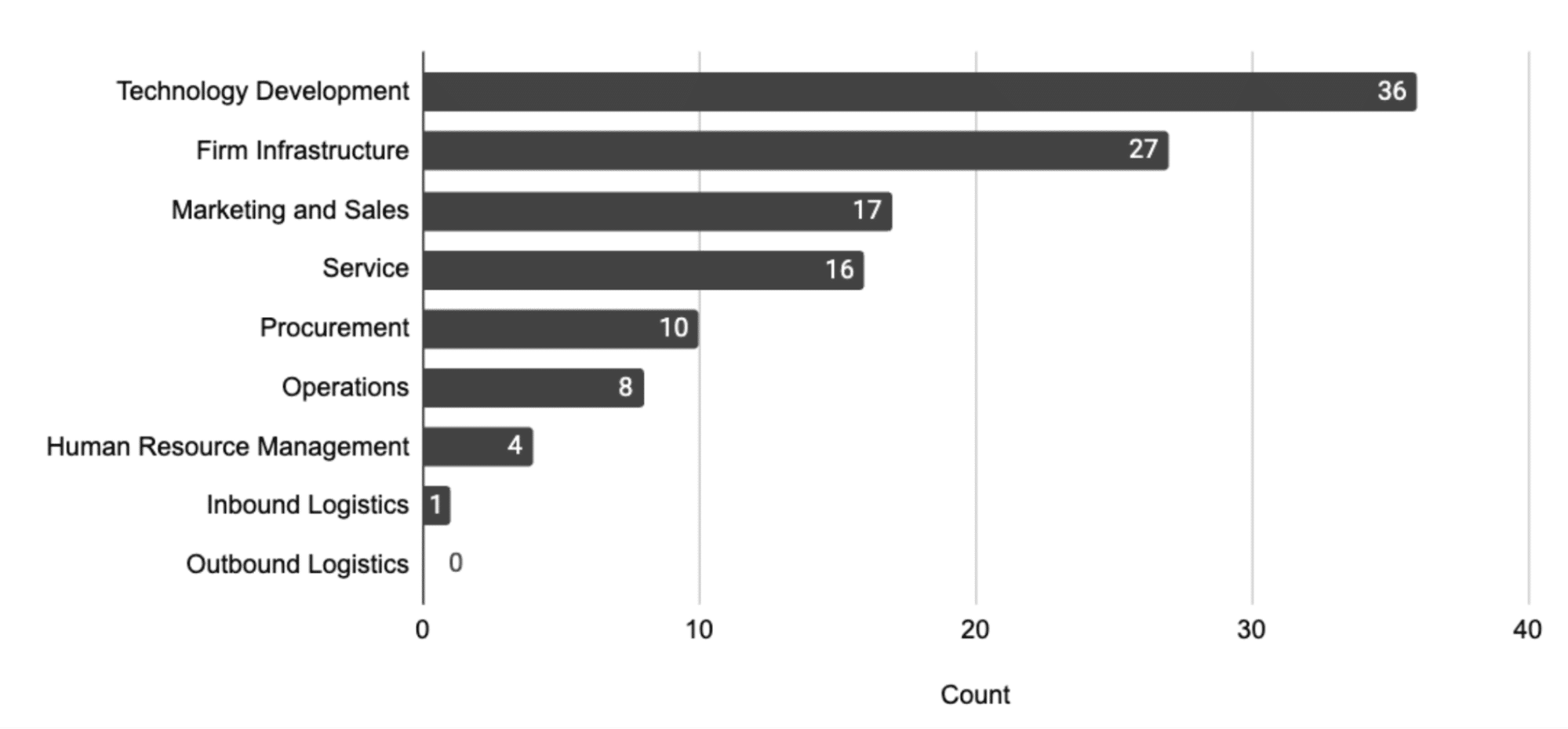
Here we address the question of which stages of the value chain each startup makes more efficient.
For value-chain categories, we draw on the framework Michael Porter proposed in Competitive Advantage (1985), dividing corporate activities into "primary activities" and "support activities" and identifying the stage at which each startup creates added value.
Primary Activities
Inbound Logistics
Inbound logistics: receiving raw materials and parts, warehousing, inventory management, and internal distribution.
Operations
Operations: the processes that convert raw materials into finished products (manufacturing, assembly, packaging, maintenance, and so on).
Outbound Logistics
Outbound logistics: everything from storing finished products in warehouses through delivering them to customers (order processing, arranging shipments, and so on).
Marketing and Sales
Marketing and sales: activities aimed at getting customers to buy the product (advertising, promotions, pricing, channel selection, sales work, and so on).
Service
Service: activities that maintain and enhance the product's value after the sale (installation, repairs, training, parts supply, handling complaints, and so on).
Support Activities
Firm Infrastructure
Firm infrastructure: activities that concern the running of the company as a whole (corporate planning, finance, accounting, legal, general affairs, quality control, and so on).
Human Resource Management
Human resource management: recruiting, training and development, staffing, evaluation, compensation decisions, and so on.
Technology Development
Technology development: product design, improving manufacturing processes, building internal IT systems, accumulating know-how, and so on.
Procurement
Procurement: the function of purchasing raw materials, machinery and equipment, supplies, and so on (deciding what to buy and negotiating with suppliers).
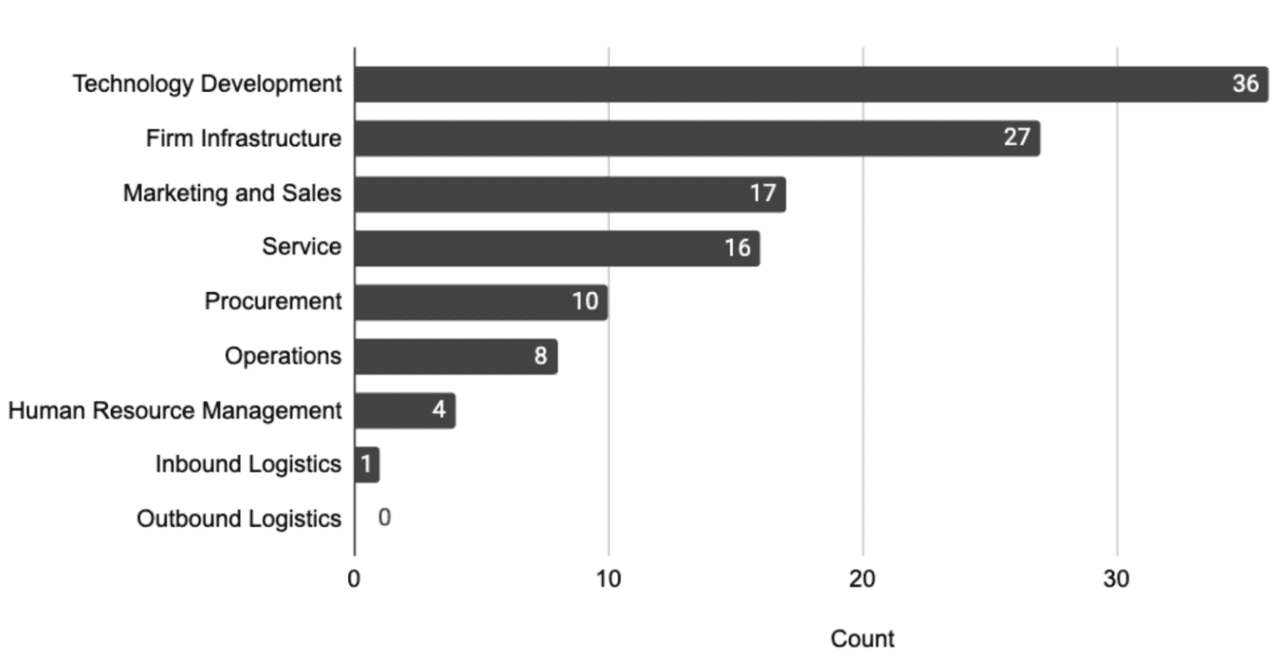
The results are as follows.
The largest group, 36 startups, offers services that support Technology Development. With a wave of AI-powered applications expected to emerge, many of these companies are building either the AI models that will underpin those applications or tools that make app development more efficient.
Skyramp is a testing platform for developers that saves them the time spent wrestling with cumbersome test frameworks and reduces the risk of problems surfacing in production.
Keycard is rethinking machine identity for the internet, helping developers seamlessly connect people, agents, and services across networks, clouds, and apps.
Services related to Firm Infrastructure were also common, with 27 companies. This group includes personal AI assistants and solutions that connect data and systems from across an entire organization.
Wonderful delivers enterprise-grade AI agents for every market and every language, letting companies build, manage, and monitor customer-facing AI agents and streamline both front-office and back-office workflows.
Summation offers a decision-level AI platform that helps enterprise teams generate insights, automate workflows, and uncover strategic opportunities. It unifies data across systems such as ERP, CRM, EPM, and data warehouses, and lets leaders trace analytical results back to the source records, ensuring auditability and trust.
In areas centered on making human communication more efficient—marketing, sales, HR, and the like—many companies are building tools in which AI handles interactions automatically.
Listen Labs is a customer research service that uses AI to automate customer interviews and deliver actionable insights.
Supersonik offers an AI-powered platform that lets SaaS companies provide interactive product demos 24/7, giving prospects a way to explore a demo instantly, with no scheduling or manual intervention.
In Operations, we found several companies automating assembly and design by embedding AI in factory machinery and robots.
Dirac is an assembly-automation software company building an automated work-instruction platform aimed at improving mechanical design. It automatically generates accurate assembly work instructions directly from CAD files, allowing companies to move smoothly from design to manufacturing.
Ricursive Intelligence is developing AI-driven systems that automate and optimize semiconductor design by creating a feedback loop: machine learning models design next-generation chips, and those chips in turn support more powerful models.
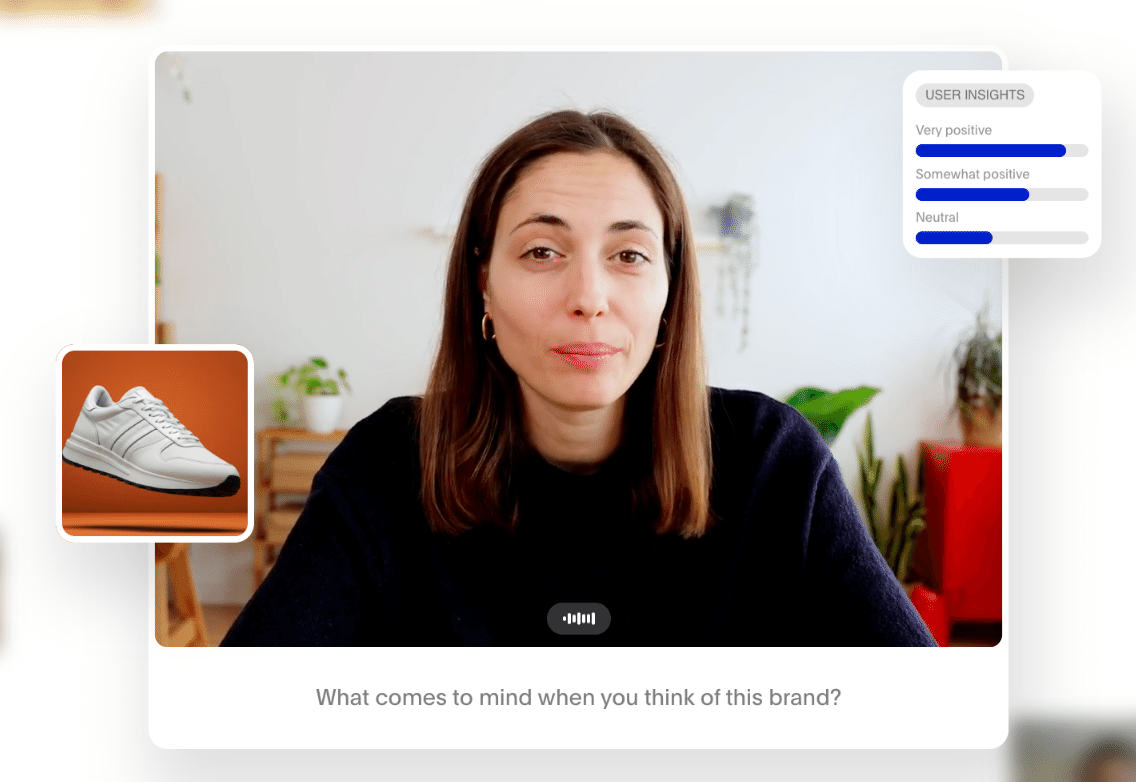
https://listenlabs.ai/
What technologies and approaches are they using?
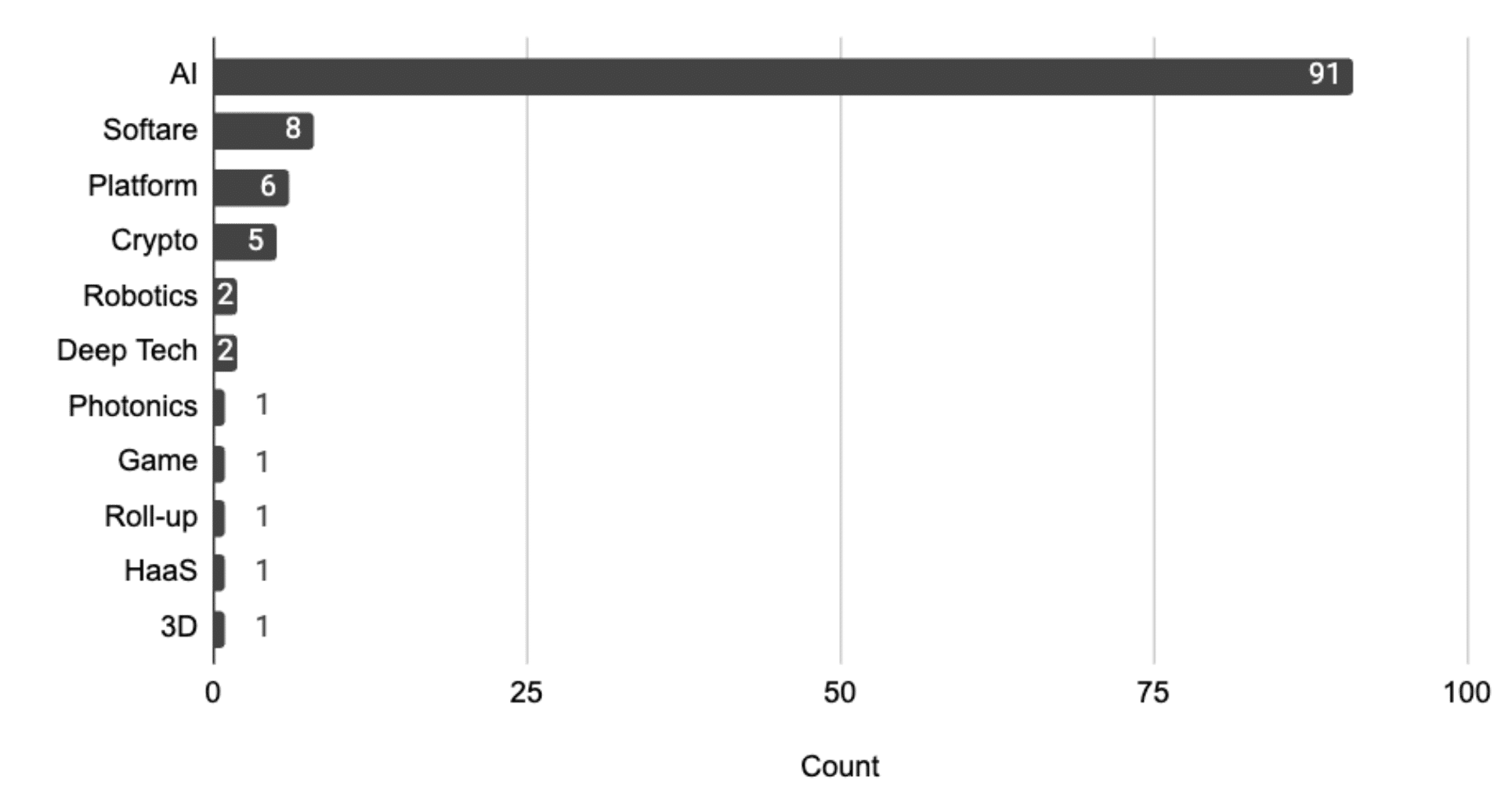
The results are as follows.
Startups with AI as their core technology made up the vast majority, at 91 companies—a clear sign of how much investment is flowing into the AI space.
Among the AI startups, a large number are building vertical AI agents, meaning AI agents designed for a specific industry.
Pryzm helps organizations win government funding through AI-powered search, strategic planning, and simple collaboration tools.
M.AI Unbound, Inc offers AI agents purpose-built for marketing, automating marketers' workflows and maximizing ROI.
Also common among the AI startups were AI platform services—companies that deliver AI in the form of a platform.
August specializes in customizable legal AI platforms for law firms and legal professionals, taking a personalized approach that builds custom workflows and generates legal documents in Word, PDF, and other formats in line with each firm's standards.
Prime Intellect's platform makes it easy to find compute resources around the globe and train state-of-the-art models through distributed training across clusters.
Five companies build services on cryptographic technology, reflecting both the security risks that grow as AI spreads and rising interest in national defense.
Multifactor delivers secure identity management through authentication, authorization, and auditing built on strong cryptography, offering a secure account management and access-sharing platform designed for both humans and AI agents.
Aravolta provides software that helps data center operators monitor, control, and manage complex infrastructure through a unified platform, bringing data center infrastructure management, network monitoring, and asset tracking together in a single interface that supports real-time visibility and operational workflows.
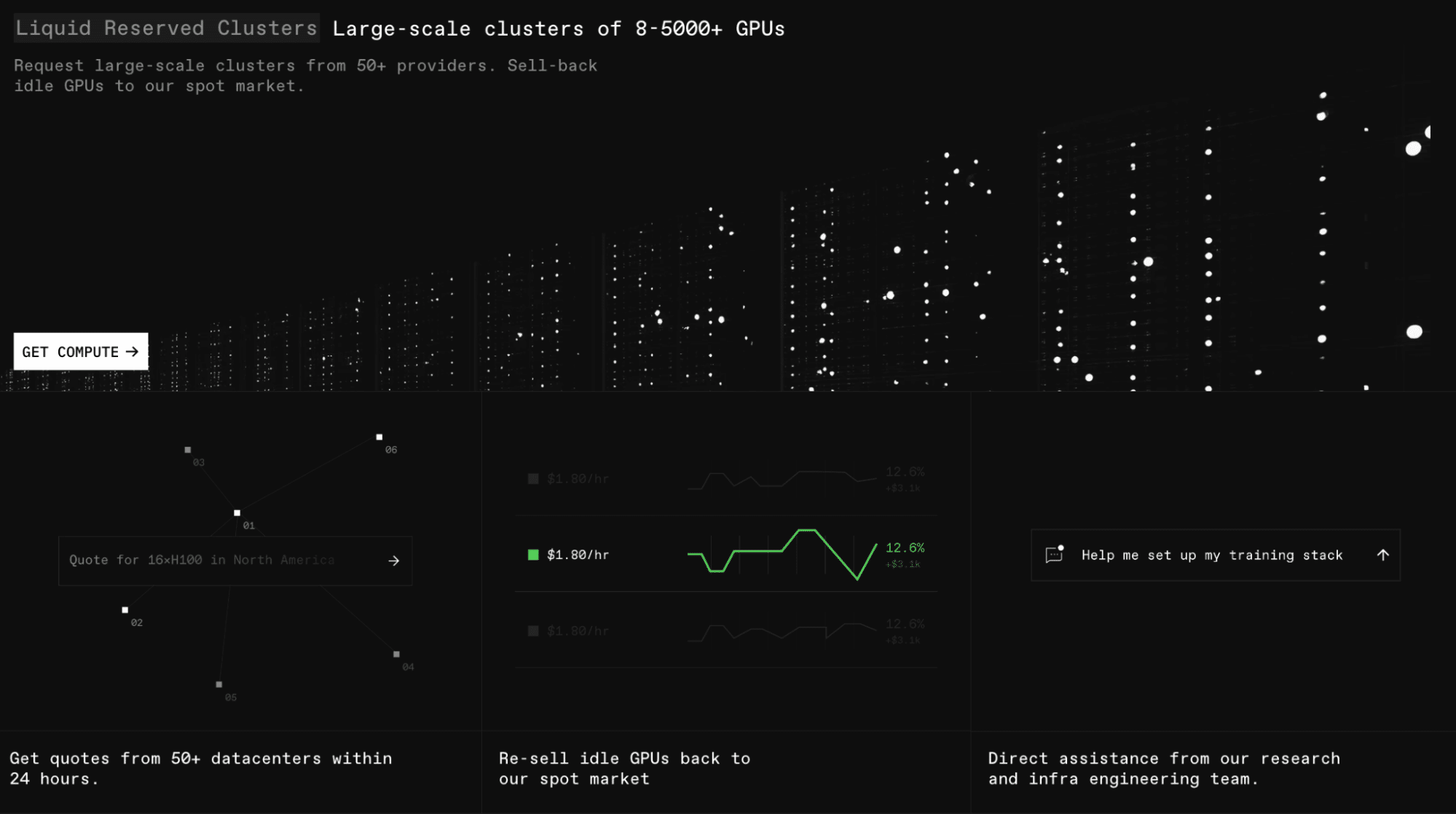
https://www.primeintellect.ai/
Closing Thoughts
This concludes our overview of the defining characteristics of the startups that major VCs have backed over the past year.
Consistent with the investment climate described at the outset, we saw many companies operating in areas and with business models that offer fast cash recovery and easy exits, including M&A (B2B, enterprise, horizontal), and on the technology side, a great many startups building on AI, by far the dominant trend.
As long as global inflation and geopolitical fragmentation persist, we expect these trends to continue.
Appendix: List of Startups Covered
Startups backed by Sequoia Capital
DevAgentic
Finch Legal
Nexad
Listen Labs
ARAI
Crosby
Traversal
wilgo.ai
Skyramp
TwinMind
Magentic
Inspiration Moment
Accordance
Lobo Intelligence
Open Campus
Touka Technology
CUE Labs
Podium
Ricursive Intelligence
Unconventional AI
Startups backed by Y Combinator
Mercura
Lemon Slice
Aravolta
Enlightra
Lucis
NavierAI
Channel3
Vybe
Multifactor
Guide Labs
Bravi
Karumi
Sourcebot
Moss
Boom AI
Allus AI
SellRaze
Leadbay
Cranston AI
Thesis Labs
Startups backed by Andreessen Horowitz
Leona
Mirelo AI
Pryzm
Unconventional AI
Unlimited Industries
Genki Robotics
ZAR
Doublespeed
Keycard
Alleviate Health
Tradepost
Periodic Labs
Longeye
Vibranium Labs
Airbuds Widget
Sharp Performance
Supersonik
Qloud Games
North Pole Security
Thinking Machines Lab
Startups backed by Benchmark
GAIM.FUN
Summation
Startups backed by Kleiner Perkins
Dazzle AI
First Voyage
M.AI Unbound, Inc
Phia
Keplar
Convoke
Arena
Biz AI Last
Startups backed by Founders Fund
CUE Labs
Valthos
Dirac
Amca
Prime Intellect
Network Bio
Magdrive
Swish Club
ThreatMate
Biosphere
Startups backed by Index Ventures
Mirelo AI
Duvo
AdsGency AI
Wonderful
Ankar AI
Duna
Natoma Labs
Vinyl Equity
Arondite
nexos.ai
Hyperline
Dot Product
Startups backed by Accel
Leona
Hera
Seezo
Generation Lab
ego AI
Sprouts
Flint
August
AnySoft
Periodic Labs
Shorebird
Rocket
Praan
AegisAI
Kernel
Nuance Labs
Arivihan
ASETS
Thinking Machines Lab
Polar
Startups Backed by New Enterprise Associates
H2
LizzyAI
Liza Health
Popai Health
Brale
Accordance
PortfolioPilot
Ohai.ai
Translucent AI
Elion
August
Genie
Foresight Data
Ceramic
Hydra Host
The end
Read next ↓