Articles
Generative AI in Architecture and Construction: Practical Use Cases for ChatGPT and Image Generation
Product
Career
対話型AIのChatGPT、画像生成のMidjourneyなどの生成AI(Generative AI)が話題に多く上がっており、社会や業界を大きく変革していくことが期待されています。ここでは、不動産、建設、まちづくりなどの建築・土木領域に着目して、生成AIのこれまでの歴史やAIの最新の研究やサービスの事例を踏まえて、これからの生成AIの活用方法の例をあげていきたいと思います。
Overview
対話型AIのChatGPTや画像生成のMidjourneyなどの生成AI(Generative AI)は、社会や業界を大きく変革していくことが期待されています。本稿は、生成AIの定義・歴史・種類と、建築・土木領域におけるこれまでのAIの活用例を概観したうえで、不動産、建設、まちづくりなどの建築・土木領域における生成AIの活用方法の例を整理します。結論としては、生成AIは本質的には入力と出力の間にある人の高度な技術・知識を置き換えるものであり、建築・土木領域がより良くなることを通じて、人々の暮らしが豊かになることに大きく貢献する技術となることが期待されます。
生成AIとは

生成AIの定義
生成AIは黎明期ということもあり、定義の表現が少しずつ異なります。以下に、主要な企業や研究機関による定義の例をあげます。
生成AIとは、ニューラルネットワークと呼ばれるシステムを使ってデータを分析し、パターンを見つけ、そのパターンを使ってテキスト、写真、ビデオ、コード、データなどの新しいアウトプットを生成または作成するAIのカテゴリを指します。
(Microsoft News Center, 2023)
生成AIとは、学習させたデータをもとに、高品質のテキストや画像などのコンテンツを生成できるディープラーニングモデルを指します。
(Martineau, 2023)
生成AIとは、音声、コード、画像、テキスト、シミュレーション、動画などの新しいコンテンツを作成するために使用できるアルゴリズム(ChatGPTなど)のことを指します。
(McKinsey & Company, 2023)
まとめると
学習データをもとに
ディープラーニングを活用し
新しいコンテンツを生成する
という点が生成AIの定義の要点だといえます。
生成AIの歴史
生成AIは自然言語処理とコンピュータービジョンの2つの主な発展の流れがあります。
自然言語処理では、Hidden Markov Models (HMMs) (Knill & Young, 1997)やGaussian Mixture Models (GMMs) (Reynolds & Others, 2009) から始まり、これらのモデルは、音声や時系列などの連続的なデータを生成していました。深層学習の登場以降、生成モデルの性能が大幅に向上し、Recurrent neural networks(RNN)が言語モデリングタスクに導入され、比較的長い依存関係をモデリングすることができるようになりました。Transformer architecture (Vaswani et al., 2017)が開発後は、このモデルがGPTなどその後の様々な生成モデルの主要なバックボーンとなり、現在に至ります。
コンピュータビジョンでは、Texture synthesis (Efros & Leung, 1999) and Texture mapping (Heckbert, 1986) から始まり、これらのアルゴリズムは、手作業で設計された特徴量に基づき、複雑で多様な画像を生成するというものでしたが、大量に生成する能力には限界がありました。2014年には、Generative Adversarial Networks (GANs) (Goodfellow et al., 2020)やVariational Autoencoders (VAEs)など、拡散生成モデル(Song & Ermon, 2019) などの手法も開発され、画像生成プロセスをよりきめ細かく制御し、高品質な画像を生成することができるようになり、その後、Transformer architecture (Vaswani et al., 2017)をコンピュータービジョンと組み合わせることでこの概念をさらに進め、画像ベースの出力を可能にしました。そしてこれによって、マルチモーダルなタスクを実現することも可能にしました。
今後は、生成の精度の向上や、入力や出力の種類や組み合わせが多様になるマルチモーダル化が進んでいくと考えられます。
生成AIの種類
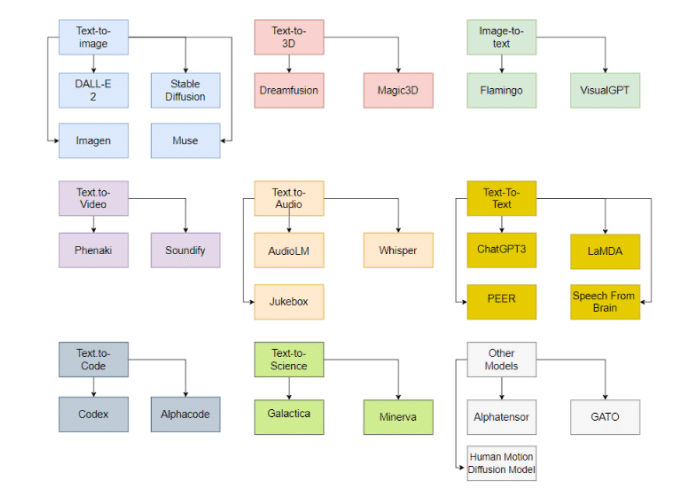
近年登場した主要な生成AIモデルを、入力と生成の形式によって分類したものが以下の図ようになります (Gozalo-Brizuela & Garrido-Merchan, 2023)。
自然言語処理に特化したTransformer architecture (Vaswani et al., 2017)がベースとなっていることからも、入力がテキストであるものが多くあります。生成する形式としては、テキスト、画像だけでなく、3D、映像、音声、プログラムコードなど様々あります。また、FlamingやVisualGPTなどは画像が入力形式となっています。
建築・土木領域の生成AIの活用方法
建築・土木領域においてどのように生成AIが活用されうるか記載します。まずは、これまでAIがどのように建築・土木領域において活用されてきたのか概観したのちに、生成AIの活用の可能性について記載します。建築・土木領域を計画・設計プロセス、施工プロセス、運用・維持管理プロセスの3つにわけて説明します。
これまでのAIの活用例
詳しくはこちらの記事をご覧ください。
計画・設計プロセス
デザイン生成とエミュレーション(Huang & Zheng, 2018; Liu et al, 2017)
デザイン評価 (Lorenz et al., 2018; Y. Zhang et al., 2018)
構造設計において、構造物の応答と性能の予測、実験データの解釈、構造ヘルスモニターデータのパターン認識など (Sun et al, 2021)
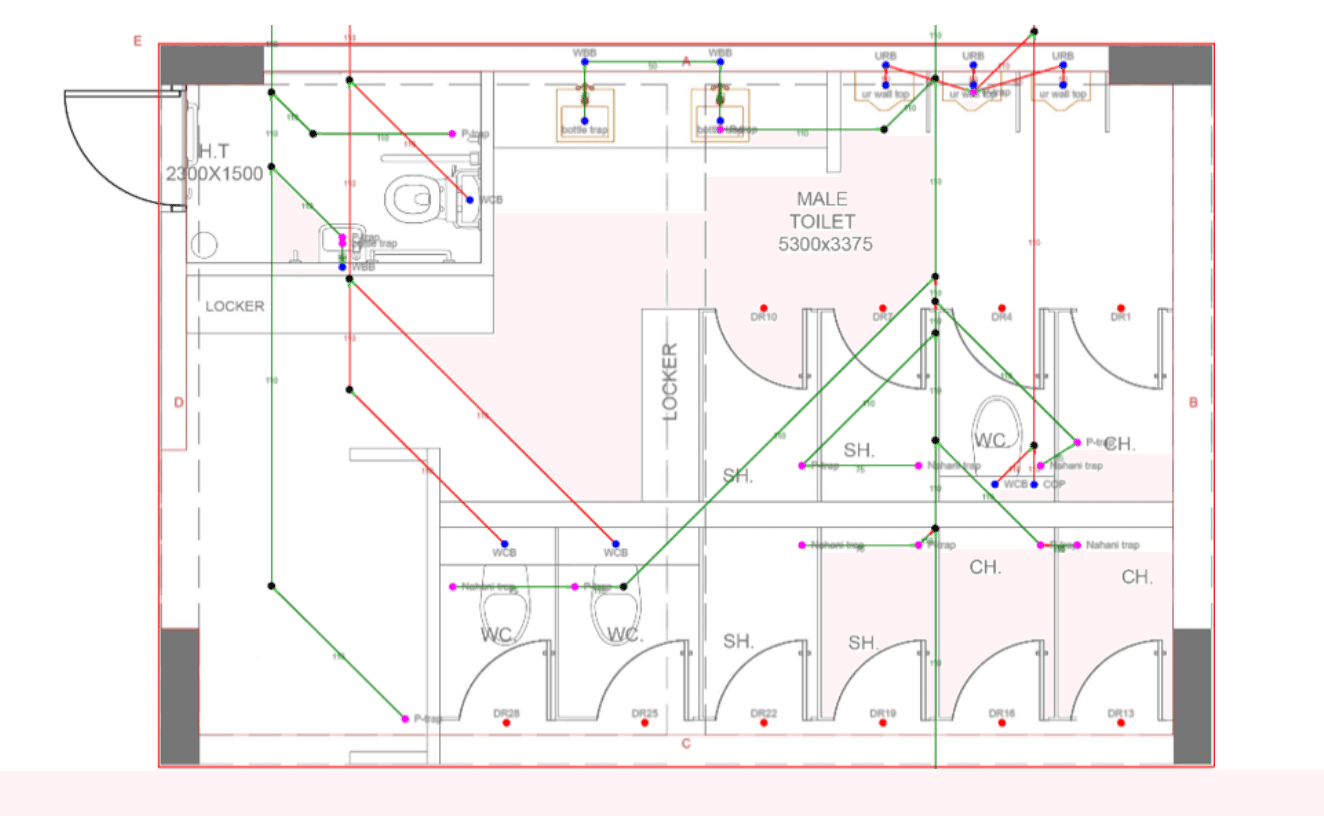
レーザースキャナデータからBIMモデルを作成 (Tang et al., 2010)
BIMログを解析し、設計生産性の改善方法の検討 (Pan & Zhang, 2020)
https://pillarplus.com/ai-tech/
施工プロセス
プロジェクトファイナンスコストを最小化する工程の作成(Alavipour & Arditi, 2019)
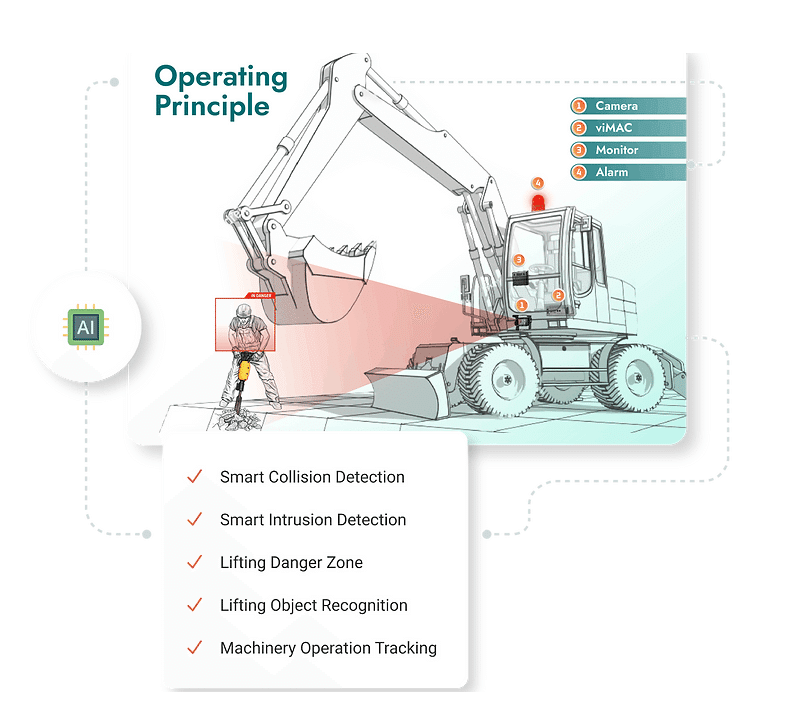
安全靴・ヘルメット・作業着等の保護具の不適切な使用、危険区域の露出、転倒の危険、安全手順や計画されたワークフローに従わないことを検出する (Fang et al., 2020)
製造の自動化(Hatami Mohsen et al., 2019)
サポートベクターマシン(SVM)を用いた建設段階における物流コストの予測 (Tian et al., 2009)
建物のエネルギー消費量の予測(Himeur et al., 2021; Wang & Srinivasan, 2017)
コンピュータビジョンを用いて建設廃棄物を自動的に識別(Kuritcyn et al., 2015)
https://www.viact.ai/vimac
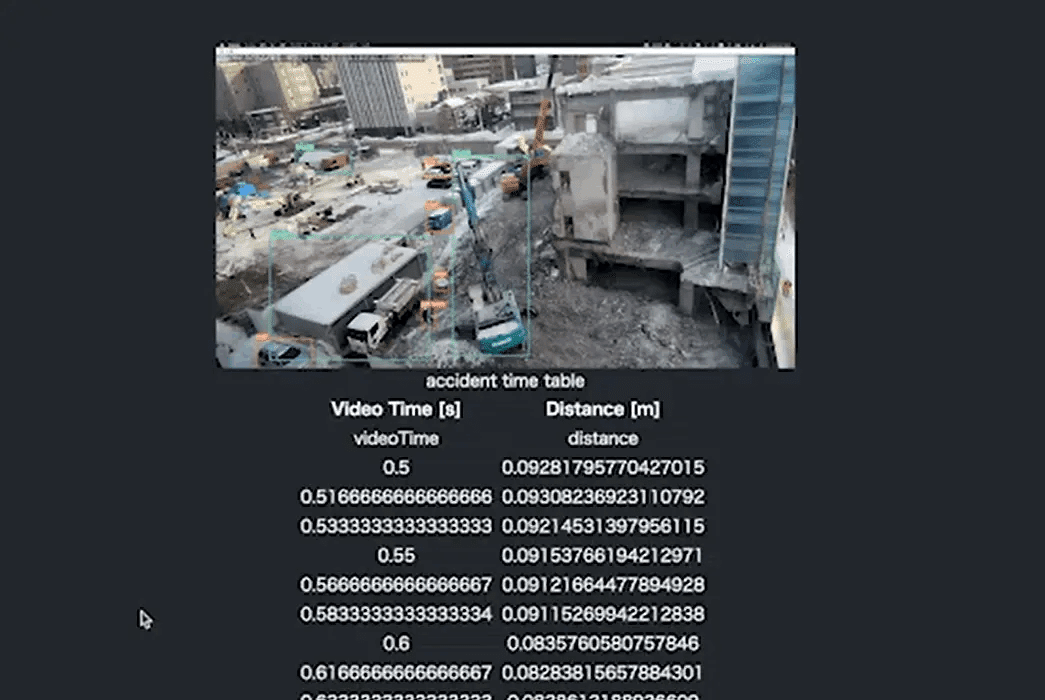
https://prtimes.jp/main/html/rd/p/000000018.000100410.html
運用・維持管理プロセス
建築物、橋梁、トンネル、道路、下水道管など、様々な種類の社会基盤に発生する欠陥や損傷(亀裂、剥離、腐食、穴、接合部の損傷など)を自動的に検出・評価 (C. Zhang et al., 2020)
建物エネルギーシステム(HVACなど)の故障を検出・診断する(Y. Zhao et al, 2019)
建物の築年数を予測(Tooke et al., 2014)
スマートグリッドのための電気負荷予測(Raza & Khosravi, 2015)
生成AIの活用方法
上記のようにこれまでAIがどのように建築・土木領域で活用されてきたのかを踏まえ、生成AIの活用方法について記載します。
計画・設計プロセス
インタビュー段階
クライアントや行政へのヒアリングをテキストデータに要約・抽象化する。
クライアントへのヒアリングをもとに、見積書を自動出力する。
文献調査段階
競争入札プロジェクトの要求資料から重要な情報をピックアップする。
建設工事にチューニングした対話モデルで、各地域のゾーニングなどの規制についてAIに質問できる。
設計段階
クライアントへのヒアリングをもとに、デザインイメージを自動出力する。
デザイン画像を表示し、関連する画像を複数生成する。
3Dモデルを生成し、BIM/CIMにインポートする。
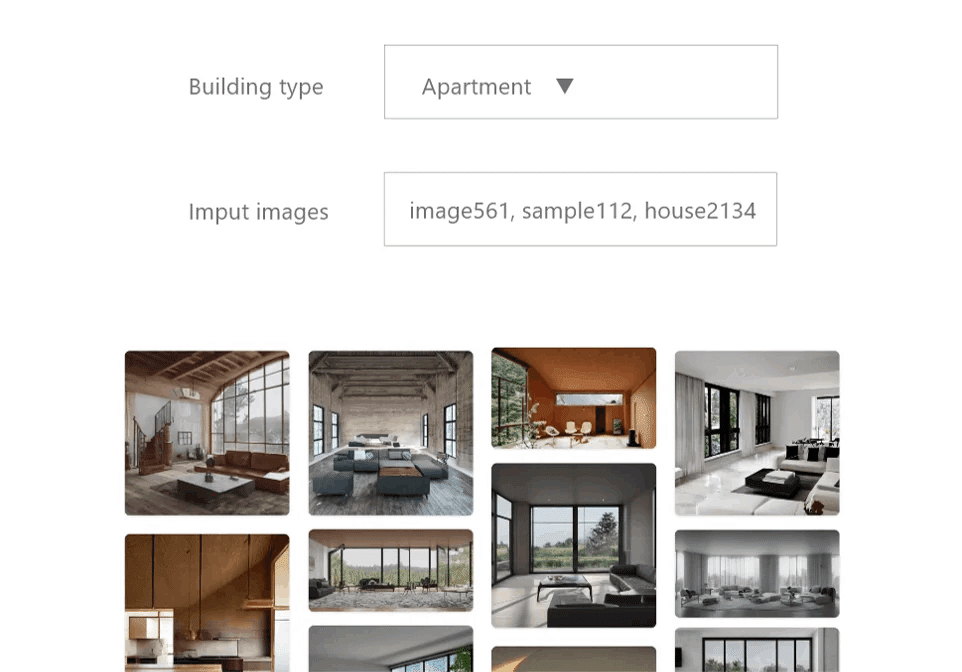
https://prtimes.jp/main/html/rd/p/000000013.000100410.html
施工プロセス
調達段階
これまでの見積り書や発注書の情報を踏まえて、新たな見積り書や発注書の作成ができる。
施工段階
建設工事にチューニングした対話モデルで、工事の進め方など疑問があれば質問できる。
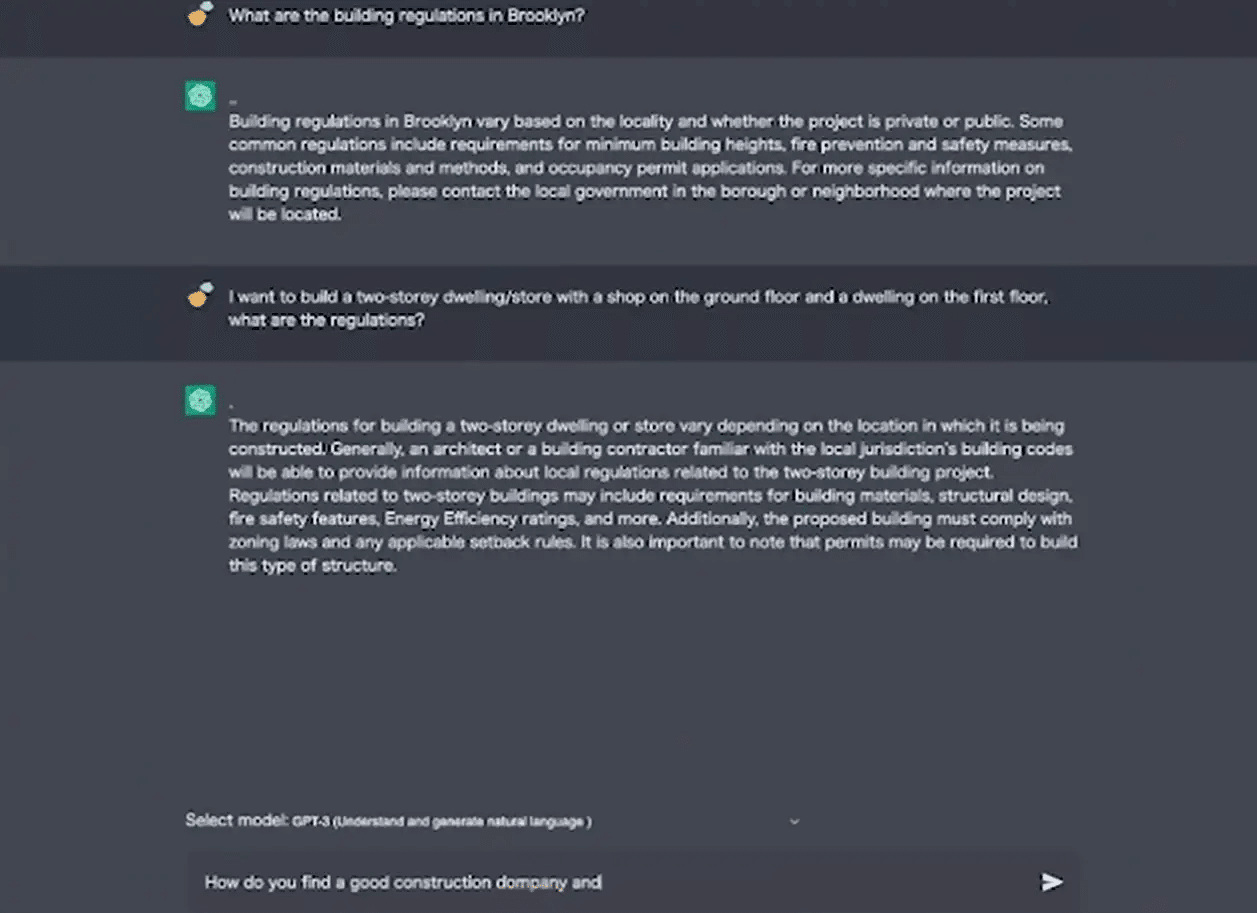
運用・維持管理プロセス
モニタリング段階
構造や空調の画像をを入力し、故障診断(FDD)のレポートを出力する
メンテナンス段階
建物や構造物の劣化診断部分に関する画像や動画を入力し、メンテナンスレポートを自動作成する
まとめ
生成AIの歴史や種類、これまでのAIの活用例などを概観し、生成AIの活用方法について検討しました。本質的には、入力と出力の間にある人の高度な技術、知識を置き換えるものだと考えられます。建築・土木領域がより良くなることを通じて、人々の暮らしが豊かになることに大きく貢献する技術となることが期待されます。
よろしければ、外部データとの連携が可能なLangChainや作業の自動化ができるAutoGPTのような拡張機能の活用方法についての記事もご参照ください。
最後にmignでは先端技術を活用し、建築・土木領域の世界初のソリューションを常につくり続け、豊かな社会の実現を目指しています。現在は生成AI(ChatGPT・画像生成)にフォーカスし、開発を進めており、上記に関連するソリューションの開発を対応は可能ですので、ご関心のある方はお気軽にご連絡ください。
お問い合わせフォーム(ウェブサイト)
https://www.mign.io/contacts/new
メールアドレス
contact@mign.io
建築・土木領域特化ChatGPT関連ソリューションのプレスリリース
https://prtimes.jp/main/html/rd/p/000000020.000100410.html
https://prtimes.jp/main/html/rd/p/000000023.000100410.html
建築・土木領域特化画像生成AIソリューションのプレスリリース
https://prtimes.jp/main/html/rd/p/000000013.000100410.html
https://prtimes.jp/main/html/rd/p/000000022.000100410.html
その他のプレスリリース
https://prtimes.jp/main/html/searchrlp/company_id/100410
参考文献
Alavipour, S. M. R., & Arditi, D. (2019). Time-cost tradeoff analysis with minimized project financing cost. Automation in Construction, 98, 110–121.
Efros, A. A., & Leung, T. K. (1999). Texture synthesis by non-parametric sampling. Proceedings of the Seventh IEEE International Conference on Computer Vision, 2, 1033–1038 vol.2.
Fang, W., Love, P. E. D., Luo, H., & Ding, L. (2020). Computer vision for behaviour-based safety in construction: A review and future directions. Advanced Engineering Informatics, 43, 100980.
Goodfellow, I., Pouget-Abadie, J., Mirza, M., Xu, B., Warde-Farley, D., Ozair, S., Courville, A., & Bengio, Y. (2020). Generative adversarial networks. Communications of the ACM, 63(11), 139–144.
Gozalo-Brizuela, R., & Garrido-Merchan, E. C. (2023). ChatGPT is not all you need. A State of the Art Review of large Generative AI models. In arXiv [cs.LG]. arXiv. http://arxiv.org/abs/2301.04655
Hatami Mohsen, Flood Ian, Franz Bryan, & Zhang Xun. (2019). State-of-the-Art Review on the Applicability of AI Methods to Automated Construction Manufacturing. Journal of Computing in Civil Engineering, 368–375.
Heckbert, P. S. (1986). Survey of Texture Mapping. IEEE Computer Graphics and Applications, 6(11), 56–67.
Himeur, Y., Ghanem, K., Alsalemi, A., Bensaali, F., & Amira, A. (2021). Artificial intelligence based anomaly detection of energy consumption in buildings: A review, current trends and new perspectives. Applied Energy, 287, 116601.
Knill, K., & Young, S. (1997). Hidden Markov Models in Speech and Language Processing. In S. Young & G. Bloothooft (Eds.), Corpus-Based Methods in Language and Speech Processing (pp. 27–68). Springer Netherlands.
Kuritcyn, P., Anding, K., Linß, E., & Latyev, S. M. (2015). Increasing the safety in recycling of construction and demolition waste by using supervised machine learning. Journal of Physics. Conference Series, 588, 012035.
Lorenz, C.-L., Packianather, M., Spaeth, A., & Bleil De Souza, C. (2018). Artificial neural network-based modelling for daylight evaluations. SimAUD 2018, Delft, The Netherlands. https://orca.cardiff.ac.uk/id/eprint/112040/
Martineau, K. (2023, April 20). What is generative AI? IBM Research Blog; IBM. https://research.ibm.com/blog/what-is-generative-AI
McKinsey & Company. (2023, January 19). What is generative AI? McKinsey & Company. https://www.mckinsey.com/featured-insights/mckinsey-explainers/what-is-generative-ai
Microsoft News Center. (2023, April 4). AI explained. Stories. https://news.microsoft.com/2023/04/04/ai-explained/
Pan, Y., & Zhang, L. (2020). BIM log mining: Exploring design productivity characteristics. Automation in Construction, 109, 102997.
Reynolds, D. A., & Others. (2009). Gaussian mixture models. Encyclopedia of Biometrics, 741(659-663). http://leap.ee.iisc.ac.in/sriram/teaching/MLSP_16/refs/GMM_Tutorial_Reynolds.pdf
Song, Y., & Ermon, S. (2019). Generative modeling by estimating gradients of the data distribution. Advances in Neural Information Processing Systems, 32. https://proceedings.neurips.cc/paper/2019/hash/3001ef257407d5a371a96dcd947c7d93-Abstract.html
Tang, P., Huber, D., Akinci, B., Lipman, R., & Lytle, A. (2010). Automatic reconstruction of as-built building information models from laser-scanned point clouds: A review of related techniques. Automation in Construction, 19(7), 829–843.
Tian, J., Gao, M., & Zhou, S. (2009). The Research of Building Logistics Cost Forecast Based on Regression Support Vector Machine. 2009 International Conference on Computational Intelligence and Security, 1, 648–652.
Tooke, T. R., Coops, N. C., & Webster, J. (2014). Predicting building ages from LiDAR data with random forests for building energy modeling. Energy and Buildings, 68, 603–610.
Vaswani, A., Shazeer, N., Parmar, N., Uszkoreit, J., Jones, L., Gomez, A. N., Kaiser, Ł., & Polosukhin, I. (2017). Attention is all you need. Advances in Neural Information Processing Systems, 30. https://proceedings.neurips.cc/paper/7181-attention-is-all
Wang, Z., & Srinivasan, R. S. (2017). A review of artificial intelligence based building energy use prediction: Contrasting the capabilities of single and ensemble prediction models. Renewable and Sustainable Energy Reviews, 75, 796–808.
Zhang, C., Chang, C.-C., & Jamshidi, M. (2020). Concrete bridge surface damage detection using a single‐stage detector. Computer-Aided Civil and Infrastructure Engineering, 35(4), 389–409.
Zhang, Y., Burton, H. V., Sun, H., & Shokrabadi, M. (2018). A machine learning framework for assessing post-earthquake structural safety. Structural Safety, 72, 1–16.
The end
Read next ↓