
Articles
How will product UI/UX transform after AGI?
Product
Career
Automatically translated from the Japanese original.
Introduction
Today's AI systems (ChatGPT, Gemini, Claude and others) can already be said to know more than the average specialist. Once that capability is generalized further into AGI (Artificial General Intelligence), people's lives are expected to change dramatically.
This article looks at how product UI/UX is likely to change as a result.
References
A great deal has been written about AGI, so we have limited our sources to highly credible ones, such as those published by the following organizations.
- Leading AI developers: OpenAI, Google, etc.
- Leading consulting firms: McKinsey & Company, BCG, etc.
- Leading securities and investment firms: Goldman Sachs, Sequoia Capital, etc.
- Leading research institutions: Harvard University, Stanford University, etc.
- Leading academic journals: Nature, Science, etc.
- International organizations: World Economic Forum, OECD, etc.
The discussion below draws on the sources listed here. Please refer to them directly for further detail.
- Amble, S. (2026). Is Software Losing Its Head? Andreessen Horowitz (a16z).
- Butler, J., Jaffe, S., Janßen, R., Baym, N., Hecht, B., Hofman, J., Rintel, S., Sarrafzadeh, B., Sellen, A., Vorvoreanu, M., & Teevan, J. (Eds.). (2025). Microsoft New Future of Work Report 2025. Microsoft.
- Cahn, D. (2024). AI's $600B Question. Sequoia Capital.
- Flinders, M. (2025). What is AI product design? IBM.
- IDC. (2025). Charting the Agentic Future: 10 Vision Statements for 2030. IDC.
- Leviathan, Y., Valevski, D., Lumen, D., Kalman, M., Natchu, V., Nygaard, V., Manyika, J., Matias, Y., Segalis, E., Molad, E., Pasternak, S., & Venkatachary, S. (2025). Generative UI: LLMs are Effective UI Generators. Google Research.
- Li, Y. (2025). Emerging Developer Patterns for the AI Era. Andreessen Horowitz (a16z).
- Moran, K., & Gibbons, S. (2024). Outcome-Oriented Design: The Era of AI Design. Nielsen Norman Group.
- Nielsen, J. (2026). 18 predictions for 2026. UX Tigers.
- Patel, D. (2025). Dwarkesh Patel Podcast.
- Schmidt, J. (2025). Trading Margin for Moat: Why the Forward Deployed Engineer Is the Hottest Job in Startups. Andreessen Horowitz (a16z).
- Wobig, E., Kiral, B., Miller, M., Ribera, M., Kwon, Y., & Mishra, S. (2025). Farewell, SaaS: AI is the future of enterprise software. AlixPartners.
1. Generative UI (GenUI) and the Rise of "Disposable" Interfaces
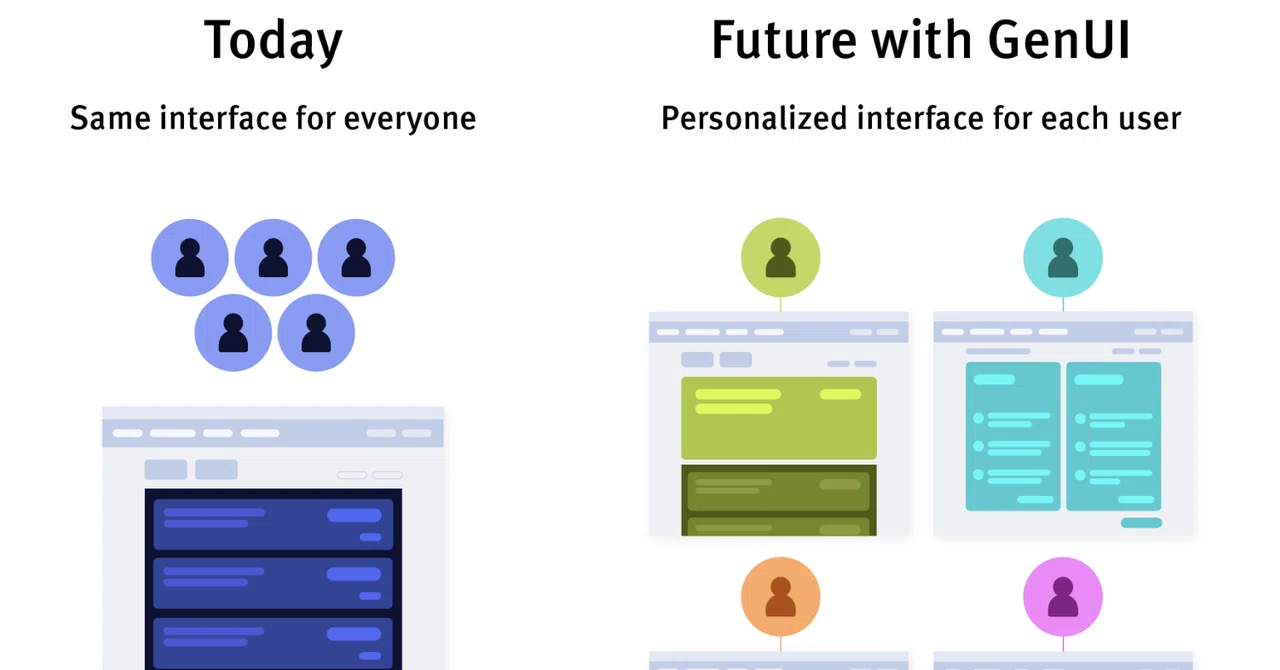
- Generated in real time, then gone: The conventional approach of serving every user the same fixed screen will become obsolete. In its place, "Generative UI" (GenUI) will take hold: AI reads a user's intent, context and history at that particular moment and dynamically generates the optimal interface in real time. Once the task is complete, the generated interface simply disappears—it is disposable.
- Full personalization: from the "average" to the "individual": UI design has traditionally aimed for a lowest-common-denominator experience that works well enough for most people. GenUI makes design "for the individual" possible. For example, a user with dyslexia could automatically be presented with a UI that uses specialized fonts and contrast settings, delivering a dramatic leap in accessibility.
- The loss of muscle memory: Because the UI adapts to the user's context every time, users will no longer be able to "learn where the buttons are" through muscle memory. Instead, they will operate on the trust that the AI will always present an appropriate interface, and immediacy and relevance will take priority over fixed, consistent UI.
2. The Shift from Conversational UI to Delegative UI
- From "asking questions" to "delegating goals": The way we engage with AI will evolve from a "Conversational UI," in which we simply pose questions to a chatbot, to a "Delegative UI," in which we hand an autonomous AI agent a final objective and leave the planning and execution to it.
- A new role for the user: Users will shift from hands-on operators who work software in detail to something more like a manager—a "Vibe CEO"—who coordinates multiple agents and issues instructions. AI will autonomously handle the bulk of day-to-day tasks, leaving people free to concentrate on higher-level strategic judgment and setting direction.
3. Audit Interfaces and Countering "Review Fatigue"
- From "creating" to "checking": As AI agents autonomously carry out complex workflows, the primary human role becomes verifying and approving the AI's output.
- The risk of review fatigue: Having a human check every one of the dozens of complex reasoning steps and work products an AI produces can impose a heavier cognitive load than doing the work oneself, creating a real danger of "review fatigue."
- Why the audit interface matters: To prevent this, designing an "Audit Interface"—one that summarizes the logic behind the AI's actions so a person can confirm safety and make decisions at a glance—will become the single biggest UX challenge going forward.
4. "Headless" Software and the Relocation of the Competitive Moat
- Agents that bypass the UI altogether: Software has traditionally needed a UI because humans had to operate it. AI agents, however, skip the browser UI entirely and execute tasks by accessing APIs and data layers directly.
- Value migrates to the back end: With this shift to "headless" software, the value of dashboards and UI usability in themselves declines in relative terms. In their place, the "back-end machinery"—proprietary data, closed execution loops, permission management and workflow logic—becomes the source of a product's defensibility and value.
5. The Evolution Toward Outcome-Oriented Design
- From designing "screens" to designing "constraints": The UI/UX designer's job will shift from placing individual buttons and laying out screens to defining the parameters and constraints (guardrails) that govern how AI dynamically generates the interface.
- From process to outcome: Because AI shortcuts the process users go through to reach their goals, designers will place greater weight on "outcome-oriented design," focusing on what result the user should ultimately achieve rather than on how the user operates the product (micro-interactions).
6. Dynamic Dashboards and Proactive Collaboration
- The dashboard as synthesis: Traditional dashboards, with their fixed rows of data and charts, will evolve into interactive interfaces synthesized dynamically by AI. A user need only ask in natural language—"What caused yesterday's errors?"—and the relevant data and charts are assembled in real time.
- AI as a teammate: Rather than simply waiting for instructions, AI will monitor system status on its own and proactively step in with suggestions—"Error rates are rising. Here is the likely cause and a recommended fix"—taking on the role of a teammate rather than a mere tool.
7. Multimodal Integration and the Rise of Universal Interfaces
- The move to Large World Models (LWMs): AI models that seamlessly integrate and process not just text but also audio, vision and video as first-class objects will become the norm. This enables intuitive interactions such as issuing voice instructions while directly manipulating and editing elements on screen.
- A new use for accessibility APIs: Accessibility APIs—the assistive features built for users with visual or motor impairments—will be repurposed as the means by which AI agents "see" existing software. This allows agents to semantically understand and operate a UI just as a human would, even in legacy systems that offer no dedicated API for AI.
Conclusion
As AI advances, what is expected of a product will change not only in terms of features but also in terms of UI/UX. Since the majority of systems are expected to be built on the assumption that AI agents are embedded from the outset, we will need to adapt to these new forms of UI/UX.
The end
Read next ↓