Articles
Innovation Realization Processes and Strategies Based on Latest Research
Product
Career
大企業の新規事業、スタートアップ、基礎研究、さまざまな場面でイノベーションがあります。企業などの組織が継続して発展していくためには、既存事業の効率化のみでは限界があり、イノベーションが不可欠であると言われます (Christenson, 1997)。
ここでは、イノベーションは何なのか、イノベーションを起こすために何が必要なのか、最新の研究を含めた学術的な理論と実際のビジネスにおける事例の両面からイノベーションを考え、主に企業がどのような施策を実行していくべきか検討したいと思います。
Overview
企業などの組織が継続して発展していくためには、既存事業の効率化のみでは限界があり、イノベーションが不可欠であると言われます。本稿は、最新の研究を含めた学術的な理論と実際のビジネスにおける事例の両面から、シュンペーターやクリステンセンらによるイノベーションの定義、インターネットやスマートフォンなどの具体例、イノベーションのプロセス、オープンイノベーションをはじめとする取り組みの種類と事例、イノベーションを起こす要素を整理します。結論としては、外部環境の変化や技術の進展を把握したうえで、課題の検討と解決策の創出に取り組み、創出した解決策をサービスとして実施・普及・拡大させていくことが、イノベーションを起こすために企業が実施するべき施策です。
イノベーションの定義
イノベーションは、斬新な価値をもたらす新しいアイデア、製品、サービス、プロセスを創造、開発、実施するプロセスなどと関連して述べられることが多くあります。
ここでは、いくつかの主要なイノベーションの定義を列挙します。
新しい生産方法、新製品、新市場、新しい供給源、新しい組織形態など、生産要素の新しい組み合わせを導入するプロセス (Schumpeter & Swedberg, 2021)
持続的イノベーション(既存顧客のために既存の製品やサービスを改善する)と破壊的イノベーション(新たな市場や価値ネットワークを創造し、多くの場合、既存の市場リーダーを駆逐する)がある (Christenson, 1997)
組織が市場において前進し、競争し、差別化を成功させるために、アイデアを新商品、新サービス、新プロセスへと転換させる多段階のプロセス (Baregheh et al., 2009)
イノベーションの2つの主要な次元は、新規性の程度(すなわち、イノベーションが企業にとって新しいか、市場にとって新しいか、業界にとって新しいか、世界にとって新しいか)とイノベーションの種類(すなわち、プロセスか製品・サービス・システムのイノベーションか)がある (Edison et al., 2013)
イノベーションは、既存のビジネスであれ、公共サービス機関であれ、あるいは家庭の台所で一個人が始めた新規事業であれ、起業家精神に特有の機能である。 起業家が新たな富を生み出す資源を創造するか、あるいは既存の資源に富を生み出す可能性を付与する手段である。 (Drucker, 2002)
イノベーションは、新しい創造的なアイデアを生み出すだけでなく、実際に実現していくことが含まれる (Hartley et al., 2013)。
簡潔に整理すると
新しいこと
富を生み出すこと⇒利益がでること
売上が大きくなること
コストが小さくなること
がイノベーションの主な要素としてあげられます。
イノベーションの例
ここでは、イノベーションを具体的にイメージできるように、いくつかのイノベーションの例をピックアップしてみます。
インターネット :インターネットの発達は、情報の共有と世界的なコミュニケーションを可能にした。 (Leiner et al., 1997)
スマートフォン:コンピュータの機能をモバイルデバイスに統合することで、人々の交流、情報へのアクセスを容易にした。(Katz & Aakhus, 2002)
ブロックチェーン技術:元々はデジタル通貨ビットコインのために考案されたブロックチェーン技術は、安全で分散化された記録管理を可能とした。(Nakamoto, 2008)
3Dプリンティング:Adaptive Manufacturingとしても知られる3Dプリンティング技術は、デジタルモデルから複雑な3次元オブジェクトを作成することを可能にした。 (Wohlers & Others, 2014)
CRISPR-Cas9遺伝子編集: CRISPR-Cas9は、DNA配列の一部を削除、追加、変更することによってゲノムの一部を編集することを可能にし、医療、農業、生物学において大きな可能性をもたらした。 (Doudna & Charpentier, 2014)
イノベーションのプロセス
イノベーションがどのようなプロセスで発生するのか、様々な文献で述べられています。例えば、以下のようなプロセスが紹介されています。
イノベーションのプロセスは、1)アイデア創出、2)問題解決、3)実行である。 (Utterback, 1971)
1) 問題定義、2) アイデア創出、3) テスト、4) 実施、5) 普及、1) 問題定義 -> ...のように循環する (Hartley et al., 2013)
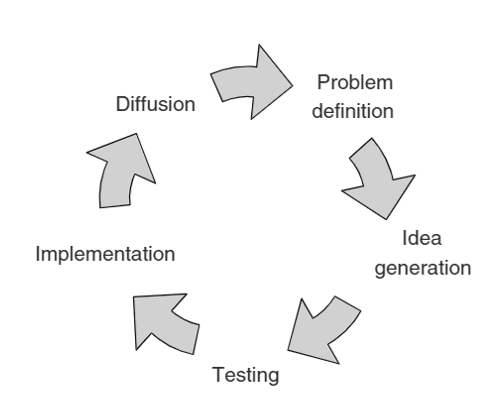
上記では、アイデア創出と問題解決の順番が逆となっていますが、これはニーズが初めにあるのか、シーズが初めにあるのか、どちらのケースも想定されるということと関連すると考えられます。
イノベーションを起こす取り組み
イノベーションの種類
End-user innovation. これは、個人や企業が、既存の製品が自分たちのニーズを満たさないため、自分たち自身(個人または社内)で使用するイノベーションを開発することである。 (von Hippel, 2009)
Co-creation, Co-production: 企業と顧客が相互作用を通じて価値を生み出すこと(Galvagno & Dalli, 2014),企業とユーザーを巻き込んだ共同的でオープンなプロセス(von Hippel, 2009)
Open innovation: オープン・イノベーションとは、企業が技術を進歩させるために、社内のアイデアだけでなく社外のアイデアも利用できる、また利用すべきであるとするパラダイムである(Chesbrough, 2003)
Openness: 競争に遅れないために、外部環境からアイデアやリソースを得るために、さまざまなタイプのパートナーと関わる(Dahlander & Gann, 2010)
ビジネスにおける事例
ソフトウェア・ツール会社のAtlassianは、四半期ごとに「ShipIt Days」を実施している。 (Atlassian, n.d.)
Googleの社員は、時間の20%を自主プロジェクトに費やしている(Innvation Time Offとして知られている)(Schrage, 2013)
この手法は、医薬品の創薬にも使われることがある。 何千もの化合物がハイスループット・スクリーニングにかけられ、疾患に対して生物学的に重要であると同定された標的分子に対する活性があるかどうかを調べる。
関連技術であるA/Bテストは、ウェブサイトやモバイルアプリのデザインを最適化するためによく使われる。
19世紀イギリスの製鉄業界では、彼らが建設した高炉の設計や性能を、口頭でのやりとりや出版物の中で定期的に共有していた。 (Allen, 1983)
アイデアの販売やライセンス、特許としての提供 (Dahlander & Gann, 2010)
既存のアイデアや技術、外部から入手可能なアイデアの利用、市場を通じてイノベーション・プロセスへ導入することなど、ほとんどのイノベーションは発明ではなく借用から生じる(Cohen & Levinthal, 1990)
オープンソースを活用したソフトウェア開発 (von Krogh et al., 2012)
イノベーションを起こす要素
これまでの研究ではイノベーションを起こす要素として様々なものがあげられており、以下に主要なものを記載します。
新たな技術を社内に取り込む能力、技術知識、外部環境の知識 (Cohen & Levinthal, 1990)
競合の存在: イノベーションの前提としての企業、市場、競争の存在 (Hartley et al., 2013)、イノベーションは企業が競争市場で生き残ることを可能にする (Hartley et al., 2013)
資金: 大組織はイノベーションに投資する資源をより多く持っており、イノベーションの失敗のコストを吸収する能力がある。 (Hartley et al., 2013)
産業構造の変化、市場構造の変化、地域および世界の人口動態の変化、人間の知覚の変化、利用可能な科学的知識の量の変化など。 (Drucker, 2002)
まとめ:イノベーションの施策
上記のイノベーションの事例や要素を踏まえて、イノベーションを起こすために企業が実施するべき施策を整理すると、下図のようになります。
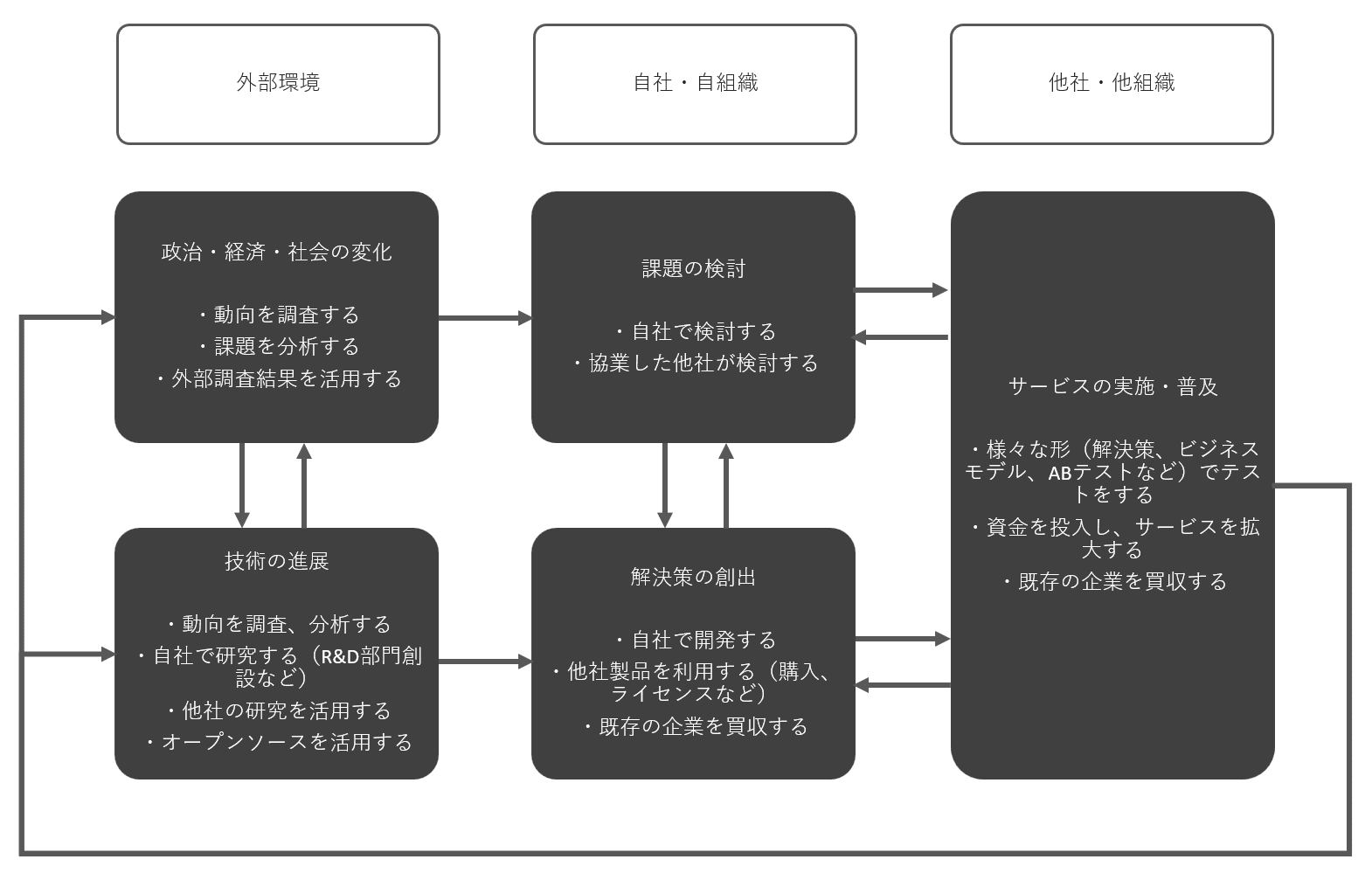
まず、外部環境としての政治・経済・社会の変化や技術の進展を把握することは重要です。将来の動向や課題を分析したり、技術であれば自社のR&D部門で研究したり、他団体の研究成果を活用することが考えられます。
その後、自社で課題の検討や、解決策の創出に取り組みます。課題の検討では、自社内の人材や、協業する他社と検討します。解決策の創出では、自社で開発するか、他社製品の利用、既存企業の買収などが考えられます。
最後に、創出した解決策をサービスとして実施・普及していきます。様々なパターンや、ABテストでサービスの改善をしつつ、資金の投入や、既存企業の買収によって、サービスを拡大させていきます。
参考文献
Allen, R. C. (1983). Collective invention. Journal of Economic Behavior & Organization, 4(1), 1–24.
Atlassian. (n.d.). About us. Atlassian. Retrieved November 15, 2023, from https://www.atlassian.com/company
Chesbrough, H. W. (2003). Open innovation: The new imperative for creating and profiting from technology. https://books.google.com/books?hl=en&lr=&id=4hTRWStFhVgC&oi=fnd&pg=PR9&dq=.+Open+Innovation:+The+New+Imperative+for+Creating+and+Profiting+from+Technology&ots=XuZFUQw7wG&sig=HKm5AIP1XtOgAZSo_crGktbuf_A
Christenson, C. (1997). The innovator’s dilemma. Harvard Business School Press, Cambridge, Mass.
Dahlander, L., & Gann, D. M. (2010). How open is innovation? Research Policy, 39(6), 699–709.
Drucker, P. F. (2002). The discipline of innovation. Harvard Business Review. https://www.academia.edu/download/57049925/6._The_Discipline_of_Innovation.pdf
Nakamoto, S. (2008). Bitcoin: A peer-to-peer electronic cash system. Decentralized Business Review. https://assets.pubpub.org/d8wct41f/31611263538139.pdf
Schrage, M. (2013, August 20). Just How Valuable Is Google’s “20% Time”? Harvard Business Review. https://hbr.org/2013/08/just-how-valuable-is-googles-2-1
Schumpeter, J. A., & Swedberg, R. (2021). December 2007 – page 7 –. Cambridge Forecast Group Blog; taylorfrancis.com. https://doi.org/10.4324/9781003146766/theory-economic-development-joseph-schumpeter-richard-swedberg
Wohlers, T., & Others. (2014). Wohlers report 2017: 3D printing and additive manufacturing state of the industry: annual worldwide progress report. (No Title). https://cir.nii.ac.jp/crid/1130282269773835776
The end
Read next ↓